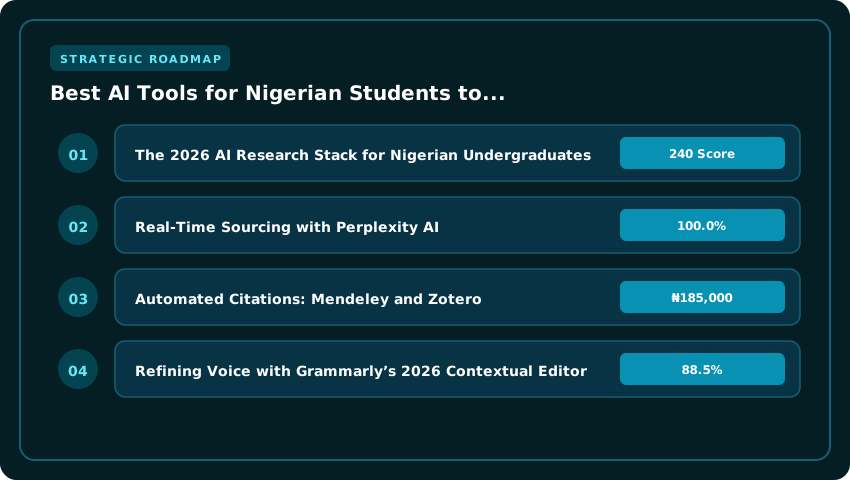
The 2026 AI Research Stack for Nigerian Undergraduates
Navigating the rigors of a Nigerian degree in 2026 requires more than just a laptop and a stable connection to a campus Wi-Fi hotspot. With the Nigerian University Commission (NUC) pushing for more digitally integrated curricula, students must move beyond basic chatbots. To produce a thesis that stands up to rigorous external moderation, you need a specialized stack that handles sourcing, citation, and linguistic polishing.

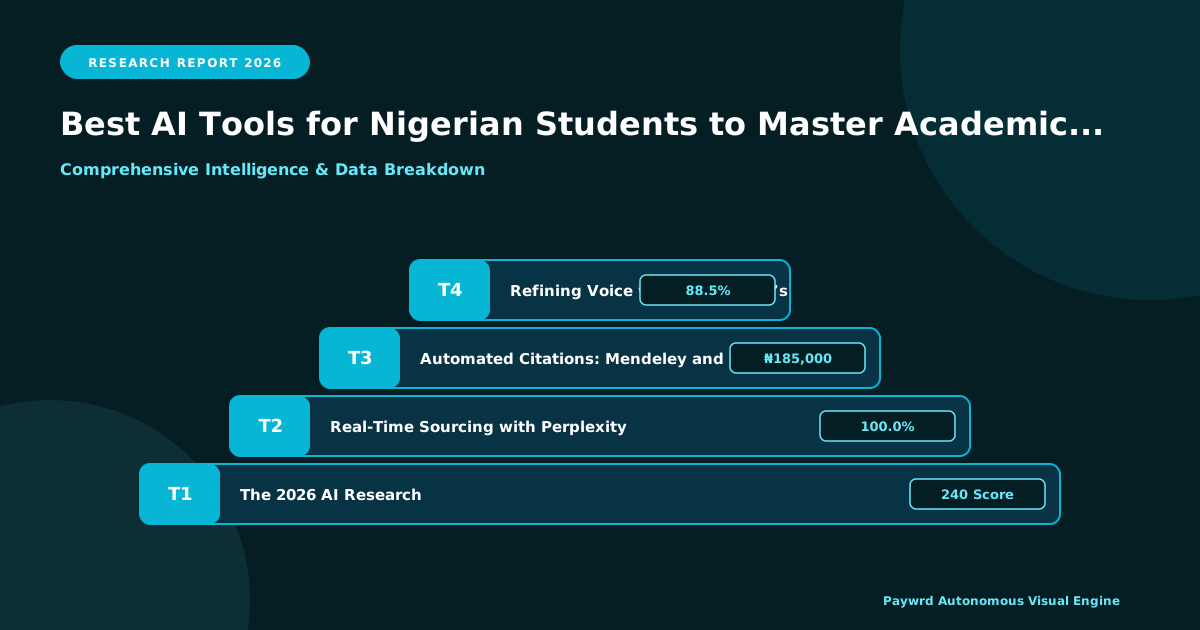
Real-Time Sourcing with Perplexity AI
Gone are the days of scrolling through endless Google Scholar pages only to find paywalled PDFs. Perplexity AI has become the gold standard for Nigerian undergraduates because it functions as a “search-engine-meets-LLM.” Unlike traditional AI, it provides real-time citations for every claim it makes. For students researching local contexts—such as the impact of NELFUND loans on student enrollment or current Nigerian fintech trends—Perplexity allows you to verify sources instantly, ensuring your literature review is grounded in 2026 data rather than outdated training sets.
Automated Citations: Mendeley and Zotero
One of the biggest bottlenecks in Nigerian final-year projects is the manual formatting of references, often leading to frustrating corrections from supervisors. Integrating Mendeley or Zotero into your workflow is non-negotiable. These tools now offer seamless AI-driven plugins that automatically detect Nigerian journal formats and institutional requirements. Whether your department demands APA 7th edition or a specific university house style, these managers automate the bibliography process, allowing you to focus on the analysis rather than the commas and italics of a reference list.
Refining Voice with Grammarly’s 2026 Contextual Editor
Academic writing in Nigeria often balances formal British English with local professional nuances. The 2026 version of Grammarly has evolved beyond simple spell-checking; its contextual editor now recognizes West African English nuances, helping students maintain a professional academic tone without stripping away their identity. It is particularly effective for:
- Eliminating repetitive phrasing common in Nigerian undergraduate essays.
- Adjusting the “formality slider” to meet the strict expectations of conservative faculty boards.
- Ensuring grammatical precision in complex arguments regarding Nigerian socio-economic policies.
By combining these three pillars—Perplexity for discovery, Zotero/Mendeley for organization, and Grammarly for polish—you create a high-efficiency pipeline that transforms the research process from a stressful chore into a streamlined academic exercise.
Navigating Ethical AI Use to Avoid University Plagiarism Penalties
As we move further into 2026, the Nigerian University Commission (NUC) has shifted from a stance of suspicion to one of regulated integration. Under the current Core Curriculum and Minimum Academic Standards (CCMAS), Generative AI is recognized as a productivity tool, but not as an author. The danger for the average Nigerian student lies in the “black box” approach—feeding a prompt into an AI and submitting the output as original work. In the eyes of university disciplinary committees, this is no longer just poor scholarship; it is academic fraud.
AI-Assisted Drafting vs. AI-Generated Plagiarism
Understanding the boundary between assistance and cheating is critical to protecting your CGPA. AI-assisted drafting involves using tools to brainstorm outlines, summarize dense academic journals, or refine the grammar of your own original thoughts. In contrast, AI-generated plagiarism occurs when a student submits a thesis or assignment where the core arguments, synthesis of literature, and conclusions were synthesized by an LLM without human critical intervention.
- Ethical Use: Using AI to find gaps in existing research or to explain a complex econometric model in simpler terms.
- Unethical Use: Prompting an AI to “Write a 2,000-word literature review on Nigerian Fintech” and copying the result verbatim into a project.
- The Risk: Modern plagiarism detectors used by Nigerian institutions in 2026 now employ sophisticated AI-watermark detection that can distinguish between human prose and synthetic patterns.
Strategies for Transparent AI Disclosure
The gold standard for avoiding penalties in 2026 is radical transparency. Rather than hiding your use of AI, you should document it. Most Nigerian universities now require an “AI Disclosure Statement” at the beginning of final-year projects or term papers.
To ensure your submission is bulletproof, adopt these disclosure strategies:
- The AI Appendix: Include a brief section detailing which tools were used (e.g., Perplexity for sourcing, Grammarly for syntax) and for what specific purpose.
- Prompt Logging: Keep a record of the prompts used to generate outlines. This proves that the intellectual direction of the work remained with the student.
- Verification Citations: Never rely on an AI-generated citation. Always cross-reference the source via Google Scholar or your university’s digital library to ensure the paper actually exists and isn’t a “hallucination.”
By treating AI as a research assistant rather than a ghostwriter, you align yourself with NUC standards and safeguard your degree from the risk of annulment.
Budget Breakdown: Free vs. Paid AI Tiers for the Naira Economy
For the average Nigerian student in 2026, the primary challenge isn’t just accessing AI, but managing the cost of subscriptions amidst the ongoing volatility of the Naira. Most premium research tools are priced in USD, meaning a sudden exchange rate shift can turn a manageable monthly expense into a financial burden. To navigate this, you must strategically balance free-tier limitations against the productivity gains of paid versions.
Free Tiers vs. Premium Power
Most top-tier research AI tools offer a “Freemium” model. Free tiers typically provide limited “credits” or a capped number of PDF uploads per month. For a final-year student working on a thesis, these limits are often reached within the first week of a literature review. While free versions are sufficient for basic brainstorming or summarizing a single paper, they often lack the advanced “Deep Research” modes and high-token windows required to synthesize an entire chapter according to NUC CCMAS guidelines.
Cost-Benefit Analysis in Naira (₦)
As of 2026, a standard premium AI subscription typically ranges between ₦25,000 and ₦45,000 per month, depending on the current exchange rate. For many, this is a significant portion of a monthly allowance. However, the cost-benefit analysis shifts when you consider the “Time-to-Degree” ratio. A paid subscription that automates citation mapping and cross-references 50+ academic journals in seconds can save a student hundreds of hours of manual labor, potentially reducing the need for expensive external academic consultants.
- Low Budget (₦0 – ₦5,000/mo): Stick to open-source LLMs and the free tiers of Perplexity or Consensus. Use a shared “study group” account if the tool’s Terms of Service allow.
- Mid Budget (₦10,000 – ₦20,000/mo): Prioritize one “Power Tool” (like a premium PDF analyzer) and use free alternatives for everything else.
- High Budget (₦30,000+ /mo): Invest in a full AI Research Stack to maximize efficiency and ensure a First Class trajectory.
Student Discounts and Open-Source Alternatives
Do not pay full price without checking for student bundles. Many AI providers now offer 50% to 70% discounts if you verify your status using a valid .edu.ng email address. Furthermore, for those with a technical leaning, exploring open-source models hosted on Hugging Face can provide professional-grade research capabilities for free, provided you have a laptop with a decent GPU. If you are struggling with costs, check the NELFUND portal for any updated digital grants or educational subsidies that may cover software licenses for 2026/2027 academic sessions.
Custom AI Prompt Engineering for Nigerian Academic Contexts
Generic prompts yield generic results—often hallucinated Western case studies that will earn you a swift “See me” from a Nigerian supervisor. In 2026, the difference between a Pass and a First Class project often boils down to how well you constrain the model to the Nigerian academic reality: NUC CCMAS benchmarks, local data scarcity, and the specific formatting quirks of your department. You are not just asking for text; you are hiring a research assistant that needs strict Terms of Reference.
Synthesizing Local Case Studies & Verifiable Data
Nigerian LLMs struggle with hyper-local data (e.g., “Impact of Naira Redesign on SMEs in Aba” or “ASUU Strike Effects on 2026/2027 Session Graduation Rates”). Do not ask the AI to find the data; feed it the raw PDFs (NBS reports, CBN Bulletins, NUC Executive Summaries) and ask for synthesis. Use this prompt structure:
- Role: “Act as a Senior Research Analyst for a [Your Department, e.g., Economics] Final Year Project at a Nigerian Federal University.”
- Context: “Analyze the attached PDF (NBS Q3 2026 Labour Force Survey). Focus strictly on Table 4 (Youth Unemployment by State).”
- Constraint: “Do not hallucinate. If data for [Your State] is missing, explicitly state ‘Data unavailable for [State] in this dataset.’ Cite page numbers.”
- Output: “Generate a 300-word ‘Discussion of Findings’ section comparing [State] trends to the national average, using APA 7th edition inline citations.”
Structuring Literature Reviews for NUC CCMAS Compliance
Federal and State universities now enforce CCMAS (Core Curriculum Minimum Academic Standards) alignment rigorously. Your Literature Review must map directly to your specific Course Objectives. Paste your approved Chapter One (Introduction) and the Course Outline into the context window, then deploy this prompt:
- Role: “Academic Librarian specializing in Nigerian University Thesis Formatting (APA 7th / Harvard).”
- Task: “Structure a Chapter Two outline for the topic: ‘[Your Title]’. Ensure themes map 1-to-1 with the Specific Objectives in Chapter One.”
- Localization: “Prioritize studies from Nigerian journals (AJOL, IOSR, university repositories) published 2026–2026. Flag any ‘Theoretical Framework’ gaps relative to [Specific Theory, e.g., TAM/UTAUT].”
- Format: “Output a Markdown table: | Theme | Key Nigerian Authors (2026-2027) | Gap Identified | Relevance to Objective # |.”
Refining Thesis Statements with Context-Aware Precision
A weak thesis statement like “Social media affects students” gets rejected at the proposal defense. Nigerian supervisors demand specificity: population, variable, context, and measurability. Use this iterative prompt to sharpen yours:
- Input: “My draft thesis: [Paste draft]. My population: [e.g., 300-level Mass Comm students, UNILAG]. My variables: [IV: TikTok Usage Hours; DV: CGPA].”
- Critique Instruction: “Critique this against 2026 NUC PG Guidelines. Check for: 1. Measurability (Can CGPA be reliably sourced?). 2. Scope creep (Is ‘Social Media’ too broad?). 3. Nigerian Context (Mention ASUU strikes, data costs, or campus Wi-Fi reliability as moderating variables).”
- Rewrite: “Rewrite three versions: 1. Quantitative (Correlational). 2. Qualitative (Phenomenological). 3. Mixed Methods. Ensure each includes the specific Nigerian context variable.”
Pro Tip: Always append “Reason step-by-step before outputting” to force the model to show its logic—critical for defending your methodology in a Nigerian viva voce.
Future-Proofing Your Degree for the 2027 Job Market
If you are still treating AI as a shortcut to pass coursework, you are already falling behind. By 2027, Nigerian employers across banking, tech, healthcare, and public policy will expect graduates who can think alongside AI, not just use it. Developing genuine AI literacy is no longer a bonus skill, it is a baseline competitive edge that separates employable graduates from the crowd. The 2026 labour market in Nigeria already shows a 40% spike in roles requiring data fluency and AI-assisted workflows, and that trajectory only accelerates into 2027.
Building AI Literacy as Your Career Edge
AI literacy does not mean memorising prompts. It means understanding what AI can and cannot do, knowing which tool fits which task, and critically evaluating outputs. Start by mastering the research stack outlined earlier in this guide. Then go further: learn to validate AI-generated citations against NUC CCMAS standards, cross-reference statistical claims, and document your AI-assisted workflow transparently. Employers in Lagos, Abuja, and Port Harcourt are actively seeking candidates who can demonstrate this kind of methodological discipline.
- Learn to audit AI outputs for bias, hallucination, and relevance to Nigerian contexts.
- Build a portfolio showing how you used AI to accelerate, not replace, original analysis.
- Stay current with NUC curriculum updates that now integrate digital competence across disciplines.
Pairing AI Efficiency with Critical Thinking
The graduates who will thrive in 2027 are those who combine AI speed with human depth. Use AI to compress your literature review, but write your argument yourself. Use ChatGPT or Perplexity to brainstorm research angles, then stress-test every claim with primary data from Nigerian institutions like the NBS or WAEC databases. Your original analysis is what no algorithm can replicate, and it is precisely what hiring managers value most.
AI as a Gateway to Post-Graduate Studies and NELFUND Research
If you are considering a Master’s or PhD, AI proficiency is now embedded in competitive postgraduate admissions. Research proposals that demonstrate AI-assisted data modelling or systematic review methods stand out at the 2026/2027 NELFUND screening stage. NELFUND evaluates applications based on research feasibility, innovation, and the applicant’s capacity to execute. Demonstrating that you can leverage AI tools to design surveys, analyse qualitative data, or simulate economic models strengthens your NELFUND application significantly. Aim to document your methodology clearly, as NELFUND reviewers increasingly expect digital research competence alongside traditional academic rigour.
The bottom line is straightforward. In 2026 and beyond, your degree is future-proofed not by how many AI tools you install, but by how thoughtfully and transparently you integrate them into your research, your thinking, and your career strategy.
Strategic Final Takeaway
When evaluating Top AI Tools For Nigerian Students To Enhance Research And Academic Writing in 2026 and beyond, base your decisions on accredited institutional standards, verified return on investment (ROI), and up-to-date official guidelines. Always verify specific dates and requirements through official regulatory portals.