Current UK Home Office Mandates for Nigerian Passport Holders
Navigating the UK Student Route visa in 2026 requires more than just an admission letter; it demands strict adherence to the Home Office’s evolving compliance framework. For Nigerian applicants, the baseline for eligibility is centered on the “Genuine Student” test. The Home Office now employs enhanced digital screening to ensure that applicants intend to study and are not using the student route as a backdoor for unauthorized labor.

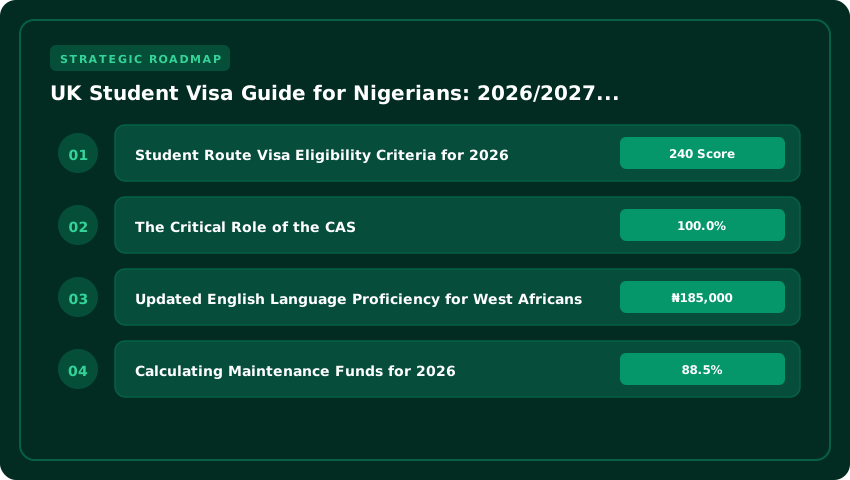
Student Route Visa Eligibility Criteria for 2026
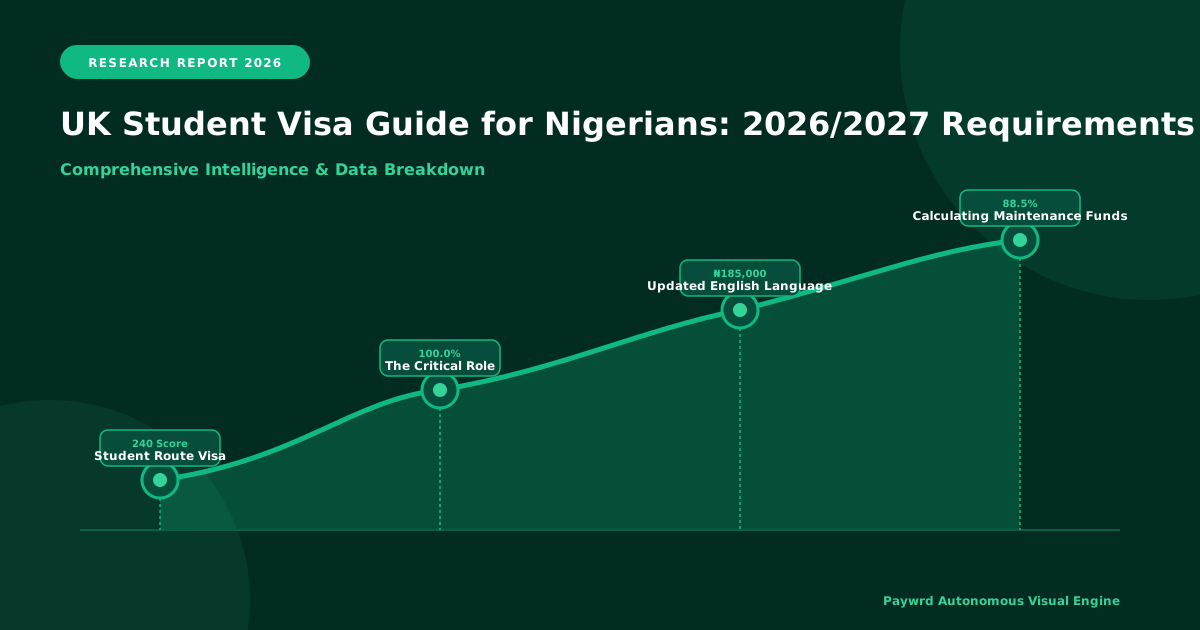
To qualify for a Student visa for the 2026/2027 academic session, Nigerian passport holders must meet several non-negotiable mandates. First, you must hold a valid offer from a Student Sponsor (a university licensed by the Home Office). Second, you must demonstrate sufficient financial capacity to cover your tuition fees and monthly living expenses.
- Financial Evidence: Funds must be held in a personal or parent’s bank account for a consecutive 28-day period.
- Maintenance Funds: The Home Office has adjusted the monthly living cost requirement for 2026 to reflect current UK inflation, meaning applicants must show a higher Naira equivalent than in previous years.
- Tuberculosis (TB) Test: A valid TB certificate from an IOM-approved clinic in Nigeria remains a mandatory requirement for all applicants staying longer than six months.
The Critical Role of the CAS
The Confirmation of Acceptance for Studies (CAS) is the cornerstone of your application. It is not a physical document but a unique digital reference number issued by your university. In 2026, the Home Office has integrated CAS data more tightly with the visa application portal. Any discrepancy between the course details, tuition fees paid, or the scholarship amounts listed on your CAS and your bank statements will lead to an immediate refusal.
Updated English Language Proficiency for West Africans
While the UK has historically recognized certain West African qualifications, the 2026 mandates require precise documentation. Nigerian applicants must prove their English proficiency through one of the following approved channels:
- SELT Exams: A valid IELTS Academic or PTE Academic score meeting the university’s specific tier.
- WAEC/NECO: While C6 or above in English is often accepted, some high-ranking universities now require a supplementary English test if the WAEC result is older than five years.
- Degree Medium of Instruction: If your previous degree was taught in English, you must provide an official letter from the institution confirming this, though this is subject to the university’s discretion.
Proof of Funds (POF) Breakdown: GBP vs Naira Calculations
Securing a UK Student Visa in 2026 requires surgical precision in your financial documentation. The UK Home Office does not just look for a balance; they look for stability and authenticity. Your Proof of Funds (POF) must cover two primary components: your remaining tuition fees (after any deposits) and your monthly maintenance funds for the first nine months of your course.
Calculating Maintenance Funds for 2026
For the 2026/2027 academic session, maintenance requirements are split by location. If your institution is inside London, you are required to show approximately £1,334 per month; outside London, the requirement is roughly £1,023 per month. For a standard nine-month period, this totals £12,006 (Inside London) or £9,207 (Outside London). These figures must be added to any outstanding tuition balance listed on your CAS.
Managing Naira (₦) Volatility and Exchange Rates
The most common cause of visa refusals for Nigerians in 2026 is the “Exchange Rate Gap.” The Home Office does not use the official Central Bank of Nigeria (CBN) rate; they use OANDA. Because the Naira remains volatile, a balance that looks sufficient today may fall below the threshold by the time the caseworker reviews your application.
- The Buffer Strategy: We strongly advise maintaining a 15% to 20% financial buffer above the minimum GBP requirement to insulate your application against sudden Naira depreciation.
- Real-time Tracking: Check the OANDA converter daily during your application window to ensure your Naira balance still converts to the required GBP amount.
The 28-Day Rule and Accepted Institutions
The “28-Day Rule” is non-negotiable. The total required funds must have been in your account for a consecutive period of 28 days. The closing balance on the 28th day must not drop even by one Naira below the required amount. Your bank statement must be dated within 31 days of your visa application date.
To avoid scrutiny, use reputable Nigerian commercial banks (e.g., Zenith, GTBank, Access, or UBA). If you are using a sponsor, such as a parent, you must provide their birth certificate or a legal affidavit to prove the relationship, alongside a signed letter of consent. While NELFUND provides critical support for domestic studies, remember that for UK visas, the Home Office requires liquid cash or an official government loan letter that explicitly states the funds are available for use in the UK.
The 2026 Essential Document Checklist for Nigerian Students
Securing a UK Student Visa in 2026 leaves zero room for clerical errors. The UK Home Office has increased its reliance on digital verification, meaning any discrepancy between your submitted documents and your Confirmation of Acceptance for Studies (CAS) can lead to an immediate refusal. To avoid the stress of a “Request for Further Information” (RFI), use this definitive checklist to organize your folder.
Identity and Biometric Compliance
Your international passport is the foundation of your application. Ensure your passport is valid for at least six months beyond your intended date of entry into the UK. In 2026, the UKVI (UK Visas and Immigration) has streamlined biometric enrollment via the UK Immigration: ID Check app, but Nigerian applicants must still be prepared for physical appointments at TLScontact centers in Lagos or Abuja if the app fails to verify their document security features.
- Current International Passport (Original and clear color scan of the bio-data page).
- Previous passports (if applicable, to show travel history).
- Two recent passport-sized photographs meeting the UKVI digital specifications.
Mandatory Health Screenings
Nigeria remains on the list of countries where a Tuberculosis (TB) test is mandatory for stays longer than six months. You cannot use any private clinic for this; the Home Office only recognizes certifications from IOM (International Organization for Migration) Nigeria. Ensure your TB certificate is dated within six months of your visa application date.
- Valid TB Test Certificate issued by IOM Nigeria (Lagos or Abuja centers).
- Proof of appointment and payment receipt from the IOM portal.
Academic Verification and Credentials
With the implementation of the new NUC CCMAS standards in Nigeria, the UK Home Office now cross-references academic credentials more rigorously. You must provide original documents that match the details listed on your CAS. If your WAEC or NECO results were obtained several years ago, ensure you have the digital verification codes ready for the visa officer.
- Original WAEC/NECO/NABTEB certificates (verified via the respective portals).
- Complete University Transcripts (for postgraduate applicants), stamped and signed by the Registrar.
- Degree Certificate or a formal “Letter of Completion” if the final certificate is still pending.
- English Language Proficiency evidence (IELTS Academic, PTE, or a university waiver based on your WAEC C6 or above in English).
Pro tip: Scan all these documents into a single, high-resolution PDF folder. In 2026, the “Digital First” approach means that clear, legible uploads are prioritized over physical stacks of paper during the initial assessment phase.
Navigating the Application Process from Lagos and Abuja
Once your CAS is secured and your financial documents are verified, the physical logistics of your application begin. For Nigerians, the visa process is managed through TLScontact, with primary centers located in Lagos (Ikeja) and Abuja. Given the surge in applications for the 2026/2027 academic session, booking your appointment early is non-negotiable. Slots for the September intake often fill up by May or June, so we recommend scheduling your biometric appointment the moment your online application is submitted.
Processing Times and Priority Services
In 2026, the UK Home Office continues to offer tiered processing speeds to accommodate different urgency levels. Choosing the right service depends on your budget and your course start date:
- Standard Service: Typically takes 3 weeks. This is the most cost-effective route but carries the risk of delays during peak August rushes.
- Priority Service: Usually provides a decision within 5 working days. This is highly recommended for students who received their CAS late or are balancing work commitments in Nigeria.
- Super Priority Service: Offers a decision by the next working day. While expensive, it is the safest bet for those with imminent flight deadlines.
Mastering the Credibility Interview
The “Credibility Interview” remains the most stressful hurdle for Nigerian applicants. The Home Office uses these interviews to ensure you are a genuine student and not using the visa as a backdoor for migration. In 2026, interviewers are focusing heavily on the “Value Proposition” of your degree.
Be prepared to answer the following common questions with specific, grounded facts:
- Why this specific university? Avoid generic answers like “it is a world-class institution.” Instead, mention specific modules, professors, or research facilities that align with your career goals.
- Why the UK instead of Nigeria or Canada? Compare the curriculum of your chosen UK course with similar programs at top Nigerian universities (like UNILAG or ABU) to show you’ve done your research.
- What are your post-study plans? Be clear about how this degree will increase your earning potential or professional standing upon your return to Nigeria.
- How are you funding your studies? If using a sponsor, be ready to explain their relationship to you and the source of their funds to satisfy the tightened 2026 financial scrutiny.
Remember, consistency is key. Your verbal answers must align perfectly with the statements provided in your Statement of Purpose (SOP) and the details on your CAS.
Visa Compliance and Legal Work Limits to Avoid Deportation
Securing your visa is only the first hurdle; maintaining it is where many Nigerian students falter. The UK Home Office has intensified its monitoring of Student Route compliance in 2026, utilizing digital tracking and tighter institutional reporting. A single breach of your visa conditions can lead to immediate curtailment, meaning your leave to remain is cancelled and you face mandatory deportation.
The 20-Hour Work Limit: A Hard Line
For most undergraduate and postgraduate taught students, the legal limit for employment is 20 hours per week during term time. It is a common misconception that you can “average out” these hours over a month; the Home Office views this on a strict weekly basis. Working 21 hours in one week and 19 in the next is still a violation.
- Term-Time vs. Vacations: You may work full-time during official university holidays (Christmas, Easter, and Summer breaks). However, ensure your university’s academic calendar explicitly defines these dates.
- Self-Employment Ban: Under current 2026 regulations, student visa holders are strictly prohibited from being self-employed or engaging in business activities (including freelance consulting or running a Nigerian-based business while residing in the UK).
- Unpaid Work: Be cautious with “voluntary” roles; if the role is normally a paid position, the Home Office may classify it as illegal employment.
Course Withdrawals and Sponsorship Risks
Your right to stay in the UK is tethered to your Confirmation of Acceptance for Studies (CAS). If you withdraw from your course, fail to register, or are expelled for academic misconduct, your university is legally mandated to report this to the Home Office immediately.
Once the university withdraws its sponsorship, your visa is typically curtailed to 60 days. Attempting to switch to a different course or institution requires a new CAS and a fresh visa application. In 2026, the window for “switching” has narrowed, and any gap in enrollment can trigger a red flag during your future Graduate Route (Post-Study Work) application.
Reporting Changes in Circumstances
Transparency is your best defense against deportation. You must notify both your university’s International Student Office and the Home Office regarding any significant changes, including:
- Change of Address: Failure to update your residency details can be viewed as an attempt to evade monitoring.
- Passport Renewal: If you renew your Nigerian passport while in the UK, you must update your records to ensure your BRP (Biometric Residence Permit) or digital status remains valid.
- Course Changes: Changing your major or switching from a full-time to a part-time track without official authorization is a breach of visa conditions.
Post-Study Work Rights and the Graduate Route for 2027
For Nigerian students heading to the UK in 2026, the primary driver for the investment is often the Graduate Route visa. This post-study work (PSW) permit allows you to transition from a Student Visa to a work visa without needing an immediate job offer or a corporate sponsor. As we move into 2027, this route remains the most viable pathway to recouping your tuition costs and gaining international professional experience.
Transitioning from Student Visa to the Graduate Route
The transition is not automatic. To successfully switch, you must have completed your degree—whether it is a Bachelor’s, Master’s, or PhD—at a UK Higher Education Provider (HEP) licensed by the Home Office. The application is typically submitted through the UK Government’s official portal after your university confirms your successful completion of the course to the Home Office.
- Duration: Undergraduate and Master’s graduates are eligible for a 2-year permit. PhD graduates receive a 3-year permit.
- Timing: You must apply before your current Student Visa expires. It is highly recommended to apply as soon as your university notifies you of your results to avoid “visa gaps.”
- Financials: While you no longer need the heavy maintenance funds required for the initial Student Visa, you must still cover the application fee and the Immigration Health Surcharge (IHS) for the duration of the permit.
Career Opportunities for Nigerian Graduates in 2027
The UK labor market in 2027 continues to show high demand for skilled professionals, particularly those coming from STEM, Healthcare, and Fintech backgrounds. Nigerian graduates are increasingly finding success in “Shortage Occupation” roles, which provide a smoother bridge from the Graduate Route to the more permanent Skilled Worker Visa.
To maximize your Return on Investment (ROI), focus on these high-growth sectors:
- Health & Social Care: With an aging population, nursing and biomedical sciences remain top priorities.
- Technology & AI: Software engineering and data analytics roles are booming, especially in London and Manchester hubs.
- Finance & Accounting: Given the strong ties between Nigerian professionals and global finance, roles in auditing and risk management are highly accessible.
By leveraging the Graduate Route, you can earn in Pounds Sterling (GBP), allowing you to settle any outstanding NELFUND loans or family obligations in Nigeria while building a global CV that makes you a premium candidate in any market worldwide.
| Requirement Criteria | Standard Student Route (2026/2027) | Priority Service (Fast Track) |
|---|---|---|
| Visa Application Fee | Approximately £490 (₦1,100,000+) | Standard Fee + Priority Surcharge |
| Health Surcharge (IHS) | £776 per year (Standard Rate) | £776 per year (Standard Rate) |
| Financial Evidence | Tuition + Living Costs (28-day rule) | Tuition + Living Costs (28-day rule) |
| Processing Timeline | 3 Weeks (Standard) | 5 Working Days (Priority) |
| English Proficiency | Updated 2026 IELTS/PTE Benchmarks | Updated 2026 IELTS/PTE Benchmarks |
Frequently Asked Questions
What are the UK student visa financial requirements for Nigerians in 2026?
For 2026, Nigerian students must provide evidence of sufficient funds to cover one year of tuition and living expenses. Funds must be held in a bank account for a consecutive 28-day period. The Home Office has increased scrutiny on fund sources to prevent fraudulent documentation during the CAS verification process.
How do I pass the UK 'Genuine Student' test for the 2026/2027 intake?
To pass the 2026 Genuine Student test, applicants must demonstrate a clear academic progression path and a legitimate intent to study. Be prepared for digital screening and potential interviews where you must explain why the specific UK course is essential for your future career goals in Nigeria or globally.
What is the current UK student visa processing time for Nigerians in 2026?
Standard UK student visa processing for Nigerian passport holders typically takes 3 weeks. However, applicants can opt for the Priority Service to receive a decision within 5 working days. It is recommended to apply as soon as your Confirmation of Acceptance for Studies (CAS) is issued for 2026/2027.
Which English proficiency tests are accepted for UK student visas in 2026?
The UK Home Office accepts Secure English Language Tests (SELT) such as IELTS for UKVI, PTE Academic UKVI, and TOEFL iBT. For the 2026/2027 session, ensure your test scores meet the updated benchmarks required by both your chosen university and the Home Office compliance framework for Nigerian applicants.
Can Nigerian students work in the UK under the 2026 student visa rules?
Under 2026 regulations, most international students on a Student Route visa can work part-time up to 20 hours per week during term time and full-time during vacations. However, strict adherence to these limits is mandatory to avoid visa revocation and maintain compliance with Home Office mandates.
Strategic Final Takeaway
When evaluating UK Student Visa Requirements For Nigerian Students 2026/2027 Guide in 2026 and beyond, base your decisions on accredited institutional standards, verified return on investment (ROI), and up-to-date official guidelines. Always verify specific dates and requirements through official regulatory portals.