2026 ICAN vs ACCA: Strategic Path Selection for Nigerian Graduates
Choosing between ICAN and ACCA in 2026 demands a clear-eyed look at three realities: where you want to sign documents legally, what Big 4 firms actually recruit for, and what the total Naira cost will be across your 2026/2027 diet. This guide cuts through the noise.

Global Mobility vs Local Statutory Signing Rights Under CAMA 2026
Under the Companies and Allied Matters Act (CAMA) 2026, only ICAN-qualified accountants hold statutory signing rights for audit reports on Nigerian company financial statements. This is non-negotiable. If your career goal is to sign off audits for Nigerian-registered entities, ICAN is your legal gateway. ACCA provides exceptional global mobility — recognized across 180+ countries and highly valued by multinational firms operating in Nigeria. However, ACCA members seeking signing rights in Nigeria must supplement with ICAN qualifications or operate under specific regulatory exemptions that remain limited in practice.
Cost-Benefit Analysis: Total Naira Investment for 2026/2027 Diet
Here is where the decision gets granular. For the ICAN pathway, expect total registration and examination fees across all papers ranging from approximately ₦350,000 to ₦550,000 for the full program when completing your 2026/2027 diet. ACCA costs significantly more — registration alone runs around ₦180,000, with individual exam fees per paper between ₦180,000 and ₦260,000, pushing total program investment to roughly ₦1.2 million to ₦1.8 million across both cycles. The return differential matters: ACCA holders command higher starting salaries in multinational firms, but ICAN holders gain immediate legal employability within Nigerian regulatory frameworks.
Decision Matrix: B.Sc vs HND Holders Targeting Big 4 Firms
Big 4 recruitment patterns in Nigeria for 2026 reveal a clear split. For B.Sc graduates, ACCA provides the strongest competitive edge during campus recruitment, particularly at PwC, Deloitte, and EY, where international certification signals readiness for global audit methodologies. HND holders face a different calculus — many Nigerian Big 4 offices value ICAN qualification more heavily for HND candidates because it aligns directly with local statutory requirements and CAMA compliance roles. HND holders pursuing ACCA should budget for the higher cost but can leverage the qualification for lateral moves into international affiliate offices within two years.
- If your primary goal is statutory signing rights in Nigeria under CAMA 2026, prioritize ICAN first, then consider ACCA as a supplement.
- If you are targeting multinational Big 4 roles immediately after graduation, ACCA delivers stronger initial ROI despite the higher ₦ investment.
- B.Sc holders have the flexibility to pursue either path; HND holders should weigh ICAN more seriously for local regulatory compliance roles.
- Track both registration portals — ICAN’s official registration desk and ACCA’s global student portal — for 2026/2027 diet deadlines, which typically open between January and March 2026.
The bottom line in 2026: align your certification investment with the specific regulatory and employer environment you are entering, not with generic prestige rankings.
ICAN 2026 Registration Workflow: ATSWA, PE & Professional Levels
The ICAN student portal at students.ican-ngr.org is your single source of truth for the 2026 cycle. Do not rely on third-party cafes; the institute has tightened identity verification, and a mismatched BVN or blurry NYSC certificate will hard-stop your application. Log in with your registered email — if this is your first attempt, click “New Student Registration” and generate a unique registration number before proceeding to the dashboard.
Step-by-Step Portal Navigation for May & November Diets
Once inside the dashboard, select Examination Entry from the left-hand menu. The 2026 diet calendar is hardcoded: the May diet typically closes entries in late January, while the November diet shuts down in late July. Pick your diet, then your level — ATSWA (Accounting Technicians Scheme), Professional Examination (PE) Levels I–III, or the Professional Level (Foundation, Skills, Professional). The system auto-filters eligible papers based on your exemption status and previous passes. Confirm your center — Lagos, Abuja, Port Harcourt, and Kano fill up fast; select a backup center immediately. Pay the exam fees via the integrated Remita gateway; the portal only releases your exam docket after payment confirmation reflects, which can take 24 hours during peak windows.
Document Upload Specs: NYSC & Transcript Verification
This is where 40% of 2026 applicants got stuck. For 2026, ICAN mandates NUC transcript verification before you can sit for Professional Level papers. Upload a single PDF (max 2MB) containing your degree certificate, academic transcript, and NYSC discharge/exemption certificate. The file name must follow the convention: ICAN_RegNo_Surname_FirstName.pdf. Scan at 300 DPI in grayscale — color scans bloat file size and trigger auto-rejection. Crucially, the NYSC certificate must show the Director-General’s signature and the QR code clearly visible. If you are awaiting NYSC discharge, upload your call-up letter and a sworn affidavit; you must replace it with the discharge certificate before the diet closing date or your entry will be voided.
2026 Fee Schedule Breakdown (₦)
Fees are non-negotiable and non-refundable. Budget these amounts before you click “Submit”:
- New Student Registration (One-off): ₦52,500 (covers registration form, identity card, and student levy).
- Annual Subscription (Due Jan 1 yearly): ₦15,750 for Students; ₦31,500 for Associates (ACA).
- ATSWA Exam Fees (Per Paper): ₦10,500.
- PE / Professional Level Exam Fees (Per Paper): ₦15,750.
- Exemption Fee (Per Paper Granted): ₦18,900.
- Transcript Verification (NUC Portal): ₦5,250 paid directly to NUC via Remita, receipt uploaded to ICAN portal.
Pro Tip: Pay your Annual Subscription before exam entry. The portal blocks diet registration if your sub status reads “In Arrears.” Keep PDF receipts for every transaction — Remita RRR codes are your only proof if the portal glitches.
ACCA 2026 Entry Routes: Exemptions Calculator & Applied Knowledge/Skills
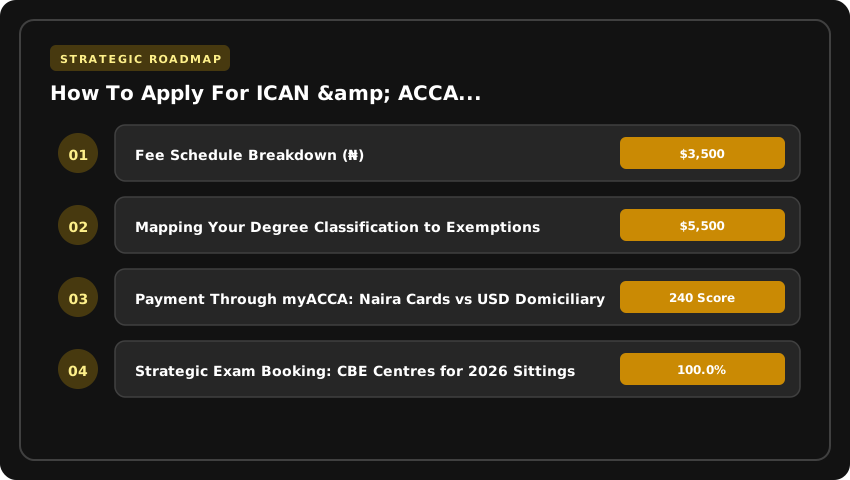
If you are a Nigerian graduate stepping into the ACCA pipeline in 2026, your first strategic move is not booking an exam — it is understanding exactly what exemptions you qualify for. The ACCA Exemption Calculator exists inside the myACCA portal, but using it effectively requires knowing how Nigerian degree classifications map onto ACCA’s 2026 syllabus exemptions.
Mapping Your Degree Classification to Exemptions
ACCA’s Applied Knowledge level covers three core papers: Business and Technology (BT), Management Accounting (MA), and Financial Accounting (FA). The number of exemptions you receive depends directly on your final degree classification from a recognised Nigerian university:
- First Class Honours: Typically qualifies for up to 9 exemptions across Applied Knowledge and partial Applied Skills modules. This is the strongest entry point, allowing you to skip straight into strategic-level preparation faster.
- Second Class Upper (2:1): Usually grants 6 exemptions at the Applied Knowledge level. You will sit BT, MA, and FA as free-standing papers but gain early access to certain Applied Skills papers.
- Second Class Lower (2:2): Generally earns up to 3 exemptions, mostly from Applied Knowledge. You will need to sit more papers, which extends your timeline and total cost.
- Pass or Below: Minimal to no exemptions. You enter through the standard route, sitting all Applied Knowledge papers before progressing.
Always run the official Exemption Calculator through myACCA after uploading your final transcript. Pre-2026 syllabus exemptions do not carry over, so even returning candidates must revalidate.
Payment Through myACCA: Naira Cards vs USD Domiciliary
Registering via myACCA in 2026 gives Nigerian candidates two practical payment rails. First, you can use Naira-denominated Visa or Mastercard issued by major Nigerian banks (Access, Zenith, GTBank, First Bank). The system processes the transaction at the prevailing ACCA Nigeria retail rate, and your bank handles the forex conversion — usually cleaner for smaller registration fees.
Second, if you hold a USD domiciliary account, you can pay directly in dollars. This route benefits candidates who want to avoid multiple FX conversions or who are paying for full-year subscription packages exceeding ₦250,000. The key advantage is price stability; your bank does not apply the parallel market spread that sometimes inflates Naira card transactions.
Whichever method you choose, confirm payment status inside myACCA within 48 hours before your registration deadline.
Strategic Exam Booking: CBE Centres for 2026 Sittings
ACCA’s Computer-Based Exams (CBE) for Applied Knowledge and Applied Skills run on demand throughout the year, but centre availability determines your scheduling flexibility. For 2026, the three primary CBE centres in Nigeria are:
- Lagos: Highest sitting frequency with multiple daily slots. Best for candidates who need to reschedule quickly.
- Abuja: Strong infrastructure and consistent centre uptime. Ideal for candidates in the Federal Capital Territory and North-Central regions.
- Port Harcourt: Serves the South-South and Niger Delta corridor. Booking opens earlier for March and September sittings, so plan ahead.
Book at least six weeks in advance for peak sittings. Centre capacity fills fast, and late bookings often force candidates into inconvenient locations or deferred dates that push results past the 2026 closing window.
Navigating 2026 Exam Diets: Key Deadlines, Deferral Policies & CBE Logistics
ICAN 2026 Diet Calendar
ICAN runs two main diets each year — May and November. For 2026 the critical cut‑off dates are:
- May 2026 diet – Early registration closes 31 January 2026. Late entry window runs 1 February – 15 March 2026 with a ₦15,000 penalty per paper.
- November 2026 diet – Early registration closes 31 July 2026. Late entry window runs 1 August – 15 September 2026 with the same ₦15,000 per‑paper surcharge.
- Deferral is allowed up to 30 days before the first exam day of the chosen diet. A deferral fee of ₦10,000 per paper applies and the request must be submitted through the ICAN student portal (https://student.icanig.org).
ACCA 2026 Session CBEs vs On‑Demand CBEs
ACCA offers four session windows in 2026 — March, June, September and December. Session CBEs have fixed start dates; on‑demand CBEs can be booked any working day at approved centres.
- Session CBE registration deadlines – 31 January 2026 (March), 30 April 2026 (June), 31 July 2026 (September), 31 October 2026 (December). Late entry incurs a £45 (≈ ₦38,000) fee per exam.
- On‑demand booking window – Opens 1 January 2026 and remains open year‑round. Slots fill fast at high‑traffic centres; book at least 6 weeks ahead for preferred dates.
- Deferral for session CBEs is permitted up to 5 working days before the exam date with a £30 (≈ ₦25,000) fee via myACCA. On‑demand exams can be rescheduled up to 48 hours prior at no extra cost.
Test‑Centre Capacity Alerts: Lagos/Ikeja & Abuja Hubs
Both ICAN and ACCA rely on a limited pool of CBE centres in Lagos (Ikeja, Victoria Island, Yaba) and Abuja (Garki, Wuse, Maitama). Historical data shows >80 % occupancy during the first two weeks of each session.
- Early‑booking tactic – Register for the May ICAN diet and March ACCA session by mid‑January; for November ICAN and September ACCA, lock slots by mid‑July.
- Centre‑specific tip – Ikeja’s “ICAN CBE Centre, 12 Adeola Odeku” and Abuja’s “ACCA CBE Centre, 4 Garki” release additional seats 48 hours after the official deadline. Set a calendar reminder to check the portal at 09:00 WAT on those days.
- Backup plan – Identify a secondary centre (e.g., Yaba for Lagos, Maitama for Abuja) and pre‑register a “wait‑list” request; ACCA’s system auto‑assigns when a slot frees.
Stick to the hard deadlines above, budget the penalty fees into your study fund, and secure your CBE seat the moment the booking window opens. In 2026 the difference between a smooth exam run and a costly deferral is often just a few days of proactive scheduling.
Funding Your Certification: NELFUND, Employer Sponsorship & 2026 Scholarships
Let’s be honest — ICAN and ACCA exam fees are not pocket change. Between registration, tuition, exam sitting fees, and study materials, candidates in 2026 can easily spend ₦350,000 to ₦700,000 across the full qualification path. That is real money on a graduate salary. The good news: three major funding streams are actively available this year, and most ambitious candidates only tap one or two.
Accessing NELFUND for Professional Exams
The NELFUND portal (nelfund.gov.ng) now covers accredited professional certifications, not just university degrees. To qualify in 2026, you need: a confirmed admission or active registration status with ICAN or ACCA, a minimum CGPA of 4.0 on a 5.0 scale or its equivalent, and Nigerian citizenship. The application window typically opens between January and March each year, so mark the NELFUND portal as a bookmark now. Loans cover tuition, exam fees, and prescribed study materials — but they do not cover travel to exam centres. Repayment begins 12 months after you complete your certification, with a grace period that is more flexible than the old FGN-SSD scheme ever offered.
Negotiating Study Leave & Fee Reimbursement
This is where Nigerian graduates consistently leave money on the table. Major employers across Banking, Oil & Gas, and FMCG actively sponsor professional certifications — but rarely advertise it. First, identify your company’s HR policy on staff development. Banks like Access, Zenith, and First Republic have structured tuition reimbursement bands — typically covering 50% to 100% of exam costs with a cap of ₦150,000 to ₦500,000 annually. In Oil & Gas, companies like Shell, TotalEnergies, and NNPC offer full sponsorship including study leave of 3 to 6 months. FMCG giants such as Unilever and Dangote Cement run internal sponsorship programmes tied to departmental needs. Your pitch should be simple: show how the certification directly improves your current role, name the specific cost breakdown, and request a written commitment before you register.
ICAN & ACCA 2026 Scholarships
Both bodies have opened 2026-specific funding. ICAN’s scholarship application window runs from February to April 2026, requiring a 500-word essay on how the certification will impact Nigerian financial reporting standards. ACCA’s global scholarship applications close in May 2026, with a regional essay prompt focused on ethical leadership in emerging markets. Both require proof of admission and a recommendation letter from a practising member. Additionally, the Petroleum Technology Development Fund opens its 2026/2027 scholarship cycle around June — worth exploring if your career leans toward energy sector finance.
- Check NELFUND eligibility at nelfund.gov.ng before registering for any exam
- Request a formal meeting with HR before paying full fees yourself
- Set calendar alerts for ICAN (Feb-Apr), ACCA (by May), and PTDF (by June) 2026 windows
Post-Exam Compliance: ICAN ACA Induction & ACCA Practical Experience (PER) in Nigeria
Passing the final paper is the easy part. In 2026, the bottleneck for Nigerian graduates is the mandatory work experience and induction logistics that convert a “finalist” into a chartered accountant. Miss a deadline here, and your certificate gathers dust while your peers sign audit opinions.
Securing ICAN-Approved Training Contracts (ATP) in 2026
You cannot become an ACA without a Training Contract under an ICAN-Approved Training Partner (ATP). For the 2026/2027 cycle, the Big 4 (PwC, KPMG, Deloitte, EY) and Tier-2 firms (BDO, PKF, SIAO, Ernst & Young alumni firms) remain the primary pipelines. Applications for the September 2026 intake typically close by May 2026; the January 2027 intake closes around October 2026. Do not wait for results—apply with your “Finalist” status letter.
- Top 2026 Targets: Beyond the Big 4, target banks’ finance control units (GTBank, Access, Zenith) and FMCGs (Nestlé, Unilever, Dangote) — all hold ATP status.
- Contract Duration: 36 months for non-graduates; 30 months for graduates with relevant degrees (B.Sc/HND Accounting). Ensure your employer registers the contract on the ICAN portal within 30 days of resumption.
- Stipend Reality: Budget ₦80,000–₦150,000/month for Tier-2; Big 4 pays ₦180,000–₦250,000 plus transport/housing allowances.
Logging ACCA PER via myACCA: Nigerian Supervisor Sign-Off
ACCA’s Practical Experience Requirement (PER) demands 36 months and 9 performance objectives (5 Essentials + 4 Technical). In 2026, the myACCA portal is the only valid ledger. The friction point? Nigerian supervisors. Many local line managers (especially in industry) are unfamiliar with the PER sign-off workflow or refuse to create supervisor accounts.
- Remote Sign-Off Protocol: If your supervisor is off-site or non-ACCA, they must register as a “Workplace Mentor” on myACCA using a corporate email. ICAN/ACCA Nigeria office (Victoria Island) runs quarterly “Supervisor Clinics” — drag your boss to the next one in Q3 2026.
- Evidence Standard: Upload monthly timesheets signed by HR, not just your boss. ACCA Nigeria now audits 15% of PER logs; vague entries like “prepared accounts” get rejected. Map every task to specific PO codes (e.g., PO 10: Prepare Financial Statements).
- Time Limit: You have 10 years from passing your first exam. If you qualified in 2026, your clock expires 2033. Do not drift.
Annual Practising Licence (APL) & CPD: The 2026 Cost of Staying Legal
Once inducted (ICAN) or admitted (ACCA), the meter starts running. For 2026 inductees, the first Annual Practising Licence (APL) fee is due by 31 March 2027.
- ICAN APL 2026/2027: ₦52,500 (Associate) + ₦10,500 stamp duty. Pay via Remita on the ICAN portal. Late payment attracts 10% penalty per month.
- ACCA Annual Subscription 2026: £134 (approx. ₦215,000 at ₦1,600/£) + £112 (approx. ₦180,000) for Practising Certificate if you intend to sign audit reports. Pay directly via myACCA; Naira cards often fail — use a domiciliary card or PayPal.
- CPD Mandate: 40 units/year (21 verifiable). ICAN requires 20 units from ICAN-organised programmes (MCPD/DPCD). ACCA accepts IFRS updates, tax webinars, and tech training (Excel/Power BI). Log them instantly; the 2026 audit window opens January 2027.
Bottom line: The certificate is a receipt. The licence is the permit. Budget ₦300,000–₦500,000 for your first compliance year (dues, CPD courses, transport to induction) so the transition from student to principal doesn’t stall your career.
| Decision Criteria | ICAN (Institute of Chartered Accountants of Nigeria) | ACCA (Association of Chartered Certified Accountants) |
|---|---|---|
| Statutory Signing Rights (CAMA 2026) | Full statutory signing rights for audit/financial statements in Nigeria | No statutory signing rights in Nigeria; requires ICAN membership for local sign-off |
| Total Estimated Cost (2026/2027 Diet) | ₦1,200,000 – ₦1,800,000 (Exams, Subscriptions, Tuition, Diet fees) | $3,500 – $5,500 / ~₦5.5M – ₦8.5M (Exam fees, Annual Sub, Tuition, CBEs at current FX) |
| Entry Requirement (2026 Graduates) | B.Sc/HND (Any discipline); ATSWA holders exempt Foundation | B.Sc/HND (Any discipline); 3 GCSEs + 2 A-Levels incl. Maths/English |
| Exam Structure & Timeline (2026/2027) | 3 Levels (Foundation, Skills, Professional); 2 Diets/Year (May, Nov); Min 1.5 – 2 Years | 3 Levels (Applied Knowledge, Skills, Strategic Pro); 4 Windows/Year (Mar, Jun, Sep, Dec); Min 2 – 3 Years |
| Big 4 Recruitment Preference (Nigeria 2026) | Mandatory for Audit track partnership; preferred for Tax/Advisory local roles | Preferred for Advisory, Consulting, Risk, IFRS reporting roles; Global mobility track |
| Global Mobility & MRA Status | Limited MRAs (ICAEW, CPA Canada, CPA Australia via reciprocity) | Recognized in 180+ countries; Strong MRAs (CPA Canada, CPA Australia, HKICPA) |
| Practical Experience Requirement (PER) | 3 Years supervised training (ICAN approved firms); Logbook sign-off | 36 Months relevant experience; 9 Performance Objectives; Supervisor sign-off |
Frequently Asked Questions
Which certification gives statutory signing rights in Nigeria for 2026?
Under the Companies and Allied Matters Act (CAMA) 2026, only ICAN-qualified Chartered Accountants hold statutory signing rights for audit reports and financial statements in Nigeria. ACCA members must obtain ICAN membership via the MRA pathway to legally sign off accounts locally.
What is the total cost difference between ICAN and ACCA in Nigeria for 2026?
ICAN costs approximately ₦1.2M–₦1.8M for the 2026/2027 diet covering exams, tuition, and subscriptions. ACCA costs significantly more at $3,500–$5,500 (est. ₦5.5M–₦8.5M at 2026 FX rates) due to pound-denominated exam fees, annual subscriptions, and CBE center charges.
How many exam diets are available for ICAN vs ACCA in 2026?
ICAN conducts two main diets yearly in May and November 2026. ACCA offers four computer-based exam windows in March, June, September, and December 2026, allowing faster progression if papers are passed on first attempt.
Can a 2026 Nigerian graduate with a non-accounting degree apply for ICAN or ACCA?
Yes, both bodies accept 2026 graduates with any B.Sc or HND discipline. ICAN requires registration at the Foundation level (exemptible via ATSWA). ACCA requires 3 GCSEs and 2 A-Levels including Maths and English; graduates typically enter at Applied Knowledge or Skills level with exemptions.
Which qualification is better for Big 4 audit careers in Nigeria 2026?
ICAN is mandatory for the Audit partnership track in Nigerian Big 4 firms due to CAMA 2026 signing rights. ACCA is highly valued for Advisory, Risk Consulting, and IFRS reporting roles, and supports secondment opportunities to UK, Canada, or Middle East offices.
Strategic Final Takeaway
When evaluating How To Apply For ICAN And ACCA Professional Certification Exams For Nigerian Graduates in 2026 and beyond, base your decisions on accredited institutional standards, verified return on investment (ROI), and up-to-date official guidelines. Always verify specific dates and requirements through official regulatory portals.