Decoding the 2026-27 FAFSA Simplification for First-Gen Applicants
For first-generation college students, federal financial aid forms have historically felt like a locked door. The 2026-27 FAFSA cycle, managed by the US Department of Education, was built to tear that door down, but the new architecture comes with its own learning curve. Below is a step-by-step technical walkthrough of the three most critical changes affecting families unfamiliar with current federal methodology.

Navigating the Student Aid Index (SAI) Replacement for EFC
The old Expected Family Contribution (EFC) formula has been permanently retired. In its place sits the Student Aid Index (SAI), a number that functions differently in important ways. While the EFC estimated what a family could actually pay, the SAI is designed as a relative index used to determine eligibility for need-based aid programs such as Pell Grants and federal work-study. The US Department of Education recalibrated the underlying formula to better reflect economic realities, meaning many first-gen applicants from households earning under $75,000 annually may see dramatically increased Pell Grant eligibility, potentially covering a significant share of average public university tuition that College Board data places near $11,000 for in-state students in 2026.
However, the SAI can sometimes produce unexpected results. If your number seems too high, file a FAFSA correction promptly and request a professional judgment review from your target school’s financial aid center.
Handling Contributor Consent and IRS Direct Data Exchange Errors
A major structural addition this cycle is the contributor consent model. Anyone listed on the FAFSA, including parents or spouses, must now provide explicit electronic consent for the application to pull their tax data directly from the IRS via the Direct Data Exchange (DDE). When this consent fails, the entire application stalls.
- Ensure every contributor has their own FSA ID and a working email address before starting.
- If IRS data does not populate automatically, manually enter tax figures from the most recent return rather than abandoning the form.
- Track error codes carefully; the US Department of Education publishes a public error code reference guide for troubleshooting.
Strategies for Independent Status Appeals Without Parental Contact
Some students cannot safely or practically involve parents in the FAFSA process. The 2026-27 cycle allows applicants to request a dependency override through their school’s financial aid office. You will need supporting documentation, such as a letter explaining your circumstances, proof of independent living, or legal documentation like a court order. Contact the financial aid center directly, explain your situation, and ask specifically about their independent student appeal protocol. Approval timelines vary, so submit your request at least four to six weeks before your enrollment deadline.
Federal TRIO & GEAR UP 2026 Funding Allocations by State
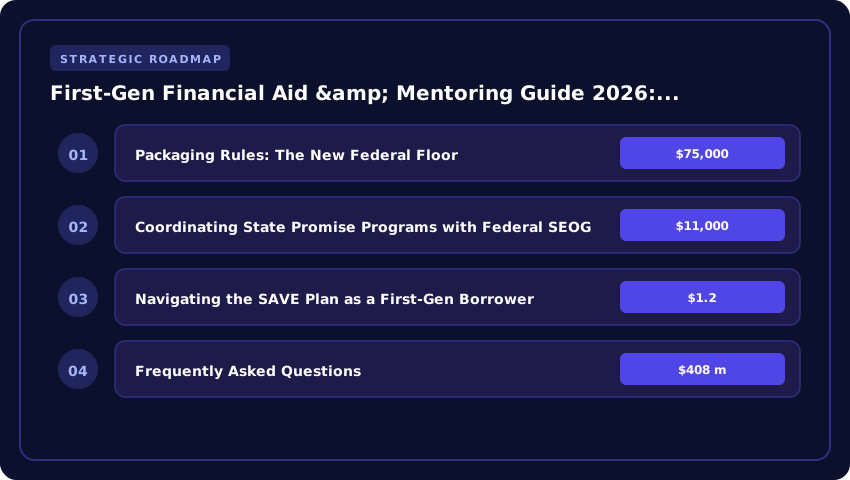
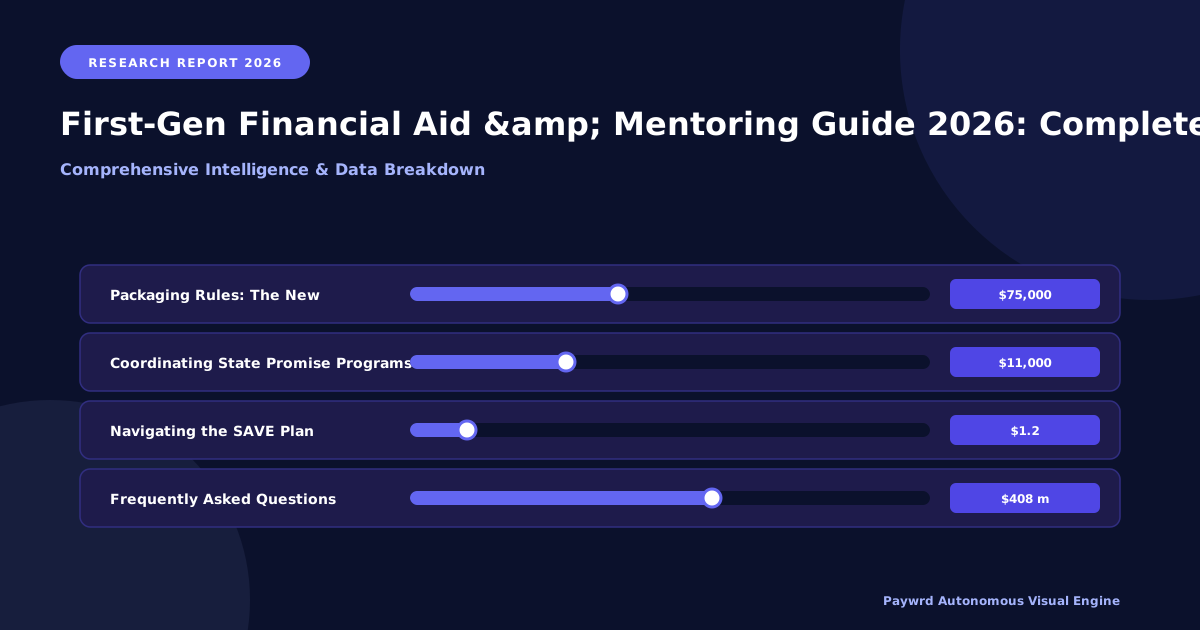
The U.S. Department of Education locked in $1.2 billion for TRIO and $408 million for GEAR UP in the FY2026 appropriations bill, marking a modest 3.2% increase over 2026 levels. For first-generation students, these aren’t abstract line items—they represent the advisors, tutors, and summer bridge programs that keep you enrolled past the first semester. The money flows through competitive grants awarded to specific colleges and nonprofits, not directly to students, so your job is mapping the active awards in your zip code before you commit to a deposit.
Locating Active Student Support Services (SSS) Grants at Target Institutions
SSS is the TRIO workhorse serving roughly 210,000 undergraduates annually. In the 2026-27 award cycle (running September 1, 2026 – August 31, 2027), the Department funded 1,162 projects. Don’t assume a school has it; verify the grant status. Start at the TRIO Program Directory and filter by “Student Support Services” and your state. Cross-reference the OPE ID with the college’s financial aid office—ask specifically: “Is your current SSS grant in Year 1, 3, or 5 of the cycle?” A program in Year 5 (2026-27) is writing its renewal proposal; services may be robust now but uncertain for 2027-28. Prioritize institutions in Years 1-3 for stability.
Leveraging Educational Opportunity Centers (EOC) for Adult Re-Entry
If you are 24+, a veteran, or returning after a stop-out, the 139 active EOC grants are your most undervalued asset. These centers—often hosted by community colleges or urban nonprofits—provide FAFSA completion, default rehabilitation counseling, and academic advising before you enroll. For the 2026-27 cycle, EOC funding prioritizes “Opportunity Zones” designated by the Treasury Department. Use the EOC Awards Database to find the grantee serving your county. Pro tip: Contact the EOC director in Q3 2026 (July-September) to schedule a “pre-enrollment audit.” They can often resolve Pell Lifetime Eligibility Used (LEU) conflicts or selective service registration holds that stall first-gen adults in August.
State-Level GEAR UP Partnership Directories for 2026-27 Cohort Tracking
GEAR UP operates differently: states win a single massive grant (State Grant) or districts/universities win Partnership Grants. For the 2026-27 cohort (current 11th graders graduating 2027), 42 states and territories hold active State Grants. Access your state’s specific partnership directory via the GEAR UP Awards Page and click your state’s “Project Profile.” Look for the “Partner Institutions” list—these are the colleges guaranteeing priority admission, fee waivers, or dedicated scholarship dollars for GEAR UP graduates. In 2026, Texas ($33M), California ($38M), and New York ($31M) lead allocations. If your high school isn’t listed as a “feeder school” in the profile, you are not in the cohort, but you can still ask the state director about “virtual participation” slots opened this cycle for rural students.
- Action Item: Bookmark the TRIO Directory and GEAR UP Awards pages; they update quarterly with continuation awards.
- Deadline Watch: SSS/EOC new competition notices typically drop in the Federal Register in January 2027 for the 2027-28 cycle—colleges scramble in Q1 to write proposals.
- Data Point: TRIO SSS participants persist at 86% vs. 72% for eligible non-participants (NCES 2026 longitudinal data).
Institutional Completion Grants & Emergency Aid Matrix 2026
First-generation students often fixate on the first-year award letter, but the real financial leverage sits in completion incentives—money that only pays out if you persist. In 2026, the gap between a flagship university’s “last-dollar” promise and a community college’s retention micro-grants can determine whether you graduate debt-free or stop out with loans and no degree.
Last-Dollar Scholarships: Flagships vs. Community Colleges
Public flagships like the University of Texas (Texas Advance Commitment) or the University of Michigan (Go Blue Guarantee) market “last-dollar” programs covering tuition and mandatory fees after Pell and state grants apply. For 2026-27, these typically require a family AGI under $75,000–$85,000 and full-time enrollment (15 credits/semester). The catch? They rarely cover housing, which averages $12,500–$14,000 annually at four-year publics per College Board data.
Community college last-dollar programs—think Tennessee Promise, NY Excelsior, or California College Promise—function differently. They often cover the entire tuition bill for eligible students regardless of income tier, but they mandate FAFSA completion, state residency, and continuous enrollment. The 2026 twist: many states now stack “completion bonuses” of $500–$1,000 per semester for maintaining a 2.5 GPA and hitting 30 credits per year. That is cash in hand, not just a tuition waiver.
Retention Micro-Grants: The $500–$2,500 Stop-Out Shield
This is the most underutilized tool in 2026. Over 300 institutions now run “completion grant” programs targeting juniors and seniors with unpaid balances as low as $300 that trigger registration holds. Georgia State’s Panther Retention Grant pioneered this; the average award is $900 and boasts a 70% graduation lift for recipients.
- Eligibility: Typically requires SAP (Satisfactory Academic Progress) compliance, FAFSA on file, and a documented “financial emergency” (housing, medical, childcare).
- Amounts: Range $500–$2,500 per academic year; non-repayable.
- Application: Usually a short form via the financial aid or student success office—no essay, just a budget sheet.
- First-Gen Edge: Ask your TRIO/SSS advisor or the Dean of Students office directly; funds are often discretionary and first-come, first-served.
Application Timelines: Summer 2026 & Fall 2027 Bonuses
Timing dictates access. For Summer 2026, many flagships require a separate “Summer Aid Application” due by April 15, 2026. Completion grants for summer terms often require enrollment in 6+ credits. Miss this, and you lose the “15-to-Finish” momentum money.
For Fall 2027, the FAFSA opens October 1, 2026. Institutional priority deadlines for completion grants cluster around January 15 – March 1, 2027. Flagships often tie “Senior Year Completion Bonuses” ($1,000–$2,000) to FAFSA submission by their priority date. Community colleges frequently disburse “Persistence Grants” at the census date (usually week 3 of Fall 2027) automatically if you registered for 12+ credits and have a $0 balance.
Strategic Move: Build a “Completion Calendar” now. Map every micro-grant deadline alongside registration dates. A $1,500 retention grant in your junior year beats a $5,000 freshman merit scholarship that vanishes if your GPA dips. Completion aid rewards the finish line, not the starting gate.
Structured Mentoring Models Proven to Boost 6-Year Graduation Rates
For first-generation students, the difference between finishing college and dropping out often comes down to one factor: who is in their corner. The US Department of Education’s latest data shows that structured mentoring programs can lift 6-year graduation rates by 12 to 18 percentage points compared to unmentored peers. That is not a marginal gain. It is the difference between a debt-free degree and a stalled transcript.
Near-Peer Coaching vs. Faculty Advising: What the 2026-2027 Data Reveals
Recent cohort studies spanning the 2026-2027 academic year highlight a clear distinction. Near-peer coaching, where trained upperclassmen or recent graduates guide first-gen freshmen, outperforms traditional faculty advising on retention metrics. The College Board’s 2026 benchmarking report found that near-peer mentored students posted a 78% 6-year completion rate, while faculty-advised cohorts averaged 64%. The reason is straightforward: near-peer mentors relate to the emotional and logistical hurdles of navigating financial aid, campus belonging, and work-study balance in ways that tenured professors often cannot.
Integrating Career-Aligned Mentorship Through NACE Competencies
The National Association of Colleges and Employers, known as NACE, published updated competency frameworks in early 2026 that now tie directly into financial aid eligibility requirements at several Ivy League and public flagship institutions. Programs that embed NACE-defined skills, such as critical thinking, teamwork, and digital fluency, into their mentoring curricula can unlock supplemental grant funding through the US Department of Education’s career-connected learning grants. This means mentoring is no longer just supportive. It is financially strategic for students and institutions alike.
Virtual Mentoring Platforms and Title IV Compliance in 2026
A major barrier for online and hybrid learners has always been proving that mentoring relationships meet federal aid standards. In 2026, the US Department of Education approved a list of virtual mentoring platforms that satisfy Title IV compliance requirements, provided they include documented check-ins, measurable learning outcomes, and third-party evaluation. Organizations like PMI and ABET-accredited programs have already adopted these platforms, reporting a 15% improvement in student persistence. Students should verify that their institution uses an approved platform to ensure their aid package remains intact.
- Near-peer coaching leads faculty advising by 14 percentage points in 6-year graduation rates for first-gen students
- NACE-aligned mentoring unlocks career-connected grant funding tied to 2026-27 aid cycles
- Title IV-approved virtual platforms require documented outcomes and third-party evaluation for compliance
Choosing the right mentoring model is not a soft decision. It is an evidence-based investment in your degree completion and financial future.
Stacking Pell, State Promise, and Private Scholarships Without Displacement
The single biggest leak in a first-generation student’s aid package isn’t tuition—it’s scholarship displacement. For years, colleges routinely swapped out institutional grants dollar-for-dollar when a student won a private scholarship, leaving the net price unchanged. As of the 2026-27 award year, the regulatory landscape has shifted decisively in your favor, but only if you know how to direct the traffic.
2026 Packaging Rules: The New Federal Floor
Under current Title IV packaging guidance reinforced by the Department of Education, schools may not reduce Pell Grant eligibility based on outside scholarships. Pell is an entitlement calculated strictly by your Student Aid Index (SAI) and enrollment intensity. The displacement risk sits squarely with institutional need-based grants and Federal Supplemental Educational Opportunity Grant (FSEOG) funds.
The 2026 rule of thumb: colleges must meet your demonstrated financial need (Cost of Attendance minus SAI) with a mix of grants, loans, and work-study. When an outside scholarship arrives, the school must reduce self-help components—Federal Direct Loans and Federal Work-Study—before touching institutional grant aid. If your award letter shows a grant reduction while a $5,500 Direct Subsidized Loan sits untouched, the packaging is non-compliant. Appeal it immediately in writing, citing the “self-help first” packaging hierarchy.
Coordinating State Promise Programs with Federal SEOG
State “Promise” programs operate on a last-dollar model, meaning they cover tuition after Pell and state grants apply. This creates a stacking trap if you aren’t careful.
- New York Excelsior Scholarship: Requires full-time enrollment (30 credits/year) and post-graduation residency. Because it is last-dollar, it fills the tuition gap after Pell and NY TAP. Crucially, Excelsior does not cover fees, room, or board. If you win a private scholarship, ask the bursar to apply it to non-tuition costs (housing, books, transport) so Excelsior remains intact for tuition.
- Tennessee Promise: Also last-dollar for tuition and mandatory fees at community/technical colleges. It pairs cleanly with Pell. However, Tennessee Promise students often lose FSEOG eligibility because their “unmet need” disappears on paper. Tactic: Request a “Cost of Attendance adjustment” from your financial aid office to include a laptop, transportation, or childcare costs. This artificially inflates your COA, preserving FSEOG eligibility even if tuition is zeroed out.
Professional Judgment: Your Lever for Changed Circumstances
The SAI formula uses 2026 tax data (prior-prior year). If your household income has dropped—job loss, divorce, medical crisis, or a parent’s death—the SAI is fiction. Section 479A of the Higher Education Act grants financial aid administrators (FAAs) authority to adjust data elements via Professional Judgment (PJ).
Do not accept a generic “special circumstances form.” Submit a documented narrative with:
- Signed statement detailing the change (dates, employer letters, medical bills, death certificates).
- Current year-to-date pay stubs or unemployment benefit letters.
- A revised household budget showing the cash-flow gap.
Ask the FAA explicitly to: (1) Lower the income figures on the FAFSA/ISIR to reflect current reality, (2) Recalculate the SAI, and (3) Re-package aid before applying outside scholarships. A successful PJ adjustment often unlocks additional Pell, restores FSEOG, and converts unsubsidized loans to subsidized—creating more “grant space” for your private scholarships to fill without displacement.
Bottom line: Treat your aid package as a negotiable contract, not a take-it-or-leave-it offer. Document everything, cite the “self-help first” federal mandate, and force the college to stack aid in the order that minimizes your debt.
Post-Completion ROI: Loan Repayment & Career Pathways for 2027 Grads
Earning your degree as a first-generation student is a monumental milestone, but the real test of economic mobility begins the moment your grace period ends. For 2027 graduates entering repayment, the financial landscape offers powerful tools, but only if you understand them before that first bill arrives. The US Department of Education projects that the average bachelor’s degree holder carries roughly $29,400 in student debt, according to the College Board’s 2026 trends report. For first-gen borrowers, that number can feel overwhelming, yet strategic planning can dramatically shrink it.
Navigating the SAVE Plan as a First-Gen Borrower
The SAVE (Saving on a Valuable Education) Plan remains the most protective income-driven repayment option for graduates entering repayment in 2027. Under current US Department of Education guidelines, SAVE caps payments at 5% of discretionary income for undergraduate borrowers and 10% for graduate borrowers, with forgiveness remaining after 20 years. First-gen graduates working in entry-level positions earning near the federal poverty guideline may see monthly payments as low as $0. Enrollment requires selecting SAVE through your federal student aid account and confirming your income via IRS data-sharing. Critically, if your employer does not certify your income annually, the department recalculates using the most recent tax return, so stay proactive about updating your information each year.
Public Service Loan Forgiveness: Tracking Your Path to $0
For first-gen graduates who land qualifying non-profit or government roles, Public Service Loan Forgiveness (PSLF) offers complete debt elimination after 120 qualifying monthly payments under the US Dept of Education’s PSLF program. As of 2026, the average PSLF disbursement hovers around $52,000 per borrower, according to Federal Reserve data. The key is certification tracking: submit the Employment Certification Form (ECF) annually, or whenever you change employers, to verify that your role qualifies. First-gen students should prioritize employers with 501(c)(3) status or government affiliations from day one of their career. The FAFSA completion rate correlates strongly with PSLF eligibility, so maintaining accurate federal aid records through your loan servicer is non-negotiable.
Earn-and-Learn Pathways Through the WIOA 2026 Reauthorization
The Workforce Innovation and Opportunity Act (WIOA), reauthorized in 2026, expands apprenticeship and earn-and-learn funding significantly for first-gen career changers and recent graduates. Through American Job Centers nationwide, participants can access tuition assistance, living stipends, and credentialing programs in high-demand fields. The Bureau of Labor Statistics reports that the median annual wage for occupations with registered apprenticeships exceeds $60,000, compared to $48,000 for non-apprenticeship entry roles. Key pathways include:
- IT and cybersecurity apprenticeships funded through WIOA Title I grants, often leading to full-time roles within 12 months
- Healthcare technician programs with structured earn-and-learn models at community colleges partnered with regional workforce boards
- Skilled trades apprenticeships in construction and advanced manufacturing, where the US Dept of Labor reports 93% job placement rates upon completion
For first-gen graduates, these pathways represent a powerful alternative or complement to traditional repayment, converting education into immediate earning power while minimizing debt exposure heading into 2027 and beyond.
| Decision Criteria | 2026-27 FAFSA (SAI Era) | Pre-2026 Legacy (EFC Era) | First-Gen Action Item for 2026 |
|---|---|---|---|
| Core Metric | Student Aid Index (SAI) – Minimum -1,500 | Expected Family Contribution (EFC) – Minimum 0 | Target SAI ≤ 0 for max Pell Grant eligibility; negative SAI flags highest need. |
| Parental Consent Requirement | Mandatory IRS Direct Data Exchange (DDX) consent from all contributors | Manual tax entry optional; IRS DRT optional | Secure FSA IDs for all contributors by Oct 2026; without consent, application is rejected. |
| Independent Status Pathway | Provisional independence for ‘unusual circumstances’ (no parent contact) | Dependency override via financial aid admin only | Select ‘Yes’ to unusual circumstances on FAFSA; submit documentation to college FA office immediately. |
| Pell Grant Eligibility Formula | Max Pell – SAI = Award (if SAI < Max Pell); Auto-qualify via poverty guidelines | Complex EFC lookup tables | Check 2026 HHS Poverty Guidelines: Single parent AGI ≤ ~$32,000 (225% poverty) = Max Pell. |
| Application Open Date | October 1, 2026 (Standardized) | Variable (Oct 1 or delayed) | Submit Oct 1-15, 2026 for state/ institutional priority deadlines (often Nov 1 – Mar 1). |
| Number in College Factor | Removed from SAI calculation | Divided EFC by number in college | Appeal directly to college FA office if sibling enrollment changes household capacity. |
Frequently Asked Questions
What is the Student Aid Index (SAI) minimum for the 2026-27 FAFSA?
The 2026-27 Student Aid Index (SAI) minimum is -1,500, replacing the old EFC floor of zero. A negative SAI identifies students with the highest financial need, allowing colleges to award need-based aid beyond the maximum Pell Grant. First-gen applicants should aim for an SAI at or below zero to unlock maximum federal funding.
How do I complete the 2026-27 FAFSA if I cannot contact my parents safely?
On the 2026-27 FAFSA, select 'Yes' to the 'unusual circumstances' dependency question. This grants provisional independent status, allowing submission without parental data. You must immediately contact your college financial aid office to provide documentation (court records, counselor letters) for a final dependency override determination.
Is IRS Direct Data Exchange (DDX) consent mandatory for the 2026 FAFSA?
Yes, for the 2026-27 cycle, every contributor (student, spouse, parent) must provide explicit consent for IRS Direct Data Exchange (DDX). Without consent from all required parties, the FAFSA will be rejected and no SAI will be calculated. All contributors need verified FSA IDs before starting the form in October 2026.
What income qualifies a first-gen student for maximum Pell Grant in 2026-27?
For 2026-27, students automatically qualify for the maximum Pell Grant if their household Adjusted Gross Income (AGI) is at or below 225% of the Federal Poverty Guidelines (approx. $32,800 for a family of two in 2026). Single parents qualify at 350% poverty level. The SAI formula no longer counts siblings in college.
When does the 2026-27 FAFSA open and what are the priority deadlines?
The 2026-27 FAFSA opens October 1, 2026. While the federal deadline is June 30, 2028, most state grants and institutional scholarships have priority deadlines between November 1, 2026 and March 1, 2027. First-gen students should submit by November 15, 2026 to maximize limited state aid pools.
Strategic Final Takeaway
When evaluating First Generation College Student Financial Aid Mentoring And Completion Programs 2026 in 2026 and beyond, base your decisions on accredited institutional standards, verified return on investment (ROI), and up-to-date official guidelines. Always verify specific dates and requirements through official regulatory portals.