The 2026 Roadmap: From Amateur to FIDE Grandmaster Status
Transitioning from a casual player to a FIDE Grandmaster in Nigeria requires more than just tactical brilliance; it demands a systematic approach to the Elo rating system. The journey is a ladder of titles, each acting as a milestone of professional competence. You start as an unrated player, moving toward the Candidate Master (CM) title, then progressing to FIDE Master (FM), International Master (IM), and finally, the pinnacle: Grandmaster (GM).

To reach the GM title, you must achieve a peak Elo rating of at least 2500 and secure three “GM Norms.” A norm is essentially a high-performance certificate earned in a FIDE-rated tournament where you face multiple titled players from different federations and achieve a performance rating of 2600+.
The Role of the Nigeria Chess Federation (NCF)
You cannot climb this ladder in isolation. The Nigeria Chess Federation (NCF) is the sole governing body recognized by FIDE in Nigeria. To begin your professional journey in 2026, you must be officially registered with the NCF to obtain your FIDE ID. Without this ID, your results in national tournaments will not be uploaded to the global database, meaning your rating remains stagnant regardless of how many games you win.
- Registration: Ensure your profile is updated on the NCF portal to be eligible for national selection.
- Sanctioned Events: Only play in NCF-sanctioned tournaments to ensure your Elo gains are recognized globally.
- Sponsorship: The NCF often facilitates pathways for elite youth players to attend international opens, which are critical for earning norms.
Setting 2026-2027 Milestones for Elo Growth
Rating growth is rarely linear. To avoid burnout, you must set realistic, data-driven milestones for the 2026-2027 cycle. For an ambitious amateur, the goal should be consistent incremental gains rather than overnight jumps.
- Q3-Q4 2026: Focus on breaking the 1200-1500 Elo barrier by competing in local Nigerian Opens and utilizing AI-driven analysis tools.
- H1 2027: Target the 1800-2026 range. This stage requires transitioning from “playing for fun” to “studying for results,” focusing heavily on endgame theory and opening repertoires.
- H2 2027: Seek out “Closed” tournaments or international invitations to face titled players (CMs and FMs), which accelerates rating growth and prepares you for the IM/GM grind.
Elite Training Hubs: Certified Chess Academies in Lagos and Abuja
To ascend the Elo ladder in 2026, you cannot rely on casual club play. The leap from a National Master to a FIDE Grandmaster requires structured, high-performance environments. In Nigeria, the epicenter of elite training remains Lagos and Abuja, where the concentration of FIDE-certified trainers and high-rated players creates a competitive ecosystem essential for growth.
Vetting Your Coach: The FIDE Gold Standard
Not every strong player is a qualified coach. To avoid wasting years on suboptimal training, you must verify your mentor’s credentials. Ensure your coach is officially registered as a FIDE Trainer (FT) or FIDE Instructor (FI). You can verify this by cross-referencing their name on the official FIDE ratings and trainers portal. In the Nigerian context, prioritize coaches who have a proven track record of guiding students through the Nigeria Chess Federation (NCF) sanctioned tournaments and who understand the specific logistics of securing norms within the African circuit.
Bootcamps vs. Long-Term Mentorship
Depending on your current rating and financial capacity, you will face a choice between two primary training modalities:
- Intensive Bootcamps: These are high-pressure, short-term programs (typically 2 to 4 weeks) often hosted in Lagos during the off-season. They are ideal for rapid tactical sharpening and preparing for specific international opens.
- Long-Term Mentorship: This is the gold standard for GM aspirants. A dedicated mentor provides a multi-year curriculum, analyzing your specific weaknesses in endgame theory and positional play. This approach is more sustainable and prevents the burnout common in “cramming” sessions.
The 2026 Hybrid Approach: AI and Human Synergy
Modern Grandmaster preparation in Nigeria has evolved. The most successful students now employ a hybrid model. While human coaches provide psychological grounding and strategic intuition, AI-driven tools like Stockfish 17 and Leela Chess Zero are used for deep engine analysis. Elite academies in Abuja now integrate these tools into their curriculum, teaching students how to “interrogate” the engine rather than blindly following its top move. This synergy allows Nigerian players to bridge the gap with European and Asian counterparts without needing to relocate permanently.
For those seeking funding for international norms, remember that NELFUND and specific STEM-based scholarships are increasingly recognizing high-level competitive chess as a cognitive achievement, provided you are enrolled in a recognized Nigerian tertiary institution.
Strategic Rating Gains: Navigating International Tournaments
To secure the Grandmaster (GM) title, a Nigerian player cannot rely solely on domestic competition. While the Nigeria Chess Federation (NCF) organizes vital national championships, the mathematical requirements for GM norms—specific high-performance benchmarks in FIDE-rated events—demand exposure to a diverse, global pool of opponents. In 2026, the strategic focus must shift toward international opens where the density of titled players is highest.
Targeting High-Yield Tournaments
For Nigerian aspirants, the most efficient route involves a hybrid calendar of West African and European opens. Regional tournaments in Ghana and Senegal provide accessible FIDE-rated opportunities to build a baseline Elo. However, to achieve the 2500 Elo threshold and the necessary norms, European circuits—specifically the open tournaments in Spain, Germany, and Serbia—are indispensable. These events offer a higher concentration of Grandmasters, which is a prerequisite for earning a norm.
The Mathematics of Elo Gains
Rating growth is a game of probability and risk management. To accelerate your climb toward 2500, you must strategically seek out “upward” pairings. The Elo system rewards players more heavily for defeating higher-rated opponents than for beating lower-rated ones. In 2026, the most effective strategy is to enter “Closed” round-robin tournaments or “Open” sections where you are among the lowest-seeded players. While this increases the risk of losses, the potential for massive rating jumps is significantly higher when you consistently challenge players rated 100 to 200 points above you.
Funding the Global Pursuit
The primary barrier for Nigerian players is the cost of international travel, visa fees, and tournament entry. Securing sponsorship requires treating your chess career as a professional STEM venture. In 2026, aspirants should focus on the following funding streams:
- Corporate Sponsorship: Pitching to Nigerian FinTech firms and Telecommunications giants by highlighting the cognitive prestige and intellectual branding associated with the GM title.
- NELFUND and Educational Grants: Leveraging the Nigerian Education Loan Fund (NELFUND) or university sports grants if you are currently enrolled in a tertiary institution, framing chess as an academic and mental discipline.
- NCF Support: Applying for official federation subsidies reserved for top-tier national representatives.
- Crowdfunding: Utilizing digital platforms to engage the Nigerian diaspora and chess enthusiasts to cover specific tournament entry fees.
Financial Planning for the Aspiring GM in 2026
Pursuing the Grandmaster (GM) title in Nigeria is a high-stakes investment. In 2026, the financial barrier is often the steepest hurdle for talented players. To move from a National Master to a GM, you must transition from local club play to international FIDE-rated opens, which necessitates a robust budget for travel, registration, and professional mentorship.
Estimated Annual Expenditure (2026 Projections)
Depending on your current Elo rating and the number of international norms you are chasing, your annual budget will vary. For a serious aspirant in 2026, expect the following estimated costs:
- High-Performance Coaching: ₦800,000 to ₦2,500,000 per annum. This covers personalized training with an International Master (IM) or GM, focusing on opening theory and endgame precision.
- Tournament Travel & Logistics: ₦1,200,000 to ₦4,000,000. This includes flights to rated tournaments in Europe, Asia, or other African hubs, hotel accommodation, and FIDE registration fees.
- Software & Hardware: ₦250,000. Subscriptions to premium engines (like Stockfish 17+ integrations) and database management tools like ChessBase 2026.
Funding Your Journey: NELFUND and STEM Grants
Because chess is recognized globally as a cognitive sport rooted in mathematics, logic, and strategic analysis, it aligns with STEM (Science, Technology, Engineering, and Mathematics) frameworks. In 2026, ambitious players should look beyond personal savings:
- NELFUND Integration: While the Nigerian Education Loan Fund (NELFUND) primarily targets tuition, students pursuing degrees in Computer Science or Mathematics can leverage these loans to stabilize their academic finances, freeing up personal funds for chess pursuits.
- Private STEM Grants: Many Nigerian tech hubs and philanthropic foundations now offer “Cognitive Excellence” grants. Positioning your chess journey as a study in algorithmic thinking and pattern recognition can make you eligible for private sponsorships.
Monetizing the Climb: Revenue Streams
You do not need to be a GM to start earning. The 2026 digital economy allows aspiring masters to subsidize their training through “skill-scaling”:
- Digital Coaching: Offering remote coaching to beginners and intermediate players via Zoom or Google Meet. A rated player can comfortably charge between ₦5,000 and ₦15,000 per hour.
- Content Creation & Streaming: Leveraging platforms like Twitch and YouTube to stream rated blitz games. With the rise of Nigerian esports, sponsorships from local fintech brands are becoming more common for high-Elo influencers.
- Corporate Training: Selling “Strategic Thinking” workshops to corporate firms in Lagos and Abuja, using chess as a tool for executive decision-making.
The Mental Game: Psychological Conditioning for Elite Play
Technical mastery of the Sicilian Defense or the Ruy Lopez is useless if your mind collapses under the pressure of a ticking clock. For the aspiring Nigerian Grandmaster in 2026, the psychological barrier is often steeper than the Elo climb. Tournament anxiety—specifically the fear of losing rating points in high-stakes NCF-sanctioned events—can lead to “analysis paralysis,” where a player overlooks simple tactical blunders due to sheer stress.
To combat this, elite players are adopting cognitive behavioral techniques to maintain a “flow state.” This involves decoupling your self-worth from your current Elo rating and focusing instead on the objective quality of the moves. In the high-pressure environment of Nigerian Open championships, the ability to reset emotionally after a devastating blunder in Game 1 to ensure a win in Game 2 is what separates a Candidate Master from a Grandmaster.
Developing a 2027 Preparation Regime for World Chess Olympiads
Looking toward the 2027 World Chess Olympiads, your conditioning must shift from general improvement to peak performance periodization. A professional regime for the coming year should include:
- Simulated Pressure Tests: Playing blitz and rapid games with strict time controls against higher-rated opponents to mimic Olympiad tension.
- Physical Conditioning: Implementing a cardiovascular routine; brain oxygenation is critical during 5-hour classical games to prevent late-game fatigue.
- Psychological Anchoring: Developing pre-game rituals to signal the brain that it is time to enter a state of deep concentration.
Balancing Academic Pursuits with Professional Training
In the Nigerian context, the tension between academic excellence and chess professionalism is a significant stressor. Whether you are navigating a rigorous STEM degree or preparing for professional certifications, the “all-or-nothing” approach leads to burnout. The key is integrated scheduling.
Top-tier players utilize “deep work” blocks—allocating 4 hours of uninterrupted study to chess theory in the early morning, followed by academic commitments. Furthermore, leveraging NELFUND student loans or academic scholarships can alleviate the financial pressure of traveling for FIDE-rated tournaments, allowing you to focus on the board without the anxiety of tuition arrears. Remember, the discipline required to master the NUC’s Core Curriculum and Minimum Academic Standards (CCMAS) in your degree is the same discipline required to memorize complex opening variations; they are complementary skills, not competing interests.
| Milestone Title | Minimum FIDE Rating | Key Norm Requirements (2026 Standards) | Estimated Annual Cost (NGN) | Typical Timeline from Previous Level |
|---|---|---|---|---|
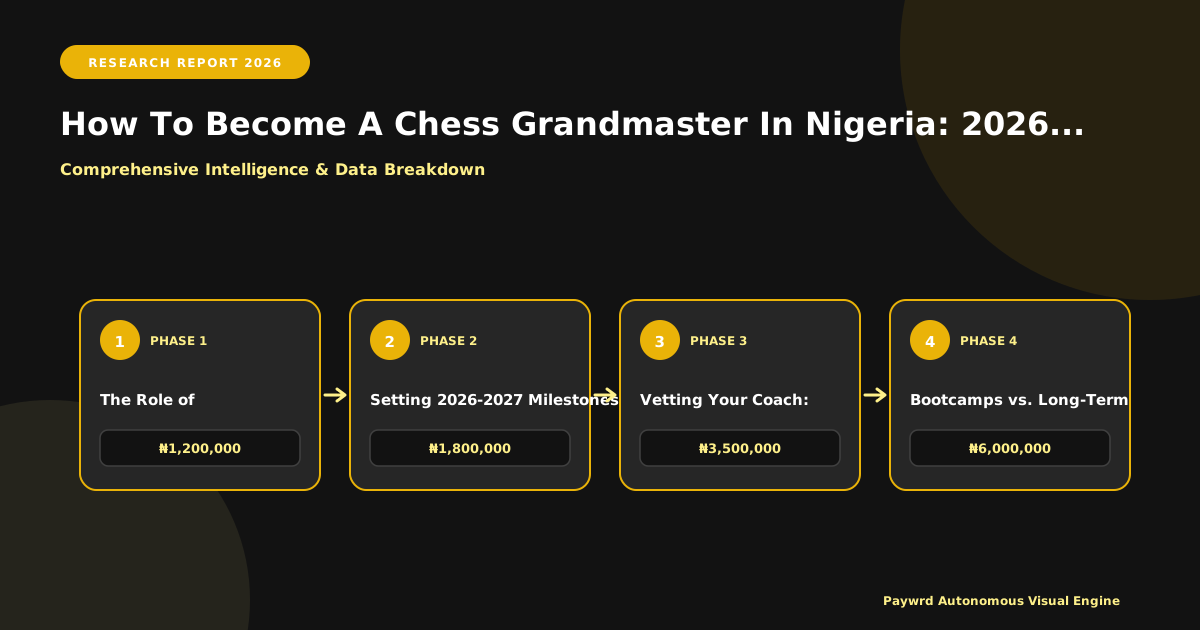
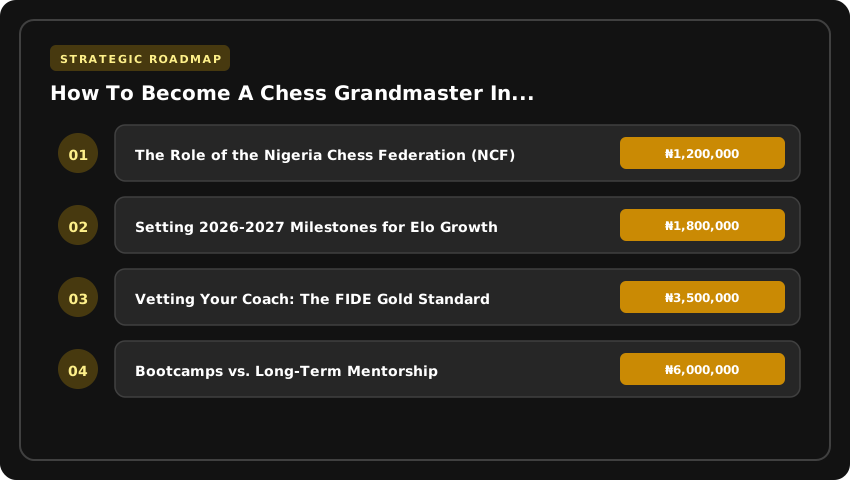
| Candidate Master (CM) | 2200 Elo | No norms required; rating achievement only | ₦1,200,000 – ₦2,500,000 | 2-4 Years from Unrated |
| FIDE Master (FM) | 2300 Elo | No norms required; rating achievement only | ₦1,800,000 – ₦3,500,000 | 1-3 Years from CM |
| International Master (IM) | 2400 Elo | 3 IM Norms (27-game min) across 3+ federations | ₦3,500,000 – ₦7,000,000 | 3-6 Years from FM |
| Grandmaster (GM) | 2500 Elo | 3 GM Norms (27-game min) across 3+ federations | ₦6,000,000 – ₦12,000,000+ | 4-8 Years from IM |
Frequently Asked Questions
What is the exact FIDE rating required to become a Grandmaster in Nigeria for 2026?
As of 2026, FIDE regulations require a peak live rating of 2500 Elo to qualify for the Grandmaster title. This rating floor is universal; the Nigeria Chess Federation (NCF) cannot lower it. You must also achieve three GM norms in tournaments with at least three different federations represented.
How much does it cost annually to pursue a Grandmaster title in Nigeria in 2026?
In 2026, serious GM aspirants in Nigeria budget ₦6,000,000 to ₦12,000,000 annually. This covers international travel for norm tournaments (visa, flights, accommodation), high-level coaching fees (₦150k-₦300k/month), FIDE registration, and NCF licensing. Costs spike significantly during norm-hunting years requiring European circuit play.
Which tournaments in 2026 count towards GM norms for Nigerian players?
For 2026, valid GM norm tournaments must be FIDE-rated with a minimum 9-round Swiss or Round Robin format, featuring at least 3 GMs from 3 different federations. Key accessible events for Nigerians include the Lagos International Open, Accra Open (Ghana), and European festivals like Riga Technical University Open or Abu Dhabi Masters.
What is the role of the Nigeria Chess Federation (NCF) in the 2026 GM application process?
In 2026, the NCF acts as the mandatory national validator. They must endorse your norm certificates, verify tournament eligibility, and submit the final title application to FIDE with the ₦50,000 processing fee. Without active NCF registration and clearance, FIDE will reject the GM title application regardless of norms achieved.
Can a Nigerian player become a Grandmaster playing only local tournaments in 2026?
No. 2026 FIDE regulations mandate that GM norms require opponents from at least three different federations (excluding your own). Since Nigerian domestic events rarely host the required density of foreign GMs, you must travel internationally—typically to Europe, Asia, or strong African opens—to secure the necessary cross-federation pairings.
Strategic Final Takeaway
When evaluating How To Become A Chess Grandmaster In Nigeria Training And Certification in 2026 and beyond, base your decisions on accredited institutional standards, verified return on investment (ROI), and up-to-date official guidelines. Always verify specific dates and requirements through official regulatory portals.