2026 Challenge Timeline: Key Dates from Registration to Grand Finale
This is the definitive timeline every Lagos State secondary school teacher, STEM coordinator, and aspiring student needs to internalize. The 2026 edition runs on a tight eight-month cycle, and the organizers enforce every deadline ruthlessly through the official NELFUND-aligned portal system. There are no extensions, no grace periods, and no exceptions.

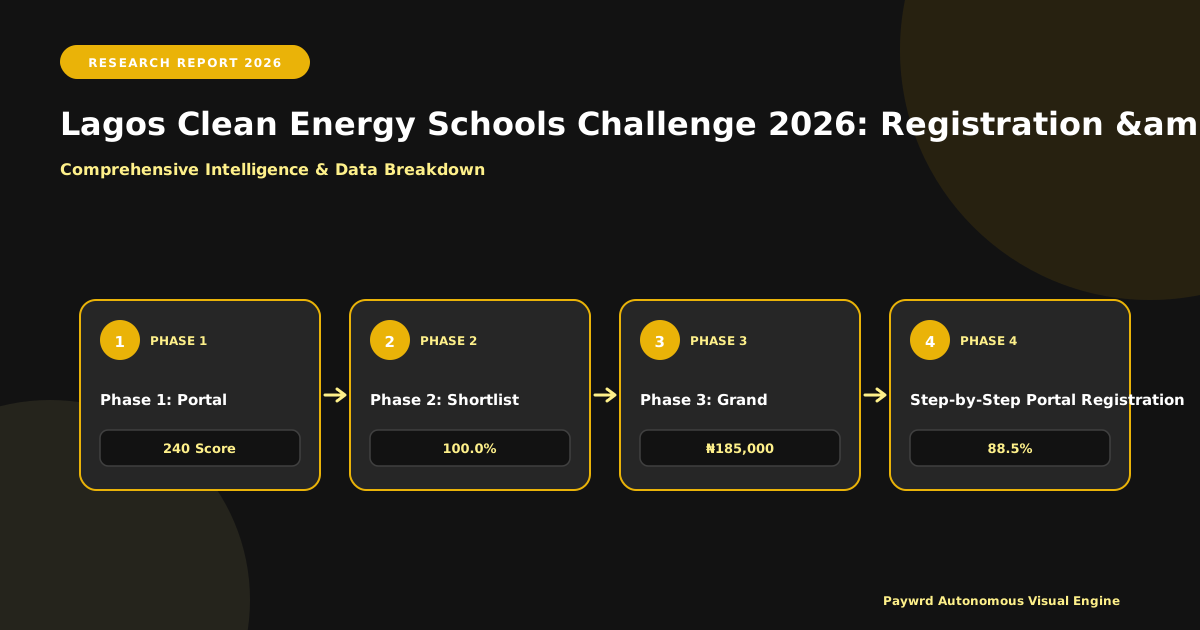
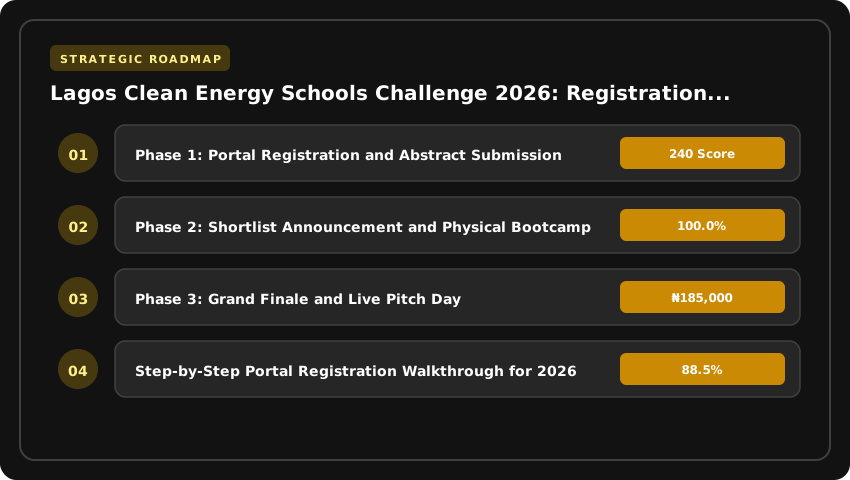
Phase 1: Portal Registration and Abstract Submission
The registration portal swings open on Saturday, February 2, 2026, at exactly 9:00 AM WAT. Access it exclusively through the official Lagos Clean Energy Schools Challenge dashboard (hosted on the NELFUND portal ecosystem). Teams of four students, supervised by a named teacher-mentor, must upload a 500-word project abstract focused on clean energy solutions relevant to Lagos communities.
- Portal Opens: February 2, 2026, 9:00 AM WAT
- Abstract Submission Deadline: March 31, 2026, 11:59 PM WAT (hard cutoff)
- Required Documents: Signed parental consent forms, school ID confirmation, and a brief project proposal PDF
Submit early. The portal experiences heavy traffic in the final 72 hours, and system timeouts are not accepted as excuses by the review committee.
Phase 2: Shortlist Announcement and Physical Bootcamp
Successful teams receive notification via registered email and SMS by April 14, 2026. The bootcamp runs for three consecutive Saturdays across two Lagos State STEM resource centres.
- Bootcamp Dates: April 25, May 2, and May 9, 2026
- Venue: Lagos State Model College, Igbonla, and Herbert Macaulay Way, Yaba
- Schedule: 8:00 AM to 3:00 PM daily, covering mentorship sessions, prototype-building workshops, and pitch rehearsals
- Materials: Basic kits are provided, but teams are encouraged to bring recycled materials for their energy prototypes
Attendance at all three bootcamp days is mandatory. One missed session triggers automatic removal from the competition track.
Phase 3: Grand Finale and Live Pitch Day
The grand finale takes place on Saturday, July 18, 2026, at the Eko Convention Centre, Victoria Island, Lagos. Doors open at 8:00 AM, with live pitches beginning at 9:30 AM WAT.
- Live Streaming: Watch via the official challenge YouTube channel and NELFUND Facebook page for parents unable to attend physically
- Judging Panel: Industry engineers, NUC representatives, and clean energy entrepreneurs from Lagos-based firms
- Awards: Cash prizes up to ₦5,000,000 for winning teams, plus full STEM scholarship placements
Mark every date now. Set calendar reminders. This challenge rewards discipline as much as brilliance.
Eligibility Criteria: Who Can Enter for Lagos Public & Private Schools
The Lagos Clean Energy Schools Challenge 2026 is strictly designed for secondary institutions operating under the regulatory oversight of the Lagos State Ministry of Education. Whether you run a government-funded college in Badagry or a private academy in Lekki, the gatekeeping rules are identical: no shortcuts, no exceptions. Understanding these parameters now saves your team the heartbreak of building a prototype that never gets judged.
Age Brackets and Class Levels Permitted (JSS 1 – SSS 3)
The competition targets the full secondary spectrum: Junior Secondary School (JSS 1 through JSS 3) and Senior Secondary School (SSS 1 through SSS 3). In practical terms, this covers students typically aged 10 to 18 years old as of the registration opening date on February 2, 2026. Students in Primary 6 awaiting Common Entrance results, or those already admitted into tertiary institutions (universities, polytechnics, or colleges of education) for the 2026/2027 session, are ineligible. The challenge focuses on pre-tertiary innovation; if a student wears a university matriculation gown before the Grand Finale on July 18, 2026, the team is disqualified. Mixed-class teams are encouraged—a JSS 2 student handling documentation while an SSS 2 student codes the microcontroller creates the exact cross-pollination the judges reward.
Team Composition Rules: Student Roles and Mandatory Teacher-Mentor
Every entry must be a team of three to five students from the same school. Solo entries will be rejected at the portal gate. Within that unit, roles must be explicitly declared during registration:
- Team Lead: Project manager, timeline owner, and primary liaison with the mentor.
- Technical Lead: Hardware/software architecture, prototype build, and system integration.
- Research & Documentation Lead: Literature review, logbook maintenance, and the final project report (PDF upload).
- Presentation & Design Lead (Optional but recommended): Pitch deck design, video editing, and live demo choreography.
Critically, one teacher-mentor per team is mandatory. This must be a full-time staff member of the entering school—NYSC corps members posted to the school qualify, but external consultants, parents, or alumni do not. The mentor’s Teacher Registration Council of Nigeria (TRCN) number and official school email address are verified against the Ministry’s HR database. One mentor may supervise multiple teams, but each team must list a distinct mentor to ensure accountability during the bootcamp phases.
Accreditation Proof Required for Private Schools Under Lagos Ministry of Education
Public schools (Junior and Senior Secondary) are auto-verified via the Lagos State Universal Basic Education Board (LASUBEB) and the Ministry’s Senior Secondary database. Private schools face a stricter documentary hurdle. You must upload a clear, coloured scan of your current Lagos State Ministry of Education Approval Certificate valid for the 2026/2027 academic session. Expired certificates (2026/2027 or older) trigger automatic rejection. The certificate must display the school’s approved name exactly as it appears on the Corporate Affairs Commission (CAC) registration, the Ministry’s approval number, and the Director-General’s signature. Schools operating under “Provisional Approval” are eligible provided the provisional letter is dated within the last 12 months. Do not upload Parent-Teacher Association (PTA) receipts, tax clearance certificates, or WAEC/NECO centre numbers—they are not substitutes for Ministry accreditation.
Step-by-Step Portal Registration Walkthrough for 2026
The Lagos State Government (LASG) STEM portal at stem.lagosstate.gov.ng went live at 12:01 AM on February 2, 2026. It runs on a refreshed React-based interface that loads faster on 4G than the 2026 version, but the logic remains strict: one school account, multiple team profiles, zero tolerance for duplicate NIN entries. Bookmark the URL now; search-engine redirects often land you on the 2026 archive.
1. Create the School Master Profile
Only the designated STEM Coordinator or Principal should execute this step. Click “Register New School” and select “Public” or “Private”—the dropdown determines which LASG education district validator reviews your submission. Enter the school’s CAC registration number (for private schools) or the LASG School Code (for public schools). The system cross-references this against the Ministry of Education’s 2026/2027 master list in real time. A mismatch triggers an instant red banner; you cannot proceed until the district desk officer manually clears it via the backend.
Upload the Principal’s signed authorization letter on school letterhead (PDF, max 2 MB). The portal now auto-extracts the letterhead logo and compares it to the stored template—blurry scans get rejected. Once submitted, you receive a six-digit School Access Code (SAC) via SMS and email. Save it; you need it for every team registration.
2. Build Team Profiles & Handle NIN/BVN Verification
Log in with the SAC. Click “Add Team”. Each team requires a unique Team Lead (must be a student in SS1–SS3). Here is where 2026 friction lives: the portal now enforces NIN-BVN linkage for the Team Lead to prevent proxy registrations.
- Error: “NIN not found on NIMC backbone.” The student’s NIN has not been synced to the NIMC verification API. Fix: Visit any NIMC enrolment centre or approved bank branch (GTBank, Access, Zenith) for a “NIN Verification Update”—costs ₦500. Wait 24 hours, then retry.
- Error: “BVN Name Mismatch.” The BVN registered name differs from the NIN (e.g., “Abdulrahman” vs “Abdul Rahman”). Fix: The student must visit their bank to align BVN records to match the NIN exactly. No portal workaround exists.
- Error: “Duplicate NIN Detected.” The same student was entered in another team or school. Fix: The previous entry must be deleted by that school’s coordinator before you can proceed.
Team members 2–4 only need valid NINs; BVN is optional for them. Upload each student’s recent passport (JPEG/PNG, 500 KB max, white background). The portal runs a liveness check—selfies with filters or glasses get flagged.
3. Upload Project Abstracts: Format, Size & Plagiarism Gate
Navigate to the “Project Submission” tab. The 2026 template is a locked DOCX file (download link on the page). Do not convert to PDF; the plagiarism engine (Turnitin API integrated) only parses DOCX metadata. Fill every section: Problem Statement, Clean Energy Solution, Prototype Plan, Budget (capped at ₦500,000), and SDG Alignment.
- File name convention:
SAC_TeamName_Abstract.docx(e.g.,LGS042_SolarSquad_Abstract.docx). Wrong naming = auto-reject. - Size limit: 5 MB hard cap. Compress images inside the doc using “Compress Pictures” in Word (96 ppi).
- Plagiarism threshold: Similarity index > 18% triggers manual review; > 30% = instant disqualification. Run a free check on
plagiarismchecker.cobefore upload—cite every data source, including LASG policy PDFs.
Hit “Submit for Review”. You get a timestamped receipt PDF. Download it. If the status stays “Pending District Review” beyond 72 hours, email stemchallenge@lasg.gov.ng with the SAC and receipt number—phone lines jam during peak weeks.
Approved 2026 STEM Project Themes: Solar, Wind & Circular Economy
Priority Problem Statements from the Lagos State Ministry of Energy
The Ministry has released three core problem statements that every participating school must address through their project. First, off-grid solar electrification of public school classrooms — teams must propose how solar energy can power learning spaces in areas with unstable grid supply. Second, wind energy micro-generation for coastal communities — Lagos’ shoreline geography makes this a pressing design challenge. Third, waste-to-value circular economy models — converting plastic and organic school waste into usable energy or construction materials. Projects that do not clearly align with at least one of these statements will be flagged during the eligibility screening on the official CAPS portal.
Prototype Requirements: Budget, Materials & Safety
Every team must build a working physical prototype. The strict budget cap is set at ₦25,000 per project, covering all components, labour, and documentation. The local materials mandate requires that at least 70% of all raw materials must be sourced from within Lagos State — suppliers from local markets like Alaba International Market or Ladipo Market qualify under the verification process. Safety standards are non-negotiable; prototypes must pass a risk assessment checklist covering electrical insulation, structural stability, and fire-resistant wiring. Teams using lithium batteries must include a protective casing certified by the Lagos State Safety Commission. Submit your material sourcing declaration alongside your project file through the NELFUND portal before the registration deadline closes.
Judging Rubric Breakdown: How to Score Maximum Points
Understanding the rubric is the single most strategic move you can make. Here is how the 400 total points distribute across the four categories:
- Innovation (30% — 120 points): Judges reward novel approaches. Avoid copying last year’s winning designs. Introduce a unique mechanism, smart sensor integration, or an unconventional material pairing that solves the problem statement in a genuinely fresh way.
- Feasibility (25% — 100 points): Your prototype must actually work under demonstration conditions. A beautifully designed model that fails during live testing scores zero in this category. Test repeatedly under realistic conditions before the finale at Eko Convention Centre.
- Impact (25% — 100 points): Judges evaluate how many students or households your project could realistically benefit. Quantify your projected impact with hard data — for instance, “this solar unit powers three classrooms serving 120 students daily.” Specificity wins here.
- Presentation (20% — 80 points): Clear documentation, professional diagrams, a confident pitch, and a well-organised project logbook all contribute here. Do not underestimate this category — it frequently separates finalists from outright winners.
Align every design decision with these weighted categories from the moment you sketch your first concept, and your team will be positioned strongly for the July 18 grand finale.
Funding & Prototyping Grants: Accessing ₦500k Seed Capital per Team
Securing a spot in the 2026 finals triggers the release of the ₦500,000 prototyping grant per team, disbursed directly by the Lagos State Ministry of Science and Technology through the Lagos State Science Grant framework. This is not a blank cheque; it is a milestone-based tranche system designed to mirror real-world R&D funding cycles. The first tranche of ₦200,000 hits the school’s designated project account within five business days of the finalist announcement in late May 2026. The second tranche of ₦200,000 releases only after the mid-term audit in June, and the final ₦100,000 drops after the pre-finale technical inspection at Eko Convention Centre. Principals and STEM coordinators must ensure the school bursar has an active corporate account tied to the school’s TIN—personal accounts are an automatic rejection trigger.
Application Process: From Nomination to Disbursement
The application for the grant is embedded inside the finalist onboarding portal (lcesc.lagosstate.gov.ng/grants). Once your team is shortlisted, the lead teacher receives a unique Grant Access Code via the registered email and SMS. You have 72 hours to upload the following: a signed Letter of Commitment on school letterhead, the detailed Bill of Quantities (BoQ) matching the prototype design submitted during semi-finals, and the Bank Verification Number (BVN) of the two signatories (Principal and Bursar). The Lagos State Science Grant Committee runs a 48-hour compliance check. Any discrepancy between the BoQ and the semi-final pitch deck—like swapping a 200W monocrystalline panel for a cheaper polycrystalline unit without approval—flags the account for manual review, delaying the first tranche by up to two weeks. Pro tip: use the Ministry’s standardized BoQ template (downloadable from the portal) to avoid formatting rejections.
Accountability Reporting: Receipts, Milestone Photos, and Mid-Term Audit
Compliance is where most teams lose funding in 2026. The grant agreement mandates a digital paper trail uploaded to the Grant Monitoring Dashboard every Friday by 4:00 PM WAT. Requirements are non-negotiable:
- Itemized Receipts: Every kobo spent must have a VAT-compliant receipt from the vendor. Market receipts from Alaba or Katangua without TIN numbers are rejected. Scan at 300 DPI; blurry uploads bounce.
- Milestone Photos: Geotagged, timestamped photos showing the prototype at three stages: bare chassis, electronics integration, and final enclosure. The dashboard EXIF reader verifies location (must be school premises) and date.
- Mid-Term Audit (June 10–14, 2026): A two-person team from the Ministry’s Inspectorate Division visits unannounced. They physically verify components against the BoQ. Missing parts or “ghost purchases” trigger immediate fund freeze and potential disqualification. Keep a physical “Grant File” with original receipts ready for spot checks.
Partnership Leverage: Connecting with NASENI and Private Solar Firms
The ₦500k cap is tight for a functional clean energy prototype—especially if you are building a solar-powered water purification unit or a mini-grid simulator. Smart 2026 teams treat the grant as seed equity to unlock in-kind partnerships. The National Agency for Science and Engineering Infrastructure (NASENI) maintains a STEM Collaboration Desk at their Idu Industrial HQ, Abuja, but their Lagos liaison office at the Science Equipment Centre, Yaba, handles prototype part requests. Submit a formal “Technical Partnership Request” on school letterhead citing your LCESC 2026 Finalist ID. NASENI typically provides access to CNC milling, PCB fabrication, or certified lithium-ion cells at zero cost, provided you credit them on the final pitch deck.
Simultaneously, approach private solar EPC firms—think Arnergy, Rensource, or local integrators like SolarKobo—for “CSR Component Sponsorship.” Pitch them a branded visibility package: logo on the prototype chassis, a mention in the finale livestream (projected 50k+ views), and a post-event impact report. Many firms allocate ₦100k–₦300k worth of panels, inverters, or BMS units annually for exactly this pipeline. Document every in-kind donation in your Grant Dashboard under “Leveraged Assets”—it boosts your “Resourcefulness Score” during the finale judging.
Prizes & Post-Competition Pathways: Internships & University Scholarships
Winning the Lagos Clean Energy Schools Challenge 2026 is about far more than a trophy. The prize structure is deliberately engineered to translate student innovation into real academic and professional momentum. Here is exactly what stands between your school and life-changing rewards this year.
Cash Prizes: 1st to 3rd Place & How the Money Moves
The 2026 prize pool totals ₦9,500,000 across the top three finalists. First-place teams receive ₦5,000,000, second place takes ₦3,000,000, and third place earns ₦1,500,000. Every winning school receives its funds via direct bank transfer into the school’s verified institutional account within thirty days of the grand finale on July 18, 2026. There is no cheque-by-post delay. The disbursement is audited through the Lagos State Ministry of Education’s compliance unit, so schools should ensure their CCMAS-registered account details are submitted correctly during the registration phase on the official portal.
Direct Entry into LASUSTECH & UNILAG STEM Summer Camps
Beyond cash, top-performing teams unlock exclusive academic pathways. First- and second-place schools receive guaranteed direct-entry slots into the LASUSTECH STEM Summer Bootcamp and the University of Lagos (UNILAG) Faculty of Engineering Summer Outreach Programme. These camps run in August 2026 and give participating students early exposure to university-level laboratories, mentorship from tenured academics, and hands-on renewable energy research. Importantly, strong showings at these camps have historically influenced admissions considerations, giving students a measurable edge when writing the 2027 JAMB UTME or applying through direct entry channels.
Corporate Internship Pipelines: Ikeja Electric, Rite Foods & Arnergy
This is where the ROI becomes tangible. The 2026 edition formalises three corporate internship pipelines:
- Ikeja Electric offers shortlisted finalists a four-week summer internship shadowing engineers in grid modernization and smart metering divisions. Students gain practical exposure to Nigeria’s power sector realities.
- Rite Foods opens positions within its sustainability and packaging innovation units, connecting STEM talent to fast-moving consumer goods operations.
- Arnergy runs a solar technology immersion programme at its Lagos headquarters, where students work alongside technicians deploying off-grid solutions.
These placements are not casual work experience stints. Each partner company provides a stipend, a formal reference letter, and a potential conditional job offer upon completion of the student’s university degree. For a Lagos State secondary school student entering the 2027 academic cycle, having Arnergy or Ikeja Electric on your CV before even sitting for JAMB is a serious competitive advantage.
Participation in the 2026 Challenge is an investment that pays dividends across cash, university admissions, and career launch. Bookmark the registration portal opening on February 2, 2026, and move early.
Compliance Checklist: Child Protection, Data Privacy & Intellectual Property
Before your team uploads a single line of code or a prototype schematic to the 2026 challenge portal, you must square away the legal paperwork. The Lagos State Ministry of Education and the Office of the Special Adviser on Education (OSAE) treat compliance as a gatekeeper criterion—missing forms mean automatic disqualification, regardless of how brilliant your solar-powered water purifier looks. This is not bureaucracy for bureaucracy’s sake; it is the shield that protects your students and your school’s reputation.
Lagos State Child Rights Law: Media Consent & Supervision
Under the Lagos State Child Rights Law (2026, as amended), any minor participating in a public-facing event—especially the Grand Finale at Eko Convention Centre on July 18, 2026—requires explicit, written parental consent for media capture. The 2026 registration portal mandates the upload of a signed Form LSCRL-MC/2026 for every student team member before the March 15 project submission deadline. This form covers live streaming, photography, and post-event promotional use by the Lagos State Government and technical partners like GIZ or Sterling Bank. Pro tip: Collect these during the February 2 portal opening week. Chasing signatures in June is a recipe for a dropped team slot. Additionally, schools must assign a designated Child Protection Officer (usually the Vice Principal or Senior STEM Coordinator) whose details are logged on the portal; this officer must be physically present at the finale.
Protecting Student IP: Non-Disclosure Agreements (NDAs)
Your students are building novel solutions—think IoT-enabled waste-to-energy converters or AI-driven grid optimization models. That is Intellectual Property (IP) with commercial legs. The 2026 guidelines require a simplified Mutual NDA Template (Appendix 4B) signed between the school (acting in loco parentis) and the event organizers before the technical abstract is uploaded. This template, downloadable from the challenge resource hub, defines “Confidential Information” to include source code, circuit diagrams, and business model canvases. It restricts organizers and judges from exploiting concepts for 24 months post-event. Do not use generic internet templates; the Lagos State version includes specific clauses referencing the Patents and Designs Act (Cap P2, LFN 2026) and the Copyright Act 2026. Ensure the school principal countersigns; student signatures alone hold zero legal weight for minors.
NDPR & GDPR Alignment: Portal Data Hygiene
The competition portal—hosted on a NITDA-certified Tier III data centre in Lagos—processes sensitive personal data: names, BVN-linked school IDs, biometric verification photos, and academic records. Compliance with the Nigeria Data Protection Regulation (NDPR) 2026 and the Nigeria Data Protection Act (NDPA) 2026 is non-negotiable. As the Data Controller (the school), you must verify the organizer’s Data Protection Impact Assessment (DPIA) report, published on the portal footer. Key actions for your team:
- Confirm the portal uses TLS 1.3 encryption (check the padlock icon) for all data in transit.
- Ensure your school’s Data Privacy Policy references the specific Lawful Basis for processing: “Performance of a task carried out in the public interest” (NDPA Section (e)).
- Exercise the Right to Erasure: Request deletion of student biometrics within 30 days of the finale (by August 17, 2026) via the portal’s “Data Subject Request” widget.
Failure here exposes the school to fines up to ₦10 million or 2% of annual gross revenue under NDPA Section 48. Treat this checklist with the same rigour you apply to your engineering logbooks.
| Challenge Phase | 2026 Key Dates | Mandatory Requirements | Deliverables & Outputs | Critical Compliance Notes |
|---|---|---|---|---|
| Phase 1: Registration & Abstract Submission | Opens: 2 Feb 2026 Closes: 15 Mar 2026 |
Lagos State secondary school affiliation; Team of 3-5 students + 1 STEM teacher; Valid NELFUND portal profile | Completed online registration form; 300-word project abstract (Clean Energy focus); Signed principal endorsement letter | Portal locks automatically at 11:59 PM WAT on 15 Mar. No late entries accepted. Abstract cannot be edited post-submission. |
| Phase 2: Prototype Development & Mentorship | 16 Mar – 31 May 2026 | Assigned industry mentor check-ins (bi-weekly); Mid-term progress report due 30 Apr 2026; Budget ₦50,000 seed grant utilization proof | Working prototype/model; 10-slide pitch deck; 3-minute demo video; Financial expenditure sheet | Failure to submit mid-term report by 30 Apr triggers automatic disqualification. Seed grant released upon mentor verification. |
| Phase 3: Regional Qualifiers (Virtual) | 1 Jun – 10 Jul 2026 | Live virtual pitch to judging panel; Q&A session readiness; Updated prototype demonstration | Qualifier scorecard (min. 70% to advance); Judge feedback implementation log; Finalist announcement 12 Jul 2026 | Top 12 projects advance. Scores reset for Grand Finale. Technical failures during virtual pitch are not grounds for appeal. |
| Phase 4: Grand Finale & Awards | 18 Jul 2026 (Eko Convention Centre) | Physical attendance mandatory; Exhibition booth setup by 08:00 WAT; Final pitch deck submitted 16 Jul 2026 | Live 5-minute pitch + 3-minute Q&A; Prototype exhibition; Winner selection for ₦10M grant pool & international exchange slots | Travel/accommodation for finalists sponsored by LASG. Non-attendance forfeits all prizes. Media consent forms required. |
Frequently Asked Questions
When does registration open for the Lagos Clean Energy Schools Challenge 2026?
Registration for the Lagos Clean Energy Schools Challenge 2026 opens on Saturday, February 2, 2026, via the official NELFUND-aligned portal. The portal remains open for abstract submissions until March 15, 2026. Schools must complete team profiles and upload principal endorsement letters before the hard deadline to avoid automatic disqualification.
What is the deadline for abstract submission in the 2026 Lagos Clean Energy Challenge?
The absolute deadline for abstract submission is March 15, 2026, at 11:59 PM WAT. The portal locks automatically with no extensions, grace periods, or exceptions permitted by organizers. Teams must submit a 300-word clean energy project abstract and signed principal endorsement letter before this cutoff to proceed to the prototype development phase.
Where will the 2026 Lagos Clean Energy Schools Challenge Grand Finale be held?
The 2026 Grand Finale pitches live from the Eko Convention Centre on July 18, 2026. Physical attendance is mandatory for all 12 finalist teams. The event features live prototype exhibitions, 5-minute pitches, and awarding of the ₦10 million grant pool plus international STEM exchange opportunities sponsored by the Lagos State Government.
Who is eligible to participate in the Lagos Clean Energy Schools Challenge 2026?
Eligibility is restricted to Lagos State public and approved private secondary schools. Each team requires 3–5 students (SS1–SS2) and one designated STEM teacher coordinator. Schools must hold a valid NELFUND portal profile. Individual student entries or teams without teacher supervision are automatically rejected during the February 2 registration verification.
Is there a registration fee for the Lagos Clean Energy Schools Challenge 2026?
No, registration for the Lagos Clean Energy Schools Challenge 2026 is completely free for all eligible Lagos State secondary schools. The program provides a ₦50,000 seed grant per qualified team during Phase 2 for prototype development. Finalists receive sponsored travel and accommodation for the July 18 Grand Finale at Eko Convention Centre.
Strategic Final Takeaway
When evaluating Lagos Clean Energy Schools Innovation Challenge 2026 Registration STEM Projects And Competition Guidelines in 2026 and beyond, base your decisions on accredited institutional standards, verified return on investment (ROI), and up-to-date official guidelines. Always verify specific dates and requirements through official regulatory portals.