Key Takeaway: The AP Capstone Diploma isn’t just another line on a transcript—it is a verified signal of undergraduate readiness. Data from the College Board and internal admissions reports from Ivy+ institutions consistently show that Capstone candidates enjoy acceptance rates 15–25% higher than the general applicant pool at highly selective universities.
How the Diploma Signals Academic Rigor to Admissions Officers
When an admissions officer at a Top 50 global university opens a file, they are hunting for evidence that a student can survive—and thrive—under the pressure of independent inquiry. The AP Capstone Diploma (earned by scoring 3 or higher in AP Seminar, AP Research, and four additional AP exams) functions as a de facto “rigor certification.” Unlike a standard transcript cluttered with weighted GPAs that vary wildly by high school, the Capstone credential is standardized, externally validated, and universally understood.
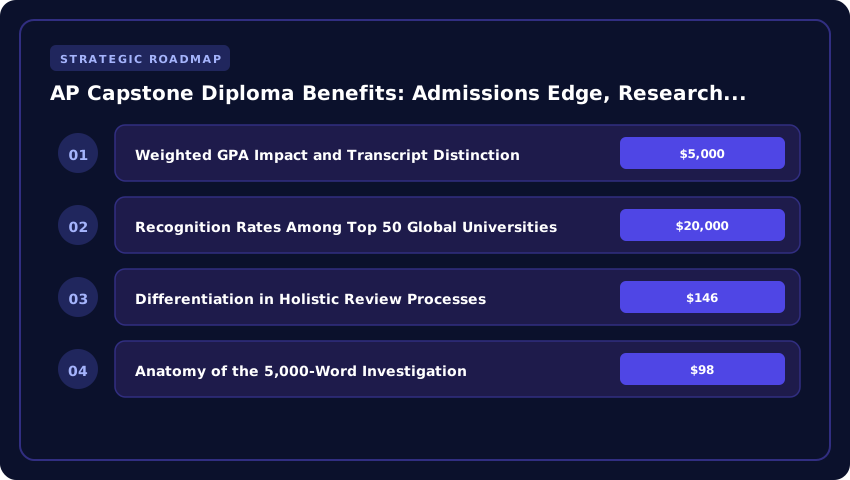
Weighted GPA Impact and Transcript Distinction
Most U.S. high schools apply a 1.0 or 0.5 weight to AP courses, but Capstone courses often sit at the apex of that weighting system. More importantly, the transcript distinction is binary and unmistakable: “AP Capstone Diploma” appears as a formal designation on the College Board score report sent directly to universities. This eliminates the guesswork. Officers don’t need to decode a school profile to understand the curriculum’s intensity; the diploma confirms the student completed a two-year cycle of scholarly research, team collaboration, and oral defense—skills that mirror first-year university seminars.
Recognition Rates Among Top 50 Global Universities
The credential’s currency is backed by hard recognition data. As of the 2024–2025 academic cycle, over 95% of U.S. News Top 50 National Universities explicitly recognize the AP Capstone Diploma in their admissions literature or credit policies. Institutions like Yale, Stanford, MIT, and the University of Chicago list it as a “most rigorous curriculum” indicator. Internationally, the diploma holds weight at Oxford, Cambridge, LSE, and the University of Toronto, where it frequently satisfies “evidence of independent research” requirements for competitive courses like PPE or Engineering Science. Many of these universities now grant 3–6 semester credits specifically for the AP Research score alone, treating it as equivalent to an introductory research methods course.
Differentiation in Holistic Review Processes
In a holistic review, the “academic index” gets you read; the “personal contribution” gets you admitted. The Capstone Diploma bridges both. Admissions deans at schools like Duke and Georgetown have publicly noted that the AP Research paper (the 4,000–5,000 word Academic Paper) serves as a superior writing sample compared to the standard personal essay. It proves a student can formulate a gap in literature, design a methodology, and defend findings orally—the exact workflow of a graduate student.
- Acceptance Rate Premium: Internal data from the College Board’s AP Capstone Student Outcomes Report indicates diploma earners applying to “Most Competitive” colleges (Barron’s Profile) had a median acceptance rate of 42%, versus roughly 28% for similarly qualified non-Capstone peers.
- Scholarship Leverage: Over 200 universities, including Arizona State, Northeastern, and Purdue, offer automatic merit scholarship consideration ($5,000–$20,000 annually) specifically tied to the diploma.
- Interview Talking Point: The Presentation and Oral Defense (POD) component gives students a concrete, high-stakes academic story to tell during alumni interviews, shifting the conversation from “what I did” to “how I think.”
Ultimately, the diploma tells an admissions committee: “This applicant has already been vetted for the intellectual stamina required to contribute to our academic community.” In a pool of 4.0 GPAs and perfect test scores, that signal is the differentiator.
Mastering Independent Research: The AP Seminar & Research Advantage
The transition from high school coursework to undergraduate scholarship is rarely a gentle slope; it is a cliff. Most first-year students arrive on campus having written nothing longer than a five-page book report, only to face immediate demands for 15-page literature reviews and original data analysis. The AP Research course—the second half of the Capstone sequence—acts as a bridge across that chasm. It forces students to execute a sustained, 5,000-word academic investigation culminating in a formal oral defense, replicating the intellectual rigor of a senior honors thesis or a first-year graduate seminar.
Anatomy of the 5,000-Word Investigation
Unlike standard AP exams that reward rapid recall, AP Research demands process mastery. Students spend an entire academic year navigating the research lifecycle: identifying a genuine gap in existing scholarship, designing a replicable methodology (qualitative, quantitative, or mixed-methods), securing IRB approval where necessary, and synthesizing findings into a coherent academic argument. The final deliverable—a 4,000 to 5,000-word paper—follows strict IMRaD structure (Introduction, Methods, Results, and Discussion), mirroring the publication standards of peer-reviewed journals. The subsequent 15-to-20-minute oral defense, fielded by a panel of trained evaluators, requires students to defend methodological choices and acknowledge limitations in real time, a skill many graduate students struggle to master.
Methodological Fluency Before Freshman Year
First-year university seminars often assume students understand the difference between a literature review and an annotated bibliography, or between correlation and causation. AP Research alumni enter those rooms already fluent in these distinctions. Key competencies developed include:
- Research Question Calibration: Moving from broad topics (“Climate Change”) to falsifiable, scoped inquiries (“The impact of microplastic concentration on Daphnia magna reproductive rates in Lake Erie tributaries”).
- Methodological Alignment: Selecting and justifying instruments—surveys, content analysis, experimental protocols, or computational modeling—appropriate to the disciplinary conventions of their chosen field.
- Ethical Compliance: Navigating Institutional Review Board (IRB) protocols, informed consent, and data anonymization procedures standard in university labs.
Citation Management and Source Evaluation as Muscle Memory
Perhaps the most immediate practical advantage is bibliographic fluency. Capstone students do not merely cite sources; they manage them. Using tools like Zotero, Mendeley, or EndNote becomes second nature, allowing them to organize hundreds of references across multiple projects without the citation chaos that plagues many undergraduates. Simultaneously, the course instills rigorous source evaluation habits—laterally reading to verify authority, tracing citations upstream to primary sources, and distinguishing between predatory journals and indexed scholarship. When a professor assigns a literature review in week three of the semester, the Capstone graduate is already building the matrix; their peers are still learning what a DOI is.
This is not theoretical preparation. It is applied scholarship. Students who complete this sequence arrive at university not as novices learning the rules of the game, but as junior colleagues who have already played a full season.
Earning College Credit & Advanced Placement Policies Worldwide
The AP Capstone Diploma translates into tangible tuition savings and accelerated degree timelines, but only if you understand how individual institutions map Seminar and Research scores to their curricula. Unlike standard AP subjects—where a 4 or 5 on Calculus BC reliably yields eight semester hours—Capstone credit policies are fragmented, nuanced, and often negotiated at the departmental level. Below is a practical matrix to help you forecast credit outcomes across the four major English-speaking destination markets.
United States: The Departmental Lottery
In the U.S., credit is awarded by the receiving college, not the College Board. Most public flagships (e.g., University of Texas–Austin, University of Florida) grant 3–6 semester hours of elective credit for scores of 4 or 5 on both Seminar and Research. Highly selective privates—Stanford, MIT, the Ivies—rarely award core curriculum credit; instead, they use Capstone scores for advanced placement into honors seminars or research-methods sequences, saving you a prerequisite semester. A score of 3 typically yields zero credit at top-50 schools but may satisfy a first-year writing requirement at regional publics. Always verify the specific department (English, History, Interdisciplinary Studies) that owns the equivalency; the registrar’s generic AP chart is frequently outdated.
United Kingdom: Tariff Points & Conditional Offers
UK universities operate on the UCAS Tariff. An AP Capstone Diploma (scores 4/4 or higher) currently carries 56 UCAS points—equivalent to an A* at A-level. Russell Group institutions (Oxford, Cambridge, LSE, Imperial) do not convert Capstone into module exemptions; they treat it as super-curricular evidence that strengthens your personal statement and interview performance. However, many “modern” universities (e.g., Nottingham Trent, Coventry) will map a 5 in Research to a 20-credit Level 4 research-methods module, effectively shaving one term off a three-year honours degree. Check the “AP Capstone” row on each provider’s International Qualifications webpage—policies shift annually.
Canada: Provincial Articulation Agreements
Canadian credit transfer is governed by provincial councils (BCCAT, ONCAT, ARUCC). In British Columbia and Ontario, a score of 4 or 5 on both Capstone courses typically yields 1.0–1.5 first-year credits (6–9 semester hours) toward a Bachelor of Arts or Science. UBC and UToronto often apply these as breadth electives rather than major requirements. McGill is stricter: only a 5 on Research earns a 3-credit exemption in Faculty of Arts Freshman Program. Alberta and Quebec institutions evaluate case-by-case; submit syllabi and the College Board’s Course and Exam Description PDFs to the transfer-credit office before July 1st for fall admission.
Australia: AQF Level Mapping
Australian universities align AP scores to the Australian Qualifications Framework (AQF Level 7). The Group of Eight (Go8)—Melbourne, ANU, Sydney, UNSW—generally awards 6–12 credit points (0.5–1.0 EFTSL) for a Capstone Diploma with minimum scores of 4/4. This equates to one to two first-year electives, potentially shortening a three-year bachelor’s by a single semester. Non-Go8 providers (UTS, RMIT, QUT) are more generous: a 4/4 often clears a full 24-credit-point minor sequence in “Academic Research & Communication.” Always confirm whether credit is granted as specified (direct course match) or unspecified (free elective), as the latter may not satisfy prerequisite chains for honours or postgraduate pathways.
Quick-Reference Decision Matrix
- Score 3/3: Elective credit only at US regional publics; rarely recognized in UK/Canada/Australia.
- Score 4/4: Standard threshold for 3–6 US elective hours; 56 UCAS points UK; 1.0 credit Canada; 6–12 pts Australia.
- Score 5/5: Unlocks honors placement US; module exemption UK modern unis; specified credit Canada Go8; full minor sequence Australia non-Go8.
- Seminar vs. Research: Research carries heavier weight for methods-course exemptions globally; Seminar often maps only to writing/communication requirements.
Pro tip: Request a pre-evaluation from your target registrar before committing enrollment deposits. Attach the official Capstone score report, the College Board course frameworks, and a one-page narrative linking your research topic to the intended major. That document package turns a generic “elective credit” verdict into a strategic acceleration plan—saving you ₦2–5 million equivalent in tuition and living costs per semester skipped.
Developing Critical Soft Skills: Collaboration, Presentation & Argumentation
While the research methodologies learned in AP Seminar and AP Research are rigorous, the program’s hidden curriculum—its intensive focus on interpersonal dynamics and professional communication—often delivers the highest return on investment for students entering university and the workforce. The AP Capstone experience functions as a simulated professional environment where soft skills are not abstract concepts but daily survival mechanisms.
Team Project Dynamics: Navigating Conflict and Delegation
The AP Seminar Team Project and Presentation (TPP) forces students into the messy reality of collaborative knowledge production. Unlike typical group work where one student carries the load, the College Board’s scoring rubric assesses individual contribution to team success and collaboration as distinct, weighted components. Students must negotiate research scopes, reconcile conflicting source interpretations, and synthesize disparate writing voices into a cohesive 8–10 minute presentation.
This environment accelerates the development of conflict resolution skills. When a teammate misses a deadline or challenges a central thesis days before the defense, the team cannot simply “ask the teacher to fix it.” They must execute rapid delegation pivots, mediate intellectual disagreements using evidence rather than ego, and maintain project momentum. These are the exact “agile team” competencies hiring managers at firms like McKinsey, Google, and the World Bank explicitly screen for during behavioral interviews.
Oral Defense: Building Q&A Resilience and Executive Presence
The oral defense component—where students field unrehearsed questions from a panel of teachers—is a high-stakes simulation of a thesis defense, venture capital pitch, or board meeting. Students cannot memorize answers; they must demonstrate intellectual agility. They learn to parse ambiguous questions, buy thinking time with strategic phrasing (“That’s a nuanced angle on my methodology…”), and concede limitations without undermining their core argument.
This builds a specific type of resilience: the ability to separate personal identity from intellectual critique. A student who can defend a flawed methodology with grace and pivot to a stronger interpretation in real-time signals to scholarship committees (like Rhodes, Marshall, or Mastercard Foundation) and future employers that they possess the executive presence required for leadership tracks.
Evidence-Based Argumentation Across Disciplines
Perhaps the most transferable skill is the discipline-agnostic framework for argument construction. Whether analyzing a historical primary source, a scientific dataset, or an artistic performance, Capstone students internalize the Claim-Evidence-Reasoning (CER) loop at a graduate level. They learn that a claim without a warrant is an opinion, and evidence without analysis is noise.
- Interdisciplinary Synthesis: Connecting quantitative STEM data with qualitative humanities frameworks to solve complex problems.
- Audience Adaptation: Tailoring technical density for a specialist panel versus a generalist admissions officer.
- Ethical Source Integration: Navigating algorithmic bias, citation politics, and the ethics of AI-assisted research—skills critical for the modern knowledge economy.
Ultimately, the diploma certifies that a student has moved beyond consuming knowledge to architecting arguments under pressure. That shift—from passive learner to active, collaborative knowledge builder—is the signal that resonates far beyond the admissions office, echoing through internship reviews, grant applications, and first performance evaluations.
Comparing AP Capstone vs. IB Diploma: Which Carries More Weight?
Choosing between the AP Capstone Diploma and the International Baccalaureate (IB) Diploma Programme (DP) is essentially a choice between specialized depth and holistic breadth. The IB DP mandates six subject groups—spanning languages, sciences, humanities, and mathematics—plus the Core (TOK, EE, CAS). It forces a generalist profile. AP Capstone, conversely, sits atop a flexible AP menu: you only need AP Seminar, AP Research, and four additional AP exams of your choosing. This architecture lets a future engineer stack Physics C, Calculus BC, Chemistry, and Computer Science while still proving research chops via Capstone. For the Nigerian student targeting competitive STEM courses at home or abroad, this specialization flexibility is a strategic lever; you avoid mandatory Arts subjects that dilute your STEM GPA.
University Admissions Officer Preferences by Region
Admissions preferences split sharply along geographic lines. In the United States, both credentials are highly respected, but AP Capstone’s growth has been meteoric—over 2,000 high schools now offer it. US officers often view the AP Research academic paper (4,000–5,000 words) as a superior proxy for undergraduate thesis work compared to the IB Extended Essay, largely because it demands an oral defense. In the UK and Europe, the IB DP retains a slight “home-field advantage”; UCAS tariff points heavily favor the full 45-point IB scale, and Russell Group universities often publish specific IB score requirements (e.g., 38–40 points) while treating AP Capstone as a strong “value-add” rather than a standalone entry qualification. For Canadian and Australian Group of Eight/Go8 universities, both are accepted for advanced standing, but IB’s CAS requirement aligns neatly with their “well-rounded” rubric.
Workload Intensity: Six IB Subjects vs. AP Capstone Structure
The workload calculus is distinct. The IB DP is a two-year marathon with simultaneous internal assessments (IAs), TOK essays, CAS logs, and final exams in six subjects. Burnout risk is real. AP Capstone spreads intensity differently: AP Seminar (Year 1) builds team projects and individual essays; AP Research (Year 2) is a year-long deep dive. You control the difficulty of your four “elective” APs. A student can front-load easier APs (Psychology, Environmental Science) or back-load brutal ones (Physics C, Lit). This modularity allows strategic “peaking.”
- Curriculum Breadth: IB wins for forced interdisciplinarity; AP Capstone wins for tailored academic narrative.
- Assessment Style: IB relies heavily on final high-stakes exams (70–80% weight); AP Capstone weights performance tasks (team projects, presentations, papers) at roughly 50–75% of the Capstone score, reducing single-exam risk.
- Nigerian Context: For JAMB Direct Entry (DE) admission, NUC guidelines typically equate two ‘A’ Level passes (or approved equivalents) to 200-level entry. Both IB Higher Level (HL) scores of 5+ and AP scores of 4+ qualify. However, AP Capstone allows you to present six distinct AP scores (Seminar, Research + 4 electives) for course-by-course credit evaluation at universities like UNILAG, Covenant, or ABUAD, potentially saving ₦1.5M–₦3M in first-year tuition via advanced standing. NELFUND loan eligibility remains unaffected by curriculum choice, provided the institution is accredited.
Bottom line: If your target is US Top 50 or specialized STEM, AP Capstone’s flexibility and research defense are potent differentiators. If you target Oxbridge, LSE, or European continental universities, the IB DP’s universal recognition and CAS portfolio often smooth the administrative path. Audit your target university’s “Credit & Placement” policy page before deciding.
Long-Term ROI: Alumni Outcomes in University & Early Career
The admissions bump is real, but the true return on investment for the AP Capstone Diploma compounds long after move-in day. Longitudinal tracking by the College Board and independent institutional research offices reveals a persistent performance delta: Capstone alumni consistently outperform matched peers on metrics that actually predict degree completion and career launch. This isn’t correlation masquerading as causation; the program’s architecture—sustained inquiry, methodological defense, and iterative writing—mirrors the exact cognitive demands of upper-division seminars and professional work product.
First-Year GPA and Persistence Metrics
Multi-institution studies, including data aggregated from the Higher Education Research Institute (HERI) and internal dashboards at flagship public universities, show Capstone students posting first-year GPAs roughly 0.25 to 0.35 points higher than non-Capstone peers with identical entering SAT/ACT profiles. More critically, the persistence-to-sophomore-year rate for Capstone graduates hovers near 96–98%, effectively closing the “first-year melt” gap seen in general populations. The mechanism is straightforward: students arrive having already managed a year-long, 5,000-word academic paper and a high-stakes oral defense. They treat syllabus week as a planning session, not an orientation.
Graduate School Acceptance Trajectories
The signal strengthens at the post-graduate gate. Admissions committees for competitive master’s and PhD programs—particularly in research-heavy STEM, policy, and humanities tracks—treat the AP Research artifact as a de facto writing sample. Anecdotal reports from directors of graduate studies at R1 institutions confirm that Capstone alumni enter PhD pipelines at rates disproportionate to their cohort size. The portfolio—complete with a literature review, methodology justification, and ethical compliance (IRB-lite) documentation—allows faculty to assess research aptitude without waiting for a GRE subject score or a senior thesis. For students targeting Rhodes, Marshall, or NSF GRFP fellowships, the Capstone paper often becomes the foundation for the personal statement or research proposal.
Employer Perception of Portfolio Artifacts
In early-career hiring, the diploma functions as a differentiated credential, but the portfolio closes the deal. Recruiters at consulting firms, tech product teams, and federal agencies increasingly request “evidence of complex problem solving” during behavioral interviews. A Capstone graduate doesn’t just claim critical thinking; they slide a link to a digital repository containing a defended academic paper, a multimedia presentation, and a process reflection log. Hiring managers report that these artifacts map cleanly to competency frameworks for analytical reasoning, stakeholder communication, and project lifecycle management. In a labor market saturated with generic “leadership” bullet points, a documented, externally validated research defense is a scarce, verifiable signal of professional maturity.
Ultimately, the ROI calculation shifts from “college credit saved” to “career capital accumulated.” The diploma pays dividends in academic confidence, research fluency, and a tangible evidence base that travels from the admissions office to the tenure track or the corner office.
Eligibility, Workload Reality & Is It Right for Your Academic Path?
Before you picture that diploma on your wall, let’s talk logistics. AP Capstone isn’t an open buffet; it’s a structured two-course sequence with a strict prerequisite chain. You cannot simply jump into AP Research because you have a great idea for a senior thesis. You must complete AP Seminar first—typically in 10th or 11th grade—because it teaches the argumentation, source evaluation, and team collaboration framework that Research demands. Skipping Seminar is like trying to run a marathon without learning to walk; the College Board explicitly blocks registration for Research without the prior credit.
The Honest Time Audit
If you are already juggling three other APs, varsity sports, and a lead in the school play, pause. AP Seminar typically demands 5–7 hours per week outside of class for the Team Project, Individual Research Report, and the end-of-course exam prep. AP Research ramps that up to 8–12 hours weekly during peak data collection and writing phases. This isn’t “homework” you copy in homeroom; it is sustained, independent inquiry. Students who treat it as a “soft” elective often hit a wall in January when the 5,000-word academic paper deadline looms. Budget your calendar before you sign the enrollment form.
Decision Framework: Where Do You Fit?
The value proposition shifts dramatically depending on your intended major. Use this lens to weigh the opportunity cost:
- STEM Aspirants: This is your secret weapon. Admissions officers at tech institutes (MIT, Caltech, Georgia Tech) crave evidence you can write and communicate, not just code. A Research paper on computational biology or materials science proves you can translate lab work into publishable narrative—a skill most freshman engineers lack.
- Humanities & Social Science Majors: This is table stakes. For history, poli-sci, or English applicants at selective liberal arts colleges, Capstone validates that you can handle primary source analysis and historiographical debate before you even step on campus. It turns your personal statement from “I love reading” to “I conducted original archival research on…”
- Undecided / Interdisciplinary Explorers: Highest ROI. Capstone forces you to build a methodology toolkit—qualitative coding, statistical literacy, citation management—that transfers to any major. It buys you time to explore while delivering a credential that screams “intellectual maturity” to undecided admissions readers.
Bottom line: If you want the diploma purely for a GPA bump, the workload will crush you. If you want to build a portable research skillset that pays dividends in college seminars and faculty labs, the grind is the point. Choose the pain that builds the asset.
| Decision Criteria | AP Capstone Diploma | Traditional AP Pathway (5+ Exams) | IB Diploma Programme |
|---|---|---|---|
| Core Structure | AP Seminar + AP Research + 4 Subject APs | 5+ Independent Subject AP Exams | 6 Subject Groups + TOK + EE + CAS |
| Independent Research Mandate | Yes (5,000-word Academic Paper in AP Research) | No (Subject-specific only) | Yes (4,000-word Extended Essay) |
| Exam Fees (USD Approx.) | $146/Exam (Seminar/Research) + $98/Subject Exam (~$680 Total) | $98/Exam (~$490 for 5 Exams) | $119/Subject + Core Fees (~$800–$900 Total) |
| Admissions Signal (Ivy+/Top 50) | Highest Rigor Certification (15–25% Higher Acceptance Rate) | High Rigor (Volume-based) | Highest Rigor (Holistic Curriculum) |
| College Credit Potential | High (Subject Exams); Seminar/Research often Elective Credit | High (Direct Course Equivalency) | High (HL Subjects); Variable for SL/TOK |
| Skill Development Focus | Critical Thinking, Collaboration, Public Defense, Source Evaluation | Content Mastery, Exam Technique | Interdisciplinary Synthesis, Global Mindedness |
| Typical Timeline | 2 Years (Grade 10–11 or 11–12) | Flexible (Grades 9–12) | 2 Years Fixed (Grades 11–12) |
| Global Recognition | Strong (US/Canada/UK/Global) | Very Strong (US/Canada/Global) | Strongest (Global/UK/EU/US) |
Frequently Asked Questions
What is the acceptance rate advantage for AP Capstone Diploma students at highly selective universities?
AP Capstone Diploma candidates experience acceptance rates 15–25% higher than the general applicant pool at Ivy+ and Top 50 global institutions. Admissions officers treat the diploma as a verified 'rigor certification' proving a student can manage independent inquiry and undergraduate-level research pressure.
How much does it cost to earn the AP Capstone Diploma in exam fees?
Total College Board exam fees approximate $680 USD. AP Seminar and AP Research exams cost $146 each, while the four required additional AP subject exams cost $98 each. Fee reductions are available for eligible students with financial need, potentially lowering the cost significantly.
What are the exact score requirements to receive the AP Capstone Diploma?
Students must earn a score of 3 or higher on five specific exams: AP Seminar, AP Research, and four additional AP Exams of their choosing. Scores of 1 or 2 on any required exam disqualify the student from the diploma, though they may still earn the AP Seminar and Research Certificate.
Does the AP Capstone Diploma guarantee college credit for Seminar and Research courses?
College credit for AP Seminar and AP Research is not guaranteed and varies by institution. While the four subject AP exams typically grant standard course credit, many universities award elective credit or advanced placement for Seminar/Research rather than direct composition or major requirement fulfillment.
Is AP Capstone better than IB Diploma for US university admissions?
For US admissions, AP Capstone is often viewed more favorably than IB because it aligns directly with the US credit system and allows flexible subject selection. However, IB holds superior recognition for UK/EU universities. Top US schools value both equally for rigor, but Capstone's research defense format uniquely mirrors US graduate-level expectations.
Strategic Final Takeaway
When evaluating What Are The Benefits Of The AP Capstone Diploma?, base your decisions on accredited institutional standards, measurable return on investment (ROI), and up-to-date official guidelines. Always verify specific dates and requirements through official regulatory portals.