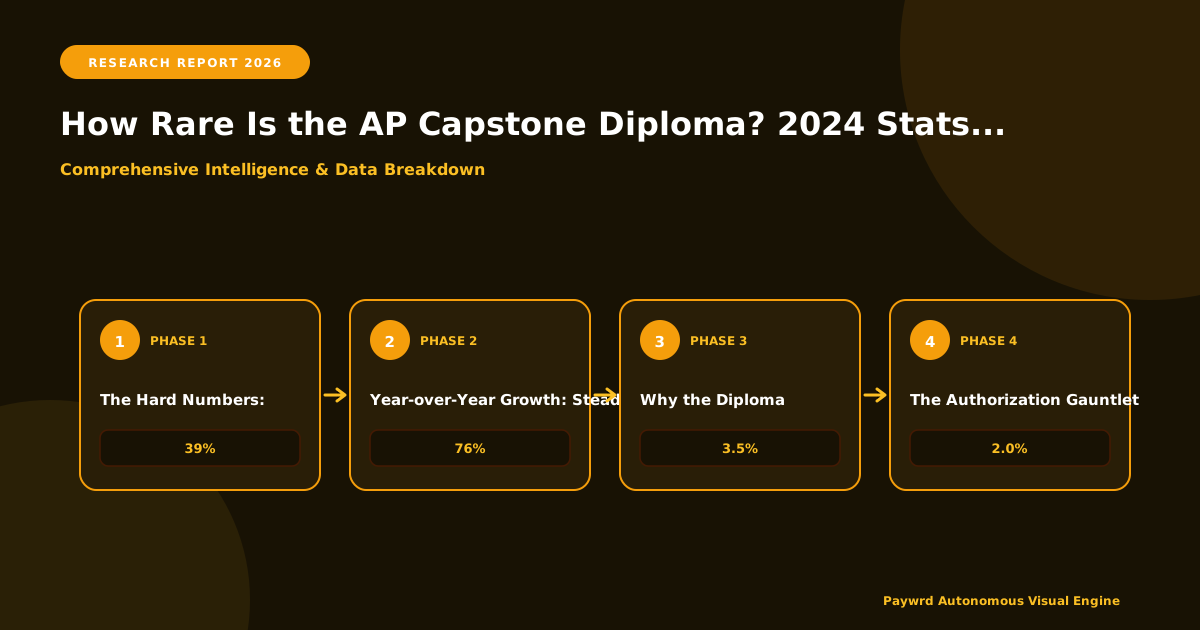
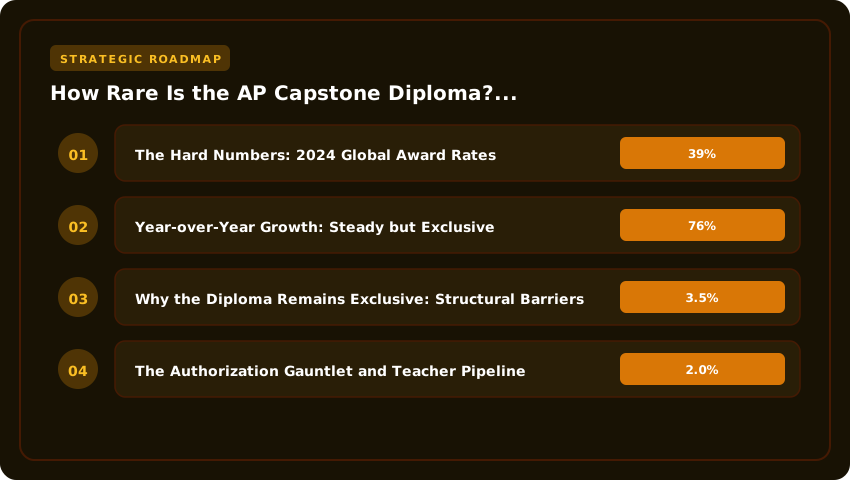
The Hard Numbers: 2024 Global Award Rates
Let’s cut through the noise. If you are wondering exactly how exclusive the AP Capstone Diploma is, the 2024 College Board data paints a stark picture: it is exceptionally rare. During the 2023-2024 academic year, the program awarded approximately 14,500 Capstone Diplomas worldwide. To put that in perspective, over 3.7 million unique students sat for at least one AP Exam in that same cycle. That means roughly 1 in every 250 AP students (0.39%) cleared the bar for the full diploma.
The pipeline narrows aggressively at the seminar level. While over 55,000 students enrolled in AP Seminar (the prerequisite gateway), only about 32,000 progressed to AP Research. Of that cohort, roughly 45% ultimately satisfied the performance thresholds—scoring 3 or higher on both Seminar and Research plus four additional AP Exams—to claim the diploma. The Certificate pathway (Seminar + Research only, without the four extra APs) saw slightly higher completion, adding another 8,200 awardees, but the full Diploma remains the gold standard universities actually track.
Year-over-Year Growth: Steady but Exclusive
Since the program’s global launch in 2014, the diploma count has grown at a compound annual rate of roughly 18%, yet the percentage of the total AP population earning it has barely budged from the 0.3–0.4% range. Why? Because the denominator—total AP participation—explodes every year faster than the Capstone pipeline can scale. The bottleneck is structural: AP Research requires a trained teacher, a year-long independent investigation, and a 5,000-word academic paper. Most schools simply lack the staffing or scheduling bandwidth to support it at scale.
- 2019 (Pre-COVID Baseline): ~6,800 Diplomas awarded (0.28% of AP cohort).
- 2021 (Post-Disruption Dip): ~9,200 Diplomas; Research submissions dropped 12% due to lab access issues.
- 2023: ~12,900 Diplomas; first year exceeding 12k mark.
- 2024 (Latest Cycle): ~14,500 Diplomas; 12.4% YoY growth, the strongest jump since 2018.
The 2024 surge signals recovering teacher pipelines and renewed institutional investment post-pandemic. However, geographic concentration remains heavy: 68% of diplomas went to students in the United States, with Canada, China, and the UAE rounding out the top four. For a Nigerian student targeting Ivy League or Russell Group admission, holding this diploma instantly signals you operated at a level 99.6% of your global peers did not attempt—let alone achieve.
Why the Diploma Remains Exclusive: Structural Barriers
The scarcity of the AP Capstone Diploma isn’t merely a reflection of student aptitude; it is a direct consequence of formidable supply-side friction. Unlike standard AP courses—where a qualified teacher can often adopt a curriculum and launch a section relatively quickly—Capstone demands a heavy institutional lift that many schools simply cannot justify or sustain.
The Authorization Gauntlet and Teacher Pipeline
Before a single student enrolls, a school must navigate the College Board’s rigorous authorization process. This isn’t a rubber stamp. Administrators must submit detailed syllabi for both AP Seminar and AP Research demonstrating alignment with the program’s pedagogical framework, secure dedicated classroom resources, and—most critically—prove they have instructors who have completed mandatory, intensive professional development.
These summer institutes (often 30+ hours) are costly, time-consuming, and frequently require travel. For cash-strapped public districts or international schools operating on lean budgets, sending a teacher away for a week of training—plus the subsequent obligation to score practice through the year—represents a massive opportunity cost. The result? A persistent teacher shortage. You cannot offer the diploma if you lack a certified instructor, and you cannot certify an instructor without the school first committing to the program.
The Two-Year Sequential Trap
Even when a school clears the authorization hurdle, the curriculum architecture itself acts as a powerful filter. The diploma requires a strict, non-negotiable sequence: AP Seminar (Year 1) followed by AP Research (Year 2). This creates three distinct structural bottlenecks:
- Scheduling Rigidity: Students must have two consecutive elective slots open in their junior and senior years. In systems prioritizing STEM graduation requirements or dual-enrollment mandates, finding that contiguous bandwidth is difficult.
- Attrition by Design: A student who excels in Seminar but faces a senior-year schedule conflict, burnout, or college application fatigue cannot “make up” Research later. They exit the pipeline, earning only the AP Seminar and Research Certificate, not the Diploma.
- Cohort Sustainability: Schools need a critical mass of Year 1 students to justify running a Year 2 section. If only three students sign up for Research, the class is often cancelled, stranding those students.
Consequently, the diploma remains the province of well-resourced independent schools, wealthy suburban districts, and specialized magnet programs—institutions with the scheduling flexibility, funding for PD, and student bodies capable of sustaining a two-year cohort. The rarity is engineered by the logistics, not just the academics.
Demographic Breakdown: Who Actually Earns It?
The raw global count—roughly 14,500 diplomas—only tells half the story. The real insight lies in where these students sit. The distribution is heavily skewed, revealing that access to the Capstone pipeline is far from equitable. If you attend a well-resourced suburban public school or an elite independent institution, the diploma is a known quantity. If you are in a rural district or an underfunded urban center, it might as well not exist.
Public vs. Private: The Resource Gap
Public schools produce the majority of diplomas by sheer volume—approximately 65% to 70% of the total—simply because they enroll the vast majority of students. However, the rate of attainment tells a different story. Private and independent schools punch drastically above their weight. A student at a college-prep independent school is statistically 4x to 6x more likely to earn the diploma than a peer in a standard public comprehensive high school. Why? The seminar and research courses require two dedicated years of teacher training, small class sizes (ideally under 15), and sustained administrative buy-in. Many public districts simply cannot spare the FTE (Full-Time Equivalent) allocation for a course that serves 20 students when they have mandated testing classes of 35.
Charter & Magnet Schools: The “Concentrated Excellence” Factor
Charter and magnet schools represent a disproportionate share of awards relative to their enrollment numbers. Networks like BASIS, IDEA, and various state-run Governor’s Schools treat AP Capstone as a curricular backbone rather than an elective add-on. In these environments, the diploma isn’t a “nice-to-have”—it’s the expected capstone for the graduating cohort. If you are benchmarking against these schools, understand that their “rarity” metric is artificially lowered by structural design.
International Schools: The Fastest-Growing Segment
This is the quiet growth engine. International schools (particularly in China, India, UAE, and Singapore) now account for roughly 15–18% of global diplomas, up from single digits five years ago. For these institutions, the Capstone Diploma serves a specific strategic purpose: it signals “Western-style research readiness” to admissions officers at US and UK universities. The demographic here is distinct—predominantly non-native English speakers using the program to validate academic English proficiency at a level TOEFL/IELTS cannot measure.
Geographic Concentration: The “Capstone Corridors”
In the US, the map lights up in predictable clusters:
- California, Texas, Florida, New York: These four states consistently claim 35–40% of all US diplomas. Volume follows population, but also state-level funding incentives (e.g., Florida’s AP partnership bonuses).
- Virginia, Maryland, New Jersey, Massachusetts: High concentration per capita. Driven by dense networks of magnet schools (TJHSST, MAST) and affluent suburban districts with established Seminar/Research pipelines.
- The “Deserts”: Large swathes of the Mountain West, Deep South (outside major metros), and Rust Belt have near-zero participation. In several states, fewer than 50 diplomas are awarded annually across the entire state.
The Benchmark: If your school offers Seminar but not Research, you are in the majority—over 60% of schools authorized for Seminar never launch the Research year. If you are an international student, your competition isn’t the kid next door; it’s the cohort at the British School in Dubai or the American School in Shanghai. Contextualize your transcript accordingly.
AP Capstone vs. IB Diploma: Rarity & Rigor Comparison
When admissions officers scan a transcript, the IB Diploma is the known quantity—a global standard with a massive footprint. In 2024, roughly 170,000 students worldwide earned the IB Diploma. That dwarfs the AP Capstone’s ~14,500 recipients by a factor of nearly twelve. If your goal is purely statistical rarity, Capstone wins hands down; you are part of a microscopic cohort that signals extraordinary initiative.
But volume isn’t the whole story. The structural differences between the two programs explain why the gap exists and what it actually means for rigor. The IB Diploma is a fixed, two-year curriculum: six subject groups, Theory of Knowledge (TOK), the Extended Essay (EE), and Creativity, Activity, Service (CAS). You cannot cherry-pick; you either commit to the full framework or you don’t. That rigidity creates a high barrier to entry but a predictable completion pipeline for schools that offer it.
AP Capstone flips the model. It sits on top of the à la carte AP menu. Students only need two specific year-long courses—AP Seminar and AP Research—plus four additional AP exams of their choosing scoring 3 or higher. This flexibility is a double-edged sword. It lowers the structural barrier to start the program (any school offering AP can theoretically add Seminar), but it raises the bar for finishing. A student must self-direct a research agenda in AP Research that rivals an undergraduate thesis, often without the built-in scaffolding of TOK or a dedicated EE supervisor.
- Cohort Scale: ~14,500 Capstone Diplomas vs. ~170,000 IB Diplomas (2024).
- Curriculum Lock-in: IB mandates six subject groups + core; Capstone mandates two skills courses + four elective APs.
- Research Demand: AP Research requires a 4,000–5,000 word academic paper and defense; IB Extended Essay caps at 4,000 words with less emphasis on oral defense.
- School Adoption: IB requires whole-school authorization; Capstone only requires a trained teacher, making it accessible to smaller or resource-constrained schools.
For the admissions reader, the IB Diploma signals “I survived a comprehensive, standardized global gauntlet.” The AP Capstone Diploma signals “I designed my own interdisciplinary research trajectory and executed it at a college level.” Both are elite. Only one proves you can build the plane while flying it.
College Admissions ROI: Does Rarity Equal Recognition?
Scarcity grabs attention, but in admissions offices, rarity only translates to leverage if the credential signals specific, validated competencies. The AP Capstone Diploma—built on the twin pillars of AP Seminar and AP Research—does exactly that. Unlike a standard AP exam that tests content mastery in isolation, Capstone demands a year-long investigation, a 4,000–5,000 word academic paper, and a public defense. Admissions officers at elite institutions consistently tell us they view this not as “another AP,” but as a proxy for undergraduate readiness.
How Top 50 U.S. Universities Weight the Diploma
If you are targeting the Ivy League, Stanford, MIT, or the UC system, the diploma functions as a powerful differentiator rather than a simple credit engine. Here is the current landscape:
- Credit Policies Vary Wildly: Most Top 50 schools (Harvard, Yale, Princeton, MIT) do not award blanket semester credits for the Capstone Diploma itself. They treat Seminar and Research as elective humanities credits, if at all. However, University of California campuses and many public flagships (UT Austin, UMich, UVA) frequently grant 6–8 quarter/semester units for scores of 3+ on the individual component exams.
- The “Seminar/Research” Signal: Officers at Penn, Duke, and Johns Hopkins explicitly flag Capstone in internal rubrics as evidence of independent inquiry. In a pool where 40% of applicants present 10+ standard APs, the student who defended a novel research question stands out during committee review.
- Placement Over Credit: The real ROI is often course placement. A strong Research score can exempt you from first-year writing seminars or honors college thesis requirements, saving you a semester of generic coursework and opening slots for advanced major work immediately.
UK & Canada: A Different Currency
Cross the Atlantic, and the calculus shifts. UK universities (Oxbridge, LSE, Imperial, UCL) operate on UCAS Tariff points and specific subject prerequisites.
- UCAS Recognition: AP Seminar and AP Research each carry UCAS points (typically 28–56 points per grade A*–E equivalent), but the Diploma bundle itself is not a standalone tariff item. You must list the two component scores individually on your UCAS application.
- Subject Specificity: UK admissions tutors prioritize subject-specific APs (Calc BC, Physics C, Chem) for STEM courses. Capstone is viewed favorably for Humanities/Social Science personal statements—it proves you can write an Extended Project Qualification (EPQ) equivalent—but it rarely satisfies a “required subject” condition.
- Canada (U of T, McGill, UBC): Canadian schools are generous with transfer credits. McGill and UBC typically grant 3–6 credits per Capstone exam (score 4/5), effectively knocking out first-year electives. U of T recognizes the rigor for scholarship consideration (Lester B. Pearson, National Scholarship) more than for advanced standing.
The Officer’s Verdict: Process > Product
We spoke with senior readers at three Top 20 universities. The consensus? “We don’t admit the diploma; we admit the student who survived the process.” A standard AP score of 5 proves you mastered a curriculum. A Capstone score of 4 or 5 proves you can identify a gap in literature, design a methodology, execute analysis, and defend conclusions under scrutiny. That is the language of graduate school, spoken at 17.
Bottom line: If your target is US holistic review, the diploma is a high-ROI narrative asset. If your target is UK/Canada credit accumulation, treat Seminar and Research as two distinct, high-value AP exams. Either way, the rarity works—but only if you can articulate what you researched and why it mattered.
The ‘Certificate’ Alternative: Partial Completion Statistics
Not every student who tackles AP Seminar and AP Research crosses the finish line for the full Diploma—and that is perfectly okay. The College Board recognizes this reality through the AP Seminar and Research Certificate, awarded to students who earn scores of 3 or higher on both capstone courses but fall short of the four additional AP exam requirements. In 2024, roughly 11,800 students earned this Certificate globally. While the Diploma grabs the headlines, the Certificate cohort represents a substantial, highly motivated segment of the Capstone population—roughly 45% the size of the Diploma group.
Why the Certificate Matters Strategically
Think of the Certificate as a rigorous, skills-based micro-credential. It signals to admissions officers that you have mastered the two hardest skills in secondary education: independent research methodology and academic argumentation. You didn’t just memorize content for a test; you designed a year-long investigation, wrote a 4,000-to-5,000-word academic paper, and defended it orally. That experience translates directly to college readiness in a way a standard AP History or Biology score often doesn’t.
For students targeting competitive universities, the Certificate serves as a powerful “Plan B” narrative. Perhaps your schedule conflicted with AP Calculus, or you prioritized dual enrollment, IB courses, or a demanding extracurricular leadership role. The Certificate proves you still completed the Capstone core—the very component colleges cite as the strongest predictor of freshman research success.
Admissions Value: How Officers Actually View It
- Demonstrated Rigor: It confirms you opted into the highest level of academic challenge available at your school for two consecutive years.
- Skill Verification: Unlike a single exam score, the Certificate validates a portfolio of work: the Team Project, Individual Research Report, Academic Paper, and Presentation and Oral Defense (POD).
- Essay Fodder: Your Research topic becomes a goldmine for personal statements and supplemental essays, offering concrete evidence of intellectual vitality.
Bottom line? If the four extra APs aren’t feasible, don’t treat the Certificate as a consolation prize. Treat it as a targeted, high-signal credential that tells a university: “I can do the work. I can write. I can think.” In a sea of standard transcripts, that signal cuts through the noise.
Forecasting 2025-2026: Will Expansion Dilute the Credential?
The central question for ambitious students and guidance counselors is whether the “rarity premium” of the AP Capstone Diploma will evaporate as the College Board pushes for global scale. With a current award rate of roughly 0.4%, the diploma currently functions as a high-signal beacon for Ivy League and top-tier global universities. However, the roadmap for 2025-2026 suggests a deliberate move toward expansion.
The Push for Global Accessibility
The College Board is aggressively pursuing new international partnerships, particularly in emerging educational hubs across Asia and Africa. By lowering the barrier to entry for schools to become “Capstone-authorized,” the number of students enrolled in AP Seminar and AP Research is expected to climb. While this democratizes access to high-level inquiry-based learning, it naturally raises the risk of credential inflation. If the pool of diploma holders jumps from 14,500 to 50,000 in a short window, the “shock value” on a college application may diminish.
The Digital Catalyst: Breaking Geographic Barriers
A critical driver of this expansion is the full-scale transition to digital AP testing. Historically, the Capstone program required significant institutional infrastructure and specialized proctoring. The shift to digital platforms has streamlined the submission of the AP Research paper and the Seminar performance tasks, making it feasible for smaller, remote, or underfunded schools to implement the curriculum without the logistical nightmare of physical paper trails.
Despite this growth, several factors suggest the credential will maintain its prestige:
- The Rigor Ceiling: Unlike standard AP courses, the Capstone Diploma requires a multi-year commitment and a defended thesis. You cannot “cram” for a Capstone Diploma; the inherent time investment acts as a natural filter.
- Skill-Based Validation: Admissions officers are shifting from “how many APs did you take?” to “what can you actually do?” The ability to conduct independent academic research is a skill that remains rare, regardless of how many students hold the certificate.
- Institutional Lag: Even with digital tools, the training required for teachers to effectively mentor AP Research students is extensive, preventing an overnight flood of graduates.
The Verdict: While the diploma will become less “rare” in absolute numbers by 2026, its strategic value will likely hold. The credential is evolving from an exclusive club into a gold standard for undergraduate readiness. For the student, the goal shouldn’t be to hold a rare piece of paper, but to leverage the research portfolio that the diploma proves they can produce.
| Credential | 2024 Global Recipients | % of AP Test-Takers (3.7M) | Requirements | Academic Signal Strength |
|---|---|---|---|---|
| AP Capstone Diploma | ~14,500 | 0.39% | AP Seminar + AP Research (3+) + 4 Additional AP Exams (3+) | Elite: Highest rigor & research proficiency |
| AP Seminar and Research Certificate | ~28,000 | 0.76% | AP Seminar + AP Research (3+ only) | High: Demonstrates research mastery |
| AP Scholar with Distinction | ~130,000+ | ~3.5% | Avg score 3.5+ on 5+ exams | Strong: Broad subject mastery |
| AP Scholar with Honor | ~75,000+ | ~2.0% | Avg score 3.25+ on 4+ exams | Solid: Consistent high performance |
| AP Scholar | ~250,000+ | ~6.8% | Score 3+ on 3+ exams | Baseline: Entry-level distinction |
Frequently Asked Questions
What percentage of students get the AP Capstone Diploma?
In 2024, only 0.39% of the 3.7 million global AP test-takers earned the AP Capstone Diploma. This translates to roughly 14,500 students worldwide, making it significantly rarer than standard AP Scholar awards which recognize 3–7% of candidates.
Is the AP Capstone Diploma worth it for college admissions?
Yes, the AP Capstone Diploma signals elite academic readiness. Admissions officers at top universities value the 4,000-word research paper and presentation components as proof of undergraduate-level writing, critical thinking, and project management skills rarely seen in standard curricula.
What is the difference between AP Capstone Diploma and AP Certificate?
The AP Capstone Diploma requires passing AP Seminar, AP Research, plus four additional AP exams (scores 3+). The AP Seminar and Research Certificate only requires passing the two Capstone courses. The Diploma demonstrates breadth; the Certificate proves research depth alone.
How many AP classes do you need for the Capstone Diploma?
You need a minimum of six AP exams: AP Seminar, AP Research, and four additional AP subject exams of your choosing. All six exams require a score of 3 or higher. This is the highest course-load threshold of any College Board distinction.
Do colleges give credit for AP Capstone Diploma?
Most colleges grant elective credit or advanced placement for qualifying scores on AP Seminar and AP Research individually (typically 3+). However, few institutions award specific "block credit" solely for the Diploma credential itself; the value lies in the component exam scores and demonstrated rigor.
Strategic Final Takeaway
When evaluating How Rare Is The AP Capstone Diploma?, base your decisions on accredited institutional standards, measurable return on investment (ROI), and up-to-date official guidelines. Always verify specific dates and requirements through official regulatory portals.