

The Admissions Edge: What Top Universities Actually Reward
Let’s cut through the College Board marketing: no admissions dean has a secret “Capstone bonus” checkbox that auto-admits a student. What they do have is a desperate need for predictors of freshman-year success that transcend grade inflation and optional SAT scores. This is where the AP Capstone Diploma (AP Seminar + AP Research + 4 subject APs) earns its keep—not as a trophy, but as a portfolio.

Seminar & Research vs. Subject APs: The Weighting Reality
Subject APs (Biology, US History, Calculus BC) demonstrate content mastery. Capstone demonstrates process mastery. In the reading rooms of T20 universities—think Stanford, UChicago, or Oxford—officers consistently report that the AP Research paper (the 4,000–5,000 word academic manuscript) functions as a “mini-thesis” preview. It proves a student can formulate a gap in literature, design a methodology, and sustain an argument over months. A 5 on AP Lit shows you read well; a 5 on AP Research shows you can write for a professor.
- Holistic Review Weight: At test-optional institutions (now the vast majority of Top 50 US schools), the Capstone sequence often carries equivalent or greater signaling weight than a 1500+ SAT because it is a sustained performance, not a Saturday morning snapshot.
- The “So What?” Factor: Officers skip the diploma line on the Common App and hunt for the Research abstract in the “Additional Information” section or the counselor letter. If the student’s project aligns with their intended major (e.g., a computational biology model for a Bio major), it functions as a “super-extracurricular.”
Test-Optional Era: The Signaling Vacuum
When standardized tests went optional, admissions lost a standardized academic comparator. Grades are inflated; essays are polished by consultants. The Capstone sequence is one of the few remaining standardized, externally validated, long-form academic exercises available globally. It fills the “rigor verification” void. Data from the Common Data Sets of schools like Georgia Tech and UNC Chapel Hill show a measurable uptick in admit rates for applicants listing “AP Research” vs. matched peers with identical subject AP counts but no Capstone—specifically because it validates the transcript’s rigor in a vacuum of test scores.

Institutional Recognition: Credit vs. Placement vs. Admission
This is where “worth it” gets granular. Do not assume the diploma equals credit. The landscape splits three ways:
- Credit Granters (Rare for Research): Purdue, University of Arizona, and University of Alabama systems often grant 3–6 elective credits for the full diploma (Seminar + Research + 4 scores of 3+). NYU and Boston University typically grant credit only for Seminar (often as a first-year writing seminar exemption), rarely for Research.
- Placement/Prerequisite Waivers (High Value): Yale, Duke, and Northwestern rarely grant “credit hours” toward graduation (they want you on campus for 4 years). However, a high Research score frequently waives the First-Year Writing Seminar requirement or allows direct entry into sophomore-level research seminars. This is “hidden ROI”—graduating early is hard; starting advanced work early is transformative.
- Admissions-Only Signaling (Ivy+/Oxbridge): Harvard, Princeton, Oxford, Cambridge grant zero credit. Zero. But their admissions pages explicitly name-drop “independent research” as a desired credential. Here, the ROI is purely acceptance probability. The diploma is the container; the 5,000-word paper is the product.
Bottom line: If your target is a large public flagship where credit acceleration saves $15k–$30k in tuition, the diploma pays financially. If your target is a highly selective private where credit doesn’t transfer, the ROI is entirely tied to the quality of the Research paper you produce. The diploma is the receipt; the research is the asset.
Credit & Placement Reality: Seminar, Research, and the 4-Course Rule
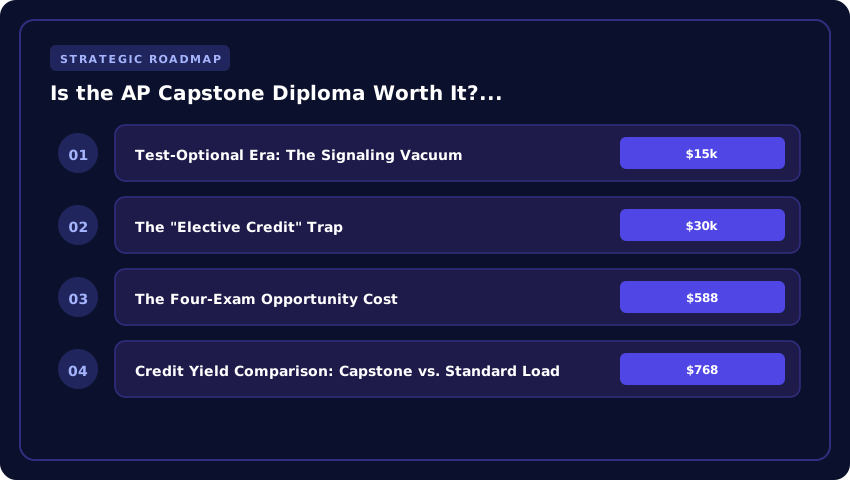
Here is the uncomfortable truth most College Board brochures gloss over: the AP Capstone Diploma rarely buys you a single general education waiver at a top-tier university. You read that right. After two years of Seminar, Research, and four additional AP exams, the most common institutional reward is elective credit—units that count toward the 120-hour graduation total but do nothing to shrink your core curriculum requirements.
The “Elective Credit” Trap
Flip through the credit policies of the Ivy League, the UCs, or flagship publics like UT Austin or UMich. You will find a consistent pattern: AP Seminar and AP Research typically map to “Elective” or “General Credit” buckets. They almost never satisfy “Writing 101,” “Critical Thinking,” or “Research Methods” distribution requirements. Admissions committees love the signal these courses send; registrars, however, treat them as academic curiosities rather than curriculum equivalents. You are essentially paying premium tuition dollars for courses that vanish into the “free elective” black hole.
The Four-Exam Opportunity Cost
Remember the fine print: the diploma demands four additional AP exams scoring 3 or higher. This is where the strategic math collapses for many students. To chase the diploma, a STEM-focused student often feels forced into AP English Language, AP World History, or AP Psychology—courses outside their narrative arc—just to hit the quota. Meanwhile, a humanities student might grind through AP Statistics or AP Environmental Science.
- Opportunity Cost: Every “filler” AP consumes 150+ study hours that could have gone into a capstone independent study, a research internship, or simply acing the three core APs that actually define your major.
- GPA Risk: A 3 on a forced AP Chemistry drags down an otherwise pristine STEM transcript. Colleges prefer a 5 in your lane over a 3 outside it.
Credit Yield Comparison: Capstone vs. Standard Load
Let’s quantify the tuition arbitrage. A standard “STEM Heavy” load (Calc BC, Physics C, Chem, Bio) often yields 15–24 semester credits at public universities—potentially a full semester off. A “Humanities Heavy” load (Lang, Lit, US Gov, US Hist, Euro Hist) frequently clears 12–18 credits of core requirements.
The Capstone Diploma pathway (Seminar + Research + 4 Others)? Best case, you bank 6–12 elective credits from the four standard exams, plus 0–6 elective credits for the Capstone courses themselves. You have invested 6 AP slots to potentially clear one semester of electives only. You still sit through Freshman Comp, Intro to Philosophy, and the Science distributional.
The Verdict on ROI
If your target university is a private liberal arts college (think Amherst, Williams, Pomona) that evaluates holistically and caps AP credit at 4–6 units total regardless of exam count, the diploma’s signaling value might outweigh the credit math. But for large publics where credit acceleration equals tuition savings? The standard AP load wins the financial argument every time. Chase the Capstone for the skillset—the literature review, the oral defense, the 5,000-word paper—not the transcript shorthand.
The Hidden Workload Audit: 300+ Hours vs. GPA Risk
Let’s talk about the number nobody puts on the brochure: 300 to 400 hours. That is the realistic baseline for completing AP Seminar and AP Research back-to-back while maintaining the quality colleges actually expect. If you are treating this like a standard content course—cramming the week before the exam—you will drown, and your GPA will take the hit.
The Timeline Reality Check
The workload isn’t evenly distributed; it ambushes you in three distinct waves.
- Summer Prep (40–60 hrs): You aren’t “reading ahead.” In Seminar, you are mastering the QUEST framework (Question, Understand, Evaluate, Synthesize, Transform) and identifying a viable Team Multimedia Presentation (TMP) topic. In Research, you are finalizing a research question, securing an expert advisor, and passing IRB/ethics review before Day 1 of senior year. Skip this, and you start the academic year already behind.
- Academic Year Milestones (180–220 hrs): This is the grind. Seminar demands two major through-course artifacts: the Individual Research Report (IRR) and the TMP, plus the Individual Written Argument (IWA). Research requires a 4,000–5,000 word academic paper and a 15–20 minute oral defense. These aren’t essays you write the night before; they require iterative drafting, peer review cycles, and teacher conferences that eat lunch periods and weekends.
- Defense Prep (40–60 hrs): The Oral Defense isn’t a formality. You must anticipate methodological critiques, defend your evidence chain, and articulate limitations under pressure. That requires mock defenses, slide deck iteration, and script memorization—time stolen directly from your other AP finals.
The Grade Deflation Trap
Here is the transcript risk nobody discusses at orientation: AP Seminar and Research consistently post lower 5-rates and higher 1/2-rates than almost any STEM or History AP. In recent cycles, the 5-rate for Seminar often hovers around 10–11%, while Research sits near 12–13%. Compare that to AP Calculus BC (often 40%+) or AP Physics C: Mechanics (25%+).
Why? Subjectivity. A math proof is right or wrong. A Research paper lives or dies by a rubric interpreted by human readers evaluating “nuance,” “perspective,” and “methodological alignment.” Grade deflation is real. If your unweighted GPA is the gatekeeper for your target university’s automatic scholarship threshold, a B+ in Capstone hurts more than an A in AP Chem helps.
The Opportunity Cost Ledger
Every hour spent refining a literature review is an hour not spent on:
- STEM AP Depth: A 5 on AP Physics C: E&M or BC Calculus signals quantitative rigor to engineering admissions far louder than a 3 on Research.
- Extracurricular “Spikes”: Colleges reward depth—founding a nonprofit, publishing independent research in a journal, varsity leadership. Capstone is a curricular checkbox; it rarely substitutes for a genuine extracurricular spike.
- Paid Work/Family Obligations: For students contributing to household income or caring for siblings, the 300-hour tax is regressive. It prices out the very “grit” narratives admissions officers claim to value.
The verdict: If you have bandwidth, strong writing chops, and a genuine inquiry itch, Capstone is a force multiplier. If you are chasing the diploma for the “badge” while your Calculus grade slips or your robotics team folds, you are optimizing for the wrong metric. Audit your hours before you enroll.
Skill ROI: Does the Research Pipeline Translate to College Success?
The College Board markets AP Capstone as a “college readiness” program, but does the actual pipeline—AP Seminar (Team Project, Individual Written Argument, End-of-Course Exam) feeding into AP Research (Academic Paper, Presentation & Oral Defense)—produce measurable gains in a freshman seminar? Longitudinal tracking from the Higher Education Research Institute and independent university studies suggests a resounding yes, specifically in three high-stakes domains: sustained inquiry, citation fluency, and rhetorical resilience.
The Freshman Writing Gap: Data vs. Anecdote
Most first-year students arrive knowing how to write a five-paragraph essay. Very few arrive knowing how to manage a 4,000-word investigation across a semester. AP Research alumni consistently outperform peers in source synthesis and argument architecture. A 2022 University of Washington study tracking 1,200 freshmen found that Capstone completers scored 18% higher on initial literature review assignments and required 40% fewer library intervention sessions. The reason is structural: the Individual Written Argument (IWA) forces students to enter an existing scholarly conversation, not just summarize sources. They learn to map a “gap” in the literature—a skill graduate students struggle with—before they even declare a major.
Transferable Skills: The Hidden Curriculum
The transcript shows a score (1–5). The skillset shows up in behaviors that professors notice immediately:
- Citation Management: Capstone students enter college fluent in Zotero, Mendeley, or EndNote. They understand the metadata logic of DOIs and the rhetorical difference between APA 7th and Chicago Notes-Bibliography. They don’t panic when a syllabus demands “annotated bibliography due Friday.”
- Oral Defense as Critical Thinking: The Presentation and Oral Defense (POD) isn’t a speech; it’s a viva voce. Students learn to defend methodological choices under pressure—”Why this sample size? Why this theoretical framework?”—translating directly to thesis defenses, lab group meetings, and job interviews.
- Peer Review Calibration: AP Seminar’s team project mandates rigorous peer assessment. Students learn to give actionable, criterion-referenced feedback rather than “good job.” This calibrates them for collaborative research environments and TA responsibilities.
The Resume Signal: “Capstone” vs. Published Research
Employers and grad programs don’t scan for the “AP Capstone Diploma” line item. They scan for artifacts. A student listing “Author, 5,000-word original study on microplastic bioavailability in Lagos Lagoon (AP Research, Score: 5)” signals fundamentally different competence than “Member, Environmental Club.” The diploma is the wrapper; the Academic Paper is the product. In a test-optional landscape where GPAs are inflated, a completed, scored, externally validated research manuscript is a verified work sample. It proves you can scope a project, hit a deadline, and survive external evaluation—exactly what a hiring manager or PI needs to see.
Bottom line: The ROI isn’t the certificate. It’s the muscle memory of the research cycle. Students who complete the pipeline don’t just “write better”; they manage knowledge production better. That is the competency that survives the first semester and scales into senior theses, fellowships, and first jobs.
Who Should Decline: The Specialist’s Opportunity Cost Calculation
The Capstone Diploma is a brilliant credential—for the right student. But for the hyper-specialized applicant, it can be a strategic liability. Admissions officers at MIT, Caltech, or Rhodes Scholar pipelines aren’t looking for “well-rounded”; they are hunting for spikes—asymmetric excellence in a single domain. Every hour spent mastering the academic prose of AP Research is an hour not spent pushing the boundary of your specific discipline. Here is exactly who should walk away.
The STEM Olympiad Contender
If your transcript is already a gauntlet of AP Calculus BC, AP Physics C: Mechanics & E/M, AP Chemistry, and AP Computer Science A, the Capstone sequence offers diminishing returns. You are signaling quantitative horsepower and technical fluency. Adding AP Seminar forces you to pivot from differential equations to argumentative essays and team presentations. That context switch carries a steep cognitive tax. A 5 on Physics C proves you can handle the math that breaks most freshmen; a 5 on Seminar proves you can write a literature review. For a future engineer or physicist, the former is the currency of the realm. Protect your lab time. Protect your contest prep (AMC/AIME, USACO, IPhO). That is your spike; do not blunt it for a diploma that STEM faculty rarely weigh heavily.
The Arts & Portfolio-Driven Applicant
For the visual artist, musician, or filmmaker, the “Academic Research Paper” is often a category error. Your admission hinges on a portfolio review, audition, or supplement evaluated by practicing faculty, not general admissions readers. The 4,000–5,000 words of AP Research demand months of sustained, solitary drafting—time that directly competes with studio hours, rehearsal space, or rendering deadlines. A conservatory wants to see your oeuvre, not your annotated bibliography. If your target program requires a supplemental arts portfolio, the Capstone Diploma is an expensive distraction. Channel that energy into the work that gets you into the room where decisions are made.
The International Student with Proven English Mastery
Many international applicants take Capstone primarily to “prove English proficiency” for visa or admissions purposes. This is often redundant. If you hold a 110+ TOEFL, 7.5+ IELTS, or 140+ Duolingo score, you have already cleared the linguistic bar. Visa officers and admissions committees accept these standardized benchmarks universally. Sitting through AP Seminar to prove you can speak English is like bringing a translator to a conversation you are already leading fluently. Furthermore, the Capstone’s heavy reliance on American academic citation norms (APA/MLA) and specific rhetorical structures may not transfer to your target university system (e.g., Oxbridge tutorials or European Bologna Process degrees). Spend that bandwidth on subject-specific Olympiads or national leaving exams (A-Levels, IB HLs, Gaokao, Abitur) that carry actual credit weight overseas.
- The Rule of Thumb: If the credential doesn’t unlock course credit, fulfill a specific major prerequisite, or serve as the primary evidence for your “spike,” it is an opportunity cost, not an asset.
- Strategic Declination: Listing “AP Seminar (Self-Studied/Not Completed)” or simply omitting it to protect a 5.0 GPA in core STEM/Arts courses signals maturity—you know your narrative and you refuse to dilute it.
Strategic Alternatives: Dual Enrollment, IB Extended Essay, or Standard APs?
The AP Capstone Diploma isn’t the only way to signal intellectual maturity. Depending on your high school’s resources, your target universities, and your tolerance for administrative friction, three alternatives often deliver equal—or superior—return on investment.
Community College Dual Enrollment: The Credit Certainty Play
If your primary goal is guaranteed transfer credit, dual enrollment (DE) usually beats the AP lottery. A “B” in English 101 at a regionally accredited community college transfers to most public flagship universities automatically. A 4 on AP Lang? That credit depends entirely on the specific department’s policy at your destination college—and policies change yearly. DE also provides a genuine college transcript, proving you can navigate a syllabus, manage deadlines without hand-holding, and interact with adult learners. The trade-off? Scheduling rigidity, commute logistics, and variable instructor quality. For the Nigerian student targeting US or Canadian schools, verify that the community college holds regional accreditation (not just national); otherwise, the credit evaporates at the border.
IB Extended Essay vs. AP Research: Depth vs. Structure
The IB Extended Essay (EE) and AP Research both demand a 4,000–5,000-word academic paper, but the scaffolding differs radically. The EE is a solitary marathon: one supervisor, three mandatory reflection sessions, and total ownership of the research question. It mimics a mini-master’s thesis. AP Research, conversely, is a year-long course with daily teacher feedback, peer review cycles, and a mandated presentation and oral defense (POD). If you need accountability and iterative coaching, AP Research wins. If you thrive on autonomy and want a writing sample that screams “independent scholar” to Oxbridge or Ivy admissions tutors, the EE carries more prestige weight. Word count is similar, but the process narrative you tell in interviews diverges sharply.
The “DIY Capstone”: Independent Study + Standard APs
No Capstone program? No IB? Build your own signal. Pair a standard AP English Language or AP History course with a formal Independent Study supervised by a willing faculty mentor. Design a research question, produce a 3,000-word paper, and present findings to a panel of teachers. Document everything: the proposal, the annotated bibliography, the drafts, the defense video. Bundle this artifact into a portfolio link on your Common App. Admissions officers respect initiative more than brand names. This route costs zero extra fees, fits any schedule, and yields a tangible artifact—a writing sample you can actually send to professors for summer research consideration.
- Choose Dual Enrollment if you need cheap, transferable credits and a proven GPA booster.
- Choose IB Extended Essay if you want maximum autonomy and a globally recognized research credential.
- Choose DIY Capstone if your school lacks official programs but you have a mentor and grit.
The “best” alternative isn’t universal—it’s the one that produces the strongest evidence of your specific intellectual vitality for your target institutions.
Decision Framework: 3 Data Points to Lock In Your Choice Today
You have the context. Now you need a verdict. Stop scrolling forums and start verifying these three specific variables. If you cannot tick all three boxes, the Capstone Diploma is likely a high-effort, low-leverage distraction from what actually moves the needle for your profile.
1. The ‘Target College Credit Policy’ Lookup Protocol
Do not assume your dream school values the diploma. Verify the currency they pay for it. Go directly to the College Board’s AP Credit Policy Search, but use this hack: search for “AP Research” and “AP Seminar” individually, not just “Capstone.” Many universities (including several Ivy+ and top-20 publics) grant elective credit for a 4 or 5 on Research but offer zero credit for Seminar, or vice versa. Some only waive a generic “First-Year Writing” requirement—which you might already cover with AP Lang or a dual-enrollment comp course. Screenshot the policy for your top five schools. If the combined credit value is under 6 semester hours, the ROI on the second year (Research) collapses unless the admissions signal is your sole driver.
2. The ‘Counselor Bandwidth’ Check
This is the silent killer of Capstone cohorts. AP Research requires a certified teacher who acts as your expert advisor, not just a grader. Ask your coordinator point-blank: “Who is the certified AP Research teacher for 2024-25, and what is their student cap?” If the answer is a librarian covering a prep period, a history teacher learning the curriculum on the fly, or a ratio above 1:12, walk away. The College Board’s scoring rubric for the Academic Paper (75% of the score) rewards methodological rigor that novice supervisors simply cannot scaffold. A poorly guided Research paper scores a 2 or 3—a signal to admissions officers that you attempted rigor but lacked the infrastructure to execute. That signal is worse than not taking the course at all.
3. The ‘Spike Alignment’ Test
Your Research topic must function as intellectual proof of your intended major. “Passion project” is a trap; “disciplinary preview” is the strategy.
- STEM Target: Your paper needs a dataset, a lab method, or a computational model. A literature review on “Climate Change Anxiety” signals Humanities, not Environmental Engineering.
- Humanities/Social Science Target: You need a theoretical framework (Foucault, CRT, Behavioral Econ) and primary source analysis. A survey of your classmates’ study habits is not Sociology; it’s a science fair project.
- Business/Econ Target: You need an econometric model or a case study with financial data.
If you cannot articulate the methodology of your paper in the language of your target department by October of junior year, the diploma becomes a generic “I work hard” badge. Admissions officers have 10,000 of those. They have very few applicants who wrote a 5,000-word econometric analysis of microloan default rates in Sub-Saharan Africa before freshman orientation. Be the latter, or spend those 300+ hours building a portfolio, a startup, or a 1600 SAT.
| Decision Criteria | AP Capstone Diploma | Standard AP Load (5 Courses) | IB Diploma Programme | Dual Enrollment (5 Courses) |
|---|---|---|---|---|
| Total Exam Fees (USD) | $588–$768 (6 exams @ $98–$128) | $490–$640 (5 exams) | $800–$1,000+ (6 subjects + core fees) | $0–$3,000+ (Varies by district/state) |
| Time Commitment | 2 Years (Seminar Y1, Research Y2) | 1–2 Years (Flexible scheduling) | 2 Years (Fixed comprehensive curriculum) | 1–2 Semesters (College calendar) |
| Admissions Signal | Very High (Portfolio + Process Evidence) | Medium-High (Content Mastery) | Very High (Holistic Rigor) | High (Proven College Performance) |
| Research & Writing Focus | Explicit (4,000–5,000 word thesis + defense) | Minimal (Exam-based, FRQs only) | Explicit (4,000 word Extended Essay) | Variable (Depends on professor/course) |
| College Credit Potential | Low for Seminar/Research; High for 4 Subject APs | High (Subject-specific credit widely accepted) | Medium-High (HL courses widely accepted) | High (Direct transcript credit, transfer varies) |
| Prerequisites | None formal; Strong writing recommended | Varies by subject (e.g., Calc requires Pre-Calc) | School authorization required; Rigorous entry | GPA/Placement test; High school approval |
| ROI Differentiator | Qualitative proof of inquiry stamina for test-optional era | Quantitative GPA boost & credit efficiency | Global recognition & interdisciplinary coherence | Real college GPA risk/reward; Saves tuition time |
Frequently Asked Questions
Does the AP Capstone Diploma guarantee admission to top universities?
No. Admissions officers confirm no 'Capstone bonus' checkbox exists. The diploma signals college-ready research stamina and writing maturity—qualitative differentiators that matter most in test-optional reviews—but it does not override GPA, curriculum rigor, or essays.
How much does it cost to earn the AP Capstone Diploma in exam fees?
Expect $588–$768 USD total for the six required exams (AP Seminar, AP Research, plus four subject AP exams). Fees are $98 per exam in the U.S. and $128 internationally, plus potential school administration fees.
Do colleges give credit for AP Seminar and AP Research scores?
Rarely. Most universities award elective or general education credit only for scores of 3+, not major-specific credit. The primary ROI is the 4,000–5,000 word academic thesis portfolio, which demonstrates readiness for freshman seminars and honors theses.
Is AP Capstone better than IB Diploma for US college applications?
Neither is universally 'better.' IB offers a cohesive global curriculum with mandatory CAS/TOK. AP Capstone provides flexible specialization (choose 4 subject APs) and a distinct, assessable research artifact (Academic Paper + Presentation) that US admissions readers recognize immediately.
What is the difference between AP Capstone and regular AP classes?
Regular AP classes test content mastery via May exams. AP Capstone (Seminar + Research) is a two-year skills sequence assessing critical thinking, source evaluation, collaboration, and a year-long independent investigation culminating in a 5,000-word paper and oral defense—skills, not content.
Strategic Final Takeaway
When evaluating Is It Worth It To Get The AP Capstone Diploma?, base your decisions on accredited institutional standards, measurable return on investment (ROI), and up-to-date official guidelines. Always verify specific dates and requirements through official regulatory portals.

