The Two-Course Core: AP Seminar vs. AP Research Breakdown
Most Advanced Placement courses test what you know. AP Capstone tests how you think. The program rests on two distinct, year-long courses—AP Seminar (typically Grade 10 or 11) and AP Research (Grade 11 or 12)—and the sequencing is non-negotiable. You cannot enroll in Research without a passing score in Seminar because the latter builds the methodological skeleton the former requires you to flesh out.
AP Seminar: The Collaborative Foundation
Think of Seminar as your academic boot camp. It is interdisciplinary by design, forcing you to analyze arguments across STEM, humanities, and the arts. The assessment structure is unique: there is no single “final exam” in the traditional sense. Instead, your AP score (1–5) aggregates three components:
- Team Project & Presentation (20%): You collaborate to investigate a real-world problem, synthesize perspectives, and defend a solution. This tests your ability to negotiate consensus and delegate intellectual labor.
- Individual Research-Based Essay & Presentation (35%): Using College Board–provided stimulus materials, you craft a 2,000-word argument and deliver a 6–8 minute oral defense. This is your solo debut—evidence selection, citation discipline, and rhetorical control all under the microscope.
- End-of-Course Exam (45%): A two-hour written test featuring three short-answer questions (argument analysis) and one evidence-based argument essay. It validates that you can perform under timed pressure without a team safety net.
AP Research: The Independent Deep Dive
If Seminar teaches you to read the map, Research hands you the compass and drops you in the wilderness. You spend the entire year designing, executing, and defending a single, original academic inquiry—typically 4,000 to 5,000 words. There is no team component. There is no stimulus packet. You identify the gap in the literature, choose your methodology (qualitative, quantitative, mixed, or creative), secure IRB approval if human subjects are involved, and generate new knowledge.
The scoring is binary but rigorous:
- Academic Paper (75%): Evaluated on research design, evidence integration, and contribution to the field.
- Presentation & Oral Defense (25%): A 15–20 minute presentation followed by a grilling from a panel of trained teachers. You must justify every methodological choice and limitation on the spot.
Why the Sequence Matters
The prerequisite rule exists because Research demands autonomy that Seminar scaffolds. In Seminar, you practice argumentation with guardrails: provided sources, team support, and teacher checkpoints. Research removes the guardrails. Students who skip Seminar inevitably struggle with literature reviews, citation management, and the sheer stamina required for a year-long independent project. The diploma requires scores of 3 or higher in both courses plus four additional AP exams—proof that breadth and depth are partners, not rivals.
Earning the AP Capstone Diploma vs. Certificate: Score Thresholds
Let’s cut through the bureaucracy: the currency of AP Capstone is the score of 3 or higher on the 5-point scale. There is no curve, no percentile ranking, and no “good enough” below that line. Whether you are gunning for the full Diploma or the standalone Certificate, every single assessment—AP Seminar, AP Research, and the four subject-specific AP exams—must clear that 3+ hurdle. A score of 2 on even one component breaks the chain entirely.
The AP Capstone Diploma: The Full Portfolio
This is the credential that signals sustained, interdisciplinary rigor to admissions officers. To earn it, a student must hit the magic number (3+) on six distinct exams:
- AP Seminar (Year 1: Team project, individual essay, and end-of-course exam)
- AP Research (Year 2: 4,000–5,000 word academic paper, presentation, and oral defense)
- Four additional AP Exams of the student’s choosing (taken at any point during high school)
Think of the four elective AP exams as the “breadth” requirement. They prove you can handle college-level content in traditional disciplines—Calculus, Biology, History, Literature—while Seminar and Research prove you can synthesize that knowledge. For international applicants, including those targeting competitive programs in Nigeria, the UK, or the US, this Diploma functions as a powerful differentiator. It tells a university: “This student doesn’t just memorize; they investigate.”
The AP Seminar and Research Certificate: The Skills Credential
If a student completes the two-year core sequence (Seminar + Research) and scores 3+ on both, but does not complete the four additional AP exams (or scores below 3 on them), they earn the AP Seminar and Research Certificate.
This is not a “consolation prize.” It is a verified, College Board-endorsed transcript notation confirming mastery of critical thinking, research methodology, academic writing, and public defense. For a student whose school offers limited AP subject options, or one who specializes early (e.g., a dedicated STEM student taking heavy math/science loads but only two humanities APs), the Certificate validates the process skills that standard transcripts often miss.
How Colleges Weigh the Diploma vs. Standard AP Loads
Admissions committees at top-tier institutions (Ivies, Oxbridge, Russell Group, and leading Nigerian private universities like Covenant or Pan-Atlantic) view the Diploma as a “capstone” achievement—pun intended. It sits atop a transcript like a thesis defense. A student with 8 APs but no Capstone shows breadth; a student with 6 APs plus the Capstone Diploma shows breadth and proven research stamina.
The Certificate carries weight in holistic review, particularly for programs requiring personal statements or interviews. It gives you a concrete artifact—a 5,000-word paper and a defense—to discuss. However, for automatic credit placement or advanced standing, universities almost universally require the individual subject exam scores (the “4 additional APs”), not the Capstone courses themselves. Seminar and Research rarely grant course credit; they grant readiness.
Strategic Takeaway: Plan your four “elective” APs early. If your school offers limited AP sections, self-study is a viable route for the content exams, but Seminar and Research must be taken in a certified classroom with a trained teacher. You cannot self-study the defense.
Skill Development: Critical Thinking, Collaboration & Academic Writing
AP Capstone does not merely ask students to absorb information; it demands they interrogate it. The program’s intellectual backbone is the QUEST framework—Question, Understand, Evaluate, Synthesize, Transform—a recursive cycle that mirrors the actual workflow of academic researchers and industry analysts. In AP Seminar, students practice this cycle in controlled sprints: they learn to formulate a research question that is neither too broad to answer nor too narrow to matter, then hunt for credible evidence across disciplinary boundaries. By AP Research, QUEST becomes second nature, driving a year-long, single-project investigation where the “Transform” phase produces a 4,000–5,000-word academic paper and a formal oral defense.
From Five-Paragraph Essays to Literature Reviews
The most jarring transition for high-achieving students is the death of the “thesis-first” essay. Traditional high school writing rewards a student who picks a stance and cherry-picks quotes to defend it. AP Capstone flips the script. Students must first map the conversation surrounding their topic—executing a genuine literature review that identifies gaps, methodological flaws, and theoretical tensions. They learn that a research question emerges from the evidence, not before it. This requires mastering citation management tools (Zotero, Mendeley, or NoodleTools) not as formatting chores, but as intellectual infrastructure for tracking how ideas evolve across decades of scholarship. The result is a paper that doesn’t just “prove a point” but contributes a nuanced argument to an ongoing scholarly dialogue.
Collaboration Under a Microscope: The Team Project
AP Seminar’s Team Multimedia Presentation (TMP) is where “soft skills” harden into assessable competencies. Groups of three to five students tackle a complex problem—say, algorithmic bias in healthcare or water scarcity in megacities—producing a joint report and presentation. Crucially, the College Board rubric isolates individual contribution within the collective output. Students are scored on their specific research lens, their written component, and their reflection on team dynamics. This forces accountability: a “free rider” cannot hide behind a strong group grade. Teachers use structured peer evaluations and process logs to verify who synthesized the data, who designed the visual argument, and who mediated conflict when the group hit a methodological dead end. It is the closest simulation of a professional research lab or consulting team a secondary student will encounter.
- Argumentation: Moving beyond binary pro/con structures to qualified claims supported by warrant and backing (Toulmin model).
- Evidence Evaluation: Distinguishing between primary empirical studies, systematic reviews, and opinion pieces; assessing methodology, sample size, and funding bias.
- Citation Management: Building a living bibliography that tracks the genealogy of an idea, enabling rapid retrieval during the oral defense.
- Metacognitive Reflection: Articulating how the research process changed the student’s thinking, a required component of the final presentation.
These are not “college prep” skills; they are college-level skills deployed early. Admissions officers and first-year seminar professors consistently report that Capstone alumni skip the remedial “how to write a research paper” phase entirely, entering university ready to produce knowledge rather than just consume it.
College Admissions Impact: How Officers Evaluate Capstone Work
Let’s be blunt: admissions officers at selective universities are not impressed by a laundry list of AP scores anymore. They see five 5s on standard exams every single day. What stops them mid-scroll is evidence that a student can actually do the work of a university scholar before they even set foot on campus. That is precisely where the AP Capstone Diploma earns its keep. It signals research readiness in a way a multiple-choice score never can.
Demonstrating Research Readiness for Undergraduate Thesis Programs
When a reader sees “AP Research” on a transcript, they see a student who has already formulated a gap in the literature, designed a methodology, navigated IRB considerations (or at least ethical constraints), and defended a 4,000–5,000-word academic paper. For programs with senior theses—think honors colleges, engineering capstones, or liberal arts tutorials—this is a green light. Officers often flag these files for faculty review because the student has proven they won’t crumble when handed a primary source archive or a dataset. It moves you from “prepared for college” to “prepared to contribute.”
Leveraging the Academic Paper and Presentation in Supplemental Portfolios
Do not let that 5,000-word paper gather dust in your College Board account. Savvy applicants treat the AP Research paper as a portfolio anchor. Here is how to deploy it:
- Upload the full paper via the “Additional Information” section or a dedicated research supplement portal (common at MIT, Caltech, Yale, and UChicago).
- Reference the defense in essays. Describe the moment your methodology failed and how you pivoted—that narrative grit is gold.
- Ask your AP Research teacher for a supplemental recommendation focused specifically on your research trajectory, distinct from your standard counselor letter.
Institutional Recognition Policies: Credit, Placement, or Admissions Weight
Here is where you must read the fine print, because policies vary wildly.
- Course Credit: Many public flagships (e.g., University of Florida, UT Austin) grant elective credit for scores of 3+ on Seminar and Research, often 3–6 semester hours total.
- Placement/Waivers: Elite privates (Ivies, Stanford, Duke) rarely grant graduation credit for APs. Instead, they use Capstone for placement into advanced seminars or to satisfy first-year writing/research requirements.
- Admissions Weight: This is the hidden lever. In “holistic review” rubrics, Capstone often carries a specific “academic distinction” flag. It doesn’t guarantee admission, but it validates the rigor of your transcript in a way that protects you during committee deliberations.
Bottom line: The diploma itself is a nice certificate. The artifact—the paper, the presentation, the teacher’s endorsement of your scholarly voice—is what actually moves the needle. Treat the course as your first professional research job, not just another AP class.
Implementation Barriers: School Authorization, Costs & Scheduling
Before a student can enroll, the school must clear a surprisingly high administrative bar. Unlike standard AP courses—which any authorized school can add to its catalog with a syllabus submission—AP Capstone requires a distinct program application through the College Board. Administrators must demonstrate a viable two-year instructional plan, secure leadership sign-off, and—critically—send designated teachers to mandatory, paid professional development (usually the AP Summer Institute) before the first Seminar class convenes. If your school hasn’t budgeted for that training or lacks a teacher willing to shoulder the intensive scoring calibration, the program simply won’t launch, no matter how many students sign the interest sheet.
The Price Tag: Beyond Standard Exam Fees
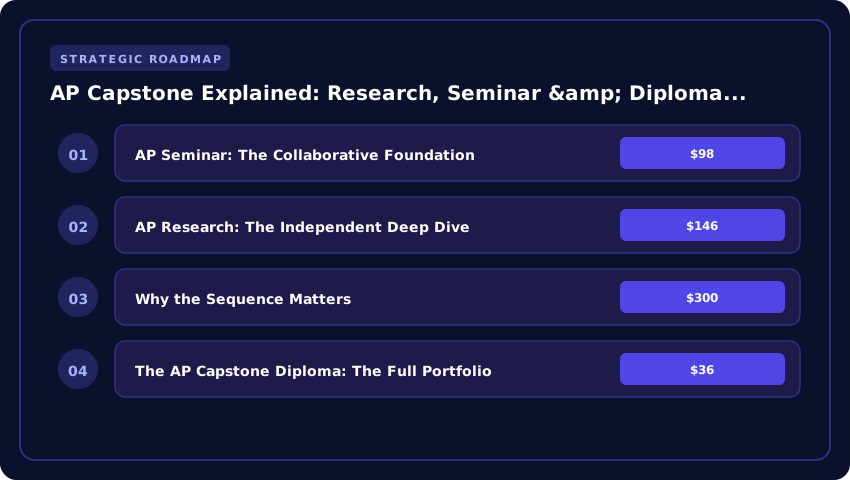
Financially, Capstone sits in a different tier. For the 2024–25 cycle, the standard AP exam fee is $98 per test (approximately ₦155,000 at current CBN rates). AP Seminar and AP Research each carry a $146 fee (roughly ₦230,000 each) because the College Board funds the centralized scoring of performance tasks and the academic paper. A student pursuing the full diploma faces nearly $300 in Capstone fees alone, on top of any four subject-specific AP exams. Fee reductions exist—$36 per exam for eligible low-income students via the College Board and many state subsidies—but the school must process the paperwork correctly and on time. Counselors should verify fee-waiver eligibility before the November ordering deadline to avoid surprise invoices.
Master Schedule Tetris
The scheduling puzzle is often the hardest barrier. AP Seminar demands a full-year block; AP Research demands another. In a traditional seven- or eight-period day, that consumes two precious elective slots across two years. For STEM-focused students chasing Calculus BC, Physics C, and multiple lab sciences, or for International Baccalaureate (IB) candidates managing Theory of Knowledge and Extended Essay overlaps, the transcript real estate vanishes fast. Schools running block schedules (4×4) face a different risk: a student might finish Seminar in the fall of Grade 11 and not take Research until spring of Grade 12, creating a dangerous skills gap. Smart coordinators map four-year graduation plans in Grade 9, flagging Capstone aspirants early so core requirements (health, PE, government) are front-loaded, preserving junior/senior bandwidth for the research sequence.
- Authorization Check: Confirm your school appears on the College Board’s “AP Capstone Schools” list before promising enrollment.
- Budget Line Item: Factor in teacher training costs (~$1,000+ per teacher for APSI) and the higher per-exam fees.
- Schedule Audit: Run a “what-if” graduation audit for every interested sophomore to ensure the two-year block fits without summer school remediation.
Capstone vs. IB Extended Essay vs. A-Level EPQ: Curriculum Comparison
For internationally mobile families navigating the alphabet soup of AP Capstone, the IB Extended Essay (EE), and the A-Level Extended Project Qualification (EPQ), the devil is in the structural details. All three signal “university readiness,” but they demand radically different commitments of time, teacher support, and intellectual stamina.
Scope, Word Counts & Supervisor Dynamics
The AP Research paper caps at 5,000 words, typically produced over a single academic year (roughly 120 guided hours). The IB EE allows 4,000 words but spans 18 months, requiring three mandatory reflection sessions with a supervisor who acts more as a guardian of process than a co-author. The EPQ sits at 5,000 words (or an artefact + 1,000-word report) over one year, with a supervisor offering “guidance not teaching”—a crucial distinction for students used to Nigerian or British tutorial styles where teachers heavily scaffold arguments. AP Seminar’s team project and individual multimedia presentation add a collaborative dimension the others lack, forcing students to defend methodology orally before the final thesis defence.
Assessment Philosophy: Portfolio vs. Single Dissertation
This is the strategic fork in the road. AP Capstone assesses a process portfolio: Seminar scores (Team Project, Individual Essay, End-of-Course Exam) combine with Research scores (Academic Paper, Presentation & Oral Defence). A weak Seminar performance drags down the diploma, but a stellar Research paper can salvage the certificate. The IB EE is a single high-stakes dissertation graded externally on criteria like “Focus & Method” and “Critical Thinking”—one shot, no safety net. The EPQ assesses the production log (planning, decision-making, reflection) alongside the final product, rewarding the journey as much as the destination. For students who thrive on iterative feedback, AP’s multi-component model is forgiving; for the self-starter who wants one deep dive, IB or EPQ fits better.
Global University Recognition Parity
Admissions officers at top-tier universities—from Ivy League to Russell Group and leading Nigerian private universities like Covenant or Pan-Atlantic—view all three as “gold standard” evidence of independent inquiry. However, nuance exists. US colleges often grant course credit or advanced placement for AP Research scores of 4/5, effectively skipping freshman composition seminars. UK universities frequently lower A-Level offers by one grade (e.g., AAA → AAB) for an A* EPQ, treating it as a “super-curricular” differentiator. The IB EE contributes up to 3 core points toward the 45-point diploma, directly lifting the total score used for global rank conversion. No single qualification “wins”; the win comes from aligning the assessment style to the student’s learning profile and target destination.
| Criteria | AP Seminar (Year 1) | AP Research (Year 2) |
|---|---|---|
| Typical Grade Level | Grade 10 or 11 | Grade 11 or 12 |
| Prerequisite | None (Entry point) | Must pass AP Seminar (Score 3+) |
| Core Focus | Collaborative skill-building: argumentation, source evaluation, team research | Independent inquiry: research methodology, ethical practices, academic writing |
| Primary Assessment Components | 1. Team Project & Presentation (20%) 2. Individual Research-Based Essay & Presentation (35%) 3. End-of-Course Exam (45%) |
1. Academic Paper (4,000–5,000 words, 75%) 2. Presentation & Oral Defense (25%) *No written end-of-course exam |
| Key Output Artifact | Individual Written Argument (IWA) ~2,000 words + Team Multimedia Presentation | Academic Thesis Paper (4,000–5,000 words) + Public Defense |
| Skills Developed | Critical thinking, collaboration, synthesis of perspectives, presentation design | Research design, data collection/analysis, scholarly writing, expert defense |
| Role in Capstone Credential | Foundational “Methodological Skeleton” | Culminating “Independent Investigation” |
Frequently Asked Questions
What is the difference between AP Seminar and AP Research?
AP Seminar is a collaborative foundational course teaching argumentation and source evaluation assessed via team projects, individual essays, and a written exam. AP Research is an independent, year-long investigation requiring a 4,000–5,000-word academic paper and oral defense, taken only after passing Seminar.
Can you take AP Research without taking AP Seminar first?
No, you cannot enroll in AP Research without a passing score (typically 3 or higher) in AP Seminar. The College Board mandates this sequence because Seminar builds the methodological skeleton—research questions, evidence evaluation, and citation practices—that Research requires you to flesh out independently.
What are the requirements to earn the AP Capstone Diploma?
To earn the AP Capstone Diploma, students must score 3 or higher on both AP Seminar and AP Research exams, plus score 3 or higher on four additional AP exams of their choosing. Students who pass only Seminar and Research receive the AP Seminar and Research Certificate instead.
How is the AP Seminar exam scored and structured?
AP Seminar uses a three-component scoring model: a Team Project and Presentation (20%), an Individual Research-Based Essay and Presentation (35%), and a timed End-of-Course Written Exam (45%). The final score (1–5) combines these performance tasks and the exam, evaluating argumentation, evidence use, and collaboration.
What is the word count requirement for the AP Research paper?
The AP Research academic paper must be between 4,000 and 5,000 words, excluding the bibliography, abstract, and appendices. This thesis represents the culmination of a year-long independent investigation and accounts for 75% of the final AP Research score, with the remaining 25% derived from the presentation and oral defense.
Strategic Final Takeaway
When evaluating What Are The AP Capstone Courses?, base your decisions on accredited institutional standards, measurable return on investment (ROI), and up-to-date official guidelines. Always verify specific dates and requirements through official regulatory portals.