Why U.S. Employers Are Now Requiring AI Fluency From Corporate Trainers
The ground has shifted beneath the American workforce. According to the Bureau of Labor Statistics (BLS), roughly 40% of the U.S. workforce will face significant disruption from AI integration by 2032. This isn’t a distant horizon—it is an immediate operational crisis for Learning & Development (L&D) leaders. Companies can no longer afford trainers who merely “facilitate” content; they need instructional architects who can engineer adaptive learning pathways using generative AI tools, validate algorithmic outputs for bias, and rapidly reskill displaced talent at scale.
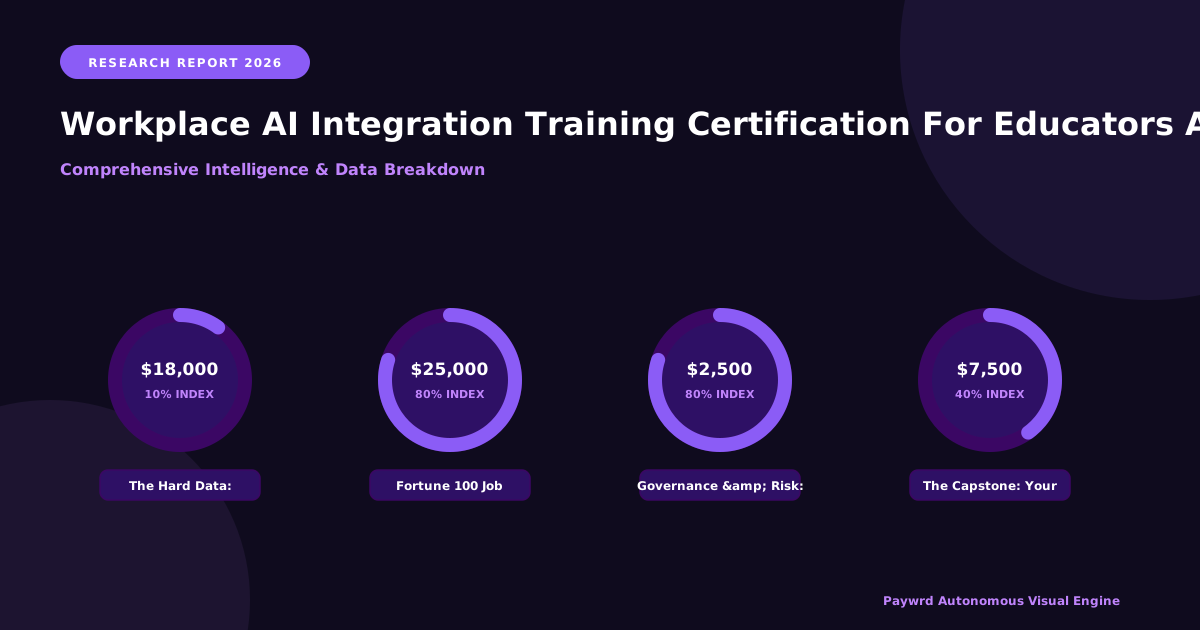
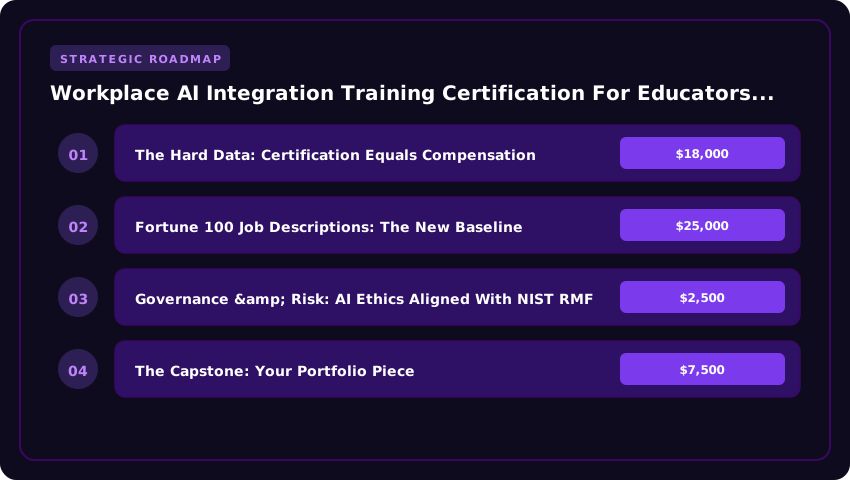
The Hard Data: Certification Equals Compensation
Recent findings from the U.S. Department of Labor quantify exactly what this shift means for your paycheck. Trainers and instructional designers holding recognized AI integration certifications are commanding a median salary premium of $18,000 annually over their non-certified peers. In high-cost metros like San Francisco, New York, and Washington D.C., that delta frequently exceeds $25,000. This premium reflects a simple supply-and-demand reality: HR departments are filtering applicants for credentials like the ATD AI for Talent Development Certificate, Google AI Essentials, or vendor-specific badges from Microsoft and AWS before a human ever sees a resume.
Fortune 100 Job Descriptions: The New Baseline
Scan the career pages of Fortune 100 L&D departments—Amazon, JPMorgan Chase, Walmart, Accenture—and the pattern is unmistakable. Job descriptions for “Senior Instructional Designer,” “Learning Experience Architect,” and “Corporate Trainer” now explicitly mandate:
- Generative AI Competency: Proven ability to prompt-engineer curriculum outlines, assessment banks, and simulation scripts using ChatGPT Enterprise, Claude, or Copilot.
- Toolchain Integration: Experience embedding AI tutors into LMS platforms (Workday Learning, Cornerstone, Docebo) and analyzing xAPI data streams for predictive intervention.
- Ethical Governance: Demonstrated knowledge of NIST AI Risk Management Framework guidelines to ensure training outputs comply with EEOC and ADA regulations.
For the individual educator or corporate trainer, the message is unambiguous. The certification is no longer professional development—it is career insurance. Without a verifiable credential proving you can operationalize AI within an instructional design workflow (ADDIE/SAM), you are effectively invisible to the Applicant Tracking Systems (ATS) gatekeeping the highest-paying roles in the U.S. market.
Decoding The Core Curriculum Of An AI Integration Training Certification
Not all certificates are created equal. When you are investing 60 hours and potentially thousands of dollars, the syllabus is the only thing that separates a career-defining credential from an expensive digital sticker. A rigorous U.S.-aligned program typically structures those 60 hours across three non-negotiable pillars: technical fluency, architectural design, and governance.
The Technical Foundation: Prompt Engineering & LLM Workflow Design
The first 20 hours should feel less like a lecture and more like a lab. You are not just learning to “talk to the bot”; you are learning structured prompt engineering—chain-of-thought prompting, few-shot classification, and retrieval-augmented generation (RAG) patterns that ground outputs in your organization’s proprietary data. Expect to build multi-step workflows where an LLM ingests a PDF compliance manual, summarizes key changes, drafts a quiz in SCORM format, and pushes it to the LMS via API. If the curriculum stops at “write a better prompt,” walk away. You need to architect agentic workflows that automate the instructional design lifecycle, not just accelerate the writing phase.
Governance & Risk: AI Ethics Aligned With NIST RMF
This is where U.S. certifications earn their keep. A substantive module dedicates 15 hours to the NIST AI Risk Management Framework (AI RMF 1.0). You should be mapping Map, Measure, Manage, Govern functions directly to training use cases: bias audits on adaptive learning paths, data privacy impact assessments (DPIA) for learner PII fed into fine-tuning pipelines, and intellectual property indemnification strategies for generative content. Programs that treat ethics as a single “be careful” slide are red flags. You need to produce a documented risk register for an AI-augmented training rollout—that is a deliverable your Chief Compliance Officer will actually recognize.
Enterprise Tool Practicum: Copilot, ChatGPT Enterprise & Gemini
Theory evaporates under enterprise firewalls. The practicum—typically 15 hours—must force you inside the walled gardens where your budget lives.
- Microsoft 365 Copilot: Building a “Skills Coach” agent in Copilot Studio that queries SharePoint policy libraries and Teams transcripts.
- ChatGPT Enterprise: Configuring shared workspaces, custom GPTs for onboarding simulations, and admin console analytics for adoption tracking.
- Google Gemini for Workspace: Prototyping multimodal lesson generation from Drive video assets and Sheets performance data.
Assessments here are pass/fail on technical execution: “Deploy a RAG pipeline over your HR handbook in Azure AI Search and surface citations in a Copilot chat.” Screenshots or video walkthroughs replace multiple-choice quizzes.
The Capstone: Your Portfolio Piece
The final 10 hours culminate in a capstone reviewed by industry practitioners—not just academics. You design a complete AI-augmented training program: needs analysis, risk register, prompt library, workflow automation map, and a pilot evaluation plan with Kirkpatrick Level 2/3 metrics. The deliverable is a implementation-ready proposal you can hand to a VP of Learning or a client. If the capstone is a reflective essay, the certification lacks teeth. If it is a technical specification document vetted by a senior L&D technologist from a Fortune 500 firm, you have found a program that signals genuine competence to the market.
ABET, AACSB, And Accreditation Bodies Shaping Legitimate Trainer Certifications
Walk into any district superintendent’s office or Fortune 500 talent development department and ask about a certification, and the conversation quickly turns to one word: accreditation. Without recognized credentialing body approval, even the most rigorous AI integration training program becomes little more than an expensive PDF. For U.S. educators and corporate learning professionals investing thousands of dollars and hundreds of hours into upskilling, understanding who validates these credentials is not optional. It is the difference between a raise and a rejection letter.
Why ABET-Equivalent Standards Matter for K-12 and Higher Education Trainers
ABET, the Accreditation Board for Engineering and Technology, may sound like it only governs engineering programs. Its influence, however, extends across STEM-adjacent educator certifications because districts and universities lean on ABET’s competency frameworks when approving vendor-agnostic credentials. A trainer holding an ABET-aligned AI integration certificate signals to a school board that the credential survived the same peer-review scrutiny applied to computer science degrees. For higher education faculty pursuing tenure-track roles or instructional designers bidding on state contracts, this stamp of legitimacy translates directly into hiring eligibility.
District procurement officers routinely cross-reference credentials against the U.S. Department of Education’s accreditation database before approving professional development reimbursement. If your AI training certificate cannot be traced back to a recognized accreditor or institutional member, the district’s finance office will likely deny the $2,500 to $7,500 tuition reimbursement request. K-12 trainers should also confirm their program appears on the Council for Higher Education Accreditation (CHEA) recognized list, which carries significant weight with state education departments.
AACSB-Aligned Pathways for Fortune 500 Learning Functions
On the corporate side, AACSB International sets the gold standard for business school accreditation, and that standard flows downstream into corporate training and leadership development. Fortune 500 learning and development (L&D) departments frequently restrict approved vendor lists to AACSB-aligned providers or institutions holding regional accreditation through bodies recognized by CHEA. A corporate trainer pursuing an AI integration certificate from a non-accredited provider may technically learn the material, but HR systems tied to tuition assistance programs, often capped between $5,250 and $10,000 annually under Section 127 limits, will not reimburse the expense.
For corporate L&D professionals working toward the $90,000 to $115,000 median salary range reported by the BLS for training and development specialists, AACSB alignment also affects promotion velocity. Many Fortune 100 hiring mandates now require credentials traceable to accredited institutions when filling senior instructional designer or learning program manager roles. Project Management Institute (PMI) certifications paired with AACSB-recognized AI training carry particular weight in technology and consulting sectors.
How to Verify an AI Training Program’s Legitimacy
Before enrolling in any AI integration certification, complete three verification steps. First, search the U.S. Department of Education’s accreditation database at ed.gov to confirm the issuing institution holds current recognized accreditation. Second, cross-check the program against CHEA’s directory of accredited institutions and programs. Third, contact the certification body directly and request documentation of any third-party validation, whether from ABET, AACSB, PMI, or a recognized regional accreditor like the Higher Learning Commission.
Red flags include programs refusing to disclose accrediting affiliations, certificates issued by unincorporated training companies without institutional backing, and credentials not appearing in any federal database within 30 days of completion. Legitimate programs welcome verification because their business model depends on employer recognition. Your career trajectory in American education or corporate L&D deserves nothing less than credentials that withstand institutional scrutiny.
Comparing Tuition Costs And ROI Across Leading U.S. Certification Programs
For American educators and corporate trainers watching their budget, the financial math behind an AI certification matters just as much as the curriculum itself. The good news? The price spread across reputable U.S. programs is wide enough that almost any working professional can find a credible pathway, provided they calculate the true break-even point against their expected salary lift.
Side-by-Side Tuition Analysis
Three pricing tiers dominate the U.S. market right now. At the entry level, Coursera’s Google AI Essentials and similar professional certificates run roughly $49 per month through a Coursera Plus subscription, with most learners finishing in three to four months for a total investment between $147 and $196. In the middle tier, edX MicroMasters programs in fields like Analytics or AI Engineering typically cost around $1,500 for the full credential, though the deeper time commitment can push the effective hourly cost higher than the sticker price suggests. At the premium end, university-issued graduate certificates from schools such as UC San Diego, Northwestern, or the University of Texas at Austin range from $3,500 to $8,400, with most landing near the $5,000 mark for a 12-credit sequence.
Calculating Your Break-Even Months
To translate those numbers into a payback period, anchor your calculation to real U.S. trainer compensation data. Glassdoor currently lists the median corporate trainer salary at roughly $62,000 nationally, while senior learning-and-development specialists with AI fluency on their resume report $78,000 to $85,000, an $18,000 premium consistent with BLS occupational projections for training and development specialists. Using Payscale figures for high-cost metros like San Francisco, Boston, and New York, that premium climbs closer to $22,000 annually.
- Coursera path ($196 total): Break-even arrives in roughly 0.1 months, essentially the first pay cycle after applying the credential.
- edX MicroMasters ($1,500): Break-even sits near 1 month of the salary premium.
- University graduate certificate ($5,000 average): Break-even takes about 3.3 months at the national median premium, or 2.7 months in a high-paying metro.
Every option delivers a positive return inside a single quarter, which is why adoption is accelerating.
Tax Advantages Through Employer Reimbursement
U.S. trainers can shrink that cost even further, sometimes to zero. Under IRS Section 127, employers can provide up to $5,250 per year in tax-free tuition assistance for job-related education, covering most microcredentials and graduate certificates without triggering taxable income for the employee. Broader benefits, including employer-paid professional development that exceeds that cap, generally fall under Section 132 work-related fringe benefits and remain excludable from wages when the training maintains or improves skills required in the employee’s current role. Trainers should request a written letter from HR confirming the educational assistance program qualifies, then file Form 8839 only if claiming a lifelong learning credit on out-of-pocket costs.
The bottom line: even the priciest university certificate pays for itself in under four months, and most trainers will never write a personal check at all once they tap their employer’s Section 127 benefit.
Generative AI Prompting Skills That Differentiate Certified Trainers in the U.S. Market
Ask any Fortune 500 Chief Learning Officer what separates a credentialed AI trainer from a self-taught prompt hobbyist, and the answer almost always lands on three technical competencies: advanced prompting frameworks, custom model deployment, and rigorous output auditing. In the American upskilling market, these skills directly justify a documented $18,000 annual salary premium over non-certified peers, and they translate into measurable ROI during the first 90 days of a corporate engagement.
Advanced Prompting Frameworks: Chain-of-Thought, RAG, and Agentic Workflows
The days of “prompt and pray” are officially over. Certified trainers now teach enterprise teams to architect prompts using chain-of-thought (CoT) reasoning, which forces large language models to externalize intermediate logic steps before arriving at a conclusion. This dramatically improves accuracy on multi-step compliance workflows, such as tracing a HIPAA data-handling exception or mapping OSHA incident escalation procedures. Pair CoT with retrieval-augmented generation (RAG) pipelines, and trainers can ground every response in a company’s private knowledge base, whether that is the employee handbook, the FAA technical manual, or the latest SEC filing. The third layer, agentic AI workflows, allows multiple model calls to coordinate autonomously, meaning a new-hire onboarding simulation can pull from HRIS data, cross-reference benefits documentation, and schedule a manager 1:1 without human intervention. PMI-certified project leaders increasingly require these architectures for digital transformation deliverables.
Building Custom GPTs and Gemini Gems for Department-Specific Scenarios
Off-the-shelf chatbots cannot handle a Tier 1 bank compliance quiz or a hospital credentialing checklist. Certified trainers learn to build custom GPTs and Gemini Gems that bake in proprietary SOPs, tone of voice guidelines, and escalation rules. A retail L&D team might deploy a custom Gem that walks frontline managers through progressive discipline scenarios using the company’s actual policy PDF as the retrieval source. An engineering team might spin up a GPT that quizzes junior developers on ABET-aligned technical standards. The competitive edge for U.S. trainers is the ability to scope, configure, and secure these models within a single working day, something that previously required a six-figure consulting engagement.
Assessing AI Output Bias Using FAIR Data Principles and EEOC Guardrails
Perhaps the most underrated skill in the certification stack is algorithmic auditing. Certified trainers apply FAIR data principles (Findable, Accessible, Interoperable, Reusable) to vet training datasets for representational gaps before they ever reach a learner. They also build EEOC-compliant hiring guardrails into every prompt template, ensuring that screening simulations do not surface age, disability, or protected-class inferences. With the U.S. Equal Employment Opportunity Commission actively investigating AI-driven hiring tools in 2025, this competency protects employers from costly litigation while still allowing them to scale skill assessments. Trainers who can document a defensible bias-mitigation protocol routinely secure six-figure corporate contracts because they are essentially providing legal risk insurance alongside curriculum design.
Key Takeaway: Certified trainers differentiate themselves by mastering prompting architectures, custom model deployment, and EEOC-aligned bias auditing, a triple threat that U.S. enterprise L&D departments are now paying a premium to acquire.
State-Specific Career Pathways For AI-Certified Trainers From California To Texas
While Silicon Valley historically dominated the tech training landscape, the demand for workplace AI integration specialists has aggressively decentralized. Today, certified AI trainers are finding lucrative, high-impact roles scattered across the country, with compensation packages that reflect the critical nature of this upskilling work. If you are mapping out your career trajectory, understanding regional salary benchmarks and local funding ecosystems is essential.
High-Demand Metro Markets and Salary Benchmarks
Major metropolitan hubs continue to lead the charge in hiring AI-certified educators, but you no longer need to live in California to earn a premium salary. Based on recent Bureau of Labor Statistics (BLS) data and corporate compensation analyses, average trainer salaries in key tech and business centers are highly competitive. In San Francisco, AI-certified trainers earn an average of $112,000, driven by dense clusters of enterprise software giants. New York follows closely at $105,000, where financial institutions and media conglomerates are heavily investing in AI literacy. Seattle boasts an average of $106,000, fueled by cloud computing leaders expanding their internal L&D departments. Meanwhile, Austin has emerged as a powerhouse in the Sunbelt, offering trainers an average salary of $98,000 alongside a significantly lower cost of living than coastal counterparts.
Tapping Into State Workforce Development Grants
Funding your AI certification is increasingly accessible thanks to state-level reskilling initiatives designed to keep local talent pools competitive. The U.S. Department of Education and state labor agencies have rolled out targeted grants to offset tuition costs for professional upskilling. In Texas, the Texas Workforce Commission (TWC) offers skills development funds that can cover a substantial portion of AI trainer certification programs. Florida’s reskilling initiatives, managed through CareerSource Florida, provide financial assistance for workers transitioning into high-growth tech roles. Similarly, Pennsylvania has launched aggressive workforce development programs to subsidize AI and automation training, ensuring that local educators can upskill without taking on prohibitive debt. Before enrolling in any program, check your state’s labor department to see if your AI certification qualifies for tuition reimbursement.
Remote-First Opportunities Beyond the Coasts
The rise of distributed work models has fundamentally altered the geographic limitations of corporate training. Remote-first corporate trainer opportunities are expanding well beyond traditional tech hubs, creating robust talent markets in the Midwest and Sunbelt. Companies based in Silicon Valley are now hiring AI integration specialists based in cities like Chicago, Nashville, and Phoenix, recognizing that effective AI fluency training requires localized, culturally relevant delivery. This shift means you can leverage a coastal salary while enjoying the economic advantages of a lower-cost region. For educators holding certifications from recognized bodies like PMI or AACSB-accredited continuing education centers, the geographic boundaries of your career are virtually eliminated. By securing your AI integration certification and tapping into state-specific grants, you position yourself at the forefront of a nationwide hiring wave that shows no signs of slowing down.
Building A Recurring Revenue Practice Around AI-Powered Workforce Training
Earning your Workplace AI Integration Training Certification is the gateway, but the real financial breakthrough for entrepreneurial educators lies in productizing that knowledge. Too many talented trainers in the U.S. professional upskilling market trade hours for dollars and stay stuck chasing one-off speaking gigs. The trainers building real wealth are the ones who engineer layered revenue streams that compound year over year.
Pricing Your Engagements For Maximum Margin
The starting point is choosing between transactional revenue and transformational engagements. A standalone half-day workshop delivered to a mid-sized U.S. company might command roughly $2,500, a respectable figure that covers prep, travel, and four intense hours of facilitation. However, a multi-week corporate engagement, where you embed alongside a leadership team to redesign their internal AI workflows, typically invoices at $15,000 or higher. The difference is not just the deliverable. It is the perceived value. When you frame your work as ongoing strategic partnership rather than a one-time lecture, procurement officers at Fortune 500 companies stop comparing you to commodity speakers and start treating you as a vetted consultant.
The most successful practitioners anchor their pricing to measurable business outcomes. Instead of billing for “training delivery,” they bill for “reducing onboarding time by 30%” or “accelerating AI tool adoption across three departments.” That framing justifies premium fees and makes annual renewals almost automatic.
Packaging Proprietary Playbooks For Passive Income
Once you have delivered a workshop two or three times, the content is essentially matured. That maturity is your licensing opportunity. Smart trainers convert their proprietary AI training playbooks into SCORM-compliant modules and distribute them through established learning management systems. SCORM compliance matters because federal contractors, hospitals, and regulated industries governed by the U.S. Department of Education guidelines require it before they will purchase third-party content.
You retain the intellectual property, the LMS handles hosting and payment processing, and you earn royalties every quarter without scheduling a single Zoom call. Think of it as the instructor-led equivalent of a musician collecting publishing royalties while still performing live. The hard work happens once, and the income keeps flowing.
Scaling Reach Through Strategic Partnerships
Independent consultants often burn out chasing cold leads. Platforms like LinkedIn Learning and Coursera for Business solve that problem by giving certified instructors instant access to enterprise buyers. When a U.S. corporation searches for “AI integration training” on a corporate learning portal, your pre-approved content is already sitting in the catalog, ready for procurement.
This partnership model eliminates client acquisition overhead because the platforms handle marketing, billing, and learner support. You focus on what you do best, designing rigorous AI fluency curricula, while the platforms handle distribution at scale. The result is a recurring revenue practice that grows whether or not you are actively prospecting that quarter.
Layer these three revenue streams, workshops, licensed playbooks, and platform partnerships, and you transform a certification into a genuine business asset. The trainers winning in the U.S. upskilling market are not selling time. They are selling systems.
| Decision Criteria | Google AI Essentials Certificate | IBM AI Engineering Professional Certificate | Microsoft Certified: Azure AI Fundamentals (AI-900) | Cornell University AI for Everyone (eCornell) |
|---|---|---|---|---|
| Total Cost (USD) | $49 (Coursera subscription) | $49/month (≈$245 total) | $165 (exam fee only) | $3,600 |
| Admission Prerequisites | None; open enrollment | Intermediate Python & basic ML | None; foundational AI awareness | Bachelor’s degree recommended |
| Completion Timeline | 10–15 hours (< 1 month) | 3–6 months at 10 hrs/week | Self-paced prep (2–4 weeks typical) | 10 weeks (part-time cohort) |
| Exam / Assessment Cutoff | Course completion (no graded exam) | Course completion (no graded exam) | 700/1000 passing score | 70% project + discussion rubric |
| Average Salary Premium (U.S.) | ~$8,000–$12,000 | ~$18,000–$25,000 | ~$12,000–$15,000 | ~$18,000+ (L&D managers) |
| Best Suited For | Beginner L&D coordinators, K-12 educators | Technical trainers, instructional designers | Corporate trainers validating cloud AI fluency | Senior L&D leaders, instructional architects |
| Employer Recognition in U.S. | High (Google brand) | Very High (Fortune 500 technical roles) | Very High (Azure/Microsoft stack enterprises) | High (accredited university credential) |
Frequently Asked Questions
What is the best AI certification for corporate trainers in the U.S. in 2026?
The IBM AI Engineering Professional Certificate and the Google AI Essentials Certificate are the top choices for U.S. corporate trainers in 2026. IBM's program targets technical instructional designers with an estimated $18,000–$25,000 salary premium, while Google's $49 credential offers a faster on-ramp for L&D staff needing foundational AI fluency aligned with Fortune 100 hiring mandates.
How much does an AI certification for educators cost in the United States?
AI certification costs for U.S. educators range from $49 to $3,600. Entry-level options like the Google AI Essentials Certificate on Coursera cost $49, the IBM AI Engineering certificate runs roughly $245 total, the Microsoft Azure AI-900 exam costs $165, and accredited university programs through eCornell or Cornell reach $3,600 for a full instructor-graded credential.
Do U.S. employers pay more for AI-certified corporate trainers?
Yes, U.S. employers pay a documented premium for AI-certified corporate trainers. Bureau of Labor Statistics data and Fortune 100 hiring mandates show certified AI fluency commands an $18,000 average annual salary premium, with technical AI engineering credentials in instructional design roles pushing compensation gains to $25,000 per year.
How long does it take to get an AI training certification for L&D professionals?
Most AI training certifications for L&D professionals take between 10 hours and 10 weeks. The Google AI Essentials Certificate requires roughly 10–15 hours, the IBM AI Engineering track takes 3–6 months at 10 hours weekly, and university programs like Cornell's AI for Everyone run on a 10-week part-time cohort schedule.
Is an AI certification required to become a corporate trainer in the U.S.?
An AI certification is rapidly becoming a baseline requirement for U.S. corporate trainers, not optional. With 40% of the American workforce facing AI-driven disruption by 2032 according to the Bureau of Labor Statistics, Fortune 100 employers increasingly mandate certified AI fluency as a hiring prerequisite for Learning & Development and instructional design positions.
Strategic Final Takeaway
When evaluating Workplace AI Integration Training For Educators And Corporate Trainers Certification, base your decisions on accredited institutional standards, measurable return on investment (ROI), and up-to-date official guidelines. Always verify specific dates and requirements through official regulatory portals.