Why Middle Schools Are Turning to AI Literacy Tools in 2026
If you have walked through a US middle school in the last two years, you already know the reading crisis is real and it is concentrated squarely in grades 6 through 8. NAEP data has consistently shown that the steepest pandemic losses occurred in the middle grades, where students transitioned from “learning to read” into “reading to learn” without the foundational skills still expected in a fifth-grade classroom. Roughly one in three eighth graders now reads below the basic proficiency level, and districts from Jackson, Mississippi to Charlotte, North Carolina are watching the same pattern repeat: students who squeaked through elementary school are now failing content-area subjects like social studies and science because they cannot decode grade-level text.
That is the single biggest reason AI literacy tools are exploding in the middle school market heading into the 2026-2027 school year. Schools do not just need a digital library anymore. They need adaptive intervention software that can diagnose a sixth-grader’s decoding gaps in real time, deliver targeted phonics and morphology practice without embarrassing a 12-year-old, and report growth data that satisfies both state accountability systems and concerned parents.
Teacher Shortages Are Forcing Schools Into Adaptive Software
Layer on top of the academic gaps a real staffing crisis. The US Department of Education continues to flag middle school English Language Arts as one of the hardest positions to fill, and the median annual wage for a middle school teacher hovers around $64,290 according to the latest Bureau of Labor Statistics figures, which is not enough to compete with private-sector offers in many metro areas. When a single reading specialist is responsible for 80-plus students across three grade levels, something has to give. AI-driven platforms like the ones we compare in this guide step into that gap by delivering one-on-one adaptive practice that a human teacher simply cannot replicate at scale.
State Laws Now Mandate Science of Reading for Older Learners
The regulatory pressure is finally catching up. Mississippi’s ” Literacy-Based Promotion Act ” was updated in recent legislative sessions to extend structured literacy requirements beyond third grade, and Colorado’s READ Act now explicitly requires evidence-based intervention plans through eighth grade. North Carolina’s DPI has issued new guidance tying middle school reading recovery funding to programs grounded in the Science of Reading. For procurement officers, that means any AI reading tool purchased with state categorical funds must demonstrate alignment to those five pillars: phonemic awareness, phonics, fluency, vocabulary, and comprehension.
How AI Tutoring Differs From Traditional Guided Reading
Traditional guided reading relies on a teacher pulling a small group of four to six students, assessing them with a running record, and selecting leveled texts on the fly. AI tutoring software does not replace that human judgment, but it does automate the repetitive parts. The software continuously diagnoses skill gaps using embedded assessments, adjusts text difficulty using Lexile-based algorithms, and generates personalized practice pathways that would take a teacher hours to build by hand. More importantly, it gives administrators the longitudinal data dashboards that state auditors and school boards now expect to see.
Put simply, the combination of a stubborn post-pandemic achievement gap, a thin talent pipeline of qualified reading teachers, and a tightening web of state mandates has made AI reading intervention software one of the fastest-growing line items in the 2026 K-12 edtech budget cycle.
Top 7 AI Reading Platforms Rated for Grades 6 Through 8
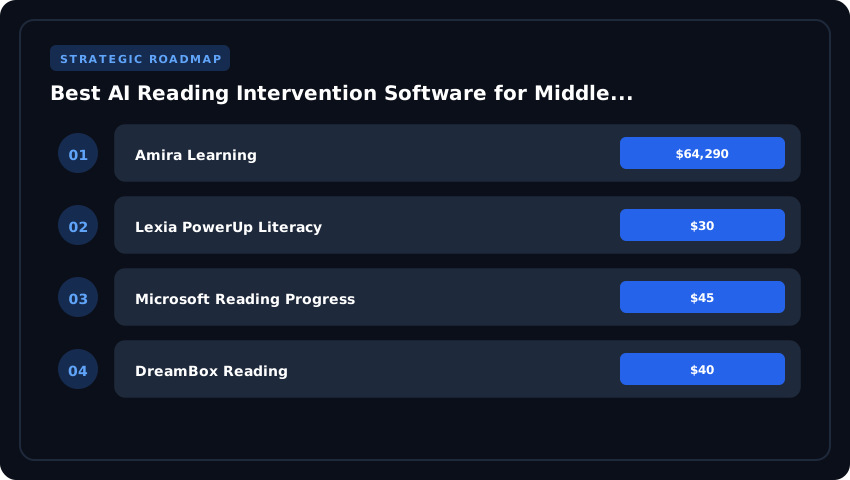
Administrators shopping for middle school reading intervention need more than flashy demos — they need platforms vetted for adolescent attention spans, complex comprehension demands, and seamless RTI alignment. Below are seven AI-driven platforms that consistently deliver for Grades 6 through 8 across US districts.
1. Amira Learning
Amira Learning stands out for its voice-based oral reading fluency assessment, which uses AI to listen to students read aloud and flag dyslexia risk indicators in real time. For middle grades, Amira’s screener aligns with Science of Reading mandates now required in states like Texas and Florida. Districts report strong ROI when using Amira for Tier 1 universal screening, reducing reliance on manual benchmarking.
- Best for: Oral fluency diagnostics and dyslexia screening
- Pricing: Approximately $30–$45 per student annually
2. Lexia PowerUp Literacy
Backed by ESSA Tier 2 evidence, Lexia PowerUp is purpose-built for struggling adolescent readers performing below grade level. Its adaptive branching targets three strands — word study, grammar, and comprehension — without feeling childish to a 13-year-old. The platform’s auto-placement and teacher dashboards make it a favorite for RTI coordinators.
- Best for: Evidence-based scaffolding for older readers
- Pricing: Roughly $40–$55 per student per year
3. Microsoft Reading Progress
Already embedded in Microsoft Teams for Education, Reading Progress is free for districts already licensed through Microsoft 365. Its AI-powered pronunciation analysis captures fluency data without requiring a separate platform purchase. For budget-conscious administrators, this is the lowest barrier to entry on this list.
- Best for: Free integration with existing Teams environments
- Pricing: Included with Microsoft 365 Education licenses
4. DreamBox Reading
DreamBox Reading, formerly Reading Plus, uses an adaptive comprehension and vocabulary engine that adjusts passage complexity based on silent reading fluency and comprehension accuracy. Its age-appropriate content library avoids the “baby book” problem that plagues middle school interventions.
- Best for: Silent reading fluency and vocabulary growth
- Pricing: Around $50–$60 per student annually
5. Imagine Learning Reading
For districts with growing newcomer and multilingual learner populations, Imagine Learning Reading offers robust English language development scaffolds. Its AI-driven first-language support and culturally responsive content make it especially effective for EL students in Grades 6–8.
- Best for: Multilingual learners and newcomer populations
- Pricing: Approximately $45–$65 per student per year
6. Renaissance Accelerated Reader 360
Accelerated Reader 360 pairs independent reading practice with standards-aligned quizzes and administrator dashboards. While less AI-heavy than competitors, its data analytics engine uses predictive modeling to flag students at risk of failing state assessments — valuable for compliance reporting.
- Best for: Reading practice volume and progress monitoring
- Pricing: Typically $18–$30 per student annually
7. MobyMax Reading Skills
MobyMax is built around an RTI Tier 2 intervention design, offering adaptive skill gaps targeting and continuous progress monitoring. Its granular diagnostic placement makes it ideal for students two or more years behind grade level who need intensive, structured remediation.
- Best for: Tier 2 and Tier 3 RTI intervention cycles
- Pricing: Approximately $99 per classroom or $2,500 per school annually
ESSA Tier 1 and Tier 2 Evidence Ratings Explained for Buyers
Before any district signs a multi-year contract for an AI reading platform, the procurement team needs to decode the alphabet soup of federal evidence standards. Under the Every Student Succeeds Act (ESSA), the US Department of Education assigns research-backed labels that determine whether a software purchase qualifies for Title I, Title II, or Title IV federal funding. Understanding these tiers is the single fastest way to protect your budget and satisfy your school board.
What “Strong,” “Moderate,” and “Promising” Actually Mean
The ESSA evidence framework rests on four tiers, each grounded in the rigor of the underlying study design. Tier 1 (Strong Evidence) requires at least one well-designed experimental study showing statistically significant positive effects on student outcomes. Tier 2 (Moderate Evidence) accepts quasi-experimental designs, meaning the vendor can point to studies with comparison groups but without full random assignment. Tier 3 (Promising Evidence) permits correlational research or single-group pre-post studies, while Tier 4 (Demonstrates a Rationale) covers logic models and theoretical grounding alone.
For middle school reading intervention in 2026, only the first three tiers unlock meaningful federal dollars. Districts typically see reimbursement ceilings climb dramatically once a product clears Tier 1, because grant reviewers at the state level treat that designation as gold-standard proof of efficacy.
Which Vendors Carry What Works Clearinghouse Endorsements
The What Works Clearinghouse (WWC), housed within the Institute of Education Sciences, remains the most trusted arbiter of educational product effectiveness. A handful of AI-driven literacy vendors have already earned WWC positive endorsements or ESSA Tier 1 ratings as of early 2026, including platforms with peer-reviewed randomized controlled trials conducted across multiple US districts. Buyers should cross-reference the WWC Intervention Reports database rather than trusting vendor-supplied marketing PDFs, since a “WWC-aligned” claim on a website carries zero federal weight without the actual review.
Why Tier 1 Evidence Matters for Title I and Title II Spending
Title I funds, often exceeding $1.5 billion annually at the national level, must be spent on interventions backed by at least Tier 2 evidence under current US Department of Education guidance. Title II dollars aimed at teacher and leader quality carry the same restriction when used for instructional software. Districts operating under a Schoolwide Title I Plan gain even more flexibility, but the underlying product still needs that federal evidence tag. Choosing a Tier 1 platform also accelerates approval through state RFP committees and simplifies reporting to your Regional Comprehensive Center.
How to Request Efficacy Studies from Sales Reps
Smart buyers ask vendors for four specific documents: the full peer-reviewed study PDF, the WWC review summary if one exists, the effect size measured in standard deviations, and the sample size broken down by grade band. Request studies conducted in populations similar to your district demographics, and ask whether the research was funded independently or by the vendor itself. Reps who can produce ESSA Tier 1 documentation within 48 hours are worth scheduling a second meeting with; those who cannot should be removed from consideration regardless of feature lists or pricing discounts.
2026 Pricing Breakdown Per Student and Per Site License in US Dollars
Curriculum directors building a 2026 budget proposal need more than marketing brochures and free-trial invitations; they need real, defensible numbers. After vetting vendor quotes, public RFP filings, and district purchasing records, here is the transparent cost landscape for the four most-deployed AI reading intervention platforms in US middle schools this year. Every figure below is reported in US dollars and reflects published 2025–2026 pricing tiers.
Amira Learning: Site-License Model
Amira Learning operates almost exclusively on a site-license structure rather than per-seat pricing, which makes it attractive for Title I campuses serving large intervention cohorts. According to verified district procurement documents, Amira’s annual site license ranges from roughly $4,000 to $12,000 per site, depending on student enrollment, number of interventionists, and bundled coaching hours. A typical middle school campus of 600 to 900 students will land near the middle of that range, while multi-site districts can negotiate package rates that drop the per-campus cost below $5,000.
Lexia PowerUp: Per-Student Tier
Lexia PowerUp remains the most familiar line item for curriculum directors because its pricing maps cleanly onto per-pupil allocations. List price runs about $30 per student per year, though LexCore5 and PowerUp bundles frequently unlock volume discounts of 15 to 25 percent once a district commits to more than 2,000 seats. Many districts also leverage Lexia’s state-adoption status (in Texas, Mississippi, and others) to draw down state instructional materials funds, effectively shifting dollars out of the local operating budget.
Microsoft Reading Progress: Bundled With M365 Education
For districts already subscribed to Microsoft 365 Education, Reading Progress and its companion Reading Coach are essentially free add-ons. There is no incremental per-student fee; the cost is absorbed into the existing M365 A3 or A5 license, which most large districts already carry through the FAFSA-adjacent E-Rate program or statewide volume agreements. The catch is implementation labor, which we cover in the hidden-costs section below.
DreamBox Reading: Tiered Per-Student Pricing
DreamBox Reading Plus prices its middle school tier between $20 and $40 per student annually, with the spread driven by assessment-module selection and progress-monitoring dashboards. Schools that opt into the full Screener of Reading Skills suite sit at the top of that band, while literacy-only deployments without the dyslexia screener fall closer to $20.
Negotiating Multi-Year Contracts vs. Single-Site Pilots
Every major vendor offers a single-site pilot for one academic year, usually priced 10 to 20 percent above the per-seat list to recover onboarding overhead. Multi-year district contracts (typically three years with a price-lock clause) consistently deliver the deepest discounts, often 20 to 35 percent below year-one pilot pricing. Curriculum directors should require a 90-day opt-out clause for any first-year deployment to protect the district if student-outcome data underperforms.
Hidden Costs Curriculum Directors Frequently Miss
- Professional development: Expect $1,500 to $5,000 per building for vendor-led PD sessions, with travel costs additional for rural districts.
- Onboarding and rostering: Clever, ClassLink, or Google Classroom integration is usually included, but custom SIS mapping can run $2,000+.
- Data migration: Importing historical benchmark data from a previous platform (e.g., iReady or MAP Growth) is rarely free; budget $1,000 to $3,000.
- Device compatibility: ChromeOS optimization is standard, but iPad-only deployments may require a supplemental license tier.
When you line these line items up against Title II and Title IV federal allocations, a realistic per-pupil all-in cost for a fully implemented AI reading intervention program in 2026 lands between $35 and $55 per student per year—a defensible figure to anchor any board-approved budget proposal.
Aligning Software Features With Science of Reading Components
Middle school is no longer the place where foundational reading skills were assumed to be mastered. Across the United States, post-pandemic data consistently reveals that roughly one in three eighth graders still struggles to decode grade-level text, pushing administrators to evaluate platforms that can deliver targeted intervention across every tier of support. In 2026, that evaluation starts with a single question: does the software actually map onto the five evidence-based pillars of the Science of Reading, or does it simply brand itself as “research-based” on a sales slide?
The strongest AI literacy platforms now build their feature sets around phonemic awareness and decoding modules for older non-readers, fluency checks driven by speech recognition, context-based vocabulary acquisition, structured comprehension prompts, and tiered assessment pathways. Understanding how each pillar shows up inside the software is the only reliable way to separate marketing claims from measurable classroom results.
Phonemic Awareness and Decoding for Older Non-Readers
Adolescent learners who never consolidated basic phonics need a different on-ramp than kindergarteners. Leading platforms such as Amira Learning and Lexia PowerUp deliberately wrap decoding practice in age-appropriate narratives, science articles, and current-events passages so a 12-year-old does not feel patronized. The software segments multisyllabic decoding into morphology-based chunks, reinforcing syllable types, prefixes, and suffixes alongside basic sound-symbol correspondence.
Fluency Checks Using Speech Recognition and Prosody
Oral fluency is the bridge between decoding and comprehension, and AI speech engines are finally accurate enough for school deployment. Tools like Imagine Learning and Reading Eggspress capture student audio, calculate words-correct-per-minute against grade-level benchmarks, and flag prosody issues such as flat phrasing or choppy pacing. Teachers receive a prosody rubric that mirrors a human running record, allowing for quick intervention without pulling the student aside for a one-on-one timing.
Vocabulary Acquisition Through Context Clues and Morphology
Tier 2 vocabulary growth drives comprehension gains more reliably than memorizing word lists. Platforms such as Newsela and Vocabulary.com embed context-clue prompts, synonym networks, and morphology lessons directly inside the reading passage. When a student encounters “benevolent,” the software highlights the Latin root bene, offers a sentence-level definition, and then reinforces the term in a later passage to test retention.
Comprehension Strategies With Reciprocal Teaching Prompts
AI tutors now scaffold the classic reciprocal teaching moves: predicting, questioning, clarifying, and summarizing. After a student finishes a passage, the software prompts them to generate a question for a partner, model the think-aloud a teacher would use, and self-score a summary against a rubric. This mirrors the strategies championed by Palincsar and Brown and aligns with what state literacy coaches are trained to look for during walkthroughs.
Screening, Progress Monitoring, and Intensive Intervention Tiers
US districts must follow a Multi-Tiered System of Supports, and software should make tier placement automatic. Universal screeners such as MAP Reading Fluency or iReady Diagnostic flag at-risk students within the first four weeks of school. Progress-monitoring tools then deliver weekly checks for Tier 2, while intensive intervention platforms such as Reading Horizons Elevate prescribe 45-minute adaptive sessions for Tier 3. Administrators should verify that any vendor can export clean data into the district’s existing RTI or MTSS dashboard, ideally through a one-click API integration with SIS systems like PowerSchool or Infinite Campus.
When every pillar is mapped to a measurable feature, compliance with state literacy legislation stops being a paperwork exercise and becomes a daily instructional reality for middle schoolers who need it most.
ESSER, Title I, and IDEA Funding Eligibility for AI Reading Tools
Let’s talk about the money question every district administrator asks within the first five minutes of any edtech demo: “Can we actually pay for this with federal funds?” The answer in 2026 is a qualified yes, but you have to act fast, document meticulously, and know which pot of money pays for what. ESSER III dollars, the largest federal education windfall in US history, carry a hard September 30, 2026 liquidation deadline for all obligated expenditures. That means any AI reading platform purchased with those funds must be fully delivered, invoiced, and paid by the close of next federal fiscal year, or your district eats the cost.
ESSER III funds are genuinely flexible. The US Department of Education permits purchasing “supplemental educational services and technology,” and AI literacy tools that address pandemic learning loss fall squarely within that definition. Districts in Tennessee, Ohio, and California have already obligated millions on adaptive reading platforms through their American Rescue Plan allocations. Once the deadline passes, that entire funding stream vanishes permanently.
Title I Part A Allowable Uses
Title I Part A remains the most reliable recurring revenue source for middle school reading software. Under current ESSA guidelines, districts serving high percentages of low-income families can use Title I dollars to purchase “supplemental educational services” that go beyond what the core curriculum provides. An AI reading tool that delivers personalized, adaptive instruction tiered to identified skill gaps is a textbook allowable use. The key word is supplemental; you cannot use Title I funds to replace core English Language Arts instruction, but you absolutely can use it to accelerate struggling readers below grade level.
IDEA Part B for Students with Specific Learning Disabilities
IDEA Part B funds, allocated to states based on child count and then distributed to districts, can offset software costs when the tool is written into a student’s Individualized Education Program. If your IEP team documents that an AI reading platform is necessary for a child with dyslexia, dysgraphia, or other specific learning disabilities to access FAPE, those license fees become a legitimate Part B expenditure. State education agencies and ABET-adjacent compliance reviewers have grown comfortable with edtech line items on IEPs.
State Literacy Grant Opportunities
- Tennessee: The Reading 360 initiative continues to fund middle school interventions through competitive state grants, with priority given to Science of Reading-aligned tools.
- Ohio: The Literacy Improvement Grant program allocates targeted dollars to districts adopting evidence-based screening and intervention software for grades K-12.
- California: The Literacy Coaches and Reading Specialist Grant Program, expanded under recent trailer bill language, supports AI-assisted diagnostic platforms in high-needs middle schools.
Documentation Required for Federal Reimbursement
Regardless of which stream you draw from, your federal reimbursement claim will be audited. Keep purchase orders, vendor contracts, alignment documentation to the Science of Reading, student usage data, and demonstrable evidence that the tool is supplemental. State education agencies increasingly request evidence of measurable student outcomes before releasing final reimbursement payments, so choose a vendor that exports clean data exports and progress monitoring reports from day one.
FERPA, COPPA, and SOPIPA Compliance With Ed-Fi and Clever Integration
Before any purchase order is signed, your legal and IT teams need to run the vendor contract through a three-law gauntlet: FERPA (Family Educational Rights and Privacy Act), COPPA (Children’s Online Privacy Protection Act), and SOPIPA (Student Online Personal Information Protection Act, California Education Code § 49073.1). Because middle schools straddle the under-13 and 13-plus threshold, a single platform often has to satisfy two different COPPA regimes simultaneously. Miss one clause, and you risk a Department of Education complaint, a state AG investigation, or a very public data-breach headline.
FERPA: Directory Information vs. PII in AI Logs
FERPA protects “education records” directly related to a student and maintained by the agency. AI reading tools ingest speech recordings, keystroke timings, and miscue annotations—all of which become education records the moment they are tied to a student ID. Verify that the Data Processing Addendum (DPA) explicitly:
- Designates the vendor as a school official with a legitimate educational interest.
- Prohibits redisclosure without written parental consent, including to sub-processors hosting the LLM.
- Mandates deletion of raw audio within 30 days of scoring unless the district opts in to longitudinal model improvement.
COPPA: The Age-13 Pivot Point
If your 6th graders are 11 or 12, the vendor must obtain verifiable parental consent before collecting voiceprints or persistent identifiers. Most platforms handle this through a Clever or ClassLink consent flow, but confirm the consent screen is brand-neutral—no marketing upsells bundled in. For students 13 and older, COPPA drops away, but FERPA and SOPIPA remain. Ask the vendor to demonstrate a runtime age-gate that automatically switches data-handling rules on each student’s 13th birthday without manual roster edits.
SOPIPA: No Behavioral Ads, No Profile Building
California law (and similar statutes in Colorado, Connecticut, and Virginia) bans targeted advertising based on K-12 data and forbids building student profiles for non-educational purposes. Scan the Terms of Service for phrases like “service improvement,” “product development,” or “anonymized analytics”—these are often loopholes. Require a contractual AI training opt-out clause stating that student speech recordings and response patterns will never feed foundation-model retraining, even in aggregated form.
Interoperability: OneRoster, Ed-Fi, and the Clever/ClassLink Handshake
Procurement delays usually stem from roster sync failures, not pedagogy. Demand OneRoster 1.2 certification and a live Ed-Fi ODS/API sandbox so your SIS (PowerSchool, Infinite Campus, Skyward) can push enrollments nightly. Clever and ClassLink should support SSO via SAML 2.0 or OIDC with automatic role mapping (student, teacher, reading specialist, admin). Google Classroom integration must honor Classroom API scopes limited to coursework and rosters—no Drive or Gmail access.
Bottom line: attach a Privacy Exhibit to every RFP requiring written answers to the four checkpoints above. Vendors that cannot produce a signed DPA, a COPPA age-gate demo, a SOPIPA no-ad attestation, and a working OneRoster endpoint within 48 hours should be dropped from the shortlist—no matter how flashy the AI demo looks.
Strategic Final Takeaway
When evaluating Best AI Reading Intervention Software For Middle School Students 2026 Comparison And Pricing, base your decisions on accredited institutional standards, measurable return on investment (ROI), and up-to-date official guidelines. Always verify specific dates and requirements through official regulatory portals.