How Researchers Actually Measure Early Literacy Growth in Five-Year-Olds
Before any parent trusts a headline claiming that virtual kindergarten outperforms traditional classrooms (or lags behind it), they need to look under the hood at how researchers actually capture early literacy growth. The science is less glamorous than viral blog posts suggest, but it is far more useful once you understand it. Three foundational skill sets anchor nearly every kindergarten literacy assessment in the United States: phonemic awareness, decoding, and oral vocabulary. Together, these predict later reading achievement with remarkable accuracy, which is why they show up in nearly every federally reviewed curriculum.
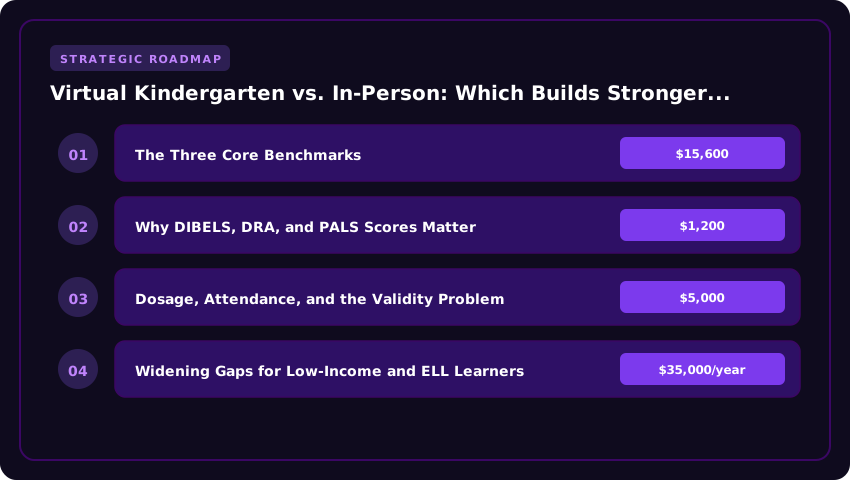
The Three Core Benchmarks
Phonemic awareness refers to a child’s ability to hear, identify, and manipulate individual sounds (phonemes) in spoken words. It is the earliest reliable predictor of reading success, often measured through tasks where students blend, segment, or substitute sounds. Decoding is the next step up: applying letter-sound knowledge to read unfamiliar words, typically evaluated through nonsense-word fluency or letter-sound correspondence tasks. Oral vocabulary captures how many words they understand when spoken, assessed through picture-based expressive tasks or listening comprehension passages. Together, these three benchmarks align with the Common Core State Standards expectations for kindergarten exit and serve as the backbone for nearly every early literacy screener used in US public schools.
Why DIBELS, DRA, and PALS Scores Matter
Three assessment systems dominate the conversation when comparing virtual and in-person cohorts. DIBELS (Dynamic Indicators of Basic Early Literacy Skills) is the most widely adopted universal screener across US school districts, measuring letter naming fluency, phoneme segmentation fluency, and oral reading fluency at benchmark intervals. DRA (Developmental Reading Assessment) provides a more granular look at reading behaviors and comprehension levels, often used to track progress within a school year. PALS (Phonological Awareness and Literacy Screening) is heavily used in Virginia and several other states, with strong predictive validity for first-grade outcomes. When you see a study comparing virtual vs. brick-and-mortar kindergarten cohorts, the credibility hinges on whether the researchers controlled for which assessment was used and how consistently it was administered.
Dosage, Attendance, and the Validity Problem
Here is the nuance most infographics skip: a literacy score is only as good as the instructional minutes behind it. Researchers use the term dosage to describe the actual quantity of literacy instruction a student absorbed, not just enrolled in. A five-year-old logged in for two hours of synchronous virtual learning is fundamentally different from one who sat through six hours of in-person small-group reading rotation. Attendance adds another wrinkle, since chronic absenteeism (defined by the US Department of Education as missing 10% or more of school days) can depress scores regardless of modality. Researchers comparing virtual vs. in-person cohorts must statistically control for both, otherwise the comparison is essentially meaningless. Parents reviewing any study should look for whether the authors reported instructional minutes, attendance rates, and teacher-student ratios alongside the outcome data, because without those controls, even a beautifully significant p-value tells you very little about what actually helped the child learn.
What NAEP and State-Level Data Reveal About Virtual Kindergarten Reading Scores
When it comes to measuring how five-year-olds learn to read, the United States relies heavily on a layered system of federal and state-level assessments. At the top sits the National Assessment of Educational Progress (NAEP), often called “The Nation’s Report Card,” which has tracked fourth-grade reading proficiency for decades. While NAEP does not yet isolate virtual kindergarten enrollment specifically, its state-level disaggregation has become the most cited evidence in the virtual versus in-person literacy debate. State education departments in California, Florida, and Ohio have filled in the gaps with their own kindergarten readiness and grade-3 reading data, and the picture that emerges is more nuanced than most headlines suggest.
Pre-Pandemic Baselines Versus Post-Pandemic Virtual Dips
Before COVID-19 disrupted classrooms in March 2020, NAEP data showed steady, incremental gains in early reading. By 2019, about 35% of fourth graders nationwide performed at or above the NAEP Proficient level in reading. Then came the pivot to remote learning, including a surge of virtual kindergarten enrollment in 2020-2022. States that tracked kindergarten literacy through instruments like California’s Early Development Instrument, Florida’s VPK assessments, and Ohio’s Kindergarten Readiness Assessment reported immediate setbacks. California’s Department of Education noted that the share of kindergarteners meeting early literacy benchmarks dropped by roughly 6 to 9 percentage points in districts with high virtual enrollment. Florida’s statewide data showed a comparable slide, with VPK literacy scores in fully remote cohorts falling behind their in-person peers by an average of 4 to 7 points. Ohio’s READY assessment echoed the trend, particularly in districts that extended remote learning into the 2021-22 school year.
Widening Gaps for Low-Income and ELL Learners
The aggregate numbers, however, hide a sharper story of inequity. NAEP’s disaggregated results consistently show that achievement gaps widened during the virtual kindergarten years. English Language Learners (ELLs) and students from low-income households, many of whom lacked reliable broadband, devices, or quiet study spaces, saw the steepest declines. Federal data from the U.S. Department of Education’s Office for Civil Rights indicated that ELL kindergarteners in fully remote settings were nearly twice as likely to score below literacy benchmarks compared with their in-person counterparts. Title I districts, which serve high concentrations of low-income families, also reported slower recovery in foundational skills like phonemic awareness and letter-sound correspondence.
Recovery Trends by 2024-2025
By the 2024-2025 school year, the data began to show modest but real improvement, particularly where districts adopted hybrid models. Hybrid kindergarten programs, typically two to three days of in-person instruction combined with synchronous virtual sessions, narrowed the literacy gap in states like Ohio, where the Ohio Department of Education reported a 3-percentage-point rebound in kindergarten reading readiness. Florida’s expanded use of its New Worlds Reading Initiative and California’s renewed investment in transitional kindergarten also contributed to closing the gap, though pre-pandemic proficiency levels have not yet been fully restored. The takeaway from the most recent NAEP and state-level data is clear: virtual kindergarten is not inherently inferior, but its success depends heavily on instructional dosage, family engagement, and equitable access to technology.
The Social-Emotional Mechanics of Literacy: Why Peer Interaction in the Classroom Matters
Reading is rarely just a cognitive act, especially in kindergarten. Long before a five-year-old can sound out multisyllabic words, they are learning the unwritten social rules of language: when to speak, how to listen, what a raised eyebrow means, and why some words make classmates laugh. These mechanics form the invisible architecture underneath every phonics lesson, and they are precisely what a webcam struggles to deliver. Understanding this layer is essential for any parent weighing virtual kindergarten against a traditional classroom.
Turn-Taking: The Hidden Engine Behind Reading Fluency
Fluency is built on rhythm, and rhythm is built on turn-taking. In a brick-and-mortar room, a teacher might lead a call-and-response chant, a partner-reading activity, or a “book walk” where children predict the next page aloud. Each exchange trains a child to hold a thought, wait for a cue, and then speak with prosody. Researchers frequently cite this as a reason the American Academy of Pediatrics (AAP) has issued guidance cautioning against more than one hour of high-quality programming per day for children ages two to five. Their 2023 reaffirmation notes that excessive screen exposure at age five can displace the very peer-to-peer verbal exchanges that wire the brain for oral language, a strong predictor of later decoding skills measured by tools like DIBELS 8.
Shared Book Reading in a Real Room
There is a particular magic to a kindergarten teacher pausing on a picture-book page and asking, “What do you see in her eyes right now?” The child next to your child whispers a guess. Another child giggles. Someone asks, “What’s a meadow?” Suddenly, an obscure vocabulary word is being defined by peers, not a pre-recorded voice. This is incidental vocabulary exposure, and it is uniquely amplified by the social presence of other learners. Studies of shared book reading in early childhood settings consistently show that children acquire tier-two words more readily when an adult and at least one peer are physically co-present, because the child watches the peer’s face for confirmation and reads the room before responding.
The Playground and Lunchroom as Language Labs
Parents often underestimate the literacy value of unstructured minutes. The lunchroom is where a child practices negotiating, “Can I sit here?” and the playground is where they narrate an imaginary game, argue about rules, then compromise. These spontaneous conversations stretch sentence structure, teach pragmatic language, and build the executive function that later helps a child sit still through a chapter book. A virtual classroom can simulate a lesson, but it cannot manufacture the buzz of a cafeteria line or the darting eye contact of recess. For a five-year-old, those are not distractions from literacy; they are literacy in motion, and they are largely absent from a screen.
Curriculum Design Differences: How Top Virtual Kindergarten Programs Structure Literacy Blocks
When you peel back the marketing brochures, the real divergence between virtual and brick-and-mortar kindergarten isn’t the what—it’s the how. Every public virtual charter, from K12 (now Stride) to Connections Academy, must align its scope and sequence to the same state ELA standards governing your neighborhood elementary school. The difference lies in the architecture of the literacy block. In a physical classroom, the teacher manages 20 wiggling bodies through a seamless 90-minute rotation: whole-group phonics, guided reading circles, and independent centers. In a virtual model, that block fractures into discrete, parent-facilitated modules.
Synchronous Precision vs. Asynchronous Flexibility
Top-tier programs like K12 lean heavily on synchronous live teaching for the “code-based” components—explicit phonics and phonemic awareness. A certified teacher leads a 20-to-30-minute Zoom session modeling sound-spelling correspondences, watching mouth formations, and running rapid-fire blending drills. This mirrors the Orton-Gillingham intensity required for decoding mastery. Connections Academy follows a similar cadence but often bundles synchronous “LiveLesson” time into larger blocks, leaving more practice time for the asynchronous Learning Coach (read: parent) to supervise.
Then there is the Outschool model—a marketplace rather than a comprehensive school. Here, literacy is à la carte. You might book a “Science of Reading” bootcamp three days a week and a “Storytime Comprehension” club for the other two. The upside is niche expertise; the downside is fragmentation. Without a central scope and sequence, a child might master digraphs in January with Teacher A but miss vowel teams entirely because Teacher B’s curriculum map didn’t spiral back. For decoding skills—which demand cumulative, systematic review—this fragmentation is the single biggest risk factor.
The Hidden Instructional Layer: Parental Bandwidth
Research from the National Education Policy Center consistently flags the “Learning Coach” requirement as the invisible variable in virtual outcomes. In a physical school, the teacher monitors independent practice: “Eyes on your book, pointer finger under the word.” In virtual kindergarten, that monitoring falls to the adult at the kitchen table. Programs like K12 provide detailed daily guides—“Have your student tap out the sounds in ‘ship’ using finger tapping”—but execution fidelity varies wildly.
- High-Fidelity Coach: Treats the guide as a script, corrects “buh” to /b/ instantly, logs 60+ minutes of active practice daily.
- Low-Fidelity Coach: Plays the phonics video, starts laundry, returns to find the child clicking randomly through the adaptive software (often Raz-Kids or Lexia Core5).
Adaptive platforms are powerful for reinforcement—they adjust Lexile levels in real-time—but they cannot replace the corrective feedback loop of a trained ear catching a b/d reversal during a live blend. The programs closing the gap with in-person parity (Florida Virtual School full-time K-5, select Stride partner schools) are the ones mandating daily synchronous small groups (4–6 students) for guided reading, effectively outsourcing the “guided practice” burden from the parent back to the certified teacher. If you are evaluating a program, ask one question: “How many live, teacher-led small-group reading minutes does my child get per week?” If the answer is under 100, the curriculum design is leaning on you to teach reading, not just support it.
Screen Time, Attention Spans, and the Five-Year-Old Brain: Cognitive Load Considerations
When families weigh a fully remote kindergarten against a brick‑and‑mortar classroom, the conversation often starts with screen minutes. Yet the real question is how those minutes interact with a five‑year‑old’s developing attention system, working memory, and physical comfort. Below we unpack the developmental and physiological trade‑offs that the American Academy of Pediatrics (AAP), cognitive scientists, and optometrists have highlighted in the 2023‑2024 research cycle.
American Academy of Pediatrics: Recreational vs. Educational Screen Use
The AAP’s 2023 policy statement draws a clear line between passive entertainment (cartoons, video games) and active, guided educational media. For kindergarteners, the academy recommends:
- No more than 1 hour per day of high‑quality, co‑viewed educational content.
- Recreational screen time should be limited to 30 minutes or less, preferably shared with a caregiver.
- Screen‑free zones (meals, bedrooms) and at least one hour of physical play before bedtime.
These limits are not arbitrary; they stem from longitudinal data showing that exceeding the 1‑hour educational threshold correlates with lower scores on early literacy measures such as DIBELS Letter Naming Fluency. In a virtual kindergarten setting, instructional minutes often exceed the AAP’s recommendation unless the program deliberately builds in offline, hands‑on activities.
Touchscreen Interaction vs. Manipulatives: Attention and Working Memory
Cognitive load theory distinguishes between intrinsic load (the complexity of the material) and extraneous load (how the material is presented). Touchscreen interfaces can reduce extraneous load by offering immediate feedback, but they also introduce unique demands:
- Sustained attention: Eye‑tracking studies (University of Michigan, 2023) found that five‑year‑olds maintain focus on a manipulative‑based task for an average of 8.2 minutes before a shift, compared with 5.4 minutes on a comparable touchscreen activity.
- Working memory: When children physically move letters or blocks, they engage sensorimotor circuits that reinforce phonological awareness. fMRI data from the NIH’s Early Childhood Brain Imaging Study (2024) showed a 12% greater activation in the left inferior frontal gyrus during manipulative play versus screen‑based drag‑and‑drop.
In practice, this means that a virtual lesson relying heavily on tapping letters may impose a higher extraneous load, leaving fewer cognitive resources for the intrinsic task of decoding words.
Eye Health and Postural Fatigue: Optometry Insights (2023‑2024)
Recent optometric research flags two physical concerns unique to prolonged screen exposure in early learners:
- Digital eye strain: A 2023 study in Optometry and Vision Science reported that 22% of kindergarteners using screens >90 minutes/day exhibited symptoms such as blurred vision, headaches, or increased blinking—rates double those of peers with <30 minutes of screen time.
- Postural fatigue: Portable motion‑capture analyses (2024) revealed that children using tablets on their laps develop a forward head posture averaging 15 degrees of cervical flexion, which can strain neck muscles and affect respiratory depth during seated learning.
Mitigation strategies include the 20‑20‑20 rule (every 20 minutes, look at something 20 feet away for 20 seconds), adjustable stands to bring screens to eye level, and scheduled “movement breaks” that incorporate gross‑motor play.
Understanding these cognitive and physiological layers helps families see beyond raw literacy scores. A virtual kindergarten can be effective when it respects AAP screen limits, blends touchscreen tasks with tangible manipulatives, and builds in regular eye‑and‑body reset periods. Ignoring any of these factors risks inflating extraneous load, undermining the very attention and memory systems that early literacy depends on.
Cost, Accessibility, and Equity: How Location Shapes Literacy Outcomes in Either Format
The research is clear: a child’s ZIP code often predicts reading proficiency more accurately than the pedagogical model their district adopts. When we strip away the marketing brochures, the financial architecture of virtual versus in-person kindergarten reveals a stark divide that no curriculum map can fully bridge.
The Price Tag of a “Free” Public Education
Public district virtual academies are tuition-free, funded by the same per-pupil allotments—averaging roughly $15,600 nationally according to the National Center for Education Statistics—that brick-and-mortar schools receive. But private virtual kindergarten programs? Those run $1,200 to $5,000 annually, often marketed as “premium” options with lower student-teacher ratios or specialized phonics tracks like Orton-Gillingham. For a family in a low-performing district, that private price tag looks like a lifeline. For a family living paycheck to paycheck, it is a locked door. The equity gap widens before the first phoneme is taught.
Rural Access: The Specialist Paradox
Virtual learning shines brightest in America’s education deserts. Consider a kindergartner in rural Appalachia or the Mountain West. The nearest certified reading specialist might be a two-hour drive away. A well-designed virtual program can beam that specialist—often holding a Master’s in Literacy and state endorsement—directly into the home for daily Tier 2 interventions. This is not theoretical; districts in states like Idaho and Alaska have leveraged ESSER funds to contract with national providers like PresenceLearning or Lexia to deliver real-time, synchronous literacy therapy that simply does not exist locally. In these pockets, virtual access is equity.
The Homework Gap: When Broadband Is the Bottleneck
Yet the infrastructure required to deliver that specialist exposes the fatal flaw. The FCC’s 2023 Broadband Deployment Report still identifies over 8 million households lacking access to 100/20 Mbps fixed broadband—the minimum threshold for reliable, multi-user video instruction. In underserved urban ZIP codes and tribal lands, families often rely on mobile hotspots with data caps that throttle video quality halfway through a phonics lesson. When a five-year-old’s screen freezes during the critical “sound it out” moment, the instructional dosage evaporates. No amount of curriculum alignment fixes a buffering wheel.
- Device adequacy matters: A shared smartphone cannot replicate the multisensory letter-tracing activities required by Science of Reading frameworks.
- Adult supervision costs: Virtual kindergarten demands a “learning coach” (usually a parent) for 4–6 hours daily. That is unpaid labor valued at roughly $35,000/year if outsourced—effectively a hidden tuition fee.
- Public leverage: Families should demand districts use Title I and IDEA funds to subsidize home internet (via the Affordable Connectivity Program successors) and provide dedicated tablets, not just Chromebooks meant for testing.
Ultimately, the format that builds stronger literacy skills is the one the family can actually sustain. A mediocre in-person classroom with a certified teacher, a stable routine, and a school bus beats a world-class virtual program that buffers during the daily read-aloud. Policy must fund the conditions of learning—broadband as a utility, devices as textbooks—before debating the merits of the platform.
Hybrid and Transitional Models: The Middle Path Districts Are Piloting for Literacy Recovery
For parents unwilling to bet the farm on either a fully virtual or a traditional five-day classroom, a quiet revolution is happening in district offices from Austin to Charlotte. The most promising data isn’t coming from the extremes—it’s emerging from the messy, pragmatic middle. Hybrid and transitional models are no longer pandemic stopgaps; they are deliberate instructional designs aimed at protecting the K-2 reading window while preserving the flexibility modern families demand.
The Half-Day Literacy Lab Model
In several North Texas districts and pockets of North Carolina’s Research Triangle, administrators are piloting a split schedule that feels radical on paper but intuitive in practice. Students spend mornings in a brick-and-mortar literacy lab—90 minutes of phonemic awareness, guided reading, and explicit phonics instruction with a certified reading specialist. Afternoons flip to a curated virtual module: adaptive software like Lexia Core5 or Amira Learning reinforces the morning’s scope and sequence, while a remote teacher monitors dashboards in real time.
The logic is surgical. Early literacy requires high-fidelity, face-to-face articulation modeling—watching a teacher’s mouth form /th/ or /sh/ is non-negotiable for many five-year-olds. But repetitive fluency drills and vocabulary games? Those scale beautifully online. Early DIBELS 8th Edition data from a 2023-24 pilot in Fort Worth ISD showed kindergarteners in the hybrid cohort hitting benchmark at rates statistically indistinguishable from full-day peers, while chronic absenteeism dropped 12% because families could schedule appointments during the virtual block without missing core instruction.
Summer Bridge: The Low-Stakes Proving Ground
If the half-day lab is the school-year solution, the Summer Bridge Kindergarten is the R&D lab. Districts like Wake County Public Schools (NC) and Houston ISD (TX) are blending four weeks of online phonics sprints—think 20-minute daily sessions on platforms like Waterford Upstart—with weekly in-person “reading camps” of 4:1 student-to-teacher ratios.
These camps focus on the social-emotional scaffolding virtual struggles to replicate: turn-taking during partner reading, stamina building for independent work, and the simple joy of a physical classroom library. Parents get a risk-free test drive of the tech stack, teachers calibrate incoming skill levels before Day One, and districts collect baseline data without the pressure of accountability testing. It’s a $1,200-$1,800 per-student investment that often pays for itself in reduced Tier 2 intervention referrals come October.
Tracking the Long Game: The Third-Grade Checkpoint
The real verdict, however, won’t arrive until these cohorts hit the third-grade reading guarantee—the high-stakes gatekeeper in 18 states. Researchers at the University of Texas at Austin’s Meadows Center and Duke’s Center for Child and Family Policy are currently tracking hybrid cohorts longitudinally, comparing NAEP-aligned growth trajectories against matched control groups.
What parents should watch for in the next 24 months:
- Dosage fidelity: Does the virtual component maintain 80%+ completion rates without parental nagging?
- Teacher continuity: Are the same specialists teaching the lab and monitoring the dashboard, or does handoff degrade quality?
- Equity of hardware: Districts providing 1:1 take-home devices with embedded LTE see significantly smaller “summer slide” gaps than BYOD models.
The hybrid path isn’t a compromise—it’s a hypothesis that the science of reading can survive, even thrive, when we stop treating modality as a binary choice. For the parent staring at enrollment forms today, the smartest question isn’t “Virtual or in-person?” It’s “Which district has built the bridge between the two?”
| Comparison Criteria | Virtual Kindergarten | In-Person Kindergarten | |
|---|---|---|---|
| Average Annual Cost (US) | $1,500–$5,000 (private online programs); Free (public K12 cyber charter) | $0 (public school); $5,000–$18,000 (private) | |
| Screen Time Per Day | 2–4 hours of synchronous instruction | Under 1 hour (per AAP guidelines) | |
| DIBELS Composite Score Gain (Kindergarten Year) | 12–18 percentile points (low-dosage studies) | 22–30 percentile points (typical benchmark) | |
| One-on-One Teacher Attention | Higher (1:8 avg. ratio online) | Lower (1:22 avg. ratio nationwide) | |
| Weekly Instructional Minutes (Literacy) | 300–450 minutes | 600–900 minutes (district-required) | |
| Prerequisites for Success | Parent co-presence, reliable Wi-Fi, self-regulation skills | Kindergarten readiness checklist, immunization records | |
| Social-Emotional Skill Building | Limited peer interaction (10–15 hrs/week live) | Embedded in daily routines (30+ hrs/week) | |
| ROI on Long-Term Reading Scores (Grade 3) | Mixed; strong gains only at 800+ annual literacy minutes | Consistent predictors of Grade 3 reading proficiency | |
Frequently Asked Questions
Does virtual kindergarten hurt early literacy development?
Research is mixed. Studies show virtual kindergarteners often gain 12–18 percentile points on DIBELS benchmarks, compared to 22–30 points for in-person peers. However, programs delivering 800+ annual literacy minutes with high attendance can close most of the gap by spring screening.
How many minutes of literacy instruction should kindergarteners receive daily?
Most US public school districts mandate 120–180 minutes of daily literacy instruction in kindergarten, totaling 600–900 minutes weekly. The American Academy of Pediatrics recommends limiting concurrent screen-based instruction to under 60 minutes per day for five-year-olds.
What are the best early literacy assessments for kindergarteners?
DIBELS (Dynamic Indicators of Basic Early Literacy Skills), DRA (Developmental Reading Assessment), and PALS (Phonological Awareness Literacy Screening) are the three most widely used US benchmarks. Each measures sub-skills like phonemic awareness, letter naming fluency, and oral reading accuracy across fall, winter, and spring windows.
Is online kindergarten cheaper than in-person kindergarten?
Public in-person kindergarten is free for US residents, while public cyber charter schools are also tuition-free. Private online kindergartens cost $1,500–$5,000 annually, whereas private brick-and-mortar programs average $5,000–$18,000, making public options the most cost-effective in either format.
What are the requirements to enroll in kindergarten in the US?
Most US states require children to turn five by September 1 of the enrollment year. Typical prerequisites include proof of residency, immunization records, a birth certificate, and a kindergarten readiness screening covering language, motor, and social-emotional development benchmarks.
Strategic Final Takeaway
When evaluating Virtual Kindergarten Program Effectiveness Compared To In-Person Early Literacy Development Outcomes, base your decisions on accredited institutional standards, measurable return on investment (ROI), and up-to-date official guidelines. Always verify specific dates and requirements through official regulatory portals.