
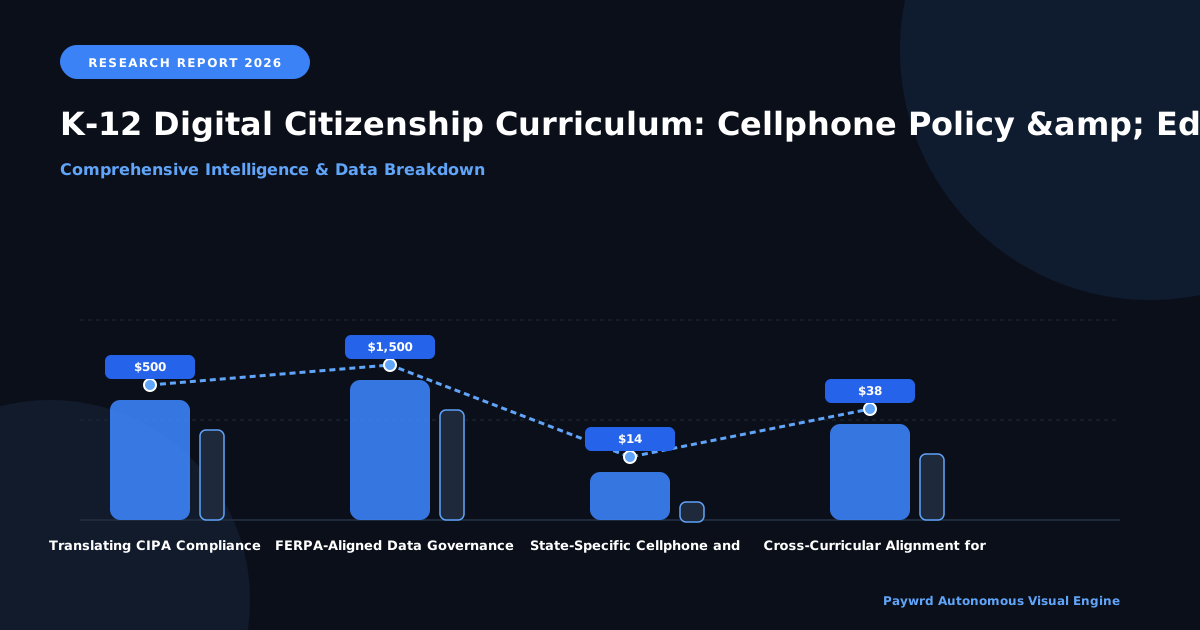
Anchoring Digital Citizenship to CIPA, FERPA, and State Privacy Statutes
Walk into any district leadership meeting right now and you’ll hear two refrains: “We need a robust digital citizenship curriculum,” and “Our legal team is nervous about EdTech data exposure.” The smartest superintendents and principals are fusing those conversations into one playbook. By mapping curriculum modules directly to the Children’s Internet Protection Act (CIPA), the Family Educational Rights and Privacy Act (FERPA), and the rapidly expanding patchwork of state privacy and device statutes, instructional leaders can demonstrate both pedagogical rigor and legal defensibility in the same breath.

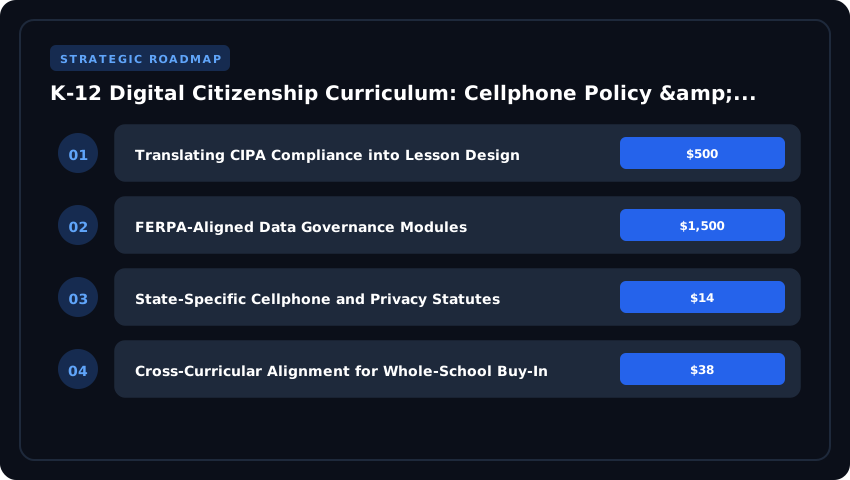
Translating CIPA Compliance into Lesson Design
CIPA is the federal floor for any school accepting E-Rate discounts, mandating internet filters, monitoring minors’ online activity, and teaching cyber-safety. Instead of treating CIPA as a boilerplate paragraph in your technology acceptable-use policy (AUP), rewrite your media-literacy scope and sequence to mirror it. Open a Grade 6 unit on “Search, Verify, Cite” by citing 47 U.S.C. § 254(h)(5), then have students evaluate why a district filter blocks specific domains. Close the unit with a performance task where learners design a PSA explaining how over-sharing personal data online triggers CIPA-aligned monitoring protocols. This turns compliance language into a teachable moment rather than a legal footnote.
FERPA-Aligned Data Governance Modules
FERPA (20 U.S.C. § 1232g) governs the personally identifiable information (PII) housed inside every EdTech platform a district licenses. Build a dedicated “Data Footprint” module where students diagram how a click in a learning management system (LMS) becomes a record that the U.S. Department of Education’s Privacy Technical Assistance Center (PTAC) expects districts to safeguard. Pair this with an administrator-facing rubric criterion that scores vendors on Student Privacy Pledge participation, SOC 2 Type II audits, and data-deletion clauses—exactly the documentation the Department of Education’s Student Privacy Policy Office (SPPO) reviews during complaints.
State-Specific Cellphone and Privacy Statutes
The legal landscape fractured in 2024–2025 as states moved aggressively on classroom phones. California’s AB 272 and the earlier Bellflower Unified-inspired guidance push districts to adopt bell-free instructional time, while Florida HB 379 now requires districts to formalize phone-storage procedures and document instructional disruptions. New York’s 8 NYCRR Part 100 amendments empower individual educators to confiscate devices without a schoolwide policy delay. Each jurisdiction changes your curriculum’s evidence trail: a Florida administrator should be able to pull a lesson plan citing the DOE rule alongside an EdTech rubric row referencing the state statute.
Cross-Curricular Alignment for Whole-School Buy-In
Digital citizenship is no longer a “computer lab Friday” topic. Anchor ELA units on rhetoric by requiring source-evaluation citations tied to CIPA filters; integrate social studies discussions on surveillance using FERPA case studies; and fold data-privacy decision trees into CTE business and health-science pathways where students handle simulated PII. When teachers across departments see the same statutory language cited in lesson plans, district-wide adoption becomes a matter of instructional coherence, not compliance theater.
Designing a Tiered K-12 Cellphone Policy Implementation Timeline
Walk into any teachers’ lounge in the United States right now, and you’ll hear the same conversation: cellphones are reshaping the classroom faster than districts can legislate them. A defensible rollout is rarely about willpower; it’s about sequencing. The strongest K-12 cellphone policies recognize that a kindergartner and a high school junior are not the same stakeholder, the same liability, or the same pedagogical case. Designing a tiered implementation timeline gives your district a defensible arc—one that survives PTA pushback, school board scrutiny, and the inevitable parent opt-out request.
Match the Model to the Grade Band
Before you draft a single calendar entry, decide which structural model fits each band. Elementary schools (K-5) overwhelmingly succeed with bell-to-bell bans—the phone never leaves the backpack, period. Compliance is high because younger students rarely carry devices independently. Middle schools (6-8) typically adopt either locked pouch models (e.g., Yondr) or hallway locker storage; pouches tend to win where lockers are shared or unsecured. High schools (9-12) benefit from hybrid approaches—pouches during instruction, designated rehydration windows between periods, and clear before/after-school use.
Build the Stakeholder Coalition Early
No timeline survives without a four-legged stool of support: teachers, parents, school board members, and—critically—student voice. Convene a coalition by Month 2 of planning. Pay teachers a modest stipend (often $500–$1,500 per building lead, drawn from Title II or Title IV-A funds) to serve as policy champions. Invite parents through PTA/PTO channels and bilingual community meetings. Engage the school board with a draft resolution tied to local evidence. And seat students at the table—high schoolers especially will spot the loopholes adults miss, and giving them ownership dramatically reduces resistance. Districts like Fairfax County, VA and Beaverton, OR have published coalition charters worth modeling.
The Quarter-by-Quarter Rollout
- Q1 (Summer–Early Fall): Foundation. Audit current AUP language. Survey stakeholders. Pass board policy. Purchase pouches or signage. Train staff during pre-service week. Set baseline metrics: disciplinary referrals, instructional time lost, phone-related incidents.
- Q2 (Fall): Soft Launch. Pilot in two grade bands—one elementary and one secondary—using a control school for comparison. Daily 10-minute homeroom check-ins surface friction. Collect teacher and student feedback through Google Forms or Qualtrics.
- Q3 (Winter): Full Expansion. Roll the model to all K-8 buildings. Introduce high school pouch or locker storage with a four-week “grace window” emphasizing digital citizenship lessons rather than punishment.
- Q4 (Spring): Hardening & Evaluation. Formalize enforcement. Publish a public-facing outcomes dashboard. Measure against baseline. Present results to the board in May for budget alignment the following fiscal year.
Crisis-Communication Protocols
Expect parent pushback—particularly around medical necessity, afterschool pickups, and IEP accommodations. Prepare a one-page FAQ aligned with Section 504 and IDEA, plus a documented opt-out process that routes medical exemptions through the school nurse, not the front office. Designate a single district spokesperson and a 24-hour response window for media inquiries. Districts that pre-write their crisis statements—covering everything from classroom confiscation to viral social media incidents—recover instructional momentum twice as fast as those improvising in real time.
Key Takeaway: A tiered timeline converts a politically charged policy into a measurable, well-governed program. Sequence by grade band, co-design with stakeholders, and instrument every phase with metrics your board can actually read.
Building an EdTech Evaluation Rubric That Scores Pedagogical Value Over Marketing
Walk into any vendor demo and you will hear the same pitch: “engaging,” “research-backed,” “AI-powered.” District CTOs and curriculum directors do not get paid to be impressed by adjectives—they get paid to be skeptical. A defensible evaluation rubric converts that skepticism into a scoring matrix you can defend in front of your school board, your finance office, and a parent FOIA request. The trick is weighting dimensions that survive legal scrutiny, not the ones that survive a sales pitch.
Weighted Scoring Dimensions That Actually Matter
Start with four non-negotiable pillars and assign point values that reflect real risk:
- Privacy (30 points): Data minimization, retention schedules, subprocessors, breach notification SLA, and alignment with the CoSN Privacy Framework. Anything below 24 points is a hard reject.
- Accessibility (25 points): WCAG 2.2 AA conformance, VPAT or ACR on file, keyboard navigation, captions on all video, and screen-reader compatibility tested with NVDA and JAWS.
- Interoperability (20 points): LTI 1.3 and OneRoster 1.2 certification, SCIM provisioning, and clean exit through standard IMS Global specs. If the platform is a “walled garden,” it loses points and probably the contract.
- Evidence Base (25 points): ESSA Tier 2 or Tier 3 evidence, peer-reviewed efficacy studies, and disaggregated outcome data by subgroup. Marketing whitepapers do not count.
Vendor Due-Diligence Checklist
Before a single login is provisioned, the vendor must answer the COSN-aligned questionnaire in writing: Where is student data stored (US-only, no exceptions)? Who has access (named employees with background checks)? What happens to data on contract termination (export format, timeline, deletion certificate)? Attach the answers to the procurement file. When the rubric score is challenged, this documentation is what survives.
The 30-Day Pilot Protocol
A rubric without classroom evidence is just a spreadsheet. Build a 30-day pilot that includes two teacher cohorts of at least 30 students each, a pre/post assessment, weekly teacher observation logs using a Danielson-aligned rubric, and a student Net Promoter Score. Capture screen recordings of accessibility failures—these become ironclad negotiation leverage. Districts that skip the pilot end up paying for five-year contracts on platforms that teachers abandon by October.
Pricing Transparency Criteria
The final column of the matrix is where most RFPs fail. Score vendors on three pricing layers:
- Per-seat licensing: Is pricing based on enrollment, active users, or unique logins? Lock the model that matches your SIS count.
- District-wide site license: Does the vendor offer unlimited building or user counts at a flat fee? Often 15–20% cheaper than per-seat at scale.
- Hidden fees: Data migration, SSO setup, professional development hours, and annual “platform access” surcharges. Require line-item disclosure or dock 10 points.
Publish the weighted total alongside the per-student cost. A platform scoring 85/100 at $14 per student beats a platform scoring 90/100 at $38 per student every time—because the rubric made the trade-off visible, defensible, and aligned to instructional value rather than marketing copy.
Structuring Cross-Grade Digital Citizenship Scope and Sequence
Most digital citizenship programs collapse under their own ambition because they try to teach everything at once to every student. The curriculum that actually sticks—and holds up to a board audit—is built like a staircase. Kindergarteners do not need to debate the philosophical weight of algorithmic bias, and high school seniors should not be reviewing the definition of a digital footprint for the first time. Vertically aligning your scope and sequence to the ISTE Standards for Students and the CSTA K-12 Computer Science Framework gives every lesson a documented anchor, so when a parent challenges a unit on AI or a principal asks why third graders are learning copyright, you can point to a national benchmark.
K-2 Foundations: Identity, Kindness, and Screen-Time Balance
In the earliest grades, digital citizenship should feel less like a rulebook and more like a social-emotional extension of the playground. Lessons center on three pillars: who I am online, how I treat others, and when to put the device down. Align these units to ISTE Standard 1.1a–c (Digital Identity) and CSTA 1A-NI-04, which addresses safe online behavior at an age-appropriate level. Schools like Common Sense Education and Nearpod offer free K-2 lesson banks, but your scope and sequence should explicitly require that every classroom dedicate at least 20 minutes per week to a digital well-being circle, not just a one-off assembly.
Grades 3-5: Information Literacy, Copyright, and Digital Footprint
Once students can read independently and search the web with minimal scaffolding, the curriculum shifts from “be kind” to “be critical.” This is the window where ISTE Standard 3 (Knowledge Constructor) and CSTA 1B-DA-06 (data collection and its implications) become the spine. Third graders should learn that not everything on Google is true, fourth graders should practice citing Creative Commons images, and fifth graders should map their own digital footprint using a teacher-supervised audit worksheet. Pair these lessons with the school’s acceptable-use policy so students see the direct link between classroom rules and their browsing behavior.
Middle School: Social Media Influence, Data Tracking, and Algorithmic Bias
Middle school is where the curriculum gets uncomfortable, and that is precisely the point. With 95% of US teens ages 13-17 owning a smartphone according to Pew Research, districts cannot afford to delay these conversations until high school. Anchor this band to ISTE Standard 1.3 (Knowledge Constructor) and ISTE Standard 2.3 (Digital Communicator), while pulling in CSTA 1B-IC-21 on the social impacts of computing. Students should dissect a TikTok recommendation, identify the data signals feeding the algorithm, and write a one-page reflection on how their feed is shaped by invisible tracking. This is also the band where districts should explicitly name state-level cellphone restrictions—California’s AB 272, Florida’s HB 379, and New York’s Part 100 amendments—so students understand that school policy and state law are layered, not arbitrary.
High School Capstone: Civic Engagement, AI Ethics, and Postsecondary Digital Readiness
The senior capstone should function like an AP exam, complete with a rubric, a portfolio defense, and a documented performance task tied to ISTE Standards 1.4, 1.5, and 1.6. Students evaluate the ethics of generative AI, draft a civic social-media campaign for a local election, and audit their college-applicant digital footprint. Align the capstone to CSTA 1B-IC-25 and 1B-IC-26, which frame computing’s impact on society and demand evidence-based advocacy. Districts that fund this capstone through Title IV-A student support dollars typically see stronger FAFSA completion rates downstream, because students who understand digital identity also understand the long-term financial weight of their online presence. The payoff is a graduate who is not just college-ready, but citizenship-ready—on and offline.
Measuring Implementation ROI Through Outcome Dashboards and Cost-per-Impact
Here is the hard truth every superintendent quietly acknowledges: a digital citizenship curriculum lives or dies on the spreadsheet. Compliance language written into a board policy might satisfy the district’s legal counsel, but the people writing the checks want to see a dashboard—preferably one that fits neatly next to the district’s existing EdTech ROI metrics. If you cannot translate cellphone restrictions, screen-time logs, and rubric scores into reclaimed instructional minutes and per-pupil savings, your program will be the first line item cut when budgets tighten.
Defining the KPIs That Actually Move the Needle
Start with three measurable indicators that any principal can pull from existing SIS data. First, track the reduction in disciplinary referrals tied specifically to device misuse—a figure most student-information systems can isolate by infraction code. Second, monitor screen-time logs exported from your MDM platform (e.g., Lightspeed, GoGuardian, Securly), looking for sustained downward trends in off-task app usage during core instructional periods. Third, layer in academic engagement scores drawn from formative-assessment platforms like Renaissance or iReady. Tie these three data streams to a single quarterly review, and you have the bones of a defensible outcome dashboard.
- Disciplinary referrals coded for “inappropriate device use” — measured per 100 students per grading period.
- Average daily off-task screen-time minutes — pulled from MDM reporting.
- Engagement index delta — comparing rubric-calibrated class averages before and after rollout.
Translating Time Back Into Dollars
The conversation shifts the moment you attach a salary figure to reclaimed minutes. According to the U.S. Bureau of Labor Statistics, the average US teacher salary sits at roughly $66,600 as of the latest published data, which works out to about $32 hourly when adjusted for a 40-hour, 40-week contract. If your outcome dashboard shows that structured cellphone policies and rubrics are returning even 15 minutes of focused instruction per class period, a single elementary teacher regains roughly 45 hours annually—worth about $1,440 in instructional value per classroom. Multiply that across a 200-teacher elementary wing, and you are looking at nearly $288,000 in reclaimed instructional capacity without hiring a single additional staff member.
Benchmarking EdTech Spend Against National Medians
Superintendents are increasingly grilled by board members about per-pupil EdTech expenditure. National median district spending on digital tools now hovers between $250 and $400 per pupil, depending on whether you are counting licenses alone or full-stack implementation including professional development. Your dashboard should plot your district’s figure against this median using publicly available data from the EdTech Evidence Exchange or Project Tomorrow’s “Speak Up” surveys. Tools that fail to move engagement or referral metrics over a 12-month window should trigger an automatic sunset clause—no exceptions, no grandfathered renewals.
Annual Review Cadence and Rubric Recalibration
Build a written annual review cadence into the original board policy. Every July, convene a cross-functional committee—a building principal, two classroom teachers, the director of technology, and a parent representative—to recalibrate the EdTech rubric against the prior year’s outcome data. Any tool that scores below a pre-established threshold on engagement delta, referral reduction, or cost-per-impact must either be renegotiated or retired. This annual sunset clause is what keeps the curriculum honest. It also gives district leaders a clean, audit-ready narrative to present to the school board, the state department of education, and, when necessary, the public.
Selecting and Piloting Vendor-Neutral Assessment Tools for Digital Literacy
Curriculum coordinators across the country are quietly inheriting one of the most expensive, legally consequential decisions in modern K-12: which digital literacy assessment platform will actually stand up to a state auditor’s flashlight. The right vendor-neutral instrument does not just score a student’s ability to spot a phishing email; it also produces clean, exportable evidence that satisfies the U.S. Department of Education’s evidence tiers under ESSA and survives a public records request. Below is a practical shortlist strategy built from districts that have already piloted these tools without getting locked into a single vendor’s walled garden.
Criteria for Choosing Common Sense Education, Nearpod, and Learning.com Integrations
Before shortlisting a single product, anchor your rubric in three measurable benchmarks: (1) interoperability with your SIS and LMS through LTI 1.3 or OneRoster APIs, (2) explicit alignment to the ISTE Standards and CIPA-aligned content, and (3) per-student pricing that fits a Title IV-A budget line averaging $5 to $15 per pupil annually. Common Sense Education remains the gold standard for digital citizenship lessons and pre-built rubrics, while Nearpod shines when coordinators need real-time formative data through interactive slides and VR field trips. Learning.com rounds out the shortlist with its EasyTech and Digital Literacy series, particularly for districts wanting to embed keyboarding and coding logic into the same item bank. Vet each vendor against a weighted scorecard so the final pilot choice is defensible to your school board.
Item-Bank Quality Review: Difficulty, Cultural Responsiveness, and Bias Audits
A shiny dashboard means nothing if the items themselves are statistically weak. Demand a current item-response theory (IRT) report from every vendor showing b-values, point-biserial discrimination, and Differential Item Functioning (DIF) flags. Pilot coordinators should pull a stratified random sample of at least 600 student responses across demographic subgroups to run an independent bias audit. Watch for cultural responsiveness: scenario items featuring only urban broadband assumptions, or English-only multimodal prompts, will crater validity for Title III English Learners and rural Title I students. Insist that vendors share their editorial review board’s composition and their three-year roadmap for refreshing culturally specific content.
Teacher Scoring Calibration and Inter-Rater Reliability Targets
Even with auto-graded multiple choice, performance-task rubrics need human calibration. Schedule two 90-minute inter-rater reliability sessions before the pilot launches, using the platform’s own benchmark essays or constructed-response prompts. Calculate Cohen’s kappa after each session; a target of 0.81 or higher signals “almost perfect” agreement by Landis and Koch standards. Pair new teachers with veteran raters in a buddy system for the first 200 student artifacts, and require quarterly re-calibration to combat rubric drift. This documentation also becomes a teacher-quality artifact your district can submit under the Every Student Succeeds Act (ESSA) Title II professional development reporting.
Student Self-Assessment Portfolios as Graduation Pathway Evidence
Forward-thinking districts are folding digital literacy evidence directly into graduation seals of biliteracy, civic readiness, or STEM distinction. Ask vendors whether their platform exports artifacts into a portable portfolio format—preferably a sealed PDF, HTML zip, or IMS Global ePortfolio compatible file—that students can carry from grade 6 through grade 12. Each portfolio entry should include the original prompt, the student response, the rubric score, and a reflection paragraph. When a senior applies to a state university or a federal financial aid review through FAFSA, a defensible digital citizenship portfolio can substitute for redundant placement testing. That single feature turns a $10-per-pupil line item into a lifetime transcript asset.
Funding Streams, Grant Pathways, and Public-Private Partnership Models
Sustaining a robust digital citizenship curriculum across multiple school years takes more than a one-time windfall. District leaders who anchor their funding strategy to federal formula dollars, sunset ESSER reserves, and carefully vetted corporate partnerships tend to outlast the grant-cycle boom-and-bust cycle that has derailed so many EdTech rollouts since 2020. Let’s break down the four funding pillars every K-12 administrator should have on the spreadsheet right now.
Title IV-A Student Support and Academic Enrichment Allocations
Title IV-A of the Every Student Succeeds Act remains the most reliable recurring revenue source for digital citizenship work. Districts receive an allocation based on their Title I, Part A funding, and at least 20% of every dollar must land in the “Effective Use of Technology” (EdTech) bucket, with another 20% earmarked for safe and healthy students. A district carrying a $500,000 Title IV-A award can reasonably route $100,000 toward a digital citizenship platform, rubric development, and teacher micro-credentialing, all without competitive grant paperwork. The U.S. Department of Education’s Student Support and Academic Enrichment guidance is explicit: digital literacy, media literacy, and cyberbullying prevention all qualify as allowable uses. Districts should submit an aligned needs assessment to their state education agency each spring to protect the allocation.
ESSER Sunset Timelines and Reallocation Strategies for EdTech Sustainability
ESSER I, II, and III funds officially sunset on September 30, 2024, and the 27-month liquidation window closes March 31, 2027. Any unspent digital citizenship dollars remaining after those dates revert to the U.S. Treasury, so the clock is ticking. Smart districts are using this final window to purchase multi-year licensing (a defensible allowability argument under 2 CFR 200), train instructional coaches who can carry the curriculum forward on salary lines, and convert subscription platforms into perpetual licensed tools. Treat ESSER as bridge financing, not permanent infrastructure.
Corporate Partnership Vetting: Sponsor Transparency, Advertising Limits, and FERPA Risk
When a vendor offers free curriculum in exchange for student data exposure, run. Best-practice vetting standards require: signed Family Educational Rights and Privacy Act (FERPA) addenda with no third-party data-sale loopholes, explicit advertising limits for any K-12 sponsorship (the BBB Wise Alliance and the Future of Privacy Forum both publish model clauses), and full sponsor transparency that names the funder on every lesson landing page. Districts should also require SOC 2 Type II audits and reject any partnership where student work product becomes vendor training data.
Procurement Contract Negotiation Clauses on Data Deletion and IP Ownership
Two clauses make or break a digital citizenship contract: data deletion and intellectual property. Negotiate a 30-day post-termination data purge with written certification, and confirm that all student-generated artifacts, rubrics, and educator content remain district property. The State Educational Technology Directors Association (SETDA) and the Council of Chief State School Officers (CCSSO) both publish sample procurement language worth lifting wholesale. Avoid automatic renewal riders, lock in price caps tied to the Consumer Price Index, and require breach notification within 48 hours.
- Lock at least 20% of Title IV-A funds into recurring EdTech line items.
- Treat ESSER as bridge financing—spend by September 30, 2024.
- Vet every corporate partner against FERPA, SOC 2, and sponsor-disclosure standards.
- Insist on 30-day data deletion and full district IP ownership in every contract.
| Federal/State Statute | Scope | K-12 Compliance Trigger | Curriculum/Rubric Action Item | Estimated Cost of Non-Compliance |
|---|---|---|---|---|
| CIPA (Children’s Internet Protection Act) | Federal — E-Rate recipients | Public schools receiving federal internet subsidies | Documented digital citizenship lessons + content filtering rubrics | Loss of E-Rate funding (~$2.5B annually nationwide); FCC enforcement actions |
| FERPA (20 U.S.C. § 1232g) | Federal — All US schools receiving DOE funds | Any EdTech tool collecting student PII | Data privacy audit + parent consent workflow in AUP | $50,000+ per violation; loss of federal funding eligibility |
| California AB 272 | California K-12 | Student data sold/shared by EdTech vendors | Contractual data-deletion addendums in vendor RFPs | $25,000 per violation; class-action exposure $500K–$2M |
| Florida HB 379 | Florida K-12 | Student cellphone use during instructional time | Bell-to-bell phone-free policy + teacher enforcement rubric | $10,000 district fines; repeated findings jeopardize accreditation |
| New York Part 100 Amendments (8 NYCRR § 100.2) | New York K-12 | Smartphone use in K-8 schools (phased) | Phone storage caddies, instructional minute logs, parent notices | $5,000 initial finding; $25,000+ for repeat citations |
| COPPA (Children’s Online Privacy Protection Act) | Federal — Under-13 users | Any EdTech platform used by students <13 | Verifiable parental consent + minimum-data collection rubric | $50,120 per violation (2024 FTC adjusted) |
| IDEA + Section 504 | Federal — Special education | Accessibility of digital citizenship curriculum | Assistive-tech compatibility & IEP-aligned rubric criteria</ajustment | OCR investigation costs; compensatory education awards |
Frequently Asked Questions
What federal laws govern a K-12 digital citizenship curriculum?
Three federal statutes anchor every defensible K-12 digital citizenship curriculum: CIPA requires internet safety instruction and content filtering for E-Rate recipients; FERPA (20 U.S.C. § 1232g) restricts disclosure of student education records to EdTech providers; and COPPA mandates verifiable parental consent before collecting data from children under 13. Districts should map each curriculum module to these statutes for audit-proof compliance documentation.
What does California AB 272 require for EdTech in schools?
California AB 272 (effective January 1, 2024) prohibits EdTech vendors from selling or sharing K-12 student data and requires written authorization before disclosing personal information to a third party. Districts must amend vendor contracts to include data-deletion clauses within 60 days of contract termination, with violations carrying $25,000 penalties per occurrence and potential class-action exposure reaching $500,000 to $2 million.
Does Florida HB 379 ban cellphones in schools?
Yes. Florida HB 379, signed in 2024, directs school districts to adopt bell-to-bell phone-free policies prohibiting student cellphone use during instructional time. Each district must document enforcement procedures, provide phone-storage accommodations, and address emergency exceptions. Non-compliant districts face $10,000 in fines and potential accreditation consequences during repeat state review cycles.
What are the New York Part 100 smartphone rules for schools?
New York's amended 8 NYCRR § 100.2 requires all K-8 schools to implement a bell-to-bell smartphone prohibition by the 2025-2026 academic year. Districts must provide secure storage caddies, document instructional minute recovery, and notify parents in writing. First-time violations trigger $5,000 state findings, escalating to $25,000 or more for repeat citations.
How much does a CIPA violation cost a school district?
CIPA non-compliance is financially severe: districts lose eligibility for E-Rate discounts, which fund roughly $2.5 billion in annual K-12 connectivity nationwide. Additionally, the FCC can impose enforcement actions and require remedial certification. For an average 5,000-student district, loss of E-Rate Category 1 funding alone exceeds $150,000 per year until compliance documentation is restored.
Strategic Final Takeaway
When evaluating Digital Citizenship Curriculum K-12 Cellphone Policy Implementation And EdTech Evaluation Rubric, base your decisions on accredited institutional standards, measurable return on investment (ROI), and up-to-date official guidelines. Always verify specific dates and requirements through official regulatory portals.

