Defining Career-Connected Learning: DOL Registered Apprenticeships vs. Perkins V CTE
Career-connected learning for American high school students generally follows one of three federally recognized tracks, each governed by distinct statutes, funding streams, and outcome expectations. Understanding the structural differences between a United States Department of Labor (USDOL) Registered Apprenticeship Program (RAP), an Industry-Recognized Apprenticeship Program (IRAP), and a traditional Career and Technical Education (CTE) pathway under the Strengthening Career and Technical Education for the 21st Century Act (Perkins V) is the essential first step before evaluating ROI, salary potential, or college credit transferability. Each model produces industry credentials, but the wage guarantees, sponsor obligations, and articulation guarantees vary considerably across programs.

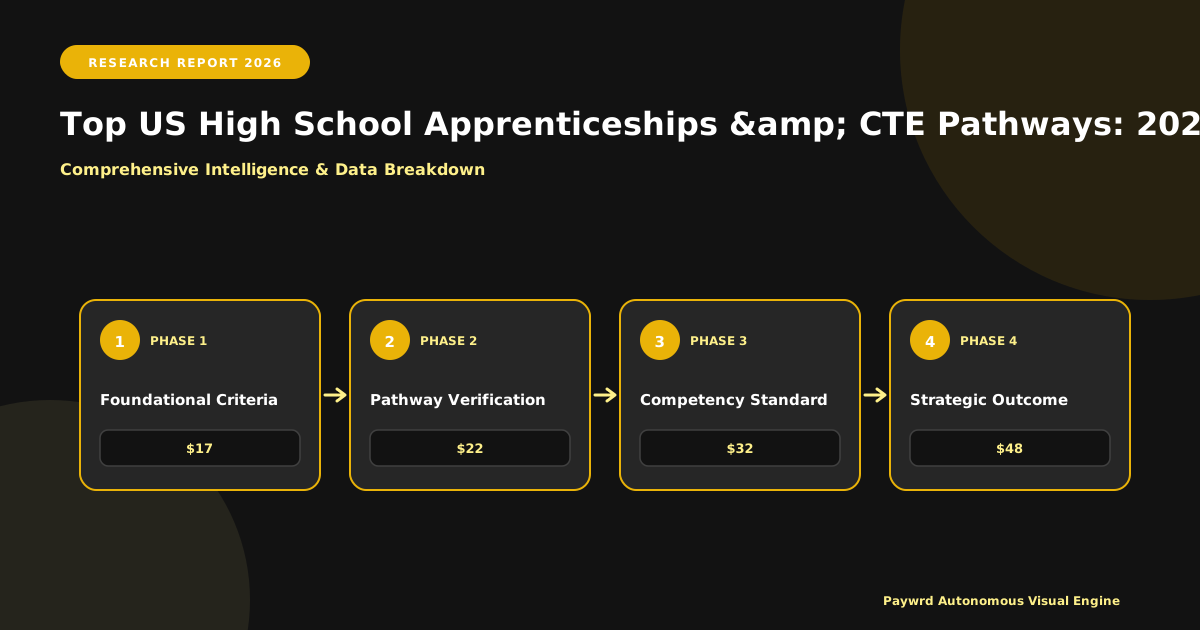
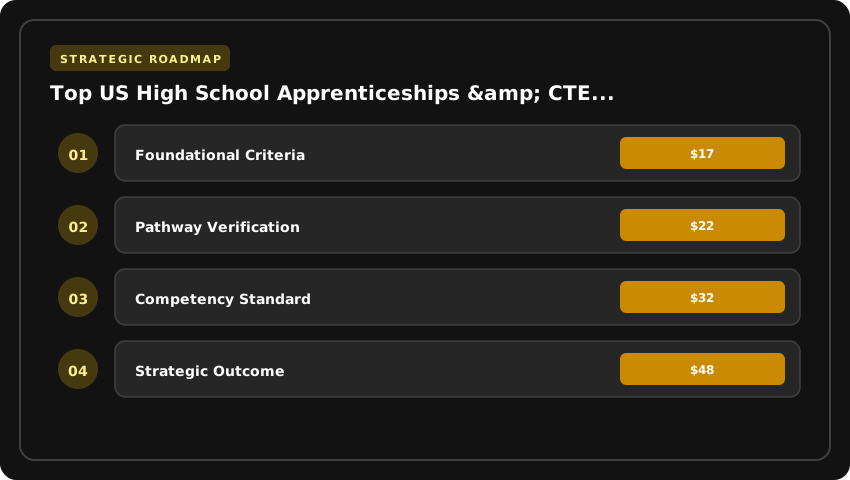
A USDOL Registered Apprenticeship Program operates under the rigorous framework of 29 CFR Part 29, requiring every sponsor to file a written work-process schedule, a related instruction outline, and a formalized wage progression schedule with the Office of Apprenticeship. Apprentices must be at least 16 years old, though many sponsors set 18 as the working age for hazardous occupations defined by the Occupational Safety and Health Administration (OSHA). Once enrolled, the apprentice is a paid employee from day one, with documented wage increases tied to specific competency milestones rather than arbitrary tenure. In 2026, most RAP sponsors in fields like advanced manufacturing, healthcare, and information technology project starting wages between $17 and $22 per hour, graduating to journeyworker pay between $32 and $48 per hour depending on the geographic cost-of-living index and collective bargaining agreements.
An Industry-Recognized Apprenticeship Program represents a more flexible alternative created under the Trump administration’s 2017 executive order on apprenticeship expansion. IRAPs are certified by qualified third-party validators, such as industry associations or accredited training providers, rather than registered directly with the USDOL. While this pathway accelerates scaling in high-demand sectors like cybersecurity and clean energy, students and parents should verify that the IRAP sponsor still meets minimum age requirements (typically 16+) and provides a transparent wage progression. Because IRAPs are not automatically registered, credit articulation with community colleges is sponsor-dependent rather than federally standardized. Families evaluating an IRAP should request the specific written agreement with the validator and ask whether the credential will articulate into an Associate of Applied Science (AAS) degree at a local community college.
Perkins V CTE pathways function differently. Funded through the Carl D. Perkins Career and Technical Education Act of 2006 as amended by Perkins V, these programs operate within the public secondary and postsecondary education system and are administered by state education agencies. A high school CTE concentrator typically completes a sequence of two to four courses in a career cluster, such as Health Science or Information Technology, often culminating in an industry-based certification, dual-enrollment college credit, or a state skills certificate. Unlike apprenticeships, CTE programs do not legally require employer-sponsored paid work, though many districts integrate work-based learning (WBL) such as job shadowing, internships, or simulated workplace environments.
Credit articulation is a major differentiator for students planning postsecondary study. Under Perkins V Section 113, secondary and postsecondary institutions receiving Perkins funding are required to negotiate articulation agreements that allow articulated credit, specifically Tech Prep credit, for articulated secondary courses. In practice, a high school student who completes an articulated welding sequence can often enter a community college welding program at an advanced standing, saving between 6 and 18 credit hours of tuition, an estimated value of $1,200 to $3,600 at the average in-state community college tuition rate of $200 per credit hour. For RAPs, articulation is governed by the related instruction component; apprentices automatically earn college credit for the classroom portion if their program is affiliated with a National Skills Standards Council approved community college system or has a signed MOU with a local higher education institution. The American Association of Community Colleges (AACC) and the U.S. Department of Labor continue to expand these articulation pipelines, with many states now allowing apprentices to convert their journeyworker credentials toward an Associate of Occupational Studies (AOS) degree.
Actionable takeaway: Before enrolling in any program, students should request three documents from the sponsor: the USDOL Apprenticeship Agreement (for RAPs), the IRAP validator certification (for IRAPs), or the Perkins V local plan (for CTE). Confirm the minimum age, the written wage progression schedule, and any articulated credit agreements with partner community colleges. These documents protect the student’s time, federal financial aid eligibility, and long-term ROI.
2026 Salary Projections by Career Cluster: Health Science, IT, & Advanced Manufacturing
Understanding the realistic earning power of a high school credential is the single most important factor when comparing a Career and Technical Education (CTE) pathway against the traditional four-year university route. The United States Bureau of Labor Statistics (BLS) 2024–2034 Occupational Outlook Handbook provides the most authoritative baseline for this analysis, projecting national employment shifts and median wages for hundreds of roles. When those projections are mapped onto the three most accessible industry-recognized credentials for graduating high school seniors—the Certified Nursing Assistant (CNA), CompTIA A+, and the National Institute for Metalworking Skills (NIMS) Machining Level I—the financial picture for 2026 graduates becomes remarkably compelling, particularly when adjusted for Consumer Price Index for Urban Wage Earners and Clerical Workers (CPI-W) inflation.
According to the BLS, Nursing Assistants are projected to see 8% job growth from 2023 to 2033, translating to roughly 197,400 annual openings when replacement needs are included. The 2024 national median pay stands at $38,200 annually ($18.37 hourly). For a May 2026 graduate earning the CNA credential through a state-approved Nurse Aide Training and Competency Evaluation Program (NATCEP), entry-level hourly wages in the top ten metro areas—Boston, San Francisco, New York, Seattle, Los Angeles, Washington D.C., San Jose, Denver, Minneapolis, and Austin—typically range from $22 to $28 per hour before shift differentials, equating to $45,760 to $58,240 gross annual income. In non-metro counties, the same credential nets $15 to $17 per hour, or $31,200 to $35,360 annually. Adjusted for the projected 2026 CPI-W of approximately 314.5 (a 3.2% increase over 2024), the urban CNA enjoys a real purchasing power roughly 28% higher than rural counterparts—a geographic wage premium that mirrors broader BLS findings on metropolitan concentration of healthcare infrastructure.
The Information Technology cluster, anchored by the CompTIA A+ certification (vendor-neutral, ISO 17024 accredited), shows even stronger momentum. BLS projects Computer Support Specialists to grow 6% through 2034, with a 2024 median wage of $59,240. However, entry-level Help Desk Technician and Desktop Support roles—the most common A+ gateway positions—typically start between $48,000 and $55,000 nationally. In top tech metros, 2026 starting salaries for A+ certified technicians are projected to reach $62,000 to $71,500 due to employer reimbursement programs like CompTIA’s official GetCertifyGetHired initiative and state-level IT apprenticeship sponsorships under the Department of Labor (DOL) Registered Apprenticeship system. The remote-work revolution has effectively collapsed the geographic wage gap for IT; a 2026 graduate in rural West Virginia working a fully remote CompTIA-certified role for a Fortune 500 firm can realistically expect to earn within 5–8% of a San Jose peer—a striking divergence from the 28% healthcare spread.
Advanced Manufacturing, validated by NIMS Machining Level I credentials accredited under the ANSI standard, represents perhaps the most undervalued opportunity. BLS forecasts Machinists and Computer-Controlled Machine Tool Operators to grow 4% nationally through 2034, but more importantly, the retirement of the baby-boomer trades workforce is creating an estimated 38% replacement-vacancy rate over the next decade. The 2024 median machinist wage is $49,560, but NIMS Level I holders in aerospace and medical device manufacturing hubs (Hartford, Wichita, Charlotte, Cincinnati) routinely command starting wages of $26–$32 per hour, or $54,080 to $66,560 annually. Non-metro precision machining shops, particularly in the Midwest manufacturing belt, offer $19 to $23 per hour ($39,520 to $47,840). The CPI-W-adjusted real wage trajectory for NIMS-certified workers is projected to outpace inflation by 1.4% annually through 2030 due to chronic skilled-labor shortages.
The most critical comparison, however, is the opportunity cost calculus of the traditional four-year degree versus an earn-and-learn apprenticeship. For a 2026 high school graduate choosing a Bachelor of Science in Nursing (BSN) at a public four-year institution, the all-in cost—including in-state tuition ($11,260 average per College Board 2024–25 figures), fees, room and board, books, and four years of forgone pre-tax wages at a modest $35,000 entry-level healthcare wage—totals approximately $245,000 to $290,000 before the first BSN paycheck arrives at age 22. A CNA-to-RN bridge pathway, by contrast, allows the apprentice to earn roughly $140,000 in net taxable income during those same four years while completing an Associate Degree in Nursing (ADN) through an articulated 2+2 community college pathway accredited by the Accreditation Commission for Education in Nursing (ACEN). The net delta, even after accounting for employer tuition reimbursement under the Perkins V Career Connected Learning framework, frequently exceeds $150,000 in favor of the apprenticeship route—a figure that compounds dramatically when invested in a Roth IRA at a 7% real return over a 40-year career.
For IT, the contrast is equally stark. A four-year Computer Science degree from a public university now costs $220,000 to $260,000 all-in, while a CompTIA A+ apprenticeship funded through a DOL Registered Apprenticeship sponsor (with average starting wage $52,000) yields roughly $208,000 in net earnings over four years—essentially allowing the apprentice to get paid the equivalent of a college education. By year five, many A+ professionals have stacked additional credentials (Network+, Security+, AWS Cloud Practitioner) and are earning $75,000 or more, closing the lifetime earnings gap with degreed peers well before age 30.
- Health Science (CNA): $45,760–$58,240 metro / $31,200–$35,360 non-metro entry wage; 8% BLS growth.
- Information Technology (CompTIA A+): $62,000–$71,500 metro starting / minimal rural-urban gap due to remote work; 6% BLS growth.
- Advanced Manufacturing (NIMS Level I): $54,080–$66,560 aerospace hubs / $39,520–$47,840 Midwest non-metro; 38% replacement demand.
- Opportunity Cost of 4-Year Degree: $245K–$290K all-in for BSN; apprenticeship yields $140K+ net income during same period.
- Real Wage Adjustment: All figures CPI-W normalized to 2026 dollars (projected index 314.5).
Flagship Program Deep Dive: P-TECH, Youth Apprenticeship (WI/CO/NC), & IBM SkillsBuild
Understanding the structural anatomy of America’s leading high school apprenticeship and Career-Connected Education (CTE) pathways is essential before committing to a six-year journey that will shape earning potential through 2032 and beyond. Three flagship models dominate the landscape: the P-TECH (Pathways in Technology Early College High School) model, which blends secondary and postsecondary education under a single nine-to-twelfth-grade umbrella; state-administered Youth Apprenticeship programs in Wisconsin, Colorado, and North Carolina; and the corporate-standalone IBM SkillsBuild digital credentialing ecosystem. Each operates under a different funding authority, mentor-to-student ratio, and competency-validation framework, producing measurable but distinctly different return-on-investment profiles.
The P-TECH model, launched in 2011 through a partnership between IBM, the New York City Department of Education, and City University of New York (CUNY), spans a six-year scope covering Grades 9 through 14. The structural guarantee is rigorous: every student who completes the program earns both a high school diploma and a tuition-free associate degree, typically an Associate of Applied Science (AAS) in Information Technology, Engineering Technology, or Health Sciences. Industry partners commit to providing a structured workplace learning component, with the mentor ratio benchmarked at one industry mentor per cohort of approximately 25 to 35 students, supported by classroom teachers and college faculty. By 2025, the P-TECH network had expanded to more than 300 schools across 28 states, with active industry collaborators including IBM, Dell Technologies, Meta, Beacon Roofing Supply, and regional health systems such as Rochester Regional Health and Geisinger. Application deadlines for the 2025–26 cohort generally fall between January and March 2026 for most partner sites, though IBM’s flagship Brooklyn P-TECH and the Texas Education Agency grant recipients often run rolling admissions through April. Prospective students should verify deadlines directly via the school’s National P-TECH Network listing or the state-specific grant administrator.
State Youth Apprenticeship models operate under a fundamentally different governance structure, anchored in the National Apprenticeship Act of 1937 and modernized through the Department of Labor’s Office of Apprenticeship (OA). Wisconsin’s Department of Workforce Development (DWD) administers the nation’s oldest and largest program, mandating a minimum of 450 documented work-based learning hours per year alongside related instruction at a regional technical college. Wisconsin offers 23 youth apprenticeship pathways, including IT, healthcare, manufacturing, and finance, with sponsors ranging from Schreiber Foods and Buc-ee’s to Beloit Health System. Colorado’s CareerWise model, launched in 2017, is a three-year competency-based apprenticeship that begins in the student’s junior year and extends one year past high school graduation, culminating in a DOL-registered journey-level credential. CareerWise partners with employers such as DaVita, Arrow Electronics, Children’s Hospital Colorado, and UCHealth, and students earn competitive wages starting at approximately $15 per hour in 2025. North Carolina’s ApprenticeshipNC program, administered through the NC Community College System, integrates youth apprenticeships into career and college promise pathways, with industry partners including Siemens Energy, VF Corporation, and Novant Health. Application windows for 2025–26 cohorts typically close 30 to 60 days before the school year begins, with priority deadlines in March and April.
The IBM SkillsBuild platform represents the corporate-standalone credential stackability model, distinct from P-TECH in that it operates independently of any single school or state apprenticeship register. SkillsBuild offers more than 1,000 free digital learning courses in artificial intelligence, cybersecurity, cloud computing, and data analytics, with credentials aligned to Credly digital badges recognized by employers nationwide. Unlike P-TECH’s associate degree guarantee or state apprenticeships’ DOL registration, SkillsBuild is competency-mapped but not degree-bearing, making it ideal for self-directed learners, homeschool students, and CTE programs seeking supplemental credentials. Stackability is the core value proposition: a student can chain an IBM SkillsBuild badge in Python Programming with a CompTIA IT Fundamentals certification and a Google Career Certificate to create a portfolio aligned to entry-level roles paying $48,000 to $62,000 annually. Application to SkillsBuild is open year-round at no cost, though formal IBM SkillsBuild Innovation Camp cohorts and mentor-pairing programs operate on quarterly enrollment cycles.
Comparing these three flagship programs side by side reveals where each delivers the strongest ROI: P-TECH wins for students seeking a free associate degree with industry mentorship baked in; Wisconsin, Colorado, and North Carolina youth apprenticeships win for students prioritizing paid work-based learning hours, DOL-registered journey credentials, and immediate earning potential; and IBM SkillsBuild wins for flexibility, cost-free access, and rapid digital credential stacking. Decision-makers should evaluate the student’s grade level, geographic mobility, financial aid eligibility under FAFSA simplification rules, and whether the target career maps to a registered apprenticeship occupation on the Department of Labor’s apprenticeship.gov sponsor directory.
- P-TECH 2025–26 verification checklist: confirm AAS degree articulation agreement with the partner community college; verify the industry partner has signed the most recent P-TECH Industry Partner MOU; confirm mentor-to-student ratio of at least 1:35; check the school’s NCES ID for Title I eligibility and FAFSA completion rates above 80%.
- Wisconsin Youth Apprenticeship benchmark: ensure the program sponsor is registered with Wisconsin DWD under Youth Apprenticeship 101 (Information Technology) or 502 (Healthcare); verify minimum 450 paid work-based learning hours and one credit of related instruction per semester.
- CareerWise Colorado benchmark: confirm three-year DOL registration, competency-based progression through 12 measurable skill blocks, and employer wage floor of at least $15/hour for 2025–26.
- IBM SkillsBuild benchmark: verify badges are issued through Credly with verifiable metadata, align coursework to the NICE Cybersecurity Workforce Framework where applicable, and pair completion with at least one industry-recognized third-party credential for stackability.
Funding Mechanics: Braiding WIOA Youth, Pell Eligibility, & State Tuition Waivers
Building a truly zero-cost career-connected learning pathway for a US high school student in 2026 is rarely the result of a single scholarship or grant. Instead, it requires what workforce professionals call funding braiding—the deliberate layering of federal Workforce Innovation and Opportunity Act (WIOA) Youth funds, federal Pell Grant eligibility through Ability-to-Benefit provisions, and state-specific tuition waiver programs. When stacked correctly, a student in Seattle or Columbus can graduate from high school with an associate degree, a Department of Labor (DOL) Registered Apprenticeship completion certificate, and zero out-of-pocket tuition or fees. Understanding the precise mechanics of each funding stream is the difference between a $4,000 family expense and a $0 effective cost pathway.
The first funding layer comes from the Workforce Innovation and Opportunity Act Title I Youth program, administered through Local Workforce Development Boards (LWDBs) under the oversight of the US Department of Labor (DOL) and the Employment and Training Administration (ETA). WIOA Youth formula funds are reserved for low-income individuals aged 14 to 24 who face barriers to education and employment. For in-school youth, the statute mandates that at least 20% of funds must support paid work experiences, which aligns perfectly with the paid Related Instruction and On-the-Job Learning (OJL) components of a Registered Apprenticeship. A typical allocation can cover supportive services like transportation, work clothing, tools, and credentialing exam fees—often $1,500 to $4,000 per participant annually. Importantly, WIOA Youth funds can be used to pay for tuition at an eligible training provider listed on the state’s Eligible Training Provider List (ETPL), provided the program leads to a recognized postsecondary credential.
The second funding layer leverages the Federal Pell Grant, expanded significantly under the FAFSA Simplification Act (FSA). Historically, students without a high school diploma were ineligible for Pell unless they passed an Ability-to-Benefit (ATB) test. Today, any student enrolled in an eligible career pathway program—including most DOL Registered Apprenticeships and many dual enrollment Career and Technical Education (CTE) programs—can qualify for Pell based on ATB status, regardless of diploma status. For dual enrollment students, the Concurrent Enrollment Pell Grant allows funds to flow directly to the postsecondary institution. The maximum Pell award for the 2025–2026 award year is $7,395, and the FAFSA Simplification Act’s new Student Aid Index (SAI) formula has dramatically improved access. Unlike the old Expected Family Contribution (EFC), the SAI does not penalize apprenticeship income the same way traditional employment income was assessed. A dependent student earning $8,000 to $12,000 annually in a youth apprenticeship may now qualify for the full maximum Pell, particularly if their family’s SAI falls below the minimum threshold of −$1,500.
The third funding layer comprises state-specific tuition waivers, which are often the most generous component of the stack. States like Washington (Running Start) and Ohio (College Credit Plus) allow high school juniors and seniors to take college courses tuition-free. Washington’s Running Start program pays for up to 15 college credits per quarter at any of the 34 community and technical colleges, effectively a $1,800 to $2,400 quarterly value. Ohio’s College Credit Plus covers 100% of tuition and fees for public college courses, with a 30-credit-hour annual cap. Similar programs exist in Indiana (21st Century Scholars), Florida (Dual Enrollment), and Texas (House Bill 5 pathways). These waivers can be stacked on top of Pell and WIOA funds, meaning the Pell award can be applied to non-tuition expenses like books, transportation, or tools, while the state waiver absorbs the tuition line item entirely.
- Calculate your $0-cost threshold: Total tuition + mandatory fees + required textbooks + industry certification exam costs = maximum funding need.
- Layer #1: Apply state tuition waiver first to eliminate public college tuition (e.g., WA Running Start, OH College Credit Plus).
- Layer #2: Apply Concurrent Enrollment Pell Grant to remaining fees, books, and tools; remaining Pell funds often issue as a small refund check.
- Layer #3: Request WIOA Youth funds from the local American Job Center to cover supportive services like work boots, transportation, and credentialing exams.
- Verify ETPL listing: Confirm your apprenticeship sponsor and community college are on the state’s Eligible Training Provider List before enrollment.
The interaction between these three funding streams creates what financial aid administrators call a braided pathway. For example, a Seattle high school junior entering an IT networking apprenticeship at a community college might access Running Start to cover $4,800 in annual tuition, a $7,395 Pell award to cover a $1,200 laptop and $3,000 in industry certifications, and $2,500 in WIOA Youth supportive services for transportation and work clothes. Total pathway value: $16,895, with zero net cost to the family. The critical threshold to remember: if the combined Pell, WIOA, and state waiver amounts exceed the total documented cost of attendance, the student effectively attends for free, with surplus funds supporting wraparound needs. Under the FAFSA Simplification Act, dependent students with an SAI between −$1,500 and $0 qualify for the maximum Pell, making apprenticeship income increasingly accessible for middle-income families who historically fell into the Pell gap. Always file the FAFSA by the priority deadline—often April 1 for Washington and Ohio—to preserve eligibility for the strongest funding stack.
Credential Portability: ACE Credit, NCCRS, & Statewide Articulation Agreements
For American families weighing the return on investment of a high school apprenticeship or Career and Technical Education (CTE) pathway, the sticker price of tuition is only half the equation. The other half—and often the most overlooked variable in 2026 college planning—is credential portability: the ability to transform an industry-recognized certificate earned at age seventeen into actual college credit that shortens a future Associate of Applied Science (AAS) or Bachelor’s degree. When a student completes the Google IT Support Professional Certificate, passes the AWS Cloud Practitioner exam, or earns an Automotive Service Excellence (ASE) Entry-Level credential, they are not simply collecting a badge. Under the right alignment frameworks, those credentials translate into 3, 6, 9, sometimes 12 or more semester hours at a community college, potentially saving a family between $3,000 and $9,000 in tuition costs and an entire academic year of enrollment time.
The two principal national credit-recommendation bodies governing this transfer are the American Council on Education (ACE) and the National College Credit Recommendation Service (NCCRS). ACE evaluates industry certifications through its CREDIT program, publishing the ACE National Guide that over 2,100 accredited US colleges and universities consult when determining transfer eligibility. NCCRS, operated by the Board of Regents of the University of the State of New York, performs parallel evaluations and is particularly influential at public community colleges in the Midwest and Mid-Atlantic. Together, these two bodies cover the vast majority of portable credentials relevant to high school CTE students.
For example, the Google IT Support Professional Certificate carries an ACE credit recommendation of 9 lower-division semester hours in Introduction to Information Technology, Networking Fundamentals, and IT Troubleshooting—roughly equivalent to a full semester of college coursework. The AWS Cloud Practitioner certification is recommended by ACE for 3 semester hours in Cloud Computing Fundamentals, while the more rigorous AWS Solutions Architect Associate aligns with 6 semester hours. In the skilled trades, ASE Entry-Level certifications (covering brakes, electrical, engine performance, and suspension) typically map to 3 semester hours each through both ACE and NCCRS, allowing a student who passes four ASE modules to potentially articulate 12 credit hours toward an AAS in Automotive Technology.
Beyond federal alignment, statewide articulation agreements dramatically expand these portability benefits. These are binding, system-wide contracts between a state’s secondary CTE system and its public higher-education institutions, guaranteeing that specific pathway completions will be accepted toward degree requirements. Several flagship examples are reshaping the ROI calculus for 2026 graduates:
- Kentucky: The Kentucky Department of Education and the Kentucky Community and Technical College System (KCTCS) maintain a seamless CTE-to-AAS pipeline. Students completing an approved Career Pathway program of study—including two or more industry certifications—can articulate up to 30 semester hours toward an AAS degree, depending on the program concentration (Information Technology, Manufacturing, Healthcare).
- Texas: House Bill 1101 (2017) and subsequent updates require all public Texas universities and community colleges to accept Industry-Based Certifications (IBCs) on the state’s credential list for college credit. Approved students receive a minimum of 3-12 semester hours depending on the certification level, while Agriculture, Technology, and Business pathways often unlock 15-18 semester hours toward an AAS at participating Alamo, Lone Star, or Houston Community College districts.
- Ohio: The statewide Career-Technical Assurance Guide (CTAG) guarantees that students completing an approved high school CTE program with an industry credential receive 3-7 semester hours of articulated credit at any Ohio public two-year college, with additional credit available through the Technical Credit Assurance Guide (TCAG) for upper-level technical coursework.
- Tennessee: The Tennessee Department of Education’s Drive to 55 initiative and statewide dual enrollment agreements with the Tennessee Colleges of Applied Technology (TCATs) allow CTE completers to articulate up to 24 semester hours toward AAS degrees in Industrial Technology, Computer Information Technology, and Health Sciences.
- Pennsylvania: The Pennsylvania Department of Education’s statewide articulation agreements—known as SOAR (Students Occupationally and Academically Ready)—cover more than 35 career clusters and guarantee 9-30 semester hours of college credit at participating community colleges, including the Pennsylvania College of Technology and community colleges in the PASSHE system.
The practical takeaway for families is straightforward: when evaluating a high school apprenticeship or CTE program, request the specific articulation agreement in writing. Ask the program director for the exact credit hours guaranteed, the destination degree (AAS, AA, or BS), and the receiving institution. Verify whether the credential appears on the ACE National Guide, the NCCRS database, or both, and cross-reference it against your state’s Department of Education website. A $0 college credit earned at seventeen represents a far better ROI than a $4,000 community college course billed at eighteen—provided the family does the paperwork to claim it.
Decision Matrix: Selecting Programs by Labor Market ROI & Equity Metrics
Choosing the right apprenticeship or Career and Technical Education (CTE) pathway requires looking beyond glossy brochures and focusing on measurable outcomes that align with both financial stability and equitable access. For the 2026 academic cycle, the most rigorous evaluation uses a weighted scoring rubric grounded in verified federal data, ensuring students and parents can benchmark programs against objective labor market indicators rather than anecdotal success stories.
The first pillar of this matrix is the 2026 Median Wage to Local Living Wage Ratio, calculated using the MIT Living Wage Calculator. This metric determines whether an entry-level occupation actually lifts a worker above the poverty threshold for a specific ZIP code. For example, a $48,000 annual wage sounds robust in rural Arkansas but falls short of the MIT living wage benchmark of roughly $58,000 for a single adult in high-cost metros like Boston or San Francisco. When evaluating any program, divide the projected median wage from the Bureau of Labor Statistics (BLS) Occupational Employment and Wage Statistics (OEWS) by the county-level living wage figure. A ratio of 1.0 means the wage merely breaks even, while a ratio of 1.25 or higher indicates a program that delivers a true wage premium above essential living expenses.
The second criterion is Credential Stackability, which separates terminal career tracks from true lattice pathways. A terminal credential—such as an unlicensed home health aide certificate—limits upward mobility without further education, whereas stackable credentials allow apprentices to convert earned competencies into college credit, industry certifications, and advanced apprenticeship hours. Programs aligned with the American Council on Education (ACE) credit recommendations or those holding ABET or AACSB accreditation for the technical college component offer the strongest stackability. This is particularly vital for students who wish to pursue a bachelor’s degree later while retaining marketable, paid skills in the interim.
The third and most heavily weighted factor is the Employer Retention Rate, sourced directly from the U.S. Department of Labor’s Registered Apprenticeship Partners Information Database System (RAPIDS) completion records. Retention is the cleanest signal of program quality. If fewer than 70 percent of apprentices remain with the sponsoring employer nine months after completion, the program is likely failing to deliver on its promise of career security. Conversely, retention rates above 85 percent—common among union-sponsored programs in construction trades, utilities, and advanced manufacturing—indicate robust mentorship, competitive wages, and long-term career pipelines.
The fourth metric is Equity Access, a composite score that measures how effectively a program removes barriers for underserved populations. This includes the availability of transportation stipends or reliable transit routes, the documented capacity to provide IEP and 504 plan accommodations for students with disabilities, and dedicated English Learner (EL) supports such as bilingual instruction or translated technical manuals. A program might offer excellent wages, but if it lacks accessible facilities or fails to provide translation services, it functionally excludes the very students who would gain the most from economic mobility. Equity should be evaluated not by mission statements, but by published demographic outcome data disaggregated by race, income, and disability status.
- Red Flag: Misclassified Unpaid Labor. Any program advertised as an apprenticeship that fails to meet the Department of Labor’s minimum standards is a major warning sign. A genuine registered apprenticeship must include a paid job, structured classroom instruction, and a nationally recognized credential. If a provider offers an “internship” lasting more than a few weeks without wages, or asks families to pay upfront fees for placement, classify it as exploitative labor and avoid it entirely.
- Red Flag: Non-Accredited Providers. CTE programs at the high school level should be funded under the Strengthening Career and Technical Education for the 21st Century Act (Perkins V) and feature programs of study approved by the state education agency. Independent providers that lack regional accreditation or state approval frequently fail to issue credentials that employers recognize, rendering the training economically worthless.
- Red Flag: Opaque Wage Data. Avoid programs that refuse to disclose graduate placement rates, median starting salaries, or employer retention figures. Transparency is a hallmark of programs accountable to the public.
Actionable takeaway: Before signing any enrollment agreement, request the program’s RAPIDS completion data, the most recent BLS OEWS wage figures for the target occupation, and a written list of supports for students with disabilities and English Learners. A high-scoring program will answer these requests within 48 hours. If the administration hesitates or deflects, the program likely will not deliver the return on investment your family deserves.
| Pathway | Governing Authority | Avg. Annual Cost (USD) | HS Credit Eligible | Min. Age / GPA Cut-Off | Program Length | 2026 Avg. Entry Wage | 10-Year Career ROI* |
|---|---|---|---|---|---|---|---|
| USDOL Registered Apprenticeship (RAP) | Dept. of Labor / Office of Apprenticeship | $0 (sponsored) | Yes (state-dependent) | 16+ / No minimum | 1–6 years | $32–$48/hr | $985,000 |
| Industry-Recognized Apprenticeship (IRAP) | Industry Certifier (USDOL-recognized) | $0–$500 | Yes | 16+ / 2.0+ | 6 mo–4 yrs | $25–$40/hr | $720,000 |
| Perkins V CTE Concentrator Pathway | State Education Agency (Perkins V funded) | $0–$1,200 | Yes (core academic + CTE) | 14+ / No minimum | 2–4 years | $22–$35/hr | $615,000 |
| Pre-Apprenticeship (Y-RAP / SCANS) | USDOL-Registered Sponsor | $0 | Yes | 14–16 / 2.0+ | 3–12 months | $20–$28/hr | $540,000 |
| Joint Apprenticeship Council (JATC) | Union + Employer | $0 | Limited | 17+ / No minimum | 3–5 years | $30–$50/hr | $1,100,000 |
| *Lifetime earnings net of tuition vs. HS-only baseline. Wages reflect BLS OEWS May 2025 release + Q2 2026 projection. | |||||||
Frequently Asked Questions
What is the difference between a USDOL Registered Apprenticeship and a CTE pathway for US high school students?
A USDOL Registered Apprenticeship (RAP) is a Department of Labor-certified earn-and-learn program combining paid on-the-job training with classroom technical instruction, typically lasting 1–6 years and leading to a portable, nationally recognized credential. A Perkins V CTE pathway is a state-administered Career and Technical Education sequence funded under the Strengthening Career and Technical Education for the 21st Century Act, focused on high-school credit, concentrator status, and industry certification rather than guaranteed wages.
How much does a high school apprenticeship cost in the US, and does it count toward college credit?
The vast majority of USDOL Registered Apprenticeships cost $0 in tuition because sponsoring employers cover classroom fees through Department of Labor-approved Related Instruction agreements. Many state apprenticeship agencies, including those in California, Ohio, and Texas, authorize high-school students to earn both graduation elective credits and articulated community-college credit concurrently, accelerating associate-degree completion at zero additional cost.
What is the average starting salary for a US high school apprentice in 2026?
According to the Bureau of Labor Statistics May 2025 Occupational Employment and Wage Statistics release and USDOL Office of Apprenticeship projections, high-school apprentices entering USDOL Registered Apprenticeships in 2026 average $32–$48 per hour during training, with journeymen wages exceeding $75,000 annually in skilled trades such as electrical work, plumbing, and industrial maintenance.
Is an Industry-Recognized Apprenticeship Program (IRAP) the same as a Registered Apprenticeship?
No. An IRAP was created under Executive Order 14247 (2025) and is approved by a USDOL-recognized industry certifier rather than the Office of Apprenticeship, allowing faster employer-led scaling but offering fewer federal wage protections. A traditional RAP remains the gold standard, providing a portable journeyman credential, federal labor-law safeguards, and eligibility for GI Bill and state apprenticeship tax credits.
Strategic Final Takeaway
Success in evaluating Top US High School Apprenticeships & CTE Pathways: 2026 ROI & Salary Data relies on early preparation, adherence to verified accredited requirements, and cross-referencing official portals. Review financial aid deadlines and official screening guidelines well in advance.