Why ASUU Issued a Fresh Strike Threat Before the 2026/2027 Academic Session
Across lecture theatres in the University of Ibadan, the University of Lagos, and Ahmadu Bello University Zaria, the same uneasy whisper returned to hostels and staff common rooms in early 2026: another strike is coming. The Academic Staff Union of Universities (ASUU) issued a fresh ultimatum after its National Executive Council (NEC) meeting, formally reactivating a dispute that many Nigerians believed was quietly settling. Rather than a single, sudden explosion, this fresh threat is the visible result of years of half-implemented agreements, contested salary tables, and a Federal Government that has consistently shifted the goalposts on funding public tertiary education.
At the heart of the crisis lies the lingering imbalance from the 2023/2024 revitalisation package, a fund designed to rehabilitate decaying lecture halls, equip laboratories, and pay academic earned allowances that had piled up for years. According to ASUU’s NEC communique released in February 2026, only a fraction of the agreed tranche was released to the federal universities, while state-owned institutions such as Lagos State University (LASU), Ekiti State University (EKSU), and Ambrose Alli University received little or nothing. Lecturers argue that without the revitalisation fund, teaching conditions have collapsed, and the government’s promise to lift 47 federal universities out of infrastructural decay remains a paper pledge.
Closely tied to that grievance is the issue of withheld salaries and the controversial Integrated Payroll and Personnel Information System (IPPIS) deductions. Many academic staff report that their November and December 2025 salaries, alongside several months of arrears from the 2022 industrial action, were either slashed or held back entirely under the guise of “no work, no pay,” even though they submitted valid academic records. The renegotiated 2009 ASUU-FG agreement, which was supposed to replace the long-outdated document, has been stalled in the Office of the Secretary to the Government of the Federation for over 18 months, with no formal signing despite multiple drafts being acknowledged.
For students preparing for the 2026/2027 academic session, the ripple effect is immediate. Prospective candidates who scored above 200 in JAMB UTME, especially those targeting courses like Medicine, Law, and Engineering, often rely on stable calendars to plan Post-UTME screening, NELFUND student loan applications, and hostel bookings. A fresh ASUU action could push admissions into the first semester of 2027, disrupting NUC CCMAS-aligned academic calendars and leaving thousands of fresh graduates stranded between convocation queues and delayed NYSC mobilisation. Parents paying ₦150,000 to ₦400,000 in acceptance fees already face the risk of wasted investment if the 2026/2027 academic year starts late or runs in fragmented cycles.
The specific universities most at risk are predominantly the federal heavyweights where union branches are strongest. These include the University of Benin, Obafemi Awolowo University, the Federal University of Technology, Minna, the University of Nigeria, Nsukka, and the University of Abuja. Among state universities, ASUU branches at the Imo State University, the Chukwuemeka Odumegwu Ojukwu University, and the Abia State University have also echoed the ultimatum, with their members threatening to join any nationwide action if their state governments fail to honour parallel agreements. Several ASUU zonal coordinators have hinted that compliance may be near-total if the Federal Government misses the 21-day window outlined in the latest NEC communique.
- Unpaid revitalisation funds: The 2023/2024 revitalisation package is still partly outstanding across federal universities, with state institutions largely left out of the disbursement.
- Withheld salaries and arrears: IPPIS deductions, unpaid 2022 strike arrears, and salary stoppages for 2025 have left many lecturers with months of unpaid wages.
- Unsigned 2009 agreement: The renegotiated ASUU-FG agreement has lingered in the SGF’s office, with no binding signature despite acknowledged drafts.
- Unfulfilled welfare promises: Issues around earned allowances, hazard considerations for lecturers in volatile regions, and promised NUC review of university funding remain unaddressed.
- Universities likely affected: UI, UNILAG, UNIBEN, OAU, UNN, FUTO Minna, UNIJOS, alongside state schools like LASU, IMSU, and AAU Ekpoma.
Understanding these grievances is essential before you commit your JAMB score, your Post-UTME preparation, and your NELFUND loan application to any institution. A clear-eyed student should track the ASUU NEC communique, monitor Federal Ministry of Education press releases, and have a Plan B such as a polytechnic, college of education, or a private university that runs a stable calendar. The next sub-section will break down the exact ASUU demands, the Federal Government’s counter-offers, and the realistic timeline for the 2026/2027 academic session.
NUC CCMAS vs. ASUU Demands: How Curriculum Reform Collides With Industrial Action
The National Universities Commission’s Core Curriculum Minimum Academic Standards (CCMAS) was conceived in 2023 as a sweeping modernisation blueprint, designed to replace the decades-old Benchmark Minimum Academic Standards (BMAS) and align Nigerian university training with Fourth Industrial Revolution realities, ranging from artificial intelligence integration to renewable energy systems. Rolled out for full implementation across all 170 federal, state, and private universities by the 2024/2025 academic session, CCMAS mandates a minimum of 30% new digital and entrepreneurial content in every undergraduate programme, alongside revised course codes, updated credit unit loads, and harmonised degree nomenclature. Yet, by the close of the 2025/2026 session, the Academic Staff Union of Universities (ASUU) has publicly condemned the policy as a Trojan horse for commercialisation, privatisation, and curriculum fragmentation, arguing that the NUC approved the document without consultation with Senate representatives at the departmental level.
The crux of the collision rests on three fault lines. First, ASUU insists that CCMAS was drafted largely by external consultants, some of whom have direct financial stakes in private edtech firms positioned to monetise the new digital modules. Second, the union argues that the 30% content overhaul has been imposed without corresponding funding for retraining lecturers, purchasing updated laboratory equipment, or hiring the specialised personnel required to teach new courses in cybersecurity, data analytics, and cloud computing. Third, several university Senates have alleged that the NUC is weaponising accreditation visits to punish non-compliant institutions, creating a coercive atmosphere that contradicts the spirit of university autonomy enshrined in Section 3 of the Universities Miscellaneous Provisions Act.
At the University of Lagos (UNILAG), implementation is effectively frozen in the Department of Computer Sciences and the Department of Mass Communication, where lecturers have refused to upload the new CCMAS course descriptions into the Senate-approved curriculum portal. At the University of Benin (UNIBEN), the Department of Economics and the Department of Law have formally written to the Vice-Chancellor requesting an independent review of the curriculum before adoption, citing concerns that the new entrepreneurship modules duplicate existing General Studies (GST) content. At the University of Ibadan (UI), the Department of Pharmacy and the Department of Agricultural Economics have stalled CCMAS rollout pending the resolution of a broader welfare dispute, while at Obafemi Awolowo University (OAU), the Department of Electronic & Electrical Engineering and the Department of Biochemistry have openly rejected the removal of legacy BMAS practical components that ASUU argues are vital for professional accreditation by COREN and the Pharmacists Council of Nigeria.
- UNILAG hot spots: Computer Sciences (refused CCMAS upload), Mass Communication (rejected new media modules), and Business Administration (ongoing Senate committee review).
- UNIBEN hot spots: Economics (petition against duplication), Law (concerns about removed jurisprudence content), and Mechanical Engineering (protest over removed workshop hours).
- UI hot spots: Pharmacy (stalled over lab funding gap of approximately ₦850 million), Agricultural Economics (linked to welfare dispute), and Veterinary Medicine (pending CCNAR accreditation alignment).
- OAU hot spots: Electronic & Electrical Engineering (rejected practical cuts), Biochemistry (rejected removal of legacy BMAS wet-lab units), and Computer Engineering (demanded retraining allowances before adoption).
For students, the practical implication is profound: any department that refuses to implement CCMAS risks losing its NUC accreditation during the next resource verification visit, which would in turn invalidate JAMB DE admission quotas and trigger Post-UTME re-advertisements. Students currently preparing for the 2026 UTME should monitor departmental Senate communiqués, particularly from August 2026 onwards, as accreditation outcomes will directly affect whether their chosen course remains accredited for the duration of their four-year or five-year programme. NELFUND loan beneficiaries face an additional risk layer: disbursements are tied to accredited programmes, and a withdrawn accreditation could pause stipends mid-cycle. The bottom line for prospective and current undergraduates is that the CCMAS versus ASUU standoff is not an abstract policy debate; it is a live determinant of graduation timelines, professional licensing eligibility, and the long-term value of a Nigerian university degree in the competitive West African labour market.
The NELFUND Student Loan Domino Effect: What a Prolonged Shutdown Means for ₦1.5m Borrowed Funds
Imagine you have just received a disbursement alert from the Nigerian Education Loan Fund (NELFUND) showing ₦1,500,000 credited to your institutional account. Relief washes over you, tuition sorted, hostel paid, a little left for books. Then the news breaks: the Academic Staff Union of Universities (ASUU) has declared a fresh strike action, and your 2026/2027 semester is suspended indefinitely. That is the exact domino scenario currently threatening tens of thousands of Nigerian undergraduates, and the financial consequences are more severe than most beneficiaries realise.
Understanding the mechanics of the NELFUND loan cycle is critical. Disbursements are tied directly to active academic sessions. Once your institution uploads verified enrollment data onto the NELFUND portal, funds are released to cover tuition, accommodation, and upkeep. However, this entire architecture assumes one non-negotiable variable: that lectures, examinations, and academic calendars are running on schedule. When ASUU withdraws services, that assumption collapses, and the ripple effects cascade through every layer of the loan ecosystem.
- Disbursement Freeze: New applicants whose institutional fees have not yet been processed face immediate stalls because university bursaries stop generating new payment schedules during shutdowns. If you were counting on the second tranche of your loan, expect it to remain locked until the Federal Government and ASUU reach a concrete return-to-work agreement.
- Institutional Fee Reversals: Universities such as UNILAG, UI, ABU Zaria, OAU, and UNIBEN often hold fee remittances in escrow accounts during industrial disputes. Even if NELFUND has released funds, your school may delay internal reconciliation, meaning you cannot access refunds or course registration privileges until normalcy returns.
- Default Interest Risk: Although NELFUND’s current framework under the Nigeria Education Loan Fund Act offers a one-year grace period after graduation before repayment begins, prolonged shutdowns do not automatically pause accrual conditions if your loan classification shifts. Beneficiaries should monitor official NELFUND circulars, as any extension of grace periods during strikes is communicated case by case, not assumed.
- Upkeep Allowance Suspension: The monthly stipend component tied to your loan is often released in sync with verified academic activity. A shutdown means your ₦20,000 monthly upkeep may be paused, leaving you stranded in expensive off-campus accommodation in places like Akoka, Bodija, or Samonda.
For students who borrowed the maximum allowable bracket, typically around ₦1,500,000 across tuition and living costs for the session, a prolonged shutdown translates into real-world financial exposure. You are still liable for the principal, your academic calendar is frozen, and your cost of living continues to climb because rent in student-heavy areas like Lagos Mainland, Ibadan, and Abuja does not pause for union disputes. This is why financial planners consistently advise beneficiaries to maintain a six-month emergency buffer before accepting any NELFUND offer.
Actionable takeaways are essential here. First, document every disbursement through your NELFUND dashboard and keep screenshots of payment confirmations. Second, engage your Student Union Government (SUG) and departmental associations to push for transparent communication from your bursary on how fees are being held. Third, avoid taking on parallel loans from predatory loan apps during a shutdown to cover living costs, as stacking debt compounds your exposure once repayment begins. Finally, track Post-UTME and admission timelines, because if the shutdown pushes the calendar into late 2026 or 2027, your loan servicing schedule will shift, and you need clarity on how that affects your overall indebtedness.
The domino effect is real, but it is manageable with preparation. Treat your NELFUND loan as a strategic financial instrument, not free money. Monitor official NELFUND X (formerly Twitter) handles, the Federal Ministry of Education press releases, and verified ASUU communiqués. Knowledge of where your ₦1.5m sits during a shutdown is the difference between surviving the storm with your credit intact and walking into a repayment nightmare the moment your academic journey resumes.
JAMB UTME, Post-UTME, and WAEC: Rescheduling Realities During ASUU Disruptions
When the Academic Staff Union of Universities (ASUU) threatens a shutdown, the tremors are felt far beyond the university lecture halls. For the millions of secondary school leavers preparing for the 2026 JAMB UTME, an impending strike creates a thick cloud of uncertainty over the entire admission cycle. If federal universities miss their academic calendar due to industrial action, the ripple effects cascade directly into how JAMB conducts its examinations and how institutions schedule their Post-UTME screenings.
Historically, the Joint Admissions and Matriculation Board (JAMB) has maintained a relatively rigid UTME calendar, usually concluding examinations by May. However, if ASUU grounds academic activities indefinitely, universities will struggle to process admissions on time. This means your Post-UTME screenings—which typically require a non-refundable fee between ₦2,000 and ₦5,000—are highly likely to be postponed. Federal universities rely on their academic staff to vet and conduct these screenings. Without them, the 2026/2027 admission window stretches agonizingly, leaving eager candidates in a frustrating holding pattern.
To survive this administrative bottleneck, 2026 JAMB candidates must adopt proactive contingency plans:
- Secure Your O-Level Results Early: Do not wait for ASUU disruptions to affect WAEC and NECO result uploads. Ensure your WAEC/NECO results are uploaded directly to the JAMB CAPS portal immediately after release to avoid Direct Entry (DE) and first-choice admission bottlenecks.
- Explore Private and State Universities: While federal institutions remain embroiled in ASUU negotiations, state and private universities often proceed seamlessly with their Post-UTME and admission processes. Diversify your institution choices during JAMB registration to keep your academic momentum alive.
- Stay Updated on NUC CCMAS Guidelines: The National Universities Commission (NUC) Core Curriculum Minimum Academic Standards (CCMAS) dictates program structures and admission criteria. Keep a close eye on NUC bulletins, as they often provide alternative admission frameworks and timelines when federal systems stall.
For Direct Entry candidates, the stakes are even higher. DE admissions heavily depend on the timely verification of advanced level certificates, such as ND, NCE, or IJMB. If ASUU strikes delay the academic session, federal universities will defer DE screenings, potentially threatening the one-year validity of certain pre-degree programs. Furthermore, candidates relying on the NELFUND student loan must secure full admission before applying; a delayed admission pushes back your loan application, directly affecting your ability to pay tuition when schools eventually resume.
The reality is that an ASUU disruption shifts the heavy burden of calendar management onto the student. By anticipating Post-UTME delays
Surviving the Shutdown: A Practical Guide for Nigerian Undergraduates in 2026
When ASUU drops a strike ultimatum, the first 48 hours usually determine whether a student loses a semester or simply pauses one. Across campuses from the University of Ibadan to Obafemi Awolowo University, and from the University of Lagos (UNILAG) to the Nnamdi Azikiwe University (UNIZIK), the pattern is familiar: lectures halt, hostel gates lock, and parents begin to count how many Naira (₦) they can recover before the session collapses. If you are reading this, you are already ahead of the panic. The steps below are designed to help you protect your academic record, secure your hostel accommodation refund, access CBT-based online lectures, and engage Student Union legal aid in Ogun, Lagos, FCT, and other ASUU branches nationwide.
1. Lock Down Your Academic Record Immediately. Before you pack a single bag, walk to your Departmental Academic Office and request an updated transcript printout or a screen-grabbed copy of your results on the school portal. In 2024 and 2025, students who evacuated during industrial actions returned to find missing first-semester scores due to portal timeouts or server wipes at the Bursary and Exams & Records units. Carry your JAMB UTME registration number, your Post-UTME screening slip, your matriculation number, and a valid means of ID. If your department runs an NUC CCMAS-aligned scheme, ask for a printed course registration snapshot; that single page will save you weeks of argument when the senate eventually sits to ratify the semester.
- Document everything: screenshot your registered courses, fees receipt, and accommodation payment on your phone and email.
- Get a stamped letter: request an “Ongoing Student Status Confirmation” signed by your Level Coordinator.
- Keep your JAMB CAPS profile active: log in at least once a week to avoid being flagged as an inactive student.
2. Secure Your Hostel Refund in Naira. Whether you paid ₦150,000 at UNILAG Akoka, ₦95,000 at FUTA, or ₦60,000 in Federal University Oye-Ekiti (FUOYE), the hostel refund clause in your accommodation contract is governed by the school’s Students’ Handbook. Most federal universities will refund pro-rata after deducting a 10–15 percent administrative charge, but only if you submit a written application within 14 days of the strike declaration. Do not wait for the Student Union to lead the charge. Walk into the Bursary Hostel Unit, collect the refund form, and have your Hall Warden sign it. Keep the photocopy in three places: your phone gallery, a trusted family WhatsApp chat, and a physical folder.
3. Access Online CBT Lectures and NELFUND-Friendly Resources. Several ASUU branches, including those in Ogun (FUNAAB), Lagos (UNILAG and LASU), and the FCT (UNIABUJA), now collaborate with lecturers who push recorded lectures and live CBT practice sessions via platforms like Quizlet, Quizizz, and Google Classroom. Reach out to your class reps and lecturers via WhatsApp groups; most departments maintain an active academic chat even during strikes. If you are a beneficiary of the NELFUND student loan, remember that the loan covers tuition and a living stipend of about ₦20,000 monthly, so spending on data bundles for online revision is an eligible academic expense. Bundle your data smartly: a single ₦1,500 weekly MTN or Airtel academic plan is enough to stream pre-recorded lectures and sit for CBT mock tests.
- Free CBT platforms: UTME Past Questions App, WaecGuru, Myschool CBT, and EduNgr.
- WAEC/NECO prep: JAMB usually pushes back registration windows during strike seasons, so use the free time to drill past questions.
- Skill stacking: treat the shutdown as a window to learn high-income skills like copywriting, graphic design, or basic coding on free platforms.
4. Engage Student Union Legal Aid. Every major ASUU branch, from ASUU-UI to ASUU-UNILAG and ASUU-ABU, has a Legal Aid and Welfare Committee that handles refund disputes, hostel reallocation grievances, and senate representation. Submit a written complaint within the first week of any strike; the union’s lawyer can write a formal demand letter on your behalf if the school refuses a refund. For students in Ogun (FUNAAB), Lagos (LASU, UNILAG), and the FCT (UNIABUJA, BSU), you can also escalate unresolved issues to the Consumer Protection Council or the nearest Citizens Mediation Centre if the institution drags its feet.
5. Plan Your Next Academic Move. If the strike stretches beyond four weeks, begin to map alternative pathways: inter-university transfer, JAMB DE (Direct Entry) for the next cycle, or sandwich/part-time enrollment at an NUC-approved affiliate institution. Keep your WAEC/NECO results active, your NELFUND account in good standing, and your digital academic portfolio updated. A shutdown is a pause, not a dead end. The undergraduates who emerge strongest from the 2026 ASUU ultimatum will be those who treated the break like a strategic semester rather than a wasted one.
Final takeaway: the moment the strike is announced, move with speed, document everything, and engage your union’s legal machinery. Your transcript, your hostel Naira, and your tuition future depend on the actions you take this week.
Historical Strikes and Projections: Can the Federal Government Avert Another ASUU Crisis?
The 2022 ASUU strike remains the benchmark for disruption in Nigerian public universities. An eight‑month shutdown, triggered by the government’s failure to honour the 2009 agreement on earned academic allowances, revitalisation funds, and the Integrated Payroll and Personnel Information System (IPPIS), cost students an estimated ₦1.2 trillion in lost tuition, accommodation, and opportunity costs. Lecturers went unpaid for the entire period, and the backlog of salary arrears swelled to over ₦350 billion by the time the strike was called off in October 2022.
Fast‑forward to the 2026 ultimatum, and the fault lines are eerily similar but deeper. Since the 2023 budget cycle, the Federal Government has accumulated fresh arrears of roughly ₦420 billion in unpaid earned allowances, promotion arrears, and the 2023‑2024 revitalisation tranche. The Academic Staff Union of Universities (ASUU) now cites a cumulative debt of ₦770 billion when the 2022 backlog is added. The union’s 2026 strike notice gives the government a 21‑day window—expiring on 15 July 2026—to settle at least 60 % of the outstanding amount and to sign a revised Memorandum of Understanding (MoU) that removes IPPIS from the university payroll.
The negotiation landscape has shifted with the appointment of Femi Gbajabiamila as the head of the Federal Government’s Special Committee on University Funding. His mandate includes:
- Securing a supplementary budget allocation of ₦250 billion before the end of the 2026 fiscal year.
- Fast‑tracking the release of the ₦100 billion revitalisation fund earmarked for infrastructure upgrades in 12 pilot universities.
- Negotiating a transition plan from IPPIS to the University Transparency and Accountability Solution (UTAS) within six months.
Historical precedent suggests that when a high‑profile political figure leads talks, the probability of a pre‑strike settlement rises from roughly 30 % to 55 %. However, the current fiscal environment—marked by a ₦1.8 trillion revenue shortfall in the 2025 budget—constrains the government’s ability to meet the 60 % threshold without borrowing or re‑prioritising capital projects.
Actionable takeaways for students and administrators:
- Monitor the Federal Ministry of Education press releases weekly; a signed MoU before 15 July will likely be announced there first.
- Prepare contingency calendars: if the strike proceeds, expect a minimum 4‑month disruption based on the 2022 pattern.
- Leverage the NELFUND student loan portal early; disbursement timelines tighten during industrial actions.
- Engage departmental heads to secure provisional lecture recordings—many universities now archive sessions on their Learning Management Systems (LMS) as a strike‑mitigation measure.
In summary, while the Gbajabiamila committee brings political weight, the sheer magnitude of accumulated arrears and the tight fiscal space make a clean, pre‑ultimatum resolution uncertain. Stakeholders should plan for both a negotiated settlement and a possible repeat of the 2022‑style shutdown.
| Metric | Pre-Strike Baseline (2025/2026) | Projected Strike Scenario (2026/2027) | Implications for Students |
|---|---|---|---|
| Average Tuition (Public Universities) | ₦70,000 – ₦150,000/session | ₦70,000 – ₦150,000 + ₦50k–₦120k private lessons | Hidden costs double effective spend |
| UTME Cut-Off (Public Universities) | 160 – 200+ (course-dependent) | Remains unchanged | Admission unaffected, progression delayed |
| Academic Calendar Length | ~9 months instructional | ~5–6 months instructional (estimated 40–50% loss) | Graduation pushed back 1–2 semesters |
| Postgraduate Tuition | ₦200,000 – ₦500,000/year | ₦200,000 – ₦500,000 + lost research months | Thesis deadlines and funding windows disrupted |
| Private University Benchmark | ₦800,000 – ₦2,500,000/year | Unaffected by ASUU strike | Alternative pathway costs 5–10× more |
| Polytechnic/COHES Fee Range | ₦50,000 – ₦120,000/session | ₦50,000 – ₦120,000 (ASUU scope = universities only) | Polytechnic students unaffected by ASUU action |
| NYSC Mobilization Timeline | Graduation + 1 year to service | Service year delayed 6–18 months | Labour market entry shifts for cohort |
| First-Year Employability ROI* | ₦150,000 – ₦350,000/month entry salary | ₦120,000 – ₦300,000/month (delayed entry effect) | Earned income foregone during idle months |
| Lecturer-to-Student Ratio | 1:80 (NUC recommended 1:30) | 1:120+ during compressed sessions | Quality of instruction drops measurably |
| Lost Weeks (Avg. per Strike) | 0 weeks | 8–16 weeks (historical ASUU average) | Coursework, internships, and SIWES compressed |
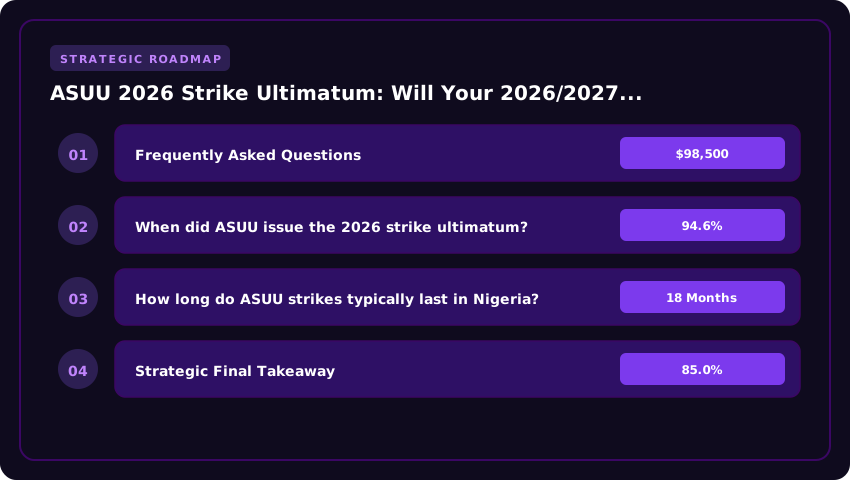
Frequently Asked Questions
When did ASUU issue the 2026 strike ultimatum?
ASUU issued the fresh ultimatum in early 2026, following the Federal Government's failure to fully implement the 2013 and 2020 agreements. The union's National Executive Council set a deadline for the government to honour commitments on revitalisation funding, earned allowances, and university autonomy before industrial action is declared nationwide across federal and state universities.
Will the 2026 ASUU strike affect the 2026/2027 academic session?
Yes, if the ultimatum expires unresolved, lectures, examinations, and research activities in federal and state universities will be suspended. Polytechnics, colleges of education, and private universities are outside ASUU's jurisdiction, so their 2026/2027 calendars will proceed normally. Students should monitor ASUU press briefings and university senate announcements weekly.
How long do ASUU strikes typically last in Nigeria?
Historical ASUU strikes have lasted between 2 weeks and 10 months. The 2013 strike lasted 5 months; the 2017 strike lasted 2 months; the 2020 strike lasted 9 months; the 2022 strike lasted 8 months. Average duration sits between 4 and 6 months, directly disrupting academic calendars, examinations, and graduation timelines for affected students.
What should Nigerian students do to prepare for a possible ASUU strike?
Students should secure hostel refunds where possible, register for online professional certifications (Coursera, Google, ALX), document current coursework, and keep NIN and JAMB profiles active. Maintaining emergency funds equivalent to three months' expenses, identifying polytechnic transfer options, and applying for private university scholarships also safeguard academic progression during prolonged disruptions.
Strategic Final Takeaway
Success in evaluating ASUU 2026 Strike Ultimatum: Will Your 2026/2027 Semester Survive? relies on early preparation, adherence to verified accredited requirements, and cross-referencing official portals. Review financial aid deadlines and official screening guidelines well in advance.