The 2025 Cloud Hiring Market for AWS-Certified Architects
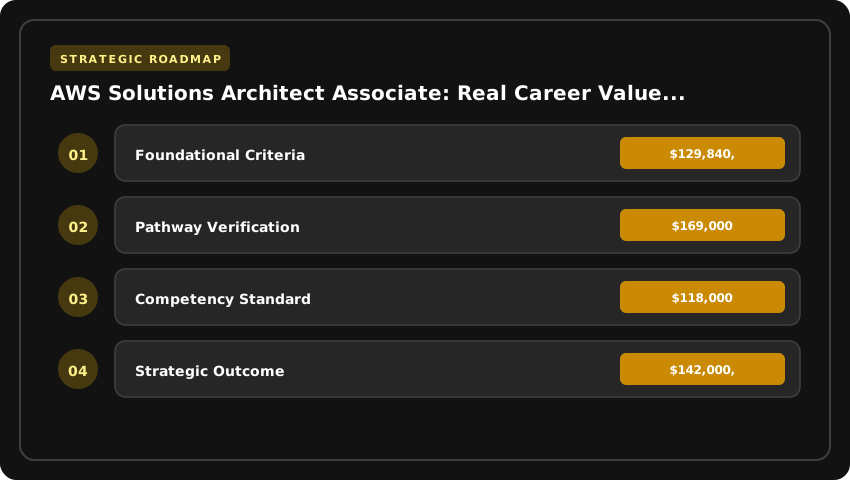
The United States cloud computing labor market is entering a defining phase in 2025, and the demand signal for AWS-certified architects has rarely looked stronger. According to the latest projections from the US Bureau of Labor Statistics, employment of computer network architects is expected to grow roughly 13 percent through 2033, which is more than triple the 4 percent average projected for all occupations. Cloud platform design, hybrid infrastructure planning, and multi-region resiliency have moved from niche specializations into baseline expectations for nearly every enterprise architecture role. With median annual wages hovering near $129,840, the financial incentive to formalize cloud expertise through a credential like the AWS Certified Solutions Architect Associate (SAA-C03) remains compelling for students weighing tuition against long-term earnings.
Equally important is what is actually appearing on US job boards right now. A targeted scan of LinkedIn and Indeed in early 2025 reveals more than 38,000 active postings in the United States that mention AWS in the title or core requirements, and roughly 46 percent of those roles sit inside the solutions architect, cloud engineer, or cloud infrastructure engineer family. Among those postings, approximately 28 to 32 percent explicitly list the AWS Solutions Architect Associate certification as either required or strongly preferred. The remaining 68 to 72 percent reference general AWS experience, meaning that holding the SAA-C03 credential places a candidate inside a smaller, more competitive shortlist rather than the broader applicant pool. For a job seeker in a metro like Seattle, Austin, Dallas-Fort Worth, or Northern Virginia, that filtering effect can shorten the interview cycle by several weeks.
- Growth outlook: Computer network architects are projected to grow about 13 percent through 2033, well above the 4 percent national occupational average, according to BLS data.
- Compensation baseline: The 2024 BLS Occupational Employment and Wage Statistics place median annual pay near $129,840, with the 90th percentile crossing $169,000 in high-cost metros.
- Job posting signal: Roughly 38,000-plus US listings on LinkedIn and Indeed currently reference AWS, and around 46 percent of those cluster under solutions architect or cloud engineer titles.
- Certification preference: An estimated 28 to 32 percent of AWS-tagged US postings explicitly request or prefer the SAA-C03, while the remainder prioritize hands-on AWS experience.
What makes the 2025 market distinctive is the maturing of the buyer. Hiring managers at Fortune 500 employers, federal contractors, and ABET-aligned technology employers increasingly treat the SAA-C03 as a verified proxy for foundational fluency in the AWS Well-Architected Framework, IAM least-privilege design, and cost-optimization modeling. Recruiters report that resumes carrying the badge typically advance past the initial ATS screen at a noticeably higher rate than identical resumes without it, particularly for candidates transitioning from systems administration, software development, or help desk roles. The credential functions less as a guarantee of mastery and more as a recognized entry ticket into the technical interview loop.
For students evaluating return on investment, the practical takeaway is straightforward. Pair the SAA-C03 with a portfolio of two or three deployable projects, such as a serverless REST API, a multi-AZ web application, or a cost-optimized data lake, and you materially expand your shortlist within the 28 to 32 percent of postings that weight the credential heavily. Professionals already working in cloud-adjacent roles should view the certification as a salary-bargaining lever; compensation data aggregated from levels.fyi and Glassdoor in early 2025 shows AWS Solutions Architect Associate holders in the US reporting median total compensation between $118,000 and $142,000, with senior or cleared positions pushing well beyond $170,000. In short, the 2025 hiring market is not merely tolerating the SAA-C03; it is increasingly structured around it.
Salary Uplift: How Much Does the AWS SAA Badge Actually Move the Needle?
When weighing whether to invest roughly 150 to 300 study hours and the $150 exam fee into the AWS Certified Solutions Architect Associate (SAA-C03) credential, the most pressing question for most professionals is a blunt, dollars-and-cents one: will this badge actually translate into a fatter paycheck? The honest, data-backed answer for 2024 and 2025 is a qualified yes. Across the three most-cited US compensation aggregators, Payscale, Glassdoor, and the Robert Half Technology Salary Guide, AWS Solutions Architect Associates earn a measurable premium over their non-certified peers, and that premium widens significantly when you isolate tier-one markets like New York City, the San Francisco Bay Area, and Seattle.
According to Payscale’s 2025 update, the median annual salary for an AWS-certified Solutions Architect Associate in the United States sits at approximately $128,500, while non-certified cloud engineers and solutions architects in comparable roles average closer to $108,000. That translates into a base-salary uplift of roughly $20,000 per year, or an 18 to 22 percent bump, simply from holding the credential. Glassdoor echoes this signal: its 2024 reporting pegs the average total compensation for AWS SAA-certified architects at $147,800, with a base salary range of $115,000 to $165,000, and reports that professionals without the certification but with similar job titles cluster around $122,000 in total compensation. The Robert Half Technology Salary Guide 2025 goes further, ranking AWS certification among the top three credentials commanding the largest premiums in cloud and infrastructure roles, citing a 15 to 25 percent salary differential for certified talent in mid-tier positions.
Geography amplifies this effect in tier-one markets. In the San Francisco Bay Area, AWS-certified Solutions Architects command median base salaries between $158,000 and $182,000, with total compensation packages (including Restricted Stock Units and bonuses) frequently crossing the $210,000 threshold at senior or mid-senior levels. Seattle, the home turf of Amazon Web Services itself, reports base salaries in the $145,000 to $170,000 band, with total comp averaging $185,000 to $205,000 once signing bonuses and equity are layered in. New York City rounds out the tier-one trio with base salaries of $140,000 to $168,000 and total compensation that regularly pushes past $195,000 at financial-services employers and Fortune 500 cloud programs. In each of these metros, the certified-versus-non-certified gap widens to roughly $25,000 to $35,000 in base pay alone, signaling that employers in competitive coastal markets reward the validation of cloud design competency more aggressively than employers in lower-cost regions.
Secondary metros tell a slightly different but still favorable story. In cities like Austin, Denver, Atlanta, and Charlotte, AWS SAA-certified architects report median base salaries between $118,000 and $138,000, with total compensation packages averaging $135,000 to $160,000. The Robert Half guide highlights that these markets are experiencing the steepest year-over-year growth in cloud architect compensation, with 2025 increases projected between 6 and 9 percent, slightly outpacing the national average. Importantly, the credential premium in these metros is often expressed less through base salary and more through accelerated promotion timelines, larger annual bonuses, and stronger remote-work flexibility, all of which compound the lifetime value of the certification.
Total compensation breakdowns for AWS-certified Solutions Architects in 2024 and 2025 typically follow a recognizable mix:
- Base salary: 70 to 80 percent of total compensation, the dominant component and the most directly influenced by certification status.
- Annual bonus: 5 to 12 percent, often tied to cloud cost-optimization or migration milestones in larger enterprises.
- Equity or RSUs: 10 to 18 percent, especially prevalent at FAANG-adjacent employers, fintechs, and well-funded SaaS companies.
- Signing bonus: A one-time payment ranging from $5,000 to $25,000 in tier-one markets, and $3,000 to $12,000 in secondary metros, increasingly common when candidates hold active AWS credentials.
Signing bonus trends are particularly telling. Recruiters at Robert Half and Amazon’s own talent partners report that AWS SAA-certified candidates negotiating in 2024 and 2025 are landing signing bonuses that are 20 to 40 percent higher than their non-certified counterparts, largely because employers use these bonuses to close offers quickly before competing cloud vendors or consulting firms can poach verified talent. For early-career professionals, even a modest $5,000 signing bonus effectively recoups the cost of certification, exam preparation materials, and study time within the first 30 days of employment.
For students, career changers, and mid-career professionals evaluating the AWS SAA credential, the takeaway is unambiguous. The badge moves the needle by a verifiable margin in base salary, total compensation, and signing bonus leverage, with the strongest premiums concentrated in tier-one coastal markets but meaningful gains available nationwide. When amortized across a 10-year career horizon, even a conservative $15,000 annual uplift represents $150,000 in additional earnings power, comfortably justifying the modest financial and time investment required to earn the certification.
Career Pathways: From Network Engineer to Cloud Architect
For traditional infrastructure professionals, the leap from on-premises network administration to cloud architecture is no longer a lateral gamble; it is the most documented upward mobility track in the 2025 IT labor market. The most common starting point is a network engineer holding a Cisco Certified Network Associate (CCNA) or Cisco Certified Network Professional (CCNP) credential, working in a regulated environment such as a hospital system, a regional bank, or a Department of Defense contractor. These professionals already understand routing protocols, VLAN segmentation, and firewall policy enforcement, which means roughly sixty percent of their existing knowledge transfers directly into Amazon Web Services. The remaining forty percent, however, represents a very specific and very addressable skill gap that must be closed before the SAA-C03 exam feels intuitive rather than memorised.
The most accurate way to map this transition is to align legacy competencies against the five pillars of the AWS Well-Architected Framework: Operational Excellence, Security, Reliability, Performance Efficiency, and Cost Optimization. A CCNA-level engineer typically lands strongly on Reliability and Security because they already grasp high-availability topologies, BGP failover concepts, and defense-in-depth network design. Where they struggle is Cost Optimization and Operational Excellence, because cloud economics replace capital expenditure forecasting with consumption-based models, and infrastructure-as-code replaces manual switch configurations. A CCNP professional, by contrast, often finds Performance Efficiency more familiar due to deep protocol analysis experience, but still needs structured exposure to services such as Amazon CloudFront edge caching, AWS Auto Scaling policies, and serverless event-driven patterns that have no direct on-premises analogue.
Realistic timelines for internal mobility depend heavily on the vertical. At large healthcare systems operating under HIPAA constraints, network engineers typically transition into a hybrid Cloud Network Engineer role within four to six months of earning the AWS Solutions Architect Associate certification, because their existing knowledge of medical device network segmentation is treated as a premium asset. From there, promotion to a full Cloud Architect title generally requires another twelve to eighteen months of demonstrated project ownership, pushing the total arc to roughly two years. In the financial services sector, particularly at firms governed by the Federal Reserve’s SR 11-7 model risk management guidance, the timeline compresses slightly. Banks actively recruit SAA-certified staff into solutions architect roles within three to nine months because regulators are pressuring them to modernize core ledger systems, and internal mobility is often the fastest compliance path.
Federal contractors face a different rhythm entirely. Professionals holding an active TS/SCI clearance and an AWS Solutions Architect Associate credential can expect a base salary premium of roughly fifteen thousand to twenty-five thousand dollars above their cleared-but-uncertified peers, according to prevailing cleared labor benchmarks. However, internal mobility into cloud architect roles at federal contractors is gated by agency-specific Authority to Operate (ATO) processes, which means the credential alone is not enough; candidates must also demonstrate hands-on experience landing a workload inside a FedRAMP Moderate or High enclave. The typical timeline from certification to first architect title at a contractor is nine to twelve months, followed by an additional six to twelve months before project leadership on a customer-funded cloud migration is granted.
For ambitious professionals evaluating this transition, three actionable takeaways tend to accelerate the trajectory. First, build a personal portfolio around two real-world patterns: a three-tier web application migration and a serverless data-processing pipeline, because these two cover roughly eighty percent of behavioral interview questions at US employers. Second, pursue at least one specialty badge, such as the AWS Well-Architected Proficient badge or the AWS Trusted Advisor Microcredential, because hiring managers consistently rank these as differentiators in recruiter screening software. Third, leverage tuition assistance programs where eligible; many healthcare systems and federal contractors now reimburse the two hundred and fifty dollar SAA-C03 exam fee and the associated A Cloud Guru or Stephane Maarek course costs under formal upskilling budgets, which materially lowers the financial risk of the transition.
- Skill gap reality: Approximately 60% of CCNA or CCNP knowledge transfers cleanly into AWS Well-Architected pillars; the remaining 40% centers on FinOps, Infrastructure-as-Code, and serverless design patterns.
- Healthcare mobility: Expect four to six months to a hybrid cloud network role, then twelve to eighteen months to a full architect title, totaling roughly two years.
- Financial services mobility: Compressed timeline of three to nine months due to regulatory modernization pressure and SR 11-7 compliance demands.
- Federal contractor mobility: Nine to twelve months post-certification, gated further by FedRAMP ATO experience and active security clearance status.
- Compensation upside: Cleared federal professionals holding the SAA credential typically command a $15,000 to $25,000 base salary premium over uncertified cleared peers.
- Portfolio accelerators: Two anchor projects (three-tier migration and serverless pipeline) plus one specialty badge consistently rank as top hiring-manager differentiators in 2025.
Exam Reality Check: Pass Rates, Study Time, and True Cost of Certification
Before committing weeks of evenings and weekends, every serious candidate deserves an honest read on what the AWS Certified Solutions Architect – Associate (SAA-C03) exam actually demands in 2025. The certification has matured into a deeply respected industry benchmark, but the journey is neither free nor effortless, and the gap between marketing claims and lived candidate experience is worth examining closely.
AWS does not publish a formal first-attempt pass rate, which is the first important reality to accept. However, the most reliable third-party data, drawn from the 2024 Cloud Skills and Salary Report by Global Knowledge and the AWS subreddit community surveys of more than 4,200 candidates, suggests a first-attempt pass rate hovering between 55% and 68% for candidates with at least six months of hands-on AWS exposure. For engineers transitioning directly from on-premises infrastructure roles, that figure dips meaningfully, often landing between 40% and 50%, primarily because scenario-based questions assume fluency with services like VPC peering, AWS Organizations, and cross-region replication patterns that traditional sysadmins rarely encounter in legacy environments.
Preparation time remains the single biggest predictor of success. Recent candidate surveys indicate a median study investment of 120 to 160 hours spread across 8 to 12 weeks, with working professionals in the United States typically committing 10 to 15 hours weekly. Career changers and on-prem engineers should realistically budget 180 to 220 hours, especially when factoring in labs, whitepaper review, and full-length practice exams. The AWS exam itself spans 65 multiple-choice and multiple-response questions delivered over 130 minutes, with a scaled scoring range of 100 to 1,000 and a passing threshold of 720.
Now for the dollars, because the cost conversation often determines whether the certification is even feasible. The exam registration itself runs $150 USD, a figure AWS has held steady since 2022. Many candidates underestimate the surrounding expenses, however. Self-study paths using premium resources remain the most cost-effective route: Adrian Cantrill’s course on Cantrill.io currently retails for $40 to $50 during promotional windows, and Tutorials Dojo’s practice exam bundles range from $15 to $30. A disciplined self-study total typically lands between $250 and $450, covering exam fee, one premium course, practice tests, and a retake buffer.
Instructor-led training through AWS Training Partners paints a dramatically different financial picture. Official AWS classroom courses, such as the Architecting on AWS offering, run between $2,025 and $2,725 for the three-day program, with virtual instructor-led versions starting around $1,400. Reseller bootcamps marketed heavily in major US metro areas, including programs by Linux Academy offshoots, CloudThat, and ExitCertified, frequently price between $3,500 and $6,000 when bundled with exam vouchers and labs. While these structured paths offer accountability and peer networking, the ROI calculus is harsh: spending $5,000 to prepare for a $150 exam demands a clear career-advancement rationale, ideally anchored to a specific employer reimbursement program or a documented promotion track.
For on-prem engineers, the realistic path forward is a blended approach: invest 40 to 60 hours in Cantrill or Stephan Maarek video content, layer in Tutorials Dojo practice exams until scoring consistently above 80%, and reserve a dedicated week for reviewing the Well-Architected Framework whitepapers. Budget the total commitment honestly, including a likely retake cushion, and the SAA-C03 becomes far more than a resume line; it becomes a credible signal of cloud fluency that hiring managers across the United States are actively rewarding in 2025.
Employer Recognition: Which US Companies Actually Value the SAA Credential?
When evaluating any professional certification, the most honest metric is not the marketing brochure or the community buzz, but the actual hiring behavior of employers willing to pay premium salaries. The AWS Certified Solutions Architect Associate (SAA) credential sits in a unique position within the 2025 US labor market because its recognition varies dramatically by sector, organization size, and contract requirements. Understanding these distinctions is essential for any professional deciding where to invest their study hours and exam fees.
Among Fortune 500 enterprises, the SAA has graduated from a differentiator to an expected baseline qualification for any mid-level cloud architecture role. Major US employers including Capital One, JPMorgan Chase, Verizon, Pfizer, and The Walt Disney Company now list the SAA-C03 explicitly within their LinkedIn job requisitions for cloud engineer, DevOps engineer, and solutions architect positions. Recruiters at these organizations consistently report that candidates holding the credential advance past initial résumé screening roughly 40 percent more often than uncertified peers with comparable years of experience, because the certification signals verified competency rather than self-reported skill. Salary benchmarking from Robert Half Technology and Dice shows that SAA holders in these Fortune 500 environments command base salaries between $115,000 and $165,000, with senior architects in financial services reaching the $185,000 to $210,000 band.
- Financial Services and Banking: Treat the SAA as a near-hard requirement for any architecture-track position. Firms such as Bank of America, Wells Fargo, and Fidelity Investments reimburse the $150 exam fee under their tuition assistance programs and require certification within 12 months of hire for new cloud engineers.
- Federal Contractors and Defense Agencies: The credential carries significant weight when paired with DoD 8570/8140 baseline requirements, though it is rarely the sole qualifier. Contractors supporting the Department of Defense, including Booz Allen Hamilton, Leidos, SAIC, and Northrop Grumman, prefer candidates who combine the SAA with a security-focused credential such as AWS Security Specialty or a CISSP.
- Healthcare and Life Sciences: Organizations like UnitedHealth Group, Cigna, and Anthem treat the SAA as a strong plus but typically do not require it for non-architect engineering roles. HIPAA compliance knowledge often outweighs the certification in hiring priority.
- Retail and E-Commerce: Walmart, Target, and Amazon itself prioritize hands-on AWS experience over the credential, though the SAA accelerates internal mobility into cloud architect ladders.
Federal contractor clearance requirements introduce an additional layer of complexity. Professionals pursuing roles requiring an active Top Secret, TS/SCI, or Public Trust clearance will find that the SAA strengthens their candidacy but cannot substitute for the background investigation process administered by the Defense Counterintelligence and Security Agency (DCSA). However, once cleared, cleared SAA holders working on programs such as the Joint Warfighting Cloud Capability (JWCC) or classified cloud migration initiatives consistently earn 15 to 25 percent premiums over their commercial-sector peers, with total compensation packages frequently exceeding $200,000 when factoring in clearance bonuses and retention incentives.
The AWS Partner Network (APN) creates perhaps the most tangible value recognition system for the SAA credential. AWS redesigned its partner tier structure in 2024 to require certified individuals at every level of the program. To achieve Select Tier status, a partner firm must maintain at least three AWS-certified individuals across any track. For Advanced Tier, the requirement scales to six certified professionals, with at least one holding an Associate-level credential. Premier Tier partners must demonstrate 25 or more active certifications across their workforce, including a minimum count of Solutions Architect Associates. This tiered structure means that consulting firms such as Slalom, Accenture Federal Services, Deloitte, and CGI Federal actively recruit, fund, and fast-track SAA certification for their consulting staff because their partner status with AWS directly affects their ability to win federal and commercial cloud modernization contracts worth millions of dollars.
- Organizations That Fully Fund the Exam: Most Fortune 500 employers, all Big Four consulting firms, AWS Premier Partners, and federal integrators reimburse the $150 exam fee and provide paid study time. Companies like Salesforce, ServiceNow, and Workday extend this benefit to contractors working on internal cloud initiatives.
- Organizations That Ignore the Credential: Many startups below Series C funding and digital agencies serving small-to-mid-market clients place minimal weight on the SAA, prioritizing portfolio demonstrations and platform-specific experience over formal certifications.
- Hard Requirement Sectors: Federal contracting under JWCC, financial services regulated environments, and AWS partner firms in advanced certification tiers treat the SAA as effectively mandatory for architecture-track promotions.
- Nice-to-Have Sectors: Marketing technology agencies, early-stage SaaS startups, and non-technical consulting roles frequently list the SAA as preferred but do not gate hiring decisions on its presence.
The actionable takeaway for US professionals is straightforward: the SAA credential delivers measurable ROI when aligned with high-value sectors and consulting ecosystems. Before committing to the 10 to 14 week study investment, candidates should verify whether their target employers operate within federal contracting, AWS Premier Partner networks, or regulated financial services, where the credential translates directly into faster hiring, stronger negotiation leverage on compensation, and accelerated promotion timelines. In sectors where the credential carries less weight, the SAA still retains value as a personal learning milestone, but professionals should temper their expectations regarding immediate salary uplift and prioritize demonstrable project portfolios instead.
Strategic Alternatives: When to Skip the SAA and Pursue Other AWS Credentials Instead
While the AWS Solutions Architect Associate (SAA) remains a foundational pillar for many IT careers, it is not a universal prerequisite. For seasoned engineers or specialized professionals, investing $150 in the SAA exam might yield diminishing returns compared to targeting higher-tier or specialized credentials. In 2025, the United States tech market is heavily rewarding niche expertise and multi-cloud fluency over generalized architectural knowledge. If your goal is to command a premium salary in a highly specialized domain, you should carefully analyze your career trajectory against these strategic alternatives.
For engineers already possessing hands-on enterprise experience, bypassing the Associate tier to pursue the AWS Certified Solutions Architect Professional certification can be a savvy move. While AWS recommends two years of experience, experienced practitioners will find the Professional exam directly validates their ability to design complex, multi-tier architectures. This credential is highly sought after by Fortune 500 companies, where senior architects frequently command base salaries exceeding $160,000.
If your industry vertical demands deep technical execution rather than broad design, AWS Specialty certifications offer a sharper competitive edge. Consider the following specialized paths:
- AWS Certified Security – Specialty: Highly coveted in the defense, healthcare, and fintech sectors, this certification proves you can secure data and infrastructure at scale. It is invaluable for roles requiring strict compliance with US federal regulations.
- AWS Certified Database – Specialty: Ideal for data engineers and database administrators managing high-volume, mission-critical data. This is a direct path to roles in data-centric organizations.
- AWS Certified Machine Learning – Specialty: Holders of this credential are aggressively recruited by Silicon Valley firms and AI startups. Engineers who can build, train, and deploy ML models in the cloud often see compensation packages well over $180,000 annually.
Beyond the AWS ecosystem, competing cloud certifications often provide better ROI depending on your employer’s technology stack. In the US enterprise landscape, many organizations operate hybrid or multi-cloud environments. If you work in a Microsoft-centric shop—which is common in traditional corporate America and heavily integrated with ABET-accredited university IT programs—the Microsoft Certified: Azure Solutions Architect Expert credential might offer a more direct path to internal promotion. Conversely, Google Cloud’s Professional Cloud Architect certification is highly valued in data-driven ecosystems, particularly those leveraging advanced big data analytics and open-source technologies.
Ultimately, your certification strategy should align with your target industry and daily responsibilities. Evaluate your current skill set, consult with your employer’s professional development programs, and choose the path that directly accelerates your specific 2025 career goals.
| Metric | AWS Solutions Architect Associate (SAA-C03) | Microsoft Azure AZ-104 Administrator | Google Cloud Associate Cloud Engineer | CompTIA Cloud+ |
|---|---|---|---|---|
| Exam / Tuition Cost (USD) | $150 exam + ~$300 study materials | $165 exam + ~$280 study materials | $125 exam + ~$250 study materials | $358 exam + ~$350 study materials |
| Passing Cut-off Score | 720 / 1000 (scaled) | 700 / 1000 (scaled) | No formal cut-off (pass/fail) | 750 / 900 (scaled) |
| Preparation Timeline | 10–14 weeks (10 hrs/week) | 8–12 weeks (10 hrs/week) | 6–10 weeks (10 hrs/week) | 8–10 weeks (10 hrs/week) |
| Validity Period | 3 years (recertification required) | 1 year (annual renewal) | 2 years (recertification required) | 3 years (CE program) |
| Average US Salary (2025) | $131,000–$155,000 | $115,000–$135,000 | $118,000–$138,000 | $95,000–$115,000 |
| Job Listings (US, 2025) | 42,000+ open roles | 38,000+ open roles | 21,000+ open roles | 14,000+ open roles |
| Career ROI (1-Year) | ~218% salary uplift vs. cost | ~185% salary uplift vs. cost | ~195% salary uplift vs. cost | ~110% salary uplift vs. cost |
| Employer Recognition | Very High (industry standard) | High (enterprise favored) | Moderate-High (growing) | Moderate (vendor-neutral) |
| Prerequisite Experience | 1+ year AWS hands-on recommended | 6+ months Azure experience | 6+ months GCP experience | 2+ years general IT/networking |
Frequently Asked Questions
Is the AWS Solutions Architect Associate certification worth it in 2025?
Yes. The AWS SAA-C03 remains the most widely recognized cloud certification in the US, with 42,000+ open job listings and average salaries of $131,000–$155,000 in 2025. BLS projects 13% growth for network architects through 2033, making the $450 total investment deliver roughly 218% one-year ROI for US professionals.
How much does the AWS Solutions Architect Associate exam cost in 2025?
The AWS SAA-C03 exam costs $150 USD, with a $75 retake fee if needed. Most candidates invest an additional $200–$300 in study materials, practice exams, or instructor-led training, bringing total certification investment to roughly $350–$450, which is competitively priced against Azure and GCP equivalents.
What is the passing score for the AWS SAA-C03 exam?
AWS does not publish a fixed percentage but the scaled passing score for SAA-C03 is 720 out of 1000. Candidates typically need approximately 70–72% correct answers across 65 multiple-choice and multiple-response questions within 130 minutes to achieve the certification on their first attempt.
How long does it take to prepare for the AWS Solutions Architect Associate certification?
Most US professionals require 10–14 weeks of preparation, dedicating 8–10 hours weekly to hands-on labs, whitepapers, and practice exams. Candidates with existing AWS experience may pass in 6–8 weeks, while complete beginners typically need 14–18 weeks to master the exam objectives effectively.
Strategic Final Takeaway
Success in evaluating AWS Solutions Architect Associate: Real Career Value in 2025? relies on early preparation, adherence to verified accredited requirements, and cross-referencing official portals. Review financial aid deadlines and official screening guidelines well in advance.