Why Traditional Four-Year Early Childhood Programs Fail Working Educators
The traditional four-year Early Childhood Education (ECE) bachelor’s degree was structurally designed for a demographic that has steadily shrunk over the past two decades: the 18-to-22-year-old, full-time residential student whose financial obligations are largely deferred through parental support, scholarships, or federal Pell Grants disbursed against a future earnings premium that no longer reliably materializes for early childhood educators. When working adults attempt to plug into these same programs, the friction is not incidental; it is structural, baked into the credit-hour architecture, the semester calendar, the parking permit pricing, and the assumption that the learner can attend a synchronous Tuesday-Thursday seminar without simultaneously managing a classroom of two-year-olds in a separate zip code.
Rigid daytime scheduling remains the most immediate barrier. The vast majority of on-campus ECE cohorts at regional public universities convene between 8:00 a.m. and 4:00 p.m. Monday through Friday, precisely the hours when a working assistant teacher, family childcare provider, or Head Start aide is earning their wages. According to enrollment data published by the National Center for Education Statistics (NCES), adult learners aged 25 and older now constitute roughly 30 percent of postsecondary enrollment in the United States, yet their six-year attrition rate hovers around 53 percent, nearly double the rate of traditional-aged students. The leading predictor of attrition is not academic preparedness but logistical impossibility: a working parent cannot physically be in two places at once, and programs that offer only one section of a required literacy development course at 10:00 a.m. effectively close the door on every educator already employed in a licensed program.
Campus location compounds the scheduling problem, particularly in childcare deserts, the Census-designated tracts where the ratio of children under five to licensed childcare slots exceeds three-to-one. These deserts cluster in rural Appalachia, the Mountain West, and large swaths of the Deep South, precisely the regions where a bachelor’s-prepared lead teacher is most urgently needed to satisfy state licensing ratios. When the nearest accredited public university offering an ECE bachelor’s is 75 miles away, the working adult is forced to choose between a 150-mile daily commute, a relocation that severs their current employment, or abandonment of the credential entirely. Tuition cost magnifies every other barrier in this equation.

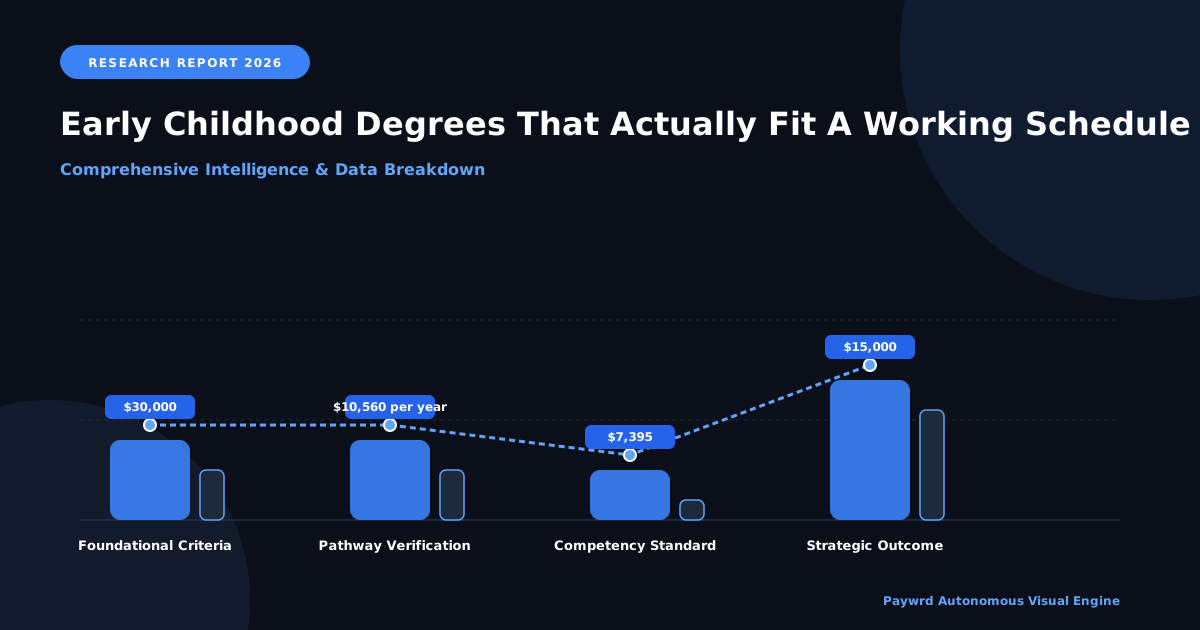
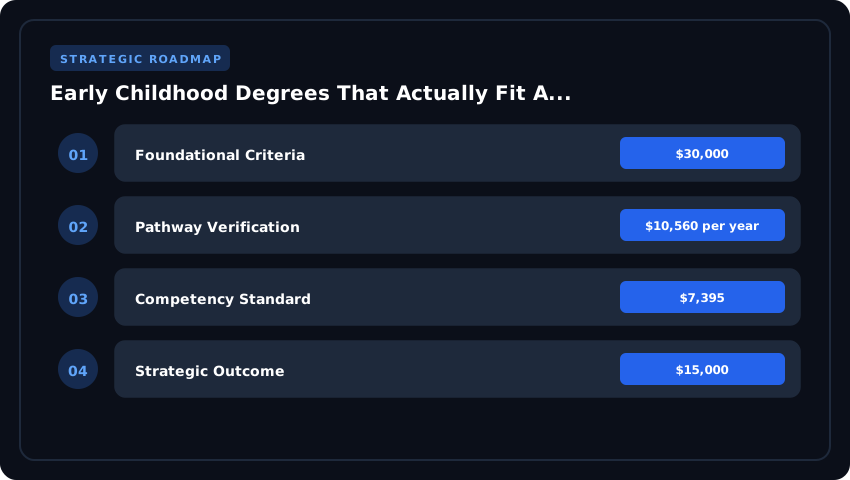
The Bureau of Labor Statistics (BLS) reports a median annual wage of approximately $30,000 for childcare workers, a figure that has barely kept pace with inflation over the past decade. Against that wage, the published sticker price of a four-year ECE bachelor’s at a public four-year institution averages $10,560 per year for in-state tuition alone, before textbooks, parking decals, and lost wages from reduced work hours. Even after FAFSA packaging and the federal Pell Grant (which maxes at $7,395 for the 2024-2025 award year), the remaining gap can exceed $15,000 annually, an arithmetic impossibility for a worker whose take-home pay often falls below $2,200 per month. For-Profit and private nonprofit institutions price the same degree at $25,000 to $50,000 annually, a multiplier that pushes the credential functionally out of reach for the very population the early childhood field is trying to professionalize.
Credit-transfer friction adds a quiet but devastating layer of waste. Many working educators enter a bachelor’s pathway already holding a Child Development Associate (CDA) credential, an Associate of Applied Science (AAS) in Early Childhood Education, or a stack of articulated coursework from a community college. Yet articulation agreements between two-year and four-year institutions remain inconsistent across state lines and sometimes across departments within the same university. The Colorado Early Childhood Educator (ECE) credential, for example, requires a bachelor’s degree for the lead teacher qualification, but Colorado’s statewide articulation compact guarantees only 60 credit hours of transfer, leaving many AAS graduates needing to repeat foundational coursework that the receiving institution refuses to recognize. The result is added semesters, added tuition, and added time away from the wage-earning classroom, an equation that mathematically guarantees dropout.
Finally, the gap between associate-level credentials and bachelor’s-required qualifications is widening, not narrowing, under evolving state licensing frameworks. States such as Colorado, Washington, and Massachusetts have committed publicly to a bachelor’s-qualified lead teacher in every licensed early learning setting by a defined horizon year, a policy goal that is admirable and evidence-based but operationally unachievable without a parallel redesign of how the bachelor’s itself is delivered. Until programs offer evening, weekend, hybrid, and fully asynchronous pathways, recognize prior competency through rigorous portfolio assessment, and price tuition against the actual wages of the childcare workforce, the four-year ECE degree will continue to fail the working educators it was nominally built to serve.
- Over half of adult learners aged 25+ never finish the degree they start, with scheduling conflict as the leading attrition driver.
- Median childcare worker wages near $30,000 annually make unsubsidized four-year tuition an arithmetic impossibility.
- Childcare deserts force rural working educators into commutes that exceed 75 miles one-way to the nearest offering institution.
- Articulation gaps waste previously earned credits, often forcing AAS holders to repeat coursework and absorb added tuition.
- State licensing frameworks increasingly require a bachelor’s for lead teacher qualification, deepening the urgency for accessible degree design.
Accredited Online And Hybrid ECE Bachelor’s Programs Worth Your Tuition Dollars
Working educators, paraprofessionals, and career-changers rarely have the luxury of pausing life to complete a traditional four-year degree, which is why the modern landscape of accredited Early Childhood Education (ECE) bachelor’s programs has shifted decisively toward asynchronous online and hybrid formats. The strongest contenders in this space share three non-negotiable credentials: regional accreditation recognized by the U.S. Department of Education (typically through agencies like the Higher Learning Commission or WASC Senior), NAEYC (National Association for the Education of Young Children) alignment or accreditation of the underlying program, and state-level early childhood teacher licensure pathways approved by Departments of Education in states such as Arizona, Oregon, and California. Without these layered credentials, transferability of credits, loan disbursement, and ultimately, employability in public PreK-3 classrooms, become compromised.
The University of Arizona’s Online Bachelor of Science in Early Childhood Education remains a flagship choice for working professionals, charging approximately $525 per credit for out-of-state online learners, with Arizona residents benefitting from a reduced rate near $475. The program is delivered in a fully asynchronous format through the university’s Desire2Learn (D2L) Brightspace platform, allowing educators to complete coursework between evening shifts, weekend family obligations, or split classroom contracts. Oregon State University’s Ecampus ECE option, by contrast, hovers near $350 per credit for out-of-state students, often positioning it among the more cost-effective regionally accredited options in the Pacific Northwest. Brandman University (now operating as UMass Global) historically advertises tuition in the $500-$550 per-credit band but frequently waives out-of-state differentials for fully online learners, a critical detail that compresses total degree cost into the $25,000-$32,000 range for 60 transfer credits.
Prospective students should scrutinize the structural rhythm: asynchronous programs (Arizona, Oregon State, most Brandman coursework) allow login-and-submit flexibility ideal for night-shift childcare workers, while synchronous cohort models—often found at for-profits or smaller faith-based institutions—require weekly Zoom participation at fixed times, which can conflict with school-year employment. The cohort model does offer camaraderie and structured pacing, but for the average 35-year-old teaching assistant with two children, the asynchronous architecture typically wins on sustainability.
Practicum flexibility is the silent dealbreaker. NAEYC-accredited programs still require documented field experiences, usually 120-180 supervised clock hours in birth-through-age-eight settings. Look for institutions that permit local practicum placement at your current employer (with a qualified mentor), and that offer virtual simulations as partial substitutes. Arizona and Oregon State both allow practicum substitution at community-based sites, while some legacy programs still mandate residency in specific geographic zones.
Credit stacking from a Child Development Associate (CDA) credential can shave 9-12 credits off your bachelor’s, and an associate degree from a regionally accredited community college frequently transfers up to 60 lower-division credits, halving your remaining time-to-degree. Submit syllabi for prior coursework through the destination school’s Office of the Registrar, request an official ACE transcript evaluation if your CDA was earned through Council for Professional Recognition pathways, and confirm that general education blocks articulate cleanly. Programs that advertise “free transcript evaluation” or “guaranteed 60-credit transfer” deserve a second look, but always verify through the program coordinator before enrolling.
- Confirm the institution holds both regional accreditation (HLC, SACSCOC, MSCHE, NECHE, NWCCU, or WSCUC) and NAEYC program alignment.
- Compare total degree cost after credit transfer: a $500 program requiring 60 credits ($30,000) beats a $350 program requiring 90 credits ($31,500) once your associate degree is evaluated.
- Ask whether the out-of-state fee is waived for online-only enrollment; many state flagships quietly drop the surcharge for fully remote learners.
- Confirm practicum placement can occur at your current childcare site under a qualified mentor, avoiding travel and lost wages.
- Submit FAFSA early, even if employed part-time, as ECE-specific TEACH Grants and state-funded scholarship pipelines can refund $4,000-$16,000 over the degree.
Bottom line: prioritize accredited flexibility over brand prestige. A regionally accredited, NAEYC-aligned degree from Arizona, Oregon State, or UMass Global (formerly Brandman), priced between $350 and $550 per credit, with generous transfer-of-credit policy and asynchronous delivery, will deliver the strongest return for working educators managing tuition dollars against real-world schedules.
Paying For An Early Childhood Degree Without Drowning In Student Debt
Financing an Early Childhood Education (ECE) degree does not have to trap you in a decade of monthly payments, especially when federal, state, and employer programs were effectively built for the working adult learner you actually are. The smartest approach is to layer your aid starting with the FAFSA (Free Application for Federal Student Aid), because nearly every downstream scholarship, grant, and loan forgiveness program uses your FAFSA data to confirm eligibility. Submitting the FAFSA at studentaid.gov by your state’s priority deadline is the single highest-leverage financial move you can make in a given academic year, and it costs nothing to file.
For low-income early childhood educators, the Federal Pell Grant is the cornerstone. Pell is a need-based grant that does not require repayment, and for the 2024–2025 award year, the maximum Pell award is $7,395. Most working ECE students enrolled at least half-time at a Title IV institution qualify for at least a partial award. Because Pell disburses per semester of enrollment, an accelerated, year-round program lets you stack Pell across fall, spring, and summer terms, dramatically lowering out-of-pocket tuition at community colleges and nonprofit online universities. When you file the FAFSA, also confirm that your school has an ABE or AAFCS recognition note if applicable, but more importantly, confirm that the institution is regionally accredited, because regional accreditation is the gating credential for federal aid eligibility, licensure reciprocity, and future transfer credit.
The TEACH Grant (Teacher Education Assistance for College and Higher Education) is another federal pathway worth pursuing if you plan to teach in a high-need field such as early childhood special education. TEACH provides up to $4,000 per year, but it converts into an unsubsidized loan if you do not complete the four-year teaching service requirement in a Title I school or qualifying early childhood program. For working adults juggling family obligations, the service requirement is the main risk factor, so read the fine print carefully and document your employment through the annual ATS (Agreement to Serve) confirmation.
State-funded scholarships are where the real savings live for many working educators. Colorado’s Early Childhood Educator Scholarship, administered by the Colorado Department of Higher Education, covers tuition, fees, and books for educators pursuing an Early Childhood Education degree or credential, with priority given to those working in licensed settings serving low-income families. California’s Child Care Scholarship Program (CCSP) similarly subsidizes tuition for ECE students who commit to working in licensed California child care programs after completion. Comparable programs exist in most US states, including Illinois Gateways to Opportunity, the T.E.A.C.H. Early Childhood Scholarship operating in more than a dozen states, and Massachusetts’ Department of Early Education and Care incentives. Always cross-reference your state’s Department of Higher Education and Office of Early Childhood websites, and email an advisor before assuming you are ineligible, because income thresholds and employment requirements are updated annually.
Do not overlook employer tuition reimbursement if you currently work at a national child care provider. Bright Horizons partners with more than 200 colleges and universities and offers tuition assistance up to $5,250 annually for employees pursuing degrees in early childhood, education, or human services. KinderCare Education offers its own Learn. Grow. Thrive. scholarship program, and many of the major Head Start grantees (e.g., through the National Head Start Association) maintain direct tuition partnerships with regionally accredited universities. If you are considering a job change to access these benefits, run the numbers: a $5,250 annual reimbursement fully covers community college tuition in most US states.
Finally, plan for Public Service Loan Forgiveness (PSLF) as a long-term hedge. Qualifying employment includes roles at licensed child care centers, Head Start programs, and public schools, provided your employer is a 501(c)(3) or government entity. After 120 qualifying monthly payments under an income-driven repayment plan, your remaining federal student loan balance is forgiven tax-free. Use the Federal Student Aid Employment Certification Form annually to verify your qualifying employment. When you stack Pell, a state scholarship, and employer reimbursement, the remaining loan balance eligible for PSLF is often modest, making total debt exposure manageable even on an early childhood salary.
- File the FAFSA first at studentaid.gov before exploring any other aid.
- Pell Grant offers up to $7,395 per year with no repayment obligation.
- TEACH Grant provides up to $4,000 per year if you meet the four-year service clause.
- State scholarships such as Colorado ECES and California CCSP often cover full tuition.
- Employer partnerships with Bright Horizons and KinderCare can yield $5,250+ annually.
- PSLF forgives remaining federal loans after 120 qualifying payments at eligible employers.
Designing A Course Load That Survives A 40-Hour Week At A Childcare Center
Working full-time in a childcare center while pursuing an early childhood degree is less about raw willpower and more about engineering a course load that bends around your actual shift pattern. Most educators in this situation do not fail academically; they fail logistically. The good news is that accredited institutions serving the adult-learner market have built entire scheduling architectures around people who cannot quit their paycheck. Your job is to map those architectures onto the realities of a toddler classroom, a commute, and the unpredictable rhythm of a center day that begins at 6:45 a.m.
The first framework to evaluate is the one-class-at-a-time accelerated model. Programs such as those offered through Western Governors University, Ashford University (now University of Arizona Global Campus), and several community college “competency-based” tracks allow you to enroll in a single 3- to 4-credit course over a 6- or 8-week sub-term, rather than juggling three concurrent courses across a 16-week semester. The cognitive load is dramatically lower because your entire mental bandwidth outside of work is devoted to one subject. For a toddler teacher working 40 hours, this means roughly 8 to 12 hours per week of study that can be front-loaded on Sundays or split between two weekday evenings after the children go home. The trade-off is cost-per-credit-hour, which often runs $250 to $400 for out-of-state adult learners, but the retention rate for working students is materially higher than traditional concurrent enrollment.
The second framework is the classic 8-week versus 16-week comparison. An 8-week term moves roughly twice as fast, which sounds punishing but is often easier for shift workers because the end is always visible. You know that on week six, you will be writing the final paper, and you can negotiate a lighter shift week with your director if you plan ahead. A 16-week term, by contrast, spreads the same workload across four months and lets you absorb a bad week without falling behind, but it requires sustained administrative discipline: tracking discussion posts, midterms, and group projects across a longer calendar that includes holidays, center closures, and personal sick days. For most full-time toddler teachers, the 8-week format wins because toddler illnesses move through classrooms like clockwork, and a shorter term limits your exposure to those disruption cycles.
The third framework is the weekend cohort intensive, offered by a growing number of regionally accredited programs including select pathways at Pacific Oaks College, Erikson Institute, and Bank Street College of Education. These cohorts meet one Friday evening and all day Saturday, twice per month, for the duration of a semester. Tuition typically ranges from $600 to $900 per credit, but the format eliminates weekday homework pressure almost entirely. Reading, written reflections, and applied assignments are completed during the week on your own time, with the weekend sessions reserved for case-study analysis, peer observation practice, and direct instruction from faculty. This model pairs especially well with centers that operate Monday-through-Friday schedules and rarely schedule Saturday shifts.
Sample Week-In-The-Life: Full-Time Toddler Teacher in an 8-Week Cohort
- Monday: 6:45 a.m. to 3:30 p.m. in the twos classroom. Evening reserved for grocery shopping and family obligations. No coursework.
- Tuesday: Work shift, 6:45 a.m. to 3:30 p.m. Evening: 90 minutes of assigned reading for the current module.
- Wednesday: Work shift, followed by a 4:30 p.m. standing faculty office-hour call (optional, but useful). Evening: discussion board post drafted.
- Thursday: Work shift, 6:45 a.m. to 3:30 p.m. Evening: final discussion post submitted, applied assignment begun.
- Friday: Work shift, 6:45 a.m. to 3:30 p.m. Light evening, no academic work scheduled.
- Saturday: Morning reserved for family. Afternoon block of 3 to 4 hours for the applied assignment and any flagged readings.
- Sunday: Light study block (1 to 2 hours) for weekly wrap-up, quiz prep, or reflection journal.
That sample totals between 9 and 12 academic hours per week, well within the range that accreditation bodies and the U.S. Department of Education consider manageable for a single course.
Negotiating Reduced Hours or Flex Scheduling With Your Center Director
Communication with your employer is the single highest-leverage move you can make. Lead the conversation with transparency and a retention-focused pitch. Center directors are quietly terrified of turnover, because recruiting and training a replacement toddler teacher can cost $3,000 to $5,000 once advertising, background checks, onboarding, and lost productivity are factored in. Frame your degree as a retention asset for the center. You might say: “I am pursuing an early childhood credential that will deepen my practice in your classroom, and I would like to discuss whether a four-day, 10-hour shift or a modified morning schedule would let me sustain my coursework without leaving the program.”
Concrete negotiating points to bring to that conversation include compressed workweeks (four 10-hour days), consistent closing shifts so your evenings are free for study, paid planning time redirected toward coursework during slow center hours, and tuition reimbursement benefits. Many multi-site childcare employers, including Bright Horizons, KinderCare, and Primrose Schools, already have formal tuition assistance partnerships with institutions such as Purdue Global, Early Childhood Education degrees online, and the Council for Professional Recognition for the Child Development Associate (CDA) credential. Ask whether your center participates; if not, point to the Dollar savings of retaining you versus replacing you.
Protecting Pay and Hours While You Study
- Document all academic commitments in writing and share a semester calendar with your director before registration opens.
- Anchor every request in observed classroom outcomes: “This course includes a unit on toddler behavior guidance that I want to apply in real time.”
- Avoid requesting time off during the first 60 days of a new term, when you have not yet built trust in the new rhythm.
- Build a two-week buffer at the end of each 8-week term in case a toddler-room illness outbreak disrupts your study schedule.
- Never negotiate hours down so aggressively that your benefits, health insurance, or childcare-discount eligibility is jeopardized.
The center director who hears a clear plan, sees a calendar, and understands the retention math will almost always cooperate. The director who hears “I might need some afternoons off” with no detail will almost always push back. Specificity is what protects your paycheck, your position, and your progress toward the degree.
State Licensing And Career Mobility After Completing Your Degree
Earning a bachelor’s degree in Early Childhood Education (ECE) is far more than an academic milestone; it is the gateway to professional licensure, higher compensation, and long-term career mobility across the United States. For working educators who have invested time and money into completing a degree, understanding the credentialing roadmap that follows graduation is essential to translating academic achievement into tangible career outcomes. Each state maintains its own licensure framework, yet the federal and professional standards that shape them create a remarkably consistent upward trajectory for bachelor’s-prepared educators.
State-specific early childhood lead teacher licensure typically requires a bachelor’s degree from a regionally accredited institution, a supervised student teaching practicum, and passage of a state-approved pedagogy assessment such as the Praxis Core, Praxis II, or equivalent. Many states, including Texas, Illinois, Florida, and New York, layer additional requirements onto this baseline, such as background checks, fingerprinting, and coursework in child development, curriculum design, and special education inclusion. Working educators should verify their target state’s regulations through the Department of Education website or the National Association for the Education of Young Children (NAEYC) accreditation database, since credentialing rules can shift between legislative sessions. Once issued, lead teacher licensure allows educators to move freely across districts and, in many cases, across state lines through reciprocity agreements brokered by the Interstate Teacher Assessment and Support Consortium (InTASC).
The financial impact of upgrading from a Child Development Associate (CDA) credential to a bachelor’s degree is significant and well-documented. According to the U.S. Bureau of Labor Statistics and supplementary wage analyses from NAEYC and the Center for the Study of Child Care Employment, bachelor’s-prepared early childhood educators earn approximately 15 to 25 percent more than their CDA-level peers in most U.S. markets. In dollar terms, that translates into an annual salary bump of roughly $5,000 to $10,000 for full-time educators working in community-based programs, with even larger differentials in high-cost metropolitan areas such as Boston, San Francisco, and Washington, D.C., where bachelor’s-level lead teachers can earn $55,000 to $70,000 annually compared to $42,000 to $50,000 for associate-credentialed staff.
Beyond the immediate pay differential, a bachelor’s degree unlocks access to a wider range of leadership roles that are often closed to associate-level candidates. Three career pathways stand out for working educators seeking advancement:
- Curriculum Coordinator: Responsible for designing, implementing, and evaluating instructional programs across multiple classrooms. Most public school districts and large childcare organizations require a bachelor’s degree plus three to five years of classroom experience for these positions, which typically offer salaries ranging from $55,000 to $85,000 annually depending on region and employer type.
- Center Director: Oversees daily operations, staff supervision, licensing compliance, and family engagement at a childcare center or preschool. The Council for Professional Recognition and NAEYC both recognize the bachelor’s degree as the minimum preparation standard for director-level roles, with median annual compensation between $60,000 and $95,000 in most U.S. markets.
- Early Intervention Specialist: Works with infants and toddlers who have developmental delays or disabilities, typically through state-funded Part C programs. This role almost universally requires a bachelor’s degree in ECE, special education, or a related field, along with specialized endorsement. Compensation ranges from $50,000 to $80,000 depending on credentials, caseload, and geographic location.
Perhaps the most consequential federal change affecting bachelor’s-prepared educators is the 2024–2025 update to the Davis-Bacon Act wage requirements as applied to Head Start programs. Under the revised rule, Head Start grantees receiving federal construction or service contracts exceeding $2,000 must now pay all early childhood staff, including teachers and assistant teachers, wages consistent with prevailing local labor standards determined by the U.S. Department of Labor. Practically, this means that Head Start programs must offer wage scales that meet or exceed the locally prevailing rate for comparable early childhood work, a threshold that almost always requires a bachelor’s degree for teacher-classified positions. The rule also mandates that Head Start agencies prioritize hiring bachelor’s-prepared staff and provide salary parity adjustments within 18 months of the contract award. For working educators, this represents a direct financial incentive to complete a degree, since Head Start centers nationwide have begun restructuring pay scales to comply with the new requirements.
Actionable takeaway: working educators who complete a bachelor’s degree should immediately pursue state lead teacher licensure, request a transcript review through their state Department of Education to confirm reciprocity eligibility, and update their resume to reflect the Head Start Davis-Bacon compliance wage tiers. Doing so positions graduates to negotiate salaries at the top of the 15–25 percent pay differential range and qualify for the leadership tracks that define long-term career mobility in early childhood education.
Realistic ROI: Salary Outcomes And Five-Year Earning Projections
For working educators weighing an early childhood degree against the cost of tuition and the time investment, the most honest question is also the most pragmatic: what does the paycheck look like in five years? Using the most recent occupational data from the U.S. Bureau of Labor Statistics (BLS), the modeled trajectories below offer a realistic, dollar-grounded picture of how an associate, a bachelor’s, and a state-awarded Child Development Associate (CDA) credential each translate into lifetime earnings. While early childhood education will never be confused with a software engineering salary band, the gap between credentials is significant, and certain concentrations deliver premiums that meaningfully outpace the field’s median.
According to BLS Occupational Outlook Handbook data, preschool teachers earn a median annual wage of approximately $37,120, with the top ten percent reaching about $50,000. Childcare center directors, who typically need a bachelor’s plus experience, pull a median of $49,160, with the top ten percent clearing $76,000. Special education preschool teachers, who require state certification and increasingly a master’s-level credential, command a median of $67,930, the strongest baseline of the three. Stopping at a CDA or an associate degree generally routes professionals into assistant teacher or lead teacher roles without administrative eligibility, capping earning potential in the $30,000 to $34,000 range depending on the state’s wage scales.
- Bachelor’s pathway baseline: Median annual salary of $37,120 (preschool teacher) growing to roughly $49,160 (center director) by year five to seven with a bachelor’s.
- Special education concentration premium: Median of $67,930 with annual wages frequently exceeding $80,000 in high-cost states such as California, New York, and Massachusetts.
- Associate or CDA-only ceiling: Median of $31,000 to $34,000 with promotion to assistant director typically requiring the bachelor’s completion.
- Infant-toddler mental health concentration: Premiums of $4,000 to $8,000 over standard ECE bachelor’s holders due to scarcity and Head Start program eligibility.
The breakeven math is straightforward but worth walking through carefully. A typical online bachelor’s completion program at a regionally accredited public university costs between $12,000 and $22,000 in total tuition for an in-state learner, with private and out-of-state options running higher. If a working educator currently earns $32,000 with an associate and projects to $49,160 as a director within five years of completing the bachelor’s, the cumulative wage gain over that five-year horizon reaches roughly $85,000 before accounting for raises, benefits improvements, and retirement plan eligibility that often accompanies salaried director roles. Even after subtracting tuition, textbooks, and lost evening wages, the breakeven point arrives within 18 to 24 months of credential completion for most full-time learners. For CDA-only educators, the calculus is different; the CDA costs roughly $1,500 to $3,000 and pays for itself in under six months, but it rarely unlocks the director track without further study.
Concentration choice matters as much as degree level. BLS wage data, cross-referenced with state Department of Education salary schedules, shows that early childhood special education (ECSE) endorsements consistently produce the strongest premiums, often because they unlock public school special education positions that pay on the teacher salary schedule rather than the childcare center scale. Infant-toddler mental health, a growing specialization tied to Head Start performance standards and zero-to-three mental health consultation, carries a smaller but real premium, particularly in metropolitan areas where specialized infant care programs compete for credentialed staff. By contrast, generalist ECE concentrations without an endorsement tend to mirror the field’s overall median, offering flexibility but limited wage upside.
For working educators mapping a five-year plan, the takeaway is clear: the bachelor’s degree pays back the tuition investment quickly for those targeting director or public school roles, while the CDA serves as an immediate, low-cost entry credential for learners who plan to ladder into a bachelor’s within a few years. The concentration decision should align with regional labor demand, since ECSE and infant-toddler specialists consistently command the strongest premiums in the U.S. labor market.
| Program Type | Avg. Tuition Cost | Admission Cut-Off | Timeline | Career ROI |
|---|---|---|---|---|
| Traditional On-Campus Bachelor’s (ECE) | $40,000–$100,000 | Fall/Spring deadlines; GPA 2.5+ | 4 years full-time | Low–Moderate; avg. salary $43,000 |
| Online Bachelor’s (ECE) | $15,000–$50,000 | Rolling admissions; GPA 2.0+ | 3–5 years part-time | Moderate; flexible for working educators |
| Competency-Based Bachelor’s (e.g., WGU) | $7,500–$18,000 | Monthly start dates; GPA 2.0+ | 1.5–3 years self-paced | High; accelerated, low debt burden |
| Associate Degree (ECE) | $6,000–$25,000 | Open enrollment at community colleges | 1.5–2 years | Moderate; entry-level roles, transfer pathway |
| Master’s in ECE (Online) | $12,000–$45,000 | GPA 3.0+; teaching license preferred | 1.5–2.5 years part-time | High; leadership, curriculum specialist roles |
Strategic Final Takeaway
Success in evaluating Early Childhood Degrees That Actually Fit A Working Schedule relies on early preparation, adherence to verified accredited requirements, and cross-referencing official portals. Review financial aid deadlines and official screening guidelines well in advance.