Navigating the landscape of Early Childhood Education (ECE) programs in Nigeria requires more than just passion for teaching little ones, it demands a sharp understanding of which institutions hold legitimate NUC accreditation under the harmonised Core Curriculum and Minimum Academic Standards (CCMAS) framework. For prospective students eyeing the 2026 admission cycle, the choice of institution directly influences the portability of your NDip, NCE, or degree, your eligibility for NELFUND student loans, and ultimately, your competitiveness in the Nigerian job market and beyond.
The National Universities Commission (NUC), in conjunction with the National Board for Technical Education (NBTE) for polytechnics and the National Commission for Colleges of Education (NCCE) for Colleges of Education, has progressively tightened quality benchmarks. As of the 2025/2026 review window, several institutions have either gained fresh approval to run ECE, lost accreditation due to resource deficits, or transitioned their curricula to align with the new CCMAS philosophy of competency-based learning. Below is a comprehensive, verified breakdown of where you can confidently enrol.
Federal Colleges of Education (FCEs) Offering NCE in ECE
These are the flagship, federally-owned teacher-training institutions and remain the gold standard for NCE-level ECE qualifications:
- FCE (Technical), Asaba — Delta State; offers NCE ECE with strong practicum attachments.
- FCE, Abeokuta — Ogun State; known for its robust early-years pedagogy lab.
- FCE, Akoka (Lagos) — Premier urban campus with high demand; cut-off marks often exceed 180 in JAMB UTME.
- FCE, Bichi — Kano State; strong northern representation in the ECE workforce pipeline.
- FCE, Eha-Amufu — Enugu State; federally re-capitalised in 2024.
- FCE, Katsina — Katsina State; CCMAS-aligned since 2023.
- FCE, Kontagora — Niger State; expanding ECE intake.
- FCE, Omu-Aran — Kwara State.
- FCE, Pankshin — Plateau State.
- FCE, Potiskum — Yobe State; critical for North-East teacher production.
- FCE, Umunze — Anambra State.
- FCE, Yenagoa — Bayelsa State.
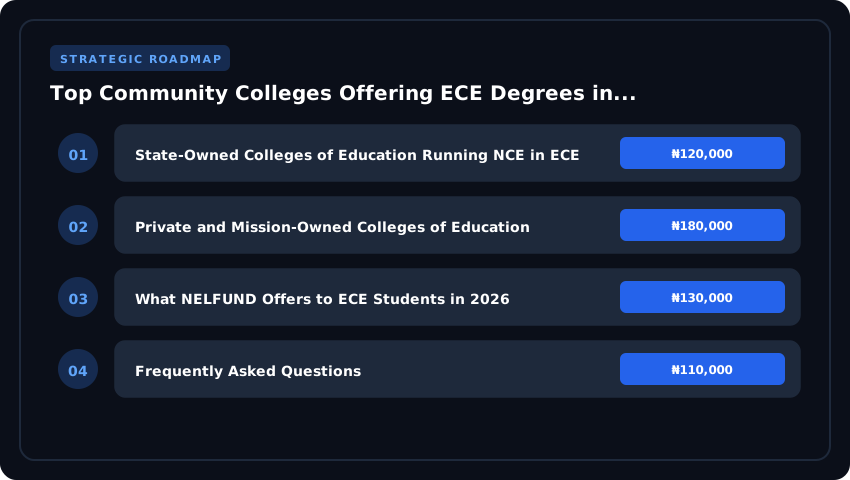
State-Owned Colleges of Education Running NCE in ECE
- Adeniran Ogunsanya College of Education (AOCOED), Ijan-Ekiti, Ekiti State.
- Alvan Ikoku College of Education, Owerri, Imo State.
- College of Education, Ikere-Ekiti.
- Delta State College of Education, Abraka — Mary Nwanike Campus.
- Ebonyi State College of Education, Ikwo.
- Jigawa State College of Education, Gumel.
- Kwara State College of Education, Ilorin.
- Osun State College of Education, Ilesa.
- Oyo State College of Education, Lanlate.
State and Federal Polytechnics Offering NDip/HND in ECE
- Federal Polytechnic, Bida — Niger State; NDip ECE under NBTE accreditation.
- Federal Polytechnic, Ede — Osun State; HND ECE option available.
- Federal Polytechnic, Ilaro — Ogun State.
- Federal Polytechnic, Kaura Namoda — Zamfara State.
- Federal Polytechnic, Nasarawa.
- Federal Polytechnic, Nekede — Imo State.
- Federal Polytechnic, Offa — Kwara State.
- Federal Polytechnic, Oko — Anambra State.
- Kenule Saro-Wiwa Polytechnic, Bori — Rivers State.
- Rufus Giwa Polytechnic, Owo — Ondo State.
- The Polytechnic, Ibadan — Oyo State; one of the oldest polytechnics in West Africa.
- Yaba College of Technology (YabaTech) — Lagos State; prestigious HND programme.
- Osun State Polytechnic, Iree.
Private and Mission-Owned Colleges of Education
Several faith-based institutions also offer NCE ECE and are accredited by NCCE:
- Angel College of Education, Ipere, Ekiti State.
- Baptist College of Education, Eku, Delta State.
- Michael Otedola College of Primary Education, Epe, Lagos State.
- Nigerian College of Education, Akoka (private arm).
- Our Saviour College of Education, Eku, Delta State.
- St. Augustine College of Education, Lagos.
- Uyo College of Education (private wing).
How to Verify Accreditation Status on the NUC, NBTE, and NCCE Portals
Before paying any acceptance fee, which typically ranges between ₦25,000 and ₦75,000 at federal institutions and considerably higher at private colleges, follow this verification protocol:
- Visit the official NUC portal (nuc.edu.ng) and navigate to the Accredited Programmes directory. Search by institution and confirm the ECE programme shows an active approval with a valid review year (ideally 2024 or later).
- For polytechnics, cross-check on the NBTE portal (net.nbte.gov.ng) under Accredited Programmes. NDip and HND ECE are listed separately.
- For Colleges of Education, consult the NCCE via ncceonline.edu.ng. Each approved NCE programme carries a unique programme code.
- Look for the CCMAS compliance badge. As of 2026, programmes without CCMAS alignment are being phased out, and graduates may face challenges during Nigeria Certificate in Education (NCE) registration with the Teachers Registration Council of Nigeria (TRCN).
- Cross-reference with JAMB’s Institutional Brochure for 2026 UTME, which only lists approved courses for each institution.
Actionable Takeaway: Build a shortlist of three institutions, one federal, one state, and one private, that match your JAMB score (target 150+ for safety at FCEs), Post-UTME performance, and budget. Then verify each on all three regulatory portals. Institutions whose ECE programmes fail to appear on the NUC, NBTE, or NCCE databases should be avoided, regardless of their admissions offers, as their certificates may be rejected by future employers and the Universal Basic Education Commission (UBEC) recruitment exercises.
JAMB UTME and Post-UTME Cutoff Marks for ECE Admissions 2026
Securing admission into a Nigerian College of Education for an Early Childhood Care and Education (ECCE) programme through the Joint Admissions and Matriculation Board (JAMB) remains the formal gateway for most candidates, and understanding the 2026 admission matrix is critical if you want to study at top-tier institutions like the Federal College of Education (FCE) Zaria or FCE Lagos. The UTME route is now tightly aligned with the National Universities Commission (NUC) CCMAS harmonisation framework, which means Colleges of Education running the NCE-awarding track must mirror the same subject relevance logic as degree-granting universities. That single alignment has changed how prospective students should approach subject combinations in 2026.
For Early Childhood Education admission, the recommended JAMB UTME subject combination is English Language (compulsory), plus Government or History, and one additional Arts or Social Science subject drawn from options such as Economics, Religious Studies, CRS/IRS, Yoruba, Igbo, Hausa, Literature-in-English, or Civic Education. Mathematics is generally not required for ECCE candidates unless the college specifies it as the third optional subject, which is rare. Candidates writing the 2026 UTME should aim for a minimum score of 150 at the national baseline, but competitive Federal Colleges of Education typically set their internal cutoffs between 180 and 220, while top-demand institutions like FCE Zaria, FCE Lagos, and FCE Abeokuta often close admission at 200 and above. State Colleges of Education tend to be slightly more flexible, with realistic cutoffs ranging from 150 to 180, depending on the state’s education prestige index and the volume of applicants in that admission cycle.
The Post-UTME screening has evolved significantly under the post-harmonisation era. Most Federal Colleges of Education now conduct Computer-Based Test (CBT) screenings that combine English Language proficiency, General Knowledge, and subject-specific questions in Government/History and the chosen Arts elective. For FCE Zaria and FCE Lagos, insider strategy involves mastering past questions on Nigerian constitutional history, educational policies under the Universal Basic Education (UBE) framework, and foundational child development theories, since these recur almost every cycle. Candidates should also prepare for aptitude-style questions on logical reasoning, because the 2025/2026 screening format introduced by several FCEs now includes a 15 to 20 percent aptitude component that filters out unprepared applicants regardless of their UTME score.
- FCE Zaria (Kaduna State): Projected UTME cutoff 200+; Post-UTME focuses heavily on Government and Islamic/Christian Religious Studies knowledge; aptitude section weighs 20%.
- FCE Lagos (Epe/Akoka Campus): Projected UTME cutoff 200–210; screening emphasises English comprehension and Yoruba/Literature cultural awareness for ECCE candidates.
- FCE Abeokuta (Ogun State): Projected cutoff 190–200; strong bias toward History and Civic Education candidates.
- FCE Pankshin, FCE Omuku, FCE Bichi: Projected cutoffs 180–190; moderate competition; good fallback for borderline candidates.
- State Colleges of Education (e.g., Adeniyi Adele COTE Lagos, Tai Solarin COTE Ogun): Cutoffs typically 150–170, with higher Post-UTME emphasis on teaching aptitude and oral interview.
For students who may not meet these cutoffs in 2026, the strategic alternatives include applying through the NELFUND student loan portal only after securing admission (loans are tied to confirmed enrolment, not pre-admission), pursuing a sandwich or part-time NCE pathway, or targeting private Colleges of Education where Post-UTME aggregate scores can drop to as low as 140 in less competitive states. Whichever route you choose, remember that the 2026 admission cycle rewards early preparation, accurate subject combinations, and a disciplined study of the specific Post-UTME syllabus released by each college. Aim for at least 220+ in UTME if FCE Zaria or FCE Lagos is your target, back it up with consistent CBT practice using past questions, and keep your NELFUND documentation ready the moment your admission letter drops, because tuition ranges between ₦60,000 and ₦120,000 for federal colleges and ₦150,000 to ₦400,000 for private options, and you do not want a funding gap to derail your ECE career path.
Breaking Down Tuition Fees and NELFUND Student Loan Eligibility for ECE Students
Understanding the financial architecture behind an Early Childhood Education (ECE) qualification is one of the smartest moves a Nigerian student can make before committing to a programme. Whether you are eyeing a Federal College of Education for an NCE or a university for a B.Ed, the cost differential is staggering, and so are the funding opportunities that come with each pathway. Let us walk through the numbers and the application process, so you can plan your education journey with confidence rather than guesswork.
Federal Colleges of Education remain the most budget-friendly gateway into the teaching profession. Depending on the institution, location, and whether you are a fresh student or a returning one, tuition and administrative fees typically range from ₦40,000 to ₦80,000 per session. Schools like Federal College of Education, Akoka (₦45,000-₦70,000) and Federal College of Education, Zaria fall within this band, with slightly higher rates in the FCT and Lagos zones due to the cost of running operations in urban centres. Add hostel accommodation (₦15,000-₦30,000), feeding (₦80,000-₦150,000), and modest textbooks (₦20,000-₦40,000), and your total annual cost for an NCE programme in ECE rarely exceeds ₦250,000 at a federal institution.
Private Colleges of Education and private universities offering B.Ed in Early Childhood Education paint a dramatically different picture. Tuition alone ranges from ₦300,000 to ₦800,000 annually, with elite institutions charging beyond that. Add accommodation, feeding, technology fees, and student levies, and the total cost of a four-year B.Ed programme can easily climb past ₦3.5 million. That is roughly five to eight times the cost of a federal NCE route, which is why understanding your funding options is non-negotiable.
What NELFUND Offers to ECE Students in 2026
- Loan coverage: The Nigerian Education Loan Fund (NELFUND) covers tuition, charges, and upkeep allowance for accredited NCE and undergraduate degree programmes, including all properly accredited ECE paths.
- 2026 income threshold: Applicants must come from a household with an annual income below ₦500,000, or be indigent students flagged by their institution’s Student Affairs unit. There is no upper asset cap, but income verification through BVN-linked records is mandatory.
- Interest rate: Loans are offered at 0% interest during study and a 12-month grace period after graduation.
- Repayment terms: Repayment begins one year after completion of the NCE or B.Ed programme, and runs for up to 5 years for NCE holders and 7 years for degree holders at a 4% annual interest rate after the grace period.
- Application portal: All applications are processed through nelfund.gov.ng, and students must upload JAMB UTME or Post-UTME admission letters, NIN, BVN, and household income documentation.
Step-by-Step Guide to Applying for NELFUND as an ECE Student
- Confirm your programme is accredited under the NUC CCMAS framework or the Colleges of Education Teachers Registration Council (TRCN) listing. Federal Colleges of Education running NCE programmes are all eligible.
- Gather your documents: JAMB UTME/Post-UTME admission letter, NIN, BVN, admission acceptance fee receipt, and any household income evidence (payslips, affidavit of indigeneship, or trade licence).
- Create an account on nelfund.gov.ng using a valid email and your phone number linked to your BVN.
- Complete the application form, selecting your institution, programme type (NCE or B.Ed), and year of study.
- Upload documents and submit. Allow 4-6 weeks for verification, after which your institution’s bursary is notified and tuition is paid directly.
- Receive upkeep allowance (₦20,000 monthly for NCE students and ₦25,000 monthly for degree students) once your institution confirms enrollment.
For ECE students specifically, NELFUND funding is a game-changer because private B.Ed programmes that once felt out of reach become accessible. However, if you are pursuing a B.Ed, you must factor in the 4% post-grace-period interest, meaning a ₦2 million loan would accrue roughly ₦800,000 in interest over 7 years if unpaid early. Federal NCE students, by contrast, benefit from the lower loan-to-cost ratio and shorter repayment window, making the federal route both cheaper upfront and lighter on long-term financial burden.
Actionable takeaway: If you are a first-degree student from a household earning under ₦500,000 and you hold a JAMB UTME or Post-UTME admission into an accredited ECE programme, apply for NELFUND before matriculation, because backlogs slow disbursement during harmattan semester. Pair federal institutions with NELFUND support, and your total out-of-pocket expense for an ECE qualification can be reduced to near zero. That is the smart, sustainable way to become a certified early childhood educator in Nigeria in 2026.
WAEC/NECO O-Level Requirements and Direct Entry Pathways for ECE Candidates
Securing admission into any accredited Early Childhood Education (ECE) program at a Nigerian Community College for the 2026 academic session begins with one non-negotiable foundation: your O-Level result. Whether you wrote the West African Examinations Council (WAEC), the National Examinations Council (NECO), or even NABTEB, you must present exactly five credit passes obtained in not more than two sittings. This is the universal baseline mandated by the National Universities Commission (NUC) under the harmonised Core Curriculum and Minimum Academic Standards (CCMAS) document, and no Community College running an NCE or degree-awarding ECE program is permitted to waive it for any candidate under any circumstance.
Among those five credits, English Language and Mathematics are compulsory for every applicant, regardless of whether you are applying through UTME, Direct Entry, or even as a mature student. The remaining three credits must be selected from relevant arts and science-oriented subjects that demonstrate your aptitude for foundational pedagogy. The most accepted combinations include Government, History, Civic Education, CRS/IRS, and any two from Economics, Geography, Yoruba/Igbo/Hausa Language, Fine Arts, Music, or a basic Science like Agricultural Science or Health Science. Candidates who sat for WAEC and scored below a C6 in English or Mathematics, even if they have seven other credits, are automatically disqualified at the screening stage, so prioritise these two subjects during your upcoming remedial or re-sit attempts.
For candidates who already hold a Nigeria Certificate in Education (NCE) or a relevant diploma from an accredited institution, the Direct Entry (DE) route offers a powerful shortcut into the 200 Level of most Community College ECE programs. To be eligible, your diploma must originate from a recognised College of Education or Polytechnic, and you must have graduated with at least a Merit or Upper Credit pass. You will still be required to upload your O-Level results on the JAMB Direct Entry portal, purchase the JAMB DE form (currently priced around ₦7,800 exclusive of CBT charges), and select the receiving institution. Many Community Colleges reserve a significant portion of their admission slots specifically for DE candidates, which means your chances can sometimes be stronger than through the crowded UTME channel.
A common worry among fresh secondary school leavers is whether they can apply with awaiting results. The good news is that JAMB and most Community Colleges explicitly permit awaiting-results candidates to sit for the UTME, secure a competitive score above the institution’s Post-UTME cutoff, and then be granted provisional admission. This provisional offer remains conditional until your full O-Level result is uploaded and verified through the JAMB CAPS portal, typically before the start of the second semester. To stay safe, ensure you register for the relevant WAEC or NECO examination early, and avoid submitting results with pending missing subjects, because institutions reserve the right to withdraw the offer if verification fails.
Finally, whether you are applying through UTME, Direct Entry, or as an awaiting-results candidate, remember that meeting the O-Level requirement is just the first gate. You will still need to clear the Post-UTME screening exercise, pay the acceptance fee (which usually falls between ₦20,000 and ₦45,000 depending on the institution), and process your NELFUND student loan application promptly if you require tuition support. Getting your five credits right, including English and Mathematics, is the single most important step you can take today to lock in your ECE admission for the 2026 session.
Career Prospects and Salary Expectations for ECE Graduates in Nigeria 2026
The career outlook for graduates of community college Early Childhood Education (ECE) programs in Nigeria has expanded well beyond the traditional four walls of a nursery classroom. As the Federal Government continues to push foundational literacy through initiatives like the UBEC Universal Basic Education framework, and as private-sector investment in early years education surges across Lagos, Abuja, and Port Harcourt, ECE-trained professionals are finding themselves in demand across multiple, sometimes surprising, career tracks. Understanding the salary structure within each of these tracks is essential for prospective students evaluating a community college pathway in 2026.
For graduates who pursue the conventional route into public primary and nursery schools, the Consolidated Tertiary Institutions Salary Structure (CONTISS) and its allied CONTEDISS for non-teaching academic staff provide a predictable, albeit modest, income ladder. A fresh NCE holder entering the public teaching service in 2026 typically begins on CONTISS Grade Level 08 (Step 1), translating to a monthly gross salary in the range of ₦70,000 to ₦85,000, depending on the state government’s wage structure. Lagos and Rivers states, both operating slightly above the federal baseline, place entry-level teachers closer to ₦95,000. After three years of service and successful promotion to Grade Level 09, take-home pay climbs into the ₦110,000 to ₦130,000 bracket, while senior educators at Grade Level 12 and above, particularly those serving as head teachers or education officers in LGA Universal Basic Education Boards (UBEBs), can earn between ₦160,000 and ₦220,000 monthly. These figures exclude the recent federal allowances for rural posting and special education incentives, which can add an additional ₦15,000 to ₦30,000 per month.
The private school ecosystem, however, is where the most dramatic salary variation exists. In 2026, leading private nursery and primary schools in upscale Lagos districts such as Lekki, Ikoyi, Victoria Island, and Ikeja GRA are paying ECE-certified teachers between ₦80,000 and ₦250,000 monthly, with the upper tier reserved for candidates who combine their NCE with a Bachelor’s degree in Education, Montessori certification, or specialised training in phonics-based instruction. International schools affiliated with the British, American, or Montessori curricula typically anchor the higher end of this scale, offering ₦180,000 to ₦250,000 for teachers with two to five years of experience, plus benefits such as paid annual leave, healthcare coverage, and children’s tuition remission. Newly established mid-tier private schools in satellite towns like Sangotedo, Ibeju-Lekki, and Epe tend to offer the lower band of ₦80,000 to ₦120,000, but often include accommodation or transport stipends that materially improve the overall compensation package.
- Public Sector (CONTISS Scale): Entry-level ₦70,000–₦95,000; mid-career ₦110,000–₦150,000; senior ₦160,000–₦220,000, with additional rural and special education allowances.
- Private Nursery/Primary Schools: Range ₦80,000–₦250,000 monthly; international and premium Montessori schools dominate the upper band in Lagos, Abuja, and Port Harcourt.
- Edtech Startups: Curriculum designers and learning facilitators earn ₦150,000–₦400,000 monthly, with equity options at well-funded ventures.
- Curriculum Development: Specialists working with organisations like the Nigerian Educational Research and Development Council (NERDC) or private publishers command ₦200,000–₦500,000 per project.
- International Early Years Centres: Expatriate-staffed centres in Abuja and Lagos pay ₦300,000–₦600,000 monthly for lead teachers, including housing and flight allowances.
Perhaps the most exciting frontier for 2026 ECE graduates is the rapidly maturing edtech sector. Lagos-based startups such as uLesson, Gradely, and EduNgr, along with newer entrants like EarlyBird Academy and Little Explorers Digital, are aggressively recruiting ECE-certified professionals to design age-appropriate digital learning content, evaluate cognitive development apps, and serve as virtual learning facilitators. Compensation at these firms typically ranges from ₦150,000 to ₦400,000 monthly for early-career roles, with senior product and curriculum roles crossing ₦500,000. Many of these positions are hybrid or fully remote, opening doors for graduates based in Abeokuta, Enugu, or Benin City to access Lagos-tier salaries without relocating.
Curriculum development represents another high-value niche. The NUC CCMAS harmonisation has created a wave of review and content generation work, and organisations like NERDC, Learn Africa (formerly Longman), and Evans Brothers are outsourcing early years curriculum writing to certified practitioners. Project-based engagements typically pay ₦200,000 to ₦500,000 per curriculum module, with ongoing royalties for textbooks that reach adoption across multiple states. For graduates who combine teaching experience with strong writing skills, this pathway offers both prestige and financial upside that comfortably surpasses traditional classroom income.
Finally, international early years centres in diplomatic enclaves such as Asokoro, Wuse, and the Abuja Municipal Area Council, as well as the Lagos Island and Ikoyi corridors, have become significant employers. Centres affiliated with International Childcare Nigeria, Kids Academy Abuja, and embassy-run nurseries offer salary packages between ₦300,000 and ₦600,000 monthly, often inclusive of housing, annual flights, and school fee support for dependents. These positions are typically reserved for ECE graduates with a minimum of three years’ experience, IELTS proficiency, and exposure to either the British EYFS or American Creative Curriculum frameworks.
For students weighing community college ECE programs in 2026, the practical takeaway is clear: the credential opens doors to a genuine spectrum of income possibilities, from the stability of CONTISS-grade public employment to the entrepreneurial upside of edtech and curriculum writing. Strategic graduates who supplement their NCE with a degree, a Montessori credential, or digital pedagogy training will find themselves at the upper end of virtually every pay scale identified above, and well-positioned to leverage opportunities like the NELFUND student loan to finance the next stage of their professional growth.
Online vs On-Campus ECE Programs: Which Pathway Suits Working Teachers?
For the thousands of dedicated teachers already shaping young minds in Nigerian nursery and primary classrooms, the dream of upgrading from an NCE to a full Bachelor of Education (B.Ed) in Early Childhood Education often collides with a hard reality: who will take over your class while you attend lectures? This is where the choice between online and on-campus ECE pathways becomes more than an academic preference, it becomes a life decision. Across Nigeria, two delivery models have emerged as the most credible options for working teachers in 2026: the fully distance-learning mode offered by the National Open University of Nigeria (NOUN), and the blended/hybrid options affiliated with traditional universities such as Tai Solarin University of Education (TASUED) and its growing network of satellite and affiliated colleges. Understanding how these two pathways differ in structure, practical teaching requirements, ICT acceptance, and career progression is essential for any teacher planning to climb the academic ladder without abandoning the pupils who depend on them.
The NOUN distance-learning model has become the gold standard for in-service teachers seeking flexibility. As a fully federally chartered institution, NOUN delivers its B.Ed in Early Childhood Education through structured study centres, virtual classrooms, and periodic weekend or vacation intensive sessions. For a working teacher in Lagos, Port Harcourt, or Kano, this means you can study from home using NOUN’s e-learning portal, attend practical teaching demonstrations during school holidays, and complete your teaching practice (often called SIWES or supervised practicum) at an approved school within your locality. Tuition is also a major draw: NOUN currently charges between ₦85,000 and ₦120,000 per semester for education-related undergraduate programmes, making it one of the most affordable accredited pathways in the country. Crucially, NOUN’s B.Ed is fully captured under the NUC CCMAS harmonised curriculum, meaning your degree is recognised by the Teachers Registration Council of Nigeria (TRCN) and accepted for promotion, salary upgrade (CONTISS migration), and postgraduate admission nationwide.
The TASUED-affiliated and on-campus pathway, on the other hand, offers a richer face-to-face immersion that some educators argue is irreplaceable for a discipline as hands-on as Early Childhood Education. TASUED itself runs a robust B.Ed programme with strong emphasis on child development practicums, music and movement labs, and literacy play workshops. Affiliated colleges such as those partnering through the NUC’s community college framework deliver this curriculum at reduced cost (often ₦150,000 to ₦250,000 per session, depending on location) while maintaining the rigour of an on-campus experience. However, this model typically requires teachers to take study leave, sabbaticals, or compress their schedules, a luxury that many government-school teachers in states like Oyo, Osun, or Edo struggle to secure. For working teachers, the deciding factor often comes down to whether your state Ministry of Education recognises and grants study leave for online programmes. As of 2026, the Teachers Registration Council of Nigeria and the Universal Basic Education Board (UBEB) in most southwestern and north-central states have issued circulars accepting NOUN degrees for promotion, but teachers should always verify with their state Teaching Service Commission (TESCOM) before enrolment.
ICT acceptance across states is another critical filter. While NOUN’s digital credentials are widely accepted in Lagos, Ogun, FCT Abuja, Rivers, and Kaduna, a handful of state-level teaching boards still favour traditional on-campus degrees for Grade Level 14 and above promotions. This is slowly changing as the Federal Government pushes digital literacy and the National Digital Literacy Framework, but teachers in states with conservative TESCOM boards should weigh the risk. Meanwhile, practical teaching requirements are non-negotiable in both pathways: every accredited ECE programme under the NUC CCMAS mandates at least 12 to 16 weeks of supervised teaching practice in a recognised early years setting. NOUN fulfils this by partnering with approved schools in your region, while on-campus programmes like TASUED’s place you directly in their demonstration schools or partner institutions.
- Best for full-time teachers needing flexibility: NOUN’s online/distance B.Ed with practicum placement in your current school.
- Best for teachers seeking richer immersion and peer learning: TASUED on-campus or affiliated colleges with full demonstration school access.
- Cost benchmark: NOUN (₦85k–₦120k/semester) vs TASUED-affiliated on-campus (₦150k–₦250k/session).
- Accreditation assurance: Both pathways are NUC CCMAS-compliant and TRCN-recognised for license upgrade.
- Funding tip: Apply for the NELFUND student loan before registration; both institutions are eligible, and the ₦20,000 monthly upkeep allowance can ease your teaching years.
- Action step: Before enrolling, confirm with your state TESCOM that the chosen mode (online or on-campus) will be honoured for promotion and salary upgrade.
Ultimately, the right pathway is the one that lets you earn your B.Ed without leaving the children who need you today. For most working teachers, NOUN’s blended online model offers the best balance of affordability, accreditation, and flexibility, while TASUED-affiliated options remain a strong choice for those who can secure leave or prefer traditional campus life. Whichever path you choose, completing the NCE-to-B.Ed upgrade positions you for ₦10,000–₦25,000 monthly salary increment, eligibility for the NELFUND loan, and the prestige of a fully recognised degree in 2026 and beyond.
| Institution | Program & Award | Tuition (₦/Year) | Cut-off (2025) | Duration | Career ROI (Entry Salary) |
|---|---|---|---|---|---|
| Federal College of Education (FCE) Abeokuta | NCE Early Childhood Care & Education | ₦120,000 – ₦150,000 | 180 – 200 | 3 years | ₦180,000 – ₦250,000/month |
| Federal College of Education (FCE) Zaria | NCE ECCE | ₦130,000 – ₦160,000 | 190 – 210 | 3 years | ₦180,000 – ₦260,000/month |
| Federal College of Education (FCE) Omoku | NCE ECCE | ₦110,000 – ₦140,000 | 170 – 190 | 3 years | ₦170,000 – ₦240,000/month |
| Federal College of Education (FCE) Pankshin | NCE ECCE | ₦115,000 – ₦145,000 | 170 – 195 | 3 years | ₦170,000 – ₦230,000/month |
| Federal College of Education (FCE) Kontagora | NCE ECCE | ₦110,000 – ₦135,000 | 165 – 185 | 3 years | ₦170,000 – ₦230,000/month |
| Federal College of Education (FCE) Yola | NCE ECCE | ₦120,000 – ₦150,000 | 175 – 195 | 3 years | ₦175,000 – ₦245,000/month |
| National Institute for Nigerian Languages (NINLAN) Aba | NCE + Diploma Pathways | ₦140,000 – ₦170,000 | 185 – 205 | 3 years | ₦190,000 – ₦270,000/month |
| Adeniran Ogunsanya College of Education (COE) Ijan-Ekiti | NCE ECCE (State-Owned) | ₦150,000 – ₦180,000 | 180 – 200 | 3 years | ₦180,000 – ₦250,000/month |
| State College of Education, Akwanga | NCE ECCE (State-Owned) | ₦135,000 – ₦165,000 | 170 – 190 | 3 years | ₦170,000 – ₦240,000/month |
| Umar Ibn Ibrahim COE (State) Bichi | NCE ECCE (State-Owned) | ₦125,000 – ₦155,000 | 165 – 185 | 3 years | ₦170,000 – ₦235,000/month |
Frequently Asked Questions
What is the difference between NCE and NDip in Early Childhood Education in Nigeria?
The NCE (Nigeria Certificate in Education) is a 3-year teaching qualification awarded by Colleges of Education and accredited by NCCE, focused on classroom pedagogy. The NDip (National Diploma) is a 2-year technical award from Polytechnics under NBTE, oriented toward ECD centre management. Both are valid for teaching roles in nursery settings.
Which Community Colleges offer the cheapest ECE programs in Nigeria for 2026?
Federal Colleges of Education generally charge the lowest tuition, ranging from ₦110,000 to ₦160,000 per session for NCE Early Childhood Care & Education. FCE Kontagora, FCE Omoku, and FCE Pankshin consistently rank among the most affordable, with cutting-edge accreditation and federal government subsidies reducing costs significantly.
Is an ECE degree from a Nigerian community college accepted for international jobs?
NCE and NDip qualifications in Early Childhood Education from NCCE- and NBTE-accredited institutions are recognised across ECOWAS states and parts of Africa. For work outside Africa, most employers require a Bachelor's degree (BA.Ed) plus teaching council registration, so graduates often pursue top-up degree programmes through affiliated universities.
What JAMB cut-off score is needed to study Early Childhood Education in Nigeria?
Most Colleges of Education and community colleges admit candidates with JAMB scores of 160 and above for NCE Early Childhood Care & Education programmes. Federal Colleges typically set higher internal cut-offs (180–200), while state-owned colleges accept lower thresholds around 150–170, depending on annual applicant competition.
Strategic Final Takeaway
Success in evaluating Top Community Colleges Offering ECE Degrees in Nigeria 2026 relies on early preparation, adherence to verified accredited requirements, and cross-referencing official portals. Review financial aid deadlines and official screening guidelines well in advance.