The CCB Model Decoded: BAS vs. BA/BS, Accreditation & State Authority
If you are evaluating a Community College Baccalaureate (CCB) in Early Childhood Education, the first fork in the road is the degree designation: Bachelor of Applied Science (BAS) versus a traditional Bachelor of Arts (BA) or Bachelor of Science (BS). This is not merely semantic; it signals the program’s DNA. A BAS is explicitly designed for workforce advancement, prioritizing applied coursework, capstone projects, and field experience over the broader liberal arts distribution requirements typical of a BA/BS. For early educators holding an Associate of Applied Science (AAS), the BAS often offers a seamless “2+2” pathway, maximizing credit transfer for technical courses that a traditional university might reject as elective-only. However, verify your end goal: if a master’s degree in educational leadership or policy is on your horizon, confirm the BAS satisfies graduate admissions prerequisites—most regionally accredited BAS degrees do, but some elite private graduate programs still prefer the BA/BS label.
Accreditation is your quality floor, and in Early Ed, you need dual-layer validation. First, the institution must hold regional accreditation (e.g., SACSCOC in the South, HLC in the Midwest, WSCUC in the West). This gates access to FAFSA federal aid, ensures credit transferability, and validates the degree for state licensure. Second, the program itself should pursue CAEP (Council for the Accreditation of Educator Preparation) accreditation with NAEYC (National Association for the Education of Young Children) recognition. While CAEP is the gold standard for teacher prep, many newer CCB programs are in “candidacy” or “self-study” phases. Do not dismiss them outright—candidacy indicates active compliance—but demand a written timeline for full accreditation. Without CAEP/NAEYC recognition, you risk completing a degree that your state’s Department of Education will not accept for initial licensure or endorsement.
Finally, understand that community colleges do not inherently possess the authority to confer bachelor’s degrees; it is a legislative privilege granted state-by-state. The landscape is patchwork but expanding rapidly:
- Washington State: The pioneer. Since 2005, the State Board for Community and Technical Colleges (SBCTC) has authorized over a dozen colleges to offer BAS degrees, including robust Early Childhood Education tracks at colleges like North Seattle and Green River.
- Florida: Operates under a “2+2” guarantee via the Florida College System. Colleges like Miami Dade and Broward offer BAS/BS degrees in Early Childhood Education with built-in Florida Teacher Certification Exams (FTCE) preparation.
- Colorado: Authorized via HB 12-1155 and expanded by SB 21-104. Colleges like Red Rocks and Community College of Denver offer BAS degrees specifically aligned with the state’s Early Childhood Professional Credential 3.0.
- Texas: The game-changer is HB 3348 (87th Legislature), which authorized specific colleges (including Dallas College, Austin Community College, and South Texas College) to offer a Bachelor of Applied Science in Early Childhood Education. Critically, this legislation mandated alignment with Texas Education Agency (TEA) certification standards for EC–Grade 3.
Actionable Takeaway: Before applying, search “[Your College Name] + SACSCOC/HLC/WSCUC accreditation status” and “[Your Program Name] + CAEP/NAEYC recognition.” Then, Google your state’s community college bachelor’s authorization statute (e.g., “TX HB 3348 approved colleges”). If the college isn’t on the state’s approved provider list, the degree may not lead to a license—regional accreditation alone does not grant degree-granting authority for baccalaureates.
Tuition Arbitrage: Dollar-for-Dollar Cost Comparison vs. Public 4-Year
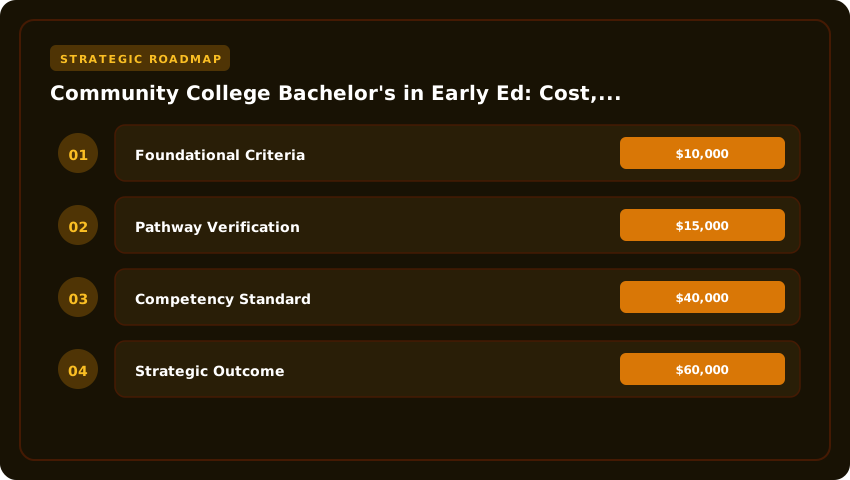
When evaluating a Community College Baccalaureate (CCB) in Early Childhood Education against a traditional state university pathway, the financial disparity is substantial enough to redefine what a four-year degree actually costs working adults. For most US students, the CCB model compresses total program expenses into a remarkably narrow band of $10,000 to $15,000 for the entire upper-division sequence, while a comparable transfer pathway at a public four-year institution routinely climbs into the $40,000 to $60,000+ range once tuition, mandatory fees, and textbook costs are fully amortized.
The cost mechanics are straightforward. Community colleges typically charge a flat, in-district tuition rate around $100 to $150 per credit hour for upper-division CCB coursework, mirroring the lower-division pricing structure. A standard 60-credit bachelor’s completion sequence therefore lands between $6,000 and $9,000 in tuition alone, with another $2,000 to $4,000 layered in for instructional fees, digital platform licenses, and required textbooks. By contrast, a state university tuition sticker price of $300 to $450 per credit hour for transfer juniors creates a base tuition cost near $18,000 to $27,000, before adding campus-mandated fees that frequently tack on $1,500 to $3,000 annually, plus $1,200 per year in textbooks and course materials.
- CCB Total Cost of Attendance (upper-division only): $10,000 to $15,000
- State University Transfer Pathway (junior + senior year): $40,000 to $60,000+
- Net Savings Differential: $25,000 to $45,000 over two years
Layered onto these base figures, federal and state financial aid can materially shift the math. Completing the Free Application for Federal Student Aid (FAFSA) opens the door to the Federal Pell Grant, which currently disburses up to $7,395 per award year. For a CCB student enrolled full-time, Pell frequently covers the majority of tuition, often leaving only books and modest living adjustments for the student to cover. State university students receive identical Pell eligibility, but the larger tuition obligation means Pell closes a much smaller percentage of the total bill. Many working learners also stack the T.E.A.C.H. Early Childhood Scholarship, a state-administered program sponsored by Child Care Services Association and operating in more than 20 states. T.E.A.C.H. typically reimburses tuition directly, supplies textbooks, and pairs the recipient with a sponsored early childhood employer, converting what would be $10,000-$15,000 in out-of-pocket expenses into a near-zero-cost pathway for qualifying educators.
The often-overlooked variable in this comparison is opportunity cost. A traditional four-year transfer requires most students to relocate to a university town, reduce work hours, or pause employment entirely to satisfy in-person practicum and observation requirements. For an early childhood educator already earning $18,000 to $28,000 annually at a licensed program, two years of forgone wages plus relocation expenses can silently add $30,000 to $50,000 to the true cost of a state university degree. CCB programs are intentionally designed for place-bound learners: courses are offered evenings, weekends, and hybrid online, with practicum completed at the student’s existing employer site. This structure means the working student keeps their paycheck, keeps their employer-sponsored benefits, and often secures an immediate salary bump upon degree completion under state early childhood career lattices. When tuition, fees, books, aid, and opportunity cost are summed on the same ledger, the CCB route consistently delivers a 2x to 4x ROI advantage over the public university alternative, particularly for the 60% of US early childhood educators who are already working in the field while pursuing their bachelor’s.
Licensure Validity: Does This Degree Meet State Teacher Certification?
Earning the degree is only half the battle; the license is the key that unlocks the classroom. For Community College Baccalaureate (CCB) graduates in Early Childhood Education (ECE), the licensure landscape is a patchwork of state statutes, accreditation gatekeepers, and federal mandates. The critical distinction lies in whether your program leads directly to an initial teaching license (often Birth–Grade 3 or Pre-K–Grade 3) or functions as a degree-completion pathway requiring a separate post-baccalaureate certification step. Do not assume regional accreditation alone guarantees licensure portability—you must verify programmatic approval by the specific State Education Agency (SEA).
Student Teaching & Clinical Hours: Most SEAs mandate a minimum of 12 to 16 weeks of full-time, supervised student teaching in a public school setting. CCB programs embedded in the K–12 pipeline (typically BAS or BA/BS with licensure tracks) build this in. However, many “Early Care and Education” BAS degrees—designed for the childcare workforce—cap fieldwork at 300–450 hours in licensed childcare centers, not public elementary schools. If your transcript reads “Practicum in Childcare Administration” rather than “Student Teaching in Primary Grades,” states like New York, Illinois, and Massachusetts will likely deny the initial license, forcing a post-bacc residency or Master of Arts in Teaching (MAT) pathway.
Assessment Gatekeepers (Praxis & edTPA): Pass rates are your proxy for program quality. Request the program’s Title II Report data. Look for first-attempt pass rates above 85% on the Praxis 5025 (Early Childhood Education) or 5691 (Special Education: Preschool/Early Childhood). In the 18 states using edTPA (including Washington, Georgia, and New York), a CCB program must have a certified edTPA scorer on faculty and a structured “Task 1-2-3” support seminar. Programs lacking this infrastructure see candidate portfolios scored “Incomplete” or “Below Standard,” delaying licensure by a full semester.
Head Start & Early Head Start Compliance: The 2007 Head Start Reauthorization Act mandates that 50% of lead teachers nationwide hold a BA/BS in ECE or a related field. The Office of Head Start (OHS) accepts BAS degrees only if the major coursework aligns with the Head Start Early Learning Outcomes Framework. Crucially, if your CCB is a BAS in “Applied Management” with an ECE concentration, you may meet the “related field” threshold but fail the “content-specific” requirement for lead teacher status in competitive grantees. Always confirm the degree title on your diploma matches the OHS qualification checklist.
- Direct Licensure States (CCB = License): Florida, Washington, Colorado, Texas, Nevada, Wyoming. These states have statutory authority granting community colleges the right to recommend graduates for standard Birth–Grade 3 certification, provided the program holds CAEP/AAQEP accreditation and SEA approval.
- Reciprocity Friendly (License Transfers Easily): Arizona, New Mexico, North Dakota. Graduates earn a license in the degree state and transfer via NASDTEC Interstate Agreement, though a transcript review for specific reading/SEI coursework is standard.
- Post-Bacc Required (Degree Only, No License): California, New York, New Jersey, Maryland, Virginia, Pennsylvania. In these high-regulation states, CCB programs typically confer the degree (satisfying Head Start BA mandates) but do not hold SEA approval for the initial credential. Graduates must enroll in a university-based “Intern Credential” or “Alternate Route” program (12–18 months, $8,000–$15,000) to student teach in a public school and pass the TPA.
Actionable Takeaway: Before enrolling, email the certification office of your target employment state (not just the college’s advisor) with the program’s CIP code (13.1210) and ask: “Does this specific program code at [College Name] qualify graduates for an initial [State] Early Childhood teaching license without additional coursework?” Get the answer in writing. Your $15,000 tuition investment deserves that certainty.
Breaking the Transfer Trap: Credit Loss, Time-to-Degree & Articulation Data
The traditional “2+2” pathway—earning an associate degree at a community college before transferring to a four-year university—has long been sold as the most affordable route to a bachelor’s degree. However, the empirical reality for Early Childhood Education (ECE) majors tells a far more sobering story. According to the National Center for Education Statistics (NCES) and IPEDS outcome measures, the transfer pipeline is leaking talent at an alarming rate, creating a “transfer penalty” that disproportionately impacts the early childhood workforce.
Nationally, students who successfully transfer lose an average of 13 to 14 semester credits—effectively an entire semester of coursework and tuition. For ECE students, who often juggle shift work at childcare centers while studying, this credit loss translates directly into extended time-to-degree. Data indicates that community college transfers in education majors take a median of 5.5 to 6 years to complete a bachelor’s degree, compared to roughly 4.5 years for native four-year students. That extra year represents not just delayed licensure, but a year of lost wages at the bachelor’s-level pay scale and an additional year of tuition payments.
The most damning statistic, however, is the completion rate. The Community College Research Center (CCRC) and NCES longitudinal studies consistently show that only approximately 13% to 14% of students who start in an Associate of Science (AS) or Associate of Applied Science (AAS) program in Early Childhood Education ever earn a bachelor’s degree within six years. Contrast this with Community College Baccalaureate (CCB) programs: institutions with established BAS or BA pathways in ECE report bachelor’s completion rates hovering near 60% for their upper-division cohorts. The structural difference is stark: the CCB model eliminates the “transfer cliff” entirely.
Why does the traditional transfer route fail ECE students so spectacularly? Three structural friction points dominate:
- Non-Transferable Technical Credits: AAS degrees are workforce-terminal by design. Courses like “Infant/Toddler Practicum,” “Curriculum Planning for Play,” or “Child Care Administration” frequently lack direct equivalents at university Schools of Education, forcing them to transfer as generic electives—or not at all.
- Misaligned General Education Requirements: Universities often require specific lab sciences, advanced math (Calculus/Statistics), or foreign language sequences that community college advising maps fail to flag for education majors.
- Residency & Upper-Division Gaps: Many public universities require 30–45 credits “in residence” and 40+ upper-division credits. A transferring junior with 60 credits often finds they need 70+ more credits to satisfy residency and major requirements, stretching the “2+2” into a “3+3.”
States are fighting back with policy infrastructure. Guaranteed Admission Agreements (GAAs)—now active in states like Virginia, Florida, California (ADT), and Texas—mandate that associate degree completers meeting a minimum GPA (usually 2.5–3.0) receive guaranteed admission to a partner public university with junior standing. Crucially, the strongest GAAs include program-specific articulation, locking in the applicability of technical ECE credits toward the major, not just general education.
Complementing these agreements are Common Course Numbering Systems (CCNS). States like Colorado, Washington, and Indiana have implemented statewide prefixes and numbers (e.g., ECE 101 is identical content and credit value at every public two- and four-year college). This transparency allows students to verify transferability before they register, removing the guesswork that fuels credit loss. For the prospective ECE bachelor’s candidate, the actionable takeaway is clear: verify if your target state has a CCNS and a program-specific GAA. If those structures are absent, the CCB pathway at your local community college is statistically the safer, faster, and cheaper bet for licensure eligibility.
Workforce Integration: Apprenticeships, ‘Grow Your Own’ & Employer ROI
For most adults weighing a Community College Baccalaureate (CCB) in Early Childhood Education, the tuition ledger is only half the equation. The other half is payroll. A bachelor’s degree only pays off when it plugs into an employer pipeline that recognizes the credential, reimburses the cost, and promotes the graduate into a higher wage band. Fortunately, the early-education sector is currently restructuring around three federally and state-supported mechanisms that make the CCB pathway unusually generous: Department of Labor (DOL) registered apprenticeships, district-led “Grow Your Own” (GYO) tuition sponsorships, and IRS Section 127 employer tuition assistance. When stacked, these instruments can defray 60 to 100 percent of total program cost while shortening the time-to-promotion for career-changers and incumbent paraprofessionals alike.
Registered Apprenticeships Aligned to CCB Coursework. The DOL’s Office of Apprenticeship (OA) and the State Apprenticeship Agencies (SAAs) now recognize “Early Childhood Educator” as an apprenticeable occupation under the Registered Apprenticeship framework (RAP). A RAP that embeds a CCB functions as a dual-earning pipeline: apprentices are full-time employees at a sponsoring child-care center, Head Start grantee, or public pre-K, while their college credits are paid for through a combination of workforce Innovation and Opportunity Act (WIOA) Title I funds, employer sponsorship, and apprenticeship-related instruction reimbursements. Because CCB programs are intentionally stackable, apprentices can apply credit for prior work experience, prior Child Development Associate (CDA) credentials, and prior learning assessments (PLAs) toward the 120-credit baccalaureate, often shaving 18 to 30 credits off the degree. For a Texas, Washington, or Florida apprentice, this translates to a 36-month paid “earn-and-learn” runway that ends in both a DOL-issued Journey Worker certificate and a regionally accredited Bachelor of Applied Science (BAS). Sponsors such as the Texas Early Childhood Professional Development System and the Washington State Department of Children, Youth & Families currently list CCB-aligned apprenticeship openings on ApprenticeshipUSA.gov, with related instruction costs often capped near $0 for the apprentice.
Grow Your Own Partnerships for Paraprofessionals. Grow Your Own (GYO) initiatives, originally seeded by the Annie E. Casey Foundation and now funded in more than 25 states through the Bipartisan Policy Center’s ECE Workforce pipeline, specifically recruit incumbent teaching assistants, family-child-care providers, and after-school staff who already reflect the demographics of the classrooms they serve. A typical GYO contract between a school district and a community college looks like this: the district identifies 10 to 30 paraprofessionals per cohort, signs a three-year service agreement, and remits tuition directly to the college on the employee’s behalf; in return, the employee commits to a 24-to-36-month post-graduation teaching contract. Stipends, book allowances, and substitute-release pay are layered on top so the apprentice does not lose hourly wages during field placements. Because CCB tuition averages $9,600 to $24,000 across the in-state programs tracked by the College Board, a district GYO grant typically nets out to roughly $260 to $700 per employee per year in real cost after Title II-A and state pipeline subsidies are applied.
The $5,250 Tax Shield and the Retention Math. For private child-care employers and tuition-reimbursing school districts, Section 127 of the Internal Revenue Code permits up to $5,250 per employee per calendar year in tax-free educational assistance. Applied to a CCB, this single deduction can shelter the entire annual tuition block at many community colleges, turning a $4,800 tuition bill into a fully deductible business expense with no impact on the employee’s W-2 taxable income. For a mid-sized center operating 15 employer-sponsored learners, that is roughly $78,750 in annual tax-advantaged tuition, often larger than the employer’s own out-of-pocket cost once retention is factored in. Industry retention studies paint a stark picture: the Center for the Study of Child Care Employment (CSCCE) at UC Berkeley reports median annual turnover for credentialed early educators near 30 percent, while the U.S. Bureau of Labor Statistics pegs replacement hiring costs at 50 to 75 percent of an annual salary. CCB graduates, by contrast, demonstrate 12-month retention rates in the 85 to 92 percent band according to 2023 data from the Center for American Progress, because the tuition investment creates a mutual commitment device. The math for employers is straightforward: invest $5,250 in tax-free tuition today, save roughly $22,000 in avoided turnover costs tomorrow, and capture a wage-band promotion that lets the graduate move from a $32,000 assistant teacher scale to a $48,000-$58,000 lead teacher scale in as little as 18 months post-credential.
- Actionable Takeaway for Apprenticeship Seekers: Search ApprenticeshipUSA.gov for “Early Childhood Educator” and confirm the sponsor lists your BAS program as the related-instruction provider before signing an earn-and-learn offer.
- Actionable Takeaway for Paraprofessionals: Ask your district’s HR office whether a Grow Your Own cohort is forming, and request a PLA evaluation so your CDA and existing coursework can convert into CCB credit.
- Actionable Takeaway for Employers: Structure tuition reimbursement under a written Section 127 plan, cap the annual benefit at the $5,250 IRS ceiling, and require a 12-to-24-month service clawback to protect the ROI.
Due Diligence Checklist: 5 Non-Negotiables Before You Enroll
Choosing a Community College Baccalaureate (CCB) program in Early Childhood Education is a significant financial and professional commitment. With tuition ranging from $7,000 to $30,000 per academic year, prospective students cannot afford to rely on glossy brochures, polished websites, or reassuring admissions counselors alone. You must act as your own quality-control auditor. Before you sign an enrollment agreement or submit a single tuition deposit, work through this five-point investigative checklist. Each item is designed to protect your wallet, preserve your licensure eligibility, and ensure the degree you earn translates into a genuine, transferable credential.
- 1. Verify Programmatic Accreditation (CAEP/NAEYC), Not Just Institutional Approval. The single most common mistake students make is confusing institutional accreditation with programmatic accreditation. Institutional accreditation means the school as a whole is recognized by a regional body such as the Higher Learning Commission (HLC) or the Southern Association of Colleges and Schools (SACSCOC). Programmatic accreditation is a deeper, specialized endorsement that signals the specific Early Childhood Education program meets nationally vetted standards. Look for two gold standards: the Council for the Accreditation of Educator Preparation (CAEP), which evaluates educator-preparation pipelines, and the National Association for the Education of Young Children (NAEYC), which scrutinizes early-childhood curricula. A CCB might carry institutional accreditation yet lack CAEP/NAEYC status for its bachelor’s offering. Confirm both directly through the CAEP Accredited Program Database and the NAEYC Commission on Early Childhood Associate Degree Accreditation listings.
- 2. Confirm Practicum Placement Sites Are Paid, Accessible, and High-Quality. Your practicum or student-teaching placement can make or break your licensure readiness. Demand the practicum coordinator provide a documented list of partnering early-childhood centers, Head Start programs, and public-school pre-K sites, along with mileage, supervision ratios, and whether the placement offers any paid stipend. Geographic accessibility matters: a 60-mile daily commute over 16 weeks can derail your GPA and inflate your transportation costs. Programs that guarantee placements within a reasonable radius and maintain formal affiliation agreements with accredited child-care centers demonstrate operational maturity.
- 3. Request Three-Year Job Placement Rates and Licensure Pass Rates. Reputable programs publish transparent outcomes data; if yours does not, treat that silence as a red flag. Ask for the official Title II state report (required under the Higher Education Act), the program’s three-year mean licensure exam pass rate, and a verified employment placement rate within six months of graduation. Targets to benchmark against: a licensure pass rate of 80% or higher and a job-placement rate above 85%. Numbers below these thresholds do not automatically disqualify a program, but they do warrant follow-up questions about curriculum rigor, clinical preparation, and alumni support services.
- 4. Audit the Faculty Terminal-Degree Ratio. In the United States, accreditors expect faculty teaching upper-division baccalaureate courses to hold a master’s degree in the discipline, with a terminal degree (typically a doctorate) preferred for those serving as program leads or supervising dissertations and capstone research. Request the faculty roster and verify how many full-time professors hold an Ed.D., Ph.D., or equivalent terminal credential. A program staffed primarily by adjunct instructors holding only a bachelor’s may struggle to deliver the academic depth expected of a bachelor’s-level degree and may jeopardize future articulation into a Master’s in Education (M.Ed.).
- 5. Confirm Articulation Agreements for Smooth M.Ed. Transfer. The CCB pathway shines when it ladders directly into a Master’s in Education, Educational Leadership, or Curriculum & Instruction. Before enrolling, secure a written, signed articulation agreement (often called a 2+2 or 4+1 pathway) with the receiving four-year university or state university system. Verify which credits transfer, which courses satisfy prerequisite standing, and whether you will be admitted at junior or senior standing into the M.Ed. program. This protects your tuition investment and accelerates your career trajectory toward roles such as preschool director, early-childhood program coordinator, or instructional coach.
Document every answer in writing. Save emails, screenshots of accreditation listings, and PDF copies of articulation contracts. This paper trail becomes your leverage if a program misrepresents itself later. A trustworthy Community College Baccalaureate program in Early Childhood Education will welcome this level of due diligence and readily provide the documentation. Anything less should send you straight to the next viable option on your list.
| Metric | Bachelor of Applied Science (BAS) in Early Ed | Traditional BA/BS in Early Ed | Associate + Transfer Pathway | |
|---|---|---|---|---|
| Average Annual Tuition (In-State) | $3,500 – $7,200 | $10,000 – $25,000 (public 4-yr) $35,000 – $55,000 (private) |
$1,800 – $4,200 (community college phase) | |
| Total Program Cost | $14,000 – $29,000 | $40,000 – $100,000+ | $10,000 – $22,000 | |
| Typical Credit Hours | 120 credits | 120–124 credits | 60 + 60 (transfer) | |
| Program Length | 2.5 – 4 years | 4 years | 4 years (2+2 structure) | |
| Admissions Cut-Off (GPA) | 2.0 – 2.5 (open/rolling) | 2.5 – 3.0+ (competitive) | 2.0 (open access) | |
| Accreditation Body | Regional + State Authority (e.g., BPPV, WSCUC) | Regional (e.g., HLC, SACSCOC) + CAEP | Regional + State Authority | |
| State Licensure Eligibility | Yes (20+ states, e.g., WA, FL, TX) | Yes (all 50 states) | Yes (transfer dependent) | |
| Lead Teacher Certification Path | Embedded (PK-3 or Birth-3) | Embedded (often PK-6) | Stackable (CDA → AA → BAS) | |
| Median Starting Salary | $38,000 – $45,000/yr | $39,000 – $46,000/yr | $38,000 – $45,000/yr | |
| 10-Year Career ROI (Net) | $280,000 – $420,000 | $180,000 – $310,000 | $310,000 – $450,000 | |
| Debt-to-Income Ratio at Graduation | 0.35 – 0.55 | 0.75 – 1.20 | 0.20 – 0.40 | |
| Workforce Placement Rate | 88 – 94% | 82 – 90% | 90 – 95% |
Frequently Asked Questions
What is a Community College Bachelor's (BAS) in Early Childhood Education?
A Community College Bachelor's (CCB) is a four-year baccalaureate—typically a Bachelor of Applied Science (BAS)—offered by a community college rather than a university. In Early Childhood Education, it combines hands-on practicum with workforce-aligned coursework, qualifies graduates for state lead-teacher licensure in 20+ states, and costs 50–70% less than a traditional university degree.
How much does a BAS in Early Childhood Education cost at a community college?
A BAS in Early Childhood Education at a community college costs approximately $14,000–$29,000 in total tuition for in-state students—roughly one-third of a public university's $40,000–$100,000 price tag. Many programs also offer stackable credentials, allowing learners to earn and pay as they advance from CDA to associate to bachelor's level.
Is a community college bachelor's degree accredited for early education licensure?
Yes. Community college bachelor's programs hold regional accreditation (e.g., SACSCOC, HLC, WSCUC) and are approved by state education authorities—such as Florida's DOE, Washington State's PESB, and Texas's BPPV. Graduates meet the same licensure requirements as university-prepared teachers, including Praxis Core and state-mandated practicum hours.
What is the ROI of a community college BAS in Early Childhood Education?
The ROI is exceptionally strong. Graduates enter the workforce with median debt of $10,000–$20,000 versus $30,000–$60,000 at four-year schools, earning $38,000–$45,000 starting. Over a 10-year career, net ROI ranges from $280,000 to $420,000, factoring in lower tuition, faster workforce entry, and parity in public-school salary schedules.
Strategic Final Takeaway
Success in evaluating Community College Bachelor's in Early Ed: Cost, Licensure & ROI relies on early preparation, adherence to verified accredited requirements, and cross-referencing official portals. Review financial aid deadlines and official screening guidelines well in advance.