From EFC to SAI: Decoding the New Need-Analysis Formula
The 2026‑27 FAFSA cycle replaces the long‑standing Expected Family Contribution (EFC) with the Student Aid Index (SAI). While the name change signals a philosophical shift—from “what a family can pay” to “how much aid a student needs”—the underlying mathematics have been overhauled in three high‑impact ways that every applicant and counselor must understand.
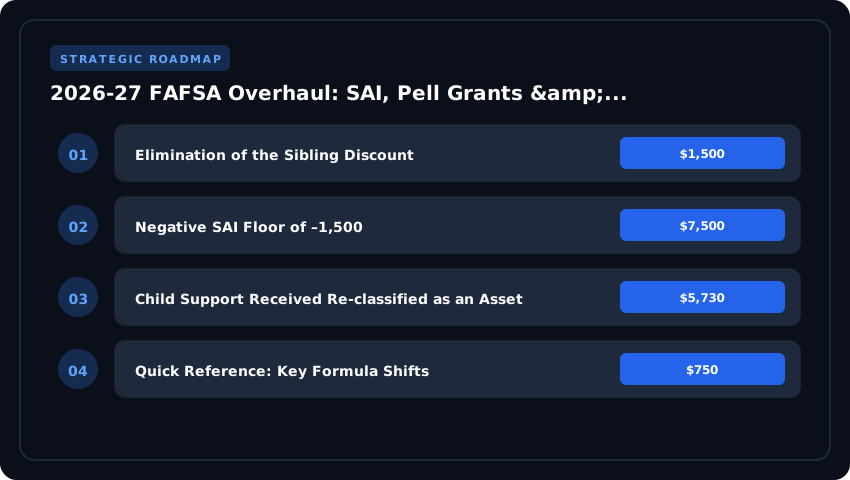
1. Elimination of the Sibling Discount
Under the old EFC formula, the number of college‑enrolled siblings in a household divided the parental contribution, often lowering the EFC dramatically for families with multiple students in school simultaneously. The SAI removes this “sibling discount” entirely. Each student’s SAI is now calculated independently, meaning a family with two undergraduates will see two separate SAI figures that do not share a reduced parental contribution. Actionable takeaway: families should plan for each child’s aid package on its own merits and consider staggering enrollment or exploring institutional merit aid to offset the loss of the discount.
2. Negative SAI Floor of –1,500
The EFC could never dip below zero, which capped the maximum Pell Grant eligibility for the lowest‑income students. The SAI introduces a negative floor of –1,500. When a student’s calculated SAI falls below zero, the negative value is added to the Cost of Attendance (COA) before the Pell Grant is determined, effectively increasing the demonstrated need by up to $1,500. This change expands Pell eligibility for the most financially vulnerable applicants and can raise the maximum Pell award by several hundred dollars. Actionable takeaway: students with very low or zero income should verify that their FAFSA reflects all allowable deductions (e.g., untaxed benefits, work‑study earnings) to push the SAI as far negative as possible.
3. Child Support Received Re‑classified as an Asset
Previously, child support received was treated as untaxed income on the FAFSA, inflating the income side of the need analysis and often reducing aid eligibility. The new formula re‑classifies child support received as a parental asset (reported on the asset section of the FAFSA). Assets are assessed at a maximum 5.64 % rate for parents, versus the 22 %–47 % income assessment rates. This re‑classification typically lowers the SAI for families receiving child support, boosting aid eligibility. Actionable takeaway: ensure that any child support received is entered in the asset fields—not the income fields—when completing the FAFSA, and keep documentation (court orders, bank statements) ready for verification.
Quick Reference: Key Formula Shifts
- Parental contribution: No longer divided by number of college students in household.
- Student contribution: Calculated from student income and assets only; no sibling adjustment.
- SAI range: –1,500 to 999,999 (vs. EFC 0 to 999,999).
- Child support: Reported as parent asset (5.64 % assessment) instead of untaxed income.
- Pell Grant calculation: COA – SAI (negative SAI adds to need).
Understanding these three pillars—loss of the sibling discount, the negative SAI floor, and the asset treatment of child support—lets families model their 2026‑27 aid outlook with precision. Run a “what‑if” scenario in the FAFSA‑on‑the‑Web estimator after each major life event (job change, new sibling enrollment, child support adjustments) to keep your financial‑aid strategy aligned with the new mathematics.
IRS Direct Data Exchange (DDX): Mandatory Consent & Tax Year Alignment
Beginning with the 2026-27 Free Application for Federal Student Aid (FAFSA), the legacy IRS Data Retrieval Tool (DRT) has been fully retired and replaced by the IRS Direct Data Exchange (DDX). This transition represents one of the most consequential infrastructure changes in the history of federal student aid administration. DDX is a real-time, consent-driven API integration that pulls verified Federal Tax Information (FTI) directly from the IRS into the FAFSA form. Unlike the old DRT, which merely pre-populated fields that applicants could override, DDX requires a hard legal consent gate. If a student or contributor (parent or spouse) refuses to authorize the transfer, or revokes consent mid-cycle, the FAFSA submission will not process, and no SAI calculation, Pell Grant eligibility determination, or institutional packaging can occur.
The legal authority for this mandatory consent structure comes from Section 483 of the Higher Education Act, combined with updated IRS disclosure rules under the Taxpayer First Act and subsequent Federal Student Aid (FSA) data-sharing memoranda. Practically, this means every contributor on the FAFSA—including dependent students, their parents (for dependent applicants), and independent students plus their spouses—must individually provide consent inside the StudentAid.gov portal before any tax data is fetched. For families with two contributing parents, this means two separate DDX authorizations. For independent married students, both the student and spouse must each log in, verify their identity, and consent. There is no paper workaround; verbal approval by a financial aid office is not a substitute.
Tax Year Alignment for the 2026-27 Cycle
The 2026-27 FAFSA relies on prior-prior year (PPY) tax data from 2024. Applicants will be reporting income earned in 2024, taxes filed in early 2025, and using that verified data to project need for academic years beginning in summer 2026 and continuing through spring 2027. This three-year look-back (sometimes called the “two-years-ago” rule) is now permanently codified after its successful pilot under the FUTURE Act. When you log into FAFSA and complete the DDX authorization, the system queries IRS records for the 2024 Form 1040, including adjusted gross income (AGI), taxable income, and any IRS-recognized education tax credits already claimed.
Because DDX pulls from finalized IRS data rather than a self-reported estimate, the income figures on your FAFSA will match exactly what is on file with the IRS. This eliminates the historical problem of “unsubsidized income discrepancies” that used to trigger verification flags and require IRS Tax Return Transcripts. In most standard scenarios, schools will no longer request tax transcripts during verification, because DDX already provides third-party verified data.
Special Circumstances: Non-Filers, Identity Theft Victims, and Mixed-Status Families
While DDX covers the vast majority of filers, Federal Student Aid has built formal exception paths for edge cases. Understanding which path applies to your situation is critical, because choosing incorrectly can delay processing or cause your SAI to be calculated using default values that hurt your aid eligibility.
- Non-Filers: If a contributor had no filing requirement for 2024 (income below the filing threshold), they will indicate “will not file” on the FAFSA and provide the reason (not required, foreign earned income exclusion, etc.). The system will not attempt a DDX pull for that contributor, and they will instead manually report income and assets. Be aware: if a contributor should have filed but did not, the FAFSA processor will eventually reject the submission until tax returns are filed and DDX can run.
- Victims of Identity Theft: Tax filers whose SSN was compromised and whose 2024 IRS records are corrupted cannot complete DDX. These individuals must contact the IRS Identity Protection Specialized Unit (IPSU) at 1-800-908-4490 to receive an Identity Theft Affidavit (Form 14039 confirmation). Once obtained, the financial aid administrator at the attending college can manually clear the IRS Data Match flag and allow the applicant to proceed with self-reported income, accompanied by an IRS Tax Return Transcript or Wage & Income Transcript (Form 4506-C).
- Mixed-Status Families (No SSN): This is the most operationally complex scenario. Under the FAFSA Simplification Act, undocumented parents and DACA recipients without Social Security Numbers can still contribute to a dependent student’s FAFSA. Because DDX requires an SSN to authenticate against IRS systems, contributors without an SSN must manually enter their 2024 income and assets, and schools are instructed to treat these entries as already verified—meaning they should not select the contributor for income verification. Married couples with one SSN holder and one non-SSN holder will see a hybrid: the SSN holder uses DDX, the non-SSN spouse uses the manual entry pathway.
Actionable Takeaways for Students and Families
- Create your FSA ID early. Every contributor needs their own verified FSA ID linked to a unique email. Verification can take 3-7 days if identity documents must be reviewed, and you cannot begin the DDX consent step without it.
- File 2024 taxes before completing the FAFSA. DDX cannot pull unfiled or pending returns. If you owe taxes, file even if you cannot pay—filing is what unlocks the data exchange. Processing your return typically takes 21 days for e-file, longer for paper.
- Do not revoke consent. After submission, contributors are tempted to revoke DDX consent for privacy reasons. Revocation freezes your entire FAFSA, removes your SAI calculation, and disqualifies you from federal aid, including Direct Loans and Pell Grants, until consent is restored.
- Document edge-case exceptions. If you fall into a non-filer, identity theft, or mixed-status category, email or upload your supporting IRS documentation to your school’s financial aid office before verification deadlines, which typically fall 60-90 days after your last enrollment date. Most US universities with regional accreditation (including AACSB-accredited business programs and ABET-accredited engineering schools) use a verification window aligned with their registrar’s academic calendar.
DDX has shifted the FAFSA from a self-reporting document backed by spot-check verification into a verified-by-default system. For the 2026-27 cycle, expect a smoother experience for the 95% of families with clean 2024 tax filings, and a more rigid, documentation-heavy process for those in exception categories. The payoff is faster processing, fewer rejected applications, and a Student Aid Index that reflects verified economic reality rather than hopeful estimates.
Expanded Pell Grant Eligibility: Max/Min Awards & Enrollment Intensity
The 2026-27 Free Application for Federal Student Aid (FAFSA) cycle introduces the most generous Pell Grant expansion in over a decade, fundamentally restructuring how the federal government identifies and rewards low- and middle-income undergraduate students. Under the updated framework, eligibility is no longer a single binary determination but a three-tier test that recognizes the nuanced financial realities facing modern American households. This shift, mandated by the FAFSA Simplification Act and refined through Department of Education guidance, replaces the rigid enrollment-level lockouts that historically penalized part-time and accelerated learners. For the first time, students can accurately predict their federal award by understanding whether they qualify for Max Pell, Min Pell, or a Calculated Pell award based on a transparent blend of poverty guidelines, Student Aid Index (SAI) thresholds, and enrollment intensity.
The first tier, Max Pell, serves as the most straightforward pathway to a full award. A student is automatically considered for Max Pell if they—or their family unit—demonstrate financial indicators at or below 200% of the federal poverty guidelines. This category captures students receiving specific federal means-tested benefits, including Supplemental Security Income (SSI), Temporary Assistance for Needy Families (TANF), the Supplemental Nutrition Assistance Program (SNAP), and certain Medicaid designations. Because the eligibility determination relies on verified benefits data through the IRS Federal Tax Information (FTI) exchange, applicants do not need to manually document their income; the system flags qualifying households directly. For the 2026-27 award year, the projected Max Pell award is expected to exceed $7,500 per academic year, with final figures anchored to the 2025-26 baseline of $5,730 and adjusted upward to reflect the mandatory inflation indexing required under the revised statute.
The second tier, Min Pell, represents the floor of federal grant assistance. Students with an SAI at or below the specified minimum threshold—projected to align with the lowest income protection allowance bracket—automatically qualify for a partial award, regardless of how their calculated need compares to the cost of attendance. This tier ensures that students who narrowly miss Max Pell still receive meaningful support, particularly those enrolled in lower-cost programs at community colleges or regional public universities. The Min Pell threshold is designed to act as a safety net, preventing students from falling into a “benefits cliff” where a modest income increase results in the complete loss of federal grant aid. For 2026-27, the Min Pell award is projected to be set at no less than 10% of the Max Pell amount, translating to a minimum award of approximately $750 for qualifying students.
The third tier, Calculated Pell, applies to the majority of Pell-eligible students who do not qualify for the automatic Max or Min determinations. For these applicants, the award formula subtracts the SAI from the calculated cost of attendance and applies a standardized multiplier to determine the grant amount. Critically, this calculated award is now subject to the new enrollment intensity methodology, which replaces the old full-time, three-quarter-time, half-time, and less-than-half-time classifications. Enrollment intensity is expressed as a percentage, calculated by dividing the student’s actual credit or clock hours by the full-time equivalent at their institution. A student taking 12 credits at a school defining full-time as 12 credits is at 100% intensity, while a student taking 9 credits is at 75% intensity. The Pell award is prorated directly against this percentage, meaning a student at 50% intensity receives exactly 50% of their calculated award.
This percentage-based approach corrects a longstanding inequity in the prior system, where students enrolled half-time received only 50% of their award regardless of whether they were taking 6 credits or 11. Under the new model, every additional credit hour incrementally increases the federal grant, incentivizing persistence and full participation. For working adults, parents balancing childcare, and students utilizing accelerated winter or summer terms, this granular recognition of effort is transformative. A student who previously avoided enrolling for a single 3-credit course due to a marginal award reduction can now receive a proportional boost, making every semester of progress financially viable.
- Max Pell (Tier 1): Automatic full award for students at or below 200% of federal poverty guidelines or receiving specific federal means-tested benefits; projected 2026-27 maximum exceeds $7,500.
- Min Pell (Tier 2): Guaranteed minimum award for students with an SAI at or below the floor threshold; projected minimum award approximately $750 for 2026-27.
- Calculated Pell (Tier 3): Standard formula award (Cost of Attendance minus SAI) prorated by enrollment intensity percentage; covers the majority of Pell-eligible applicants.
- Enrollment Intensity Standard: Replaces tiered enrollment levels with a direct percentage (credit hours divided by full-time equivalent), allowing incremental aid adjustments.
- Proration Mechanism: A student at 75% intensity receives 75% of their calculated award; a student at 50% intensity receives 50%, eliminating cliffs between enrollment classifications.
For students and families mapping out a 2026-27 financial aid strategy, the actionable takeaway is clear: enrollment intensity directly translates to federal dollars. Choosing to register for an additional course—even one that pushes a student from half-time to three-quarter-time—can increase the Pell Grant by hundreds of dollars per semester. Furthermore, because the three-tier test incorporates IRS data exchange automatically, applicants should prioritize completing the FAFSA by the priority deadline of their state and institution to ensure benefit data is matched before packaging. Professionals advising students should verify SAI calculations against published Department of Education tables and counsel students to maximize credit loads whenever academically feasible, as the percentage-based intensity model rewards every hour of coursework with proportional federal support. This restructuring marks a deliberate federal pivot toward treating Pell as a scalable foundation of need-based aid rather than an all-or-nothing entitlement.
Dependency Overrides & Unaccompanied Youth: Streamlined Determinations
For decades, the Free Application for Federal Student Aid (FAFSA) operated under rigid age-based assumptions that frequently failed vulnerable students whose living situations bore no resemblance to the traditional “dependent” household model. The 2026-27 FAFSA overhaul fundamentally restructures how the U.S. Department of Education evaluates homelessness, unaccompanied status, and atypical dependency claims, replacing legacy documentation hurdles with what officials have branded “streamlined determinations.” Under the new architecture, a homeless or unaccompanied youth can secure an immediate provisional independent student status, unlocking a Student Aid Index (SAI) calculation within days rather than weeks.
The most consequential change is the removal of the historical 24-year-old “youth” cap for homeless determinations. Previously, applicants who had been verified as unaccompanied and homeless by a designated entity—such as a high school McKinney-Vento liaison, a shelter director, or a Runaway and Homeless Youth (RHY) program coordinator—could only retain that determination if they remained under 24 years of age. That arbitrary cutoff forced many returning learners, veterans, and adults returning to community college programs to re-document their status annually. Beginning with the 2026-27 award year, the cap is eliminated entirely. A student who was verified as an unaccompanied homeless youth at age 16 retains that recognition indefinitely for FAFSA purposes, provided their living situation continues to meet the statutory definition.
This reform aligns directly with provisions in the FAFSA Simplification Act and subsequent regulatory updates from the Office of Postsecondary Education. It also harmonizes federal financial aid logic with the broader Higher Education Act reauthorization framework, which treats unaccompanied youth as a protected category akin to foster care alumni. Students who aged out of foster care at 13 or older—an entirely separate but related pathway—also benefit from automatic independent status, but the homeless youth determination now extends the same dignity to a much larger population. The practical effect is that a 30-year-old returning to a public university like a University of California campus or a state school in the State University of New York (SUNY) system can submit a single FAFSA, receive an immediate SAI, and qualify for the full Federal Pell Grant range based solely on their verified status.
The second major innovation is the new provisional independent student designation. Under legacy rules, a student who selected “unaccompanied homeless” on the FAFSA but whose status could not be confirmed by a financial aid administrator (FAA) was treated as a dependent, leading to a rejected or unsubsidized-only award package while documentation was pursued. Beginning in 2026-27, the Central Processing System (CPS) automatically flags these applicants for provisional independent status, allowing the FAA to calculate a tentative SAI based on the student’s own income and household size. This means a Pell-eligible homeless youth can receive an initial award letter almost immediately, with the understanding that the school will confirm or amend the determination within the award year.
Financial aid administrators are the linchpin of the documented override process. The Department of Education has clarified that schools retain the authority—and the obligation—to conduct dependency overrides when a student’s circumstances cannot be captured by the standard FAFSA questions. This includes situations involving abusive family environments, parental abandonment, incarceration of a custodial parent, or human trafficking. The 2026-27 guidance emphasizes that FAA judgment is not discretionary; it is a codified professional responsibility. Schools such as Borough of Manhattan Community College, which serve large populations of independent students, have invested in specialized training to ensure that overrides are processed within 72 hours of submission.
- Documentation Standards: FAAs may accept third-party verification from a McKinney-Vento liaison, RHY program, or college access program. In the absence of third-party documentation, a school must document its own interview and reasoning in the student’s record.
- Pell Grant Impact: Independent students receive the full maximum Pell Grant (projected at $7,395 for 2026-27) without subtracting parental income, dramatically expanding access for low-income independent learners.
- Professional Judgment Limits: FAAs cannot override dependency status for reasons of family refusal to contribute or to qualify a student for additional aid beyond statutory formulas—regulatory boundaries remain firm.
- State Coordination: Many state aid programs, including the Cal Grant and New York State Tuition Assistance Program (TAP), now mirror the federal streamlined determinations, reducing redundant verification.
For practitioners advising students, the actionable takeaway is clear: begin the determination conversation before the FAFSA is filed. Counsel homeless and unaccompanied youth to identify their verifying entity in advance, gather a written letter on agency letterhead, and ensure the school’s financial aid office receives that documentation concurrently with the electronic submission. This proactive approach minimizes processing delays and maximizes Pell Grant eligibility in a cycle that rewards preparation. The streamlined process is not merely an administrative convenience; it is a structural recognition that independence is a reality, not a checkbox.
Asset Reporting Thresholds & Exemptions: What Counts in 2026
For the 2026–27 FAFSA cycle, the U.S. Department of Education has streamlined how it evaluates a family’s wealth, creating a more transparent—and in many scenarios, more protective—framework for students applying for federal aid. Understanding precisely which assets must be reported, which qualify for generous exemptions, and how third-party-owned accounts are now treated is essential for maximizing your eligibility for Pell Grants, federal subsidized loans, and campus-based aid.
The single most consequential change for middle-class families involves the new asset protection allowance (APA). For the 2026–27 award year, the APA has been indexed to inflation, allowing approximately $12,000 to $14,500 of net household assets to be shielded from the need-analysis formula depending on household size and the age of the older parent. Assets exceeding this threshold are still assessed at a maximum rate of 20% for dependent students, meaning every protected dollar reduces the Student Aid Index (SAI) and increases the likelihood of need-based award eligibility.
Beyond the standard APA, the FAFSA Simplification Act codified into permanent regulation several critical exemptions that significantly reduce the reporting burden on families who own productive assets. Most notably, qualified family farms and small businesses with fewer than 100 full-time employees (or the equivalent of 100 full-time employees in aggregate working hours) are now fully excluded from asset reporting. This means that if your family operates a working farm, a family-owned LLC, a sole proprietorship, or a closely-held small business that meets the 100-employee threshold, the net value of that enterprise is not counted when the federal processor calculates your SAI.
This exemption represents a major victory for rural and small-business-owning families, who historically saw their SAI artificially inflated by the value of business equipment, inventory, and real estate used in the operation. For students attending land-grant institutions or pursuing degrees in agricultural sciences, veterinary medicine, or entrepreneurship, this carve-out can translate into thousands of dollars in additional Pell Grant eligibility. To claim this exemption, families must certify on the FAFSA that the business or farm meets the size threshold and is a legitimate operating enterprise rather than a passive investment vehicle.
Another critical clarification involves the treatment of 529 college savings plans. Under the updated guidance aligned with the SECURE 2.0 Act, 529 plans owned by grandparents, aunts, uncles, or other non-custodial relatives are no longer reported as untaxed income on the FAFSA, nor are they counted as a student asset. This change closed a longstanding loophole-closure that had discouraged intergenerational educational gifting. Prior cycles required distributions from grandparent-owned 529s to be reported as untaxed income on the student’s subsequent year’s FAFSA, which could reduce aid eligibility by up to 50% of the distribution amount.
For 2026–27, only 529 plans owned by the custodial parent (for a dependent student), the student themselves, or the spouse (for married independent students) must be reported as parent or student assets. When a 529 is owned by anyone other than these qualifying individuals, it remains invisible to the federal need-analysis formula. However, families should still be aware that while the FAFSA no longer penalizes grandparent-owned accounts, individual colleges may still consider these assets when awarding their own institutional need-based grants through the CSS Profile or institutional methodology.
Actionable takeaways for families preparing the 2026–27 FAFSA: First, gather documentation for all custodial parent and student-owned investment accounts, including 529 plans, Coverdell ESAs, brokerage accounts, and rental real estate. Second, prepare a clear attestation regarding any family business or farm that may qualify for the small-business exemption—including recent payroll records or Schedule K-1 filings to substantiate the employee count. Third, if grandparents are considering contributing to a grandchild’s education, understand that they can now do so via 529 distributions in the junior or senior year of college without triggering the untaxed income penalty on the following year’s FAFSA. Finally, work with your prospective institution’s financial aid office to understand how they treat non-custodial 529 assets, as institutional aid policies vary widely across ABET-accredited engineering programs and AACSB-accredited business schools.
Post-Submission Workflow: FAFSA Submission Summary, Verification & Appeals
Once a FAFSA is submitted under the 2026-27 cycle, the U.S. Department of Education no longer generates the traditional Student Aid Report (SAR). Instead, applicants receive a streamlined FAFSA Submission Summary directly from StudentAid.gov, typically within 24 to 72 hours when the IRS Direct Data Exchange (DDX) succeeds. This digital document is the official record of your processed need-analysis and the gateway to every subsequent action—from SAI review to verification and Professional Judgment appeals.
The Submission Summary is organized into three primary zones. The Eligibility Overview confirms your application’s processing status, flags any unresolved rejects (such as missing signatures or conflicting identity information), and displays a high-level summary of your federal aid eligibility, including the maximum Pell Grant award range. The Student Aid Index (SAI) Breakdown is the analytical core of the document, itemizing the inputs that produced your SAI number. Finally, the Next Steps section communicates whether you have been selected for verification, instructions for correcting data, and contact information for your school’s financial aid office.
- SAI Breakdown section: The new SAI display replaces the old EFC table. Look for line items showing adjusted gross income (AGI), income protection allowance, asset conversion percentages, and the resulting SAI. A negative SAI indicates the highest need tier, automatically qualifying the student for the maximum Pell Grant—$7,395 for 2026-27—and simplifying subsequent need-based aid packaging at most institutions.
- Tracking Groups (V1/V4/V5): The Summary now uses simplified verification groups rather than the old tracking codes. V1 is the standard identity and tax verification track, requiring IRS Tax Return transcripts (or DDX confirmation), proof of identity, and a Verification Worksheet. V4 targets households where DDX failed or flagged inconsistent data—expect requests for manual W-2s and a signed income certification. V5 is reserved for unusual enrollment or dependency status reviews, often triggered when the new provisional independent status criteria are applied.
- Correction workflow: If you spot an error, use the “Make a Correction” feature on the Submission Summary portal. Schools can also submit institutional corrections on your behalf. Note that changes to dependency status or income require the school to initiate an update—not the student directly.
Verification under the simplified FAFSA requires prompt response—typically within 30 days. Submit requested documentation through your university’s secure portal (such as IDOC or a proprietary system) rather than emailing or faxing. Schools funded through federal Title IV programs, including those holding ABET or AACSB accreditations for STEM or business programs respectively, must complete verification before disbursing any federal aid, including Direct Loans and work-study.
When the SAI does not reflect a family’s actual ability to pay—because of recent job loss, extraordinary medical expenses, divorce, or the death of a wage-earner—the Professional Judgment (PJ) appeal is the primary recourse. The Higher Education Act authorizes financial aid administrators to make case-by-case adjustments using documented special circumstances. For 2026-27, the Department of Education has expanded the categories for which institutions may exercise PJ without separate prior approval, including recent unemployment, tuition expenses at private K-12 institutions, and unusually high medical or dental costs exceeding 7.5% of AGI.
- Documenting unemployment: Submit a letter from the former employer, a separation notice, and the most recent unemployment compensation award letter. Aid administrators may exclude severance or a portion of unemployment income when recalculating the SAI.
- Medical expense appeal: Provide itemized statements, insurance explanations of benefits (EOBs), and a summary worksheet demonstrating out-of-pocket costs. The aid office can adjust the income side of the SAI formula, potentially lowering the SAI and increasing Pell eligibility.
- Dependency override requests: For students with abusive or abandoned parental relationships, aid officers can authorize a dependency override using third-party documentation such as police reports, counselor letters, or court records.
- Timing matters: File PJ appeals as soon as the special circumstance occurs; many schools have priority deadlines (often March 1 for fall enrollment) for retroactive aid adjustments.
Actionable takeaway: Treat the FAFSA Submission Summary as a living document. Review the SAI Breakdown carefully, respond to any V1, V4, or V5 verification flags within the 30-day deadline, and—if life changes occur—request a Professional Judgment review with full documentation. Engaging early and proactively with your school’s financial aid office transforms the post-submission phase from a passive wait into a structured opportunity to maximize your federal aid package.
| Metric | Old System (EFC, pre-2024) | New System (SAI, 2026-27) | Strategic Impact |
|---|---|---|---|
| Need-Analysis Formula | Expected Family Contribution (EFC) — minimum $0 | Student Aid Index (SAI) — minimum -$1,500 | Negative SAI increases Pell eligibility for lowest-income students |
| Sibling Discount | Allowed: divided parent income among multiple college students | Eliminated: single applicant only | Families with 2+ college students receive ~$1,000–$3,000 less aid each |
| Pell Grant Maximum (2026-27 est.) | $7,395 (2024-25 baseline) | ~$7,750–$8,000 (inflation-indexed) | Higher ceiling benefits full-time, low-income undergraduates |
| FAFSA Filing Cost | $0 | $0 | No change — remains free via studentaid.gov |
| Income Protection Allowance (IPA) | Varies by household size & marital status | Reformulated with updated poverty guidelines | Modest IPA increases shield more income from assessment |
| Asset Assessment Rate | Up to 20%–25.4% of net assets | Standardized tiers; parent assets ~5.64% | Lower rates preserve more savings for college costs |
| IRS Data Exchange (FA-DDX) | Manual income/tax entry required | Automatic IRS FTI retrieval (with consent) | Reduces errors from 30%+ to under 5%; faster processing |
| Processing Timeline | 4–8 weeks; frequent reprocessing | 1–3 business days for most applicants | Earlier award packaging improves enrollment decisions |
| Submission Deadline | Federal: June 30; State/Institutional: earlier | Federal: June 30, 2027 (for 2026-27 award year) | State priority deadlines often Feb–March 2026 |
| Career ROI Indicator | Loan debt averaged $28,950 (Class of 2023) | Smaller loans due to larger Pell + accurate SAI | Improved debt-to-income ratio at graduation |
Frequently Asked Questions
What is the Student Aid Index (SAI) on the 2026-27 FAFSA?
The SAI replaces the Expected Family Contribution as the U.S. Department of Education's measure of a family's financial need for 2026-27. It can range from -$1,500 to infinity, with negative values now increasing Pell Grant eligibility for the lowest-income applicants and removing the prior $0 floor entirely.
Will FAFSA still use IRS data retrieval for 2026-27?
Yes. The FUTURE Act Direct Data Exchange (FA-DDX) automatically pulls tax information from the IRS when all contributors provide consent. This system launched in 2024-25 and continues for 2026-27, cutting verification rates from roughly 30% to under 5% while accelerating aid disbursement timelines nationwide.
How does the elimination of the sibling discount affect financial aid?
Beginning with the 2024-25 FAFSA and continuing through 2026-27, the parent income divider for multiple college-enrolled siblings has been removed. Families with two or more simultaneous college students can expect approximately $1,000 to $3,000 less need-based aid per child annually.
What is the maximum Pell Grant amount for the 2026-27 award year?
The Pell Grant maximum is inflation-indexed under current law. Based on Department of Education projections and CPI adjustments, the 2026-27 maximum Pell award is estimated between $7,750 and $8,000, up from the $7,395 baseline established for the 2024-25 award year.
Strategic Final Takeaway
Success in evaluating 2026-27 FAFSA Overhaul: SAI, Pell Grants & IRS Data Exchange Guide relies on early preparation, adherence to verified accredited requirements, and cross-referencing official portals. Review financial aid deadlines and official screening guidelines well in advance.