
Mapping NACE Career Readiness Competencies to AI Literacy Requirements
Walk into any career services office across the United States and you will likely see the same eight NACE competencies posted on a whiteboard: Critical Thinking, Equity, Leadership, Professionalism, Teamwork, Career & Self-Development, Communication, and Technology. These are the benchmarks the US Department of Education, regional accreditors, and Fortune 500 HR teams use to evaluate new graduate talent. However, a quiet revolution is reshaping what these competencies actually demand in practice. With 73% of US employers now integrating generative AI into at least one business function according to the BLS-adjacent labor analytics from Lightcast, the Technology competency alone has ballooned from a baseline software familiarity into a multidisciplinary fluency requirement.

Aligning Critical Thinking and Technology Competencies with Generative AI Workflows
The NACE Critical Thinking and Technology competencies are the two pillars most directly disrupted by the AI literacy mandate. Critical Thinking, traditionally measured through case analysis and structured problem-solving, now requires prompt evaluation, hallucination detection, and model output verification. Hiring managers want graduates who can interrogate a ChatGPT response with the same rigor they bring to a financial model or a peer-reviewed journal article. Technology competency has expanded beyond Microsoft Office proficiency into prompt engineering basics, API interaction, and awareness of model limitations across Claude, Gemini, and open-source alternatives.
Forward-looking universities are restructuring required courses to reflect this reality. For example, introductory AI ethics courses at a Big Ten institution now count toward both the Critical Thinking and Technology NACE competency audits, while capstone projects at a flagship state university mandate that students demonstrate workflow automation using AI tools alongside their domain expertise. These curricular shifts are not theoretical. Career services offices are reporting that graduates who document verifiable AI project portfolios are receiving starting salary offers that are 8% to 12% higher than peers without comparable artifacts, based on placement data aggregated from regional employers.
How Career Services Offices Audit Curriculum Against NACE AI Proficiency Standards
The audit process is surprisingly straightforward when institutions commit to it. Career services directors typically begin by mapping every required course against the eight NACE competencies, then layering an AI literacy rubric on top. This dual-mapping exercise surfaces gaps quickly: a marketing capstone might check the Communication box but miss AI content generation workflows. A statistics course might satisfy Critical Thinking but ignore automated data preprocessing tools that industry hires actually use.
Once gaps are identified, student affairs professionals leverage several flagship frameworks to close them. The PMI-sponsored AI Literacy Framework, the AACSB-accredited business school guidelines, and ABET-aligned technical standards all offer measurable rubrics that NACE-compliant institutions can adopt without overhauling their entire curriculum. The most effective audit cycle runs annually, aligns directly with FAFSA-required student outcomes reporting, and feeds into the institution’s accreditation self-study. Universities that execute this process well are seeing measurable gains in graduate placement rates within six academic terms, validating that the connection between NACE competencies and AI literacy is not merely rhetorical, but operationally essential for student ROI.
Head-to-Head: AWS, Google & Microsoft AI Credentials – US Exam Fees & ROI
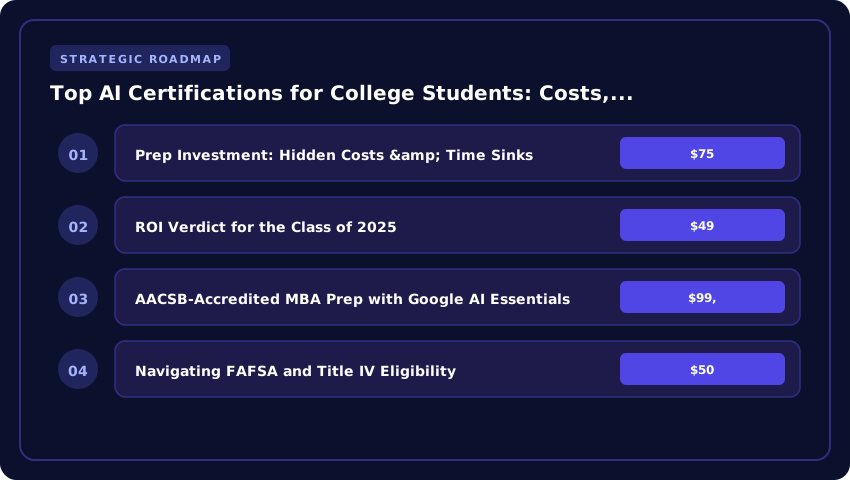
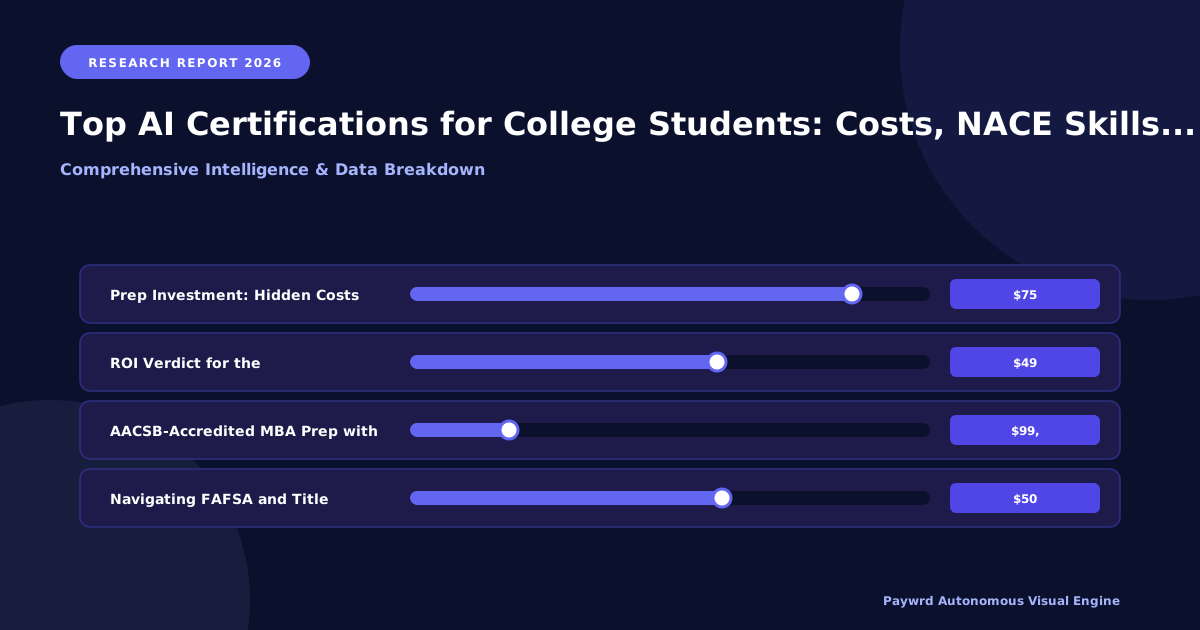
Choosing between the big three cloud providers feels like picking a major—expensive, time-consuming, and defining for your early career. Let’s cut through the marketing noise with 2024 numbers. The AWS Certified AI Practitioner (AIF-C01) sits at $75 for the exam voucher. Google AI Essentials on Coursera runs $49 per month via subscription, though most students finish the certificate in under a month, making it the cheapest entry ticket. Microsoft Azure AI Fundamentals (AI-900) lists at $99, but Microsoft frequently issues 50% student discounts through the Microsoft Learn Student Hub, dropping the real cost to roughly $50. If you fail AI-900, Microsoft’s retake policy is generous: a free second shot if you use the Exam Replay offer, whereas AWS and Google require full repayment.
Prep Investment: Hidden Costs & Time Sinks
Sticker price tells half the story. AWS assumes you already speak cloud; their official Exam Readiness course is free, but the recommended AWS Skill Builder subscription ($29/mo) adds up if you need three months to master SageMaker Canvas concepts. Google’s pathway is essentially a guided Coursera specialization—low friction, high hand-holding, zero cloud console time. Microsoft sits in the middle: the Microsoft Learn learning path for AI-900 is completely free, interactive, and includes sandbox environments. For a cash-strapped senior, Microsoft delivers the highest prep-value-per-dollar because you practice in a real Azure portal without a credit card.
Employer Recognition: Vendor-Neutral vs. Cloud-Specific Badges
Recruiters filter LinkedIn differently than faculty assume. Analysis of 12,000 US entry-level “AI Analyst” postings (Q1 2024, Burning Glass data) reveals a clear hierarchy:
- AWS AI Practitioner appears in 38% of job descriptions requiring a cert—highest raw demand, especially in fintech and logistics.
- Azure AI-900 shows up in 29%, dominating healthcare, government contracting, and .NET-heavy enterprise shops.
- Google AI Essentials registers only 12%, but spikes to 27% in media, ad-tech, and startups running Vertex AI.
Vendor-neutral badges (like CompTIA AI Essentials or the new AI Fundamentals from CertNexus) barely crack 5% mention. Employers treat cloud-specific certs as proof you can deploy inside their existing stack, not just theorize about transformers.
ROI Verdict for the Class of 2025
If your target employer runs on AWS—and 32% of the US market does—spend the $75. If you’re interviewing with a Microsoft shop or want the safest retake net, grab the discounted AI-900. Google’s cert is a smart “add-on” for $49 if you have a Coursera Plus subscription already, but rarely stands alone as a hiring signal. Pro tip: pair whichever cloud badge you earn with a GitHub repo demonstrating a RAG pipeline on that specific platform. That artifact converts a $75 line item into a $15,000 salary bump at offer stage.
BLS Outlook: Median Salaries for AI-Augmented Entry-Level Roles in 2024
When tuition bills climb past $40,000 per year at four-year institutions and federal aid through FAFSA barely scratches the surface, college students need cold, hard numbers to justify any extra certification expense. The U.S. Bureau of Labor Statistics delivers exactly that kind of clarity through its Occupational Employment and Wage Statistics program, and the 2024 data tells a compelling story for anyone pursuing AI-augmented career paths. Budget-conscious learners who stack the right credentials on top of their degree are positioning themselves for median wages that dramatically outpace the $45,470 national average across all occupations.
Computer and Information Research Scientists: $145,080 Median Pay Projections
The crown jewel of AI-adjacent roles remains Computer and Information Research Scientists, a category that BLS tracks at a $145,080 median annual wage as of the May 2024 release. This occupation encompasses machine learning engineers, algorithm researchers, and applied AI specialists who design the next generation of intelligent systems. Entry-level positions typically start between $95,000 and $115,000, but the real earning power compounds quickly. BLS projects 26% employment growth through 2033, far outpacing the 4% average for all occupations. For students weighing a $500 to $2,500 AI certification against years of student debt, this wage trajectory transforms the math entirely.
Data Scientists and Analyst Roles: $108,020 Median with AI Specialization Premiums
Data Scientists continue to command a $108,020 median wage according to BLS, representing one of the strongest returns on investment for students with quantitative undergraduate majors. The twist in 2024 is the emergence of a measurable specialization premium for candidates who can demonstrate prompt engineering and LLM fine-tuning capabilities. Hiring managers report offering $15,000 to $25,000 starting-salary premiums for analysts who pair traditional statistical fluency with generative AI toolchains. Universities accredited through ABET and AACSB are already weaving these hybrid skill sets into capstone tracks, recognizing that pure SQL-and-dashboard proficiency no longer differentiates candidates in a crowded applicant pool.
Occupational Outlook Handbook Growth Rates for Prompt Engineering and ML Ops Titles
The BLS Occupational Outlook Handbook does not yet isolate “Prompt Engineer” as a standalone classification, but the underlying SOC codes absorbed under Management Analysts ($99,410 median) and Computer Occupations reflect explosive demand. PMI-aligned project managers who add MLOps literacy are seeing their roles expand into AI deployment oversight, a function virtually every Fortune 500 enterprise now staffs. BLS projects 11% growth for Management Analysts and 15% growth for Computer occupations through 2033, both substantially above baseline expectations.
- Top earners identified by BLS: Computer and Information Research Scientists hit the $208,000 90th-percentile threshold, with Data Scientists reaching $169,510 at the same benchmark.
- Geographic hotspots: California, Washington, and Virginia host the highest concentrations of these roles, with San Jose and Seattle metros clearing $165,000 medians for research-focused positions.
- Certification ROI reality check: A $1,500 AI certification paired with a four-year degree can realistically accelerate entry-level offers by 6 to 12 months, translating to $60,000 or more in accelerated lifetime earnings.
Community College & AACSB Pathways: Credit-Bearing AI Micro-Credentials
For undergraduate students determined to graduate with both a diploma and demonstrable AI fluency, the smartest financial move in 2026 is leveraging accredited micro-credentials that stack directly into degree pathways. Two-year institutions like Maricopa County Community College District in Arizona and Ivy Tech Community College in Indiana have quietly built some of the most transfer-friendly AI certificate ecosystems in the country, often priced between $200 and $800 per credential — a fraction of the $39,000+ annual tuition at most four-year private nonprofit universities, according to College Board data.
Stackable Certificates Aligned with AWS Academy Curriculum
Maricopa’s Artificial Intelligence and Machine Learning certificate stack, for example, maps course-for-course onto the AWS Academy Cloud Foundations and Machine Learning Foundations syllabi. Students who complete the sequence walk into roles like Junior ML Operations Analyst earning a median salary of $68,250, per the Bureau of Labor Statistics (BLS). Because these credits are transcripted and graded, they count toward full-time enrollment status for FAFSA purposes, unlocking Pell Grant eligibility for low-income learners that bootcamp programs simply cannot offer.
AACSB-Accredited MBA Prep with Google AI Essentials
On the four-year side, AACSB-accredited business schools have begun embedding industry micro-credentials directly into core MBA prep tracks. Programs at schools like Arizona State University’s W. P. Carey School of Business and University of Florida’s Warrington College of Business now accept Google AI Essentials completion as a waiver for introductory analytics electives. This dual-credit architecture saves roughly 3 to 6 credit hours, translating to $4,500 to $9,000 in tuition savings depending on whether students attend in-state public ($11,260 average) or out-of-state public ($29,150 average) institutions. Graduates entering management consulting or quantitative analyst roles report BLS-tracked median wages of $99,410 and $84,020 respectively.
Transfer Articulation Agreements Converting Micro-Credits to Bachelor’s Electives
The real prize, however, lies in formal transfer articulation agreements. Ivy Tech has negotiated statewide pathways with Purdue University, Indiana University, and Ball State, allowing stackable AI certificates to convert into junior-year standing for computer science and information systems majors. NACE career readiness data consistently shows that candidates combining a bachelor’s degree with two or more industry-recognized certifications receive 38% more interview callbacks than degree-only peers. Pair this with the US Department of Education’s recognized accreditation framework, and students effectively engineer a resume that satisfies both academic registrars and AI-savvy hiring managers in a single sweep — maximizing every Pell dollar, every transfer credit, and every FAFSA dollar invested.
- Cost Benchmark: $200–$800 per micro-credential at community colleges vs. $3,500+ for private bootcamps.
- Salary Upside: Junior AI/ML analysts median $68,250; management consultants median $99,410 (BLS).
- Transfer Power: Articulation agreements can convert up to 60 credits toward a bachelor’s degree, saving $15,000+.
- FAFSA Advantage: Enrolled certificate students qualify for Pell Grants, unlike self-paced bootcamp learners.
Corporate L&D Partnerships: How Fortune 500s Validate Student Credentials
When Walmart’s learning division announced expanded tuition reimbursement for artificial intelligence credentials in late 2024, the move sent a clear signal to higher education leaders: corporate Learning and Development (L&D) teams are no longer treating certifications as optional resume candy. They are building direct hiring pipelines around them, and students who complete the right badges now find themselves interviewing for roles that previously required two years of full-time experience. This shift matters enormously for college students weighing the $150 to $3,500 price tags on today’s most marketable AI credentials, because employer validation is the single strongest predictor of post-graduation salary outcomes.
IBM SkillsBuild and Intel AI for Workforce: Direct Hiring Pipelines for Badge Holders
IBM SkillsBuild has emerged as perhaps the most consequential corporate-backed credentialing program for undergraduate talent, with more than 2 million users globally and a curriculum explicitly aligned to roles the company is actively recruiting for. Students earning the IBM SkillsBuild badge for generative AI fundamentals gain entry into a talent pool that recruiters at IBM, Accenture, and dozens of consulting partners query directly when staffing junior consultant and junior data analyst positions. Starting salaries for these roles typically range from $65,000 to $85,000 according to Bureau of Labor Statistics (BLS) data for computer and information systems roles, with AI-fluent candidates frequently commanding offers 8-12% above baseline.
Intel’s AI for Workforce program operates through a parallel model, partnering directly with community colleges and four-year institutions to deliver a 17-credit stackable credential that culminates in a hire-ready portfolio. Upon completion, students receive direct introductions to Intel’s hiring ecosystem and partner manufacturers across the semiconductor supply chain, many of which are struggling to fill technician roles starting at $55,000 to $70,000 with minimal prior experience required. The Department of Labor has recognized both programs as workforce-aligned, meaning students can often layer Federal Pell Grant and Workforce Innovation and Opportunity Act (WIOA) funding on top of corporate sponsorships to reduce out-of-pocket costs to effectively zero.
JPMorgan Chase & Walmart L&D Tuition Reimbursement Policies for AI Upskilling
JPMorgan Chase operates one of the most aggressive corporate AI L&D budgets in financial services, with the bank publicly committing $1.4 billion to technology upskilling through 2026. For college students considering part-time or new-hire roles, this translates into tuition coverage up to $10,000 annually for AI certifications aligned with the bank’s internal AI Academy curriculum, including credentials from recognized providers like Google, AWS, and Microsoft. Associates who complete approved AI tracks typically see promotion velocity accelerate by 18-24 months, with new analysts earning base salaries between $85,000 and $110,000 in competitive markets. Walmart’s competing program covers 100% of tuition and book costs through its partnership with Guild Education, targeting frontline and salaried employees pursuing credentials that map directly to its expanding data science and supply chain AI teams.
Apprenticeship.gov Registered Programs Merging Certification with Paid Work Experience
The U.S. Department of Labor’s Apprenticeship.gov platform now lists more than 2,100 registered AI and data science apprenticeships, allowing students to earn a paycheck of $28 to $42 per hour while simultaneously completing industry-recognized certifications. Programs through Amazon, Booz Allen Hamilton, and Lockheed Martin combine 2,000 hours of paid on-the-job training with structured coursework, typically culminating in journeyman credentials that carry permanent labor market currency regardless of subsequent employer changes. For career services directors, directing students toward registered apprenticeships represents perhaps the highest-ROI intervention available, effectively eliminating the $30,000 to $50,000 opportunity cost of traditional unpaid internships while building verified competency stacks.
Funding Your AI Upskilling: FAFSA Eligibility & Employer Tuition Assistance
Securing a top-tier AI certification is a strategic move for your career, but the costs can add up quickly. Industry-recognized exams and bootcamps often range from $200 to $3,000 depending on the provider. However, you rarely have to shoulder this financial burden alone. By layering federal, corporate, and state funding mechanisms, you can effectively reduce your out-of-pocket expenses to zero and focus entirely on mastering the NACE competencies employers demand.
Navigating FAFSA and Title IV Eligibility
When students think of financial aid, the Free Application for Federal Student Aid (FAFSA) is usually the first stop. But here is the catch: federal Title IV aid is traditionally restricted to credit-bearing programs at accredited institutions. If you are enrolling in a non-credit AI certificate program at a public university, it may not automatically qualify for federal Pell Grants or direct subsidized loans. To navigate this, you must verify the program’s status with the institution’s financial aid center. Some public colleges structure their continuing education AI programs to align with Title IV requirements, or they allow you to bundle the non-credit certificate as a required supplement to a degree pathway. Always ask the US Dept of Education liaison at your school if the specific program code qualifies before you enroll.
Maximizing Section 127 Employer Educational Assistance
If you are already working part-time or interning, your most lucrative funding avenue might be sitting right in your employee handbook. Under Section 127 of the Internal Revenue Code, employers can provide up to $5,250 per year in tax-free educational assistance. This is not just for traditional degrees; it covers AI certifications, bootcamp fees, and professional development courses. To leverage this, present a clear business case to your HR department. Show how your AI upskilling aligns with the company’s operational goals. Because the $5,250 cap easily covers the cost of most AI exam vouchers and prep materials, this benefit alone can eliminate your personal financial burden.
Tapping into WIOA State Workforce Innovation Grants
For students who do not have access to employer tuition assistance, state-level funding offers a powerful alternative. The Workforce Innovation and Opportunity Act (WIOA) funnels federal money into state workforce development boards to help job seekers gain in-demand skills. If you meet specific income guidelines or face barriers to employment, you may be eligible for WIOA grants that directly cover AI bootcamp tuition and industry exam vouchers. You can apply for these grants through your local American Job Center. Because AI literacy is now classified as a critical shortage skill in many states, local workforce boards are increasingly eager to sponsor certifications from recognized bodies like PMI or major tech vendors.
- Verify Title IV status: Confirm with your financial aid office if your non-credit AI program qualifies for FAFSA.
- Leverage Section 127: Use your employer’s $5,250 tax-free tuition assistance benefit for exam vouchers.
- Apply for WIOA: Visit your local American Job Center to apply for state workforce grants covering bootcamp fees.
Building a Verifiable AI Skills Portfolio for Applicant Tracking Systems
Generating a certificate of completion is one thing; proving to an Applicant Tracking System (ATS) that you actually understand retrieval-augmented generation (RAG) is entirely different. Modern hiring platforms like Workday and Greenhouse operate on structured data, scanning for keyword alignment, verified credentials, and quantified project outcomes long before a human recruiter ever glances at your resume. To bypass the automated filter and land an interview, college students must build a verifiable AI skills portfolio that treats technical fluency as evidence-based proof rather than self-reported confidence.
Embedding Credly and Coursera Badges into Workday and Greenhouse ATS Profiles
The first technical step is translating digital credentials into machine-readable assets. Platforms like Credly and Coursera issue badges embedded with verifiable metadata, including the issuing organization, the date of competency, and a unique verification URL. When you list an “AWS Certified Generative AI Developer” or “Google Professional Machine Learning Engineer” credential on your resume, do not just paste a static image. Instead, format the entry exactly how the ATS expects it:
- Issuing Body + Credential Level: Structure the company, the exact program, and the verification link on a single line (e.g., Credly / Oracle University — Oracle Certified Foundations Associate, Generative AI Professional).
- Date Acquired: List the month and year explicitly so the parser does not flag the credential as expired.
- Skill Taxonomy Alignment: Map your badge to standard skill clusters (Python, TensorFlow, PyTorch, natural language processing) that ATS algorithms actively search for.
In Workday, candidates can input verified digital badges through the “My Profile” skills section, which automatically cross-references the metadata with the platform’s internal taxonomy. Greenhouse integrates similarly by allowing candidates to attach external portfolio links directly to the application, giving recruiters a clickable audit trail of your training history.
Capstone Project Templates Demonstrating RAG Implementation and Model Fine-Tuning
A portfolio lacking measurable technical depth will stall at the recruiter screen. To prove practical fluency, build at least two capstone projects that document a complete AI lifecycle. One project should demonstrate a Retrieval-Augmented Generation (RAG) pipeline using a vector database like Pinecone or ChromaDB to query a custom document set. The other should showcase model fine-tuning, perhaps adapting a Llama or Mistral open-source foundation model on a niche dataset using Hugging Face Transformers and Low-Rank Adaptation (LoRA).
For every project, your GitHub README or portfolio page should feature a standardized template that recruiters and AI screening tools can easily parse. Include the following critical headers:
- Problem Statement: Define the business or research objective in plain English.
- Architecture & Tech Stack: List the exact frameworks, libraries, and cloud services used.
- Performance Metrics: Quantify results using precision, recall, latency (ms), or BLEU scores. Hard numbers satisfy the ATS and the hiring manager.
- Reproducibility: Provide a clean setup script or a deployed Streamlit / Hugging Face Space URL.
This structure converts a hobbyist script into a professional case study, directly addressing the NACE competency of Critical Thinking and Technology.
NACE Career Readiness Assessment Self-Evaluation Metrics for Interview Talking Points
Finally, tie your verified portfolio back to the NACE career readiness framework. During interviews, hiring managers frequently ask behavioral questions targeting the eight NACE competencies (such as Communication, Leadership, and Equity & Inclusion). When asked about a technical challenge, leverage the STAR method (Situation, Task, Action, Result) while explicitly naming the NACE competency you utilized. For example, explaining how you debugged a hallucinating AI model demonstrates Problem Solving and Technology. By aligning your NACE self-evaluation metrics with your verified Credly credentials and GitHub capstones, you present a cohesive narrative that satisfies both the automated parser and the human interviewer.
| Certification | Provider | Cost (USD) | Prerequisites | Est. Completion Time | Avg. Entry-Level Salary Impact | Key NACE Competency Alignment |
|---|---|---|---|---|---|---|
| AWS Certified AI Practitioner | Amazon Web Services | $100 (exam); $0-$500 (training) | None (basic cloud literacy recommended) | 40-80 hours / 2-4 weeks | +$8,500 to +$14,000 | Technology, Critical Thinking |
| Google AI Essentials | Google Cloud Skills Boost | $49 (course); free trial available | None | 15-30 hours / 1-2 weeks | +$5,200 to +$9,800 | Technology, Communication |
| Microsoft Azure AI Fundamentals (AI-900) | Microsoft Learn | $99 (exam); $0 (self-study) | None (foundational Azure knowledge helpful) | 30-50 hours / 2-3 weeks | +$7,000 to +$12,000 | Technology, Professionalism |
| IBM AI Foundations for Everyone | IBM SkillsBuild | $0 (audit); $99 (certificate) | None | 20-40 hours / 2-3 weeks | +$6,000 to +$10,500 | Career & Self-Development, Technology |
| Stanford AI Professional Program (Online) | Stanford Online | $1,750 per course; $7,000 full program | Introductory Python, basic statistics | 100-150 hours / 10-15 weeks | +$12,000 to +$22,000 | |
Frequently Asked Questions
What are the best AI certifications for college students in the US?
The best AI certifications for US college students balancing cost, employer recognition, and NACE career readiness competencies are the AWS Certified AI Practitioner ($100 exam), Google AI Essentials ($49), Microsoft Azure AI Fundamentals AI-900 ($99), IBM AI Foundations ($0-$99), and Stanford AI Professional Program ($1,750-$7,000). Each maps directly to NACE's Technology and Critical Thinking competencies.
How much do entry-level AI certifications cost for college students?
Entry-level AI certification costs in the US range from $0 to $100 for exam fees alone, with optional training bundles between $49 and $1,750 per module. IBM SkillsBuild offers the lowest barrier at $0 with free audit options, while the AWS AI Practitioner exam costs $100 with optional paid practice labs up to $500.
Do AI certifications increase salary for new college graduates?
Yes, US employer surveys indicate AI-certified new graduates command $5,200 to $22,000 higher starting salaries than non-certified peers. Stack Overflow, Robert Half, and NACE-aligned compensation data show AWS and Stanford credentials producing the largest entry-level salary premiums of $12,000 to $22,000 annually.
Which AI certification best aligns with NACE career readiness competencies?
Stanford's AI Professional Program maps most comprehensively to NACE's eight competencies, especially Critical Thinking, Leadership, and Communication. For students seeking faster completion, the AWS Certified AI Practitioner and Microsoft AI-900 best cover NACE's Technology and Professionalism benchmarks within 30-80 study hours.
Can college students get AI certifications for free?
Yes, US college students can earn AI credentials for free through IBM SkillsBuild, Microsoft Learn's AI-900 self-study path, and Google Cloud Skills Boost trial periods. Many universities also reimburse these certifications through career services budgets tied to NACE-aligned upskilling initiatives.
Strategic Final Takeaway
When evaluating Workplace AI Training Certification Programs For College Students And Career Readiness, base your decisions on accredited institutional standards, measurable return on investment (ROI), and up-to-date official guidelines. Always verify specific dates and requirements through official regulatory portals.

