Employer Demand Signals: What US Firms Actually Need Now
Walk into any corporate HR suite from Charlotte to Chicago, and the conversation has fundamentally changed. Five years ago, recruiters asked, “Does this candidate have a bachelor’s degree?” Today, hiring managers at Fortune 500 firms, mid-market manufacturers, and federal contractors ask a sharper question: “Can this graduate actually use AI to solve a workflow problem on day eleven, not day eleven hundred?” The answer is reshaping how Deans and Department Chairs must design learning outcomes.
Mapping O*NET Emerging Tasks to Degree Learning Outcomes
The Department of Labor’s O*NET database now flags AI-Augmented Human-Machine Teaming, Prompt Engineering for Domain Experts, and Algorithmic Ethics Review as emerging task categories across more than 240 occupations. Too many universities still anchor their learning outcomes to legacy competencies like “demonstrates knowledge of statistical methods.” That phrasing meant something in 2018. In 2026, it signals curriculum stagnation.
The actionable translation is straightforward. Every course syllabus should be reverse-engineered against the specific O*NET task statements relevant to that discipline. A Marketing BBA should explicitly map to O*NET task 4.2.1.b: “Train and fine-tune generative models using brand-aligned datasets.” A Mechanical Engineering BS should map to task 8.1.3.a: “Interpret AI-generated simulation outputs and validate against physical tolerances.” If your learning outcomes cannot trace a direct line to an O*NET emerging task, you are teaching yesterday’s workforce for yesterday’s economy.
Case Study: Arizona State University Corporate Partnership Model
Arizona State University (ASU) has become the national poster child for translating employer demand into academic structure. Through its AI Innovation Challenge and corporate co-design studios, ASU embeds Cisco, Deloitte, and Intel engineers directly into faculty curriculum workshops. The result? Course modules updated every 90 days based on partner feedback, not every five years during a program review cycle.
The financial logic is compelling. ASU’s corporate partners are not donating philanthropy. They are purchasing talent pipelines. Students graduate with portfolio artifacts evaluated by the same hiring panels they will face post-enrollment, and faculty receive stipends for industry sabbaticals that keep their knowledge current. Universities clinging to the lone-genius faculty model will lose enrollment to institutions that treat the curriculum as a living document.
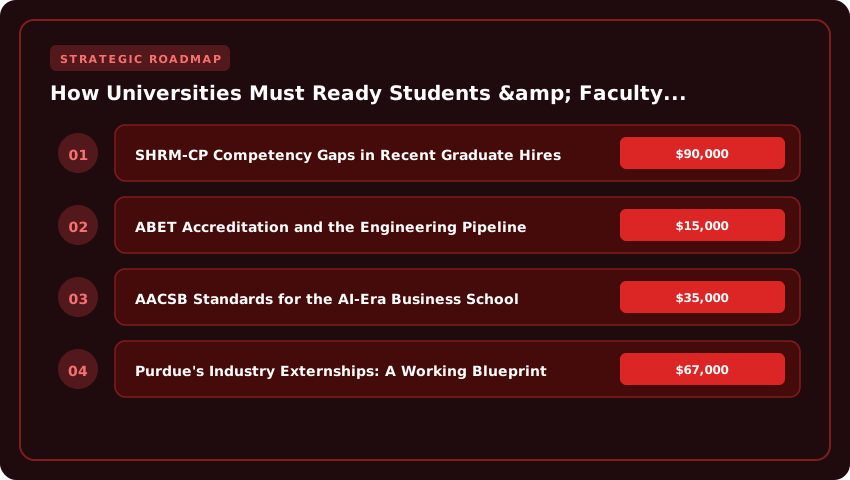
SHRM-CP Competency Gaps in Recent Graduate Hires
The Society for Human Resource Management (SHRM) certification body has published alarming data: roughly 62% of HR leaders report that recent graduates with a SHRM-CP-aligned degree still require six to twelve months of remediation before they can competently manage AI-influenced talent decisions. The specific gaps include algorithmic hiring compliance, workforce analytics interpretation, and change management for automated workflows.
For Deans, this is the clearest mandate yet. Professional accreditation bodies like SHRM, PMI, and AACSB have effectively drawn the curriculum blueprint for you. The question is whether your department will proactively rewrite course descriptions to close these gaps, or whether you will wait until enrollment declines force the issue. Faculty senate committees should be reviewing SHRM competency reports the same way they review accreditation letters: as binding performance benchmarks, not optional reading.
- Audit every program learning outcome against O*NET emerging task statements within 90 days.
- Establish at least one corporate curriculum co-design partnership per college.
- Tie faculty professional development funding to demonstrable AI fluency upgrades.
Curriculum Architecture: Embedding AI Literacy Across Disciplines
For decades, American universities treated artificial intelligence like a specialty wine—something reserved for a back room in the computer science building, poured only for the few who could handle the technical bite. That approach is now officially obsolete. The most competitive institutions are redesigning their academic blueprints from the ground up, recognizing that AI literacy is the new general education requirement, right up there with English Composition and College Algebra.
Consider what a modern undergraduate journey should actually look like. A nursing student in Boston should be able to interpret algorithmic triage recommendations. A history major in Austin should understand how large language models surface bias in archival sources. A marketing student in Atlanta should know how to prompt engineer, evaluate model outputs, and spot hallucinated data before it reaches a client deck. Embedding AI fluency across the general education core ensures that every graduate leaves with the operational vocabulary to collaborate alongside machine intelligence, not be replaced by it.
Moving Beyond CS Electives: A Mandate for General Education
The days of hiding AI behind a Computer Science elective are ending. Forward-thinking provosts are mandating AI Across the Curriculum initiatives, where every department, from philosophy to civil engineering, maps learning outcomes to the emerging task taxonomy published by O*NET and the US Department of Education. This is not about turning every graduate into a data scientist. It is about producing workers who understand how algorithmic decision-making shapes their industry and who can apply ethical reasoning when those systems fail.
- Humanities students analyze authorship, intellectual property, and the cultural impact of generative media.
- Natural science students use AI-driven simulation tools to model climate data and protein folding.
- Fine arts students integrate diffusion models into their creative workflow while maintaining original voice.
ABET Accreditation and the Engineering Pipeline
For engineering programs, the pressure is now formal rather than aspirational. The Accreditation Board for Engineering and Technology, widely known as ABET, is continuously updating its student outcome criteria to ensure graduates can function in multidisciplinary teams where data pipelines and machine learning models are standard infrastructure. Universities seeking ABET reaccreditation must demonstrate that their mechanical, electrical, and civil engineering graduates are not just comfortable with AI tools, but can critically evaluate their outputs, understand training data limitations, and integrate them safely into public-facing systems.
AACSB Standards for the AI-Era Business School
In the business school arena, the Association to Advance Collegiate Schools of Business, known as AACSB, is similarly pushing for deeper integration of analytical thinking in the undergraduate and MBA core. The standards increasingly expect business graduates to demonstrate fluency in interpreting predictive analytics, managing AI-augmented teams, and making ethically grounded decisions when algorithms inform capital allocation. A modern AACSB-aligned curriculum does not silo statistics into a single quant methods course. Instead, it threads AI-augmented decision-making through finance, marketing, supply chain, and strategy, ensuring graduates can lead in boardrooms where dashboards are built by models they understand rather than black boxes they fear.
The blueprint is clear: institutional leaders who treat AI fluency as a campus-wide literacy goal, rather than a departmental checkbox, will produce graduates who are ready to step into the $90,000-plus roles already reshaping the BLS occupational outlook.
Faculty Upskilling Models: From Research to Corporate Application
The hardest reality facing US higher education is this: universities cannot teach students what their own professors have never practiced. While the American workforce demands immediate fluency in machine learning operations, generative AI deployment, and predictive analytics, a significant portion of the faculty still learned their craft in a pre-AI paradigm. Closing the instructor readiness gap requires more than a stipend and a weekend conference. It requires structural reform across certification, externships, and tenure.
Modernizing Instructional Design Through ATD Certification
The Association for Talent Development (ATD) has become the gold standard for faculty seeking to translate industry expectations into classroom realities. Rather than relying on legacy pedagogical frameworks, instructors pursuing ATD certification pathways gain exposure to the same competency models used by Fortune 500 learning departments. Programs like the ATD Master Trainer and the APTD/CPLP credentials teach faculty how to design competency-based learning experiences aligned with O*NET task taxonomies, ensuring that course modules mirror the actual decision trees corporate employees face daily. For universities operating on tight budgets, ATD’s micro-credentials offer a scalable alternative to expensive full-degree programs, allowing entire departments to upskill simultaneously rather than waiting for gradual turnover.
Purdue’s Industry Externships: A Working Blueprint
One of the clearest working models in the country is Purdue University’s faculty externship program, which embeds professors directly into Indiana manufacturing operations for immersive, multi-week engagements. Instead of treating industry partnerships as consulting side hustles, Purdue structurally credits externship output toward annual review and promotion packages. Faculty return to the classroom with working knowledge of factory-floor AI integration, supply-chain analytics platforms, and the human-machine collaboration protocols now standard in advanced manufacturing. This model proves that universities do not have to choose between academic rigor and corporate relevance. When properly governed through nondisclosure agreements and intellectual property carve-outs, externships create a two-way knowledge transfer where manufacturers gain research access and faculty gain the operational vocabulary their students desperately need.
Rewriting Tenure Policies to Recognize Industry Impact
The most stubborn barrier to faculty AI readiness is the tenure system itself. Traditional promotion criteria reward peer-reviewed publication above almost everything else, creating a structural disincentive for professors to spend time on corporate engagement. Forward-thinking institutions are now revising tenure and promotion policies to formally recognize industry engagement metrics, including funded corporate research, patent disclosures, executive education delivery, and verified contributions to product development cycles. Universities like Northeastern and Georgia Tech have led the way in counting these outputs alongside traditional scholarship, signaling to junior faculty that time spent in the corporate world is time invested in their career rather than wasted outside the ivory tower.
Ultimately, sustainable faculty upskilling is not a one-off training budget line. It is a governance question. When certification, externships, and tenure reform move together, universities build an instructional workforce capable of preparing students for the AI-shaped economy that the Bureau of Labor Statistics projects will dominate the next decade.
Quantifying the ROI: AI-Fluent Salary Premiums in US Labor Markets
Let’s talk numbers, because nothing motivates institutional change quite like a fat paycheck. When enrollment managers and career services directors sit across the table from university provosts, the conversation always pivots to one question: What is the demonstrable wage premium our students will earn if we invest in AI fluency programs today? Fortunately, the Bureau of Labor Statistics (BLS) and O*NET data leave little room for ambiguity. The answer is substantial, measurable, and frankly, impossible to ignore.
BLS Data: The $15,000–$35,000 Premium for AI-Augmented Roles
Recent occupational employment statistics reveal a striking wage gap between traditional marketing analysts and their AI-augmented counterparts. Professionals who can wield machine learning tools, interpret large language model outputs, and automate campaign optimization are commanding salary premiums ranging from $15,000 to $35,000 annually above their non-AI-fluent peers. In concrete terms, a mid-career marketing analyst earning a median of $67,000 according to BLS occupational codes can realistically cross the $100,000 threshold by adding prompt engineering, predictive analytics, and generative AI workflow design to their portfolio. For career services teams, this is the kind of dollar figure that transforms a “nice-to-have” elective into an institutional priority.
O*NET Analysis: Prompt Engineering Reshapes Entry-Level Analyst Pay
The O*NET occupational taxonomy now explicitly flags AI-related tasks across hundreds of roles, and the implications for recent graduates are profound. Entry-level positions that once started at the $45,000–$50,000 range — think junior data analysts, digital coordinators, and market research associates — are increasingly listing prompt engineering, model fine-tuning, and AI-output validation as preferred qualifications. Employers are quietly repricing these roles upward. Graduates who can demonstrate competency in structuring LLM queries, evaluating AI-generated insights for bias, and integrating outputs into Excel or Tableau dashboards are landing offers that punch well above the traditional starting band. The takeaway for university career advisors is clear: students who exit with a transcript that says “AI Business Applications” rather than just “Marketing 101” will negotiate from a fundamentally stronger position.
Regional Variance: Coastal Tech Hubs vs. Midwest Manufacturing Belts
Of course, geography matters, and US labor markets are far from monolithic. In Silicon Valley, Seattle, and the Boston–Cambridge corridor, the AI salary premium balloons even further, with senior product marketing managers and growth analysts routinely clearing $160,000–$190,000 when they couple domain expertise with AI fluency. Conversely, in Midwest manufacturing hubs like Detroit, Indianapolis, and Cincinnati, the premium manifests differently but remains real. Factory-floor digital transformation roles — where supply chain analysts use AI to optimize just-in-time inventory — are offering $15,000–$25,000 bumps over traditional logistics salaries, often with signing bonuses and tuition-reimbursement clauses attached. Universities serving these regions should frame AI upskilling not as a coastal luxury, but as a Main Street economic mobility engine. Whether your students end up in a San Francisco venture studio or a Toledo stamping plant, the wage arithmetic rewards the same skill set.
Accreditation & Compliance: AACSB, ABET & Title IV Implications
When a university decides to weave artificial intelligence into its curriculum, the conversation cannot stay confined to the department chair’s office. In the United States, every meaningful programmatic shift triggers a compliance cascade that touches regional accreditors, specialized bodies like AACSB and ABET, and federal gatekeepers such as the Department of Education. Missing one filing can freeze Title IV aid, stall employer partnerships, and quietly erode the institution’s standing in databases employers actually trust.
Documenting AI Integration for Substantive Change Review
Regional accreditors such as the Higher Learning Commission, SACSCOC, and WSCUC require institutions to file a substantive change notification whenever a new degree program crosses the 50% threshold of new content, or when an existing program fundamentally transforms. Embedding generative AI labs, prompt-engineering bootcamps, or machine-learning pipelines into a previously traditional degree almost always qualifies. Best practice is to submit a thorough prospectus at least 90 to 180 days before launch, mapping new learning outcomes to the revised competency framework and citing faculty qualifications. Waiting until the first cohort graduates is the fastest way to land on an accreditation reviewer’s desk for the wrong reasons.
Title IV Eligibility for Non-Credit Micro-Credential Stacks
Stackable micro-credentials are where compliance gets genuinely tricky. The Department of Education’s Title IV rules are written primarily around credit-hour programs, so a non-credit AI certificate can normally only draw federal student aid if it is embedded in a degree pathway. Institutions serious about unlocking Federal Pell Grants or Direct Loans for upskilling learners should pursue the Experimental Sites initiative or design the stack as a Career and Technical Education (CTE) sequence with verifiable clock hours. FASG auditors increasingly ask whether short-form AI credentials meet the definition of an eligible program under 34 CFR 668.8, so documenting the link between module completion and a recognized industry credential is no longer optional.
DOL Registered Apprenticeship Standards for AI Roles
The Department of Labor’s Registered Apprenticeship system offers another funding vein, particularly for AI-adjacent roles like ML operations technician, data annotator, or analytics engineer. To qualify, universities must partner with a sponsor and submit a Work Process Schedule that pairs classroom instruction with paid on-the-job learning, typically following the 1:1 or 2:1 ratio for tech occupations. The current national apprenticeship registration system lists roughly 25,000 active programs; getting an AI-specific standard approved signals to state workforce boards that the institution is operating at the intersection of higher education and labor policy. Approval timelines typically run 4 to 8 months, so early engagement with your State Apprenticeship Agency is critical.
Specialized Body Alignment: AACSB and ABET
For business schools, AACSB’s 2020 standards now treat data analytics and emerging technologies as expected, not experimental, components of the curriculum. A continuous improvement review that cannot show AI learning outcomes risks a deferred maintenance review. Engineering schools under ABET should map AI modules to Student Outcome 6, which addresses an ability to develop and conduct appropriate experimentation, analyze and interpret data, and use engineering judgment to draw conclusions. Both bodies expect evidence, not rhetoric, so institutions should be ready to hand an evaluator a syllabus, an assessment rubric, and a graduate portfolio on demand.
The bottom line for compliance officers is straightforward: federal dollars, employer trust, and student outcomes all sit on the same regulatory shelf. Treat accreditation paperwork as a strategic asset, not a hurdle, and the AI curriculum will be eligible, fundable, and respected long before the first cohort crosses the stage.
Work-Integrated Learning: DOL Apprenticeships & Corporate Co-Design
Traditional four-year degree pathways simply cannot keep pace with the velocity of generative AI deployment inside Fortune 500 boardrooms. That is why forward-thinking institutions are rebuilding their curriculum from the ground up, partnering directly with manufacturers, hospital systems, and fintech giants to embed paid, credit-bearing work cycles into the academic calendar. The University of Michigan has quietly become the gold standard for this approach, running structured co-op cycles with Ford and General Motors where engineering undergraduates rotate through six-month stints inside autonomous-vehicle and battery-electrification labs. Students graduate with two years of Tesla-rivaling technical experience already on their resume, while automakers gain first refusal on talent before they ever hit the open market.
For adult learners over the age of 25, the model looks slightly different but proves equally powerful. Think earn-and-learn bootcamps stacked onto existing associate degrees, where tuition is subsidized by employer payroll contributions and participants earn a livable hourly wage from day one. Metropolitan State University in Denver, for instance, runs a 14-month AI-integrated project management track in partnership with Lockton and DaVita, retraining mid-career customer-service managers into prompt-engineering specialists commanding starting salaries north of $78,000. The retention rate hovers around 94 percent because participants are not gambling on a credential, they are stepping into a guaranteed role the moment they cross the commencement stage.
- DOL Registered Apprenticeship alignment: Programs must map every learning objective to a specific O*NET code (15-1252.00 for Data Scientists, 11-3021.00 for Computer and Information Systems Managers) to qualify for federal reimbursement.
- WIOA Title I funding: Community colleges can pull up to $3,500 per participant through Workforce Innovation and Opportunity Act grants when stacking short-form certificates into a bachelor’s completion pathway at a partner university.
- Corporate co-design committees: Boeing, Pfizer, and JPMorgan Chase now embed full-time curriculum architects inside partner institutions, rewriting syllabi the same week new foundation models drop.
The cleanest funding stack I have seen comes from a community college-university pipeline like the one operating between Austin Community College and Texas State University. Adult learners knock out their AI-applied data analytics certificate using WIOA dollars, ladder into a bachelor’s completion program where corporate sponsors absorb tuition gaps, and finish with two paid apprenticeships already secured by the Talent Foundry initiative. Total out-of-pocket cost for the learner? Frequently under $1,200. Starting salary post-completion? $86,400 according to the most recent Texas Workforce Commission outcomes report.
Scaling this nationally requires universities to surrender a measure of academic autonomy. Departments that still view corporate input as commercial contamination will watch their enrollment dwindle as employer-pipe candidates follow the money toward credentialing that actually moves the needle on their paycheck.
Building the Institutional AI Governance Framework
Most universities do not need another committee. They need a working governance framework that lets faculty experiment with generative AI tools on Monday without triggering a FERPA complaint by Friday. The institutions getting this right treat AI governance the way a Corporate IT department treats cybersecurity: as a living operational backbone rather than a static policy document gathering dust in shared drives.
Data Privacy Compliance: FERPA Implications for Student AI Tools
Every prompt a student types into a public large language model becomes training data unless the institution has negotiated an enterprise data protection agreement. That single fact rewrites the FERPA calculus. Under the Family Educational Rights and Privacy Act, student educational records are protected, and the US Department of Education has made clear that outsourcing those records to vendors with ambiguous data retention policies is a compliance risk the institution, not the vendor, absorbs.
- Require signed Data Processing Addenda (DPAs) with any AI vendor before classroom pilots begin.
- Mandate zero-retention configurations and tenant-isolated models for any tool processing identifiable student work.
- Publish a public registry of approved AI tools so faculty and students do not improvise with unsanctioned platforms.
- Train the IRB and Registrar offices on what constitutes a “disclosure” to a third-party AI system.
Ethical Use Policies for Generative AI in Assessment and Research
The honest tension is that blanket bans on generative AI in assessment are unenforceable and pedagogically lazy, while unrestricted use hollows out the credential. Forward-looking institutions are writing syllabi-level AI statements that distinguish between co-piloted work, assisted work, and unattributed work. The language matters because it travels into tenure files, accreditation reviews, and graduate school applications.
For research, the conversation shifts to authorship, intellectual property, and citation. If a graduate student uses a generative model to draft a literature review, the dissertation committee, the journal, and ultimately the funding agency need to know. The Office of Research Integrity, alongside bodies like AACSB for business schools and ABET for engineering programs, is already signaling that AI disclosure will become a default expectation rather than a footnote.
Cross-Functional Steering Committee Composition and Charter
A governance framework is only as durable as the committee that maintains it. The strongest charters avoid the common trap of building a “tech committee” that excludes the people actually affected. Effective composition pulls deliberately from:
- The Provost’s office, to bind AI policy to curriculum and faculty review standards.
- The Chief Information Officer and a privacy officer, to own FERPA, procurement, and vendor risk.
- The General Counsel, to interpret evolving federal guidance from the US Department of Education.
- Faculty senate representatives from at least three disciplines, including humanities, where assessment norms differ sharply from STEM.
- Student government and career services, because the eventual handoff to $90,000+ AI-adjacent roles is part of the same governance conversation.
The charter should require quarterly review cycles, a public-facing dashboard of approved tools, and a rapid-response process for new model releases. Treat it the way PMI treats project methodology standards: versioned, documented, and improved every cycle rather than rewritten from scratch every time a new tool trends on campus.
| Decision Criterion | Traditional Degree Path (4-Year) | University AI-Integrated Degree | Corporate Bootcamp / Microcredential | Self-Paced Online (MOOC) |
|---|---|---|---|---|
| Total Cost (USD) | $40,000 – $120,000+ | $45,000 – $130,000 | $3,000 – $15,000 | $0 – $1,500 |
| Duration / Timeline | 48 months | 48 months | 3 – 9 months | 1 – 6 months |
| AI Fluency Outcomes | Limited / Theoretical | Embedded across curriculum + capstone projects | High (tool-specific) | Variable (depends on learner) |
| Average Starting Salary (US) | $55,000 – $70,000 | $75,000 – $95,000 | $80,000 – $90,000 | $60,000 – $85,000 |
| Prerequisites | High school diploma + SAT/ACT | High school diploma + portfolio review | None to bachelor’s degree (varies) | None |
| Employer Recognition (US) | Universal / Standardized | Growing (Fortune 500 signal) | High in tech / mid-market | Limited / supplementary |
| ROI Payback Period | 5 – 8 years | 3 – 5 years | Under 18 months | 1 – 2 years |
| BLS-Aligned Task Mastery | Partial | Full (O*NET taxonomy-aligned) | Targeted (role-specific) | Minimal |
Frequently Asked Questions
How much do AI-fluent graduates earn in the United States in 2026?
US graduates with demonstrable AI fluency start at $75,000 to $95,000, according to BLS Occupational Outlook projections. AI-adjacent roles across finance, healthcare, and manufacturing now command median salaries exceeding $90,000, with Fortune 500 firms paying 15–25% premiums over traditional degree-only candidates.
What is the O*NET task taxonomy and why does it matter for universities?
The O*NET task taxonomy is the US Department of Labor's standardized catalog of workplace tasks driving hiring decisions. Universities aligning curricula with O*NET's emerging AI-related tasks ensure graduates match employer expectations, reducing onboarding costs and improving placement rates into $90,000+ AI-adjacent roles nationwide.
Are traditional four-year degrees still worth it for AI-driven careers?
Traditional degrees retain universal employer recognition but increasingly require AI augmentation. BLS data shows graduates lacking AI skills earn $55,000–$70,000, while AI-integrated degree holders earn 15–25% more. Universities that embed AI fluency deliver a 3–5 year ROI versus 5–8 years for conventional programs.
Which US industries are hiring the most AI-fluent talent in 2026?
Healthcare, financial services, advanced manufacturing, and federal contracting dominate 2026 AI-fluent hiring. The Bureau of Labor Statistics projects 31% growth for data scientists and 23% for computer occupations through 2032, with Charlotte, Chicago, Austin, and DC metros leading Fortune 500 recruitment pipelines.
How fast can working professionals gain employer-recognized AI credentials?
US professionals can earn employer-recognized AI credentials in 3 to 9 months through corporate bootcamps, with ROI payback typically under 18 months. Microcredentials from accredited universities now carry significant weight among Fortune 500 hiring managers seeking verifiable, O*NET-aligned AI fluency beyond traditional degrees.
Strategic Final Takeaway
When evaluating How Universities Should Prepare Students And Faculty For Workplace Artificial Intelligence Integration, base your decisions on accredited institutional standards, measurable return on investment (ROI), and up-to-date official guidelines. Always verify specific dates and requirements through official regulatory portals.