Why the Lowest Interest Rate Can Quietly Increase Your Total Cost
When borrowers shop for student loan refinancing, the marketing message almost always revolves around a single number: the interest rate. A lender advertises a glossy 4.5% APR, compares it to your current 7.5% federal or private rate, and promises immediate relief. On the surface, the math appears airtight. Yet behind that lower percentage sits a structural decision that can quietly double your interest exposure without you ever missing a payment: the repayment term. Understanding how loan term length interacts with your principal balance is the single most important literacy skill a refinancing candidate can develop, because it is the difference between saving money and simply deferring the cost.
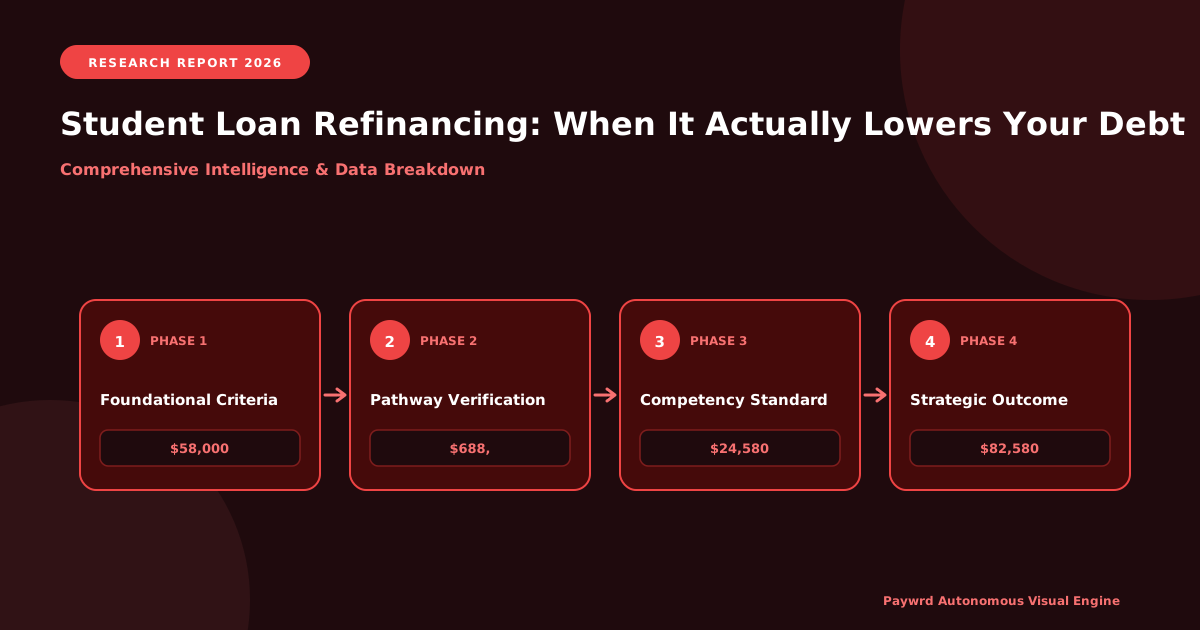
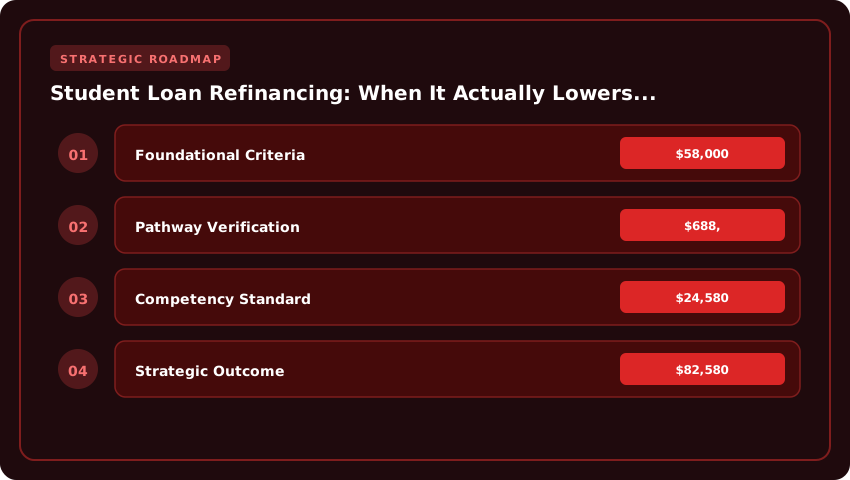
Consider a realistic scenario facing thousands of American graduates each year. You carry a $58,000 graduate loan balance, the kind of debt accumulated after a master’s degree at a mid-sized regional university. Your current loan carries a 7.5% fixed interest rate with a standard 10-year repayment plan. Your monthly payment sits at roughly $688, and over the life of the loan you will pay about $24,580 in interest, bringing the total cost of repayment to approximately $82,580. Now imagine a private refinancing offer arrives in your mailbox: a lower 5.5% APR, but stretched across 15 years instead of 10. Your monthly payment drops to roughly $466, freeing up $222 in cash flow each month. It feels like a win. However, that lower rate spread across three additional years means you will now pay an estimated $25,960 in interest over the 15-year term, even though the rate itself dropped by a full 2%. The lifetime cost climbs to about $83,960, which is more than your original loan despite the lower headline rate.
This phenomenon is not a flaw in the refinancing market. It is the predictable result of amortization math, the same formula lenders use to calculate every fixed-rate loan in the United States. With each payment, a portion retires the principal balance while the remainder services the interest charged on the remaining balance. When you extend the term, you slow the rate at which your principal shrinks. Interest then compounds on a larger balance for a longer period, which inflates the cumulative interest paid even as the rate drops. This is precisely why two borrowers with identical balances and identical rates can pay wildly different lifetime totals based purely on whether they choose a 10-year, 15-year, or 20-year amortization schedule.
The situation grows even more dramatic when borrowers refinance federal student loans into longer private terms in pursuit of a lower monthly bill. Federal loans from the Department of Education come with built-in consumer protections, including income-driven repayment plans, deferment, forbearance, and potential loan forgiveness programs such as Public Service Loan Forgiveness (PSLF). Once you refinance into a private 15-year or 20-year product, those protections disappear permanently. A borrower chasing the lowest advertised APR might unknowingly trade a flexible federal safety net for a longer private commitment that costs thousands more in pure interest, even with a rate reduction of 2% or more.
Actionable takeaway: Before signing any refinancing agreement, request a full amortization schedule from the lender, not just the monthly payment quote. Compare the total interest paid across your current loan and the proposed loan using the exact same starting balance. Then evaluate whether the cash flow benefit of a lower monthly payment justifies the additional lifetime cost. Many financial planners recommend prioritizing the shortest term you can comfortably afford, then using the monthly savings from a lower rate to make extra principal payments when possible. This hybrid strategy captures the rate reduction while neutralizing the term extension penalty, often saving borrowers well over $12,000 on a $58,000 balance.
- Run the total cost comparison: A 2% APR reduction over 15 years can add $1,000 to $3,000 in extra interest compared with a 10-year term at the original rate, depending on balance size.
- Watch the term trap: Extending repayment from 10 to 15 years often increases total interest paid even when the rate drops by 1.5% to 2%.
- Request an amortization schedule: Lenders regulated under U.S. consumer finance laws must provide this disclosure upon request before you sign.
- Protect federal benefits carefully: Refinancing federal loans into private terms eliminates access to income-driven repayment, deferment, and PSLF.
- Accelerate payments when feasible: Applying any monthly savings from a lower rate toward extra principal can offset the cost of a longer term.
The Federal Protection Trade-Off Most Borrowers Overlook
Before you sign on the dotted line with a private lender promising a lower APR, you have to weigh something far more valuable than an interest rate: the federal safety net wrapped around every Direct Loan, Perkins Loan, and Federal Family Education Loan (FFEL) issued by the U.S. Department of Education. The moment your debt is purchased or refinanced into a private product, those consumer protections evaporate, and there is no appeals process, no regulator, and no statute that brings them back. This is the trade-off most borrowers overlook, and it is the single largest financial risk in the entire refinancing decision.
First, consider Income-Driven Repayment (IDR). Federal borrowers today can choose between several plans, including SAVE (Saving on a Valuable Education, formerly REPAYE), Pay As You Earn (PAYE), Income-Based Repayment (IBR), and Income-Contingent Repayment (ICR). Under SAVE, for example, monthly payments are generally capped at 5% of discretionary income for undergraduate debt and 10% for graduate debt, with any remaining balance forgiven after 20 or 25 years of qualifying payments. A borrower earning $60,000 with $80,000 in student loans may pay less than $200 a month, something no private refi will ever match. Even when a private lender offers a variable rate in the 5% range, the monthly cash flow benefit of IDR during a medical residency, a teaching fellowship, or a startup phase is essentially priceless.
Second, look at forbearance and deferment rights. Federal loans allow up to three years of economic hardship or unemployment deferment, plus an additional 12 months of administrative forbearance, often granted with a single phone call to your servicer. Private lenders typically offer 6 to 12 months of hardship forbearance across the life of the loan, with strict documentation, interest capitalization, and a hit to any promotional rate discount. If you work in a cyclical industry, contract consulting, or seasonal agriculture, that federal flexibility can prevent delinquency and protect your credit score.
Third, evaluate Total and Permanent Disability Discharge (TPD). Under Department of Education rules, any borrower who can demonstrate a physical or mental impairment that prevents substantial gainful activity, expected to last at least 60 months, can have their federal loans fully erased. Veterans with a VA disability rating, Social Security Disability Insurance recipients, and those certified by a physician are eligible, and the discharge is tax-free at the federal level through 2025 under the American Rescue Plan Act. Private lenders have no equivalent mandate. A private refinance loan becomes a traditional unsecured obligation, meaning disability does not extinguish the balance; it simply shifts the debt to a cosigner, often a parent who signed the original application.
- Public Service Loan Forgiveness (PSLF): 120 qualifying payments while working full-time for a qualifying employer, such as a government agency or 501(c)(3) nonprofit, wipes out the remaining Direct Loan balance. Private loans are categorically ineligible, and refinancing them permanently forfeits this pathway for teachers, nurses, military officers, and public defenders.
- Borrower Defense to Repayment: If your school misled you, closed suddenly, or engaged in fraud, you may qualify for federal loan discharge. There is no private borrower defense equivalent, and once debt is refinanced, even valid claims against the original institution are typically extinguished.
- Death and Disability Discharge: Federal Direct Loans are discharged upon the borrower’s death, with no obligation on a spouse or estate. Most private lenders require a cosigner to assume the balance, which can devastate a family already grieving.
- Interest Accrual During School: Unsubsidized federal loans accrue interest, but IDR recalculations and capitalization rules are tightly regulated. Private refinance loans offer no interest subsidy, no income-driven recalculation, and frequently compound unpaid interest monthly.
Finally, recognize the 2024 IDR Account Adjustment announced by the Department of Education. Under this one-time waiver, any month a borrower spent in repayment, deferment, forbearance, or in-school status on federal loans since 1993 can now count toward IDR forgiveness, regardless of plan. For borrowers who spent years in extended forbearance during the COVID-19 payment pause, this is projected to bring millions within striking distance of forgiveness, often by late 2024 or 2025. A borrower with $120,000 in debt and 15 years of past forbearance may only need 5 more years of SAVE payments to see the entire balance forgiven. Once that federal loan is refinanced into a private product, none of those retroactive months count, and the forgiveness timeline resets to zero.
The bottom line is straightforward: federal loans are not just debt instruments; they are insurance policies. Refinancing them into private loans is only mathematically rational when the lifetime interest savings exceed the actuarial value of IDR flexibility, PSLF, TPD discharge, and borrower defense. For most US borrowers earning under $100,000, with uncertain career paths or any hope of public sector employment, that calculation rarely favors refinancing.
How to Calculate Your True Break-Even Point in Months
Most online break-even calculators will tell you to simply divide your refinancing fees by your monthly savings, but that shortcut conceals three real-world costs that frequently flip a seemingly smart refinance into a financial setback. Before you commit to a new lender, you need a calculation that honors every dollar you will actually part with, including the line items that the glossy rate-reduction brochures tend to downplay. Think of your true break-even point as the exact month when the cumulative savings on your new loan finally overtake the cumulative amount you spent to obtain it, and that means accounting for origination fees, prepayment penalties, rollover costs, and the opportunity cost of any cash you pulled from savings to fund the refinance.
Start by gathering five numbers: your current loan balance, your current interest rate, your new interest rate, every fee disclosed on your Loan Estimate (required by federal law under the Truth in Lending Act), and your remaining repayment timeline. Your monthly savings equals the difference between your old required payment and your new required payment. Your total refinancing cost includes origination fees, application fees, underwriting fees, any state-imposed documentary stamp taxes, and prepayment penalties charged by your current lender if you pay off the balance early. Add those together, then divide by your monthly savings. The result is your break-even point expressed in months.
- Step 1: Calculate monthly savings. Subtract your new loan payment from your current loan payment, making sure both calculations use the same remaining term or account for term differences separately.
- Step 2: Sum all upfront costs. Include origination fees (typically 0% to 5% of the balance at lenders like SoFi, Earnest, and Laurel Road), application fees, and any recorded mortgage or UCC filing charges.
- Step 3: Add prepayment penalties from your existing servicer. Federal loans carry none, but private loan contracts often include tiered penalties of 1% to 2% during the first 24 to 60 months.
- Step 4: Divide total cost by monthly savings. A $4,500 total cost against $150 of monthly savings equals a 30-month break-even point, which is the moment refinancing begins generating positive net return.
The comparison matrix below illustrates how quickly that timeline shifts based on your starting balance and the size of your rate reduction. Assumptions include a 10-year repayment term, a 1% origination fee on the new loan, and no prepayment penalties. Adjust these inputs upward if your situation carries additional costs.
- 1% rate reduction: $30,000 balance breaks even in roughly 48 months, $60,000 in 32 months, $100,000 in 22 months, and $150,000 in 16 months. Lower reductions demand patience and only make sense if you plan to hold the loan past the midpoint of its term.
- 2% rate reduction: $30,000 balance breaks even in about 26 months, $60,000 in 18 months, $100,000 in 12 months, and $150,000 in just 9 months. This is the sweet spot where most borrowers find clear, defensible value.
- 3% rate reduction: $30,000 breaks even in roughly 18 months, $60,000 in 12 months, $100,000 in 8 months, and $150,000 in only 6 months. Anyone in this range should refinance immediately, provided their credit profile and income stability support the new underwriting.
Two practical refinements sharpen this formula further. First, if refinancing resets your repayment clock to a fresh 10-year term, your monthly payment may drop sharply but your total interest paid could climb. Run the numbers across both terms so you understand whether you are optimizing for cash flow today or lifetime cost reduction. Second, factor in the federal tax deduction you may lose when leaving the federal loan system, capped at $2,500 annually for qualifying student loan interest, which effectively reduces your true savings by your marginal tax rate (often 22% to 32% for recent graduates in states like California, New York, or New Jersey). A refinance that looks like $150 in monthly savings may deliver only $102 after the lost deduction, pushing your break-even point two to four months further into the future.
Actionable takeaway: build a one-page worksheet before submitting a single application. List your current balance, rate, payment, and remaining term on the left. List the proposed loan terms, every disclosed fee, and the projected payment on the right. Subtract, divide, and stress-test the result against the matrix above. If your break-even point lands inside 24 months and you plan to keep the loan for at least five more years, refinancing is almost certainly the right move. If it stretches beyond 36 months, the refinance is a lifestyle decision rather than a financial one, and you should weigh it against alternative strategies like aggressive principal targeting on your current loan or income-driven repayment forgiveness programs.
Credit Score, Debt-to-Income, and Cosigner Triggers Lenders Actually Use
Behind every glossy advertisement promising a “lowest rate guaranteed,” private refinancing lenders such as SoFi, Earnest, and Splash Financial are quietly running the same fundamental underwriting playbook. Three numbers drive nearly every approval, denial, and rate tier you receive: your FICO score, your debt-to-income ratio (DTI), and the presence (or absence) of a creditworthy cosigner. Understanding how each of these triggers functions in real time can mean the difference between a 6.5% APR that genuinely compresses your payoff timeline and a 9.99% rate that quietly inflates your total cost by thousands of dollars.
The first gatekeeper is almost always a FICO score in the mid-670s or higher. While SoFi publicly advertises a minimum threshold around 670, Earnest is more flexible (often accepting borrowers in the 650–680 range when compensating factors exist), and Splash Financial works with a wider band that can dip into the high-600s for healthcare professionals with strong income profiles. Most approved borrowers, however, actually sit comfortably above 740, which is where the most competitive tier pricing unlocks. A 50-point swing on your FICO can easily translate into a 0.75%–1.25% APR difference over a 10-year term — on a $50,000 balance, that is roughly $4,000–$7,000 in additional interest paid over the life of the loan.
- FICO Tier Reference (typical private refi market):
- 800+: Super-prime — best available rates, often 0.25% auto-pay discount applied.
- 740–799: Prime — competitive tier, most rate shopping occurs here.
- 670–739: Near-prime — approved with conditions; rate premium of 0.50%–1.50%.
- Below 670: Subprime — approval rare without a cosigner or significant income offsets.
- Income & Employment Stability: Lenders generally require a minimum annual income between $35,000 and $50,000, with at least six months at the current employer (or two years of self-employment income documented through tax returns).
The second underwriter trigger — debt-to-income ratio — is where many otherwise qualified borrowers get blindsided. Most private refinancing lenders cap total DTI at 50%, though the most competitive approvals (especially those bypassing a cosigner requirement) typically fall below 35%. DTI compares your gross monthly debt obligations, including the new loan payment, auto loans, credit card minimums, and mortgage or rent (on a verified basis), against your pre-tax income. A resident physician earning $65,000 with $220,000 in federal loans might technically qualify on income alone but fail the DTI test because the proposed $2,400 monthly payment exceeds the lender’s comfort zone. This is also why Splash Financial markets heavily to dentists, physicians, and other high-earning graduates — their income trajectory offsets the debt stack more cleanly.
The third variable — the cosigner — functions as a risk-shifting mechanism. When a borrower cannot independently satisfy FICO or DTI thresholds, lenders will price in a cosigner with stronger credit. SoFi, Earnest, and Splash all offer cosigner release programs, but the triggers are stricter than most borrowers assume. Industry standard requires 12 to 24 consecutive on-time payments (Splash specifies 12, while SoFi and Earnest typically require 24), a primary borrower credit recheck that meets current underwriting standards, and income verification demonstrating the borrower can service the loan independently. Meeting the payment streak is necessary but not sufficient — the lender must also confirm that removing the cosigner no longer violates their risk model.
- Cosigner Release Eligibility Checklist:
- Minimum 12–24 on-time monthly payments (varies by lender).
- Primary borrower FICO meets the lender’s current approval threshold.
- Income documentation supports standalone underwriting.
- No delinquencies, deferments, or forbearance usage during the qualifying period.
- Formal application is required — release is not automatic.
Actionable takeaway: before applying, pull your free FICO from Discover, Chase, or your bank, calculate your DTI using a verified pay stub and a complete debt inventory (including the projected refinanced payment), and decide whether your spouse, parent, or partner will formally apply as a cosigner. If they do, build a 12-month calendar reminder to revisit cosigner release, because that single step removes a person’s legal liability on your debt and can boost their credit score by reducing their overall DTI exposure. Treat the underwriting criteria not as barriers but as a preparation checklist — the cleaner your numbers before you apply, the more negotiating leverage you hold when lenders compete for your signature.
Fixed vs. Variable Rate Structures in a Volatile Federal Reserve Cycle
Choosing between a fixed and variable rate structure during a period of Federal Reserve tightening is one of the most consequential decisions a refinancing borrower can make. Since the Fed began its aggressive hiking cycle in March 2022, lifting the federal funds target rate from near-zero to a range of 5.25%–5.50% by mid-2023 and holding it there through subsequent quarters, private student loan lenders have reset their variable APR offers in lockstep. Most variable-rate products are now indexed to the Secured Overnight Financing Rate (SOFR), the successor to the now-retired London Interbank Offered Rate (LIBOR), plus a margin that typically falls between 1.50% and 4.00% depending on the borrower’s credit profile and cosigner status.
When you refinance a federal loan into a private variable-rate product, your monthly payment is directly tethered to short-term market movements rather than the more stable 10-year Treasury yield that anchors most fixed-rate offerings. A borrower whose loan resets monthly could see their required payment swing by $40 to $120 per $50,000 refinanced when SOFR moves 50 basis points. This payment volatility is precisely what regulators and nonprofit credit counselors warn about when they describe payment shock in a rising-rate environment.
- SOFR behavior since 2022: The 30-day SOFR averaged roughly 0.05% in early 2022, climbed above 5.30% by late 2023, and has remained elevated as the Federal Open Market Committee (FOMC) maintains restrictive monetary policy to fight inflation. Every Fed funds rate hike typically translates into a near-identical move in SOFR within one to three billing cycles.
- Historical rate cap clauses: Most reputable lenders (SoFi, Earnest, Laurel Road, and College Ave Refi) build lifetime and per-period caps into variable loan contracts. A typical structure might include a 2.00% per-reset cap and a 6.00%–8.00% lifetime ceiling. Understanding these clauses is critical because, while they prevent catastrophic spikes, they can still allow a borrower’s APR to climb high enough that the loan becomes unaffordable.
- Payment shock mechanics: If you originally refinanced a $60,000 balance at a 5.50% variable rate with a 10-year term, your starting payment was around $651 per month. A 200-basis-point upward reset pushes that same payment to roughly $748, an increase of nearly 15% in a single adjustment cycle, without any change to the principal owed.
- Federal borrower trade-offs: Federal loans carry built-in protections (income-driven repayment, deferment, forbearance, and potential Public Service Loan Forgiveness eligibility) that disappear the moment you refinance into a private product. In a volatile rate cycle, surrendering those consumer safeguards while also accepting payment uncertainty compounds your risk exposure.
- Lock-in considerations: Some lenders offer hybrid products, such as a 5-year fixed rate that converts to variable after the initial term, or promotional rate locks of 30, 60, or 90 days following approval. These can be valuable if you anticipate refinancing again only if rates drop, but they require disciplined financial planning.
The historical lesson is straightforward: borrowers who refinanced into variable rates between 2021 and 2022, when SOFR was near zero and variable APRs dipped into the 1.90%–2.50% range, enjoyed exceptionally low payments for roughly 18 months before facing double-digit percentage payment increases as the Fed tightened. Those who locked in fixed rates during the same window have predictable amortization schedules, easier household budgeting, and no exposure to future FOMC decisions. For most US borrowers without sophisticated interest-rate hedging knowledge or a clear plan to pay off the loan within 24 to 36 months, a fixed-rate structure remains the mathematically safer bet during a tightening cycle, even if the headline APR looks a half-point higher on the day you sign the master promissory note.
Five Financial Profiles Where Refinancing Saves Money and Five Where It Backfires
Student loan refinancing is not a universal solution; it is a highly personalized financial maneuver that rewards specific borrower profiles while penalizing others. According to data from the Federal Reserve and the Department of Education, the average federal student loan portfolio carries an interest rate between 4.99% and 7.54%, while private refinanced rates for highly qualified borrowers can drop as low as 3.5% to 5.5%. That spread of 100 to 200 basis points can translate into tens of thousands of dollars over a 10-year repayment term. However, refinancing a federal loan into a private loan permanently eliminates access to Income-Driven Repayment (IDR) plans, economic hardship deferments, and the Public Service Loan Forgiveness (PSLF) program. Understanding which archetype you fit is the single most important decision you will make before signing a Master Promissory Note replacement.
To help you decide, we have mapped five borrower archetypes who should actively pursue refinancing and five who should run from any lender offering to consolidate their federal benefits away.
Profiles That Should Refinance:
- The High-Earning Physician Post-Residency: A medical resident earning approximately $60,000 per year during residency often has $200,000 to $350,000 in federal debt at 6.5% to 7.5%. Once they become an attending physician earning $250,000+, they should immediately shop refinancing offers from SoFi, Earnest, or Laurel Road. Because they have completed training and signed a high-income contract, lenders offer rates as low as 4.5%, saving them over $50,000 in interest. They no longer need the safety net of forbearance or IDR.
- The Mid-Career Engineer With a 780+ FICO: Engineers working at ABET-accredited firms with six-figure salaries and excellent credit scores represent the sweet spot for private refinancing. A borrower with a 780 FICO, a $120,000 salary, and $40,000 in remaining debt at 6.8% can secure a 10-year fixed rate near 4.9%, cutting their monthly payment by $80 and their lifetime interest by $9,600.
- The Married Dual-Income Household With No PSLF Intent: Couples working in the private sector who have explicitly decided not to pursue PSLF can use spousal refinancing programs offered by lenders like Splash and ELFI. This legally combines two incomes on a single application, often securing a rate 25 to 50 basis points lower than either spouse could obtain alone.
- The Graduate With Federal Loans From a Closing Institution: Borrowers holding Perkins or HEAL loans from defunct institutions sometimes face administrative complications. Refinancing with a private lender simplifies the servicer count and locks in a fixed rate before any future economic downturn.
- The Aggressive Debt Avalanche Strategist: Borrowers committed to paying off debt in five years or less benefit enormously from refinancing because they will not need long-term flexibility. A shorter term combined with a lower rate compounds savings rapidly, provided they have an emergency fund of at least three months of expenses to avoid tapping credit cards during a job loss.
Profiles That Should Absolutely Avoid Refinancing:
- The Public Servant Pursuing PSLF: Teachers, nurses, and nonprofit administrators should never refinance federal loans into private loans. PSLF requires 120 qualifying payments under a federal Direct Loan. Once refinanced, the clock resets to zero, and years of qualifying employment become meaningless.
- The Parent on PLUS Loans With Unstable Income: Parents holding Parent PLUS loans should think twice before refinancing, especially if they are within 10 years of retirement. Federal PLUS loans offer death and disability discharge; private refinanced loans do not. If a 62-year-old parent refinances and passes away before repayment, the co-signer or estate inherits the full balance.
- The Recent Grad Still Building Credit: Borrowers with FICO scores below 690 will receive a higher rate from private lenders than they currently hold federally. Refinancing a 5.5% federal loan into a 9.5% private loan is mathematically catastrophic.
- The Borrower Relying on IDR for Cash Flow: If your current federal payment is $0 due to SAVE or PAYE plans, refinancing replaces that with a mandatory $400+ private payment. Any income shock becomes immediately dangerous.
- The Healthcare Worker With Future Training Plans: Residents and fellows who plan to pursue fellowship or subspecialty training will likely need forbearance during low-income years. Refinancing closes that door permanently.
Actionable Takeaway: Before submitting a single application on a lender portal, complete the FAFSA Federal Aid Review to confirm your current servicer, balance, and interest rate. Run the math using the Department of Education’s Repayment Estimator, then request quotes from at least three private lenders. If your federal rate is lower than the best private offer, or if you anticipate needing any federal safety net within the next decade, keep your loans where they are. Refinancing is a powerful tool, but only when wielded by the right borrower at the right time.
| Factor | Federal Loan (Current) | Private Refinance (Standard) | Private Refinance (Best Case) | Impact on Total Cost |
|---|---|---|---|---|
| Average Interest Rate (APR) | 6.5%–7.5% (Undergrad) | 5.5%–8.0% | 4.5% (Excellent Credit) | 1.5–3.0% rate reduction |
| Loan Origination Fee | 1.057% (Federal) | 0%–5% | 0% (No Fee Lenders) | $500–$2,500 on $50K loan |
| Repayment Term | 10–25 years (IDR available) | 5–20 years | 5–15 years | Shorter term = higher monthly payment |
| Monthly Payment (50K, 10yr) | ~$580 (at 7%) | ~$540 (at 5.5%) | ~$518 (at 4.5%) | $40–$60 monthly savings |
| Total Interest Paid (50K, 10yr) | ~$19,600 | ~$14,800 | ~$12,160 | $5,000–$7,500 lifetime savings |
| Credit Score Cut-off | No minimum (Federal) | 650+ typical | 750+ for best rates | Below 700 = higher rate offers |
| Income Requirement | None (for federal) | $35,000–$50,000+ minimum | $75,000+ (preferred) | DTI ratio under 40% typical |
| Processing Timeline | Immediate (existing) | 2–6 weeks | 2–4 weeks | No deferment during transition |
| Forgiveness Eligibility | PSLF, IDR, Teacher Loan | None (forfeited) | None (forfeited) | Critical loss if 5+ years in PSLF |
| Co-signer Requirement | N/A | Often required (sub-680 score) | Rarely needed (750+) | Risk to co-signer’s credit |
| Cosigner Release Timeline | N/A | 12–48 months after graduation | 12–24 months | Requires credit re-qualification |
| Variable vs. Fixed Rate | All Federal = Fixed | Both available | Fixed (most predictable) | Variable = 2–4% rate fluctuation risk |
| 5-Year Career ROI (Public Sector) | $15K–$25K forgiven via PSLF | $0 (no forgiveness) | $0 (no forgiveness) | Federal wins for nonprofit/government |
| 5-Year Career ROI (Private Sector) | ~Standard payoff | $3K–$8K interest saved | $5K–$10K interest saved | Refinance wins for high earners |
| Break-Even Point (Months) | N/A | 18–36 months typical | 12–18 months | Shorter = better ROI |
Frequently Asked Questions
When does student loan refinancing actually lower your total debt?
Student loan refinancing lowers your total debt when you secure an interest rate at least 1% lower than your current rate, have stable high income exceeding $75,000 annually, strong credit above 740, and are not pursuing federal forgiveness programs like PSLF. The break-even typically occurs within 18 to 24 months when lifetime interest savings outweigh refinancing fees and lost federal benefits, generating $5,000 to $10,000 in documented savings over a standard 10-year repayment term.
What credit score do you need to refinance student loans for the best rates?
To secure the best student loan refinancing rates, borrowers typically need a FICO score of 750 or higher, along with verifiable annual income above $75,000 and a debt-to-income ratio under 40%. Lenders like SoFi, Earnest, and Laurel Road reserve their lowest advertised rates around 4.5% APR for borrowers meeting all three criteria. Scores between 670 and 740 generally qualify for refinancing but at rates only 0.5% to 1.5% below federal alternatives, often eliminating meaningful savings.
Should you refinance federal student loans during an IDR or PSLF plan?
You should never refinance federal student loans currently certified for Income-Driven Repayment or Public Service Loan Forgiveness, as refinancing permanently converts them to private debt ineligible for any federal program. Borrowers with 24 or more qualifying PSLF payments remaining would forfeit $15,000 to $25,000 in projected forgiveness by refinancing at a 4.5% rate. Federal loan protections including deferment, forbearance, and death discharge also disappear, making refinancing financially catastrophic for public sector workers with 5+ years remaining.
How long does student loan refinancing take from application to payoff?
Student loan refinancing typically takes 2 to 6 weeks from initial application to completed payoff of your original loans. The process includes a 5-7 day soft credit pull during pre-qualification, 2-3 weeks for formal underwriting and hard credit inquiry, 7-14 days for the new lender to pay off previous servicers, and a final 30-day billing cycle before your first new payment is due. Borrowers should continue making payments on original loans during this transition to avoid credit reporting damage.
Strategic Final Takeaway
Success in evaluating Student Loan Refinancing: When It Actually Lowers Your Debt relies on early preparation, adherence to verified accredited requirements, and cross-referencing official portals. Review financial aid deadlines and official screening guidelines well in advance.