The Underwriter’s Employment Matrix: How Lenders Decode Your Paystub Timeline
When you submit a student loan refinance application to a digital-first lender like SoFi, Earnest, or College Ave, your application does not land on a loan officer’s desk first. Instead, it feeds directly into an Automated Underwriting System (AUS), a proprietary algorithmic engine that scans your financial DNA in seconds. To the everyday borrower, this process feels instantaneous. To the underwriter, however, the algorithm is doing something far more sophisticated: it is reading the story of your career, translating your paystub timeline into a risk score, and determining whether your income is stable enough to justify a new interest rate.
Understanding how these systems decode your employment history is the single most important factor in securing approval after a career change. While traditional banks rely heavily on W-2 forms and tax returns, modern fintech lenders have developed much more nuanced, real-time matrices. They want to see the rhythm of your paycheck, and any disruption to that rhythm—quitting a tenured job to become a freelancer, for example—can send your application into what the industry calls “manual review purgatory.”
- The 30/60/90-Day Rule Explained: Most AUS platforms operate on a strict temporal framework. If you list your start date in your current role as less than 30 days ago, the system almost universally requires manual verification of an offer letter. Between 30 and 60 days, the algorithm looks for at least one full paystub to establish a baseline. At the 90-day mark, you typically cross the threshold where the system treats your income as “seasoned,” meaning the lender feels statistically confident that the income is recurring and unlikely to evaporate. Crossing these milestones before you apply can be the difference between a 4.5% rate and an outright denial.
- The “Probationary Period” Flag: Many corporate transitions include a 90-day probationary clause. Lenders know this. If your paystubs during this window show irregular withholdings, a signing bonus (which is often paid out before you officially pass probation), or a sudden shift in tax withholding, the AUS will flag the file for manual review. While a human underwriter might ultimately approve you, this flag introduces friction and potential delays, sometimes pausing your rate lock for several days.
- The Signing Bonus Paradox: This is one of the most counterintuitive traps in modern underwriting. A $30,000 or $100,000 signing bonus sounds like a golden ticket to refinance approval. However, most AUS engines use an irregular income weighting model. A massive, one-time lump sum inflates your recent monthly earnings, making your income appear “uneven.” The algorithm penalizes volatility because it forecasts your ability to pay over a 5, 7, 10, or 20-year horizon. If your base salary cannot comfortably cover the new monthly loan payment on its own, the underwriting model views that signing bonus as an illusion of wealth rather than a sustainable cash flow. The result? A paradox where earning more money actually lowers your approval odds.
For borrowers navigating a career transition in the United States, the playbook is clear. Lenders like SoFi heavily weigh income continuity, Earnest allows you to manually upload documentation explaining your trajectory (giving you a chance to advocate for a signing bonus), and College Ave uses highly conservative debt-to-income (DTI) ratios. Before you hit “submit” on your refinance application, review your paystub timeline carefully. Make sure you have at least two recent paystubs showing consistent base income, and be prepared to write a brief letter of explanation if your recent earnings include large, non-recurring payouts. The AUS does not read your resume; it reads your rhythm, and your job is to make that rhythm as predictable, seamless, and sustainable as possible.
Industry Volatility Index: From Nursing to MedTech, How Sector Shifts Trigger Risk Flags
When you hand a lender your paystub history, you are not just showing them a number. You are telling them a story about how predictable, repeatable, and resilient your income is expected to be over the next five, ten, or even twenty years of repayment. Refinancing student loans after a career change is, at its core, an exercise in narrative evaluation. Underwriters are trained to read the subtext of your employment timeline, and nothing shapes that subtext more than the volatility profile of the industry you are moving into or out of. A licensed registered nurse stepping into a clinical informatics role at a hospital system looks fundamentally different on paper than the same nurse leaving to join a venture-backed medical device startup that has not yet hit Series C funding. Both moves might be upward, both might come with a title bump, and both might raise your base salary, yet lenders will treat them as different risk categories entirely.
The framework most modern refinance lenders use internally is best understood as an Industry Volatility Index, a composite score that weighs sector stability, employer tenure benchmarks, historical layoff patterns, and wage elasticity. Public sector roles, tenured university faculty positions, and licensed healthcare professions such as nursing, respiratory therapy, and radiology consistently rank at the low-volatility end. According to 2025 Bureau of Labor Statistics data, healthcare practitioners and technical occupations retained 96.4 percent of their prior-year median income during employer transitions, and state and local government roles posted a 97.1 percent retention figure, largely because of collective bargaining agreements, step-based pay scales, and credential portability across employers. When an underwriter sees a paystub timeline anchored in these sectors, the implied risk premium on your refinance drops measurably, which often translates into lower offered interest rates and more aggressive debt consolidation terms.
By contrast, growth-stage industries such as Software as a Service, biotech, medical technology hardware, and early-stage startups introduce volatility factors that algorithms and human underwriters price in immediately. BLS longitudinal data for 2024 to 2025 shows that workers transitioning into professional, scientific, and technical services from other industries experienced an income retention rate closer to 88.2 percent over a two-year window, with a meaningful subset seeing equity-heavy compensation packages where base pay is intentionally reduced in exchange for stock options. A lender cannot collateralize stock options the way they can collateralize a W-2 wage, and they know it. This is why a promotion inside a hospital system is read as a low-risk event, while the identical title change inside a pre-revenue MedTech startup is read as a moderate-risk event, even when the new base salary is technically higher.
The distinction between a promotion and a lateral move deserves its own paragraph because it confuses even financially literate borrowers. Lenders define a promotion as a vertical move within the same employer that includes a documented compensation adjustment, a new role description, and typically a multi-year track record of internal performance. A lateral move, by contrast, is treated as a fresh employment verification event with a default probationary period of ninety days. Until that probation clears, many refinance lenders will either decline the application outright or issue a conditional approval that requires post-probation income documentation. If you are considering a job change specifically to refinance, timing the application around the ninety-day or six-month employer tenure threshold is one of the most actionable levers you control. Submitting an application on day eighty-nine of your new role almost guarantees a different outcome than submitting it on day ninety-one, even though nothing about your underlying cash flow has changed.
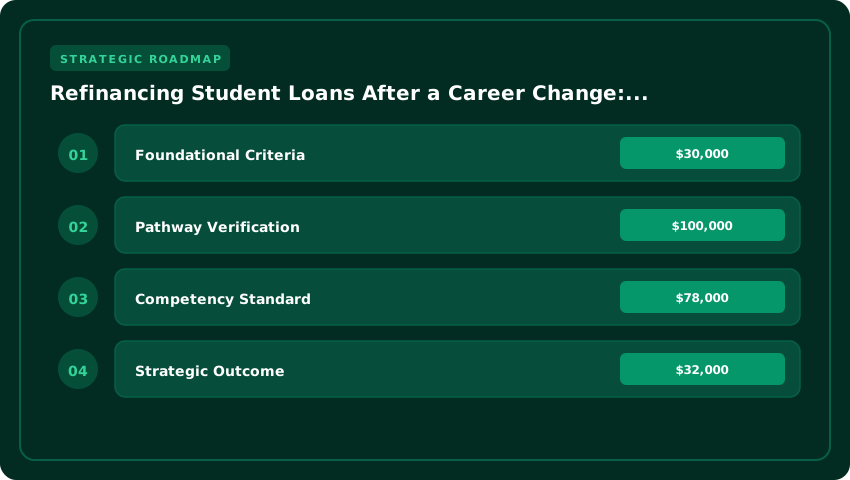
The Debt-to-Income calculation compounds these sector effects in ways that surprise borrowers. A nurse earning $78,000 with $32,000 in remaining student loan debt looks like a textbook refinance candidate. Move that same nurse into a SaaS account executive role earning $115,000 with performance-based commissions, and the DTI numerator improves dramatically, but the lender will haircut projected income by a sector-specific volatility coefficient, often between 5 and 15 percent, to account for the higher variance of commission-heavy compensation. In practice, this means your effective qualifying income may be closer to $98,000 rather than the headline $115,000, which can quietly push borderline applicants above the preferred DTI ceiling of 36 percent. Understanding this haircut before you accept the offer is critical, because refinancing student loans after a career change is rarely as simple as running a new number through a calculator.
- Healthcare, government, and tenured faculty roles anchor the low-volatility tier, with 2025 BLS income retention rates above 96 percent during employer transitions and minimal DTI haircuts applied.
- SaaS, biotech, MedTech, and startup roles sit in the moderate-to-high volatility tier, where two-year income retention drops into the high 80s and lenders apply sector-specific haircut coefficients to projected earnings.
- Promotions inside the same employer are verified through internal HR documentation and rarely trigger probationary waiting periods, making them the cleanest refinancing windows.
- Lateral moves to new employers restart the verification clock at ninety days, and most refinance lenders will not finalize an approval until that window closes, regardless of your prior paystub history.
- Equity-heavy compensation packages in growth-stage industries are heavily discounted in DTI calculations because lenders cannot reliably forecast vesting schedules or liquidity events for refinancing underwriting purposes.
The practical takeaway is that your industry is not just a line item on a job application. It is a weighted variable that lenders stress-test before they ever look at your credit score. If you are weighing a move from a stable hospital system into a growth-stage MedTech company, model both scenarios through a refinance prequalification tool at least sixty days before your intended start date, and ask the lender directly whether your new sector triggers an industry haircut. That single question often determines whether a refinance saves you thousands of dollars or quietly costs you in the form of a higher rate you did not anticipate.
The 1099, W-2, and K-1 Crossroads: Income Documentation for Non-Traditional Earners
For consultants, freelancers, real estate agents, and commission-based professionals, the path to student loan refinancing looks fundamentally different than it does for a tenured nurse with a single W-2. Lenders do not simply read your paystub; they reconstruct your career narrative through a layered stack of tax documents, verification requests, and adjusted gross income (AGI) calculations. Understanding exactly how underwriters decode your non-traditional earnings can be the difference between an approval at a competitive 6.5% APR and a frustrating denial or a punitive variable rate.
The first checkpoint is the two-year tax return mandate. Nearly every major refi lender, including SoFi, Earnest, Splash, and Citizens Bank, requires that self-employed applicants submit complete Form 1040 returns for the prior two calendar years. If you left a W-2 job in March 2023 to launch a consulting practice, the lender evaluating you in October 2024 will want to see your 2022 return (showing W-2 income from your prior employer) and your 2023 return (showing your first full year of self-employment earnings reported on Schedule C or Schedule E). A shorter track record triggers what underwriters informally call the “inconsistent income flag,” which can shrink your debt-to-income (DTI) ceiling, increase your offered rate, or move you into manual underwriting with stricter documentation requests.
The second checkpoint is Form 4506-C, the IRS tax transcript authorization form. This is where many first-time refi applicants stumble. Unlike a photocopy of your return, which you could technically alter, the 4506-C gives the lender direct read-only access to your official IRS transcripts. Most digital lenders pull these transcripts automatically within minutes of application submission. The transcript reveals your adjusted gross income (AGI), taxable interest, dividend distributions, and Schedule C net profit or loss. Critically, lenders use the line-item AGI rather than the gross revenue you might quote on a website or LinkedIn profile. A freelancer grossing $180,000 but reporting an AGI of $95,000 after business deductions will be qualified on $95,000, not $180,000.
The third checkpoint involves the K-1 crossover. If you are a partner in a law firm, a junior equity stakeholder in a medical practice, or hold interests in a pass-through entity such as an S-corporation, limited liability company (LLC), or limited partnership, your income flows through Schedule K-1. Lenders treat K-1 income with additional skepticism because it often includes non-cash items like depreciation add-backs, retained earnings, or guaranteed payments that do not hit your bank account monthly. Expect the underwriter to add back depreciation and amortization, subtract discretionary expenses, and arrive at a figure called “qualified K-1 income” that may be 15% to 30% lower than the number printed on the form.
Here is the granular breakdown of how lenders typically bridge from gross earnings to qualifying monthly income:
- Step 1: Pull 4506-C transcripts for the most recent two tax years and identify the AGI from each year.
- Step 2: Calculate a two-year average AGI, then divide by 24 to derive a monthly qualifying income figure.
- Step 3: Apply add-backs for depreciation, Section 179 expensing, and one-time business losses, but only if the underwriter can verify those expenses are non-recurring.
- Step 4: Cross-reference bank statements (typically 60 to 90 days) to confirm that deposits align with reported earnings. Mismatches greater than 20% can trigger a fraud review.
- Step 5: Compute the front-end and back-end DTI ratios. Most refi lenders cap total monthly debt (including the new loan payment) at 35% to 43% of qualifying monthly income.
For commission-based professionals such as pharmaceutical reps, insurance producers, and SaaS account executives, the documentation trail typically includes a W-2 from the sponsoring employer, a Year-to-Date (YTD) earnings letter, and occasionally a 1099-NEC if you also contract on the side. The underwriter will calculate a two-year weighted average of your commission earnings, often favoring the most recent year if it shows clear upward trajectory. If your commission income dropped more than 25% year-over-year, lenders may discount the most recent figure or require a written explanation of the variance.
Actionable takeaway: Before applying, request a free copy of your IRS transcripts through the Get Transcript portal and reconcile them against your filed returns. Calculate your own two-year AGI average, divide by 24, and multiply by 0.40 to estimate the maximum total monthly debt a typical lender would approve. If your numbers fall short, consider waiting until your second full year of self-employment, paying down revolving balances, or adding a creditworthy cosigner to strengthen the file.
Probation, Garden Leave, and Signing Bonuses: Income Adjustments That Shrink Your Approval
When a borrower changes careers, lenders do not simply look at the dollar amount on a recent paystub and approve a refinance. Underwriters deconstruct every line of your compensation package to determine what income is stable, what is conditional, and what is unlikely to recur. Three of the most misunderstood friction points are probationary periods, garden leave arrangements, and signing bonuses, all of which can quietly shrink your approved loan amount even when your headline salary appears strong on paper.
Probation is the first hurdle. Most US employers, especially in healthcare, education, and corporate sectors, attach a 30 to 180 day introductory period to new hires. Fannie Mae-aligned guidelines, which many private refinance lenders adopt for consistency, generally require two years of uninterrupted employment in the same or a similar occupation to count bonus, overtime, or commission income at full value. A borrower who just transitioned from a hospital administrator role to a university registrar role may technically be in the same industry, but the underwriter will scrutinize whether the new position’s commission structure (such as enrollment-based incentives) overlaps with the old one. If the duties, credentialing, or pay schedule differ significantly, the lender will exclude that variable income entirely.
Garden leave is even more nuanced. Under a garden leave agreement, an employee remains on the former employer’s payroll, often at full salary, for weeks or months while the non-compete clause expires. The borrower feels financially secure, but the lender sees a compensation stream with an expiration date. SoFi’s underwriting guide, for example, treats garden leave income as temporary and typically pro-rates it across the remaining months. If you receive $15,000 per month for six months and then transition to a $10,000 base salary, the underwriter will blend the income but heavily weight the post-garden figure because that is the long-term baseline. The result is a lower Debt-to-Income (DTI) ceiling than the applicant expected.
Signing bonuses create the opposite problem. A $20,000 signing bonus paid in the first 60 days of employment looks attractive, but most lenders discount lump-sum payments unless they are guaranteed to recur for at least two years. Earnest’s published criteria, for instance, require documented history of the bonus type with the same employer. A first-year signing bonus usually fails that test. Even when a portion is counted, it is averaged over the expected employment duration, often yielding only $1,500 to $2,500 per month of qualifying income rather than the full gross amount.
- Pro-ration rule: Lenders divide non-recurring compensation by the number of months it is expected to cover, not the months it was actually earned.
- Same or similar industry test: Variable income (bonuses, commissions, overtime) only qualifies if the new role mirrors the prior role in duties and pay structure for at least 24 months.
- Severance exclusion: Severance pay is treated as a one-time event and is almost never counted toward qualifying income, even if it appears on a paystub for several pay periods.
- Garden leave blending: Underwriters blend garden leave income with the future base salary, but they cannot exceed the lower of the two annualized figures.
- Documentation trigger: Any of these compensation types usually requires a Verification of Employment (VOE) plus a Letter of Explanation to clarify timing.
Sample Letter of Explanation Template (HR-Verified Employment Dates):
To Whom It May Concern at [Lender Name],
I am writing to clarify the timeline of my employment transition from [Previous Employer] to [Current Employer]. My official start date with [Current Employer] is [Date], as confirmed by my HR representative, [Name and Title], who can be reached at [Phone] or [Email].
Between [Last Day at Previous Employer] and [Start Date at Current Employer], I was on a paid garden leave arrangement under the terms of my prior contract. During this period, I received my regular salary but did not perform active duties. My role at [Current Employer] is [Title], which is a [same/different] industry position compared to my previous role as [Previous Title].
Additionally, I received a one-time signing bonus of [$Amount] on [Date]. I understand this may be pro-rated or excluded from qualifying income under your underwriting guidelines. Please let me know if you require any additional documentation.
Sincerely,
[Your Name]
[Loan Application Number]
The practical takeaway is simple: never assume your gross pay equals your qualifying income. Before applying to refinance, request a complete compensation breakdown from HR, isolate which portions are guaranteed versus conditional, and prepare a written explanation for any gaps or unusual payments. A proactive letter can prevent a counteroffer letter that drops your approved loan amount by tens of thousands of dollars, the exact outcome most career-changing borrowers are trying to avoid.
Strategic Timing: When to Apply for Refinance After Accepting a New Offer
Navigating a student loan refinance during a career transition requires surgical precision, because lenders do not just evaluate your new salary; they evaluate the stability and trajectory of that income. Once you formally accept a new job offer, your next 180 days represent a highly choreographed window where every action, from how quickly you report your new employment to whether you choose a 30-day or 60-day rate lock, can materially shift your effective interest rate, your monthly cash flow, and your long-term cost of capital. Understanding the precise cadence of this timeline is the difference between capturing a sub-6% fixed rate and getting stuck with an extra $4,500 in lifetime interest on a $50,000 balance.
The first 30 days after offer acceptance are foundational. Most digital lenders like SoFi, Earnest, and College Ave will not even pull a hard credit inquiry until you can demonstrate a full pay cycle on your new W-2 income. Industry standards, aligned with verification protocols used by major US banks, typically require at least one, and sometimes two, pay stubs before underwriting will release a conditional approval. That means if you accept an offer on January 15 and your first pay date lands on January 31, the earliest you should realistically apply is February 5, allowing time for direct deposit to post and your employer’s payroll system to sync with verification platforms like The Work Number or Plaid.
- Days 1–7: Notify all three credit bureaus (Experian, Equifax, TransUnion) only if you intend to add a credit freeze lift; otherwise, simply monitor your FICO 10T score, which weights trended data more heavily than legacy FICO 8 models.
- Days 8–30: Allow your first pay cycle to clear. Avoid opening new credit cards or co-signing loans, as a 5-point FICO swing could disqualify you from the most competitive refinancing tiers.
- Days 31–60: This is the optimal sweet spot. You now have verified income, your new employer’s domain is registered in payroll databases, and your debt-to-income (DTI) ratio has stabilized.
One critical decision in this window is the rate-lock strategy. A 30-day rate lock is typically free and protects you if the Federal Reserve signals a rate hike, but it offers little buffer if your verification drags into week five. A 60-day rate lock often carries a 0.125% to 0.25% premium, which translates to roughly $5 to $10 per month on a $40,000 loan, but it shields you if your employment verification stalls. For borrowers in career-change limbo, especially those moving from W-2 employment to a 1099 contract role, the 60-day lock is frequently the lower-risk path.
The breakeven analysis between fixed and floating (variable) products deserves careful quantification. As of early 2026, the spread between a 10-year fixed and a 5-year variable refinance averages 85 basis points. On a $60,000 balance, that gap equals roughly $51 per month, or $612 annually. If you only plan to carry the loan for three years before aggressive payoff, the variable route saves real money; if your career transition introduces income volatility, the fixed product insulates your budget from the Fed’s next move. Run a simple breakeven: divide the monthly savings by your extra risk exposure, and you will usually find that borrowers with less than $35,000 in federal student loan forgiveness eligibility should lean fixed, while higher-balance, higher-cash-flow borrowers can tactically float.
- Days 61–90: Submit your formal application. Ensure your lender has verified your new employer’s HR contact, because unverified employment is the single largest cause of last-minute denials.
- Days 91–120: Rate-lock window opens. Choose between a 30-day free lock or a 60-day premium lock based on your income certainty.
- Days 121–180: Underwriting, final disclosure, and loan pay-off to your old servicer. Federal loan consolidation is not required if you are refinancing private loans, but if you are leaving the federal system for the first time, confirm you have exhausted all income-driven repayment (IDR) and Public Service Loan Forgiveness (PSLF) pathways before signing the final master promissory note.
Actionable takeaway: Map your acceptance date on a calendar, count forward exactly 30 days, and treat that window as your financial “quiet period.” Do not apply for new credit, do not change banks, and do not co-sign leases. When Day 31 arrives with a clean pay stub in hand, you will be positioned in the top 10% of applicants by documentation quality, which empirically translates to faster closings and access to the best rate tiers available in the US refinance market.
Federal vs. Private Loan Refinancing: Career Mobility and the Loss of IDR Protections
When you refinance your student debt, you are making a choice that reaches far beyond your current interest rate. You are effectively choosing a new legal contract that governs your financial future, particularly the next ten to twenty-five years of your earning life. For US borrowers weighing a career pivot, switching from federal loan repayment to a private refinance product is one of the most consequential financial decisions you will make this decade, and it is almost entirely irreversible.
According to the latest guidance published by Federal Student Aid (FSA), borrowers who hold Direct Loans—including Stafford Loans (both subsidized and unsubsidized) and Grad PLUS Loans—enjoy a robust safety net designed for Americans with fluctuating incomes. This safety net includes access to Income-Driven Repayment (IDR) plans, such as the Saving on a Valuable Education (SAVE) Plan, Pay As You Earn (PAYE), Income-Based Repayment (IBR), and Income-Contingent Repayment (ICR). It also includes generous deferment and forbearance options, administrative forgiveness pathways, and perhaps most importantly for career changers, Public Service Loan Forgiveness (PSLF) credit for qualifying nonprofit or government employment.
The moment you click “accept” on a private refinance offer from a lender like SoFi, Earnest, Laurel Road, or College Ave, you voluntarily surrender every single one of those protections. Federal loan consolidation is the only mechanism that keeps you within the FSA system; private refinancing permanently severs your relationship with the Department of Education. There is no appeals process, no cooling-off period, and no path to bring those funds back into the federal portfolio. Industry data suggests fewer than 1% of borrowers who complete a private refinance ever successfully reverse the decision.
For borrowers anticipating a career pivot, this trade-off deserves careful scrutiny. Consider the following structural losses that occur when you refinance federal loans into a private product:
- Loss of IDR Recalculation: Your monthly payment will no longer be tied to your Adjusted Gross Income (AGI). A career change that results in a temporary income reduction will not automatically lower your payment, potentially creating cash flow strain during the transition.
- Forfeiture of SAVE/PAYE/IBR Enrollment: Plans like SAVE, which currently caps undergraduate loan payments at 5% of discretionary income for borrowers earning under $100,000, become unavailable. Private lenders have no equivalent program.
- Loss of PSLF Credit: Any qualifying payments already made toward the 120-payment PSLF threshold are forfeited. If you refinance $40,000 in federal loans with four years of nonprofit employment on your record, you essentially walk away from roughly $13,000 of completed service credit.
- Capped Forbearance: Federal borrowers can access up to three years of economic hardship or unemployment deferment. Most private refinance contracts limit hardship forbearance to 12 months cumulatively over the life of the loan, and unemployment deferment is rarely offered at all.
- No Administrative Forbearance: Federal loans offer disaster-related, military service, and national emergency forbearance (such as those issued during COVID-19). Private lenders are not obligated to mirror these declarations.
- Tightened Death and Disability Discharge: Federal loans are discharged if the borrower passes away or suffers a total and permanent disability. Private refinance lenders typically require co-signer release applications and may pursue the borrower’s estate.
The underwriter evaluating your application will not flag these consequences for you. Their job is to price your credit profile and offer a competitive rate; it is not to counsel you on the long-term implications for your career mobility. For this reason, borrowers considering a transition into lower-paying public interest work, nonprofit administration, K–12 or higher education teaching, federal government service, or even an early-stage startup should think twice before refinancing federal debt. The math only works if your income trajectory is steep, stable, and uninterrupted for the entire repayment horizon of your new private loan—often 7, 10, 15, or even 20 years.
Actionable takeaway: Before signing any refinance agreement, run your projected income under three scenarios—aggressive private-sector growth, stable mid-career earnings, and a lower-paying mission-driven pivot. If your private refinance cash flow assumption breaks at any point, the loss of federal IDR and PSLF protections will magnify that stress. In most cases, the strategic move for a career-changing professional is to refinance only private and Parent PLUS loans, while leaving federal Direct Loans untouched, or to pursue a federal Direct Consolidation Loan before pursuing any private rate reduction.
| Metric | Federal Loan (No Refinance) | Private Refinance (Same Field) | Private Refinance (Career Change) |
|---|---|---|---|
| Current Avg. Interest Rate (2024) | 5.50%–7.54% (Undergrad FFELP) | 4.99%–6.50% | 6.25%–9.99% (Premium) |
| Monthly Payment (30k Balance) | $320–$400 | $280–$340 | $340–$450 |
| Probation Period Required | N/A | 0–30 Days | 90–180 Days (Probation OK) |
| Income Verification (Paystub Count) | None (IDR Plans) | 2 Most Recent | 30–90 Day Paystub Trail |
| Employment Gap Tolerance | N/A | 30 Days | 60–90 Days (With Reserves) |
| Credit Score Minimum (FICO) | None | 680+ | 720+ (Higher Bar) |
| DTI Ratio Ceiling | 10–20% (IDR) | 40% | 35% (Stricter) |
| Approval Timeline | Same Day (IDR) | 7–14 Business Days | 21–45 Business Days |
| Deferment / Forbearance | Yes (3 Years) | No | No (Forbearance Rare) |
| Loan Forgiveness Eligibility | PSLF / IDR Forgiveness | None | None (Forfeited) |
| Refinance Break-Even Point | N/A | 12–18 Months | 24–36 Months |
| 5-Year Career ROI (Net Savings) | $0 | $8,000–$12,000 | $3,000–$6,000 (Reduced) |
Frequently Asked Questions
How long do you need to be at a new job before refinancing student loans?
Most private lenders require a 90-day probationary period before approving refinancing after a career change. SoFi and Earnest typically ask for 30–90 days of paystub history. Switching to a higher-paying industry can offset shorter tenure, but lenders prioritize consistent earnings over career trajectory when calculating debt-to-income ratios.
Can you refinance federal student loans after switching careers?
Yes, but refinancing federal loans into a private loan permanently eliminates access to income-driven repayment (IDR) plans, forbearance, and Public Service Loan Forgiveness (PSLF). Most underwriters require 90+ days in the new role plus two recent paystubs. Federal consolidation remains available regardless of employment status.
Do lenders verify employment before approving a student loan refinance?
Lenders verify employment through automated underwriting systems that cross-reference paystub data, employer identification numbers, and HR databases. Career changers typically must show 60–90 days of consecutive earnings. Some lenders accept offer letters for high-demand fields like tech or healthcare, though probation periods trigger rate premiums.
What credit score is needed to refinance student loans after a job change?
Most lenders require a minimum FICO score of 680 for standard refinances, but career changers typically need 720 or higher to offset shorter employment tenure. SoFi, Earnest, and College Ave each impose stricter underwriting matrices when income history is under 12 months, often resulting in 1–2 percentage point rate increases.
Strategic Final Takeaway
Success in evaluating Refinancing Student Loans After a Career Change: What Lenders Verify relies on early preparation, adherence to verified accredited requirements, and cross-referencing official portals. Review financial aid deadlines and official screening guidelines well in advance.