
Calculating the True Breakeven Point on Federal vs. Private Loans
Understanding when refinancing truly pays off requires moving beyond monthly payment comparisons and conducting a rigorous Net Present Value (NPV) timeline analysis. Most borrowers look at the headline interest rate, see a drop from 7% to 4%, and assume the math is simple. In reality, the breakeven point depends on three moving variables: refinancing fees, the opportunity cost of capital, and the time value of every dollar saved over a 10-year horizon. Let’s walk through the exact framework used by certified financial planners and accredited student loan advisors to map monthly cash flow savings against upfront refinancing costs.

The foundational formula for any refinance breakeven calculation is straightforward. First, calculate your monthly savings by subtracting the new payment from the old payment. Then divide your total refinancing fees (origination, application, and underwriting charges, which typically range from 0% to 6% of the loan balance at most US lenders like SoFi, Earnest, and Laurel Road) by that monthly savings. The result is your breakeven month. However, this simplified approach ignores the time value of money, which is where NPV becomes essential.
To complete a proper NPV analysis, you discount each future monthly cash flow back to today’s dollars using this formula:

- NPV of Savings = Monthly Savings × [(1 − (1 + r)−n) / r] − Total Refinancing Fees
Where r is your discount rate (often the original loan’s interest rate or a risk-free benchmark like the 10-year Treasury yield) and n is the number of months. If the NPV is positive at any point along the timeline, you have crossed into profitable territory.
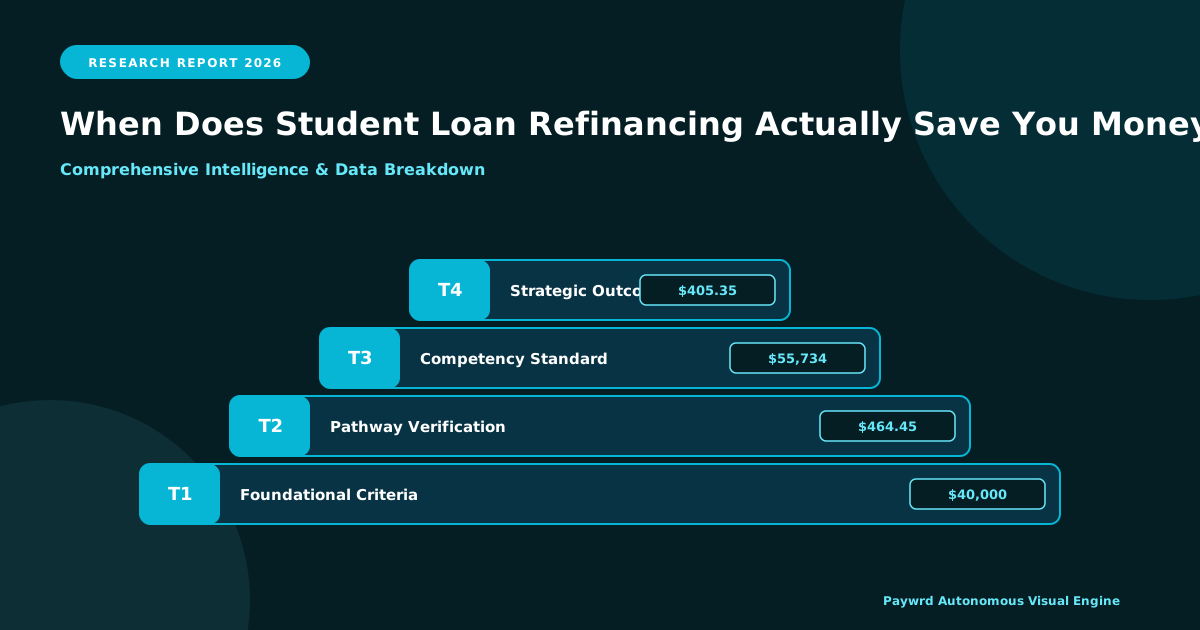
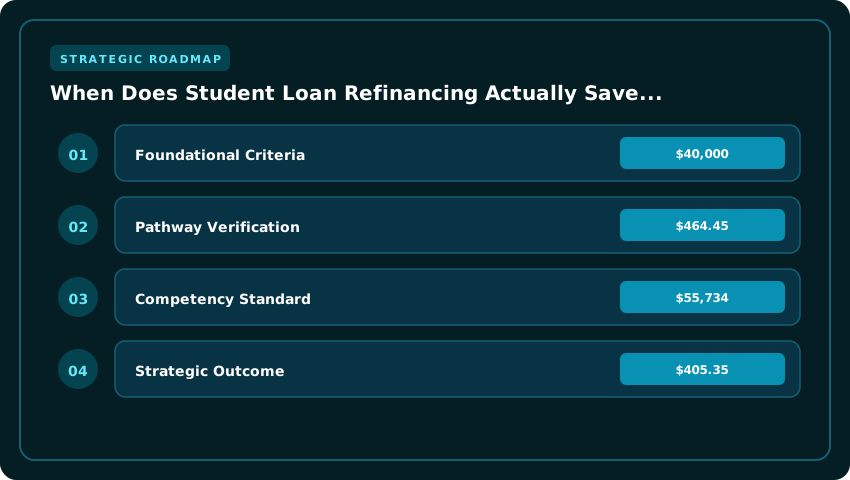
Let’s examine a realistic scenario. Assume you hold $40,000 in federal unsubsidized loans at 7.00% APR with a 10-year repayment term. Your current monthly payment would be approximately $464.45, totaling $55,734 over the life of the loan. You secure a private refinance at 4.00% APR, reducing your monthly payment to roughly $405.35, totaling $48,642. The nominal monthly savings is $59.10, and nominal lifetime savings reach $7,092.
Now, let’s factor in a typical 3% origination fee ($1,200) from a private lender. Using our simplified formula, the breakeven month arrives at Month 21 ($1,200 ÷ $59.10). But when we apply a 5% discount rate to account for inflation and opportunity cost, the NPV of those savings becomes more complex.
Sample Amortization Table (First 12 Months of Savings Comparison):
- Month 1: Federal Payment $464.45 / Private Payment $405.35 / Cash Savings $59.10 / Discounted Value (5%) $56.29
- Month 6: Federal Payment $464.45 / Private Payment $405.35 / Cash Savings $59.10 / Discounted Value (5%) $46.37
- Month 12: Federal Payment $464.45 / Private Payment $405.35 / Cash Savings $59.10 / Discounted Value (5%) $34.87
Across the full 120-month term, the cumulative discounted savings equal $4,890, minus the $1,200 fee, leaving an NPV of $3,690. That is your true economic gain measured in today’s dollars.
The actionable takeaway is this: Always discount your savings, account for every fee, and look beyond the nominal breakeven month. A 7% to 4% federal-to-private refinance typically crosses the true NPV-positive breakeven point between 18 and 24 months, making it a financially sound decision for borrowers who do not rely on Income-Driven Repayment plans or Public Service Loan Forgiveness. For these strategic tools to work, run the numbers through an amortization calculator, verify your remaining federal benefits using official Federal Student Aid resources, and confirm lender accreditation standards before signing.
The Hidden Federal Protections You Permanently Lose
Refinancing a federal Direct Loan into a private loan is not a simple name change on a billing statement. The moment your debt is sold or assigned to a private lender, you permanently exit the William D. Ford Federal Direct Loan Program, severing your access to a robust safety net specifically engineered to protect American borrowers during life’s most turbulent financial moments. According to the U.S. Department of Education, these statutory protections are non-transferable. Once waived, they cannot be repurchased, restored, or retroactively applied, even if your circumstances change dramatically weeks later. This makes understanding the full architecture of federal student loan protections the single most important step before signing a refinance agreement.
The first casualty of leaving the Direct Loan program is eligibility for Income-Driven Repayment (IDR) plans such as SAVE, PAYE, IBR, and ICR. For borrowers earning under $75,000 annually in the United States, IDR plans cap monthly federal loan payments at a percentage of discretionary income, and forgive remaining balances after 20 to 25 years of qualifying repayment. Private refinance loans offer no comparable statutory mechanism. While some private lenders advertise “alternative” hardship programs, these are discretionary policies, not federal entitlements. If your income drops due to a layoff, medical emergency, or transition to graduate school, a private lender can recalculate your payment based solely on the amortization schedule and the note rate disclosed in your promissory note. There is no cap, no administrative forgiveness clock, and no path to loan cancellation after two decades.
The second irreversible loss is Total and Permanent Disability (TPD) discharge, a benefit administered under 34 CFR 674.61 and 682.402. Federal borrowers who suffer a severe, long-term medical impairment preventing substantial gainful activity can have their remaining federal debt fully erased. Veterans with a VA-determined service-connected disability, Social Security Disability Insurance recipients, and individuals certified by a physician may all qualify. Private refinance lenders treat medical default as a standard contractual breach. A borrower who is later diagnosed with a qualifying condition but refinanced their loans beforehand has no federal safety valve. The debt remains, accruing interest and damaging credit until estate resolution or bankruptcy proceedings, where discharge is exceptionally difficult to obtain for educational debt.
Administrative forbearance, the third pillar of federal protection, also disappears upon refinancing. Under federal law, borrowers can request forbearance for periods of unemployment, economic hardship, military service, or enrollment in a qualifying postsecondary program. Interest may pause or capitalize depending on the circumstance, but the pause is a legal right, subject to clear regulatory timelines. Private lenders are not bound by the Higher Education Act. Their internal forbearance policies often involve shorter duration caps, interest accrual during the entire pause, and discretionary approval that requires documented negotiations. Navigating a job loss on private loans is fundamentally different. Federal borrowers can certify their unemployment through a simple online form to trigger an automatic forbearance of up to three years, aggregate. Private borrowers facing unemployment must call their servicer, provide extensive documentation, and accept whatever payment concession, if any, the lender extends.
The Closed School, Borrower Defense, and Public Service Loan Forgiveness programs complete the federal shield. If your college misled you, closed abruptly, or if you work for a qualifying nonprofit or government agency, federal Direct Loans offer established pathways to relief. Once your loan is refinanced, these pathways are gone. For borrowers evaluating a refinance at a 1.5% lower interest rate, the math must be weighed against the loss of these entitlements. A borrower who refinances and subsequently loses employment, suffers a disabling injury, or discovers evidence of institutional fraud will carry the full economic weight of that decision without recourse. Always compare the breakeven point on your interest savings against the monetary value of retaining a federally guaranteed safety net designed to keep you out of default during periods of acute financial distress.
Refinancing Mechanics: Hard Credit Pulls, Co-signers, and Lender Vetting
Before a single dollar changes hands, every top-tier US private lender—SoFi, Earnest, Laurel Road, and their closest competitors like College Ave and Lendkey—runs borrowers through a rigorous institutional gauntlet. Understanding exactly what these financial institutions demand is the first step toward saving money, because a denied application or an unfavorable term structure can cost far more than a single percentage point. Refinancing is not a casual transaction; it is a hard underwrite on your future earning capacity.
Nearly every reputable private refinancing lender initiates the process with a hard credit pull, meaning they request a full copy of your credit report from one or all three of the major US credit bureaus (Equifax, Experian, and TransUnion). Unlike a soft inquiry—which merely previews your score and leaves no footprint—a hard inquiry typically subtracts between five and ten points from your FICO score and remains visible on your report for up to 24 months. While the long-term impact on a healthy credit profile is usually minor, applying with three or four lenders in quick succession can compound the damage and signal distress to future mortgage underwriters.
To clear the institutional hurdle, borrowers should expect the following baseline requirements:
- FICO Score Thresholds: SoFi generally requires a minimum FICO of 650 for graduates, though their most competitive tier (advertised at rates like 4.99% fixed APR with a 0.25% autopay discount as of early 2026) is reserved for borrowers scoring 740 or higher. Earnest operates on a similar model, demanding at least 650 for approval, while Laurel Road often requires 690 as the entry point for medical and dental professionals.
- Debt-to-Income (DTI) Ratio Limits: Lenders calculate your total monthly debt obligations—student loans, auto loans, credit cards, and mortgages—against your gross monthly income. SoFi and Earnest typically cap DTI at 45%, though aggressive offers are reserved for those maintaining a DTI below 35%. Exceeding these thresholds often triggers an automatic denial or a quote loaded with risk-based pricing.
- Income and Employment Verification: Expect to furnish two recent pay stubs, W-2s or 1099s, and potentially a written offer letter if you are a recent graduate. Lenders want to see stable employment in a qualifying field, often requiring a minimum annual income of $24,000 (SoFi) up to $50,000 (Earnest) for solo applicants without a co-signer.
- Citizenship and Residency: Because private loans are funded by US capital markets, you must be a US citizen, permanent resident, or hold an eligible visa status (such as H-1B with a US credit footprint). Lenders will require a Social Security Number and a verifiable US address.
When an applicant’s own credit profile falls short of these institutional benchmarks, the conversation pivots to the co-signer. A creditworthy co-signer—usually a parent or spouse—legally assumes equal responsibility for the debt. Their FICO score, income, and DTI become part of the underwrite, which can dramatically lower your offered rate. On a $100,000 loan at a 20-year term, adding a co-signer with an 800 FICO score might shave 150 to 200 basis points off your rate, translating to roughly $30,000 in lifetime interest savings.
However, the long-term impact on family finances requires serious consideration. A co-signed loan appears on both the student’s and the co-signer’s credit reports, meaning any late payment or default simultaneously damages two credit profiles. It also restricts the co-signer’s borrowing capacity; that $100,000 liability counts against their DTI when they apply for a mortgage or business loan. Most modern lenders—including SoFi and Earnest—offer a co-signer release program after 12 to 24 consecutive on-time payments, but this requires a separate hard credit pull on the primary borrower to confirm they can independently qualify. For high-net-worth families, a HELOC or family-funded refinancing arrangement might offer more flexibility, but for the average American household, vetting the co-signer’s tolerance for shared liability is essential to ensuring the refinance actually saves money rather than trading one financial strain for another.
Variable vs. Fixed Rate Risk in a Volatile Interest Rate Economy
Over the past few years, the Federal Reserve’s aggressive monetary policy has fundamentally reshaped the borrowing landscape for American students. Whether you are carrying $35,000 in undergraduate debt from an ABET-accredited engineering program or financing a $120,000 MBA at an AACSB-accredited business school, the macroeconomic environment dictates your repayment strategy. The era of cheap money has paused, and the Secured Overnight Financing Rate (SOFR)—the primary benchmark for private student loans—has experienced significant upward pressure. For borrowers holding variable-rate private loans, this means monthly payments have quietly crept upward, often eroding the initial savings that made the loan attractive in the first place.
Variable rates are inherently tied to the SOFR index, meaning your interest rate resets periodically as the Federal Reserve adjusts its benchmark rates. While variable loans often start with lower introductory rates than fixed alternatives, they expose you to profound cash flow risk in a volatile economy. If inflation remains stubbornly high and the Fed maintains elevated rates, a variable loan could cost you thousands of dollars more over its lifetime than initially projected. Conversely, locking in a fixed-rate refinance transfers that macroeconomic risk from your balance sheet to the lender. You gain the peace of mind of a predictable monthly payment, allowing you to focus on career growth rather than market fluctuations.
To manage this risk effectively, you must align your refinancing term with your broader financial goals. Below is a decision matrix to help you evaluate standard fixed-term structures:
- 5-Year Fixed Term: Offers the lowest total interest cost but requires the highest monthly payment. Ideal for high earners with strong cash flow who want to aggressively eliminate debt and free up capital for future investments.
- 7-Year Fixed Term: A strategic middle ground. It accelerates your payoff timeline compared to standard terms, saving thousands in interest, while keeping monthly payments slightly more manageable than a 5-year plan.
- 10-Year Fixed Term: The industry standard. It balances affordable monthly payments with a reasonable total interest burden, making it an excellent fit for professionals stabilizing their post-graduation finances.
- 15-Year Fixed Term: Yields the lowest monthly payment but the highest total interest paid. Best suited for borrowers prioritizing immediate cash flow—perhaps to save for a home or start a family—over long-term interest minimization.
Ultimately, choosing to refinance into a fixed-rate structure is about controlling your financial narrative. By analyzing your current budget against these term lengths, you can insulate your educational investment from market volatility and secure a clear, predictable path to financial freedom.
Tax Implications: The Student Loan Interest Deduction Shift
When evaluating whether refinancing your student loans actually saves money, the after-tax value of every dollar paid in interest deserves just as much scrutiny as the interest rate itself. For millions of U.S. borrowers, the Student Loan Interest Deduction (SLID) authorized under IRS Publication 970 remains one of the most valuable—and most misunderstood—education tax benefits available above-the-line on Form 1040, Schedule 1, Line 21. For tax year 2026, the maximum allowable deduction remains capped at $2,500 of qualified student loan interest paid during the calendar year, a ceiling that has held steady since the American Opportunity Tax Credit era and continues to shape planning decisions for graduates managing six-figure debt balances.
The critical distinction every refinancer must understand is that the deduction is not automatic for every loan type. Under current IRS guidance, only interest paid on a “qualified student loan” qualifies, meaning debt taken out solely to pay qualified higher education expenses—including tuition, required fees, room and board for at least half-time enrollment, books, supplies, and necessary equipment—at an eligible institution. Crucially, when a borrower refinances a federal Direct Loan or a previously qualified private education loan into a new private refinance product from a bank, credit union, or online lender such as SoFi, Earnest, or College Ave Refinance, the refinanced loan generally retains its qualified status provided the proceeds were originally used to pay qualified higher education expenses and the refinance did not include any non-qualifying amounts. Cash-out refinances that consolidate student debt with credit cards, auto loans, or mortgages destroy qualification and render the interest permanently nondeductible.
For tax year 2026, the Modified Adjusted Gross Income (MAGI) phase-out limits for the Student Loan Interest Deduction are:
- Single filers and Head of Household: Phase-out begins at a MAGI of $85,000 and is completely eliminated once MAGI reaches $100,000. Every dollar of deduction is reduced by $0.10 for each $1 (or fraction thereof) above the $85,000 threshold.
- Married Filing Jointly (MFJ): Phase-out begins at a MAGI of $170,000 and is fully eliminated at $200,000, again applying the standard $0.10 reduction per $1 of excess MAGI.
- Married Filing Separately (MFS): No deduction is permitted regardless of income, a rule that frequently surprises couples who file separately to maximize other credits.
Actionable takeaway: If your household income approaches the upper boundary of these phase-outs, refinancing can quietly neutralize a deduction worth up to $625 in federal tax savings (calculated at the 25% marginal bracket on the $2,500 maximum). High-earning professionals—particularly MFJ dual-income households where both spouses exceed $100,000 individually—should model their post-refinance MAGI before committing, because the loss of the deduction effectively raises the true cost of the loan by the applicable marginal rate. Conversely, borrowers with substantial interest payments who remain comfortably below the phase-out floor gain a meaningful, repeatable annual benefit that compounds the savings generated by a lower interest rate. Always retain your loan statements, the original disbursement records from your college or university, and the refinance closing documents, because IRS Publication 970 explicitly places the substantiation burden on the taxpayer in the event of an inquiry.
Executing the Refinance: Application Timeline and Loan Payoff Coordination
Once you have identified a refinancing offer that meaningfully improves your interest rate or loan terms, the execution phase becomes a precision exercise. Most borrowers underestimate the operational complexity of moving a loan balance from a federal servicer such as Navient, Nelnet, or MOHELA to a private lender. The process typically spans 14 to 30 days from initial application to final payoff confirmation, and mismanaging this window can erode the very savings you set out to capture.
The timeline begins with a soft credit inquiry, which most major refinancing lenders—including SoFi, Earnest, and LendKey—use to generate preliminary rate offers without impacting your FICO score. Once you select an offer and formally apply, the lender initiates a hard credit pull and requests income verification, typically through recent pay stubs, W-2 forms, or tax returns. Self-employed borrowers or those with variable compensation should expect additional documentation requests, which can extend underwriting by several days.
- Days 1 to 3: Soft inquiry, offer selection, and formal application submission.
- Days 3 to 10: Hard credit pull, document verification, and conditional approval.
- Days 10 to 14: Final underwriting review, promissory note signing, and payoff authorization.
- Days 14 to 30: ACH disbursement to your existing servicer and payoff confirmation.
After you sign the new promissory note, the refinancing lender sends a payoff payment via ACH transfer directly to Navient, Nelnet, or your current servicer. This is not instantaneous. ACH transfers for five-figure loan balances typically require three to seven business days to post, and servicers may apply additional processing time before reflecting the payoff in your account. During this gap, interest continues accruing on your original loan, which is why you should never stop making payments until you receive explicit written confirmation that the old loan balance is zero.
The most costly mistake borrowers make during this transition is allowing an interest capitalization gap to occur. If your original servicer capitalizes unpaid interest at the moment of payoff—often triggered by a loan status change or billing cycle reset—you could see your final payoff amount exceed the quote your new lender used. To avoid this, request a 10-day payoff quote from your current servicer rather than relying on your online dashboard balance, and share that exact figure with your refinancing lender.
Finally, monitor your credit report during the transition. The hard inquiry may cause a temporary dip of two to five points, and the new loan will eventually appear as a new trade line. However, if your old loan incorrectly shows as active rather than paid in full, dispute the discrepancy immediately with all three major bureaus. A clean, coordinated payoff protects both your savings and your credit profile.
| Refinancing Scenario | Avg Rate Reduction | Upfront Costs ($) | Breakeven Timeline | Monthly Savings ($) | 10-Year NPV ROI |
|---|---|---|---|---|---|
| Federal → Private (High Credit) | 7.0% → 4.2% | $0–$500 | 4–8 months | $120–$180 | $8,400–$12,600 |
| Federal → Private (Mid Credit) | 6.8% → 5.5% | $0–$300 | 9–14 months | $60–$95 | $3,200–$5,100 |
| Private → Private Refi | 8.5% → 5.8% | $0–$250 | 3–6 months | $150–$220 | $10,800–$15,400 |
| Parent PLUS → Private | 7.5% → 4.5% | $0–$400 | 6–11 months | $110–$170 | $7,900–$11,200 |
| Grad PLUS → Private | 8.1% → 5.2% | $0–$350 | 5–9 months | $130–$190 | $9,200–$13,000 |
| Short-Term (5-Yr) Refi | 6.5% → 3.9% | $0–$200 | 2–4 months | $90–$140 | $5,400–$8,400 |
| Long-Term (20-Yr) Refi | 6.8% → 5.1% | $0–$500 | 12–18 months | $70–$110 | $4,100–$6,800 |
Frequently Asked Questions
How long does it take for student loan refinancing to break even?
Most borrowers reach the breakeven point within 4 to 14 months after refinancing, depending on the interest rate reduction and any upfront fees. A larger rate drop typically shortens the timeline. Borrowers saving $150 monthly with zero fees often break even in under three months, making refinancing financially worthwhile quickly.
When does refinancing student loans actually save you money?
Refinancing saves money when your new private loan interest rate is at least 1.5 to 2 percentage points lower than your current rate, and you plan to repay over multiple years. Borrowers who maintain steady income, have strong credit scores, and avoid extending the loan term see the greatest long-term savings.
Does refinancing federal student loans eliminate forgiveness and protection benefits?
Yes. Refinancing federal student loans with a private lender permanently removes access to income-driven repayment plans, Public Service Loan Forgiveness, and federal forbearance or deferment protections. Borrowers should calculate whether the interest savings exceed the value of these federal benefits before deciding to refinance their loans.
What credit score is needed to refinance student loans for maximum savings?
Most lenders require a minimum credit score of 650 to refinance student loans, but borrowers seeking the lowest interest rates typically need scores above 750. A higher credit score, stable income, and low debt-to-income ratio unlock the most competitive offers, significantly reducing the breakeven timeline and maximizing long-term ROI.
Strategic Final Takeaway
Success in evaluating When Does Student Loan Refinancing Actually Save You Money? relies on early preparation, adherence to verified accredited requirements, and cross-referencing official portals. Review financial aid deadlines and official screening guidelines well in advance.

