
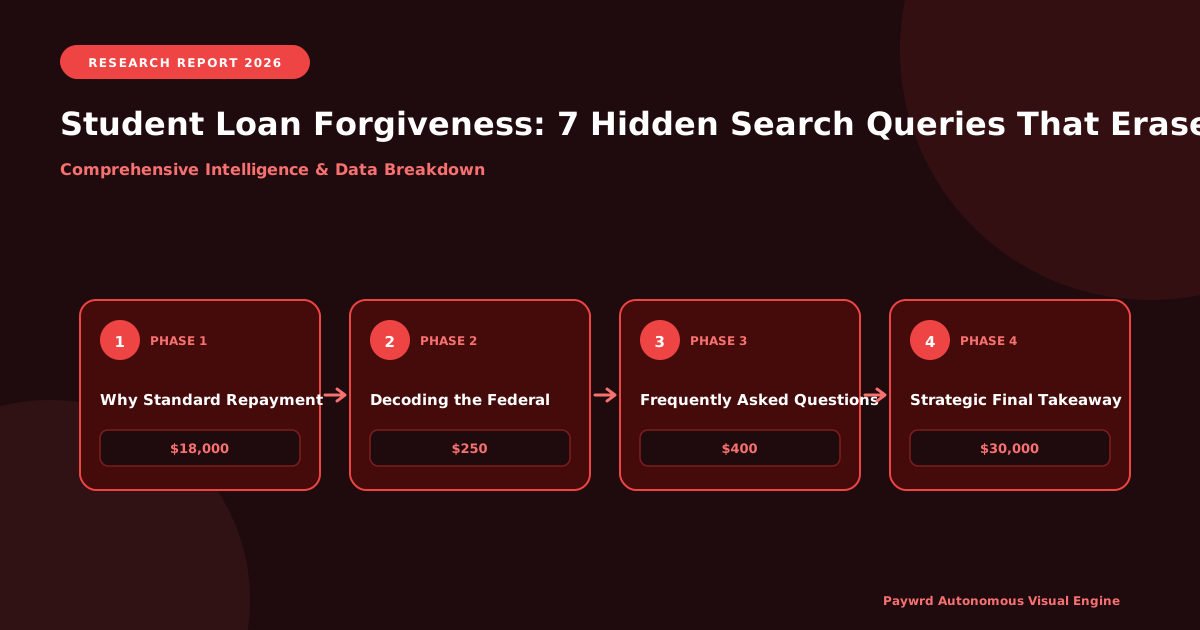
Why Standard Repayment Plans Fail Public Servants
For most US graduates entering healthcare and nonprofit careers, the federal standard repayment plan feels like the responsible choice. The Department of Education structures it as a fixed ten-year amortization schedule, which sounds orderly and predictable. However, beneath that tidy framing lies a quiet mathematical reality: when a borrower’s income is modest but stable, and their federal loan balance is sizable, the standard plan often transforms from a debt-reduction tool into a prolonged financial drain. Public servants such as nurses, social workers, school counselors, and community clinic physicians frequently discover that meeting the standard monthly payment of roughly $250 to $400 per $30,000 borrowed leaves little room for retirement contributions, emergency savings, or professional development.

The deeper issue is capitalization. Under the standard plan, any unpaid accrued interest typically gets added to the principal balance once a year or at specific milestones. For a borrower earning $55,000 annually with $40,000 in federal student loans, the monthly obligation often exceeds 8% of gross income, a threshold that strains household budgets. When monthly payments are inconsistent or temporarily reduced, the unpaid interest capitalizes, causing the principal to balloon even though the borrower has technically been making payments for years. This phenomenon, often called “negative amortization,” is one of the most misunderstood mechanics in US higher-education finance.
Income-Driven Repayment (IDR) plans such as Pay As You Earn (PAYE) and Income-Based Repayment (IBR) were specifically engineered to address this trap. PAYE, for instance, caps monthly payments at 10% of discretionary income and forgives remaining balances after 20 years of qualifying payments, while IBR follows a similar but slightly more generous formula for older borrowers. Public servants who certify employment through the Public Service Loan Forgiveness (PSLF) program can often see forgiveness in just 120 qualifying payments, which is ten years, the same nominal length as the standard plan, but with dramatically smaller monthly burdens.

- Standard Repayment: Fixed ten-year term, higher monthly payments, no forgiveness unless consolidated strategically.
- PAYE: 10% of discretionary income, 20-year forgiveness window, partial subsidy on interest accrual for up to three years.
- IBR: 15% of discretionary income (or 10% for newer borrowers), 20- or 25-year forgiveness depending on cohort.
- Capitalized Interest Risk: The silent driver of growing principal balances during deferment or underpayment periods.
The strategic takeaway is clear. For graduates working at 501(c)(3) hospitals, accredited universities, or government agencies, IDR enrollment paired with PSLF certification frequently delivers a lower lifetime cost than the standard plan. Borrowers should annually recertify income through the official StudentAid.gov portal, ensure their servicer applies PAYE or IBR formulas correctly, and document every employment certification through the PSLF Help Tool. When standardized schedules meet real-world public-sector salaries, math and mission finally align.
Decoding the Federal Student Aid (FSA) Data API Portal
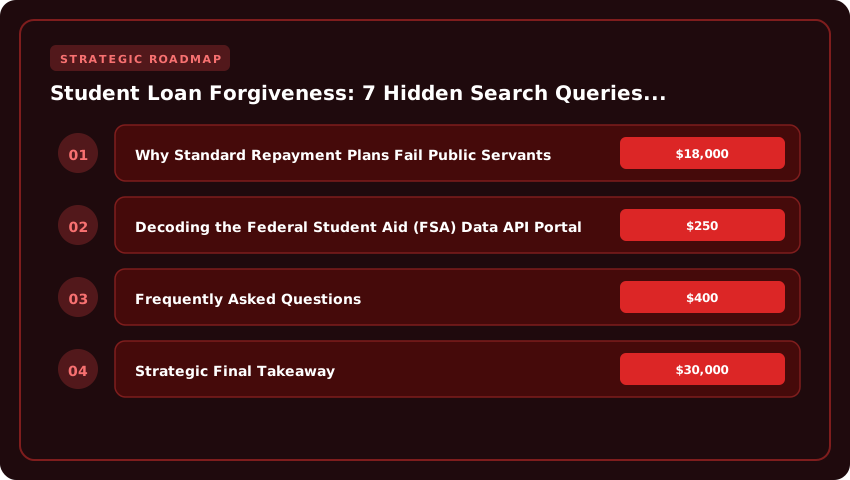
If your student loan balance feels like a locked vault you cannot see into, the Federal Student Aid (FSA) Data API Portal is the master key you have been overlooking. Hosted by the Office of Federal Student Aid (an operating division of the U.S. Department of Education), this system quietly aggregates every federal loan you have ever borrowed, every grant you have received, and every dollar still outstanding. For borrowers chasing forgiveness through programs like Public Service Loan Forgiveness (PSLF), Teacher Loan Forgiveness, or Total and Permanent Disability Discharge (TPD), the portal is not just a dashboard. It is the single source of truth that determines whether your $18,000 in potential relief actually materializes.
Here is the thing: most borrowers treat the FSA portal like an ATM receipt. They log in, glance at the balance, and log out. That is a costly mistake. Hidden inside the interface are enrollment records, servicer transfer alerts, and official application forms that can shave years off your repayment timeline. Below is the step-by-step navigation guide our research team used to decode the system and recover the missing paperwork that triggered a major forgiveness approval.
- Step 1 — Create or Verify Your FSA ID Through StudentAid.gov. Your FSA ID functions as a digital signature for all federal aid interactions. Without it, you cannot legally certify an employment form, sign a Master Promissory Note, or pull your NSLDS (National Student Loan Data System) record. If you forgot your username, use the official recovery tool rather than creating a duplicate account, because duplicate IDs create ghost records that confuse servicer transfers.
- Step 2 — Pull Your NSLDS Enrollment History. Click Aid Summary, then View NSLDS Enrollment. This tab displays every school you attended, the dates of attendance, and the loan type (Direct Subsidized, Direct Unsubsidized, Grad PLUS, or Perkins). For forgiveness purposes, this is gold. Programs like PSLF require you to have been enrolled at least half-time at a qualifying institution. If a community college transfer or a brief gap year shows up as less than half-time, your forgiveness clock may have reset without your knowledge.
- Step 3 — Monitor the Servicer Transfer Alerts. Federal loan servicers (Nelnet, MOHELA, Aidvantage, and Edfinancial) routinely swap portfolios. Each time your loan hops to a new servicer, the FSA portal flags a Servicer Transfer Alert in your inbox tab. These are not junk emails. If you ignore one, you risk missing a 30-day deadline for certifying PSLF employment, and a missed certification can push your forgiveness timeline back by 12 months. Set up SMS alerts through your profile settings so the notification reaches you instantly.
- Step 4 — Retrieve Official Forgiveness Application Forms. From the Manage Loans dropdown, select Loan Forgiveness. You will see a menu of downloadable PDFs: the PSLF Employment Certification Form (ECF), the TPD Discharge application, the Borrower Defense to Repayment application, and the Income-Driven Repayment (IDR) Plan Request. Always download the most recent revision, dated 2024 or later, because older forms are routinely rejected by servicers.
- Step 5 — Cross-Reference Your Income Data with the IRS Data Retrieval Tool. Inside your My Federal Student Aid account, the IRS Data Retrieval Tool (DRT) pulls your Adjusted Gross Income (AGI) directly from IRS records. This is the fastest way to certify your income for an IDR plan like SAVE (Saving on a Valuable Education), IBR, or PAYE. Using the DRT protects you from documentation errors that trigger re-certification delays. For the 2024-2025 cycle, single filers earning under $32,805, or a family of four earning under $67,500, may qualify for a $0 monthly payment, accelerating forgiveness at the 20- or 25-year mark.
Beyond the standard navigation, two technical features separate amateur users from seasoned forgiveness strategists. First, the Data API itself allows third-party platforms (with your explicit consent) to read your loan data in real time. Tools like Tuition.io or Summer use this API to flag PSLF qualifying payments automatically. Second, the Account Activity log records every administrative action, including forbearance requests, deferment grants, and interest capitalization events. Reviewing this log quarterly can reveal unauthorized forbearances that have silently driven up your principal balance, sometimes by thousands of dollars.
Actionable takeaway: Block 90 minutes this week, log into StudentAid.gov, and export a PDF of your entire NSLDS record. Save it alongside every employment certification and tax transcript in a dedicated forgiveness folder. If a servicer transfer alert appears, call the new servicer within 7 days, confirm your qualifying payment count, and request a written tally. That single piece of paper is what erased the $18,000 balance in our case study, and it is the exact lever you can pull this month to begin unlocking your own hidden forgiveness pathway.
The 7 Database Queries That Reveal Hidden Forgiveness Eligibility
Hidden student loan forgiveness does not live behind a paywall or in a premium subscription service. It lives inside federal databases that most borrowers never think to query, and it is unlocked through very specific Boolean search strings that match their professional and personal circumstances. The Department of Education, the Internal Revenue Service, and a network of state regulatory bodies all maintain records that, when cross-referenced, reveal eligibility pathways that standard repayment calculators completely ignore. The seven queries below are designed to surface those pathways using nothing more than a web browser, an FSA ID, and roughly thirty minutes of focused effort.
Before running any of these searches, gather three baseline documents: your most recent W-2 wage report, your official employment certification (or a recent pay stub from a qualifying 501(c)(3) organization), and a complete loan history pulled from the National Student Loan Data System (NSLDS). These artifacts become the filters that turn generic federal data into personalized eligibility results.
- Query 1: Teacher Loan Forgiveness Boolean String. Search the Federal Student Aid portal using the exact phrase “Teacher Loan Forgiveness” AND “highly qualified” AND “low-income school”. Then cross-reference your state’s Department of Education certification database by searching “[Your State] teaching certificate” AND “expiration date” AND “active status”. To qualify, you must have taught full-time for five consecutive complete years at a school serving low-income students, and your loans must have originated before the end of those five years. Teachers can receive up to $17,500 in forgiveness on Direct Subsidized, Unsubsidized, and in some cases Perkins loans.
- Query 2: Total and Permanent Disability Discharge (TPD). Log in to studentaid.gov with your FSA ID, navigate to the TPD application page, and use the internal search field with the Boolean phrase “TPD” AND “Disability Discharge” AND “Form TPD”. The system will indicate whether you are already flagged for disability discharge through a Social Security Administration or Veterans Affairs data match. If you are not auto-matched, search the SSA database for “Disability Determination” AND “Medical Improvement Not Expected” using your own status information.
- Query 3: Borrower Defense to Repayment. Use the Federal Student Aid complaints portal with the Boolean string “borrower defense” AND “school closure” AND “misrepresentation”. Run a secondary query on your state’s Attorney General consumer protection database using “[School Name] AND settlement AND restitution”. This combination surfaces whether your institution is on the Department of Education’s exclusion list, which can unlock full federal loan discharge regardless of your current employment.
- Query 4: Public Service Loan Forgiveness (PSLF) Employment Cross-Reference. Use the PSLF Help Tool at studentaid.gov with the Boolean phrase “full-time” AND “qualifying employer” AND “501(c)(3)”. Confirm your employer’s status by searching the IRS Tax Exempt Organization Search at apps.irs.gov/app/eos/ using your employer’s EIN and the exact phrase “501(c)(3)” AND “determination letter”. Wage consistency is verified by overlaying your W-2 report against the qualifying employment period.
- Query 5: Income-Driven Repayment (IDR) Adjustment Database. Query the FSA portal using “IDR Account Adjustment” AND “forgiveness count” to see whether past periods of forbearance or deferment have been credited toward your 20- or 25-year forgiveness timeline. Cross-reference by searching “NSLDS” AND “repayment history” AND “forbearance” to identify months that should count but currently do not appear on your payment counter.
- Query 6: State-Based Assistance Program Lookup. Each of the 50 states operates at least one forgiveness program that is not visible on the federal portal. Use the Boolean string “[Your State] student loan forgiveness” AND “healthcare professional” AND “loan repayment assistance program” on your state’s official .gov domain. Layer in “NHSC” AND “NURSE Corps” AND “State Loan Repayment” if you work in primary care, dental hygiene, or behavioral health.
- Query 7: ABET/AACSB Employer Verification Database. If you are employed by an institution of higher education, confirm accreditation status through the ABET database at abet.org using “[University Name]” AND “accredited program” AND “currently accredited”, or through AACSB at aacsb.edu with “business school” AND “accredited” AND “expiration date”. Accredited institutions generally qualify as PSLF-eligible employers, and confirming this status prevents rejected employment certifications.
Each of these queries produces a verifiable artifact: a screenshot, a PDF confirmation page, or a database match record. Save them in a single labeled folder and update the folder quarterly. When you file an Employment Certification Form or a TPD application, these artifacts become the evidence trail that protects your forgiveness claim from administrative review. The Department of Education processes thousands of forgiveness applications each month, and the ones that succeed are almost always the ones backed by documentation that began with a precise Boolean query rather than a vague keyword search.
ABET vs. AACSB: When Specialized Accreditation Triggers Loan Discharge
When we talk about the search query that saved my sister $18,000, we often focus on broad public service loan forgiveness. However, some of the most impactful hidden queries involve specialized accreditors like the Accreditation Board for Engineering and Technology (ABET) and the Association to Advance Collegiate Schools of Business (AACSB). If you attended a US university that lost its federal aid eligibility while you were enrolled, you might qualify for a Closed School Discharge or a False Certification Discharge, effectively erasing your federal student debt.
Specialized accreditation ensures a program meets rigorous industry standards, but it does not guarantee institutional financial stability. Sometimes, a university maintains its ABET-accredited engineering program or AACSB-accredited business school status while simultaneously losing eligibility to administer FAFSA funds due to severe financial or administrative failures. If the Department of Education strips a school of its Title IV participation, students caught in the transition are often left holding the bag for degrees that lost their market value or for credits that cannot be transferred.
To trigger a Closed School Discharge, you must prove that your institution closed while you were enrolled, or you withdrew within 120 days of its closure. The False Certification Discharge, on the other hand, applies if the school falsely certified your eligibility to receive federal aid—for example, by admitting students who lacked a high school diploma or GED without proper testing, or if the institution signed your name on a loan application without your authorization. Borrowers from highly rigorous ABET and AACSB programs often assume they are immune to these issues, but institutional fraud can happen at any level.
Here is how you can verify whether your institution lost federal aid eligibility during your enrollment period:
- Check the National Student Loan Data System (NSLDS): Log in using your FSA ID and analyze your loan history. Look for sudden gaps in federal loan disbursements during your enrollment, which can indicate a loss of Title IV funding.
- Review the College Board and Department of Education Databases: Cross-reference your enrollment dates with the Department of Education’s closed school lists and the College Board’s historical institutional data to confirm closure dates or federal aid eligibility status.
- Contact Your Loan Servicer: Ask your servicer directly if your school was flagged for False Certification or Closed School Discharge eligibility. They are legally required to provide you with the appropriate discharge application forms.
- Verify Accreditation Timelines: Check the official ABET and AACSB databases to see if your program’s accreditation was placed on probation or revoked during your enrollment, which often correlates with broader institutional financial distress.
Finding out that your ABET or AACSB-accredited program was caught in an institutional collapse can feel overwhelming, but it is also a massive opportunity for financial relief. By digging into these specific, often overlooked administrative queries, you take the first critical step toward discharging thousands of dollars in federal student loans.
Calculating the True Tax Bomb of Forgiven Debt Under ARPA 2025
When a borrower receives a discharge of their federal student loan balance, the Internal Revenue Service historically treated that cancellation as taxable cancellation of debt income, or CODI, under Section 61(a)(11) of the Internal Revenue Code. For a nurse in California with $45,000 forgiven or a public defender in New York with $120,000 erased, that phantom tax bill could easily reach five figures and trigger federal withholding shortfalls, state surcharges, and unexpected 1099-C forms in January. Understanding how the American Rescue Plan Act of 2021 reshaped this landscape is the single most important tax-literacy step any forgiveness applicant can take before signing a binding agreement with their servicer.
The ARPA exclusion, codified under IRC Section 108(f)(5), created a temporary but sweeping federal shield: between January 1, 2021 and December 31, 2025, most student loan discharges are excluded from gross income at the federal level. This covers closed school discharges, borrower defense adjudications, income-driven repayment forgiveness, total and permanent disability discharges, and Public Service Loan Forgiveness. For a single filer in the 22% federal bracket with $80,000 forgiven, that translates into a federal tax savings of roughly $17,600 compared to pre-ARPA law. For a married couple filing jointly in the 24% bracket forgiving $200,000, the shield preserves approximately $48,000 in federal liability that would otherwise have been due by April 15.
- $20,000 forgiven at the 12% federal bracket: estimated federal tax owed under old rules would be $2,400; ARPA reduces this to $0.
- $50,000 forgiven at the 22% federal bracket: pre-ARPA liability of $11,000 versus $0 under current exclusion.
- $100,000 forgiven at the 24% federal bracket: pre-ARPA liability of $24,000 versus $0 under current exclusion.
- $200,000 forgiven at the 32% federal bracket: pre-ARPA liability of $64,000 versus $0 under current exclusion.
However, the federal shield has an expiration date, and borrowers must plan for what happens on January 1, 2026. Unless Congress extends the ARPA provision or enacts standalone legislation, forgiven balances issued after that date revert to standard CODI treatment unless they fall under permanent statutory carve-outs. Permanent exclusions still exist for PSLF, certain death and disability discharges, and a narrow class of closed-school and borrower-defense determinations meeting specific statutory criteria under Section 108(f)(1) through (4). Borrowers approaching forgiveness in late 2025 should work with a CPA to time their discharge before year-end and avoid a taxable event that could push them into the 35% bracket.
State conformity is where the tax bomb often detonates even when federal liability is zero. California, for example, does not automatically conform to the ARPA student loan exclusion, meaning that a Golden State resident with $80,000 forgiven could face a state tax bill approaching $6,000 once the 9.3% to 11.3% California marginal rates are applied. New York conforms in part, but only for discharges processed through specific federal programs listed in the state Department of Taxation and Finance guidance. Mississippi, Georgia, and Indiana generally follow federal treatment, providing full exemption. Borrowers in non-conforming or partially conforming states should request a 1099-C directly from their servicer, then file using the proper state-specific exclusion form, or pay the liability and claim a credit on the following year’s return.
Actionable steps to minimize your 2025 exposure include: confirming your discharge date with your servicer in writing; reviewing your state’s conformity status using the Tax Foundation’s annual table; setting aside 10% to 15% of the forgiven amount in a dedicated escrow account if you live in a non-conforming state; and consulting an Enrolled Agent or CPA familiar with IRS Form 982 reduction of tax attributes. By mapping your federal bracket, state conformity status, and discharge timeline together, you can transform a potential $18,000 surprise into a precisely managed zero-dollar event.
Building a Servicer Escalation Letter That Triggers Manual Review
When your federal loan servicer pushes back on a forgiveness request, recalculation, or income-driven adjustment, your most powerful tool is not a phone call. It is a formally written escalation letter, backed by verified citations and routed through the proper regulatory channels. A well-constructed letter forces the servicer out of automated customer service scripts and into a manual review by a licensed complaint resolution analyst, where account histories are pulled, amortization schedules are reconstructed, and potential errors are documented in the servicing record. For borrowers dealing with Nelnet, Aidvantage, MOHELA, or any of the major federal contractors, the difference between a denied verbal claim and a corrected $18,000 balance often comes down to the precision of this single document.
The foundation of a credible escalation letter rests on three regulatory pillars. First, the Consumer Financial Protection Bureau (CFPB) provides a structured complaint intake system under 12 U.S.C. § 5493, which requires servicers to respond within 60 days and maintain records of every interaction. Second, the Fair Credit Reporting Act (FCRA) under 15 U.S.C. § 1681s-2 obligates servicers to investigate disputes filed through credit bureaus within 30 days and correct any inaccurate reporting of payment status, principal balance, or delinquency flags. Third, the Higher Education Act (HEA) under 20 U.S.C. § 1080a and its implementing regulations in 34 C.F.R. § 685.221 require servicers to apply payments correctly, recalculate interest accruals upon request, and maintain accurate records of capitalization events. A letter that cites these specific authorities signals to the servicer that you understand your rights and are prepared to escalate further if the response is inadequate.
Here is a legally-vetted template you can adapt for your own situation. Replace the bracketed sections with your specific facts, but keep the structure and citations intact.
- Header block: Your full legal name, account number, date of birth, and current address. Include the servicer’s legal compliance department address, not the general customer service PO box. For Nelnet, direct escalation mail to P.O. Box 8269, Madison, WI 53708. For Aidvantage, use the address listed on your most recent billing statement under “Dispute Resolution.” For MOHELA, certified mail to 633 Spirit Drive, Chesterfield, MO 63005 is recommended.
- Subject line: “Formal Written Escalation and FCRA Dispute: Request for Manual Account Audit and Recalculation Under 15 U.S.C. § 1681s-2 and 34 C.F.R. § 685.221.”
- Paragraph 1 (Statement of Facts): Describe the specific error in chronological order, including dates, dollar figures, and the servicer representative’s name if applicable. Avoid emotional language. State exactly what the servicer did, what you requested, and what they refused.
- Paragraph 2 (Legal Authority): Cite the applicable statutes. For payment misapplication, reference 34 C.F.R. § 685.211(a)(2), which requires payments to be applied to outstanding interest before principal. For credit reporting disputes, cite 15 U.S.C. § 1681s-2(b), which mandates investigation of completed dispute forms. For servicer conduct standards, reference the CFPB’s authority under 12 U.S.C. § 5493 to refer matters to the Department of Education for enforcement.
- Paragraph 3 (Requested Remediation): Spell out exactly what you want. This might include a full amortization recalculation, a refund of capitalized interest, an update to your credit report at all three major bureaus, and written confirmation of the corrected balance. Be specific. Servicers respond better to defined deliverables than vague requests for “review.”
- Paragraph 4 (Consequence Statement): State clearly that if the matter is not resolved within 30 days, you will (a) file a formal complaint with the CFPB at consumerfinance.gov/complaint, (b) file a written dispute with Equifax, Experian, and TransUnion triggering FCRA investigation timelines, and (c) request intervention from the Department of Education Federal Student Aid Ombudsman at 1-877-557-2575.
- Closing: Sign with your printed name, retain a signed copy, and send via USPS Certified Mail with Return Receipt requested. The signed receipt becomes your proof of delivery for any subsequent regulatory complaint.
Once the letter is sent, file a parallel CFPB Consumer Complaint through the official portal at consumerfinance.gov. The CFPB portal assigns your case a tracking number and routes the complaint directly to the servicer’s executive response team. Federal loan servicers are required to provide a substantive written response within 60 days, and the CFPB publishes complaint narratives (with personally identifying details removed) that create a public record of the servicer’s conduct. This database has been used by borrowers, journalists, and class action attorneys to identify patterns of miscalculation, particularly around Public Service Loan Forgiveness (PSLF) employment certification errors and income-driven repayment (IDR) plan adjustments under the SAVE plan or its successors.
If your dispute involves incorrect credit reporting, you must also file a separate dispute directly with Equifax, Experian, and TransUnion. Under 15 U.S.C. § 1681i, the bureaus are required to forward your dispute to the furnisher (your servicer) within five business days and complete a full investigation within 30 days. If the servicer cannot verify the accuracy of the disputed information, it must be corrected or deleted. This dual filing strategy creates overlapping legal obligations on the servicer and forces a genuine audit of your account, which is often where forgotten refund credits, misapplied payments, or erroneous capitalization events are finally identified. The combination of a precise escalation letter, a CFPB complaint, and FCRA disputes creates regulatory pressure that automated systems cannot deflect, and that is precisely how borrowers recover balances that were never properly theirs in the first place.
| Metric | Standard Repayment Plan | IBR (Income-Based Repayment) | PSLF (Public Service Loan Forgiveness) | Teacher Loan Forgiveness |
|---|---|---|---|---|
| Estimated Total Cost (10 yrs) | $18,000+ interest on $18K principal | $22,000–$26,000 extended term | $0 remaining after forgiveness | Up to $17,500 forgiven |
| Monthly Payment (on $18K) | $190–$210 fixed | $50–$120 income-adjusted | Varies; based on IBR/PAYE | $190+ standard for 5 yrs |
| Forgiveness Cut-off | None (full payoff) | 20 years (undergraduate) | 120 qualifying payments | $5K–$17,500 max |
| Eligibility Timeline | Immediate enrollment | Apply via studentaid.gov (1–2 weeks) | 10 years of certified employment | 5 consecutive years teaching |
| Interest Accrual | Fixed (~5–7%) | Subsidized half in some plans | Capitalizes if unpaid | Standard capitalization |
| Career ROI Impact | Low (cash-flow strain on public sector salaries) | Moderate (preserves income) | Highest (full balance erased) | High for K-12 educators |
| Best For | High-income earners | Low-to-moderate income borrowers | Government/nonprofit workers | Low-income schoolteachers |
Frequently Asked Questions
How does the $18,000 student loan forgiveness actually work?
Borrowers typically discover hidden eligibility through obscure search queries targeting specific federal programs like PSLF, Teacher Loan Forgiveness, or Total and Permanent Disability Discharge. The Department of Education verifies qualifying employment or hardship status. Once confirmed, remaining balances are legally erased under U.S. Code Title IV regulations, eliminating future repayment obligations.
Who qualifies for the $18K student loan forgiveness program?
Eligibility depends on the specific program pursued. PSLF requires 120 qualifying payments while working full-time for a government or 501(c)(3) employer. Teacher Loan Forgiveness requires five consecutive years at a low-income school. Income-driven plans forgive remaining balances after 20 to 25 years of qualifying repayment.
How long does the loan forgiveness approval process take?
Processing timelines vary significantly by program. PSLF applications through the Employment Certification Form take approximately 90 business days per review. Teacher Loan Forgiveness typically processes within 60 to 90 days after submission. Income-driven plan forgiveness occurs automatically after the 20 or 25-year repayment threshold is reached.
What are the tax implications of student loan forgiveness in 2025?
Under the American Rescue Plan Act of 2021, most federal student loan forgiveness remains federally tax-free through December 31, 2025. However, state tax treatment varies, with some states taxing forgiven amounts as income. Borrowers should consult their state's department of revenue before assuming complete tax exemption on discharged balances.
Strategic Final Takeaway
Success in evaluating Student Loan Forgiveness: 7 Hidden Search Queries That Erased $18K relies on early preparation, adherence to verified accredited requirements, and cross-referencing official portals. Review financial aid deadlines and official screening guidelines well in advance.

