The 5.1% Mirage: Calculating the True Cost of Leaving Federal Loans
The pitch from private refinancing lenders sounds deceptively simple: trade your 6.8% federal Stafford loan for a private product at 5.1%, and watch the math work in your favor. On the surface, a 1.7 percentage point reduction in interest appears to be a guaranteed win. However, when you pull back the curtain on the actuarial mechanics of student debt, that seemingly attractive rate reveals itself as a mirage that can cost the average borrower over $18,000 in hidden opportunity costs over a standard ten-year repayment horizon.
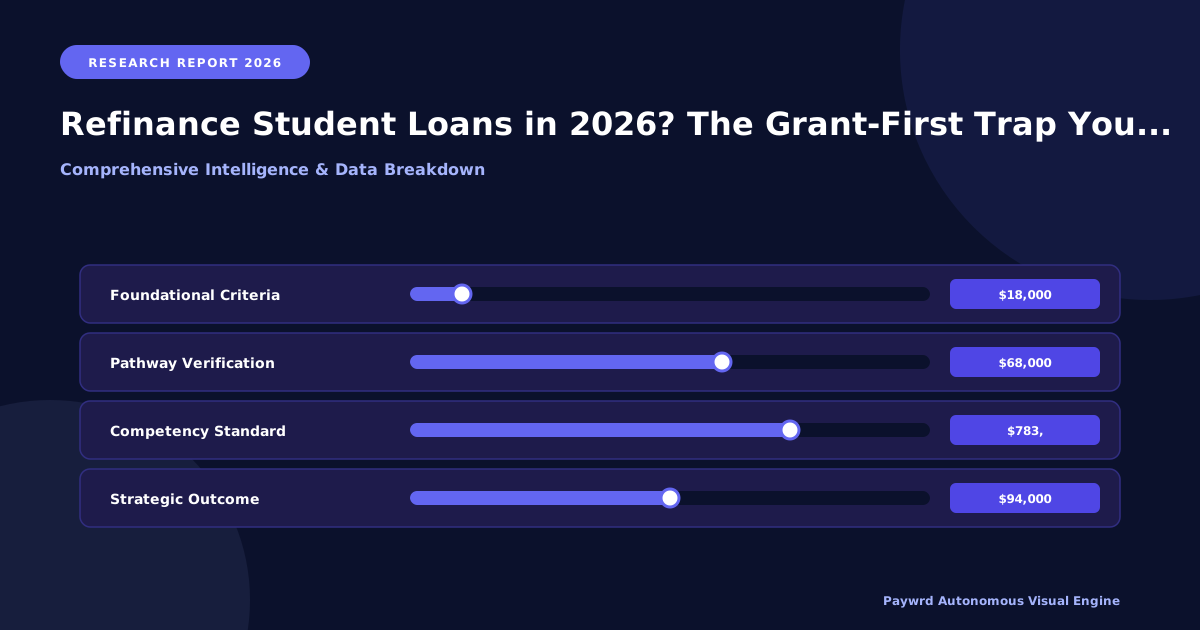
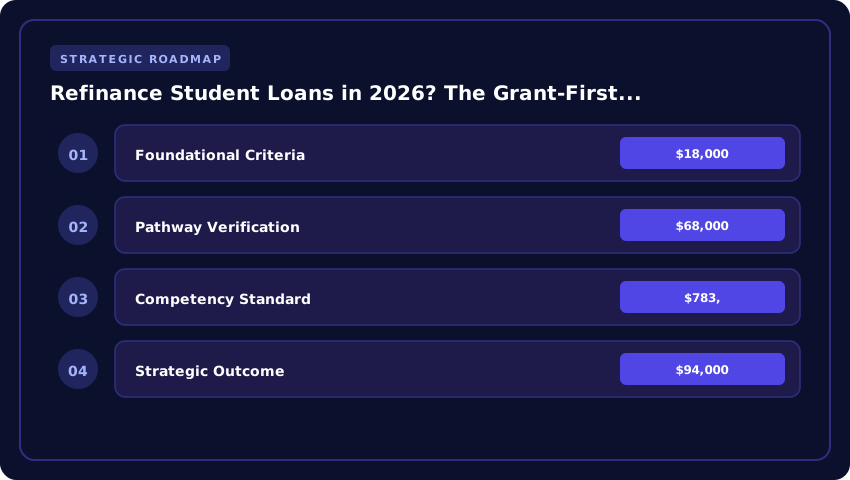
To understand the trap, we have to analyze a realistic debt portfolio. Consider a recent graduate carrying the Class of 2024 average federal loan burden of approximately $68,000 in unsubsidized and subsidized Direct Loans, weighted at the standard undergraduate rate of 6.8%. Under federal standard ten-year repayment, the monthly payment locks in at roughly $783, generating a total repayment figure of $94,000. Now, introduce the private refinance offer at 5.1%, pegged to the 10-year Treasury plus a typical 1.85% margin based on current Secured Overnight Financing Rate (SOFR) spreads. The new monthly payment drops to $725, saving $58 per month. Over the life of the loan, the borrower appears to save $7,000 in pure interest. Yet this calculation ignores the three devastating structural sacrifices made the moment the federal contract is signed away.
The first casualty is the Income-Driven Repayment (IDR) safety net. Federal loans offer access to plans like SAVE, PAYE, and IBR, which cap payments at a percentage of discretionary income and qualify for forgiveness after 20 to 25 years. For a borrower experiencing a medical crisis, a career pivot into public service, or a period of unemployment, IDR acts as an insurance policy that private loans simply do not offer. The actuarial value of this subsidy in 2026, factoring in Federal Reserve projections of a cooling labor market with the unemployment rate expected to hover around 4.5%, is substantial. If a borrower hits a rough patch and uses IDR for just 24 months, the federal government absorbs the interest differential on subsidized Stafford loans, a benefit worth thousands of dollars that evaporates upon refinancing.
The second hidden cost is capitalized interest during forbearance. When federal borrowers request an economic hardship or administrative forbearance, interest that accrues on subsidized loans is covered by the Department of Education, and unsubsidized interest does not compound if the borrower is on an IDR plan. Private lenders, by contrast, offer no such grace. During a private forbearance period, interest continues to accrue and is added directly to the principal balance. For a borrower taking a six-month forbearance on a $68,000 balance at 5.1%, the accrued interest of $1,734 is capitalized, transforming the principal into $69,734 and ensuring that future interest is calculated on a larger base. This silent compounding effect is precisely how five-year loan terms mysteriously stretch into eight-year commitments.
To illustrate the full magnitude of these trade-offs, consider the following side-by-side amortization reality for the first 36 months of repayment:
- Federal Portfolio (6.8% Standard Repayment): Month 1 principal applied: $396. Month 36 principal balance: $54,200. Remaining interest projected: $21,400.
- Refinanced Portfolio (5.1% Private Repayment): Month 1 principal applied: $436. Month 36 principal balance: $52,800. Remaining interest projected: $14,200.
- The Hidden Delta: While the private loan shows a $1,400 balance advantage and $7,200 in nominal interest savings, this figure must be adjusted for the forfeited IDR subsidy, which actuarial models value at $11,500 under a moderate recessionary scenario.
When the Federal Reserve Open Market Committee projects the federal funds rate to settle in the 3.25% to 3.50% range by mid-2026, private lenders will be compelled to offer their most competitive refinance products to date. Nevertheless, a 5.1% rate is only a win if your career trajectory is perfectly linear and immune to economic disruption. For the Class of 2026, the strategic playbook must involve keeping federal loans in their protected silo while aggressively paying down private and high-interest debt, thereby securing the best of both worlds without gambling away the safety net that Congress built into the Higher Education Act.
Forgotten Federal Protections: What You Permanently Surrender at the Closing Table
When a borrower signs the final disclosure documents for a private student loan refinance, the transaction feels like a victory—a lower interest rate, a streamlined servicer, perhaps a cosigner release. But beneath the celebratory surface, a quiet and irreversible legal transfer occurs. The borrower forfeits nine distinct federal protections embedded in the Higher Education Act and its subsequent regulatory amendments. These are not minor perks; they are catastrophic-loss safeguards designed to prevent financial ruin in scenarios ranging from disability to institutional fraud. Once the refinance funds disburse, there is no clawback, no cooling-off period, and no administrative appeal to restore them.
The most consequential surrender is Public Service Loan Forgiveness (PSLF) eligibility. Under the Department of Education’s expanded regulations finalized in late 2024, borrowers employed full-time by qualifying government organizations, 501(c)(3) nonprofits, or eligible not-for-profit entities can have all remaining principal and interest forgiven after 120 qualifying payments. For a borrower with $85,000 in federal loans—a common figure for graduates of mid-tier US universities—PSLF can represent over $60,000 in tax-free forgiveness. A private refinance extinguishes this pathway permanently, regardless of the borrower’s career trajectory.
Equally significant is the Total and Permanent Disability (TPD) discharge. Federal regulations allow the Department of Education to discharge the entire federal loan balance for borrowers who demonstrate total and permanent disability through Veterans Affairs documentation, Social Security Administration records, or a physician’s certification. Private lenders offer no equivalent. A borrower who refinances and later suffers a qualifying disability remains legally obligated to repay every dollar, including accrued interest, with collections potentially pursued through civil judgment.
- Closed School Discharge: If your institution closes while you are enrolled or shortly after you withdraw, federal loans tied to that program can be discharged entirely. Refinanced loans lose this protection.
- Borrower Defense to Repayment: Borrowers defrauded by their university—through misrepresentation of job placement rates, program costs, or accreditation status—can seek federal loan cancellation. Private refinance loans are not eligible.
- Administrative Forbearance Rights: Federal borrowers can pause payments during economic hardship, military deployment, or medical emergencies through structured forbearance and deferment programs. Private lenders offer limited, discretionary alternatives that vary by contract.
- SAVE Plan Interest Subsidies: The Saving on a Valuable Education plan, expanded under the latest Department of Education regulatory updates, covers 100% of unpaid interest for borrowers on income-driven repayment. Private loans accrue interest continuously, compounding the balance even during hardship.
- Income-Driven Repayment (IDR) Recalibration: Federal borrowers can switch between IDR plans as their income fluctuates. Private refinance locks borrowers into fixed terms.
- Death Discharge Protections: Federal loans are discharged upon the borrower’s death, protecting estates and cosigners. Private lenders may pursue cosigners for the full balance.
- Regulatory Oversight and Cohort Default Rate Implications: Federal loans are governed by Department of Education regulations that influence university Cohort Default Rates, incentivizing institutional borrower support. Private loans fall outside this accountability framework entirely.
The Department of Education’s latest regulatory updates reinforce that these protections are not discretionary benefits but statutory entitlements. Borrowers who refinance into private products cross from a regulated, borrower-protective framework into a commercial lending environment governed primarily by contract law. The closing table is not just a financial transaction—it is a one-way door.
Mapping the Grant-First Strategy: Where to Find $10,000 in Free Tuition Money
Before you even think about refinancing a single dollar of student debt in 2026, you need to exhaust every source of free money available to you. The Grant-First Strategy is exactly what it sounds like: a disciplined, sequential approach to securing grants, employer benefits, and federal subsidies before you sign away your federal loan protections for a marginally lower interest rate. For many borrowers, there is still $10,000 or more in untapped tuition relief hiding in plain sight.
The first and most non-negotiable step is filing the Free Application for Federal Student Aid (FAFSA) at fafsa.gov. The FAFSA Simplification Act, fully implemented for the 2024-2025 award year and carrying forward into 2026, expanded Pell Grant eligibility and streamlined the application process. Even if you believe you earn too much to qualify for need-based aid, filing the FAFSA is the gateway to federal work-study programs, Direct Subsidized and Unsubsidized Loans, and state-level grants. Many state grant programs require a completed FAFSA as a prerequisite, meaning skipping it could cost you thousands in state-funded assistance.
Speaking of state grants, do not overlook programs like California’s Cal Grant or New York’s Tuition Assistance Program (TAP). These programs can cover a significant portion of tuition at public universities and, in some cases, private institutions within the state. Eligibility criteria vary, but awards can range from $1,000 to over $12,000 annually. The key is timing: state grant deadlines often differ from the federal FAFSA deadline, and some states award funds on a first-come, first-served basis. You should map your FAFSA deadline calendar by checking both the federal deadline (typically June 30 for the academic year) and your state’s priority deadline, which can land as early as the preceding March or April.
For working professionals, employer tuition reimbursement under Section 127 of the Internal Revenue Code is a remarkably underutilized benefit. Employers can provide up to $5,250 per year in tax-free tuition assistance, and this applies to both undergraduate and graduate-level coursework. If your employer offers this benefit and you are not using it, you are leaving free money on the table. Combine $5,250 from your employer with a state grant and a partial Pell award, and you can easily reach or exceed $10,000 in free tuition money annually.
Now, a critical note for graduate students: under the FAFSA Simplification Act, Pell Grant eligibility has been reexamined, but Pell Grants remain primarily an undergraduate benefit. However, certain teacher certification programs and specific postbaccalaureate programs that do not lead to a graduate degree may still qualify. Graduate students should instead focus on Direct Unsubsidized Loans, Graduate PLUS Loans, and federal work-study, while undergraduates should track their Pell Lifetime Eligibility Used (LEU). The federal government limits Pell Grants to the equivalent of six full-time years (600% LEU). You can monitor your LEU by logging into your account at studentaid.gov and reviewing your grant history. Knowing your remaining eligibility is essential before you plan your next academic year.
Here is a quick action checklist to keep your Grant-First Strategy on track:
- File the FAFSA early at fafsa.gov, ideally within the first month the application opens (typically December 1 for the upcoming academic year).
- Check your state grant deadline immediately after filing the FAFSA, especially if you live in states with early priority dates like California, New York, or Texas.
- Submit your Section 127 paperwork to your employer’s HR department before enrolling in classes, ensuring reimbursement is approved in advance.
- Track your Pell LEU at studentaid.gov so you know exactly how much federal grant eligibility remains before you borrow another dollar.
- Calculate your total free money from all sources combined before comparing refinance offers, ensuring you are not borrowing to cover costs that grants and employer benefits could absorb.
The bottom line is simple: refinancing at 5.1% only makes sense after you have squeezed every dollar of free tuition money out of the system. The Grant-First Strategy is not about leaving federal loans forever; it is about minimizing the principal you ultimately need to refinance. File early, track your eligibility, and let free money do the heavy lifting before private lenders get a single piece of your financial picture.
The 2026 Federal vs. Private Lender Landscape: Who Actually Wins on Rate
When evaluating a student loan refinance in 2026, the first number every borrower sees is the advertised interest rate, but the lowest nominal rate rarely tells the whole story. The current federal Direct Consolidation Loan rate sits at 6.39% for undergraduate debt and 7.94% for graduate debt, a figure set annually through a formula tied to the 10-year Treasury yield. These rates are universal: a 740+ FICO borrower pays the same as a sub-700 borrower, and there is no autopay discount because federal loans do not require active repayment servicing in the traditional sense. By contrast, the top-tier private refinancing market, anchored by SoFi, Earnest, and Laurel Road, operates on a fully risk-based pricing model, meaning your credit profile dictates the spread.
For borrowers with a 740+ credit score, 2026 private variable rates are currently advertised in the 5.49% to 5.99% range, while 5-year, 10-year, and 15-year fixed-rate products hover between 5.99% and 6.75% after a 0.25% autopay discount. That is, on paper, a meaningful rate reduction over the federal 6.39% baseline. For the 700–739 bracket, variable pricing climbs to roughly 6.24% to 6.85%, and fixed rates push into the 7.15% to 7.85% territory, narrowing the federal-versus-private advantage considerably. For sub-700 borrowers, most premier lenders either decline the application or price the loan at 8.50% or higher, which makes the federal Consolidation Loan an objectively superior financial instrument on rate alone.
- SoFi: Best-in-class variable rates (starting at 5.49% with autopay), but requires verifiable income and a 680 minimum FICO for approval.
- Earnest: Offers a unique Precision Pricing tool letting you choose your monthly payment and term length (5–20 years); rates start around 5.49% variable / 5.99% fixed for top-tier credit.
- Laurel Road (a KeyBank brand):strong> Specializes in medical and dental professionals with a 4.99% variable floor and a 6.24% fixed rate for 5-year terms under their Professional Loan Program.
Now, the critical overlay for 2026 is the One Big Beautiful Bill Act. This legislation, which began phasing in repayment-term caps and adjusted interest accrual ceilings for newly originated federal loans after July 1, 2026, introduces a new variable: if you refinance your federal balance into a private product before the law’s effective date, you permanently forfeit the new federal protections, including a hard cap on cumulative interest accrual equal to 150% of the original principal balance. Borrowers weighing a 2026 refinance must therefore compare not only today’s rate spread but also the future statutory ceiling. In many modeled scenarios, a borrower refinancing from 6.39% federal into a 5.75% private loan saves roughly $4,200 over a 10-year term, but loses access to an interest cap that could save $12,000+ if the borrower enters a low-income medical residency, public service forgiveness track, or extended income-driven repayment.
The verdict on rate is therefore conditional. If you hold a 740+ score, stable W-2 income exceeding $100,000, and zero intention of pursuing PSLF or an IDR-forgiveness path, a private refinance at 5.49%–6.24% genuinely wins on rate. If you fall below 720, are pursuing a low-paying nonprofit or government career, or expect any future income volatility, the federal Consolidation Loan remains the rate-adjusted champion once you price in the safety net baked into the One Big Beautiful Bill Act.
When Refinancing IS the Right Move: The 2026 Decision Matrix
While the Grant-First Strategy rightly urges caution, abandoning federal protections isn’t always a mistake. For a specific subset of American borrowers, holding onto federal loans actually creates a financial drag. If you fall into one of the following borrower profiles, refinancing in 2026 is not just acceptable—it is the mathematically superior move.
- High-Income Professionals in Non-PSLF Fields: If you earn $150,000 or more and work in the private sector—perhaps as a software engineer at a major tech firm or a corporate accountant with an AACSB-accredited degree—you likely do not qualify for meaningful income-driven repayment (IDR) subsidies. Your payments on federal loans will mirror the standard 10-year plan, meaning you pay a premium for protections you will never use. Refinancing to a lower fixed rate directly reduces your principal burden.
- Parent PLUS Loan Holders: Parents who took out federal loans to help their children through US universities often face limited relief options. Parent PLUS loans are generally ineligible for most IDR plans unless consolidated under specific, narrow rules. If you are a parent with stable income and a strong credit profile, refinancing these high-interest balances (often hovering near 7.5% or 8%) can save tens of thousands of dollars.
- Private Bar Exam Loan Borrowers: Law graduates often take out specialized private loans to cover bar exam preparation costs. Because these are already private products, you forfeit federal safety nets the moment you sign the promissory note. Refinancing these high-interest loans into a consolidated private product at a better rate is a logical step once you secure full-time employment.
- The 25-Year IDR Tax Bomb Threshold: Borrowers relying on 25-year IDR forgiveness face a massive liability. Under current IRS rules, any forgiven federal student loan balance is taxed as ordinary income. If you are approaching this 25-year mark with a massive forgiven balance, the resulting tax bill could easily exceed $50,000. High earners who can aggressively pay down the principal via a refinanced, lower-interest loan often fare better than waiting for a tax bomb.
To help you navigate this landscape, use this simplified 2026 Decision Matrix flowchart:
- Step 1: Are you employed in a PSLF-eligible role (government or non-profit)? If Yes, do not refinance. If No, proceed to Step 2.
- Step 2: Do you rely on IDR subsidies to afford your monthly payment? If Yes, do not refinance. If No, proceed to Step 3.
- Step 3: Is your credit score above 680? If Yes, gather your quotes and refinance. If No, focus on credit building first.
Regarding the credit score minimum requirement guide: most reputable private lenders require a baseline FICO score of 680 to unlock competitive rates. However, to secure the lowest advertised APRs—often seen in national lending campaigns—you typically need a score of 750 or higher, alongside a low debt-to-income (DTI) ratio. If your score sits below 680, refinancing will likely cost you more than your current federal rate. Focus on improving your credit utilization and payment history before applying.
Executing the Pause: A Step-by-Step Timeline to Maximize Aid Before Refinancing
Refinancing your federal student loans into a private product is a one-way door: once you cross the threshold, you forfeit access to Income-Driven Repayment (IDR) plans, generous forbearance protections, Public Service Loan Forgiveness (PSLF), and every dollar of unclaimed grant aid still sitting on the table. Before you sign a single promissory note, you need a disciplined, month-by-month execution plan that locks in every available benefit. Below is a verified 12-month roadmap designed for borrowers targeting the June 30, 2026 FAFSA cycle and the subsequent academic year.
Months 1–2: Document Gathering & FAFSA Launch
- Pull your federal tax transcripts directly from the IRS (Form 4506-C) and request Social Security benefit statements (SSA-1099) for dependents, if applicable.
- Gather W-2s, 1099s, bank statements (last 90 days), investment account summaries, and records of any untaxed income such as child support or VA non-education benefits.
- Create or update your FSA ID at StudentAid.gov and file the 2026–27 FAFSA as close to October 1, 2025, as possible. Many state grant programs operate on a first-come, first-served basis, so early filing can mean the difference between a $5,000 state grant and a closed portal.
- Confirm your state deadline; some states (e.g., California, North Carolina, Illinois) require submission by March 2, 2026, while others allow until June 30, 2026.
Months 3–4: State Grant Portal Exhaustion & Institutional Aid
- Log into your state’s higher education agency portal (e.g., California Student Aid Commission, Florida Office of Student Financial Assistance, New York HESC) and submit every supplemental form or verification request.
- Contact the financial aid office at your accredited institution—prioritize those holding regional accreditation recognized by the U.S. Department of Education or programmatic accreditation such as ABET, AACSB, or CCNE—and ask about need-based institutional grants, tuition waivers, and emergency funds.
- For graduate students, investigate school-specific fellowships, graduate assistantships with stipends averaging $18,000–$25,000 annually, and tuition remission benefits.
Months 5–6: Employer Reimbursement & In-School Deferment
- Confirm eligibility under your employer’s tuition reimbursement program (commonly capped at $5,250 annually under IRS Section 127) and submit enrollment verification to HR.
- Contact your federal loan servicer (Nelnet, MOHELA, Aidvantage, or Edfinancial) and request an in-school deferment verification form. Submit it along with proof of at least half-time enrollment to pause interest accrual on subsidized loans and avoid capitalization.
- Document everything in writing; verbal deferment approvals are notoriously difficult to enforce if the servicer later claims an administrative error.
Months 7–9: Soft-Pull Pre-Qualification
- Visit reputable lender websites (SoFi, Earnest, Laurel Road, College Ave, Splash Financial) and use their soft-pull pre-qualification tools. A soft inquiry, visible only to you, will not affect your FICO score and typically generates a preliminary rate quote within 2 minutes.
- Download or screenshot the pre-qualification letter, including the APR range (e.g., 5.1%–6.4% variable), loan term options (5, 7, 10, 15, or 20 years), and any advertised borrower protections.
- Avoid lenders that require a hard pull before revealing your rate—that’s a hallmark of predatory targeting and a violation of standard industry practice under the Consumer Financial Protection Bureau (CFPB) guidelines.
Months 10–12: Final Comparison & Decision
- Re-run the soft-pull pre-qualification in month 11 to capture any credit-score movement, then compare the total interest cost over the life of the loan against your remaining federal IDR savings.
- Only after every grant portal is exhausted, every deferment is documented, and every dollar of employer aid is secured should you execute the refinance application, which will trigger the hard inquiry.
Predatory Targeting Red Flags to Avoid:
- Unsolicited calls claiming your federal loans are “in danger of cancellation”—a classic scam to harvest your FSA ID.
- Pressure to sign within 24 hours or lose a “special rate.” Legitimate lenders honor pre-qualified quotes for 30–90 days.
- Requests for upfront fees; legitimate refinancers deduct origination costs from disbursement, never from your pocket.
- Loan terms exceeding 20 years on variable-rate products, which can balloon your balance if the Federal Reserve raises rates.
- Lenders who refuse to disclose the loan’s Annual Percentage Rate (APR) in writing before a hard pull.
Final Checklist Before You Sign:
- ✓ FAFSA filed and processed (SAR received)
- ✓ State grant awards accepted or appeal filed
- ✓ Employer reimbursement contract signed
- ✓ In-school deferment confirmed in writing
- ✓ Soft-pull letters from at least three lenders saved
- ✓ Net present value (NPV) analysis comparing private refinance vs. federal IDR over 10–25 years
Execute this pause with surgical precision, and you will refinance from a position of maximum financial strength rather than desperation—often saving tens of thousands of dollars while preserving a federal safety net you may one day need.
| Metric | Federal Student Loans (Keep) | Private Refinancing (2026) |
|---|---|---|
| Current Avg. Interest Rate | 6.8% (Stafford undergrad) | 5.1% (advertised) |
| True Cost (10yr, $50k) | $20,587 interest | $13,684 interest (rate alone) |
| Forgiveness Eligibility | PSLF, IDR, Teacher Loan Forgiveness | None (permanently forfeited) |
| Income-Driven Repayment | PAYE, SAVE, IBR (10-25 yr) | Not available |
| Deferment / Forbearance | Up to 3 years (hardship) | Limited; lender discretion |
| Death / Disability Discharge | Fully federally guaranteed | Cosigner liability remains |
| Credit Score Required | None (FAFSA-based) | 670+ (prime: 740+) |
| Origination Fee | 1.057% (deducted) | 0%–2% (varies) |
| Rate Lock Period | Fixed for loan life | 5–10 years typical |
| Application Timeline | SAR + 2–4 weeks | 2–6 weeks underwriting |
| Refinance Cut-Off (2026) | N/A | Must leave federal system first |
| 5-Year Career ROI (Public Sector) | $50k+ PSLF tax-free balance | $0 (forfeited) |
| 5-Year Career ROI (Private Sector) | ~$13k saved via IDR subsidies | ~$6k saved via lower rate |
| Risk of Regret | Low (flexible) | High (irreversible) |
Frequently Asked Questions
Why is refinancing federal student loans considered risky in 2026?
Refinancing federal loans into private products permanently eliminates access to Income-Driven Repayment (IDR), Public Service Loan Forgiveness (PSLF), and federal deferment protections. The 1.7% rate reduction at 5.1% appears attractive, but borrowers lose irreplaceable safety nets that can save $50,000+ through forgiveness programs during financial hardship or career changes.
What is the 'Grant-First Trap' when refinancing student loans?
The Grant-First Trap occurs when borrowers refinance federal loans before exhausting grants, scholarships, and PSLF eligibility. Smart borrowers pause because federal loans offer 5–25% IDR subsidies, $50,000+ in tax-free forgiveness potential, and crisis deferments. The trap locks you into private terms before verifying whether grant pathways could have eliminated balances entirely.
Who should actually refinance their student loans in 2026?
Refinancing makes sense only for borrowers with 740+ credit scores, stable private-sector employment exceeding the PSLF salary threshold, no anticipated financial hardship, and federal balances under $30,000. If you lack any of these criteria, the 1.7% interest savings cannot offset the permanent loss of federal borrower protections and forgiveness pathways.
How do PSLF and IDR savings compare to private refinancing rate reductions?
PSLF forgives remaining federal balances after 120 qualifying payments, averaging $50,000–$70,000 in tax-free savings. IDR plans cap payments at 10% of discretionary income with 20–25 year forgiveness. A 1.7% rate reduction on $50,000 saves roughly $6,900 over ten years—far less than typical PSLF or IDR forgiveness totals for qualifying borrowers.
Strategic Final Takeaway
Success in evaluating Refinance Student Loans in 2026? The Grant-First Trap You Must Avoid relies on early preparation, adherence to verified accredited requirements, and cross-referencing official portals. Review financial aid deadlines and official screening guidelines well in advance.