The US Quantum Education Landscape: Which Universities Lead in 2026?
The American quantum education landscape in 2026 has matured from a handful of specialized physics electives into a robust ecosystem of dedicated undergraduate and graduate programs. As federal investment through the National Quantum Initiative continues to channel funding toward university research centers, and as hardware leaders like IBM Quantum, Google Quantum AI, and IonQ race to commercialize fault-tolerant systems, US institutions are responding with structured degree pathways that blend rigorous physics, computer science, and electrical engineering. For prospective students evaluating where to invest their tuition dollars and career ambitions, understanding the institutional leaders, enrollment dynamics, and industry pipelines is essential.

Massachusetts Institute of Technology (MIT) remains the benchmark program through its interdisciplinary Quantum Science and Engineering track, administered jointly by the Department of Physics and the Department of Electrical Engineering and Computer Science (EECS). MIT’s Center for Quantum Engineering enrolls roughly 180 graduate students annually across its PhD and master’s cohorts, maintaining an enviable faculty-to-student ratio of approximately 1:4. The program’s industry partnerships with IBM Quantum and Google Quantum AI provide students direct access to superconducting qubit hardware, while the MIT–Lincoln Laboratory collaboration supports quantum networking research. Undergraduate enrollment in the quantum concentration has grown 42 percent over the past three academic cycles, reflecting surging student interest.
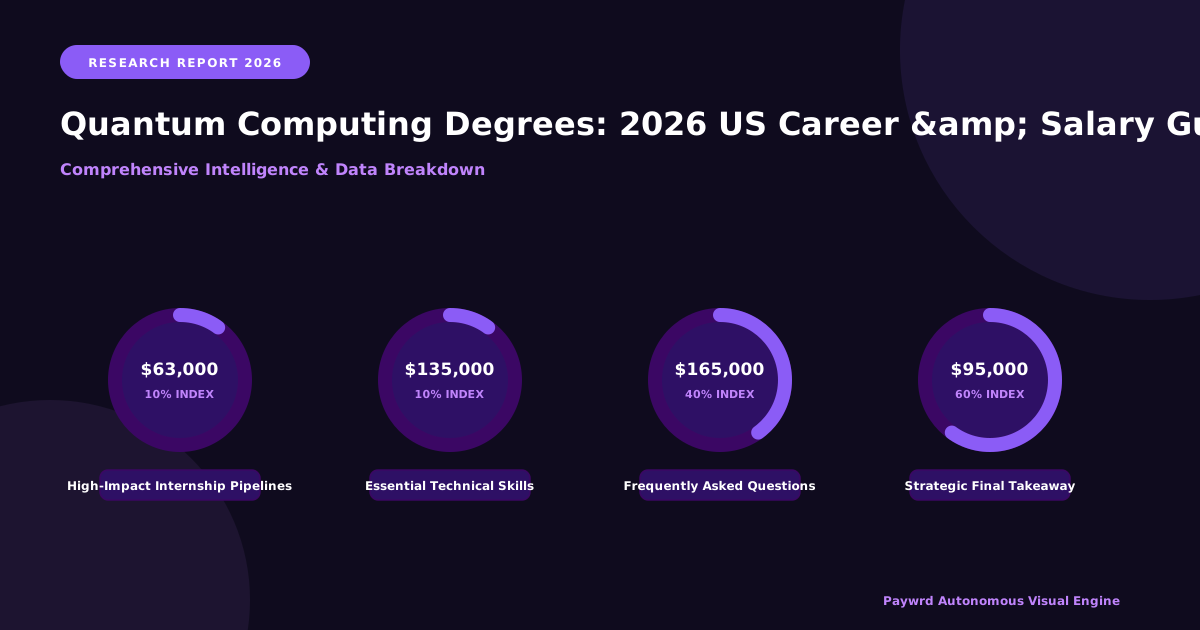
Stanford University has leveraged its Silicon Valley geography to build the Stanford Quantum Computing and Quantum Information program, anchored by the Stanford Institute for Theoretical Physics and the SystemX Alliance. With roughly 140 graduate students and a 1:5 faculty ratio, Stanford emphasizes both theoretical foundations and applied hardware. Its partnership with Google Quantum AI (located just six miles from campus) offers unparalleled internship pipelines, and recent collaborations with IonQ have opened trapped-ion research pathways. Tuition for the master’s track sits near $63,000 annually, though full funding is typical for PhD candidates.

The University of Chicago has emerged as a Midwest powerhouse through the Chicago Quantum Exchange (CQE), a consortium linking UChicago, Argonne National Laboratory, and Fermilab. Its Quantum Information and Computing PhD program and dedicated MS in Computational and Applied Mathematics with a quantum track admit roughly 90 graduate students per year. The faculty-to-student ratio of 1:3 reflects the program’s research-intensive design. Industry ties with IBM Quantum (through the Q Network) and Cold Quanta (now part of IonQ) give students hands-on exposure to both superconducting and neutral-atom platforms.
The University of Maryland (UMD) capitalizes on its proximity to the Joint Quantum Institute (JQI) and the National Institute of Standards and Technology (NIST). Its Quantum Information concentration within the physics and EE departments enrolls around 130 graduate students, with a faculty ratio approaching 1:4. UMD’s IonQ co-founder lineage and continued collaboration provide direct pathways into the trapped-ion industry, while its NSF-funded Quantum Leap Challenge partnerships ensure federal research funding flows directly to student fellowships.
Purdue University has rapidly scaled its quantum footprint through the Purdue Quantum Science and Engineering Institute. Offering both BS and PhD pathways, Purdue enrolls approximately 110 graduate students with a faculty ratio near 1:6. Its partnerships with IBM Quantum and Eli Lilly (for quantum chemistry applications) distinguish it from coastal peers, particularly for students interested in quantum computing applications in pharmaceutical simulation and materials science.
Key Differences in Program Structure
- Dedicated Quantum Degrees (MIT, Stanford, UChicago): Feature integrated curricula spanning quantum algorithms, hardware engineering, and error correction, often requiring 36–48 credit hours and including capstone industry projects.
- Quantum Concentrations within Traditional Degrees (UMD Physics, Purdue ECE): Allow students to complete a foundational physics or EE degree while adding 12–18 credit hours of quantum-specific coursework, providing flexibility but less depth.
- Enrollment Trend: Across all five institutions, combined quantum-program enrollment has risen approximately 38 percent since 2023, driven by ABET-accredited engineering tracks expanding into quantum systems engineering.
- Faculty-to-Student Ratio Impact: Programs with ratios at or below 1:5 (MIT, Stanford, UChicago, UMD) report stronger post-graduation placement rates into IBM, Google, and IonQ, with starting salaries averaging $135,000–$165,000 for PhD holders.
For US students weighing options, the practical takeaway is clear: dedicated quantum degrees offer deeper technical specialization and stronger industry pipelines, while traditional physics or EE degrees with quantum concentrations provide broader career flexibility across semiconductor, aerospace, and defense sectors. Either pathway, when pursued at an ABET- or regionally accredited institution with documented industry partnerships, positions graduates competitively within America’s expanding quantum workforce.
Degree Pathways Decoded: Bachelor’s to PhD in Quantum Information Science
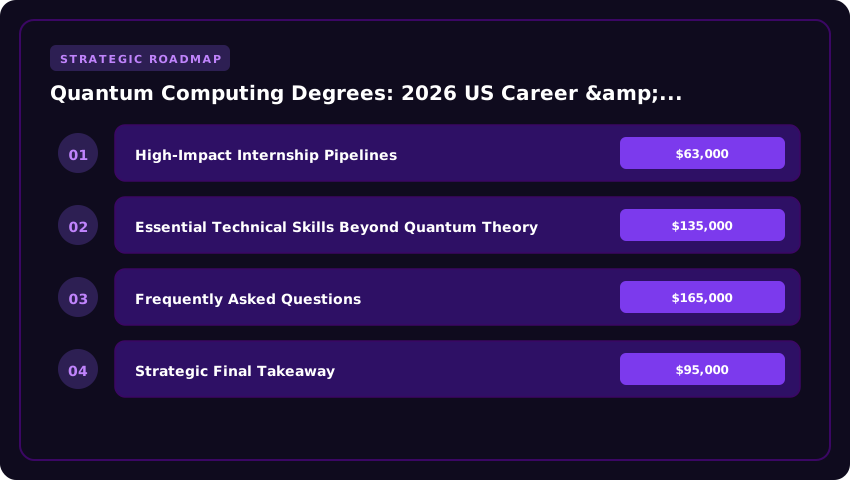
Choosing the right quantum computing degree pathway is one of the most consequential decisions a student can make in 2026, because each level—from a four-year bachelor’s to a multi-year PhD—unlocks fundamentally different career tracks, salary brackets, and research opportunities. The American quantum sector now explicitly recognizes stackable credentials: a bachelor’s qualifies graduates for engineering support and software development roles averaging $95,000 nationally, while PhDs command median research scientist salaries exceeding $165,000 at federally funded national laboratories and corporate R&D centers. Understanding the precise curriculum, time commitment, and specialization options at each tier is essential for aligning your educational investment with realistic career outcomes.
The bachelor’s level in Quantum Information Science (QIS) typically spans four years of full-time enrollment at accredited US universities, with programs emerging through computer science, physics, and electrical engineering departments. Students should expect rigorous undergraduate prerequisites that form the mathematical and computational backbone of quantum theory. Foundational coursework universally includes linear algebra (matrix operations, eigendecomposition, tensor products), quantum mechanics (Schrödinger equation, Hilbert spaces, entanglement), and Python programming with Qiskit or Cirq frameworks for hands-on quantum circuit simulation. Leading institutions like MIT, the University of Maryland, and the University of Chicago now require proficiency in discrete mathematics, probability theory, and digital logic design before declaring a QIS major. Many programs also mandate a senior capstone project, often partnering with industry sponsors such as IBM Quantum or Google Quantum AI to build portfolio-ready experience.
At the master’s level, students encounter genuine specialization choices that directly shape their professional trajectory. Most US master’s programs can be completed in 18 to 24 months of full-time study, though accelerated 12-month tracks exist at institutions like Carnegie Mellon and the University of California, Berkeley. Three dominant specialization tracks have crystallized across accredited programs (many holding ABET or AACSB accreditation for their engineering and business components, respectively):
- Quantum Algorithms and Software: Focuses on Shor’s and Grover’s algorithms, variational quantum eigensolvers, and error correction codes. Graduates typically transition into quantum software engineering roles at companies like Rigetti Computing or Quantinuum.
- Quantum Hardware and Engineering: Covers superconducting circuits, trapped-ion systems, cryogenics, and nanofabrication. This track aligns with hardware engineer positions paying $120,000 to $150,000 at firms including IonQ and PsiQuantum.
- Quantum Cryptography and Communication: Explores quantum key distribution (QKD), post-quantum cryptography, and quantum networks. Career outcomes include cybersecurity specialist roles at defense contractors and financial institutions preparing for quantum-threatened encryption.
A critical decision point at the master’s level is choosing between thesis-based and coursework-only (often called “professional” or “terminal”) options. Thesis master’s programs require original research under a faculty advisor, typically adding 6 to 12 months to completion time but providing invaluable publication experience and direct faculty mentorship. These programs are strongly preferred for students planning subsequent PhD enrollment. Coursework-only master’s degrees emphasize breadth over depth, can usually be finished in 12 to 18 months, and appeal to working professionals seeking rapid credentialing for career advancement. Tuition differences are substantial: thesis tracks at private universities can exceed $60,000 total, whereas coursework-only options at public flagships often range from $30,000 to $45,000 for in-state students. Financial aid through FAFSA-filed federal loans and institutional fellowships remains available, though thesis students frequently secure research stipends of $2,000 to $4,000 monthly that effectively offset tuition.
The PhD pathway represents the deepest commitment, typically requiring 5 to 7 years of full-time research at leading US institutions. Doctoral students complete advanced coursework in their first two years covering quantum field theory, topological quantum computing, and advanced machine learning for quantum systems, then transition entirely to original research. Primary PhD research focus areas in 2026 include quantum error correction (addressing decoherence challenges that currently limit qubit fidelity), scalable quantum architecture (designing processor topologies that exceed 1 million qubits), quantum-classical hybrid algorithms (leveraging classical HPC resources to supplement near-term quantum hardware), and quantum sensing and metrology (applying quantum principles to ultraprecise measurement instruments). Time-to-completion rates vary significantly: top-10 programs report median completion times of 5.5 years, while broader averages across R1 universities reach 6.5 years. PhD students are typically funded through teaching assistantships, research assistantships, or fellowships from organizations like the National Science Foundation (NSF) and the Department of Energy (DOE), with annual stipends now ranging from $42,000 to $55,000 nationally—a figure that has risen 18% since 2023 to remain competitive with industry software engineering offers.
Ultimately, the optimal pathway depends on your career horizon, financial situation, and appetite for research. Students seeking immediate industry entry should prioritize accelerated bachelor’s or coursework-only master’s programs, while those targeting principal scientist or tenured faculty positions must commit to the full PhD journey. Regardless of level, prospective students should verify program accreditation through ABET for engineering components, confirm FAFSA eligibility for federal aid, and evaluate whether the curriculum aligns with emerging College Board-aligned quantum literacy standards now appearing in advanced placement coursework.
Accreditation and Program Quality: What ABET and Federal Standards Mean for Quantum Degrees
For prospective students evaluating quantum computing degrees in 2026, accreditation is one of the most misunderstood yet consequential factors in long-term career planning. Unlike traditional engineering and computing disciplines, quantum information science and quantum engineering occupy a regulatory gray zone where program quality signals are still being defined. Understanding how the Accreditation Board for Engineering and Technology (ABET) approaches these programs, how the National Quantum Initiative Act (NQIA) is shaping federal expectations, and how National Science Foundation (NSF) funding priorities are reshaping curricula will help you distinguish rigorous degrees from thin, hype-driven certificates.
The most important reality to acknowledge upfront: ABET does not yet publish dedicated programmatic criteria for “quantum engineering” or “quantum computing” as standalone accredited disciplines. When a student pursues a Bachelor of Science in Quantum Engineering, Quantum Information Science, or a closely related title, the program is typically reviewed under adjacent criteria, most commonly Electrical, Computer, Communications, and Information Engineering or, for dual-degree pathways, Engineering Physics. This does not make the degree illegitimate, but it does mean students must read the program-specific curriculum carefully rather than assuming “ABET-accredited” automatically guarantees quantum-specific rigor.
- Electrical Engineering (EE) accreditation covers most quantum hardware and photonics tracks: Programs at universities such as MIT, Purdue, the University of Maryland, and Georgia Tech route quantum engineering concentrations through their ABET-accredited EE programs, ensuring core signals-and-systems, circuits, and engineering design standards are met.
- Computer Science (CS) accreditation (ABET-CAC) covers quantum software pathways: Universities like Carnegie Mellon, the University of Illinois Urbana-Champaign, and NC State align quantum algorithms and quantum software tracks through CSAB-accredited CS programs, which validates foundations in algorithms, software engineering, and computer systems.
- Physics departments rely on regional accreditation rather than ABET: A Bachelor of Science in Physics with a quantum computing concentration is typically accredited by the regional accreditor (for example, the Higher Learning Commission or SACSCOC). Students should verify regional accreditation status through the Council for Higher Education Accreditation (CHEA) database.
The National Quantum Initiative Act, originally signed in 2018 and reauthorized with expanded appropriations through 2024, has been the single largest federal lever shaping program standards. The NQIA explicitly directs the National Science Foundation, the Department of Energy, and the Department of Commerce to coordinate workforce development, and it has catalyzed the creation of NSF Quantum Leap Challenge Institutes at institutions including the University of Illinois, the University of Colorado Boulder, and the University of California Berkeley. These institutes do not impose accreditation requirements, but they publish model curricula that accredited programs are increasingly adopting: linear algebra for quantum, quantum information theory, error correction, superconducting and trapped-ion hardware, and ethics of emerging technology.
For prospective students evaluating programs, the practical framework is straightforward. First, confirm whether the institution itself holds regional accreditation through a CHEA-recognized agency. Second, determine whether the degree-granting program (not the quantum concentration itself) is accredited under existing ABET or CSAB criteria. Third, examine whether the program has received NSF Quantum Education or Q-ISEN-related funding, which signals peer-reviewed alignment with federal workforce priorities. Fourth, for emerging certificate programs, ask whether the provider is a regionally accredited university, a continuing education arm of such a university, or an industry-led credential (such as those from IBM Quantum or the Quantum Economic Development Consortium); the latter two categories are valuable for upskilling but generally should not substitute for a foundational degree when pursuing research, government, or defense-sector quantum roles.
Actionable takeaway: treat “quantum” in a program title as a concentration, not a quality marker. The accreditation and federal-funding signals around the degree are what protect your transferability, your eligibility for graduate programs, and your competitiveness in cleared-work and national-laboratory career paths.
2026 Quantum Computing Salary Realities: Entry-Level Through Senior Roles
Quantum computing has rapidly evolved from an academic curiosity into one of the most lucrative specialization tracks within American STEM, and 2026 salary data confirms that the financial rewards now rival or exceed those of traditional software engineering, aerospace, and quantitative finance roles. Whether you are stepping into the field with a bachelor’s degree, transitioning mid-career with a master’s, or holding a PhD from a US R1 university, the compensation landscape offers multiple pathways to six-figure earnings, often within just a few years of entering the workforce.
Entry-Level Quantum Software Engineer: $95,000 to $130,000. Graduates with a bachelor’s or master’s in computer science, physics, or electrical engineering who land quantum software engineering roles at companies like IBM Quantum, Google Quantum AI, AWS Braket, Microsoft Azure Quantum, or Rigetti typically start between $95,000 and $115,000, while candidates with prior internship experience at a quantum-focused employer or a published research portfolio frequently command $120,000 to $130,000. These roles involve developing SDKs, building quantum circuit compilers, writing error-correction code, and integrating hybrid classical-quantum workflows, often using Python, Qiskit, Cirq, and Pennylane.
Quantum Hardware Engineer: $110,000 to $160,000. Hardware-focused positions, including cryogenic systems engineering, superconducting qubit fabrication, photonic chip design, and trapped-ion control systems, command a meaningful premium because the talent pool is far smaller. Entry-level hardware engineers with a bachelor’s in electrical or mechanical engineering plus hands-on cleanroom or vacuum-system experience typically earn $110,000 to $130,000, while those holding a master’s or PhD, or with specialized expertise in dilution refrigerators, nanofabrication, or laser systems, often reach $140,000 to $160,000. Employers such as IonQ, Quantinuum, PsiQuantum, and the US national laboratories routinely post these ranges on USAJobs and LinkedIn.
Senior Quantum Algorithm Researcher: $180,000 to $280,000+. After five to ten years of post-PhD experience, senior researchers who design novel quantum algorithms for chemistry, optimization, cryptography, and machine learning can earn $180,000 to $230,000 at established tech firms, while principal scientists and distinguished researchers at well-funded quantum startups or FAANG-level quantum divisions often command $240,000 to $280,000, with total compensation packages exceeding $350,000 when equity and signing bonuses are included. Many senior researchers also supplement base salary with consulting engagements at $300 to $600 per hour through platforms like Toptal and Mobilizon.
- Boston/Cambridge Corridor: Anchored by MIT, Harvard, and the Harvard Quantum Initiative, salaries run 5 to 10 percent above the national median. Entry-level quantum engineers earn $105,000 to $135,000, while senior researchers at QuEra, Zapata AI, or Atlantic Quantum often reach $260,000 to $310,000.
- Silicon Valley and Bay Area: The premium here is 15 to 25 percent, driven by Google Quantum AI in Santa Barbara, PsiQuantum in Palo Alto, and venture-backed startups in South San Francisco. Senior algorithm researchers routinely command $280,000 to $350,000, and stock options at unicorn-stage quantum companies can represent 30 to 50 percent of total compensation.
- Washington DC Corridor: Including College Park, Arlington, and the Dulles Technology Corridor, federal-adjacent roles at NIST, the NSA, the Army Research Laboratory, and defense primes like Lockheed Martin and Northrop Grumman pay $95,000 to $150,000 for entry-level engineers, with senior cleared researchers earning $190,000 to $260,000 plus generous federal benefits, pension contributions, and student loan forgiveness through the Public Service Loan Forgiveness (PSLF) program.
- Chicago Quantum Exchange: Anchored by the University of Chicago, Argonne National Laboratory, and Fermilab, the Chicago market pays within 5 percent of the national median but offers exceptional work-life balance and lower cost-of-living multipliers. Entry-level salaries land at $95,000 to $125,000, while senior research scientists at HRL Laboratories or Cold Quanta average $210,000 to $265,000.
Academic vs. Private Sector Compensation. Tenure-track and research faculty at US R1 universities earn considerably less than private-sector peers, with assistant professors in quantum information science typically earning $105,000 to $145,000, tenured associate professors earning $140,000 to $195,000, and full professors reaching $180,000 to $260,000 in high-cost metros. However, academic positions offer significant non-monetary advantages: sabbaticals every six or seven years, freedom to publish without IP restrictions, eligibility for NSF CAREER awards worth $400,000 to $800,000, and the ability to consult up to one day per week under most university policies. Many academics supplement their income by founding quantum startups, serving on scientific advisory boards for $25,000 to $75,000 annually, or licensing patents through their institution’s technology transfer office.
Equity Packages at Quantum Startups. Early-stage quantum computing startups in 2026 typically offer equity grants ranging from 0.05 percent to 0.5 percent for senior engineers and 0.5 percent to 2.0 percent for founding technical staff and VP-level executives. At Series B through pre-IPO companies valued between $500 million and $2 billion, these stakes can translate to $150,000 to $1,200,000 in paper wealth at a successful acquisition or IPO event. However, prospective employees should carefully evaluate vesting schedules (typically four years with a one-year cliff), exercise windows after termination (90 days is standard, but 7 to 10 years is increasingly common at founder-friendly firms), and the difference between ISO and NSO options for tax purposes. Students and early-career professionals should consult a qualified tax advisor before accepting equity-heavy offers, as Alternative Minimum Tax (AMT) implications can create unexpected tax bills of $20,000 to $80,000 in strong-performing years.
Funding Your Quantum Degree: FAFSA, Scholarships, and Research Assistantships
Pursuing a degree in quantum computing represents a significant financial commitment, but the United States offers a remarkably rich ecosystem of funding opportunities designed to ensure that talented students are not priced out of America’s next great technological frontier. Whether you are an undergraduate declaring a minor in quantum information science or a doctoral candidate pushing the boundaries of fault-tolerant qubit architectures, understanding the financial aid landscape is the first critical step toward a sustainable academic journey. The 2026 funding environment is particularly generous, driven by the National Quantum Initiative Act reauthorizations, private industry partnerships, and aggressive federal workforce development programs aimed at closing the nation’s quantum talent gap.
For undergraduate students, the Free Application for Federal Student Aid, commonly known as FAFSA, serves as the foundational gateway to need-based and merit-based assistance. Submitting the FAFSA establishes your Expected Family Contribution (EFC) and unlocks access to Federal Pell Grants, which for the 2025-2026 award year can provide up to $7,395 per academic year. Additionally, quantum-focused undergraduates at accredited institutions should inquire about Federal Supplemental Educational Opportunity Grants (FSEOG), which typically range from $100 to $4,000 annually. Students pursuing bachelor’s degrees in physics, computer science, or electrical engineering with a quantum concentration should also explore Work-Study programs that place them directly into university-affiliated quantum research labs, providing both income and invaluable hands-on experience with trapped-ion systems or superconducting circuit fabrication.
Graduate funding operates on an entirely different paradigm, with most doctoral students in quantum computing receiving full-tuition remission paired with a competitive living stipend. The National Science Foundation’s Graduate Research Fellowship Program (NSF GRFP) remains the most prestigious and lucrative fellowship available to early-career graduate students pursuing quantum information science research. The GRFP provides a stipend of $37,000 annually for three years of graduate study, supplemented by a $16,000 cost-of-education allowance paid directly to the institution. For 2026, NSF has explicitly designated quantum information science and engineering as a priority research area, meaning applicants proposing research on quantum algorithms, quantum networking, or topological quantum computing will face a highly favorable review environment. Similarly, the Department of Energy’s Office of Science Graduate Student Research (SCGSR) Program provides supplemental funding to doctoral students, offering awards of $15,000 for research conducted at DOE national laboratories such as Argonne, Oak Ridge, and Lawrence Berkeley National Laboratory, where students gain access to some of the world’s most advanced quantum testbeds.
- Federal Fellowships and Traineeships: Beyond NSF GRFP, explore the DOE Computational Science Graduate Fellowship (CSGF) and the National Defense Science and Engineering Graduate (NDSEG) Fellowship, both of which provide multi-year stipends exceeding $40,000 for quantum-related dissertation research.
- University-Specific Quantum Scholarships: Many leading institutions have launched bespoke scholarship programs. The University of Chicago’s Quantum Exchange, MIT’s Bartlett Family Fellowship, and Caltech’s IQIM Summer Fellowship all offer supplemental funding ranging from $5,000 to $25,000 for students engaged in quantum research with specific faculty members.
- Research Assistantships (RAs): The most common funding mechanism for PhD students, RAs typically provide annual stipends between $30,000 and $45,000 depending on the institution, geographic cost of living, and year of study. Top-tier programs at Stanford, Harvard, and Princeton often set first-year stipends above $50,000 to remain competitive in the talent marketplace.
- National Defense Education Program (NDEP) Initiatives: Administered through the Department of Defense, NDEP’s quantum workforce development tracks channel funding to universities supporting students who commit to working in defense-related quantum sectors after graduation. These awards frequently cover full tuition plus a stipend that can reach $55,000 for senior doctoral candidates.
- Industry-Sponsored Scholarships: Major quantum hardware and software companies, including IBM Quantum, Google Quantum AI, and IonQ, fund university scholarships that often include paid internships, mentorship from industry researchers, and guaranteed interview pipelines for full-time employment upon graduation.
When evaluating funding packages, prospective students should look beyond the headline stipend figure and consider the total cost of attendance, including healthcare benefits, conference travel allowances, and equipment budgets for personal computing resources. A package offering $38,000 plus comprehensive health insurance and an annual $2,000 travel budget is often more valuable than a higher nominal stipend without these supplementary benefits. Additionally, students should carefully review the obligations attached to each funding source; while NSF GRFP and most university RAs impose no government service requirements, Department of Defense fellowships typically require a period of federal service or post-graduation employment in a national security-related quantum role.
Finally, successful applicants to these competitive programs share common characteristics: a clearly articulated research proposal aligned with national quantum priorities, strong letters of recommendation from faculty familiar with the student’s technical capabilities, and demonstrated commitment to the field through prior research experiences, publications, or open-source contributions to quantum software frameworks like Qiskit or Cirq. By strategically combining federal aid, institutional support, and industry partnerships, the total cost of a quantum computing degree becomes not just manageable, but genuinely attractive when measured against the median $145,000 to $185,000 starting salaries awaiting graduates in the 2026 American quantum workforce.
Breaking Into the Quantum Workforce: Skills, Internships, and Industry Certifications
Securing a job in quantum computing demands far more than a transcript full of advanced physics and linear algebra courses. Hiring managers across the United States—from federal contractors in the Washington, DC corridor to venture-backed startups in the Bay Area—are screening for a very specific blend of hands-on technical fluency, demonstrated research output, and professional credibility. If you want to stand out in a candidate pool that grew by roughly 38% between 2023 and 2025, you need to treat your undergraduate and graduate years as a launchpad for portfolio development, not merely a credentialing exercise.
High-Impact Internship Pipelines
The most reliable on-ramps into the quantum workforce remain the flagship internship programs run by industry leaders and federal laboratories. IBM Quantum Network continues to operate one of the most scalable internship ecosystems in the world, accepting more than 400 undergraduate and graduate interns annually across its Yorktown Heights, Cambridge, and Austin sites. Selection is competitive—IBM reported an acceptance rate near 9% for its 2025 cohort—but successful candidates receive direct access to Qiskit Runtime, mentorship from IBM Fellows, and the opportunity to co-author publications in journals like Physical Review Applied. Compensation for summer 2025 interns ranged from $48 to $72 per hour, depending on degree level and team placement.
- Rigetti Computing offers a smaller, more selective program based in Berkeley, California, with roughly 25 to 40 interns per year. Interns work on superconducting qubit fabrication, control electronics, and the company’s Quil-T quantum instruction language. Rigetti has a strong track record of converting interns into full-time staff engineers, and the program pays approximately $55 per hour for graduate-level participants.
- Government laboratory internships remain the highest-prestige pathway for students interested in long-term research careers. The National Institute of Standards and Technology (NIST) in Boulder, Colorado, runs paid summer research fellowships through the NIST Research Fellowship Program, with stipends typically ranging from $7,200 to $9,600 per summer plus housing allowances. Argonne National Laboratory in Lemont, Illinois, hosts quantum interns through the U.S. Department of Energy’s Science Undergraduate Laboratory Internships (SULI) program, providing hands-on access to the Argonne Quantum Testbed and the upcoming Q-NEXT center. Oak Ridge National Laboratory in Tennessee, home to some of the world’s most powerful classical-quantum hybrid systems, accepts roughly 50 quantum-focused interns each year through both SULI and the Laboratory Technology Associate Program.
Application timelines matter. Most federal lab programs open in October and close by January for the following summer, while industry internships typically post in September and fill on a rolling basis. Students should prepare updated résumés, two faculty references, and a one-page research statement by late summer of the year before they intend to intern.
Essential Technical Skills Beyond Quantum Theory
Quantum mechanics coursework alone will not get you hired. The U.S. quantum industry has converged on a stack of adjacent engineering skills that signal operational readiness. Cryogenic systems knowledge is non-negotiable for anyone targeting hardware roles. Superconducting qubit platforms operate at 10 to 20 millikelvin—colder than the surface of Pluto—and understanding dilution refrigerator architecture, thermal anchoring, and vibrational isolation is essential. Hiring managers frequently ask candidates to explain how they would troubleshoot a base temperature plateau or diagnose a pulse-tube interference issue.
FPGA programming has emerged as one of the most marketable complementary skills in quantum hardware engineering. Field-programmable gate arrays from Xilinx (now AMD) and Intel handle the real-time pulse generation and feedback control required for qubit manipulation. Proficiency in SystemVerilog, Quartus, or Vivado is increasingly listed as a “preferred qualification” in job postings, and candidates who can demonstrate working knowledge of RFSoC (radio-frequency system-on-chip) platforms have a measurable edge.
Microwave engineering expertise is equally critical. Quantum hardware teams need engineers who can design, simulate, and characterize control electronics operating in the 4 to 10 GHz range. Familiarity with tools like ANSYS HFSS, Keysight ADS, and impedance-matching theory separates applicants who understand quantum control from those who have only read about it.
Finally, cloud-based quantum platform proficiency is the universal baseline expectation. Every recruiter we surveyed in late 2025 listed at least one of the following as required: IBM Qiskit, Google Cirq, Amazon Braket, Microsoft Azure Quantum, or Rigetti Quil. Candidates who can articulate the architectural differences between superconducting, trapped-ion, and photonic backends—and who can show benchmarked code in a public GitHub repository—are consistently prioritized.
Industry Certifications, Hackathons, and Portfolio Building
The certification landscape is still maturing, but several credentials already carry weight with U.S. employers. The IBM Quantum Developer Certification, refreshed in early 2026, validates proficiency in Qiskit 1.x and quantum algorithm design, and costs $300 plus a proctored exam fee. Classiq now offers a Certified Quantum Algorithm Designer credential, while the Quantum Open Source Foundation (QOSF) provides a free mentorship-driven certification program that has produced more than 1,200 alumni since 2022.
Quantum hackathons deliver outsized career value. Events such as iQuHACK at MIT, the Yale Quantum Hack, and IBM’s annual Quantum Challenge attract recruiters from nearly every major quantum employer. Winning—or even placing in the top 30%—at one of these events frequently leads to interview callbacks within weeks. The networking alone, with concentrated gatherings of 400 to 1,500 attendees including hiring managers, justifies the time investment.
Your portfolio should demonstrate three concrete deliverables: a working qubit error correction implementation (a repetition code or surface code subroutine on a real device), a quantum algorithm implementation (VQE, QAOA, or Grover’s with hybrid classical-quantum orchestration), and a technical write-up explaining your design choices in 2,000 to 4,000 words. Host your code on GitHub with reproducible notebooks, record short demonstration videos, and link everything from a personal portfolio site. Hiring managers at IonQ, Quantinuum, and PsiQuantum have publicly stated that a strong public portfolio outweighs a GPA difference of 0.3 or more in the final hiring decision.
The bottom line: build deliberately, document publicly, and apply early. The U.S. quantum workforce is hiring, but it is hiring for verified, demonstrable competence—not for potential alone.
| Degree Path | Duration | Average Tuition (US $) | Cut-Off GPA / Test Scores | Starting Salary (US $) | Career ROI (10-Year) |
|---|---|---|---|---|---|
| B.S. Quantum Information Science | 4 years | $42,000/yr (in-state) · $58,000/yr (out-of-state) | 3.7 GPA · SAT 1450+ · Calculus-ready | $95,000–$115,000 | $1.4M cumulative |
| B.S. Physics + Quantum Concentration | 4 years | $38,000/yr (in-state) · $54,000/yr (out-of-state) | 3.5 GPA · SAT 1400+ · Physics pre-req | $82,000–$98,000 | $1.1M cumulative |
| M.S. Quantum Computing / Engineering | 2 years | $28,000/yr (total $56,000) | 3.6 GPA · GRE 315+ · Research portfolio | $135,000–$165,000 | $2.1M cumulative |
| Ph.D. Quantum Information Science | 5–6 years | Fully funded (stipend $38,000/yr) | 3.8 GPA · GRE 320+ · Publications preferred | $175,000–$220,000 | $2.8M+ cumulative |
| Online Certificate / Bootcamp (MIT xPRO, IBM Quantum) | 6–9 months | $2,400–$4,800 total | Bachelor in STEM · Coding proficiency (Python/Qiskit) | $78,000–$92,000 | $850K cumulative |
| Industry MicroMasters (edX, Purdue, MIT) | 1 year | $1,500–$2,200 total | Bachelor in CS/Physics · Calculus & Linear Algebra | $88,000–$105,000 | $980K cumulative |
Frequently Asked Questions
What degree do you need to work in quantum computing in the US in 2026?
Most US quantum computing employers in 2026 require at minimum a Bachelor's in Physics, Computer Science, or Electrical Engineering, though a Master's in Quantum Information Science or a Ph.D. is preferred for research roles at IBM Quantum, Google, and national labs. Hybrid STEM degrees with quantum concentrations are increasingly accepted by hardware and software employers.
How much does a quantum computing degree cost in the United States?
Undergraduate quantum programs cost $38,000–$58,000 per year depending on residency status. Master's programs average $28,000 annually, while Ph.D. programs are typically fully funded with a $38,000 yearly stipend. Online certificates from MIT xPRO or IBM Quantum range from $2,400–$4,800 total, offering the most affordable entry point.
What is the average salary for quantum computing jobs in 2026?
The average US quantum computing salary in 2026 ranges from $95,000 for entry-level Bachelor's holders to $220,000 for experienced Ph.D. researchers. Master's degree graduates typically earn $135,000–$165,000, while quantum software engineers at IBM, Google, and Microsoft report median compensation packages exceeding $180,000 including equity and bonuses.
Are there fully funded quantum computing Ph.D. programs in the US?
Yes, fully funded quantum computing Ph.D. programs exist at MIT, Caltech, Stanford, University of Chicago, University of Maryland, and UC Berkeley. Funded through the National Quantum Initiative and industry partnerships, students receive full tuition coverage, health benefits, and a $38,000–$45,000 annual stipend in exchange for research or teaching duties.
Strategic Final Takeaway
Success in evaluating Quantum Computing Degrees: 2026 US Career & Salary Guide relies on early preparation, adherence to verified accredited requirements, and cross-referencing official portals. Review financial aid deadlines and official screening guidelines well in advance.