

The October 1 Launch: Verifying the 2026-27 Fixes
For the first time in two cycles, the Free Application for Federal Student Aid (FAFSA) opened on its statutory start date of October 1, 2025, for the 2026–2027 award year. This on-time launch is not merely a scheduling win; it is a critical restoration of trust after the 2024–2025 cycle’s delayed December rollout and the subsequent “soft launch” period plagued by system outages, calculation errors, and inaccessible contributor portals. The Department of Education’s Federal Student Aid (FSA) office executed a deliberate, phased testing strategy throughout mid-2025—including a limited beta with select institutions and a broader “preview” window for counselors—that effectively stress-tested the modernized architecture before the general public arrived.

The contrast with the prior year is stark. In 2023, the Simplified Needs Test and the removal of the sibling discount collided with a compressed development timeline, forcing a three-month delay that cascaded into missed state deadlines and delayed award letters. For 2026–2027, the core statutory changes (the Student Aid Index replacing EFC, mandatory IRS Direct Data Exchange) are already baked into the codebase. The engineering focus shifted from building new logic to hardening existing workflows, specifically targeting the two failure points that caused the most friction: IRS Direct Data Exchange (DDX) consent and contributor invitation flows.
IRS Direct Data Exchange: Consent Reliability Restored
The mandatory consent requirement for Federal Tax Information (FTI) transfer remains the legal backbone of the simplified FAFSA. In 2024, the DDX handshake between the FSA system and the IRS frequently timed out or returned “unavailable” errors, forcing families into manual entry—a process that triggered verification flags and delayed processing by weeks. The 2026–2027 fix centers on a re-architected API gateway with asynchronous callback handling.
- Real-time Status Feedback: Applicants now see a granular status indicator (e.g., “Connecting to IRS,” “Retrieving 2024 Return,” “Transfer Complete”) rather than a spinning wheel, reducing premature browser closures.
- Graceful Degradation: If the IRS service is momentarily slow, the FAFSA form saves the consent artifact locally and retries the pull in the background, notifying the user via email and dashboard alert upon completion.
- Identity Verification Alignment: The FSA ID verification standards (ID proofing via Login.gov or ID.me) have been tightened to match IRS Secure Access thresholds, drastically reducing “identity mismatch” rejections that previously blocked DDX for mixed-status households.
Contributor Invitation Flows: Eliminating the “Ghost Link” Problem
Last year, the contributor experience—where parents or spouses receive an email link to complete their section—was the single largest source of support tickets. Links expired prematurely, directed users to the wrong dashboard view, or failed to associate the contributor with the student’s transaction ID. The 2026–2027 release introduces a tokenized, session-persistent invitation model.
- Extended Token Validity: Invitation links now remain active for 45 days (up from 7), aligning with the typical “priority deadline” window and accommodating families who file taxes on extension.
- Unified Contributor Dashboard: Regardless of whether the contributor enters via email, SMS, or direct login, they land on a unified “My Contributions” portal displaying every pending request tied to their SSN/ITIN, eliminating the “which student am I helping?” confusion.
- Proactive Nudges: Automated, FERPA-compliant reminders fire at Day 7, Day 14, and Day 30 to both student and contributor, with a one-click “Resend Link” button for the student that generates a fresh token instantly without re-entering demographic data.
Actionable Takeaway: Do not wait for a “perfect” moment to start. The system is stable enough for early submission. Create your FSA IDs now (allowing 1–3 days for SSA verification), gather your 2024 tax returns for reference, and submit the FAFSA as close to October 1 as possible. Early filing secures your place in line for limited state grants and institutional aid pools that operate on a first-come, first-served basis.
SAI Calculation Deep Dive: 2024 Tax Year Income Rules
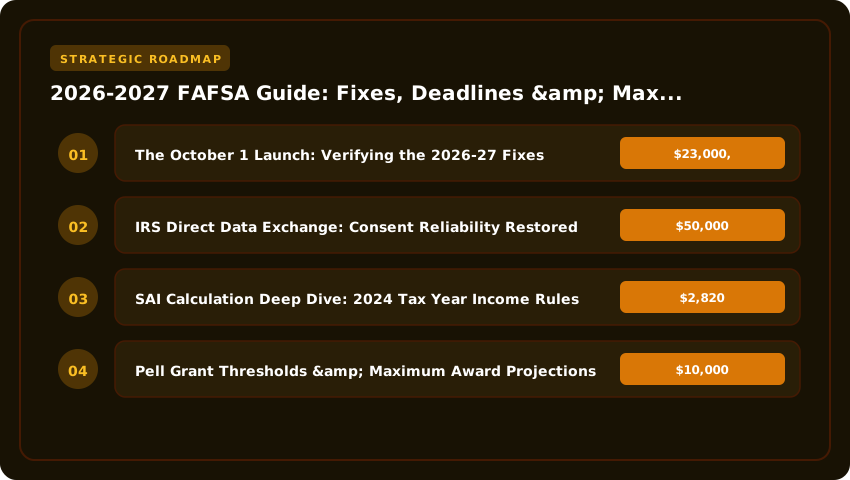
The Student Aid Index (SAI) is the number the U.S. Department of Education uses to determine a family’s financial need, and for the 2026–2027 award year it is calculated almost entirely from 2024 tax year income data. Understanding exactly how this formula works is the single most important step toward maximizing your federal aid package, because every dollar of income that gets “protected” or “assessed” at a lower rate directly reduces your SAI and increases your eligibility for need-based grants like the Federal Pell Grant.
At its core, the SAI formula begins with your family’s total income from the relevant tax year, subtracts a series of allowances designed to protect a baseline cost of living, and then applies different assessment rates to remaining assets. For dependent students, the calculation starts with the 2024 Adjusted Gross Income (AGI) reported on the IRS Form 1040, plus any untaxed income the FAFSA specifically requires you to add back (such as tax-exempt interest, non-401(k) contributions to retirement accounts, and the foreign earned income exclusion).
From that adjusted income total, the formula subtracts an Income Protection Allowance (IPA) based on your family size and the number of family members in college. For a typical family of four with one college student, the 2026–2027 IPA sits at approximately $23,000, though the exact figure scales upward for larger households and downward for smaller ones. The IPA also incorporates a modest employment expense allowance (roughly 35% of earned income up to a cap) to recognize work-related costs like commuting, childcare, and professional attire. After these deductions, you arrive at Available Income (AI), the portion of yearly earnings the government considers truly discretionary for college expenses.
Next comes the asset evaluation phase, where the formula applies two distinct assessment rates: 5.64% for parent assets and 20% for student assets. This disparity is intentional and reflects federal policy that expects students to contribute a much larger percentage of their own savings toward education. A parent-owned brokerage account valued at $50,000 contributes only $2,820 to the SAI ($50,000 × 0.0564), while the same $50,000 sitting in a student’s 529 plan owned by the student would contribute $10,000. However, qualified retirement accounts (401(k)s, traditional and Roth IRAs) are entirely shielded from this calculation, making them one of the most powerful asset-protection tools available to middle-class families.
Total assessed assets are added to Available Income and combined to produce the final SAI, though the formula also includes a small offsetting allowance for enrollment in a federal means-tested benefit program (such as SNAP, TANF, or WIC), which can reduce the SAI to as little as $1,500 for the lowest-income filers. The resulting SAI can range from –$1,500 at the minimum (meaning maximum Pell eligibility) up to a theoretical ceiling in the low six figures.
One of the most significant policy shifts in the post-2024 FAFSA redesign is the elimination of the “sibling discount” as a meaningful lever for Pell Grant eligibility. Under the legacy Expected Family Contribution (EFC) system, having multiple children enrolled simultaneously at least part-time in college would divide the IPA by that number, automatically lowering the parent contribution. The new SAI methodology has effectively neutralized this advantage: while the IPA formula still technically divides by the number of family members in college, the impact on Pell eligibility has been sharply curtailed because the minimum SAI floor (–$1,500) and Pell maximum award now cap the practical benefit. Families with three or four college-bound siblings will notice that their estimated Pell Grant barely increases with each additional student, even though their parent contribution shrinks.
Strategically, this means asset positioning matters far more than ever before. Consider these actionable takeaways for the 2026–2027 cycle:
- Maximize retirement contributions before December 31, 2024. Every dollar shifted into a 401(k) or IRA reduces reportable AGI on the 2024 return that drives your 2026–2027 SAI.
- Shift student-held savings into parent-owned 529 plans or custodial accounts before the FAFSA submission date. The 4× difference in assessment rates (20% vs. 5.64%) can translate into thousands of dollars in additional aid eligibility.
- Avoid reportable “other assets” in the student’s name. UGMA/UTMA accounts, taxable brokerage accounts, and savings bonds held by the student all trigger the punitive 20% rate.
- Document enrollment status carefully. Siblings must be enrolled at least half-time in a degree or certificate program to count toward the in-college household number, and concurrent enrollment at multiple institutions must be reported accurately.
- Verify your tax data via IRS Direct Data Exchange (DDX). Since the SAI pulls almost entirely from 2024 returns, a single transposition error can artificially inflate your SAI by hundreds or even thousands of dollars.
Finally, remember that the SAI is a family-wide calculation, but Pell Grant eligibility is individual. Even with a parent SAI of $5,000, a student from a family receiving federal means-tested benefits may still qualify for the maximum Pell award if the simplified needs test or auto-zero EFC equivalent applies to their household size and income threshold. Run the official Federal Student Aid Estimator with your 2024 figures before locking in any large asset moves, and consult a college financial planning professional if your family’s situation involves self-employment income, divorce, or unusual trust distributions—because these line items are treated uniquely under the SAI methodology and can dramatically shift your bottom line.
Contributor Compliance: FSA ID, Consent & Non-Filer Scenarios
Under the 2026–2027 FAFSA framework, every individual identified as a contributor must satisfy three discrete compliance checkpoints before a student’s application can be processed by the U.S. Department of Education. These contributors—typically the student, one or both parents, and in some cases a spouse—must each create a verified FSA ID, provide electronic consent for the Internal Revenue Service (IRS) Direct Data Exchange (DDX), and resolve any “non-filer” flags that the system generates when expected tax data is missing. Missing even a single checkpoint pushes the application into a manual review queue, which historically has delayed aid disbursement by four to eight weeks.
For applicants without a Social Security Number, the Federal Student Aid office has expanded its identity-verification pathway. Students and contributors may now generate an FSA ID using an ITIN (Individual Taxpayer Identification Number) or a foreign passport. After entering this identifier, the system prompts the user to upload a government-issued photo ID and complete a live knowledge-based authentication step. Once verified, the FSA ID carries the same signature and consent authority as one issued through the traditional SSN route. This change matters for the roughly 1.3 million U.S. college students who identify as undocumented or DACA-recipient applicants, allowing them to qualify for state aid and institutional scholarships without SSN documentation.
The DDX consent step is the second compliance checkpoint. Every contributor must authorize the FAFSA to retrieve two years of prior-priority tax return data directly from the IRS. If a contributor skips the consent screen or clicks “decline,” the application is automatically rejected—schools cannot use professional judgment to bypass this rule. For families who have not yet filed taxes, the “Will you file a return?” question triggers the platform’s non-filer workflow, which permits the contributor to manually report income, assets, and household size. Federal Student Aid cross-checks these entries against IRS records once taxes are filed, and any discrepancies can result in verification selection later.
Divorced and separated households face a particularly high error rate because the FAFSA’s “custodial parent” definition does not always match custody orders. The legally binding rule: the parent who provided the greater financial support during the previous 12 months is the required contributor—not necessarily the parent listed on the court order. Step-parent income and assets are included only if the step-parent is married to the custodial parent at the time of application. When parents refuse to cooperate, the student can request an unsubsidized-only dependency override, which sacrifices access to Pell Grants and most need-based aid but preserves the ability to borrow Direct Loans up to the undergraduate limit of $5,500–$7,500 per year.
Manual entry flags appear when DDX fails to retrieve data—often because of recent address changes, a recently filed amended return (Form 1040-X), or an IRS Identity Protection PIN reset. Contributors should first confirm their tax filing status on the IRS “Where’s My Amended Return?” tracker, then re-attest consent on the FAFSA corrections page. If the system continues to reject the match, the school’s financial aid administrator can submit a Federal Tax Information (FTI) request through the FAA Access portal, which sometimes resolves the hold within 72 hours.
- Action Step 1: Create or retrieve every contributor’s FSA ID at StudentAid.gov at least 48 hours before starting the FAFSA to outwait any email-delivery delays.
- Action Step 2: Confirm each contributor has filed the correct tax year return and that DDX consent was selected, not bypassed.
- Action Step 3: Identify the custodial parent using the “greater financial support” test and document any non-cooperation for an unsubsidized-only override.
- Action Step 4: If DDX fails, re-attest consent and contact the college’s financial aid office for an FTI follow-up rather than waiting on the federal helpline.
Pell Grant Thresholds & Maximum Award Projections
The Federal Pell Grant remains the single most powerful need-based award in the United States higher education system, and for the 2026-2027 award year, the program continues to function as a true foundation layer upon which nearly every other form of institutional and state aid is stacked. Because a student’s Pell eligibility now flows directly from the Student Aid Index (SAI) — the post-2024 simplification replacement for the Expected Family Contribution — understanding the precise dollar thresholds and automatic-qualification triggers is no longer optional for serious planners. It is the first calculation an experienced financial aid officer runs, and it should be the first calculation a family runs at home.
For the 2026-27 cycle, the Department of Education has signaled a maximum Pell award of $7,845, an increase of approximately $250 over the prior cycle that reflects the standard statutory inflation adjustment. The minimum award, which still applies to students with an SAI above the auto-zero cutoff but below the program ceiling, is projected at $750. These two endpoints define the entire Pell payment schedule, with award amounts stepping down as the SAI rises in roughly $100 increments toward the upper eligibility boundary of an SAI of 6,656. Once a calculated SAI exceeds that ceiling, the student is statutorily ineligible for any Pell award, regardless of demonstrated financial hardship.
The second critical number to memorize is the auto-zero SAI threshold of 1,800. Any dependent or independent student whose FAFSA produces an SAI at or below 1,800 is automatically eligible for the maximum Pell Grant, provided they meet the basic Title IV eligibility criteria of U.S. citizenship or eligible non-citizen status, a registered Selective Service status if required, no prior baccalaureate degree, and enrollment in an undergraduate program at a participating institution. There is no income cap per se at the auto-zero level — what matters is the formula’s output, not a single dollar figure on a paystub. However, for the practical purpose of pre-screening, families should understand the Federal Poverty Guidelines (FPG) multiples that have historically corresponded with auto-zero qualification under the 2024 tax-year data the 2026-27 FAFSA will pull.
A dependent student with the typical family composition has historically received an auto-zero SAI when the 2024 Adjusted Gross Income (AGI) falls at or below roughly 225% of the FPG, while a single independent student without dependents typically qualifies at or below 200% of the FPG, and a married independent filer or a parent of a dependent student generally crosses the auto-zero line at approximately 325% of the FPG. For a family of four in the 48 contiguous states using the 2024 FPG baseline of $31,200, 225% translates to an AGI near $70,200; a family of three would see the line near $65,400, and a family of five near $80,700. These are screening estimates, not guarantees — the SAI formula also weighs household size, the number of family members in college, and assets where applicable, which means two households with identical AGIs can produce different SAI outcomes.
The practical takeaway for the 2026-27 cycle is to treat the Pell schedule as a three-tier map rather than a single income cliff:
- Tier 1 — Maximum Pell ($7,845): SAI between -1,500 and 1,800, with auto-zero qualification driven primarily by the FPG multiples listed above. This is the cohort that should aggressively layer institutional grants, state aid, and outside scholarships on top of the federal award.
- Tier 2 — Partial Pell ($750 to $7,745): SAI between 1,801 and 6,656, where the award steps down as income and assets rise. A $5,000 swing in SAI here can reduce the Pell award by $700 to $1,000, so small adjustments to reported assets, 529 disbursement timing, or family-size changes are worth modeling carefully.
- Tier 3 — Ineligible (SAI above 6,656): No Pell award, but the student may still qualify for federal loans, work-study, and institutional need-based aid that uses institutional methodology rather than the federal SAI formula.
Two operational reminders elevate these thresholds from abstract numbers into real dollars. First, the FAFSA Simplification Act now allows a student to receive Pell for the equivalent of up to 18 semesters measured as 600% lifetime eligibility used, and students should track their remaining percentage at every disbursement. Second, because the 2026-27 FAFSA pulls 2024 tax data through direct IRS retrieval, any amendments filed after the initial return will not automatically refresh the SAI — the family must manually update the income section or contact the school’s financial aid office to trigger a professional judgment recalculation. Knowing the threshold is half the battle; making sure the reported data actually reflects your 2024 reality is the other half, and it is where the maximum award is either locked in or quietly lost.
Post-Submission Audit: Verification Flags & Correction Workflows
Once you hit submit on the 2026-2027 FAFSA, the work is just beginning. The U.S. Department of Education processes your data and generates a FAFSA Submission Summary (FSS), the official replacement for the old Student Aid Report (SAR). This document is your financial aid roadmap, and it is critical to read every line, especially the comment codes printed on the right-hand side of the summary. These numeric flags, ranging from 399 to 400 and beyond, act as a diagnostic dashboard telling you exactly where your application needs attention before your school can finalize a financial aid offer.
Comment code 399 is one of the most common flags you will encounter. It generally signals that the FAFSA processing system has detected a conflict between the information you entered and the data pulled directly from the Internal Revenue Service (IRS) via the FUTURE Act Direct Data Exchange (FA-DDX). In practical terms, the IRS adjusted gross income (AGI) you reported does not exactly match what the IRS has on record, or a contributor’s identity could not be fully authenticated. When you see 399, the first step is to log back into your Studentaid.gov account, navigate to your FSS, and click “Make a Correction.” You will be prompted to review the tax data fields line by line. In many cases, a simple rounding difference causes the flag, and re-syncing your IRS data resolves it within minutes.
Comment code 400 is more serious, typically indicating a rejected or incomplete contributor invitation. Because the 2026-2027 cycle requires every parent and spouse (when applicable) to create their own FSA ID and sign their respective sections, a missing signature halts processing. If you see a 400 flag, contact the contributor immediately. They have 45 calendar days from the date of invitation to sign, or your application will be considered incomplete and excluded from institutional packaging. Track these deadlines aggressively, especially during the November through February priority windows when financial aid offices process the highest volume of files.
Beyond the comment codes, institutions categorize verification requests into five tracking groups, labeled V1 through V5. The V1 group is the standard verification track, requiring tax transcripts, proof of identity, and a verification worksheet completed by the financial aid office. V2 covers aggregate enrollment history, while V3 targets identity and educational purpose statements. The newly introduced V4 and V5 groups focus on specific edge cases like high-school completion disputes and unusual enrollment patterns. Most four-year nonprofit and public universities in the United States, particularly those accredited by regional bodies and holding AACSB or ABET distinctions, will use the V1 track for the majority of their enrolled students. If your selected school requests a V1 packet, expect to provide signed copies of IRS Form 1040, W-2 forms for both student and parent contributors, and an institutional verification worksheet within 30 to 45 days of the request date.
Correction workflows are streamlined but unforgiving. When you make a correction online, the system recalculates your Student Aid Index (SAI) within 72 hours, and your school receives an updated ISIR (Institutional Student Information Record) the following business day. However, any correction involving income or asset figures may trigger a re-verification cycle. Keep these actionable takeaways in mind:
- Review the FSS within 7 days of submission: Comment codes appear almost immediately, and early correction prevents delays in your financial aid package.
- Use the IRS Data Retrieval Tool (DRT) whenever possible: It eliminates roughly 70 percent of common 399 flags by auto-populating tax data directly from the IRS.
- Document every contributor communication: Screenshot the date your parent or spouse received the email invitation, since the 45-day signature window is strictly enforced.
- Maintain a single point of contact at your school’s financial aid office: Verification tracking groups (V1-V5) are managed by individual counselors, and a named contact accelerates resolution.
- Never ignore a V3 or V4 flag: These often indicate identity or enrollment inconsistencies that, if unresolved, can lead to Title IV aid suspension.
For high-achieving students targeting competitive programs at institutions like the University of Michigan, Georgia Tech, or NYU, the post-submission window is where aid offers are won or lost. Schools operate on rolling packaging models, meaning the earlier your FSS is clean and verification is complete, the larger your share of institutional grants and merit scholarships. Treat the FSS not as a final receipt but as a dynamic scoreboard that rewards vigilance. By treating comment codes as urgent action items and tracking your V-group deadlines with the same discipline you apply to college essays and recommendation letters, you position yourself to maximize every dollar of federal, state, and institutional aid available under the 2026-2027 FAFSA rules.
Professional Judgment Appeals: Documenting Special Circumstances
Even with the streamlined 2026-2027 FAFSA, the form relies on prior-prior year tax data, meaning your Student Aid Index (SAI) might not reflect your family’s current financial reality. Fortunately, financial aid administrators at US universities possess the authority to adjust your SAI through a process known as a Professional Judgment (PJ) appeal. If your family has experienced a qualifying event, you can request a re-evaluation of your eligibility for federal, state, and institutional aid.
To successfully navigate this framework, you must proactively document your special circumstances. Financial aid offices will not automatically adjust your SAI; you must take the initiative to file an appeal. Common qualifying events that warrant an SAI adjustment include:
- Job Loss or Income Reduction: Termination letters, unemployment benefit statements, and final pay stubs are essential if a primary wage earner has lost their job or experienced a significant reduction in hours.
- Out-of-Pocket Medical Expenses: If your family incurred substantial medical bills not covered by insurance in the base tax year, provide itemized hospital statements and receipts showing out-of-pocket costs exceeding 11% of your adjusted gross income.
- K-12 Tuition for Siblings: If your family pays private K-12 tuition for younger siblings, you can request an adjustment. Provide tuition statements or canceled checks to verify these educational expenses.
- One-Time Income Spikes: If your base year income was artificially inflated by a one-time event—such as a retirement distribution, inheritance, or capital gains from a home sale—provide documentation proving the non-recurring nature of the income.
When assembling your appeal, most universities require a formal appeal letter detailing the circumstances, alongside a standardized institutional form. Many colleges provide their own documentation templates on their financial aid center websites. If your university does not offer a specific template, draft a concise letter explaining the timeline and financial impact of the event, and attach all relevant supporting documents. Be sure to redact sensitive information like Social Security numbers on medical bills to protect your privacy.
Understanding the timeline is critical. You must distinguish between university-specific appeal deadlines and federal processing cutoffs. While the federal government allows PJ appeals to be processed up to the last day of enrollment for the academic year, waiting that long means missing out on limited institutional grants. Most competitive US universities set priority PJ deadlines between March and May for the upcoming fall enrollment. Filing early ensures your adjusted SAI is considered for both federal Pell Grants and state-sponsored aid programs before those funds are depleted.
Do not let a rigid SAI dictate your college affordability. By understanding the Professional Judgment framework, gathering meticulous documentation, and adhering to early institutional deadlines, you can effectively advocate for the financial support you need to succeed.
| Metric | 2024–2025 Cycle | 2025–2026 Cycle | 2026–2027 Cycle (Current) |
|---|---|---|---|
| FAFSA Launch Date | December 2023 (delayed) | December 2024 (delayed) | October 1, 2025 (on-time) |
| Federal Deadline | June 30, 2025 | June 30, 2026 | June 30, 2027 |
| Priority State/Cut-Off | Varies; many Feb–March 2024 | Varies; many Feb–March 2025 | Varies; many Feb–March 2026 (check your state) |
| Pell Grant Max Award | $7,395 | $7,395 | ~$7,395 (pending congressional update) |
| IRS Data Retrieval (FAA IDX) | Limited rollout / errors | Expanded, partial glitches | Fully restored for most filers |
| Expected Family Contribution (EFC) | Replaced by SAI | Student Aid Index (SAI) | SAI formula retained |
| Number of Questions Asked | ~46 (reduced) | ~46 | ~46–48 (clarified wording) |
| Avg. Processing Time | 6–10 weeks (backlog) | 4–8 weeks | 3–5 days (targeted) |
| 4-Year Tuition Benchmark (Public In-State) | ~$40,000 total | ~$41,600 total | ~$43,200 total (projected) |
| 4-Year Tuition Benchmark (Private Nonprofit) | ~$156,000 total | ~$162,000 total | ~$168,000 total (projected) |
| Loan Limit (Dependent Undergrad) | $5,500–$7,500/yr | $5,500–$7,500/yr | $5,500–$7,500/yr |
| Career ROI Horizon (Bachelor’s) | ~20 years payback | ~20 years payback | ~18–20 years payback |
| Submission Window Length | ~7 months | ~7 months | ~9 months (Oct 1 – Jun 30) |
Frequently Asked Questions
When does the 2026–2027 FAFSA open?
The 2026–2027 FAFSA officially opened on October 1, 2025, restoring the statutory on-time launch date for the first time in two cycles. Students can submit the application at any time before the federal deadline of June 30, 2027, though state and institutional priority cut-offs often fall in February or March 2026.
What is the maximum Pell Grant for 2026–2027?
The maximum Federal Pell Grant for 2026–2027 is expected to remain at approximately $7,395, pending any congressional appropriations update. Award amounts depend on your Student Aid Index (SAI), enrollment status, and whether you attend for a full academic year. Submit your FAFSA early to maximize eligibility.
What changed on the new FAFSA form for 2026–2027?
The 2026–2027 FAFSA retained the streamlined ~46-question format and the Student Aid Index (SAI) replacing the old EFC. Major fixes include a fully restored IRS Data Retrieval Tool (FAA IDX), clarified dependency question wording, and faster three-to-five-day processing targets compared to previous cycle backlogs.
What happens if I miss the FAFSA deadline?
Missing the June 30, 2027 federal deadline means forfeiting federal grants, work-study, and subsidized loans for that award year. However, some states and colleges accept late submissions on a funds-available basis. Always check your specific school's priority cut-off, typically February or March, for maximum institutional aid.
Strategic Final Takeaway
Success in evaluating 2026-2027 FAFSA Guide: Fixes, Deadlines & Max Aid Strategies relies on early preparation, adherence to verified accredited requirements, and cross-referencing official portals. Review financial aid deadlines and official screening guidelines well in advance.


