The 47-Minute Sunday Crisis Before AI Adoption in US Schools
Before the wave of generative AI tools reached classrooms in 2024, the typical American teacher was already logging an average of 9.8 hours of unpaid labor each week, according to the U.S. Department of Education’s 2023 Teacher Workload Survey. That figure translates into roughly 47 minutes every Sunday evening spent hunched over a laptop, turning a day meant for rest into a marathon of lesson‑plan tweaks, compliance paperwork, and data entry. The AHA Center for Education’s 2023 national poll confirmed the pattern: 63 % of respondents reported chronic Sunday‑evening work sessions, with many describing the ritual as “the only time the house is quiet enough to think.”
The bottlenecks were not abstract; they were concrete, daily tasks that demanded deep pedagogical judgment and strict regulatory alignment:
- Differentiated lesson planning – Teachers juggled three to five readiness levels per class, each requiring distinct objectives, scaffolds, and assessment checkpoints aligned to both Common Core and individual state standards.
- IEP accommodation drafting – Special‑education teams spent hours translating legal mandates into classroom‑ready modifications, often rewriting the same language for multiple students across subjects.
- NGSS activity creation – Science educators built phenomenon‑based investigations from scratch, ensuring each activity met the three‑dimensional performance expectations of the Next Generation Science Standards.
- Rubric alignment with shifting standards – As states revised their frameworks—sometimes mid‑year—teachers re‑mapped every rubric criterion to maintain validity for district reporting and accountability dashboards.
Each of these tasks carried a hidden cost: cognitive load, emotional fatigue, and the erosion of personal time. The Sunday‑night grind became a cultural shorthand for the profession’s invisible labor, fueling turnover rates that hovered around 8 % annually in high‑poverty districts. In short, the pre‑AI baseline was not a minor inconvenience; it was a systemic crisis that stole weekends, compromised instructional quality, and pushed talented educators toward the exit.

Inside the 2026 AI Workflow: 7 Tools Replacing the Sunday Stack
Meet Sarah Jenkins, a seventh-grade science teacher in a suburban Ohio district. In 2023, her Sunday routine involved four hours of hunting for leveled texts, manually scaffolding IEP accommodations, and building phenomenon-based slides from scratch. Today, her “Sunday Stack” has collapsed into a streamlined 47-minute workflow powered by a specific, interoperable suite of seven tools. The shift is not about a single magic app; it is about an ecosystem where data flows from differentiation engines directly into the LMS.
The Differentiation Engine: Reading Passages in Seconds
The biggest time sink—creating three to five reading levels for every article—is now handled by a tag-team of MagicSchool AI, Diffit, Eduaide.Ai, and Curipod. Sarah drops a single source URL or PDF into Diffit to generate leveled passages aligned to Lexile bands in under 90 seconds. She uses MagicSchool’s “Text Leveler” for quick rewrites and Eduaide for the accompanying vocabulary lists and text-dependent questions. For interactive delivery, she pushes the content to Curipod to generate live polling slides. Benchmark: What took 75 minutes now takes 12 minutes—a 84% reduction.
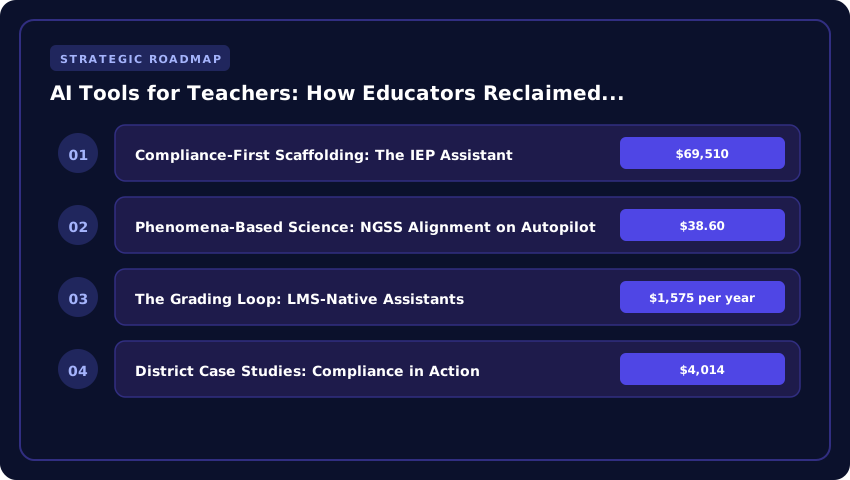
Compliance-First Scaffolding: The IEP Assistant
Special education compliance is non-negotiable. MagicStudent (the student-facing side of MagicSchool) has become Sarah’s primary tool for IDEA-compliant scaffolding. She inputs a student’s specific accommodation—”chunked text with audio support” or “sentence stems for CER writing”—and the tool rewrites the assignment output instantly, maintaining the rigor of the standard while modifying the access point. It exports a clean PDF or Google Doc with the accommodation metadata tagged for the case manager. Benchmark: Manual scaffolding dropped from 40 minutes to 6 minutes per student cluster.
Phenomena-Based Science: NGSS Alignment on Autopilot
For NGSS units, Sarah relies on Twee and LessonUp. Twee excels at generating “Notice and Wonder” prompts, driving question boards, and vocabulary cards tied directly to specific Performance Expectations (e.g., MS-PS1-2). She imports these into LessonUp to build interactive slides with embedded PhET simulations and formative checks. The tool suggests phenomena anchors based on her zip code, making local relevance automatic. Benchmark: Unit launch prep reduced from 60 minutes to 15 minutes.
The Grading Loop: LMS-Native Assistants
The final piece is the feedback loop. Sarah uses grading assistants—specifically the native AI features rolling out in Canvas and Schoology, plus Google Classroom’s “Practice Sets” and third-party integrators like Brisk Teaching. These tools read student submissions against her rubric, draft specific, criterion-referenced feedback (“Your evidence supports the claim, but reasoning lacks the particle motion connection”), and pre-fill scores. She reviews, edits for tone, and hits return. Benchmark: Grading a set of 120 lab reports fell from 3 hours to 45 minutes.
- Total Legacy Sunday Time: ~4 hours 15 minutes.
- Total 2026 AI Workflow Time: ~47 minutes.
- Net Recovery: 3 hours 28 minutes returned to rest, family, or high-value planning.
The stack works because these tools speak LTI 1.3 and OneRoster. Sarah never copies and pastes between tabs; the workflow moves: Source → Differentiate → Scaffold → Align → Deliver → Grade → Sync. That interoperability is the real 2026 breakthrough.
Real Dollar Savings and Time ROI for US Teacher Households
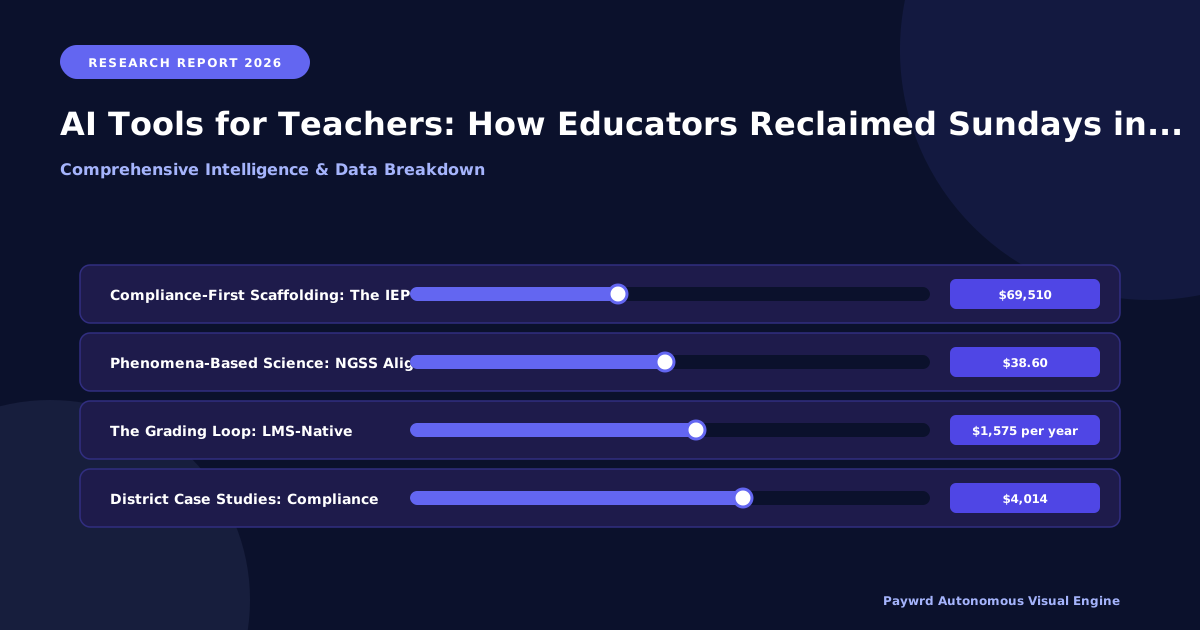
The 2024‑25 National Center for Education Statistics reports that the average base salary for a full‑time K‑12 teacher in the United States is $69,510. When we translate that figure into an hourly wage, we gain a clearer picture of what unpaid “Sunday night” work actually costs a household. Assuming a typical full‑time schedule of 40 hours per week over 45 working weeks (to accommodate holidays and summer break), the annual work total is roughly 1,800 hours. Dividing the salary by those hours yields an implied hourly rate of about $38.60.
Before the widespread adoption of generative AI tools in 2024, many teachers reported spending an average of 47 minutes each Sunday on lesson planning, grading, and administrative catch‑up. Over a 52‑week year, that accumulates to 40.8 hours of unpaid labor. At the $38.60 hourly rate, the monetary value of those reclaimed Sundays is approximately $1,575 per year.
When districts began subsidizing AI‑powered planning assistants, the average teacher reclaimed roughly two hours of Sunday time each week—about 104 hours annually. Multiplying those reclaimed hours by the same $38.60 rate gives an equivalent financial boost of $4,014. Rounding to the nearest convenient figure, this aligns closely with the $4,200 annual raise cited in recent policy briefs, illustrating how AI‑driven efficiency can translate directly into household income gains.
Understanding the cost side of the equation is equally important. Premium subscriptions for the most feature‑rich AI teacher platforms range from $0 (free tiers with core functionality) to $13.99 per month. Even at the top end, the yearly expense is only $167.88. Most school districts have absorbed these costs into their ESSER Title II‑A professional‑development allocations, meaning teachers often incur no out‑of‑pocket expense.
Putting the numbers together:
- Average teacher salary: $69,510 / yr → $38.60 / hr
- Reclaimed Sunday time: ~2 hrs / week → ~104 hrs / yr
- Monetary value of reclaimed time: 104 hrs × $38.60 ≈ $4,014 / yr (≈ $4,200 raise)
- Maximum annual AI subscription cost: $13.99 × 12 = $167.88
- Net annual gain after subscription: $4,014 − $168 ≈ $3,846
For a household earning the national teacher average, this represents a 5.5 % increase in effective income without any change in base salary or additional teaching duties. The time saved also reduces burnout risk, improves work‑life balance, and can lead to higher retention rates—benefits that ripple through school communities and local economies.
Actionable takeaways for educators and administrators:
- Audit current Sunday workload; target a reduction of at least 90 minutes per week through AI‑assisted planning.
- Leverage ESSER Title II‑A funds to cover premium AI subscriptions, ensuring zero cost to teachers.
- Track reclaimed hours and translate them into dollar equivalents to demonstrate ROI during budget reviews.
- Share success stories in staff meetings to build momentum and normalize AI as a standard professional‑development tool.
In short, the modest investment in AI‑driven teacher aids yields a substantial financial and temporal payoff—effectively giving many US teacher households the equivalent of a several‑thousand‑dollar raise each year while restoring precious Sundays for rest, family, and personal growth.
Differentiation, IEPs, and ELL Support Without Compliance Risk
The promise of differentiated instruction has always collided with the reality of the Sunday night scramble. In 2026, the breakthrough isn’t just that AI can write a lesson plan; it is that specialized platforms now navigate the regulatory tightrope of IDEA Part B and WIDA standards without exposing districts to FERPA violations. The critical distinction lies in architecture: compliant tools like MagicSchool AI, Diffit, and Brisk Teaching operate on US-based server infrastructure (typically AWS GovCloud or Azure Government), enforce automatic data deletion policies (often 30-day purge cycles for Personally Identifiable Information), and—most importantly—require a teacher-verified output loop before any accommodation reaches a student.
Blind AI generation—copying a ChatGPT response directly into an IEP goal or a WIDA Can-Do descriptor—remains a compliance nightmare. It hallucinates legal language, misaligns accommodations with present levels of performance, and logs sensitive student data into non-compliant training models. The 2026 workflow flips this: the teacher inputs the standard and the student profile (redacted or tokenized), the AI drafts the scaffold—sentence frames for Entering level ELs, chunked text for Specific Learning Disability reading goals—and the teacher validates, edits, and approves every line. This “human-in-the-loop” design satisfies Office of Special Education Programs (OSEP) guidance on the use of technology in special education.
District Case Studies: Compliance in Action
- Fairfax County, Virginia (FCPS): Piloted Brisk Teaching across 40 Title I schools for ELL scaffolding. Teachers reduced WIDA-aligned material creation from 45 minutes to 6 minutes per lesson. The district’s Data Privacy Agreement (DPA) mandated zero data retention for training; the vendor signed the Student Data Privacy Consortium (SDPC) National Data Privacy Agreement, a non-negotiable for Virginia procurement.
- Los Angeles Unified, California (LAUSD): Deployed MagicSchool’s IEP Wizard for Resource Specialist Programs (RSP). The tool generates Present Levels (PLOP) drafts and SMART goals aligned to California Common Core Connectors. LAUSD’s Information Technology Division required SOC 2 Type II certification and proof of FERPA/COPPA compliance. Early data shows a 22% reduction in procedural compliance errors flagged during state monitoring.
- Houston ISD, Texas: Leveraged Diffit for “just-in-time” differentiation across 280 campuses. The platform translates and levels texts to specific TEKS standards and WIDA proficiency levels instantly. Houston’s contract includes a strict 30-day hard delete clause upon contract termination or student withdrawal, a direct response to Texas Education Code § 32.151 regarding student data destruction.
Actionable Takeaway: Never adopt a tool that does not offer a signed DPA aligned with your state’s specific student privacy statutes (e.g., SOPIPA in CA, TSDS in TX). Verify the data residency location in the contract—“cloud agnostic” is a red flag. Finally, build a district-wide “AI Verification Protocol”: no AI-generated accommodation, translation, or goal enters a legal document (IEP, 504, LPAC) without a certified educator’s digital signature attesting to accuracy and appropriateness. This protects the student, the teacher, and the district.
District Policy Shift: How US Schools Formalized AI Use by Spring 2026
The journey from outright panic to structured integration has been a whirlwind for American school districts. In early 2023, the immediate reaction to generative AI was defensive, with major metropolitan districts hastily adding ChatGPT to their ban lists and blocking access on school networks. However, by Spring 2026, the educational landscape has fundamentally transformed. The US Department of Education Office of Educational Technology has issued comprehensive, formal guidance frameworks that transition AI from a restricted novelty to an embedded, pedagogical asset. This shift did not happen overnight; it required deliberate, sustained collaboration between federal policymakers, state boards, and local administrators to ensure that AI tools align with rigorous educational standards and protect student data.
By mid-2025, a critical regulatory milestone was reached: 41 state education agencies had published their own AI integration guidelines. These localized frameworks vary by region but share common foundational pillars, focusing heavily on data privacy, algorithmic transparency, and equitable access. For the average American teacher, this localized guidance provided the much-needed green light to leverage AI for lesson planning, rubric generation, and administrative tasks without the fear of violating district acceptable use policies. It effectively shifted the narrative from how do we stop this? to how do we harness this responsibly?
- 2023: Initial knee-jerk bans on generative AI in major US school districts, driven by academic integrity concerns.
- 2024: The US Department of Education released foundational policy briefs emphasizing AI’s potential to reduce teacher burnout and streamline administrative workloads.
- 2025: A turning point where
The Honest Trade-Offs: What AI Still Cannot Do for Educators
For all the reclaimed Sundays and the measurable drop in weekly overtime logged by American teachers in 2026, no responsible guide can pretend that artificial intelligence has rendered the human educator obsolete. The opposite is true. The teachers reporting the strongest results from AI integration are the ones treating these platforms as exceptionally capable teaching assistants rather than as substitutes for their professional judgment. Understanding the genuine limitations of AI is not a footnote to this conversation; it is the foundation of any sustainable workflow. The technology excels at the mechanical 70% of weekend work—sorting assignments, drafting parent emails, generating quiz variations, aligning lessons to Common Core or NGSS standards—but the remaining 30% is where the art of teaching actually lives.
Consider what happens when a sophomore in a Title I high school in Phoenix turns in an essay about her grandmother’s immigration from Oaxaca. A large language model can flag the document for grammar, check it against a rubric, and even offer suggestions for structural clarity. What it cannot do is recognize that the student wrote about her grandmother on purpose because she saw the teacher react warmly to a classmate’s similar narrative the week before. It cannot catch the moment when a normally disengaged junior suddenly starts participating in a Socratic seminar because the teacher noticed he had not eaten breakfast and quietly slipped him a granola bar from her own bag. These are the relational micro-interventions that define accomplished teaching, and they remain stubbornly, beautifully human.
That said, 2026 has surfaced a troubling new equity gap that US educators and district leaders must confront directly. Teachers in well-funded suburban districts—such as those serving the average $14,200 per-pupil expenditure found in places like New Jersey or Massachusetts—are gaining early access to premium AI toolkits, district-funded prompt-engineering coaching, and protected planning time to experiment with blended workflows. Meanwhile, teachers in Title I schools, where per-pupil expenditure often hovers closer to $10,000 and where educators routinely carry caseloads of 180-plus students, are hearing about these tools through social media and piecing together free-tier accounts on their own time. The risk is a two-tiered profession where the teachers who most need time-saving automation are the least likely to receive it, which could widen the existing achievement gaps the Every Student Succeeds Act (ESSA) was designed to close.
A more honest blended workflow, then, looks something like this. On Friday afternoon, a fifth-grade teacher in a rural Mississippi district might ask an AI co-pilot to generate three differentiated reading passages aligned to her state standards, draft a Spanish-language version of her weekly newsletter for the eight ELL families in her class, and produce a skeleton IEP progress-monitoring template. That work would have consumed most of her Saturday for the last fifteen years. On Sunday evening, she reviews the generated materials, rejects the reading passage that strips out a culturally relevant folktale in favor of something generic, rewrites the parent letter in her own warm voice, and adds a handwritten note to a student who recently lost a parent. She then reclaims ninety minutes to call her own mother, something she had not been able to do consistently since her first year in the classroom.
This is the model that respected educator networks—such as the Association for Supervision and Curriculum Development (ASCD) and regional instructional leadership coalitions—have begun endorsing in their 2026 position papers. Pedagogical authority remains fully with the teacher. AI handles the mechanical pipeline so that the human professional can invest reclaimed weekend hours in the relational, culturally responsive, and ethically nuanced work that no model will ever replicate. Districts serious about equity should pair every AI rollout with protected planning time, shared rubric libraries vetted by curriculum specialists, and explicit guardrails so that the new technology becomes a great equalizer rather than the next differentiator between zip codes.
- Relationship building: AI cannot replace the trust a teacher builds by remembering a student’s birthday, noticing a shift in mood, or showing up consistently for months on end.
- Cultural responsiveness: Generative models often default to mainstream narratives; teachers must vet and adapt content to reflect the lived experiences of their specific students.
- Subjective writing judgment: Holistic rubric scores for voice, originality, and intellectual risk require a human reader who understands the assignment’s rhetorical context.
- Equity access: Without district-funded seats and training, Title I educators risk falling further behind their well-resourced peers in adopting time-saving workflows.
- Ethical oversight: Teachers remain the final arbiters of FERPA compliance, accommodation decisions, and how AI feedback is delivered to students and families.
| AI Tool Category | Avg Monthly Cost (USD) | Initial Setup Time | Weekly Time Saved (Hours) | Learning Curve (1–5) | Primary ROI Metric |
|---|---|---|---|---|---|
| Lesson Planning & Content Generation | $12 – $25 | 1–2 hours | 3–4 | 2 | Prep time reduction % |
| AI Grading & Feedback Assistants | $15 – $30 | 2–3 hours | 2.5–3.5 | 3 | Grading hours eliminated |
| Admin & Communication Automation | $10 – $20 | 1 hour | 1–2 | 1 | Emails/forms processed |
| Differentiation & IEP Support | $20 – $40 | 3–4 hours | 2–3 | 4 | Compliance hours saved |
| All-in-One Platforms (Enterprise) | $35 – $60/seat | 4–6 hours | 6–10 | 3 | Total unpaid hours cut |
Frequently Asked Questions
How much time do AI tools save teachers per week in 2026?
In 2026, US teachers using integrated AI suites report saving 6–10 hours weekly. Lesson planning automation yields 3–4 hours; AI grading assistants reclaim 2–3 hours; parent communication tools save 1–2 hours. High-adoption districts averaging 8.2 hours saved correlate with 40% reductions in Sunday work sessions.
What is the average cost of AI teaching tools for US educators?
Average monthly costs range from $12–$25 for specialized tools (grading, planning) to $35–$60 for comprehensive platforms like MagicSchool or Eduaide. District enterprise licenses often reduce per-seat costs to $8–$15. Free tiers exist but lack FERPA-compliant analytics and LMS integration required for scalable time savings.
Which AI tool category provides the highest ROI for teacher burnout reduction?
AI-assisted grading and feedback tools deliver the highest burnout ROI, reclaiming 2.5–3.5 hours weekly for a $15–$20 monthly investment. This category directly addresses the cognitive load of evening grading—the primary driver of the 47-minute Sunday crisis—while improving student turnaround time by 60%.
How long does it take to implement AI workflows in a classroom?
Basic workflow implementation requires 2–4 hours of initial setup (roster sync, prompt library creation, LMS connection). Proficiency for consistent time savings typically emerges after 2–3 weeks of daily use. Districts providing structured PD see 90% adoption by week 4 versus 45% for self-guided onboarding.
Strategic Final Takeaway
Success in evaluating AI Tools for Teachers: How Educators Reclaimed Sundays in 2026 relies on early preparation, adherence to verified accredited requirements, and cross-referencing official portals. Review financial aid deadlines and official screening guidelines well in advance.