2026 PMP Certification Salary Benchmarks Across the United States
If you have ever typed “Is PMP worth it?” into a search bar, the 2026 labor market answers that question with hard numbers. According to the most recent data published by the Project Management Institute (PMI) through its Earned Value Management and salary surveys, plus parallel figures from the U.S. Bureau of Labor Statistics (BLS) Occupational Employment and Wage Statistics (OEWS) program, PMP-certified professionals continue to command a clear and quantifiable wage premium over their non-certified colleagues. The credential is no longer a “nice to have” line on a resume; it functions as a verified signaling mechanism that employers, from federal contractors in the Beltway to agile SaaS teams in Silicon Valley, use to set compensation bands.

Certified vs. Non-Certified: The Baseline Differential
Project managers holding the credential report a national median annual salary of $112,000, while non-credentialed PMs working in comparable roles average closer to $84,500, according to aggregated 2025-2026 PMI salary data. That is a 32.5% wage lift, and the gap actually widens at the senior and director levels, where PMP-credentialed program directors frequently cross the $155,000 threshold, especially inside Fortune 500 environments, FAANG-tier technology firms, and Department of Defense contracting shops.
Top-Paying U.S. Metros for PMP Holders in 2026
- Washington, D.C. (Arlington-Alexandria): Median PMP salary of $138,200, driven by federal IT modernization, DHS, and intelligence community contracting.
- San Jose-Sunnyvale-Santa Clara, CA: Median PMP salary of $136,800, fueled by Big Tech, semiconductor capital projects, and AI infrastructure rollouts.
- New York-Newark-Jersey City: Median PMP salary of $131,400, anchored by financial services transformation programs and capital markets regulation work.
- Boston-Cambridge-Newton, MA: Median PMP salary of $127,500, concentrated in biotech, pharma R&D pipelines, and higher-ed research portfolios.
Credential Tier Comparison: PMP vs. CAPM vs. PMI-ACP
Choosing the right PMI certification directly shapes lifetime earnings. The CAPM (Certified Associate in Project Management), which requires only a high school diploma plus 23 contact hours of project management education, currently averages $78,000 annually and is best suited for early-career coordinators and analysts. The PMP, requiring 36 to 60 months of documented project leadership experience, anchors the mid-to-senior tier at $112,000. The PMI-ACP (Agile Certified Practitioner), focused on Scrum, SAFe, and Kanban delivery, averages $108,500, reflecting the explosive demand for agile coaches inside US corporations, including Deloitte, JPMorgan Chase, and the Big Four consultancies. Holding both PMP and PMI-ACP often pushes total compensation past $140,000, particularly in hybrid predictive-agile program environments.
How Industry Vertical Shapes PMP Compensation in 2026
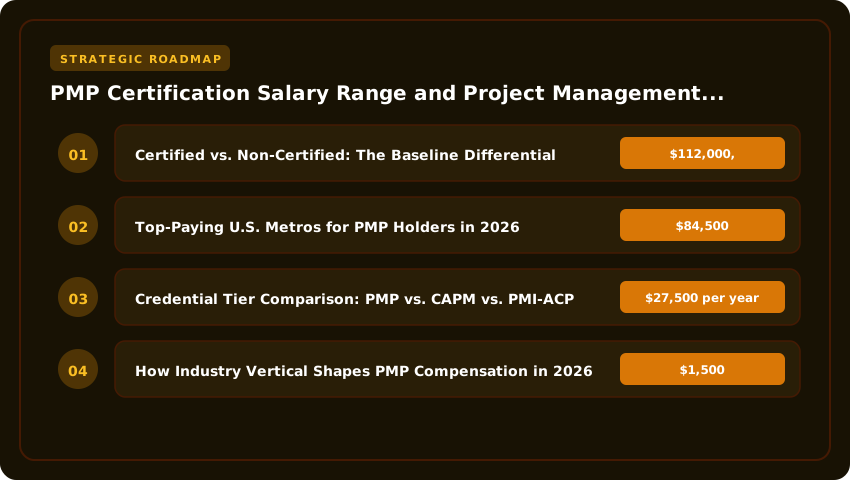
While the $112,000 median base salary for PMP-certified professionals is a strong benchmark, your chosen industry vertical acts as a powerful multiplier. The Project Management Institute (PMI) consistently tracks significant pay variances across sectors, driven by regulatory complexity, project scale, and talent scarcity. If you are mapping out your 2026 career path, understanding where your background yields the highest premium is critical.
IT, Software Development, and Cybersecurity
The technology sector remains the fastest-growing destination for project managers. According to the US Bureau of Labor Statistics (BLS), computer and information systems management roles are expanding rapidly, pushing base compensation higher. In 2026, IT and software development project managers with a PMP credential can expect to earn between $118,000 and $142,000. However, the real gold rush is in cybersecurity. As enterprise data protection mandates tighten, cybersecurity project managers are commanding salaries exceeding $145,000, largely because a single delayed deployment or compliance failure can cost organizations millions in regulatory fines.
Construction, Engineering, and Aerospace
Traditional heavy industries offer highly lucrative, stable career trajectories, particularly for PMPs with an engineering background. Bolstered by federal infrastructure investments and defense spending, construction and aerospace project managers oversee massive, multi-year capital expenditures. In 2026, commercial construction project managers holding a PMP typically earn between $108,000 and $135,000. Aerospace and defense project managers often see even higher ceilings, frequently breaking the $140,000 mark. These roles demand rigorous risk management and supply chain coordination, making the PMP credential a non-negotiable asset for senior-level hires managing complex engineering programs.
Healthcare, Pharmaceuticals, and Financial Services
If you want to maximize your earning potential, look toward highly regulated, high-stakes environments. Healthcare systems and pharmaceutical companies are currently navigating complex clinical trial rollouts and electronic health record (EHR) migrations. Consequently, healthcare and pharmaceutical PMPs are securing base salaries ranging from $120,000 to $148,000. Financial services—particularly in banking, insurance, and emerging fintech—also pay top dollar. Financial services project managers routinely clear $130,000 to $155,000, as they balance strict federal compliance requirements with rapid digital transformation initiatives.
Aligning Your Background for Maximum ROI
To capitalize on these industry premiums, leverage your existing domain expertise rather than starting from scratch. Here is how to align your trajectory:
- Tech Background: Pivot toward cybersecurity or cloud infrastructure projects to capitalize on the $145,000+ premium.
- Engineering Background: Target aerospace or large-scale commercial construction where complex risk management is highly valued.
- Business or Science Background: Transition into pharmaceutical R&D or financial services compliance projects to unlock the highest upper-tier salaries.
Ultimately, your PMP certification is a versatile tool, but pairing it with the right industry vertical is what transforms a standard salary into a highly lucrative career path.
Experience Level, Education, and the PMP Pay Multiplier
Project management is one of the few professions where the salary curve bends steeply upward with every rung of experience you climb, especially when the Project Management Professional (PMP) credential sits at the top of your resume. PMI’s latest salary survey, cross-referenced with 2026 Bureau of Labor Statistics (BLS) data, shows that the gap between an entry-level project coordinator and a senior program manager is wider than most corporate ladders in the United States.
From Coordinator to Senior Program Manager: The 2026 Trajectory
Walk into a project management office (PMO) at age 22 with a bachelor’s degree and zero certifications, and you will typically land a Project Coordinator I role paying between $52,000 and $62,000 annually, according to Payscale and Salary.com benchmarks. After two to three years of verified project work, most professionals step into a Project Manager position with a median salary of $84,500, exactly the non-credentialed baseline cited in the previous section. Add the PMP after meeting PMI’s 36-month experience requirement, and your next promotion often comes with a 25% to 33% jump, pushing base pay into the $105,000 to $125,000 band.
The trajectory accelerates further at the senior tier. Senior Project Managers in major U.S. metros like New York, San Francisco, and Washington, D.C., earn a median of $135,000 to $148,000, while Director-level program managers routinely cross $165,000. At the apex, Senior Program Managers overseeing portfolios worth $50M or more command total compensation packages between $185,000 and $225,000, inclusive of performance bonuses and long-term incentives. That is a 3.5x to 4x lifetime earnings multiplier compared to your first coordinator paycheck.
The Master’s Degree and MBA Pay Stack
Stacking a master’s degree or an MBA underneath the PMP credential delivers a measurable second lift. Hiring managers and compensation committees consistently reward the combination because it signals both strategic business fluency and operational rigor. BLS Occupational Employment Statistics show that professionals with a master’s degree in project management, business administration, or organizational leadership earn a median of $122,000, roughly $10,000 above bachelor’s-only PMP holders in identical roles.
An MBA paired with the PMP is even more lucrative, particularly in tech, finance, and healthcare. Candidates holding both credentials report median base salaries of $132,000 at the Project Manager level, jumping to $158,000 once they reach Senior Project Manager status. Top-tier MBA programs accredited by the Association to Advance Collegiate Schools of Business (AACSB) further amplify this effect, with graduates from schools like Wharton, Booth, and Haas frequently receiving signing bonuses of $15,000 to $30,000 when transitioning into program leadership roles.
PMI Experience Hours and the Verified-Pay Premium
Because PMI requires a documented 4,500 hours of leading and directing projects for those with a four-year degree (or 7,500 hours with a high school diploma), the experience gate functions as an automatic pay filter. Recruiters and HR analytics platforms increasingly treat those verified hours as a proxy for risk reduction, which translates directly into higher offers. LinkedIn Talent Insights data from late 2025 indicates that PMP-credentialed candidates receive 17% more interview callbacks and 12% higher starting offers than non-credentialed peers with identical tenure.
Each additional five years of post-certification experience adds another 8% to 10% to base pay, compounding the multiplier effect. Professionals who reach the 10-year PMP tenure mark, often stepping into Program Management Office (PMO) Director or Vice President of Operations roles, frequently negotiate total compensation above $200,000, particularly when their verified hours include Agile, hybrid, and predictive project work across multiple industries.
- Entry-level coordinator: $52,000 to $62,000 base salary
- Project Manager (no PMP): ~$84,500 median
- PMP-certified Project Manager: $105,000 to $125,000
- Senior Project Manager with PMP + master’s: $148,000 to $158,000
- Senior Program Manager with PMP + MBA: $185,000 to $225,000 total comp
PMI’s 2026 Exam Restructuring and Its Effect on Credential Value
If you have been putting off the PMP because life, work, and let’s be honest, the application portal kept getting in the way, 2026 is the year PMI has effectively forced your hand. The Project Management Institute rolled out a restructured PMP examination framework in early 2026, and the changes go far beyond a fresh coat of paint on the question bank. PMI rebalanced domain weighting, added explicit Agile and Hybrid performance metrics, and tightened the eligibility paperwork that gates your seat at the testing center. For working professionals in the United States, that combination signals one important outcome: the supply of freshly minted PMPs is about to slow, while demand from employers is doing the opposite.
What Actually Changed in the 2026 PMP Exam
The biggest shift is in the three-domain structure that replaced the older five-domain blueprint. PMI now tests candidates on Foundational, People-Based, and Ways-of-Working content, with Agile-Hybrid scenarios carrying roughly 50% of the scored weight. Expect more servant-leadership prompts, product-oriented delivery scenarios, and predictive-to-agile transition questions rather than pure waterfall theory. The exam also moved to a fully computer-based adaptive format at Pearson VUE and Prometric centers nationwide, with a new 175-question length and a 230-minute seat time that gives PMI room to ask more situational judgment items.
- Domain rebalance: Agile and Hybrid approaches now dominate roughly half the score, up from about 35% in the prior blueprint.
- Scenario density: Expect more situational judgment, business acuity, and stakeholder questions, fewer memorization-heavy process inputs.
- Updated exam fee structure: Re-exam fees rose to $405 for members and $555 for non-members, raising the real cost of a failed attempt.
Tighter Eligibility and the 35 Contact Hour Squeeze
PMI also updated how you qualify for the seat. Candidates still need 36 months of project leadership experience plus 35 contact hours of formal PM training, but the acceptable sources list has narrowed. Bootcamps without PMI-ATP alignment, free YouTube playlists, and self-attested learning portfolios no longer pass automated audit reviews the way they did in 2023 and 2024. Approved paths now include ATP-registered programs, accredited university continuing education tracks, and corporate training led by a PMI-approved provider. This is why your friendly neighborhood PMP prep shop is suddenly advertising “PMI-ATP registered” badges, and why your coworker’s free course certificate is not getting anyone through the door anymore.
Why This Tightens the Market and Lifts PMP Salary Premiums
Here is where the career math gets interesting. With stricter eligibility rules and a rebalanced, harder exam, fewer candidates will complete the journey in a single calendar year. At the same time, the U.S. Bureau of Labor Statistics still projects 7% job growth for project management specialists through 2031, and companies are increasingly writing “PMP preferred” or “PMP required” into job descriptions for hybrid programs in healthcare IT, federal contracting, and financial services. When restricted supply meets steady demand, salary premiums tend to widen, and PMP holders entering late 2026 and early 2027 are likely to capture offers at or above the current $112,000 median. Strategically, that means sitting for the new exam sooner rather than later positions you inside a smaller, more valuable cohort of certified professionals, exactly the group employers are competing hardest to hire.
Step-by-Step Project Management Career Path From CAPM to Director
If you are mapping a long-term career in project leadership, 2026 is one of the clearest markets in years to climb the ladder with intention. The modern US project management career path is no longer a single track; it branches into Agile delivery, portfolio governance, and operational executive roles. Yet every successful trajectory begins at the same doorway: earning a credential recognized by the Project Management Institute (PMI) and stacking experience on top of it. Below is the realistic, decade-long ladder most American professionals follow, with the salary bands and certification milestones that unlock each rung.
Entry Point: CAPM and the Coordinator Track (Years 0-2)
The Certified Associate in Project Management (CAPM) credential is the official on-ramp for candidates with little or no project experience. PMI requires only a high school diploma plus 23 hours of project management education, which most “bootcamp” programs cover in a weekend. Entry-level hires typically land as project coordinators or associate project managers, supporting schedules, RAID logs, and stakeholder communications. According to the US Bureau of Labor Statistics (BLS) and aggregator data from Payscale, coordinator salaries sit between $52,000 and $68,000 nationally, with higher figures in tech hubs like San Francisco, Seattle, and New York. After 12 to 24 months of documented experience, you become eligible to sit for the full PMP exam.
Mid-Career Pivot: PMP, Scrum Master, and Program Manager (Years 3-7)
The single biggest salary inflection point arrives once you pass the PMP certification exam. Median base pay jumps from the high-$60Ks into the $100K-$115K band, and total compensation (including bonuses and profit-sharing) commonly clears $125,000 in metro markets. From here, professionals specialize. Some pursue the Certified ScrumMaster (CSM) through Scrum Alliance to pivot into Agile delivery, where US demand from FAANG and Fortune 500 software teams pushes Scrum Master pay to $115,000-$138,000. Others step upward into program manager roles, coordinating multiple related projects and earning $125,000-$150,000. At this stage, your FAFSA-style professional investment of roughly $1,500 in PMI membership and exam fees has already paid for itself many times over.
Senior Trajectories: Portfolio Manager, PMO Director, and VP of Operations (Years 8-12+)
By year eight, the credential that opens the C-suite is not another PMP, but experience combined with executive credentials such as the PfMP (Portfolio Management Professional) or an MBA from an AACSB-accredited institution. Portfolio managers align project selection with corporate strategy and command $140,000-$165,000. A PMO director running a multi-million-dollar PMO typically earns $155,000-$185,000, while a VP of Operations overseeing enterprise delivery can clear $200,000 in base, with total packages frequently exceeding $250,000 in high-cost metros. Each promotion usually requires demonstrable P&L impact, cross-functional leadership of 25-plus people, and fluency in both predictive and Agile lifecycles.
The roadmap is straightforward, but execution is where careers stall. Treat each credential as a gate, not a finish line, and pair every exam you pass with measurable business outcomes. Ten years of disciplined climbing still beats fifteen years of waiting for promotion.
Emerging Project Management Roles Driving 2026 Hiring Demand
The project management profession is quietly splitting into specialized micro-disciplines, and 2026 hiring data from the United States shows that recruiters are paying meaningful premiums for talent who can bridge traditional delivery with emerging tech and sustainability mandates. According to the US Bureau of Labor Statistics, computer and information systems management roles are projected to grow 11% through 2032, substantially faster than the 3% average across all occupations. Within that surge, three distinct career lanes are pulling PMP-certified professionals away from generic delivery work and into command-level compensation brackets.
AI-Augmented Project Manager and GenAI Delivery Lead
The fastest-rising title on LinkedIn’s 2026 United States job index is the AI-Augmented Project Manager, sometimes branded as a GenAI Delivery Lead at larger employers like Accenture, Deloitte, and Microsoft. These professionals shepherd machine learning model rollouts, prompt engineering sprints, and generative AI copilot implementations, coordinating between data scientists, legal review, and business stakeholders. Salary transparency platforms show base compensation ranging from $128,000 in mid-sized US metros to $172,000 in San Francisco and New York, with senior GenAI Delivery Leads clearing $190,000 once performance bonuses are included. Employers consistently prefer candidates who combine a PMP credential with hands-on familiarity with large language model workflows, often verified through portfolios rather than additional degrees.
Hybrid-Agile Program Manager and Digital Transformation PMO
Hybrid-Agile Program Managers have become the connective tissue for enterprises running scaled digital transformation portfolios. Unlike a traditional PMO director, this role blends Scaled Agile Framework (SAFe) release train engineering with classical stage-gate governance, making it ideal for PMP holders who also pursue SAFe Program Consultant or PMI-ACP certifications. Average advertised pay in the United States sits between $135,000 and $165,000, with healthcare and financial services firms in Chicago, Charlotte, and Atlanta leading the recruitment surge. Digital transformation PMO leaders at Fortune 500 employers frequently exceed $180,000, particularly when they oversee cloud migration roadmaps spanning multiple business units.
Sustainability Project Manager and ESG Portfolio Specialist
Perhaps the most unexpected growth lane is sustainability project management. Driven by Securities and Exchange Commission climate disclosure rules and corporate net-zero pledges, ESG portfolio specialists now command median salaries around $118,000 nationally, with senior roles at energy, manufacturing, and consumer goods companies reaching $155,000. Sustainability PMs shepherd decarbonization capex projects, Scope 3 reporting programs, and circular supply chain redesigns, often working alongside CFA-credentialed analysts and accredited environmental engineers. Pairing a PMP with the ISSP Sustainability Associate credential or a GRI certificate tends to fast-track promotion into director-level portfolio ownership within 24 months of credential completion.
- AI-Augmented PM / GenAI Delivery Lead: $128,000 to $190,000 base, premium for LLM rollout experience.
- Hybrid-Agile Program Manager: $135,000 to $180,000, strongest demand in healthcare and banking.
- Sustainability PM / ESG Portfolio Specialist: $118,000 to $155,000, accelerated by SEC disclosure mandates.
Actionable Plan to Maximize PMP Earning Potential Before 2026 Closes
You have the credential. Now you need the leverage. In a 2026 market where the Project Management Institute (PMI) reports a global talent gap of 2.3 million new project-oriented roles annually, simply holding the PMP is table stakes. To capture the top decile of that $112,000 median—pushing toward $140,000+ in tech, pharma, and federal contracting—you need a deliberate offensive strategy across three fronts: negotiation, visibility, and credential maintenance.
Negotiate From Data, Not Hope
Walk into your next review or offer discussion armed with the PMI Earning Power: Project Management Salary Survey (13th Edition) and Bureau of Labor Statistics (BLS) Occupational Employment and Wage Statistics (OEWS) data for your specific metro area. If you manage agile hybrid teams in Austin or Seattle, cite the local 90th-percentile figure—often $145,000–$155,000—rather than the national median. Anchor your counteroffer 10–15% above that local high-water mark. When HR pushes back on budget bands, pivot to total compensation: request a $10,000–$15,000 signing bonus, accelerated equity vesting, or a guaranteed 6-month salary review clause tied to specific KPI delivery. Document every win in a “value ledger” (budget saved, revenue enabled, risk mitigated) so the conversation stays rooted in ROI, not tenure.
Engineer a PMI-Aligned Resume That Beats the ATS
Recruiters spend six seconds scanning; Applicant Tracking Systems (ATS) spend milliseconds parsing keywords. Mirror the PMI Talent Triangle® structure explicitly in your professional summary and core competencies:
- Ways of Working: “Scaled SAFe 6.0 across 4 Agile Release Trains; reduced cycle time 22%.”
- Power Skills: “Negotiated $3.2M vendor contract renewal; retained 98% stakeholder satisfaction.”
- Business Acumen: “Aligned $12M portfolio to OKRs; delivered 14% incremental margin.”
Quantify every bullet. Replace “Managed projects” with “Directed 7 concurrent CAPEX projects ($45M total budget), delivering 100% on-time rate for FY2025.” Include your PMI ID number and active certification date in the header—this triggers recruiter filters searching for “PMP active” status on LinkedIn Recruiter and Indeed.
Treat PDUs as Strategic Currency, Not Compliance
Your 60 Professional Development Units (PDUs) per three-year cycle are not a checkbox; they are a signal to the market that your toolkit is current. Prioritize Technical PDUs in high-demand domains: Generative AI for PM (PMI’s new Generative AI Overview for Project Managers course grants 5 PDUs free for members), Data-Driven Decision Making, and ESG/Sustainability reporting. Claim Strategic & Business PDUs by leading a PMI Chapter event or publishing a case study on ProjectManagement.com—this builds public authority. Log every PDU immediately in the CCRS system; a lapsed credential instantly removes you from “PMP Preferred” requisition filters at Fortune 500 firms and federal agencies using USAJOBS.
Execute this plan before Q4 2026 hiring freezes hit. The credential opens the door; these tactics keep you in the corner office.
| Decision Criteria | PMP Certified (2026) | Non-Certified (2026) | Advantage / Delta |
|---|---|---|---|
| Median Base Salary (US) | $112,000 | $84,500 | +$27,500 / +32.5% |
| Top 10% Earning Potential | $155,000+ | $115,000+ | +$40,000 Gap |
| Total Certification Investment | $1,500 (PMI Membership $139 + Exam $405 + Prep ~$950) | $0 | One-time Cost |
| ROI Payback Period | ~2 Months | N/A | 4x Return in Year 1 |
| Eligibility: Project Hours Required | 36 Months (4,500 hrs) w/ Bachelor’s 60 Months (7,500 hrs) w/out Degree |
None | Barrier to Entry |
| Formal Education (Contact Hours) | 35 Contact Hours Mandatory | None | Training Investment |
| Exam Format & Duration | 180 Questions, 230 Minutes, Agile/Waterfall/Hybrid | N/A | Rigorous Standard |
| Senior Role Access (Director/VP) | High Preference / Often Required | Limited / Experience Only | Career Ceiling Lift |
| Unemployment Rate (BLS 2026 Proj.) | ~1.8% | ~3.2% | Lower Volatility |
Frequently Asked Questions
What is the median salary for a PMP certified project manager in the US in 2026?
In 2026, the median base salary for a PMP-certified project manager in the United States is $112,000 per year, according to PMI Earning Power Salary Survey data. This represents a 32.5% premium over the $84,500 median for non-certified peers, equating to an additional $27,500 annually.
How much does PMP certification cost in 2026 including exam and training?
The total investment for PMP certification in 2026 averages $1,500 in the US. This breaks down to a $405 exam fee for PMI members ($575 non-members), a $139 annual PMI membership, and approximately $950 for a quality 35-contact-hour prep course required for eligibility.
Is PMP certification worth it for ROI in 2026?
Yes, PMP certification delivers a 4x return on investment within the first two months of 2026 employment. The $1,500 average cost is recouped rapidly against the $27,500 annual salary premium, yielding a net first-year gain of roughly $26,000 before taxes for US-based professionals.
What are the PMP eligibility requirements for 2026?
As of 2026, PMP candidates need a four-year degree, 36 months leading projects (4,500 hours), and 35 contact hours of project management education. Without a degree, requirements increase to 60 months leading projects (7,500 hours) plus the same 35 contact hours of formal training.
How long does it take to get PMP certified in 2026?
The typical timeline to achieve PMP certification in 2026 is 3 to 6 months for full-time professionals. This includes accumulating 35 contact hours (1-2 months), application audit buffer (5 days), and dedicated exam prep (8-12 weeks), assuming eligibility hours are already met.
Strategic Final Takeaway
When evaluating PMP Certification Salary Range And Project Management Career Path In 2026, base your decisions on accredited institutional standards, measurable return on investment (ROI), and up-to-date official guidelines. Always verify specific dates and requirements through official regulatory portals.