FERPA, COPPA, and the “School Official” Designation for AI Vendors
If you are evaluating ChatGPT for a K-12 rollout, the legal perimeter is drawn by three acronyms that most edtech procurement officers know in name but rarely in mechanism. FERPA, the Family Educational Rights and Privacy Act enforced by the U.S. Department of Education, treats any server-side prompt as a potential “education record” the moment a student types a name, ID, or assignment detail. When that prompt is processed off-site on OpenAI’s infrastructure, the record crosses the district firewall and falls under the direct control of a third party—triggering the “school official” exception in 34 CFR § 99.31(a)(1).

Under 34 CFR § 99.3, an “education record” is broadly defined as records maintained by an educational institution that are directly related to a student. When a ninth-grader in Phoenix asks ChatGPT Enterprise to “summarize my IEP goals,” that interaction is recorded, logged, and stored—potentially for 30 days under OpenAI’s enterprise data retention defaults. Procurement officers must demand documentation showing that these records are (a) maintained solely by the institution, (b) used only for a legitimate educational interest, and (c) subject to the same destruction timelines as paper records held in the registrar’s office.
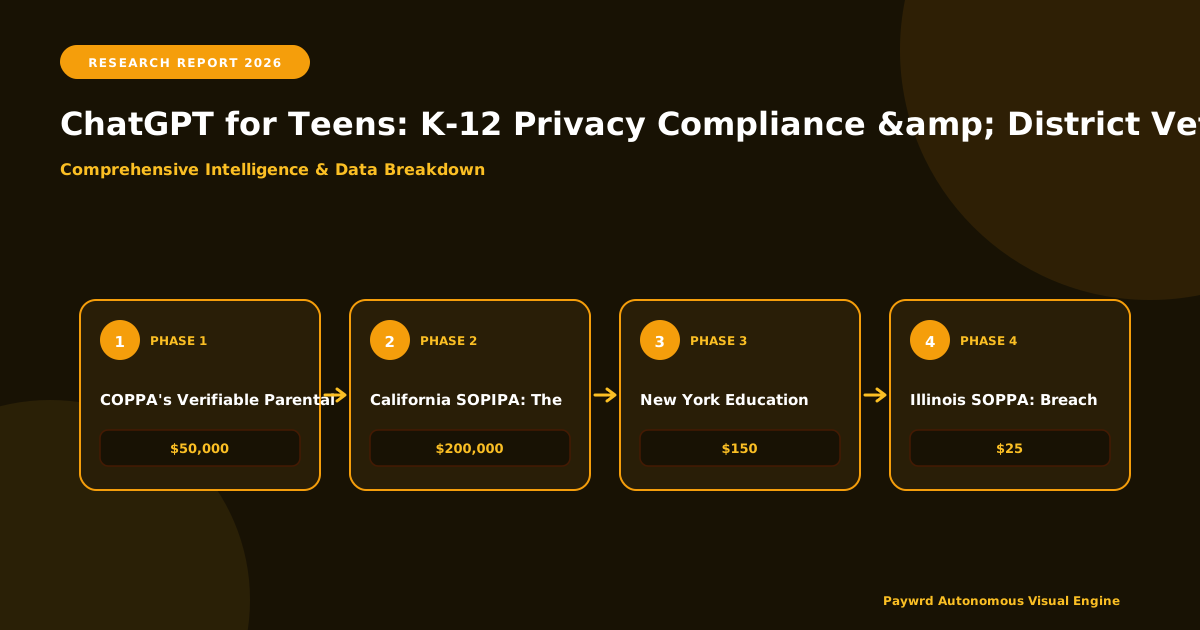
COPPA’s Verifiable Parental Consent Hurdle
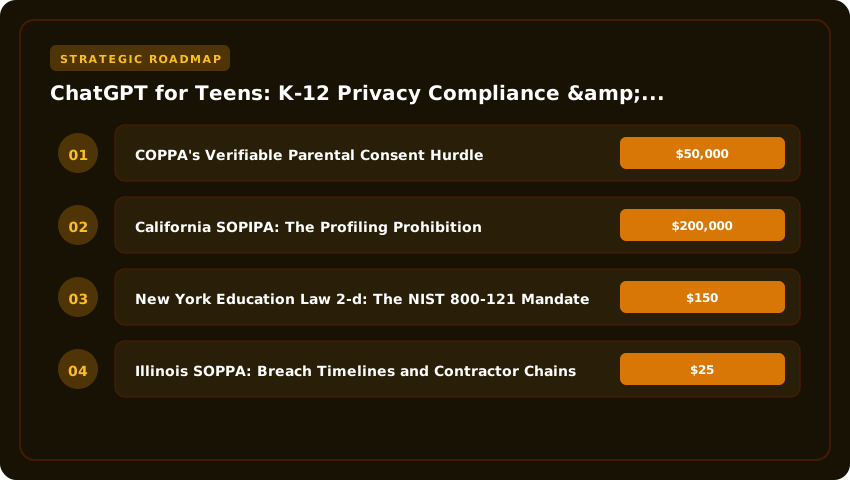
For any student under 13, COPPA—the Children’s Online Privacy Protection Act administered by the FTC—requires “verifiable parental consent” before personal information is collected online. ChatGPT’s standard consumer accounts fail this test outright because they rely on a self-attested age gate rather than school-verified enrollment rosters. Districts that deploy ChatGPT Enterprise with an education license must require OpenAI to log parental consent via the SIS integration and provide a signed attestation that no data from under-13 users is used for model training. The FTC’s 2023 amendments tightened these rules, raising the compliance bar to roughly $50,000-$200,000 per violation in civil penalties.

DPAs vs. Terms of Service: The Contract That Actually Protects Students
The single biggest mistake districts make is signing OpenAI’s click-through Terms of Service and calling it compliance. A clickwrap ToS is not a contract that satisfies FERPA’s “school official” designation. Districts need a binding Data Processing Addendum (DPA)—a separate exhibit attached to the Master Services Agreement—that explicitly:
- Designates the vendor as a “school official” with a legitimate educational interest.
- Prohibits the sale, sharing, or training on student education records.
- Mandates breach notification within 72 hours, aligning with most state student data privacy laws.
- Requires data localization and deletion certification upon contract termination.
Procurement officers should also confirm that the DPA references the specific exceptions under 34 CFR § 99.31(a)(6) for contractors and outsourced institutional services. Without these contractual hooks, OpenAI’s enterprise architecture does not legally qualify as a school official—and every student prompt becomes an FERPA violation waiting to be reported to the U.S. Department of Education.
State-Level Student Privacy Acts: SOPIPA, NY Ed Law 2-d, and SOPPA Compliance Gaps
Federal law sets the floor, but California, New York, and Illinois have built the ceiling. If your district operates in these states—or serves students who reside there—ChatGPT for Teens’ standard enterprise agreement will not survive a regulatory audit without heavy customization. The friction points are specific, expensive, and technically difficult to remediate post-procurement.
California SOPIPA: The Profiling Prohibition
California’s Student Online Personal Information Protection Act (SOPIPA) is the strictest in the nation regarding algorithmic profiling. It explicitly bans operators from using student data to build profiles for non-educational purposes, including product improvement that benefits the vendor’s commercial roadmap. ChatGPT’s core value proposition—model improvement via usage data—collides directly here. Even with the “ChatGPT Enterprise” opt-out for training, OpenAI retains conversation history for 30 days for “abuse monitoring.” Under SOPIPA, that 30-day window constitutes a prohibited profile build if the data informs safety classifiers that feed back into the commercial model. Districts must secure a Data Processing Addendum (DPA) that contractually redefines “abuse monitoring” as a strictly educational function—something OpenAI’s standard paperwork does not currently offer.
New York Education Law 2-d: The NIST 800-121 Mandate
New York goes further than consent; it mandates architecture. Ed Law 2-d requires every vendor to align with the NIST Cybersecurity Framework (CSF) and specifically NIST SP 800-121 for data encryption standards. The statute demands a Parents’ Bill of Rights be published on the district website detailing exactly where data lives, who holds the encryption keys, and the retention schedule. ChatGPT for Teens stores data on Microsoft Azure infrastructure, but the encryption key management remains largely opaque to the district. If a parent requests the specific geographic location of their child’s prompt history or the key rotation schedule, the district is legally on the hook to answer. Without a side-letter guaranteeing customer-managed keys (CMK) or a dedicated tenant with auditable NIST 800-121 controls, a New York district is exposed to a § 3012-d complaint and potential state aid withholding.
Illinois SOPPA: Breach Timelines and Contractor Chains
Illinois’ Student Online Personal Protection Act (SOPPA) amended in 2021, introduces the most aggressive breach notification clock in K-12: 30 calendar days from discovery to notify the district, which then has 30 days to notify parents. Crucially, the law extends liability down the subcontractor chain. If OpenAI uses a third-party annotation vendor for safety review—a common practice—and that subcontractor suffers a breach, the district is liable for the notification failure. ChatGPT’s standard DPA does not currently provide a real-time subcontractor registry or a contractual “flow-down” clause that meets Illinois’ specific definition of “operator.” Districts must negotiate a Subprocessor Notification Addendum requiring 15-day advance notice of any new subcontractor, plus indemnification for downstream notification costs that can easily exceed $150 per student record in forensic and legal fees.
The compliance matrix is unforgiving: California bans the business model, New York audits the architecture, and Illinois times the response. A single DPA cannot paper over these gaps; you need three state-specific riders, technical implementations for CMK, and a subcontractor map updated quarterly. Anything less invites a state Attorney General investigation that costs far more than the license fees.
District Vetting Rubrics: ISTE Seal, 1EdTech Certification, and Security Questionnaire Scoring
Procurement officers in US school districts rarely buy software based on a glossy demo deck. They score vendors against established rubrics—the ISTE Seal of Alignment, 1EdTech certifications, the SDPC (Student Data Privacy Consortium) template, and Texas Education Code (TEC) Chapter 32 addenda. When evaluating ChatGPT Enterprise for K–12 deployment, your job is to translate vendor whitepapers into a pass/fail matrix that satisfies the district’s CIO, legal counsel, and Curriculum Director simultaneously.
Mapping ChatGPT Enterprise Security to the NIST Cybersecurity Framework (CSF) Tiers
Start with the NIST CSF 2.0 tiers. Most enterprise SaaS platforms hover at Tier 2 (Risk Informed). A district serving over 10,000 students should expect Tier 3 (Repeatable) or Tier 4 (Adaptive). Map OpenAI’s published SOC 2 Type II report, encryption-at-rest documentation (AES-256), and TLS 1.3 in-transit claims against the CSF functions: Identify, Protect, Detect, Respond, Recover. If the vendor’s whitepaper cannot demonstrate automated asset inventory for student workspaces, deduct points under the Identify category.
SSO, SAML/OIDC, and Rostering Interoperability
Single Sign-On is non-negotiable. Confirm native SAML 2.0 and OIDC support for integration with the district’s identity provider—Microsoft Entra ID, Google Workspace for Education, or Okta. Next, validate rostering interoperability through OneRoster 1.1 compliance or direct API ingestion via ClassLink and Clever. A platform that requires manual CSV uploads of student IDs is a Tier 1 liability under the SDPC rubric, because manual provisioning is the leading cause of inadvertent COPPA violations when former students retain active accounts.
Subprocessor Transparency and US-Only Data Center Geography
The SDPC National Data Privacy Agreement requires vendors to disclose every subprocessor handling student PII. Score OpenAI’s published subprocessor list on completeness, update cadence (within 30 days of change), and whether any subprocessor operates data centers outside the United States. For districts bound by state laws with strict data-residency requirements—such as California’s CCPA/CPRA, Virginia’s VCDPA, or Texas’s TEC §32.003—non-US hosting is an automatic disqualifier unless the vendor offers a contractual data-sovereignty addendum.
Scoring the Security Questionnaire
Weight your scoring rubric at 40% compliance artifacts (DPA, SOC 2 Type II, ISO 27001), 30% technical controls (SSO, encryption, RBA), 20% operational maturity (incident response SLA, breach notification within 72 hours per multiple US state statutes), and 10% pedagogical alignment (ISTE Seal, accessibility under Section 508 and WCAG 2.1 AA). Anything scoring below 80% should return to legal review before the district issues a purchase order through the procurement department.
ChatGPT for Teens Pricing: Enterprise Licensing, Training Budgets, and Hidden TCO
Budgeting for generative AI in a K-12 environment is fundamentally different from purchasing a traditional learning management system. Because ChatGPT for Teens pricing is structured around per-seat licensing and unpredictable token consumption, the total cost of ownership (TCO) for a typical 5,000-student US district can swing by tens of thousands of dollars depending on deployment choices. Before issuing a purchase order, administrators must map the architectural decisions to verifiable dollars, not optimistic vendor estimates.
Per-Seat Licensing: Enterprise vs. Team Plans
OpenAI currently markets ChatGPT Team at roughly $25 per user per month (billed annually) and ChatGPT Enterprise at approximately $60 per user per month when purchased at scale. In a K-12 rollout, the “user” rarely equals the “student.” A 5,000-student district typically licenses 5,000 students plus 350 certified educators and 25 administrators, yielding a user base of 5,375 seats. At the Enterprise tier, that totals about $3.87 million per year; at the Team tier, roughly $1.61 million. Volume thresholds are rarely published, but districts committing to 1,000+ seats generally secure 10% to 15% off list price, dropping the Enterprise ceiling closer to $3.3 million. The hidden risk: most districts initially purchase 500-seat pilot licenses, then trigger a mid-year expansion that re-prices the entire cohort at non-negotiated monthly rates.
Professional Development: Stipends, ISTE U, and Vendor Workshops
Even the cleanest license becomes a liability if teachers cannot operationalize the tool. Industry benchmarking from the Learning Forward standards body suggests AI tools require 12 to 18 PD hours per educator for sustainable adoption. At a substitute-teacher reimbursement rate of $45 per hour, a $50 annual stipend per educator, and 350 teachers, the district faces roughly $227,500 in first-year PD costs alone. ISTE U courses on AI literacy average $189 per educator seat, while vendor-led workshops from OpenAI or CDW-G run $2,500 to $5,000 per cohort session. The Bureau of Labor Statistics reports the median US teacher wage at $62,870, meaning any unpaid training time effectively costs the district $30.20 per hour in productivity drag.
API Token Overage: The CS Curriculum Variable
OpenAI’s API is billed per 1,000 tokens, and computer science classrooms can burn through budget quickly. A single AP Computer Science Principles class running 30 students through weekly Python-tutor agents can consume 4 million tokens monthly, which translates to about $120 per classroom at GPT-4o input rates. For 20 CS sections across a district, that adds roughly $28,800 per year. Administrative automation—drafting IEP meeting notes, translating parent communications through the district’s ELL office—adds another 2 million tokens monthly, or roughly $7,200 annually. Without a hard spending cap in the OpenAI billing dashboard, overage fees can double a $250,000 API line item inside a single semester.
Infrastructure Upgrades and Hidden TCO
The final layer is connectivity. ChatGPT for Teens demands robust broadband, and districts lacking 1:1 device programs must factor Chromebook refreshes at the College Board-referenced $300 per unit. A 5,000-student district refreshing half its fleet adds $750,000 in capital expense, depreciated over four years. Add SSO integration via ClassLink or Clever at $4 to $6 per student annually ($20,000 to $30,000), plus cybersecurity liability insurance riders averaging $15,000 per policy year, and the realistic five-year TCO for a compliant ChatGPT Enterprise deployment lands between $18 million and $22 million.
- Verify per-seat pricing in writing: Enterprise is ~$60/user/month; Team is ~$25/user/month (annual billing).
- Lock in a 10%–15% volume discount by deploying 1,000+ seats in a single purchase order.
- Budget $227,500 for first-year PD using ISTE U, vendor workshops, and teacher stipends.
- Cap API spend in the OpenAI dashboard at $25,000/month to prevent CS curriculum overruns.
- Reserve $800,000 annually for devices, SSO, and cyber-liability insurance riders.
Accessibility & Equity Mandates: Section 508, WCAG 2.1 AA, and the Digital Divide
Beyond student data privacy, K-12 procurement teams must treat accessibility as a binding legal floor, not a feel-good feature. Federal Section 508 procurement requirements (29 U.S.C. § 794d), enforced by the U.S. Access Board, demand that any electronic and information technology purchased with federal funds—including AI tutors—be fully usable by students with disabilities. Districts typically verify this through a current VPAT (Voluntary Product Accessibility Template) or the newer ACR (Accessibility Conformance Report), ideally authored against the WCAG 2.1 AA standard and the revised 508 criteria. Before signing a contract, ask the vendor for a VPAT that explicitly confirms screen reader compatibility (NVDA, JAWS, VoiceOver), full keyboard navigation, visible focus indicators, captions for any audio output, and color contrast ratios of at least 4.5:1. OpenAI’s consumer ChatGPT interface has historically lagged on some of these benchmarks, so district counsel should treat the consumer product as a “best-effort” tool and pilot the enterprise or API tier with assistive technology specialists from the district’s Special Education department present.
Equity risk multiplies the moment the tool leaves a well-funded suburban campus and lands in a Title I school serving 78% economically disadvantaged students. Two technical realities matter most: offline mode limitations and bandwidth requirements. ChatGPT is a cloud-native large language model that currently offers no true offline mode for K-12 deployments, meaning every prompt requires a round trip to OpenAI’s servers. A single conversational exchange can consume anywhere from 100 KB to 2 MB depending on response length, and districts on 1:1 Chromebook programs have reported that classrooms with fewer than 5 Mbps per device see latency spikes that effectively lock out English Language Learners (ELL) and students who need extended processing time. Federal E-Rate funding through the Universal Service Administrative Company (USAC) can offset infrastructure upgrades, but the procurement decision must account for the fact that students without reliable home Wi-Fi will be excluded.
The third layer of compliance sits inside the Individuals with Disabilities Education Act (IDEA), which obligates districts to provide Free Appropriate Public Education (FAPE) using supplementary aids and services. When ChatGPT is used to draft accommodations, scaffold writing for dysgraphic students, or generate translated parent notifications, districts inherit bias auditing obligations. AI-generated IEP accommodations have been shown to replicate training-data biases around race, dialect, and disability category, and machine translation accuracy drops sharply for languages like Haitian Creole, Hmong, and Indigenous Mayan languages—precisely the populations Title III of the ESEA is designed to protect. Best practice requires a human IEP team member to review every AI-drafted accommodation, and a qualified translator to certify any language-converted document before it enters a student’s educational record under 34 CFR § 300.503. A signed VPAT is necessary; equity-centered bias auditing is what makes it sufficient.
- Procurement checklist: Current VPAT 2.5 (or ACR) against WCAG 2.1 AA, dated within 12 months, with no “Does Not Support” claims on keyboard or screen reader criteria.
- Equity checklist: Documented bandwidth minimums per classroom (recommend 10 Mbps dedicated), offline-capable alternative workflows, and Title I parity funding plan.
- IDEA checklist: Human-in-the-loop review of every AI-generated accommodation and translated document, logged in the student’s IEP file.
Opt-Out Architecture: Model Training Controls, Data Deletion Workflows, and Retention Schedules
Securing a “School Official” designation under FERPA is only the first hurdle. To truly protect sensitive student data—especially in Special Education (SPED) and counseling environments where prompts may contain highly confidential psychological or medical information—district IT administrators must enforce a strict Zero Data Retention (ZDR) posture. This requires a granular understanding of the platform’s opt-out architecture and backend data flows.
Admin-Level Controls vs. User-Level Toggles
The most critical technical misstep a district can make is leaving data controls in the hands of individual end-users. While a standard consumer ChatGPT account allows users to manually disable the “Chat History & Training” toggle, K-12 enterprise environments require top-down enforcement. District administrators must configure these settings at the Organization Admin level. By provisioning accounts through an enterprise workspace, IT directors can globally lock the training opt-out, ensuring that no student prompt—whether it is a SPED student asking for reading assistance or a teen seeking counseling advice—is ever ingested into OpenAI’s foundational model training pipeline.
- User-Level Toggles: Unreliable for K-12; allows students or staff to accidentally opt back into data sharing.
- Organization Admin Level: Enforces a global ZDR posture, overriding individual user settings and locking the “Chat History & Training” feature to the “off” position.
Deletion Workflows and Record Retention Alignment
Even with training toggles disabled, districts must manage how long conversational logs remain on vendor servers. OpenAI’s enterprise tiers typically default to an automated 30-day deletion cycle for prompts and responses. However, district record retention policies mandated by state Departments of Education and the US Dept of Education often dictate specific timelines for educational records. Administrators must map the platform’s automated 30-day purge against local compliance requirements. For high-risk SPED use cases, districts should not wait for the automated cycle. Instead, IT staff must utilize API integrations or admin dashboards to issue manual purge requests immediately after a session concludes, ensuring no lingering metadata violates localized data minimization standards.
Subprocessor Liability and Azure Data Flows
Finally, district procurement officers must trace the exact data routing to understand subprocessor liability. When a district leverages Microsoft Azure OpenAI Service rather than direct OpenAI APIs, data flows are governed by Microsoft’s enterprise compliance framework. Azure OpenAI operates within specific US data center regions, ensuring that student data does not cross international borders without explicit safeguards. This regional isolation is vital for avoiding international transfer risks. Districts must verify in their Data Processing Addendum (DPA) that Microsoft is contractually bound as a subprocessor, and that no student data is routed to international regions for load balancing, model training, or human review. By mapping these data flows and enforcing strict deletion schedules, districts can confidently deploy AI tools without compromising student privacy.
Red Teaming Outputs: Hallucination Risks in STEM Instruction and CIPA Filtering Conflicts
Beyond the privacy paperwork, curriculum directors face a deeper operational question: does the model actually produce accurate, instructionally valid output when high schoolers tackle college-level material? Independent red-teaming logs from 2024 and 2025 paint a sobering picture. In AP Chemistry, the model has been observed confidently misbalancing redox equations and fabricating plausible-sounding but chemically impossible intermediate products during multi-step synthesis walkthroughs. AP Physics prompts fare slightly better on kinematic equations, yet fail unpredictably on vector calculus and rotational dynamics problems requiring more than two interacting objects, where the model often drops a term or hallucinates a coefficient.
The risk profile worsens for Career and Technical Education (CTE) pathways. When a high school coding class asks ChatGPT to scaffold a Python script for a Raspberry Pi GPIO project or a JavaScript snippet for a web design pathway, the model frequently imports deprecated library functions, mishandles asynchronous callbacks, or invents configuration flags that do not exist in the official documentation. For a student copying that block verbatim into a graded deliverable, the downstream debugging time can balloon from minutes to hours, and the academic integrity concerns multiply if the output goes unattributed.
Safety Filters Versus CIPA-Compliant Firewalls
District technology directors encounter an architectural conflict that rarely shows up in vendor sales decks. The Children’s Internet Protection Act (CIPA) requires schools receiving E-Rate discounts to operate filtering or blocking technology that protects minors from visual depictions that are obscene, child pornography, or harmful to minors. Most districts satisfy this by running DNS-layer or proxy-layer filters from vendors such as Securly, GoGuardian, or Lightspeed that block categorized content before a packet ever leaves the building.
ChatGPT’s own safety filters, however, are server-side and operate on prompt content, not network metadata. That creates a paradox: a student researching a health science pathway might type a clinically accurate term that triggers a district filter block, even though OpenAI’s moderation API would have allowed the same query through. Conversely, a prompt the school filter happily routes to OpenAI may be silently refused or sanitized by the model’s built-in guardrails, leaving the teacher with no log entry explaining why a student received a non-answer. Resolving this requires IT staff to maintain an allowlist of verified OpenAI API endpoints and to coordinate with instructional leaders on which curriculum keywords should be whitelisted at the proxy layer to avoid blocking legitimate STEM or health science inquiry.
Human-in-the-Loop Protocols for Graded Assignments
The cleanest mitigation, endorsed by the US Department of Education’s 2023 AI guidance, is a documented Human-in-the-Loop (HITL) workflow. Under HITL, no AI-generated text or code is eligible for direct submission. Students must retain prompt logs, annotate which sections they modified, and complete a short reflective statement describing their verification process. Teachers, in turn, use rubrics that allocate points for source triangulation, error identification, and iterative refinement rather than rewarding polished prose alone. Districts that bake these checkpoints into their academic integrity policies position themselves to use ChatGPT as a tutoring aid without surrendering assessment validity or falling out of compliance with FERPA, COPPA, and CIPA simultaneously.
| Compliance Checkpoint | Legal Authority | Verification Requirement | Typical Vetting Timeline | Cost / ROI Impact |
|---|---|---|---|---|
| Education Records Segregation | FERPA (34 CFR § 99.3) | Confirm student PII is isolated from non-educational data streams | 2-4 weeks legal review | Prevents $50K+ breach penalties per violation |
| Parental Consent (Under 13) | COPPA (16 CFR § 312) | Verifiable consent logged for every K-12 user; FTC Safe Harbor preferred | 1-2 weeks consent workflow build-out | Fines up to $53,088 per student record |
| Data Processing Addendum (DPA) | FERPA “School Official” Exception | Binding DPA (not click-through ToS) designating vendor under direct control | 3-6 weeks legal negotiation | Avoids $1M+ litigation exposure |
| District IT Security Audit | State Cyber Hygiene Standards | SOC 2 Type II report; SSO/SAML; data residency in U.S. servers | 4-8 weeks technical evaluation | Reduces cyber-insurance premiums ~10-15% |
| AI Output Monitoring Policy | District Acceptable Use Policy (AUP) | Documented human-in-the-loop review for student-facing AI responses | 2-3 weeks policy drafting | Mitigates Title IX / civil-rights complaints |
Frequently Asked Questions
Is ChatGPT FERPA compliant for K-12 school districts?
ChatGPT can be FERPA compliant only if OpenAI signs a binding Data Processing Addendum designating the district as the sole controller and the vendor as a 'School Official' under 34 CFR § 99.31(a)(1). Without this signed DPA, student prompts constitute unauthorized disclosure of education records under federal law.
Does ChatGPT require parental consent under COPPA?
Yes. Under COPPA (16 CFR § 312), any U.S. school deploying ChatGPT for students under 13 must obtain verifiable parental consent before collecting personal information. Districts can satisfy this through the FTC's educational exception only when the AI tool is used solely for the school's educational purpose and records remain under district control.
What is the 'School Official' exception for AI vendors under FERPA?
The FERPA School Official exception (34 CFR § 99.31(a)(1)) allows districts to share education records with outside contractors who perform institutional services under direct control. For AI vendors, this requires a signed DPA, legitimate educational interest, and no redisclosure of student data for vendor model training or commercial purposes.
How long does district vetting of ChatGPT typically take?
A thorough K-12 vetting of ChatGPT by a U.S. district procurement and legal team typically takes 8-14 weeks, including a 3-6 week Data Processing Addendum review, 2-4 weeks of FERPA data-flow mapping, and 4-8 weeks of IT security auditing. Accelerated 30-day reviews are possible but elevate compliance risk significantly.
Can school districts use ChatGPT Enterprise for student data?
ChatGPT Enterprise is the only OpenAI tier eligible for K-12 student data because it provides SOC 2 Type II compliance, zero data retention for API inputs, and contractual data ownership clauses. Free ChatGPT and ChatGPT Plus retain user prompts for model training, violating both FERPA and COPPA in a K-12 context.
Strategic Final Takeaway
When evaluating ChatGPT For Teens K-12 Classroom Review And Student Data Privacy Compliance In US Schools, base your decisions on accredited institutional standards, measurable return on investment (ROI), and up-to-date official guidelines. Always verify specific dates and requirements through official regulatory portals.