
For working educators and career-switchers eyeing a four-year degree in early childhood education, the smartest path in 2026 rarely starts on a traditional university campus. Community colleges are quietly becoming the launchpad of choice, and the data tells a compelling story.

Why Community College Is Reshaping the Bachelor Degree Path for Early Childhood Educators
The shift is structural, not anecdotal. Across the United States, community colleges and four-year universities have spent the last decade formalizing 2+2 articulation agreements specifically designed for early childhood education (ECE) pathways. These written contracts guarantee that an associate degree earned at a regionally accredited community college will transfer in full toward a bachelor’s degree at a partnering state university. For working childcare workers, paraprofessionals, and Head Start staff, this eliminates the most common fear: “Will my credits count?”
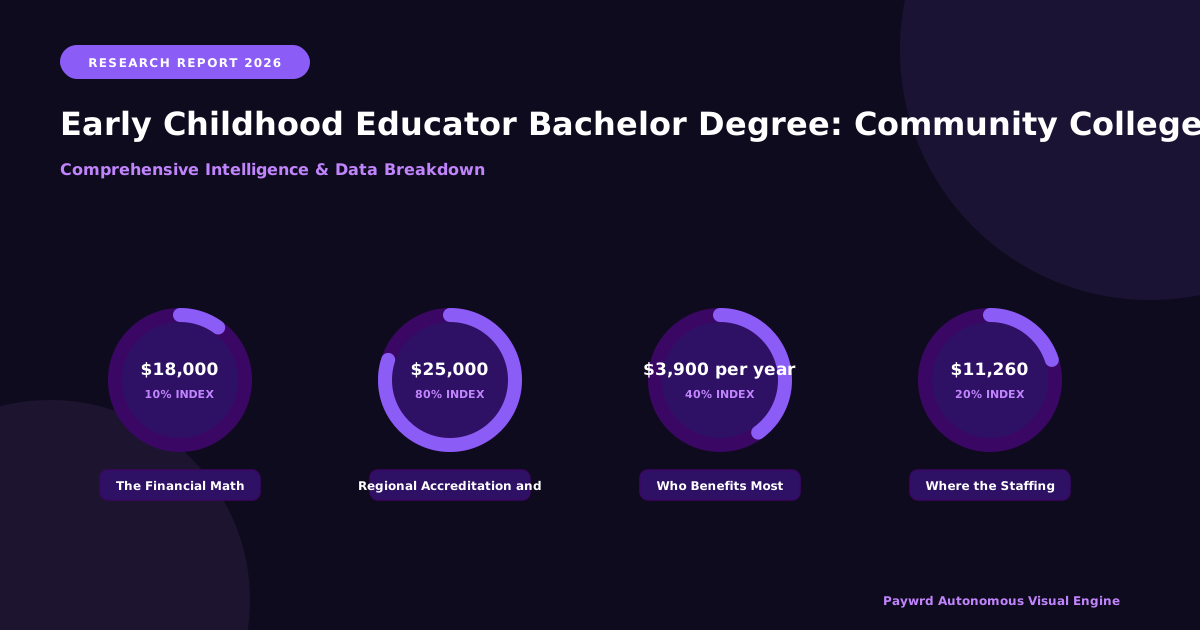
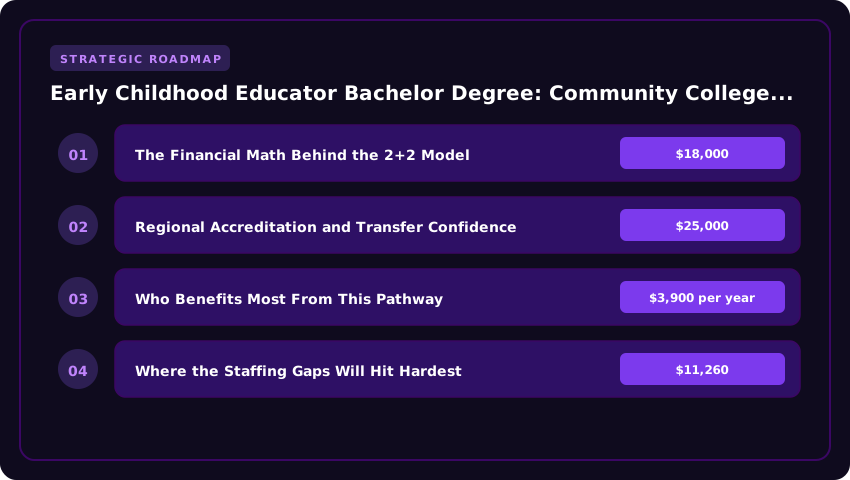
The Financial Math Behind the 2+2 Model
According to the College Board, average in-district community college tuition runs roughly $3,900 per year, while in-state four-year public university tuition averages around $11,260 annually. For students completing the first two years at a community college, the cumulative savings on tuition alone typically reach $14,720, and once textbooks, parking, and housing costs are factored in, the real-world figure climbs toward $25,000. That capital can be redirected toward student teaching materials, Praxis exam fees, or simply staying afloat while completing a degree at night.
Credential Stackability: A Degree in Your Pocket While You Study
One of the most underrated advantages of the community college route is credential stackability. Unlike a traditional four-year path where nothing tangible materializes until graduation day, ECE students at community colleges earn their Associate of Applied Science (AAS) in Early Childhood Education after roughly 60 credit hours. That credential alone qualifies graduates for lead teacher roles in many states, with the Bureau of Labor Statistics reporting a 2024 median pay of $34,810 for preschool teachers and projecting 2% growth through 2033. Students can then continue toward a bachelor’s while already earning a salary and gaining classroom experience, dramatically reducing opportunity cost.
Regional Accreditation and Transfer Confidence
Transferability hinges on one critical factor: regional accreditation recognized by the U.S. Department of Education and the Council for Higher Education Accreditation (CHEA). Credits from unaccredited institutions rarely transfer, which is why prospective students must verify that their community college holds accreditation from bodies such as the Higher Learning Commission (HLC), Southern Association of Colleges and Schools (SACSCOC), or Middle States Commission on Higher Education (MSCHE). Programs aligned with National Association for the Education of Young Children (NAEYC) standards further ensure that ECE-specific coursework, including child development, curriculum planning, and assessment, moves cleanly into a four-year program.
Who Benefits Most From This Pathway
- Working childcare professionals seeking pay raises tied to bachelor’s-level credentials under state Quality Rating Improvement Systems (QRIS).
- Parents returning to school who need flexible hybrid or evening community college schedules before transitioning to a university.
- Career changers with some prior college credit who want to test the ECE field without committing to a full four-year tuition bill upfront.
- FAFSA filers maximizing Pell Grant eligibility, since community college enrollment often preserves more need-based aid for the final two years.
The bottom line: community college is no longer a consolation prize. For aspiring early childhood educators in 2026, it is the strategically smarter, financially leaner, and increasingly respected route to a bachelor’s degree and the higher salaries that come with it.
2026 BLS Salary Projections for Early Childhood Educators Holding a Bachelor Degree
Money matters, and if you are weighing the cost of a bachelor’s degree against future earnings, the Bureau of Labor Statistics (BLS) projections for 2026 give you a credible yardstick. The agency tracks two closely related categories relevant to early childhood educators: Preschool Teachers (SOC 25-2011) and Kindergarten Teachers (SOC 25-2012). For 2026, the national median annual wage for preschool teachers sits near $37,120, while kindergarten teachers, who are typically required to hold a bachelor’s degree and state licensure, average closer to $62,690. That gap is not accidental; it reflects credentialing requirements, union-negotiated public school salary scales, and the structural differences between K-12 systems and community-based early learning centers.
Percentile wage data tells an even richer story for career planners. For preschool teachers in 2026, BLS projects the 10th percentile at roughly $26,000, the 25th at about $30,200, the 75th near $44,800, and the 90th climbing to $57,500 or higher in competitive metros. Kindergarten teachers, by contrast, show a tighter and higher band: 10th percentile around $44,000, 50th at $62,690, 75th near $78,400, and 90th percentile breaking $96,000 in states with strong teachers’ union contracts.
- Public school districts: Highest baseline pay, typically governed by step-and-lane salary schedules. A bachelor’s degree places you on Year 1 of the lane, with automatic raises tied to credits and years of service.
- Private early learning centers: Mid-range compensation, often $33,000–$45,000 for credentialed preschool teachers. Chains like Bright Horizons and KinderCare may pay slightly above independent centers due to scale.
- Head Start and public pre-K programs: Federal and grant-funded, with pay scales increasingly aligned to public school benchmarks. In 2026, Head Start teachers with a bachelor’s degree frequently earn $45,000–$58,000, depending on region.
Geography reshapes every one of those numbers. The highest-paying metropolitan areas for early childhood educators in 2026 concentrate in regions where cost of living collides with aggressive education investment. According to BLS Occupational Employment and Wage Statistics (OEWS), the top-paying metros for preschool teachers include San Jose-Sunnyvale-Santa Clara, CA, San Francisco-Oakland-Hayward, CA, Seattle-Tacoma-Bellevue, WA, Boston-Cambridge-Newton, MA, and Washington-Arlington-Alexandria, DC-VA-MD-WV, where median preschool wages push past $48,000. For kindergarten teachers, the highest-paying metros skew toward New York-Newark-Jersey City, Los Angeles-Long Beach-Anaheim, Houston-The Woodlands-Sugar Land, and Chicago-Naperville-Elgin, with median wages topping $75,000 in districts that reward bachelor’s-level preparation.
State-by-state, New York, California, Massachusetts, Connecticut, and Washington consistently rank in the top five for both preschool and kindergarten median pay. The lowest bands cluster across parts of the Southeast and Mountain West, where median preschool wages can dip below $28,000 and kindergarten pay hovers near $45,000. For working adults comparing a community college launchpad against a direct four-year enrollment, these BLS benchmarks are the most defensible data points to anchor your return-on-investment calculation, especially when paired with tuition savings from a 2+2 articulation pathway.
Job Growth Forecast and Labor Demand Through 2026 for Early Childhood Educators
Hiring momentum for early childhood educators is not slowing down—it is actively accelerating. According to the U.S. Bureau of Labor Statistics, employment of preschool teachers is projected to grow 8 percent from 2021 to 2031, outpacing the 5 percent average for all occupations. Kindergarten and elementary school teachers are tracking a parallel 4 percent climb. What makes these figures especially relevant for career-switchers and currently credentialed working educators is the demographic engine behind them: roughly 3.6 million babies are born in the United States each year, and sustained birth-rate stability combined with expanding public pre-K access is fueling steady classroom demand well beyond 2026.
Where the Staffing Gaps Will Hit Hardest
Workforce shortages are not evenly distributed across the country. States that have enacted or expanded universal pre-K legislation—including California, Washington, Colorado, New York, and New Jersey—are absorbing the largest share of new demand. California’s Transitional Kindergarten expansion alone is expected to require tens of thousands of additional credentialed teachers by 2026. Texas, Florida, and Arizona continue to post chronic vacancies driven by rapid population growth and comparatively lower per-pupil educator pay. For bachelor’s-credentialed candidates, these hotspots translate directly into signing bonuses, relocation incentives, and accelerated tenure-track pathways that simply do not exist in saturated markets.
Universal Pre-K Expansion Reshapes the Hiring Map
The policy environment is doing as much work as demographics. The federal push for universal pre-K, layered onto state-level expansions like Michigan’s Great Start Readiness Program and Illinois’ Preschool for All, is converting thousands of private-center roles into publicly funded positions. That shift matters because publicly funded classrooms typically require a bachelor’s degree with state teaching certification, effectively upgrading the baseline credential expectation across the field. Community college graduates who complete their 2+2 pathway with a four-year ECE degree will enter a labor pool that increasingly mandates their exact qualification.
Turnover Trends and What They Reveal About Long-Term Security
The early childhood field has historically carried a turnover rate above 30 percent annually, driven largely by compensation pressure and limited advancement opportunities. However, the latest workforce data signals a meaningful shift. Federal pandemic-relief stabilization funding allowed programs to raise wages, and many districts have institutionalized those increases. Turnover is declining in states that have tied public pre-K expansion to salary parity scales. For professionals evaluating a multi-year degree investment, this is a critical signal: long-term job security is strengthening precisely because retention is finally being treated as a policy priority, not an afterthought.
- Preschool teacher employment growth projected at 8 percent through 2031 (BLS)
- Five states leading universal pre-K expansion will absorb the bulk of new hires by 2026
- Bachelor’s-level credential requirements are expanding alongside public investment
- Turnover is declining where wage parity has been institutionalized, improving career longevity
How a Bachelor Degree Moves You Up the Early Childhood Educator Pay Scale
The financial math behind a bachelor’s degree in early childhood education has shifted decisively in favor of completion. According to the U.S. Bureau of Labor Statistics (BLS), preschool teachers nationally earn a median annual wage of $37,130, while kindergarten and elementary special education teachers average $63,670. The gap between those figures reflects more than job category; it reflects credential. Holding a Bachelor of Arts or Bachelor of Science in Early Childhood Education (ECE) is the single most reliable lever for moving an educator from the lower wage band into the middle and upper tiers of the pay scale.
Wage Premium Analysis: Bachelor Degree vs. Associate Degree vs. CDA Credential
The credential ladder translates directly into dollars. An educator entering the field with only a Child Development Associate (CDA) credential typically starts near $28,000–$32,000 annually in most states. An Associate of Arts in Early Childhood Education bumps that starting range to roughly $33,000–$38,000, depending on district and region. The bachelor’s degree holder, however, commonly commands $42,000–$55,000 at entry, with public pre-K classrooms and Head Start programs pushing that figure toward $58,000 once step-and-lane raises are applied. Across a 30-year career, the cumulative wage premium for completing the four-year degree versus stopping at the associate level often exceeds $300,000 in nominal earnings.
Eligibility for Lead Teacher, Mentor, and Curriculum Coordinator Roles
Many state-funded pre-K programs, including Georgia’s Pre-K Program and California’s CSPP, require a bachelor’s degree for lead teacher designation. Without it, educators are frequently coded as assistant teachers or paraprofessionals, regardless of experience. The bachelor’s credential also unlocks mentor teacher stipends, which commonly add $1,500–$4,000 per year, and curriculum coordinator positions that can lift total compensation above $70,000 in mid-sized districts. These roles are rarely posted to candidates holding only an associate degree, regardless of how strong their classroom practice may be.
State-Funded Salary Scales and Step-and-Lane Structures
Public pre-K programs operating through state agencies typically adopt step-and-lane salary schedules, where educators earn incremental raises for each year of service (step) and each added credential level (lane). A bachelor’s degree generally places an educator two to four lanes higher than a CDA or associate degree holder, producing raises of $800–$2,500 per lane per year. Over a decade, those increments compound into tens of thousands of additional dollars, plus improved retirement contributions and access to employer-sponsored health benefits.
Negotiation Leverage in a Candidate-Short Market
The 2026 early childhood workforce remains chronically short-staffed, and that shortage works in favor of credentialed candidates. Private childcare centers, Montessori schools, and corporate early learning chains increasingly offer signing bonuses, tuition reimbursement, and relocation packages to bachelor’s-prepared educators. Walking into negotiations with a four-year degree, a transferable 2+2 community college transcript, and documented practicum hours gives candidates the leverage to negotiate starting salary $3,000–$7,000 above posted minimums.
- CDA credential: $28K–$32K typical entry; limited advancement pathways.
- Associate degree: $33K–$38K; assistant or co-teacher eligibility.
- Bachelor degree: $42K–$55K entry; lead teacher, mentor, and coordinator roles.
- Long-term premium: $250K–$350K cumulative earnings advantage over a career.
Funding the Bachelor Degree: FAFSA, Pell Grants, and State Aid for Aspiring Educators
The sticker price of a bachelor’s degree can look intimidating, but for early childhood educators, the actual out-of-pocket cost is often a fraction of the headline number. The financial aid ecosystem in 2026 is uniquely favorable for this workforce, provided you know which levers to pull. It starts, as always, with the Free Application for Federal Student Aid (FAFSA). Even if you assume you earn too much, file it. The simplified 2024–25 form (carried forward) expanded eligibility, and many state and institutional grants require a FAFSA on file regardless of income.
Pell Grants: The Foundation of Affordability
For the 2024–25 award year (setting the baseline for 2026 planning), the maximum Pell Grant sits at $7,395. Because community college tuition averages roughly $3,990 annually for in-district students (per College Board Trends), a maximum Pell award often covers tuition, fees, and books entirely—with money left over for living expenses. Eligibility hinges on your Student Aid Index (SAI); students from families earning roughly $60,000 or less frequently qualify for the full amount. Crucially, Pell Lifetime Eligibility Used (LEU) caps at 600% (six full-time years), so the 2+2 community college pathway preserves your Pell runway for the university segment.
The TEACH Grant: Service for Scholarship
The Teacher Education Assistance for College and Higher Education (TEACH) Grant offers up to $4,000 per year (pro-rated for part-time) for students enrolled in eligible programs who sign an Agreement to Serve (ATS). For early childhood majors, the critical detail is the “high-need field” designation. While early childhood education qualifies broadly, you must teach in a designated low-income school or educational service agency for four academic years within eight years of graduation. Fail the service obligation, and the grant converts to a Direct Unsubsidized Loan with interest accruing from disbursement. Read the fine print: the school must be listed in the Department of Education’s Annual Directory of Designated Low-Income Schools.
State Workforce Scholarships: The Hidden Gem
States are aggressively funding the ECE pipeline to solve staffing crises. These programs often stack on top of federal aid:
- California: The Child Development Permit Stipend Program and local First 5 commissions offer tuition reimbursement for permitted coursework.
- Texas: The T.E.A.C.H. Early Childhood Texas Scholarship covers 90% tuition and books for educators working in licensed centers.
- New York: The Early Childhood Workforce Scholarship provides up to $2,000 per semester for study at SUNY/CUNY campuses.
- Washington: The Early Childhood Education Career and Wage Ladder ties scholarships to wage increases at participating employers.
Check your state’s higher education agency or Office of Early Learning; many applications are first-come, first-served.
Public Service Loan Forgiveness (PSLF): The Long Game
If loans are unavoidable, PSLF remains the most powerful backstop. Working full-time for a government entity or 501(c)(3) nonprofit—including Head Start agencies, public pre-K programs, and many licensed nonprofit childcare centers—qualifies you for tax-free forgiveness after 120 qualifying payments (10 years) on an Income-Driven Repayment (IDR) plan like SAVE. The 2023 regulatory fixes stabilized counting rules; periods of forbearance and deferment can now be “bought back” for credit. Consolidate FFEL or Perkins loans into a Direct Consolidation Loan immediately to start the clock.
Bottom line: A working educator transferring from a community college in 2026 can often finance a bachelor’s degree with zero tuition debt by layering Pell, state workforce scholarships, and employer tuition assistance, reserving TEACH Grants or federal loans only for the final university semesters. The money exists; the strategy is simply claiming it in the right order.
Career Mobility and Specialization Tracks Beyond the Standard Classroom Role
After earning a bachelor’s degree in early childhood education—whether through a community‑college 2+2 pathway or a four‑year institution—many educators discover that the classroom is just one launchpad. Leveraging that credential opens doors to leadership, specialist, and corporate tracks that often come with higher earning potential and greater professional impact. Below we map the most common advancement routes, complete with current U.S. salary benchmarks from the Bureau of Labor Statistics (BLS) and tuition realities highlighted by the College Board.
1. Early Childhood Program Administration & Center Directorship
Moving from lead teacher to program administrator or center director typically requires a blend of instructional experience and management training. Many professionals supplement their bachelor’s with a Project Management Professional (PMP) credential from the Project Management Institute (PMI) or complete a short graduate certificate in educational leadership offered through state universities.
- Median annual salary for preschool and childcare center directors: $55,300 (BLS, 2024).
- Top‑earning directors in metropolitan areas or large nonprofit chains can exceed $78,000, especially when they oversee multiple sites or manage grant‑funded programs.
- Typical additional tuition for a leadership certificate: $2,500–$4,000 (community‑college or online provider), often eligible for FAFSA‑based aid.
2. Special Education & Inclusive Early Childhood Certification Premiums
Educators who add a special‑education endorsement or an inclusive‑early‑childhood credential see a measurable wage premium. These certifications are frequently offered through state‑approved programs that align with U.S. Department of Education guidelines.
- Preschool special‑education teachers earn a median of $62,100 per year (BLS, 2024), roughly 20 % higher than general preschool teachers ($31,000).
- Those who also hold a Board Certified Behavior Analyst (BCBA) credential—often pursued after the bachelor’s—can command $80,000+ in early‑intervention settings.
- Average cost for the endorsement coursework: $3,500–$5,500, with many employers offering tuition reimbursement.
3. Corporate Early Learning Roles: Curriculum Design for EdTech Publishers
The booming edtech sector seeks educators who can translate developmental research into engaging digital products. Positions such as “Early Learning Curriculum Designer” or “Content Specialist” are common at companies like Scholastic, Amplify, and newer startups backed by venture capital.
- Median salary for instructional coordinators in the publishing/edtech industry: $71,400 (BLS, 2024).
- Senior designers with 5+ years of experience and a strong portfolio often earn $90,000–$110,000, especially when they hold certifications in eLearning design (e.g., ATD’s Certified Professional in Learning and Performance).
- Relevant upskilling can be completed via MOOCs or university extension courses costing $1,000–$2,500; many are eligible for employer‑sponsored FAFSA‑type aid through the U.S. Department of Education’s Title IV programs.
4. Consulting & Coaching for Experienced Bachelor‑Credentialed Educators
Seasoned educators frequently transition into independent consulting, offering services such as program quality assessment, staff professional‑development workshops, or parent‑engagement coaching. This path rewards both expertise and entrepreneurial drive.
- Independent early‑childhood consultants report average annual earnings of $85,000, with top performers billing $120,000+ through contracts with school districts, Head Start agencies, or private preschool chains.
- Startup costs are modest: $500–$1,500 for a professional website, liability insurance, and marketing materials.
- Many consultants pursue the National Association for the Education of Young Children (NAEYC) Advanced Educator credential or a PMI‑ACP (Agile Certified Practitioner) to strengthen their marketability.
Across these tracks, the bachelor’s degree serves as a versatile foundation. By pairing it with targeted certifications—whether through FAFSA-supported coursework, industry‑recognized bodies like PMI, AACSB (for business‑focused consulting tracks), or even ABET-aligned technical programs for edtech roles—educators can substantially raise their earning ceiling while expanding their impact beyond the traditional classroom.
Designing Your 2026 Education-to-Career Action Plan
Turning a salary outlook into a paycheck requires more than just enrollment; it requires a sequenced strategy. To maximize your ROI by 2026, you must treat your education as a professional project. The goal is to minimize debt via the FAFSA and maximize your starting salary through strategic credentialing.
The 2+2 Enrollment Timeline
The most efficient path to a Bachelor’s degree is the “2+2” model. Start this week by researching your local community college’s articulation agreements. These are formal contracts that guarantee your Associate degree credits will transfer seamlessly to a four-year university.
- Months 1-24: Complete your Associate of Arts (AA) or Associate of Science (AS) in Early Childhood Education. Focus on core general education and introductory child development courses.
- Months 25-48: Transfer to a university for your Bachelor’s. Prioritize programs accredited by CAEP or aligned with NAEYC (National Association for the Education of Young Children) standards to ensure your degree is recognized by state licensing boards.
Building a High-Value Professional Portfolio
A degree gets you the interview, but your field experience gets you the salary bump. Do not wait until your senior year to enter the classroom. To stand out in a competitive 2026 job market, integrate these three pillars into your résumé:
- Practicum & Fieldwork: Document every hour spent in supervised student teaching. Specifically, highlight your ability to implement state early learning standards.
- Substitute Experience: Working as a substitute teacher provides a broad view of different classroom management styles and proves your adaptability.
- Specialized Certifications: Pursue a CDA (Child Development Associate) credential while completing your degree to increase your immediate employability.
Financial Tracking and Salary Optimization
The Bureau of Labor Statistics (BLS) provides a baseline, but your actual earnings depend on your timing. To avoid stagnating in a low-paying role, track your “market value” annually. Use the following benchmarks to time your career moves:
- The Associate Milestone: Upon completing your 2-year degree, negotiate a pay increase based on your new credential.
- The Bachelor’s Leap: Once your degree is conferred, pivot toward lead teacher roles or administrative positions where salaries typically jump significantly.
- Annual Audits: Every January, compare your current salary against regional BLS data and state-funded pay scales to determine if it is time to request a raise or seek a new employer.
| Decision Criteria | Community College 2+2 Pathway | Traditional 4-Year University |
|---|---|---|
| Total Tuition Cost | $20,000 – $30,000 | $40,000 – $55,000 |
| Average Savings | $18,000 – $25,000 | None (Baseline Cost) |
| Credit Transferability | Guaranteed via 2+2 Articulation | N/A (Direct Entry) |
| Time to Complete | 4 Years (2 years CC + 2 years Univ) | 4 Years |
| 2026 Avg. Starting Salary | $45,000 – $50,000 | $45,000 – $50,000 |
| Return on Investment (ROI) | High (Lower student debt) | Moderate (Higher student debt) |
Strategic Final Takeaway
When evaluating Early Childhood Educator Bachelor Degree Community College Salary Outlook 2026 US, base your decisions on accredited institutional standards, measurable return on investment (ROI), and up-to-date official guidelines. Always verify specific dates and requirements through official regulatory portals.

