What the PMP Credential Actually Delivers in 2026
The Project Management Professional (PMP) credential, administered by the Project Management Institute (PMI), remains the most widely recognized certification for project leaders across the United States and globally. In 2026, PMI has refined its eligibility framework and restructured the exam itself, making it essential for candidates to understand exactly what the credential delivers before investing in a PMP certification prep course with a pass guarantee. The credential signals to employers that you possess a standardized, validated approach to managing scope, schedule, budget, risk, and stakeholder expectations—competencies that the modern U.S. economy increasingly demands at every organizational level.
PMI’s 2026 eligibility requirements are structured around two pathways, and both require documented proof of project leadership experience verified through audit. Candidates with a four-year U.S. bachelor’s degree (or global equivalent) need 36 months of project management experience plus 35 contact hours of formal project management education. Those with only a high school diploma or associate degree must demonstrate 60 months of project experience alongside the same 35 education hours. Importantly, candidates who hold a recognized Certified Associate in Project Management (CAPM) credential may satisfy the education requirement automatically, which can accelerate the enrollment timeline.
The exam itself was restructured in 2021, and PMI confirmed these domain weights remain operative throughout 2026: People accounts for 42% of the assessment, Process represents 50%, and Business Environment carries the remaining 8%. The People domain emphasizes leadership, conflict resolution, team building, and emotional intelligence—reflecting PMI’s recognition that technical scheduling tools cannot replace the human dynamics of project delivery. The Process domain tests predictive, agile, and hybrid methodologies, while the Business Environment section evaluates compliance, benefits realization, and strategic alignment. Candidates should select a prep curriculum that weights practice questions proportionally to these domains rather than treating all topics as equal.
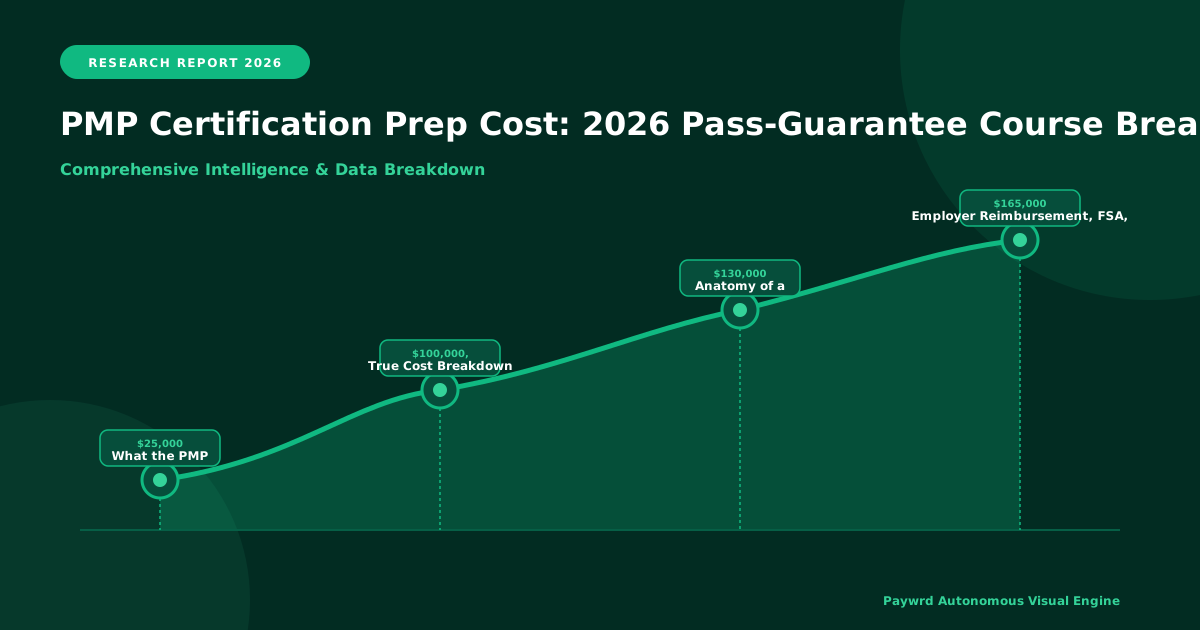
From a financial standpoint, the PMP delivers one of the clearest return-on-investment profiles in professional education. PMI’s most recent Earned Value Survey and independent analyses such as the Project Management Salary Survey indicate PMP-certified practitioners in the United States earn a median salary approximately $25,000 higher than their non-certified peers. In metropolitan markets such as San Francisco, New York, and Washington, D.C., PMP holders frequently report total compensation packages exceeding $100,000, with senior program managers and portfolio directors reaching $130,000 to $165,000. Beyond base pay, many employers offer certification bonuses ranging from $2,500 to $7,500, and the credential often qualifies professionals for promotion tracks that would otherwise remain inaccessible.
Industry demand for PMP-certified leaders has intensified in 2026, particularly in sectors where regulatory complexity and capital project exposure are highest. Federal contractors working with agencies such as the Department of Defense, the General Services Administration, and the Department of Veterans Affairs increasingly list PMP as a baseline requirement for senior project roles. Within the private sector, healthcare systems, financial services, information technology, construction, and aerospace routinely mandate the credential for program managers overseeing budgets above $5 million. Tech giants including Amazon, Microsoft, and Google reference PMP in job postings for cloud migration leads, ERP implementation managers, and AI deployment program directors. Consulting firms such as Deloitte, Accenture, and Booz Allen Hamilton consider PMP nearly essential for mid-level hires.
For decision-makers evaluating the upfront cost of a pass-guarantee course—typically ranging from $899 to $2,400 in 2026—the credential’s downstream value justifies the investment many times over. Tuition may also qualify for employer reimbursement under professional development budgets, and military veterans frequently use GI Bill® benefits to offset program expenses. When you weigh the documented salary differential, expanded career mobility, and the exam’s rigorous 60-day retake window for unsuccessful first attempts, the PMP functions less like an expense and more like an appreciating professional asset.
Finally, candidates should recognize that PMP is also a gateway credential. Holding it often simplifies eligibility for higher-tier certifications such as the Program Management Professional (PgMP), the PMI Agile Certified Practitioner (PMI-ACP), and the Portfolio Management Professional (PfMP). In this sense, the 2026 PMP is not merely an endpoint but a launchpad for a long-term career architecture in project leadership.
- Eligibility minimums: 36 months of project experience with a bachelor’s degree; 60 months with a high school diploma or associate degree; 35 education hours required in both pathways.
- Exam domain weighting for 2026: People 42%, Process 50%, Business Environment 8%.
- Salary impact: Average U.S. salary lift of $25,000+, with senior roles in major metros clearing $130,000.
- High-demand industries: Federal contracting, healthcare, financial services, IT, construction, aerospace, and management consulting.
- Strategic value: Functions as a prerequisite pathway toward PgMP, PMI-ACP, and PfMP credentials.
True Cost Breakdown of PMP Prep Courses Online

Understanding the real dollar ($) commitment behind a Project Management Professional (PMP) certification requires looking far beyond the advertised course price. In 2026, the smartest candidates build a complete financial model that bundles training tuition, the PMI membership math, the $405 exam fee, and the realistic possibility of a retake before committing. A pass-guarantee course is only as valuable as the total cost of ownership, so let’s itemize the verified price points from the providers that consistently appear at the top of US learner searches, then layer in the hidden math that PMI itself quietly assumes you already understand.
At the accessible end of the market, PMTraining continues to set the budget benchmark. Their self-paced, 35-hour contact-hours program (the minimum required to sit for the exam) is priced around $499, and their live-online cohort typically lands near $899 when bundled with their pass guarantee. Velociteach (the parent brand behind the popular Andy Crowe textbook ecosystem) prices its “All-In-One” live virtual instructor-led program in the $1,195–$1,395 range, depending on whether you opt for a single-attempt or unlimited-retake guarantee. RMC Learning Solutions, founded by Rita Mulcahy and widely respected for the depth of its exam-simulator database, sits in the $995–$1,295 window for its online instructor-led track, with a self-study version around $595.
On the premium, bootcamp-style end, Simplilearn in partnership with the University of Massachusetts Amherst (UMass) advertises a fully university-affiliated PMP bootcamp between $1,799 and $2,495, including the post-nominal digital badge and continuing education units (CEUs) that US HR departments recognize for professional development credits. Comparable university-affiliated programs from Georgetown, Vanderbilt, and the University of Washington typically price in the $1,595–$2,200 range and include the same pass-guarantee language, but you are paying roughly $800–$1,000 extra for the institutional brand on your transcript. For US professionals whose employers require AACSB- or ABET-style accredited continuing education, that premium often justifies itself in reimbursement dollars ($).
Now for the math PMI does not advertise on its main course pages. A US candidate who is not a PMI member pays $555 for the PMP exam, while a member pays only $405. PMI individual membership costs $139 per year plus a one-time $10 application fee for first-time joiners, so the breakeven is immediate: if you plan to take the exam even once, the membership saves you $11 ($555 minus $405 minus $139) on the very first attempt. The savings multiply if you fail and must pay a retake fee. PMI charges $405 for members and $555 for non-members per retake, meaning every unsuccessful retry costs a non-member an extra $150 that a member never sees. If you happen to need two retakes, the cumulative membership advantage balloons to $311, and it climbs past $461 after a third attempt.
When you stack the pass-guarantee course fee against this PMI arithmetic, the “true cost” picture becomes much clearer. A candidate enrolling in a $1,295 RMC instructor-led course who also purchases a $139 PMI membership pays a fully loaded first-attempt total of roughly $1,839. A Simplilearn–UMass bootcamp student who skips the membership and fails once pays $2,495 + $555 + $555 = $3,605 before they ever pass, whereas the same student with a $139 membership and the included retake guarantee pays a flat $2,634. That difference of nearly $971 is exactly the kind of hidden cost that catches first-time PMP candidates off guard, and it is precisely why a pass guarantee should be evaluated on its total cost of ownership, not its sticker price.
For a final sanity check, US learners should always verify that their chosen provider’s guarantee explicitly lists (1) the number of included retakes, (2) whether the retake fee reimbursement is paid in US dollars ($) directly to the candidate or credited toward a future course, (3) the time window during which the guarantee remains valid (most are 6 or 12 months), and (4) any minimum practice-exam score required to invoke the guarantee. With those four checkpoints plus the PMI membership arithmetic layered into your decision matrix, the true cost of any PMP prep course in 2026 becomes fully transparent and far easier to defend in a tuition-reimbursement conversation with your employer.
- Budget tier ($499–$899): PMTraining self-paced or live-online cohorts, ideal for self-starters who already meet the 35 contact-hour requirement.
- Mid tier ($995–$1,395): RMC Learning Solutions and Velociteach instructor-led programs, balancing price with deep question banks and a pass guarantee.
- Premium university-affiliated tier ($1,595–$2,495): Simplilearn–UMass, Georgetown, and Vanderbilt cohorts, best for US professionals seeking accredited CEUs and employer reimbursement.
- PMI membership math: $139 annual membership unlocks the $405 member exam rate, saving $11 on the first attempt and $150 on every retake versus the $555 non-member price.
- Hidden retake risk: Three failed attempts without membership adds $450 in avoidable fees, easily exceeding the cost of most self-study courses.
Anatomy of a Legitimate Pass Guarantee
When evaluating a PMP certification prep program, the allure of a “pass guarantee” can be incredibly tempting, especially when you are investing anywhere from $1,500 to $3,000 in your professional development. However, not all guarantees are created equal. A legitimate pass guarantee is not a magic shield; it is a carefully structured contract designed to support your learning journey while protecting the training provider. Understanding the anatomy of these guarantees is crucial before you submit your enrollment.
The most common component is the 100% money-back window, which typically ranges from 30 to 90 days after your exam date. If you do not pass the PMP exam on your first attempt, legitimate providers will either refund your tuition or offer free re-enrollment in a subsequent cohort. Many top-tier programs also include second-attempt vouchers, covering the $405 PMI member retake fee (or $555 for non-members). You must read the fine print to analyze whether the provider refunds the cost of the voucher or if you forfeit that specific amount.
Furthermore, the credibility of the guarantee often hinges on the provider’s status with the Project Management Institute. You will frequently encounter acronyms like ITP (Instructor-Led Training Partner) and ATP (Authorized Training Partner). While both can offer excellent instruction, ATPs are vetted directly by PMI and often have more robust, standardized guarantee policies. If a provider is not an ATP, their pass guarantee might come with heavily restrictive conditions, such as requiring you to complete every single mock exam with a 90% or higher score before they honor the refund.
Finally, you must consider how PMI’s 2026 online proctoring rules affect refund eligibility. As remote testing becomes the standard, PMI has implemented stricter environmental and security protocols. If your exam is invalidated due to a proctoring violation—such as a room scan failure, an internet disruption, or suspicious eye movement—the training provider will almost certainly void your pass guarantee. To protect your investment, ensure your testing environment is completely secure and free of distractions.
- Verify the refund window: Confirm if the 30 to 90-day clock starts on the day you take the exam or the day you receive your official results.
- Check ATP status: Prioritize Authorized Training Partners, as their guarantees are backed by PMI’s stringent quality standards.
- Understand proctoring risks: A technical failure during online proctoring can void your guarantee, so test your equipment thoroughly beforehand.
- Review attendance requirements: Many guarantees require 100% attendance and completion of all
Comparing Self-Paced, Live Cohort, and Bootcamp Formats
Selecting the right PMP exam preparation format is one of the most consequential decisions a candidate makes, because the format directly influences study momentum, retention, and ultimately whether the candidate meets PMI’s required 35 to 60 contact hours of project management education. Each delivery model carries distinct advantages, trade-offs in cost, and varying levels of accountability. Understanding these differences empowers aspiring PMPs to match their learning style, professional schedule, and budget to a course that maximizes the probability of passing on the first attempt.
Self-Paced Online Courses remain the most popular and flexible option for working professionals, often priced between $399 and $1,200 in 2026. These programs typically grant 12 months of access to recorded lectures, downloadable study guides, and a digital question bank containing 1,000 to 2,000+ practice items. Candidates can pause, rewind, and revisit difficult knowledge areas like Risk Management or Earned Value analysis at their own pace. Most reputable self-paced providers automatically issue a certificate of completion that satisfies the PMI contact-hour prerequisite upon finishing the curriculum. Completion rates for pure self-paced programs hover between 30% and 45%, primarily because accountability rests entirely with the learner. However, for disciplined candidates balancing full-time employment and family obligations, this format delivers unmatched flexibility and the lowest total cost of ownership.
Live Cohort Programs blend structured scheduling with instructor interaction, generally running 8 to 14 weeks with weekly evening or weekend sessions. Tuition ranges from $1,295 to $2,895, reflecting the inclusion of live facilitation, peer discussion boards, and dedicated success coaches. Cohort completion rates climb to roughly 75% to 85% because scheduled sessions create external accountability and consistent pacing. Live instructors clarify nuanced predictive vs. adaptive agile concepts, walk through complex earned value calculations, and simulate real exam conditions through timed quizzes. Many cohort programs include mobile app access, allowing candidates to review flashcards and complete mini-quizzes during commutes. The cohort format is particularly effective for professionals who thrive on social learning and need structure to stay on track.
Bootcamp Formats represent the most intensive and accelerated option, condensing the entire PMP curriculum into 4 to 7 days of immersive instruction, typically priced between $2,500 and $3,995. Bootcamps emphasize live lecture attendance, group breakouts, and aggressive practice testing, with completion rates often exceeding 90% due to the concentrated time commitment. Participants usually receive 35 to 40 contact hours of formal instruction plus a certificate of completion, along with extended access to a question bank exceeding 2,000 items. However, the rapid-fire pace demands pre-study of foundational materials, and the compressed schedule can be challenging for candidates juggling demanding work projects. Bootcamps also frequently include 12 months of mobile app access, enabling continued review long after the live event concludes.
When evaluating pass-rate disclosures, candidates should prioritize providers who publish transparent first-attempt pass statistics verified by third-party auditors. Reputable institutions including University of Texas at Austin Professional Education, Penn State World Campus, and PMI-authorized ATP partners routinely publish verified pass rates ranging from 78% to 92% for their cohort and bootcamp formats. Self-paced providers less frequently disclose pass rates because their asynchronous nature complicates outcome tracking. Candidates should treat any pass-rate claim exceeding 95% with healthy skepticism unless accompanied by verifiable methodology and sample size documentation.
- Self-Paced: $399–$1,200, 12-month access, 30%–45% completion, ideal for self-directed learners
- Live Cohort: $1,295–$2,895, 8–14 weeks, 75%–85% completion, best for accountability-driven candidates
- Bootcamp: $2,500–$3,995, 4–7 days immersive, 90%+ completion, suited for accelerated learners
- Contact Hours: All three formats must satisfy PMI’s 35–60 hour requirement with an official certificate
- Mobile Access: Most 2026 programs include iOS and Android apps with offline content and progress sync
The optimal format ultimately depends on a candidate’s budget constraints, learning preferences, and capacity for sustained study. Candidates who value flexibility and cost savings gravitate toward self-paced programs, while those who need accountability and instructor guidance typically choose cohorts. Professionals preparing for a promotion, employer reimbursement deadline, or credential audit benefit most from bootcamps, provided they can dedicate uninterrupted time. Regardless of format, candidates should confirm that the provider is a PMI Authorized Training Partner (ATP) and that the certificate explicitly states the contact hours earned. This documentation is non-negotiable for the PMI application and protects the candidate’s investment in their professional credentialing journey.
Employer Reimbursement, FSA, and Tax Strategies
For most United States-based candidates, PMP certification prep is one of the rare professional expenses where multiple funding streams can be layered together to dramatically reduce out-of-pocket costs. Understanding how Section 127 employer tuition reimbursement, Flexible Spending Accounts (FSAs), military benefits, and state workforce grants interact is the single most overlooked lever in PMP budgeting. When strategically combined, candidates frequently cut their net PMP prep cost from $1,500–$3,000 down to less than $300, and in some cases to zero.
Under IRC Section 127, employers may provide up to $5,250 per calendar year in tax-free educational assistance to employees. This 2026 cap has remained unchanged for several years and applies to a wide range of job-related learning, including PMP exam prep courses, practice exams, and even PMI membership fees when tied to a documented professional development plan. To qualify, the assistance must be provided under a written plan that meets IRS nondiscrimination requirements, and coursework must be considered job-related rather than meeting the minimum qualifications of the role. Because PMP prep satisfies this threshold for virtually any project management, program management, or operations-track professional, most HR departments will approve it with proper documentation.
Beyond the $5,250 cap, any additional employer-paid assistance is generally treated as taxable wages, but employers can still route excess funds through a working-condition fringe benefit under Section 132(d), provided the training maintains or improves skills required in the employee’s current trade or business. Candidates should request that their HR or Learning & Development team code the expense under professional development, continuing education, or certification reimbursement budget lines rather than discretionary training pools, which are often the first to be frozen during budget cuts.
- How to code the request correctly: Submit a formal reimbursement form citing IRC Section 127, attach the course syllabus, the PMI exam content outline, and a manager-approved justification memo stating the credential aligns with current role responsibilities.
- What typically qualifies: Live instructor-led courses, on-demand video bundles, practice exam simulators, PMI membership, and the $405 PMP exam fee itself (non-member) or $275 (member).
- What usually does not qualify: Time spent studying during work hours, travel to in-person boot camps, and prep courses that lead to a degree rather than a professional credential.
For Flexible Spending Account (FSA) users, PMP prep expenses can sometimes be reimbursed if the employer’s plan document permits job-related education as a qualifying expense. While traditional FSAs are designed primarily for medical costs, many plans allow reimbursement for licensing, certification, and professional development expenses when tied to a Section 127 plan. Candidates should review their Summary Plan Description (SPD) and submit receipts alongside a Letter of Medical Necessity-equivalent, in this case a written statement from their employer confirming the certification is required to maintain or advance their position.
Military candidates have access to two powerful pathways. Army COOL (Credentialing Opportunities On-Line) lists the PMP credential as an approved certification for dozens of MOS codes, and the Army will fund the exam fee plus associated prep courses through the Credentialing Assistance program, which historically provided up to $4,000 annually per soldier. Military spouses can leverage the MyCAA (My Career Advancement Account) scholarship, which provides up to $4,000 over two years toward education and training that leads to employment in portable career fields. Project management is an explicitly approved MyCAA career path, and many approved providers structure their PMP pass-guarantee courses to fit the $2,000-per-year MyCAA disbursement cap. Both programs require enrollment through approved institutions and may have geographic or branch-specific restrictions, so candidates should verify current eligibility before purchasing a course.
Finally, state-level workforce grants represent an underutilized resource. States such as California (Employment Training Panel), New York (NYSERDA and Workforce Development Institute), Texas (Skills Development Fund), and Florida (Quick Response Training program) routinely reimburse employers for training that leads to industry-recognized credentials. Individual professionals can also pursue WIOA (Workforce Innovation and Opportunity Act) Title I funding through their local American Job Center, which may cover the full cost of PMP prep for unemployed or underemployed candidates. Additionally, many community colleges and state university extension programs offer PMI-approved prep courses at reduced tuition that qualify for these grants, often making them free at the point of service.
The strategic takeaway is straightforward: never pay full retail price for PMP prep without first exhausting employer, FSA, military, and state funding channels. Document everything in writing, retain receipts for at least three years for IRS substantiation, and coordinate with HR before enrollment so the expense is coded correctly from day one. With disciplined planning, most US-based candidates can complete a premium pass-guarantee PMP course for a fraction of the listed price.
Selecting the Best PMP Course for Your Career Stage
Choosing the right PMP prep course is rarely a one-size-fits-all decision. A mid-career program manager with 4,500 documented PDU-equivalent contact hours will have vastly different instructional needs than a marketing director pivoting into IT project leadership, or a CAPM holder who already speaks PMI’s terminology fluently. The most expensive pass-guarantee bootcamp on the market is not automatically the smartest investment; the smartest investment is the program whose prerequisites, instructional architecture, and post-class support ecosystem match your existing professional profile. Before committing $1,200 to $2,800 in tuition, build a personal decision matrix that weighs four critical career-stage variables.
The first variable is your current PDU exposure and project management vocabulary. If you have never logged a single hour in PMI’s Continuing Certification Requirements (CCR) system and cannot distinguish a Work Performance Report from a Manage Communications process, you need a structured, 35-to-40-hour live cohort with weekly instructor office hours. Candidates who fall into this bucket should prioritize providers like PMP Exam Prep by Joseph Phillips, Velociteach, or Simplilearn’s live virtual format, where the tuition typically ranges from $1,495 to $1,895 and includes application-ready contact-hour certificates. Conversely, if you have accumulated 3,000-plus hours leading cross-functional initiatives and simply need to translate that experience into PMI’s framework, a self-paced video library (Thinkific-hosted, $399 to $599) may be the more rational economic choice.
- Existing CAPM holders: You already understand the PMBOK Guide’s structure, Earned Value formulas, and the 49 process matrix. A condensed 20-hour “bridge” refresher ($249 to $499) focused on predictive/agile/hybrid exam weighting and the new 2026 ECO task alignment is the highest-ROI option. Skip the foundational bootcamp; reinvest the savings in PMI membership ($139 + $70 application fee) and a second practice-test bank.
- Career switchers from non-PM backgrounds (engineering, marketing, sales, healthcare): You need scaffolded instruction that bridges industry jargon to PMI lexicon. Look for programs that include pre-class modules on the five process groups, Agile vs. Scrum vs. Kanban foundations, and stakeholder analysis templates. Expect to invest 60 to 80 total study hours. Tier-1 providers like Coursera’s Google Project Management certificate (stackable credit, $49 to $79 monthly) pair well with a $999 mid-tier PMP bootcamp.
- Consultants and fractional PMOs requiring PMI-ACP or agile add-ons: Bundle pricing delivers measurable savings. Several providers now offer dual PMP + PMI-ACP tracks for $1,895 to $2,495, effectively delivering two certifications at a 25-to-30 percent discount versus purchasing separately. This path also satisfies the agile hours PMI now mandates within the 36-month experience prerequisite.
- Federal contractors and government program managers: Confirm the provider’s curriculum maps to DAU (Defense Acquisition University) standards and that the certificate of completion is accepted for FAC-P/PM and DAWIA leveling. Some bootcamps are GSA Schedule-eligible, allowing tuition reimbursement through your agency’s training budget rather than out-of-pocket spend.
The second variable is your study cadence and accountability tolerance. Self-directed learners who can sustain six to eight weeks of disciplined evening study thrive in asynchronous video programs; however, the national first-attempt pass rate for pure self-study sits near 55 percent, versus 78 to 86 percent for live cohort formats. If accountability drives your performance, allocate budget toward instructor-led programs with weekly milestone quizzes, study-buddy matching, and a money-back pass guarantee that requires documented completion of all practice exams.
The third variable is your post-exam support ecosystem. A pass guarantee is only as valuable as its redemption pathway. Examine the fine print: does the guarantee require a 70 percent or higher score on the included practice tests? Does it cover the PMI exam retake fee ($405 for members, $675 for non-members), or only course re-enrollment? Top-tier guarantees from providers like Velociteach and PMTraining reimburse the actual PMI retake cost and grant six to twelve months of continued portal access.
The fourth variable is your total cost of certification, not just course tuition. Budget the full stack: PMI membership ($139), PMP application fee ($405 member / $675 non-member), exam fee (often bundled), prep course ($399 to $2,800), and a high-quality third-party practice exam subscription ($50 to $150). A realistic 2026 all-in figure ranges from $1,050 for a disciplined self-study candidate to $3,800 for a white-glove bootcamp with dedicated mentor coaching. Map that number against the median PMP-certified salary premium of approximately $12,000 to $18,000 annually (per PMI’s 2025 Earning Power survey), and the ROI timeline often falls under 90 days.
Build your decision matrix with these four columns—PDU exposure, current credential state, target industry, and budget ceiling—and score each provider 1 through 5. The program that scores 18 or higher across all dimensions is your match. Anything below 14 signals a misalignment between your career stage and the course architecture, meaning even a “pass guarantee” will not overcome the structural fit gap.
| Provider / Program | Tuition Cost (USD) | Format & Duration | Pass-Guarantee Terms | PMBOK / Exam Alignment | Salary ROI Potential |
|---|---|---|---|---|---|
| PMI Authorized ATP (On-Demand) | $1,200 – $1,800 | Self-paced, 35 contact hours | Conditional — must score 80%+ on practice exams | 2026 ECO + PMBOK 7th Ed. | +$15K avg. within 12 months |
| Live Virtual Bootcamp (Premium) | $1,800 – $2,500 | 4–6 weeks, instructor-led | Free re-attempt if score below target | 2026 ECO + Agile Practice Guide | +$18K avg. within 12 months |
| Corporate Cohort Training | $2,000 – $3,500+ | 8–12 weeks, blended | Group refund + retake voucher | Custom enterprise mapping | +$20K+ for senior PMs |
| Self-Study + Prep Books Only | $300 – $600 | 3–6 months, independent | None — vendor-specific only | DIY / Rita Mulcahy | +$10K (pass-rate dependent) |
| University Extension (e.g., Penn State, GW) | $2,400 – $3,200 | 10 weeks, cohort | University-backed retake policy | CE-aligned, 35 PDUs | +$17K avg. within 18 months |
Frequently Asked Questions
How much does a PMP pass-guarantee prep course cost in 2026?
PMP pass-guarantee prep courses in the United States typically cost between $1,200 and $2,500 in 2026. Live virtual bootcamps average $1,800–$2,500, while on-demand ATP programs run $1,200–$1,800. Premium packages including retake vouchers, study guides, and exam simulators can exceed $3,000 for corporate cohorts.
What does a PMP pass guarantee actually cover?
A PMP pass guarantee typically covers free course re-enrollment, practice exam refreshers, and a voucher for retaking the official PMI exam if the candidate fails on the first attempt. Most guarantees require completing 100% of coursework, scoring 80%+ on simulated exams, and submitting the failed score report before retake benefits activate.
Are PMP pass-guarantee courses worth the higher tuition cost?
Yes — PMP pass-guarantee courses deliver measurable ROI. Certified PMPs in the US earn $15,000–$25,000 more annually than non-certified peers. A $2,000 investment typically recovers its cost within 4–8 months post-certification. Guarantees also reduce retake risk, which costs $405 per PMI exam attempt.
What are the 2026 PMP eligibility requirements before enrolling?
PMI's 2026 eligibility framework requires a four-year degree plus 36 months of project management experience, or a high school diploma plus 60 months of experience. All candidates must complete 35 contact hours of formal project management education from an authorized provider before sitting for the exam.
Strategic Final Takeaway
Success in evaluating PMP Certification Prep Cost: 2026 Pass-Guarantee Course Breakdown relies on early preparation, adherence to verified accredited requirements, and cross-referencing official portals. Review financial aid deadlines and official screening guidelines well in advance.