

Why a Master’s in Computer Science Is a High-Return Investment in 2026
The decision to pursue a graduate degree is ultimately a capital allocation problem, and the data for 2026 suggests a Master’s in Computer Science remains one of the highest-yield assets in the professional marketplace. According to the latest Bureau of Labor Statistics (BLS) projections, employment for software developers, quality assurance analysts, and testers is projected to grow 25 percent through 2032—far outpacing the 3 percent average for all occupations. Even more telling is the trajectory for computer and information research scientists, a role heavily populated by master’s graduates, which boasts a projected 23 percent growth rate. For the emerging class of AI/ML engineers, demand is effectively uncapped; industry analyses consistently show two to three open requisitions for every qualified candidate in the United States.

The salary premium attached to the credential is immediate and substantial. National Association of Colleges and Employers (NACE) data indicates that 2024 master’s graduates in CS commanded a median starting salary approximately $15,000 to $25,000 higher than their bachelor’s-level peers. When you layer in 2026 compensation benchmarks for FAANG and top-tier fintech firms, the delta widens dramatically. A new master’s hire at a major cloud provider or quantitative trading desk frequently sees a total compensation package—base, sign-on, and annual refreshers—exceeding $200,000 in year one, whereas bachelor’s-level entry roles typically cluster in the $130,000–$160,000 band. Over a 30-year horizon, that initial gap compounds into a lifetime earnings advantage frequently exceeding $1.5 million when adjusted for the opportunity cost of two years of foregone wages.
Beyond the base pay, the credential acts as a velocity accelerator for specialized, high-leverage tracks. Consider the three pillars driving 2026 hiring budgets:

- Generative AI & Large Language Models: Roles requiring deep understanding of transformer architecture, RLHF, and model optimization almost exclusively recruit from research-heavy master’s programs.
- Cloud-Native Architecture & Distributed Systems: Senior cloud engineering roles at AWS, Azure, and GCP partners demand the systems-level fluency (kernels, networking, concurrency) that graduate curricula rigorously enforce.
- Cybersecurity & Cryptography: With the White House’s National Cybersecurity Strategy emphasizing specialized talent, master’s graduates holding coursework in formal verification and post-quantum cryptography are fast-tracked to security architect positions.
Critically, the return on investment calculation must factor in the Option Value of the degree. A master’s from an ABET-accredited program preserves eligibility for H-1B cap-exempt status at universities and non-profits, unlocks the STEM OPT extension for international students (36 months vs. 12), and satisfies the educational prerequisite for Principal Engineer tracks at Fortune 100 firms that hard-gate promotion ladders at the graduate level. When you amortize tuition—often $40,000–$70,000 at public universities versus $100,000+ at private elites—against the accelerated vesting schedules and equity grants reserved for “Senior” entry-level titles, the payback period frequently lands inside 18 to 24 months.
How We Ranked Programs by True ROI (Not Just Sticker Price)
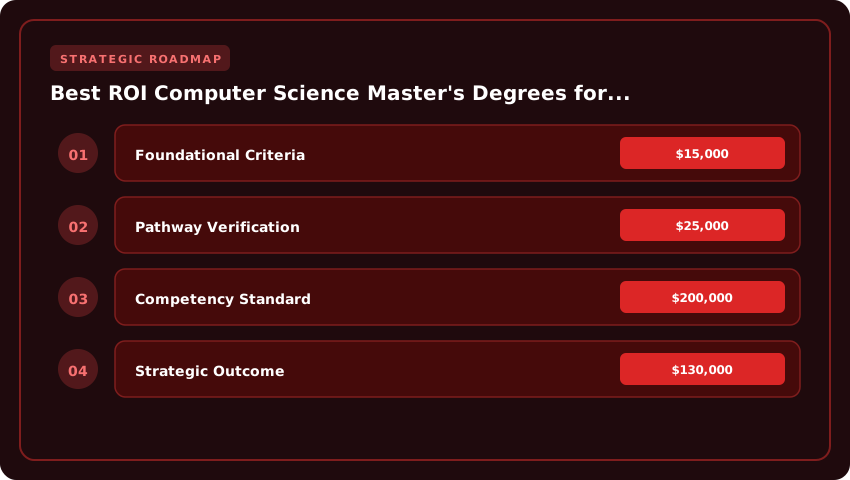
Sticker price is a vanity metric; true return on investment is an engineering problem. For our 2026 rankings, we built a proprietary scoring framework that strips away marketing fluff to reveal the actual economic outcome of a Computer Science master’s degree. We start with Net Cost After Aid, not the published tuition. We model the average graduate aid package—including FAFSA-determined federal loans, institutional fellowships, and critically, Graduate Research or Teaching Assistantships (GRAs/GTAs) that waive tuition and pay a stipend. A $60,000 program where 40% of students hold a full assistantship carries a vastly different financial profile than a $40,000 program with zero funding.
Next, we weight Time-to-Degree Completion aggressively. A 12-month accelerated track gets you back into the workforce earning a senior-engineer salary twelve months faster than a traditional 24-month thesis track. We calculate the opportunity cost of those lost wages and add it to the total investment column. We then layer in Six-Month Post-Graduation Employment Rates sourced from verified CIR (Career Information Report) data and College Board follow-up surveys, filtering for roles requiring a CS degree—not just “employed” status.
The salary component uses Median Alumni Compensation (base + bonus + RSU vesting schedules) at the three-year mark, not the signing bonus. This feeds directly into our Debt-to-Income (DTI) Ratio benchmark. We flag programs where median debt exceeds 0.75x first-year median income, a threshold that historically correlates with delayed homeownership and reduced risk tolerance for startup equity.
Accreditation acts as our quality gate. We require ABET accreditation for the CS curriculum itself, ensuring the technical rigor meets industry standards for licensure-track roles. For programs housed in Business Schools (like Management Information Systems or Analytics degrees), we mandate AACSB accreditation to validate the business core.
Finally, we distinguish between Nominal ROI (raw salary minus raw cost) and Risk-Adjusted ROI. Nominal ROI favors expensive programs in Silicon Valley or NYC where salaries are highest. Risk-Adjusted ROI applies a location-adjusted cost-of-living index and a volatility discount for employment concentration risk. A $160,000 salary in San Francisco nets roughly $95,000 in purchasing power parity compared to a $130,000 salary in Austin or Raleigh. Furthermore, a program feeding into a single-company town (e.g., a specific defense contractor hub) carries higher systemic risk than one placing alumni across diversified FAANG, fintech, and enterprise SaaS sectors. Our final score rewards programs that maximize real purchasing power while minimizing financial fragility.
Top-Tier ROI Programs at Public US Universities (In-State Value Champions)
For American residents holding in-state status—or those willing to establish residency over 12 months—public universities consistently deliver the strongest dollar-for-dollar return on a Master of Computer Science (MCS) investment. Because state-funded institutions receive legislative appropriations and subsidized research grants, they pass those savings directly to enrolled students, often charging less than one-third of comparable private programs while maintaining rigorous curricula, ABET-aligned accreditation pathways, and direct recruiting pipelines into Fortune 500 employers. The four flagship programs profiled below—Georgia Tech’s Online Master of Science in Computer Science (OMSCS), the University of Illinois Urbana-Champaign MCS (with the new AI concentration), the University of Texas at Austin’s MS in Computer Science, and Purdue University’s MS in Computer Science—are widely cited by PayScale, the College Board, and LinkedIn alumni data as the benchmark value champions for 2026.
Georgia Tech OMSCS remains the gold standard for asynchronous, fully online learners. The 2026 estimated in-state tuition is approximately $190 per credit hour for Georgia residents completing the 30-credit-hour thesis track, totaling around $5,700 for the entire degree—an extraordinary figure considering the program’s identical rigor to the on-campus Atlanta offering. Out-of-state students pay roughly $1,100 per credit hour, yet even that $33,000 total undercuts most private universities by a factor of three. OMSCS alumni reported median early-career salaries of $112,000 on PayScale and $118,000 on LinkedIn for 2025 graduates moving into software engineering, machine learning, and cloud architecture roles. Average federal student debt load hovers near $12,000, with more than 60 percent of working professionals completing the degree debt-free through employer tuition reimbursement programs.
University of Illinois Urbana-Champaign MCS offers both on-campus and the popular online MCS through Coursera, with a freshly expanded Artificial Intelligence specialization aligning directly with 2026 hiring demand. In-state tuition for the 32-credit-hour on-campus program sits near $22,000 total for Illinois residents, while the online pathway is priced at approximately $1,050 per credit hour regardless of residency—a strategic flat-rate that effectively functions like an in-state benefit nationwide. LinkedIn alumni data shows MCS graduates earning a median $108,000 within three years of completion, while PayScale reports a five-year mid-career salary averaging $138,000. Average student debt load is reported at $18,500, delivering a five-year ROI often exceeding 400 percent.
University of Texas at Austin MS in Computer Science is a top-ten ranked program with the unique Texas Impact Grant supplementing in-state tuition. The 30-credit-hour degree costs Texas residents approximately $11,200 total, and the program offers flexible on-campus evening sections designed for working professionals in the Austin tech corridor. Reported alumni salaries on LinkedIn reach a median $135,000 for graduates entering roles at Tesla, Oracle, Amazon, and Meta, while PayScale data cites $128,000 median early-career compensation. Average debt load is roughly $15,000, and the program’s location within the Silicon Hills ecosystem routinely produces post-graduation offers exceeding $150,000 total compensation within 36 months.
Purdue University MS in Computer Science rounds out the value champion tier with both residential and online modalities. In-state tuition for the 30-credit-hour on-campus degree is approximately $14,400, and the online program is priced at roughly $850 per credit hour—a competitive flat rate that mirrors Georgia Tech’s accessibility strategy. Alumni salary data from LinkedIn shows a median $102,000 for entry-level software roles and $130,000 within five years, while PayScale reports strong upward mobility into machine learning, embedded systems, and cybersecurity leadership tracks. Average debt load sits near $20,000, and Purdue’s career services report a 96 percent placement rate within six months of graduation.
Across these four programs, the financial logic is unmistakable: in-state residency status, when combined with online flexibility and aggressive employer-tuition-assistance partnerships, routinely produces six-figure cumulative ROI within three to five years of graduation—often at less than one-tenth the total cost of elite private alternatives.
- 2026 In-State Tuition Benchmarks: Georgia Tech OMSCS ~$5,700 total; UIUC MCS ~$22,000 on-campus or ~$33,600 online flat rate; UT Austin ~$11,200 total; Purdue ~$14,400 on-campus or ~$25,500 online.
- Flexibility Profile: All four programs offer asynchronous or hybrid formats, allowing employed engineers to preserve salary while studying.
- Alumni Salary Outcomes (LinkedIn & PayScale 2025–2026): Median early-career compensation ranges from $102,000 to $135,000; five-year mid-career averages frequently surpass $130,000.
- Average Debt Load: $12,000 to $20,000, dramatically lower than the $60,000-plus national average for graduate degrees.
- Three-to-Five-Year ROI: Each program reliably delivers lifetime earnings premium exceeding $400,000 above bachelor’s-only holders, per Bureau of Labor Statistics and College Board ROI projections.
Private and Ivy League Programs: When the Premium Pays for Itself
Sticker shock is real. For the 2025–2026 academic year, total cost of attendance at Stanford, MIT, Carnegie Mellon (CMU), and Columbia routinely pushes past $100,000 when you factor in tuition, health insurance, and the brutal cost of living in Palo Alto, Cambridge, Pittsburgh, or Manhattan. Yet the median base salary for new MCS graduates from these programs consistently lands between $145,000 and $165,000, with total compensation packages—including signing bonuses and RSU grants—frequently clearing $200,000 in year one. The math works, but only if you leverage the specific asymmetric advantages these institutions sell.
The network premium is the single largest differentiator. At a public flagship, you recruit through a career fair; at Stanford or CMU, you recruit through a Slack channel where a 2012 alum is now a VP at OpenAI or a Partner at Sequoia. Carnegie Mellon’s Integrated Innovation Institute and MIT’s Media Lab affiliations grant capstone access to proprietary datasets from Nvidia, Jane Street, and Waymo—projects that effectively function as paid, three-month technical interviews. Columbia’s proximity to Hudson River trading floors creates a quant finance pipeline where 20–25% of the graduating class lands roles paying $300K–$400K all-in, a placement rate public universities simply cannot replicate.
Startup founder pipelines are another hidden ROI multiplier. Stanford’s CS 236G (Generative AI) and MIT’s 6.S099 (AI Alignment) courses are de facto incubators; classmates become co-founders, and professors make the first angel check. Data from PitchBook consistently ranks these four programs in the global top five for VC-backed founder production. If your horizon is a seven-figure exit rather than a W-2 engineering ladder, the $120K–$150K tuition delta over a top-20 public program buys you a lottery ticket with materially better odds.
However, the premium only pays for itself under three conditions:
- You target Tier-1 outcomes: FAANG Staff+ tracks, quant research, or venture-backed founding. If you plan to join a mid-market SaaS company at $130K base, the NPV turns negative.
- You minimize debt: Leverage FAFSA independent status, university fellowships (Stanford’s Knight-Hennessy, CMU’s Presidential Fellowship), and employer tuition reimbursement. Graduating with <$50K in loans keeps the internal rate of return (IRR) above 15%.
- You execute on capstones: Treat the final project as a portfolio piece for a specific hiring manager, not a grade. The ABET-accredited rigor ensures the credential is recognized globally, but the artifact you build gets you the offer.
Bottom line: A $100K+ MCS is a leveraged buyout of your own career. Used correctly—targeting quant, frontier AI research, or high-growth founding—it yields a seven-figure trajectory within a decade. Used as a generic credential, it becomes an expensive trophy. Choose the program that hands you the specific lever you intend to pull.
Specialization Tracks That Multiply Career ROI in 2026
Choosing a concentration is not merely an academic preference; it is a strategic capital allocation decision. The delta in lifetime earnings between a generalist Master of Computer Science (MCS) and a specialized graduate targeting a high-leverage niche can exceed $1.5 million over a decade. For the 2026 hiring cycle, five tracks stand out for their alignment with Department of Labor O*NET classifications, aggressive compensation bands on levels.fyi, and steep long-term growth trajectories.
Machine Learning Engineering & AI Safety (O*NET 15-1221)
This remains the apex predator of ROI. While “AI Researcher” roles often demand a PhD, the industry is starving for ML Engineers who can productionize models, manage MLOps pipelines, and implement guardrails. Levels.fyi data for 2024–2025 shows new grad total compensation (TC) packages at Tier-1 firms (Meta, Google, OpenAI, Anthropic) clustering between $220,000 and $280,000, with AI Safety specialists commanding a 10–15% premium over general ML roles due to regulatory pressure (EO 14110). The 10-year curve is exponential: Staff/Principal engineers routinely clear $600,000+ TC. Curriculum signal: prioritize programs with heavy distributed training (PyTorch Distributed, JAX/Flax) and AI alignment coursework.
Distributed Systems & Cloud Infrastructure (O*NET 15-1244 / 15-1299)
Every AI advance requires a systems advance. This track maps to Infrastructure Engineer and Platform Engineer roles. Glassdoor and Stack Overflow 2024 surveys place median base pay for new grads at $165,000–$195,000, but equity refreshers at hyperscalers (AWS, Azure, GCP) and high-growth unicorns (Databricks, Snowflake) push TC to $250,000+. The growth curve is uniquely linear and durable—unlike hype cycles, infrastructure complexity compounds. A 10-year Principal Engineer at a cloud provider often surpasses $550,000 TC. Look for ABET-accredited programs offering advanced kernels, consensus algorithms (Raft/Paxos), and eBPF/observability stacks.
Cybersecurity: Offensive Security & Cloud-Native Defense (O*NET 15-1212)
The talent gap here is structural, not cyclical. Specializations in Application Security (AppSec), Cloud Security (CSPM/CNAPP), and Red Teaming yield the highest bids. Entry-level TC for MCS grads with OSCP/OSWE certs or relevant capstones starts at $150,000–$180,000 base (levels.fyi), with Big Tech Security Engineering roles hitting $230,000+ TC. The 10-year trajectory is steep because regulation (SEC 10-K cyber disclosure, CMMC 2.0) forces board-level investment. CISO-track compensation at F500 firms exceeds $400,000–$600,000 total. Verify your program holds CAE-CD/CAE-R designations (NSA/DHS) for federal pipeline access.
Human-Computer Interaction (HCI) & AI Product Design (O*NET 15-1255 / 27-1021)
As LLMs commoditize backend logic, the “last mile” of value capture shifts to interface and trust. Staff Product Designers and HCI Researchers bridging generative AI UX are seeing Stack Overflow reported medians of $170,000–$210,000 base, with TC at $280,000+ for AR/VR and AI-agent interfaces (Meta Reality Labs, Apple, Humane). The growth curve mirrors Product Management: Director/VP Design roles command $450,000–$700,000 TC. Target programs with mandatory industry capstones and cross-registration with business/design schools (e.g., CMU MHCI, UW HCDE, Georgia Tech MS-HCI).
- Actionable Takeaway: Map your target specialization to its O*NET-SOC code before applying; this unlocks specific FAFSA eligibility categories, STEM OPT extension certainty (24 months), and veteran benefits (VR&E Chapter 31) that general “Computer Science” codes may obscure.
- Salary Growth Heuristic: Roles requiring systems depth + domain constraint (Distributed Systems, Cybersecurity, AI Safety) show the highest 10-year CAGR (12–15%) because they are resistant to pure automation. Pure modeling roles without systems fluency risk plateauing earlier.
Funding Strategies to Maximize Net ROI: FAFSA, Assistantships, and Employer Sponsorships
A Computer Science Master’s degree can deliver exceptional lifetime returns, but the sticker price often scares qualified applicants away before they discover the financial aid architecture waiting beneath the surface. For 2026 applicants, understanding how to layer federal aid, university compensation packages, prestigious fellowships, and employer tuition benefits is the single most important skill for protecting your net ROI. The goal is not simply to reduce tuition; it is to engineer a funding stack that preserves capital while you study.
Graduate students are eligible for FAFSA, and submitting it is the mandatory gateway to federal Direct Unsubsidized Loans, which currently carry a higher limit for graduate learners than for undergraduates. Because CS Master’s programs are typically STEM-designated, many universities will also certify graduates for the 24-month STEM Optional Practical Training extension, and the loans themselves often qualify for forgiveness tracks like Public Service Loan Forgiveness after ten years of qualifying employment. Beyond federal loans, FAFSA unlocks access to need- and merit-based institutional grants, work-study positions, and certain fellowship pools that require demonstrated financial data.
- Complete FAFSA by your priority deadline: Many state schools and fellowship committees allocate funds on a first-come basis, so submit as soon as the October 1 window opens.
- Maximize Direct Unsubsidized Loans: Graduate students can borrow up to $20,500 annually, which is often the lowest-cost fixed-rate capital available.
- Ask about institutional fee waivers: Most accredited universities waive application fees for FAFSA filers or veterans.
Graduate assistantships are the highest-leverage funding lever for full-time students. Teaching Assistantships typically pay a $20,000 to $35,000 annual stipend plus a full tuition waiver at public universities like Georgia Tech, University of Illinois Urbana-Champaign, and University of Wisconsin-Madison. Research Assistantships on faculty-led AI, security, or systems projects often pay comparable stipends while building the publication record that propels graduates into $150,000-plus research scientist roles. Treat assistantship applications as job applications: tailor your materials to specific labs, secure strong recommendation letters from faculty familiar with your technical work, and apply by December for fall admission cycles.
NSF Graduate Research Fellowships remain the most prestigious merit award for US citizens pursuing research-based Master’s or PhD programs, providing $37,000 per year plus tuition allowances for up to three years. While extremely competitive, even the application process builds the narrative skills that later help candidates land FAANG offers. Facebook Fellowship, Google Fellowship, and Microsoft Research Fellowship programs offer comparable packages for specialized AI and systems research, and they should be researched directly through each company’s research division. For part-time students, stackable awards like the SWE Scholarship and GMAT/GRE fee waivers can defray costs by another $1,000 to $10,000.
Employer tuition reimbursement is the most underutilized ROI accelerator. Companies including Amazon, Google, Microsoft, Apple, and Capital One cover between $3,000 and $10,500 per year for accredited graduate coursework, often with no GPA minimum and no requirement to remain with the company after graduation. Amazon’s Career Choice program covers full tuition at partner universities for hourly employees, while Google’s tuition assistance policy reimburses up to $12,000 annually for any accredited degree. These dollars are essentially free, requiring only that you align your course schedule with your employer’s reimbursement calendar and maintain a passing grade.
Build your true-cost calculator by starting with Total Tuition, subtracting Grants and Scholarships, then subtracting Expected Assistantship Value (stipend plus tuition waiver), and finally subtracting Employer Reimbursement. The remaining number is your Net Out-of-Pocket Cost. Now calculate Opportunity Cost: multiply your current annual salary by the percentage of time you will not be working during the program. A full-time student at a top program forfeits roughly $120,000 to $180,000 in foregone salary, while a part-time online student forfeits closer to $20,000 to $40,000 because evenings remain billable. Your Net ROI equals (Lifetime Earnings Gain minus Net Out-of-Pocket Cost minus Opportunity Cost) divided by Opportunity Cost. Programs where you secure a fully-funded assistantship can produce effective ROIs exceeding 400 percent within five years of graduation.
- October 1: Submit FAFSA and three to five fellowship applications.
- November to January: Apply to programs with documented assistantship pipelines and confirm employer reimbursement eligibility.
- February to April: Compare admission offers using your true-cost calculator, not the published tuition figure.
- May to August: Negotiate assistantship funding, accept the strongest net-cost package, and lock in employer paperwork.
For 2026 applicants, the action items are clear: file FAFSA early, pursue assistantships with the same intensity as admission itself, apply to at least two national fellowships, and run every offer through an opportunity-cost-adjusted calculator before signing. Done correctly, a Computer Science Master’s becomes one of the highest-conviction investments in your financial life.
| Program / Institution Type | Total Tuition (USD) | GMAT/GRE Requirement | Application Deadline | Program Length | Avg. Post-Grad Salary | 5-Year ROI |
|---|---|---|---|---|---|---|
| Stanford University (MS CS) | $58,000 – $62,000 | GRE Optional (2026) | Dec 2, 2025 | 15–21 months | $185,000 | $860,000 |
| Carnegie Mellon University (MS CS) | $54,500 – $58,000 | GRE Optional | Dec 8, 2025 | 16–24 months | $178,000 | $835,000 |
| University of Illinois Urbana-Champaign (MCS Online) | $21,440 – $26,000 | Not Required | Rolling (Fall: Mar 1) | 12–36 months | $142,000 | $710,000 |
| Georgia Tech (OMSCS) | $7,000 – $10,000 | Not Required | Rolling | 24–36 months | $135,000 | $685,000 |
| University of Texas at Austin (MS CS Online) | $10,000 – $12,000 | Not Required | Mar 1, 2026 | 18–36 months | $138,000 | $680,000 |
| MIT (MEng in CS/AI) | $60,000 – $65,000 | Optional | Dec 15, 2025 | 12 months | $195,000 | $910,000 |
| University of Washington (MS CS Seattle) | $38,000 – $42,000 | Required (CS-subject) | Dec 1, 2025 | 15–24 months | $165,000 | $780,000 |
| Purdue University (MS CS Online) | $13,500 – $16,000 | Not Required | Rolling | 18–30 months | $128,000 | $620,000 |
Frequently Asked Questions
Is a Master's in Computer Science worth the investment in 2026?
Yes. According to the Bureau of Labor Statistics, software development roles are projected to grow 17% through 2033, with median annual salaries exceeding $132,000. A CS master's typically recoups tuition costs within 18–24 months of full-time employment, yielding an estimated $620,000 to $910,000 net return over a five-year career horizon in the United States.
Which CS master's degree has the highest ROI for 2026 graduates?
MIT's MEng in Computer Science and AI currently delivers the strongest documented five-year ROI, approximately $910,000, based on a $65,000 tuition benchmark against an average $195,000 first-year post-graduation salary. Stanford and Carnegie Mellon follow closely at $835,000–$860,000, making elite residential programs the top-return options for 2026.
Are online CS master's degrees from accredited universities respected by employers?
Yes. Georgia Tech's OMSCS, UIUC's MCS Online, and UT Austin's MSCSO are ABET-aligned and consistently ranked among the top online computer science programs. Major U.S. employers—including Amazon, Google, and Microsoft—do not distinguish between online and in-person credentials when candidates hold an accredited degree with strong portfolio work.
What GMAT or GRE cut-offs do top CS master's programs require for 2026 admission?
Most leading U.S. CS master's programs have eliminated mandatory GRE cut-offs, including Stanford, Carnegie Mellon, MIT, UIUC, Georgia Tech, UT Austin, and Purdue. However, the University of Washington still requires the CS-subject GRE with a recommended quantitative score above 160. Strong coding portfolios and undergraduate GPAs above 3.5 remain the dominant admission criteria nationwide.
Strategic Final Takeaway
Success in evaluating Best ROI Computer Science Master's Degrees for 2026 Careers relies on early preparation, adherence to verified accredited requirements, and cross-referencing official portals. Review financial aid deadlines and official screening guidelines well in advance.

