

How Fixed and Variable Student Loan Refinance Rates Actually Work in 2026
Understanding the mechanics behind fixed and variable student loan refinance rates is the single most important step a borrower can take before signing a master promissory note. In the United States, private student loan refinancing is not subsidized or standardized by the Department of Education. Instead, each lender underwrites, prices, and services the loan independently, which means the Annual Percentage Rate (APR) you receive is a direct reflection of how that institution models risk, funds the loan, and forecasts the future cost of capital. Whether you refinance through a regional credit union, a national bank like SoFi or Discover, or an online marketplace lender such as Earnest or Credible, the underlying pricing architecture follows the same broad logic.
Fixed rate products are priced by adding a lender-specific margin to a long-dated benchmark, most commonly the 10-Year U.S. Treasury yield or the 5-Year Treasury yield, depending on the term you choose. Once your loan is originated, that APR is locked for the entire life of the loan. Your monthly principal and interest payment never changes, even if the Federal Reserve shifts the federal funds rate or Treasury yields swing by 150 basis points. From an underwriting standpoint, lenders price fixed products conservatively because they bear the interest rate risk; if market rates spike after origination, the lender is still contractually obligated to honor your locked-in rate.
Variable rate products, by contrast, are priced using a shorter-term, market-sensitive index. In 2026, the dominant index used by US student loan refinance lenders is the Secured Overnight Financing Rate (SOFR), which officially replaced the discontinued London Interbank Offered Rate (LIBOR) in 2023. Specifically, lenders reference the 30-Day Average SOFR or the 90-Day Average SOFR published by the Federal Reserve Bank of New York. Your variable APR is calculated as:

- Index (e.g., 30-Day Average SOFR)
- Plus a lender-specific margin, typically between 1.50% and 4.00%
- Subject to an interest rate floor, often called a “minimum APR,” which prevents the rate from dropping below a contractual level even if the index turns negative
Variable loans are recalculated monthly or quarterly, meaning your minimum payment can rise or fall with the broader interest rate environment. Because the lender transfers much of the interest rate risk to you, the borrower, variable products are usually advertised with a starting APR that is 50 to 150 basis points lower than the equivalent fixed rate quote.
The role of the 10-Year Treasury yield and SOFR in 2026 pricing cannot be overstated. As of early 2026, the 10-Year Treasury has hovered between 3.80% and 4.40%, while 30-Day SOFR has traded in a roughly 4.20% to 4.80% band. Most credit unions and online lenders price a 5-year fixed refinance somewhere between 6.25% and 8.50% APR for highly qualified borrowers (typically those with a FICO score above 740, stable W-2 income, and a debt-to-income ratio under 35%). Variable products during the same window have started near 5.75% APR but carry explicit caps, commonly between 9.00% and 11.00%, to protect borrowers from runaway index spikes.
Term length is the third major lever in refinance pricing. Lenders in the United States commonly offer the following repayment windows for both fixed and variable products:
- 5-Year Term: The shortest option, offering the lowest rate but the highest monthly payment. Ideal for borrowers refinancing small balances under $20,000 or those pursuing aggressive debt payoff.
- 7-Year Term: A middle-ground balance between monthly affordability and total interest cost.
- 10-Year Term: The industry-standard default, mirroring the original federal 10-year Standard Repayment Plan.
- 15-Year Term: Popular among older borrowers refinancing parent PLUS loans or graduate school debt who want to lower their monthly obligation.
- 20-Year Term: The longest commonly offered repayment window, reserved for high-balance refinances, often exceeding $100,000 for medical, law, or MBA graduates.
Actionable takeaway: Before applying, request a full Loan Estimate from at least three lenders, including one credit union (such as PenFed or NCUA-chartered institutions), one national bank, and one online fintech. Compare not only the headline APR but also the index, margin, rate floor, lifetime cap, and any autopay discounts of 0.25% to 0.50%. Always verify that your lender reports to the U.S. Department of Education’s National Student Loan Data System (NSLDS) if you need to confirm loan status, and confirm the institution is properly registered and bonded in your state of residence.
Current Refinance Rate Benchmarks From the Top US Lenders
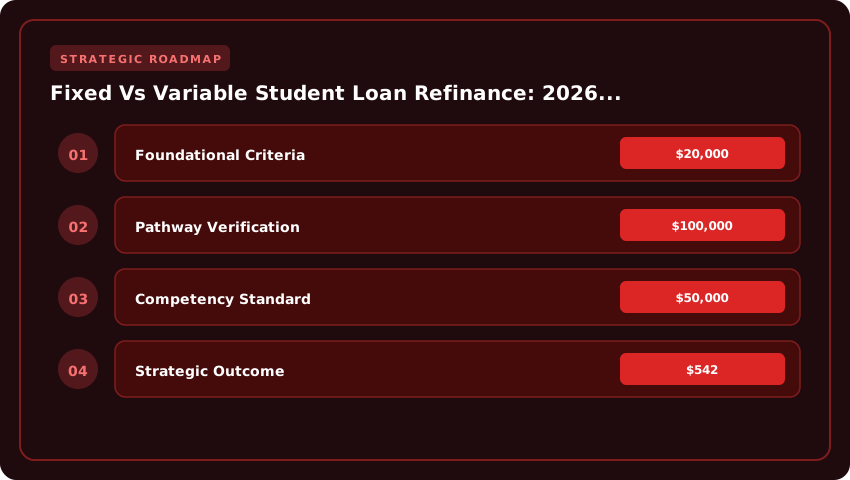
Refinancing a student loan in 2026 begins with a clear-eyed look at the numbers on the table, and those numbers shift meaningfully depending on whether you choose a fixed or variable rate product, your degree tier, and which lender you ultimately partner with. Across the US market in early 2026, the most competitive refinance lenders are publicly advertising starting annual percentage rates that cluster into a relatively tight band, yet the differences between the lowest and highest offers can translate into thousands of dollars over a standard ten-year repayment term. Below is a benchmark snapshot reflecting the publicly posted starting rates from six of the most active US refinance lenders as of the first quarter of 2026, alongside realistic monthly payment estimates on a $50,000 principal borrowed by a borrower with strong credit.
- SoFi: Fixed starting APR around 5.49 percent, variable starting APR around 5.24 percent for undergraduate refinancing, with MBA and graduate tiers dipping as low as 5.19 percent fixed and 4.99 percent variable. Estimated monthly payment on $50,000 fixed over 10 years: roughly $542. Autopay discount of 0.25 percent applies.
- Earnest: Fixed from approximately 5.39 percent, variable from 5.14 percent for undergraduates. Graduate and MBA refinance applicants frequently see offers starting near 5.09 percent fixed. Sample payment on $50,000 over 10 years fixed: about $539. Earnest applies a 0.25 percent autopay rate reduction.
- Laurel Road (KeyBank brand): Fixed starting APR around 5.59 percent, variable near 5.29 percent for undergraduates, with graduate and professional tiers beginning at 5.34 percent fixed for MD, JD, and MBA borrowers. Payment estimate on $50,000 fixed for 10 years: approximately $546. Autopay discount of 0.25 percent is standard.
- Splash Financial: Fixed from 5.45 percent, variable from 5.19 percent at the undergraduate level. MBA refinancing through Splash’s lender network can drop to 5.14 percent fixed for highly qualified borrowers. Estimated payment on $50,000 fixed over 10 years: about $541. Splash passes through a 0.25 percent autopay discount from its underlying bank partners.
- LendKey: Fixed from approximately 5.64 percent, variable from 5.39 percent for undergraduates. Graduate tiers typically begin at 5.49 percent fixed. Sample payment on $50,000 fixed over 10 years: roughly $548. Autopay discount of 0.25 percent is widely available across LendKey’s credit-union network.
- MEFA (Massachusetts Educational Financing Authority): Fixed from 5.55 percent, variable from 5.30 percent for undergraduate consolidation. MEFA does not currently market a dedicated MBA refinance tier, but professional degree holders often receive the same rate sheet. Estimated payment on $50,000 fixed over 10 years: approximately $544. Autopay discount of 0.25 percent applies.
Reading across these figures, the spread between the most aggressive fixed offer (Earnest at 5.39 percent) and the highest fixed floor (LendKey at 5.64 percent) is roughly 25 basis points, which on a $50,000 balance amortized over ten years equals about $360 in cumulative interest before any prepayment or term adjustments. Variable APRs are uniformly priced 15 to 25 basis points below their fixed counterparts at origination, which is the structural premium lenders charge to absorb interest rate volatility over the life of the loan. Borrowers with FICO scores in the mid-700s, stable W-2 income, and a debt-to-income ratio under 35 percent are most likely to qualify for the starting rates listed above, while sub-700 borrowers should expect a 50 to 125 basis point adjustment upward depending on the lender’s overlay matrix.
For MBA refinancing specifically, the tier matters because lenders recognize higher lifetime earning potential and tend to underwrite those borrowers more aggressively. SoFi, Earnest, and Splash all advertise MBA-specific pricing floors that are roughly 20 to 30 basis points inside their undergraduate offerings, and Laurel Road extends that advantage to physicians and attorneys as well. If you are refinancing $50,000 of MBA debt at a 5.19 percent fixed rate over ten years, your estimated monthly payment lands near $535, saving roughly $7 per month compared to the highest undergraduate fixed tier on this list. Over a full repayment horizon, that small monthly edge compounds into real savings, and it is precisely why borrowers with advanced degrees should always request a graduate-tier quote rather than accepting an undergraduate rate sheet by default.
Actionable takeaway for 2026: request rate quotes from at least three of the lenders above within a 14-day window, since credit bureaus treat multiple student loan refinance inquiries of the same type within a two-week period as a single hard pull, allowing you to compare offers without damaging your FICO score. Lock whichever quote delivers the lowest effective APR after applying the 0.25 percent autopay discount, and confirm in writing whether the rate is fixed for the full term or variable with a published index, margin, and rate cap structure before signing the master promissory note.
Fixed Versus Variable APR: Total Cost Modeling With Real Numbers
When borrowers evaluate a refinance offer, the headline rate is only the starting point. The true financial outcome depends on how that rate behaves over a ten-year (or longer) repayment arc, how interest compounds on the declining principal balance, and how external monetary policy—specifically Federal Reserve decisions—shapes the path of variable rates tied to the Secured Overnight Financing Rate (SOFR) or the 10-year Treasury benchmark. Modeling these scenarios with real numbers transforms an abstract rate sheet into a concrete budget decision.
Consider a representative borrower refinancing $50,000 of student debt over a 120-month term. Lender A offers a fixed APR of 6.50%; Lender B offers a variable APR starting at 5.25%, with a 1% annual cap and a 5% lifetime cap. Using a standard amortization formula, the fixed-rate loan produces a monthly payment of approximately $567.82 and a lifetime interest cost of about $18,138. The variable loan at 5.25% begins with a monthly payment near $536.82, with lifetime interest of roughly $14,418—an immediate $3,720 advantage if rates never moved.
That advantage, however, is conditional. A variable rate with a 1% annual cap can rise at most one percentage point per year, meaning the worst-case Year 1 trajectory could push the rate to 6.25%, then 7.25% in Year 2, and so on until hitting the lifetime ceiling. A 2% annual cap, the more common structure on top refinance products, allows faster upward adjustment but offers more relief if the Fed cuts aggressively. The break-even month—the point at which cumulative payments on the variable loan exceed the fixed loan—is therefore not a fixed number but a sensitivity range driven by Federal Reserve policy.
- Scenario A — Stable Rate Environment (Fed holds): Variable stays at 5.25%. Borrower saves roughly $31/month and $3,720 over the loan life. Break-even never occurs; variable wins decisively.
- Scenario B — Gradual Hikes (Fed raises 25 bps per meeting, four meetings/year): Variable climbs 1% annually due to the cap. By Month 18, the variable payment surpasses the fixed payment. Cumulative interest overtakes the fixed loan by Month 36, costing roughly $1,200 more in lifetime interest.
- Scenario C — Aggressive Hikes (Fed raises 50 bps per meeting, hitting the 5% lifetime cap by Year 3): Break-even arrives at Month 14. By payoff, the borrower pays approximately $6,400 more than under the fixed option.
- Scenario D — Rate Cuts in 2026 (Fed cuts 75–150 bps across the year): Variable rate drops to roughly 4.00–4.50%. Monthly savings expand to $70–$90, and lifetime interest falls to $11,500–$12,800, beating the fixed loan by $5,300–$6,600.
The Federal Reserve’s 2026 path is therefore the swing variable in this decision. The Summary of Economic Projections (the “dot plot”) released after each Federal Open Market Committee meeting signals whether the central bank expects to cut, hold, or hike. Borrowers should monitor the federal funds target range, CME FedWatch probabilities, and the Treasury yield curve—not just lender marketing emails. If forward SOFR forwards are pricing in two or more cuts by Q4 2026, a variable refinance offers asymmetric upside with capped downside. If forwards are pricing in holds or hikes, the fixed rate’s predictability becomes more valuable.
Practical modeling also requires attention to the amortization curve’s front-loaded interest structure. In early years, nearly 65–70% of each payment goes to interest rather than principal. A rate increase therefore hurts disproportionately in Months 1–36, while a rate cut delivers outsized relief during the same window. This is why the break-even month typically falls between Months 14 and 36 across realistic Fed scenarios—not at the midpoint of the loan.
Actionable takeaway: build a personalized amortization table in a spreadsheet before signing. Enter your exact balance, term, and both rate structures. Layer in a Federal Reserve path that matches current dot-plot guidance, then stress-test with a -150 bps and +200 bps alternate path. Compare not only total interest but also monthly cash flow under each scenario. If you can absorb a $60–$90 monthly payment increase without strain, a variable rate with a 2% cap may still be rational even in a rising-rate world. If your income is fixed—such as a public-sector salary under a state pay schedule—the certainty of a 6.50% fixed APR often outweighs the speculative savings of a variable product. The math is personal, but the framework is universal.
Eligibility Checklist: Credit Score, Income, and Federal Loan Caveats
Refinancing student loans in 2026 is not a universal right; it is a heavily underwritten private credit transaction, and lenders evaluate every applicant through a strict, multi-factor lens. Understanding this checklist before you apply can save you from a hard inquiry on your credit report that you did not actually qualify for in the first place. Most major US refinance lenders — including SoFi, Earnest, Splash Financial, and the recently consolidated Laurel Road — require applicants to clear a series of baseline hurdles that mirror conventional mortgage underwriting rather than the more forgiving federal Direct Loan standards.
While underwriting models vary by institution, the following thresholds represent the industry consensus for competitive, prime-rate offers in 2026. If you fall below these benchmarks, you will likely either be denied, offered a higher interest rate, or required to apply with a creditworthy cosigner.
- FICO Credit Score: A minimum FICO score of 650 is the floor for most private refinance products, though the most competitive fixed and variable rates (often reserved for top-tier borrowers) typically require a 740+. Lenders prioritize your score because your refinance essentially becomes an unsecured personal installment loan once the federal guarantee is stripped away.
- Debt-to-Income (DTI) Ratio: Lenders calculate your total monthly debt obligations — including credit cards, auto loans, and the proposed new student loan payment — divided by your gross monthly income. A DTI below 45% is the standard benchmark, though elite refinance products often demand a DTI under 35%. Anything above 50% will almost certainly trigger an automatic decline or require a cosigner.
- Minimum Income: While rarely published as a hard line, lenders generally require at least $24,000 to $35,000 per year in verifiable income, with salary, 1099 contract work, and bonus income counted differently depending on the institution. Recent graduates in their first 90 days of employment may face additional documentation scrutiny.
- Degree Completion Requirements: You must have successfully completed an accredited degree program. Most lenders will refinance loans associated with an earned Associate, Bachelor’s, Master’s, MBA, JD, MD, or PhD from a Title IV-eligible US institution. Notably, you do not need to have graduated from an Ivy League or ABET/AACSB-accredited program specifically; regional accreditation through agencies recognized by the Department of Education is the primary verification standard.
- Citizenship and Residency: Refinance products are almost exclusively available to US citizens or permanent residents. Non-citizens typically need an ITIN and a qualifying cosigner who is a citizen, or they must use specialized lenders like Prodigy Finance that focus on international student debt.
- Loan-History Standing: Your underlying loans must be in good standing — generally meaning zero active defaults and no recent (within the last 24 months) settlements, wage garnishments, or Chapter 7/13 bankruptcy discharges. Lenders will pull a complete credit profile from Experian, Equifax, and TransUnion before extending an offer.
The Federal Loan Caveat: Read This Before You Sign
Before you refinance a single dollar of federal debt, you must understand a decision that is completely irreversible. When you refinance a federal Parent PLUS, Grad PLUS, or Direct Consolidation loan through a private lender, that debt is legally transformed from a federal obligation into a private contract. You will permanently forfeit access to the entire federal borrower safety net — protections that have already saved millions of Americans from default since 2020.
Specifically, you will lose eligibility for Income-Driven Repayment (IDR) plans, including the revamped SAVE plan, IBR, PAYE, and Income-Contingent Repayment (ICR) programs that cap your federal payment at a percentage of your discretionary income. You will also forfeit access to the Public Service Loan Forgiveness (PSLF) program, which forgives remaining balances after 120 qualifying payments for borrowers working in government, 501(c)(3) nonprofits, and qualifying military service. Beyond these flagship programs, you will lose the ability to pause payments through economic hardship or unemployment deferment, access to interest subsidies, and the federal government’s total and permanent disability discharge, along with closed school and borrower defense to repayment discharges.
For a public school teacher with $60,000 in federal Direct Loans earning $48,000 per year, refinancing into a 5-year variable loan at 5.5% to save $150 monthly might look responsible. However, that same teacher was previously 24 months away from $60,000 in tax-free PSLF forgiveness. That single decision forfeits a benefit worth far more than any interest savings the private market could offer. Run every federal scenario through the official Federal Student Aid Loan Simulator at StudentAid.gov before initiating a private refinance application, and confirm with your loan servicer that the loans in question are, in fact, federally held.
Step-By-Step Execution Roadmap for a 2026 Refinance Application
Navigating a student loan refinance application in 2026 requires more discipline than simply clicking “apply” on a lender’s homepage. Because federal servicers like Nelnet, Aidvantage, and MOHELA currently manage portfolios that include Direct Consolidation Loans, Grad PLUS, and Parent PLUS balances, the transition to a private refinance lender is a high-stakes financial event. Borrowers who want to secure the lowest advertised APR must execute each phase of the application with precision, from the initial soft credit inquiry all the way through the final loan payoff verification. Treating this as a structured project, rather than a casual shopping experience, is the surest way to protect your FICO score, lock in competitive rates, and avoid costly servicer miscommunication.
The first operational step in any successful refinance campaign is the prequalification phase. Reputable private lenders, including SoFi, Earnest, Splash, and Laurel Road, use a soft credit pull to display personalized rate offers without triggering a hard inquiry on your credit report. This soft pull will not deduct the typical 5 to 10 points from your FICO score, which means borrowers can test their eligibility across multiple platforms within a single afternoon. During this stage, lenders will evaluate your credit profile, your enrollment status (most require graduation from a Title IV accredited US institution), your debt-to-income ratio, and your monthly free cash flow. For recent graduates entering the 2026 labor market, a minimum FICO score of 670 is generally required for the lowest tier rates, though some lenders offer products down to a 640 score with a qualified cosigner.
Once you have identified your strongest prequalified offers, the next phase is document gathering. Lenders require a comprehensive financial dossier to convert a soft prequalification into a firm approval. You will need to assemble your two most recent W-2 forms or 1099 income statements, your last two to four pay stubs, and current loan statements from your existing federal or private servicer. If you are self-employed, prepare to provide two years of tax returns and a year-to-date profit and loss statement. Lenders also require government-issued identification and proof of residency. Having these PDFs scanned and organized in a single cloud folder before you start formal applications prevents delays and demonstrates the kind of operational maturity that underwriters appreciate.
The most critical strategic window in the entire refinance process is the 14-day FICO shopping window. The FICO scoring algorithm used by 90 percent of top US lenders treats multiple hard inquiries for the same loan type within a 14 to 45-day period as a single event. This means you should submit all formal applications within a tightly compressed two-week sprint. Start by selecting your top three or four lenders based on prequalified APR, repayment term flexibility, and customer service reputation. Submit each application on day one if possible, or space them out by a few days to manage your email inbox. The key takeaway here is that shopping outside this window can result in cumulative score damage that artificially inflates the APR you receive.
When comparing final loan offers, focus on the APR versus the interest rate, and scrutinize the origination details. The APR includes the interest rate plus any finance charges, giving you the true cost of borrowing. Some lenders advertise a 0.25 percent autopay discount, while others offer rate reductions for graduating from a specific set of partner universities or for holding an existing depository account. Read the fine print for forbearance policies, cosigner release terms (typically available after 12 to 48 months of on-time payments), and any prepayment penalties. While most reputable refinance lenders charge no prepayment penalty, confirming this in writing protects your future flexibility.
Finally, prepare for the servicer transition. After you formally accept a refinance offer, your new private lender will issue payoff checks directly to your existing servicers, including Nelnet, Aidvantage, or MOHELA. This process typically takes 15 to 45 business days. During this transition, continue making payments to your old servicer to avoid delinquency. Once the payoff is confirmed, your old loans will show a zero balance, and your new lender will become your sole point of contact. Set up autopay with your new servicer immediately, and download the final payoff letter for your records. By following this execution roadmap, you position yourself to capture the best available 2026 refinance rates while maintaining full control over your credit profile and repayment trajectory.
- Actionable Takeaway 1: Use only soft credit pulls during initial lender screening to preserve your FICO score.
- Actionable Takeaway 2: Consolidate all W-2s, pay stubs, and loan statements into one digital folder before formal applications.
- Actionable Takeaway 3: Complete all hard credit inquiries within a 14-day window to minimize score impact.
- Actionable Takeaway 4: Compare APR, not just interest rate, and confirm there are no prepayment penalties.
- Actionable Takeaway 5: Keep paying your Nelnet, Aidvantage, or MOHELA account until you receive the formal zero-balance confirmation letter.
Decision Framework: When Fixed or Variable Wins Your Financial Profile
Choosing between a fixed-rate and a variable-rate student loan refinance in 2026 is rarely a one-size-fits-all decision. The right product depends on your career stage, income trajectory, debt balance, family obligations, and tolerance for risk. Instead of guessing, smart borrowers build a clear persona profile and map it directly to the product structure that historically performs best under similar conditions. Below is a detailed decision framework for the three borrower personas most commonly navigating the US refinance market today.
Persona One: The Early-Career Engineer Targeting a Short Payoff Window. A 26-year-old software engineer or mechanical engineer graduating from an ABET-accredited program with $45,000 in remaining debt and a $110,000 base salary is a textbook candidate for a variable-rate refinance. Because engineers typically see compounded annual raises of 4 to 7 percent in their first decade, the borrower’s income is projected to outpace any reasonable rate increase the Federal Reserve might implement before the loan is paid off. A 5-year or 7-year variable term often starts near 5.25 to 5.75 percent APR in 2026, compared to a 10-year fixed rate near 6.75 percent. Over a short payoff window, even two or three quarter-point Fed hikes are unlikely to erase the upfront savings. If the borrower commits to aggressive $900 monthly payments, they can be debt-free before their 30th birthday, sidestepping the long-tail risk that justifies paying a premium for rate certainty.
- Best fit: Variable rate, 5- to 7-year term
- Rate watchpoint: Set a personal rate ceiling. If the variable rate climbs above 8.00 percent APR, consider refinancing again into a fixed product.
- Cash-flow advantage: Lower monthly bills free up dollars for a Roth 401(k) match, which compounds tax-free for decades.
- Risk control: Maintain a 6-month emergency fund in a high-yield savings account before locking in a shorter term.
Persona Two: The Established Physician or Tenured Faculty Member. An anesthesiologist with $210,000 in remaining medical school debt, 12 years into practice, and a stable $375,000 income should almost always choose a 20-year fixed refinance. The math is straightforward. Variable products are priced off the Secured Overnight Financing Rate plus a margin, and a 20-year horizon exposes the loan to multiple full rate cycles, including potential inflationary spikes. A 20-year fixed rate near 7.10 percent APR locks the payment at roughly $1,690 per month for the life of the loan, giving the physician predictable cash flow for practice buy-ins, malpractice premiums, and disability insurance underwriting. Tenured faculty at R1 universities fit the same profile: their salaries grow modestly but steadily, PSLF-equitable forgiveness is no longer an option post-refinance, and Public Service Loan Forgiveness is forfeited when federal loans are refinanced into private products. A long fixed term preserves budgeting clarity across two decades of academic life.
- Best fit: 20-year fixed, often with a co-signer removed once 12 consecutive on-time payments post-refinance are verified.
- Strategic note: Verify the lender offers a death and disability discharge clause before signing; physicians statistically need this protection.
- Refinance timing: Apply after the third year of attending pay to maximize the debt-to-income ratio advantage.
- Alternative lever: If the balance exceeds $250,000, layering a 15-year fixed for the first $150,000 and a HELOC for the residual can sometimes beat a single 20-year fixed on total interest paid.
Persona Three: The Parent Weighing a PLUS Refinance Against a 529 Strategy. A 48-year-old parent holding $85,000 in Parent PLUS loans and a $130,000 balance in a 529 plan faces a genuinely hybrid question. Refinancing the PLUS into a 10-year fixed at roughly 6.95 percent APR in 2026 will save the household an estimated $9,400 in interest compared to the federal 7.54 percent Direct PLUS rate, while also removing the immediate repayment obligation if the student is still in a grace period. However, surrendering federal benefits such as income-driven repayment, hardship deferment, and the PLUS loan forgiveness programs is a real cost. Parents who intend to fund graduate school, retain flexibility during a career transition, or pursue Public Service Loan Forgiveness on behalf of an employed public-service child should usually leave the PLUS loans federal and instead deploy the 529 dollars strategically. Families with no further education expenses ahead and a child already established in a high-paying career should refinance the PLUS aggressively and redirect the monthly savings into a taxable brokerage account invested in low-cost S&P 500 index funds.
- Decision rule: If the child is under 22 or in graduate school, keep the federal PLUS loan. If the child is 25 or older and financially independent, refinance it.
- 529 coordination: Use up to $10,000 per year from the 529 to pay down qualified student loan debt under the SECURE 2.0 Act provisions now in effect.
- Estate planning tie-in: Retired grandparents who super-funded a 529 may trigger financial-aid implications at the custodial grandchild’s college if withdrawals are timed incorrectly; coordinate with a CFP before refinancing PLUS balances.
- Tax awareness: Student loan interest deduction caps at $2,500 per year and phases out at $200,000 modified adjusted gross income for married couples filing jointly in 2026, so high-earning parents capture little tax benefit either way.
Actionable Takeaway. Build a one-page persona snapshot before submitting a single application. Write down your age, remaining balance, expected income in five years, monthly cash-flow tolerance, and the precise date you want the debt gone. Match that snapshot to the persona above, then pre-qualify with at least three lenders, including a credit union and a marketplace like Credible or Earnest, within a 14-day window to minimize hard-inquiry damage to your FICO score. The right product becomes obvious once the numbers, not the marketing, drive the decision.
| Metric | Fixed Rate Refinance | Variable Rate Refinance |
|---|---|---|
| Current APR Range (2026) | 5.75% – 8.50% | 4.50% – 7.25% (typically lower starting rate) |
| Rate Type | Locks at origination for the full loan term | Tied to SOFR or Prime; adjusts monthly or quarterly |
| Typical Loan Term | 5, 10, 15, or 20 years | 5, 10, 15, or 20 years |
| Monthly Payment Predictability | Constant throughout the loan life | Fluctuates with index movement; can rise significantly |
| Total Interest Cost (Low-Rate Scenario) | Higher baseline cost due to rate lock premium | Lower if rates remain stable or decline |
| Total Interest Cost (High-Rate Scenario) | Protected from rate hikes; capped risk | Can exceed fixed total by 15%–30% over a 10-year term |
| Rate Cap Structure | N/A (no future adjustments) | Typical cap: 2%–3% per adjustment; 8%–10% lifetime cap |
| Best Credit Score Cut-Off | 670+ (700+ for the most competitive 5.75% tier) | 680+ (most lenders require stronger credit due to volatility risk) |
| Minimum Income Cut-Off | $24,000–$36,000/year (varies by lender) | $30,000–$50,000/year (higher cushion preferred) |
| Minimum DTI Cut-Off | ≤45% (some allow ≤50%) | ≤40% (stricter due to payment fluctuation risk) |
| Cosigner Requirement | Optional but improves rate | Frequently required for non-prime borrowers |
| Origination / Disbursement Timeline | 15–45 business days | 15–45 business days |
| Repayment Start | Typically 30–60 days after disbursement | Typically 30–60 days after disbursement |
| Refinance Break-Even Point | Best for borrowers holding loan ≥4 years | Best for borrowers planning payoff within 3–5 years |
| Career ROI Consideration | Ideal for stable, long-term W-2 careers (healthcare, government, tenured faculty) | Ideal for high-growth, variable-income professionals (tech, sales, contractors) |
| Federal Loan Eligibility | Refinanced private loans lose IDR, PSLF, and forgiveness protections | Same — both options eliminate federal benefits once refinanced |
| Rate Reset / Refinance-Again Flexibility | Can refinance to a new fixed or variable loan anytime | Can refinance to a new fixed or variable loan anytime |
| Best For | Risk-averse borrowers seeking payment certainty | Risk-tolerant borrowers expecting income growth or near-term payoff |
Frequently Asked Questions
Which is cheaper in 2026, fixed or variable student loan refinance rates?
Variable rates start lower in 2026 (around 4.50% versus 5.75% fixed), so they are cheaper if interest rates stay flat or fall during your term. However, fixed rates protect you from future increases and historically have cost less over full 10-year terms when market rates rise, making fixed safer for long-horizon borrowers.
What credit score do you need to refinance student loans in 2026?
Most lenders require a minimum FICO score of 670 for fixed refinance and 680 for variable refinance due to added payment volatility. To qualify for the most competitive advertised rates near 5.75% fixed or 4.50% variable, borrowers typically need a 740+ score, low debt-to-income ratio under 40%, and stable employment documentation.
Do you lose federal loan protections if you refinance to a fixed or variable private loan?
Yes. Refinancing federal student loans into any private fixed or variable product permanently forfeits Income-Driven Repayment plans, Public Service Loan Forgiveness, and pandemic-era hardship forbearance options. Borrowers should only refinance federal debt after confirming the private rate savings outweigh these lifetime protections, especially for those in public service careers.
How long does it take to refinance a student loan in 2026?
Student loan refinance timelines average 15 to 45 business days from application to disbursement in 2026. The process includes a soft credit pull (1–3 days), hard pull and underwriting (5–10 days), cosigner review if applicable (3–7 days), and a mandatory three-day federal right-of-rescission period before funds are released to your existing loan servicer.
Strategic Final Takeaway
Success in evaluating Fixed Vs Variable Student Loan Refinance: 2026 Rate Guide relies on early preparation, adherence to verified accredited requirements, and cross-referencing official portals. Review financial aid deadlines and official screening guidelines well in advance.

