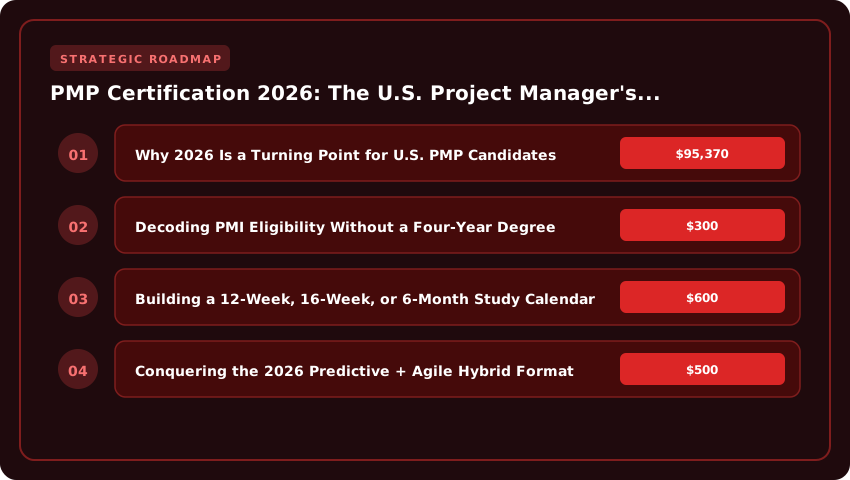
Why 2026 Is a Turning Point for U.S. PMP Candidates
If you have been quietly watching the Project Management Professional (PMP) credential from the sidelines, 2026 is the year the conversation changes. Three forces are converging at once: a meaningful exam content update from the Project Management Institute (PMI) that took effect in January 2025, a labor market that is rewarding certified project leaders with double-digit salary premiums, and an industry shift toward Agile, hybrid, and AI-augmented delivery models that is rewriting what it means to “manage a project.” Together, these forces make the next twelve months a genuine inflection point for U.S.-based candidates who want to stay competitive in a field the Bureau of Labor Statistics (BLS) expects to expand steadily through 2032.
The January 2025 PMI exam update was not a cosmetic refresh. PMI restructured the exam content outline so that roughly half of the questions now reflect predictive, plan-driven approaches and the other half reflect Agile and hybrid approaches, with dedicated weight on business acumen domains like benefits realization, compliance, and organizational change. For U.S. candidates, this matters at the desk level: if your study materials are older than mid-2024, you are likely memorizing domains that no longer map to the test blueprint. The ripple effect is real, and exam prep providers across the country have rebuilt their question banks, instructor-led bootcamps, and simulation exams to align with the new weighting.
Equally important is the labor market signal. The BLS projects 7.5% employment growth for project management specialists through 2032, faster than the 4% average for all occupations, and reports a U.S. median annual wage of $95,370 for the role. That salary benchmark alone reframes the PMP as a financially defensible investment. When you factor in PMI’s own salary surveys, which consistently show PMP holders earning roughly 25% above non-certified peers in the U.S., the credential begins to look less like a line item on a resume and more like a compounding career asset, particularly in metropolitan hubs like San Francisco, Washington D.C., New York, and Chicago where certified project managers routinely clear six figures.

Then there is the methodological shift. Hybrid delivery is no longer a buzzword, it is the default operating model in U.S. enterprises, blending Waterfall governance with Scrum execution and Kanban flow. Layer in AI-augmented tools like Microsoft Copilot, Atlassian Intelligence, and predictive analytics dashboards, and the role of the project manager is morphing into something closer to a delivery strategist who orchestrates both humans and machines. PMI’s content update explicitly reflects this: domains covering AI considerations, data-driven decision-making, and adaptive planning now appear on the exam. Candidates who prepare with the old mindset, memorizing process charts and ITTO inputs, will struggle. Candidates who learn to think in terms of servant leadership, iterative value delivery, and intelligent tooling will pass, and more importantly, will be ready for the work that follows.
Here is what this turning point looks like in practical terms for a U.S. candidate building a 2026 study plan:
- Budget for a curriculum refresh. If your last study guide predates the January 2025 content outline, set aside roughly $300 to $600 for updated question banks, and another $500 to $1,500 if you plan to enroll in a PMI Authorized Training Partner (ATP) bootcamp that explicitly maps to the new domains.
- Plan around the BLS wage signal. With a U.S. median of $95,370 and PMP-certified professionals earning meaningfully more, the credential’s return on investment, measured against a typical $2,500 to $5,000 total cost (exam fee plus prep), often pays back within the first three to six months of post-certification employment.
- Lean into Agile and hybrid fluency. Half of your exam is now Agile-adjacent. Even if you currently work in a predictive environment, intentionally study Scrum ceremonies, Kanban flow metrics, and servant leadership behaviors, because that is what the new blueprint tests.
- Future-proof for AI-augmented delivery. Expect scenario-based questions that test how you would use AI tools to forecast risk, optimize resource allocation, or surface delivery insights. Treat AI literacy as a study topic, not a side note.
- Align your study window with PMI’s exam scheduling reality. PMI transitioned to a year-round, online-proctored exam format, which lets you book a test date that matches your study readiness rather than waiting for a fixed testing window. Use that flexibility to your advantage.
The bottom line is simple: 2026 is not just another calendar year for PMP aspirants. It is the first full year in which the credential, the exam, the labor market, and the delivery models all point in the same direction. Candidates who recognize this convergence and prepare accordingly will not just pass an exam; they will position themselves for the next decade of project leadership in the U.S. economy.
Decoding PMI Eligibility Without a Four-Year Degree
The Project Management Institute (PMI) is famously strict about who it lets sit for the PMP examination, but the organization is also refreshingly flexible about how you earned your project management hours. Many American candidates assume that a four-year degree is a non-negotiable gateway to the credential, which keeps talented professionals from applying for years. In reality, PMI has built two parallel experience pathways into its global eligibility standard, and the alternative route—built around a U.S. high school diploma or a global equivalent—is intentionally designed to honor the years of on-the-ground leadership that military service members, trade professionals, career changers, and first-generation college students bring to the table. Understanding how those two pathways compare is the single most important step you can take before you ever click “start application” on PMI.org.
The first pathway is the degree track. If you hold a bachelor’s degree (or global equivalent) from a regionally accredited U.S. institution—look for the institutional accreditation recognized by the Council for Higher Education Accreditation (CHEA) or a program-level AACSB or ABET stamp on technical programs—PMI requires 60 months of unique, non-overlapping professional project management experience. The second pathway is the diploma track. If your highest credential is a U.S. high school diploma, a GED, or an associate degree that PMI classifies as “secondary education,” the threshold rises to 72 months of unique project experience. That extra twelve months—roughly 8,640 additional documented hours if you calculate it against a standard 40-hour U.S. workweek—is the trade-off PMI asks of candidates who do not hold a four-year credential. Layered on top of either track is the 35 contact hours of project management education requirement, which must be completed before you submit your application. The 2026 exam update continues to mandate these contact hours but now explicitly recognizes Agile and hybrid training, making it easier for candidates to bundle a Certified ScrumMaster course or a SAFe workshop into their compliance portfolio.
Documenting your project hours is where roughly one in four first-time applicants receives an audit denial or an “insufficient experience” rejection email from PMI. The single biggest mistake is overlapping months. If you worked as a full-time project coordinator from January 2021 through June 2024, you cannot also claim those same 42 months as a part-time Agile lead. PMI requires that every claimed month reflect experience that did not occur concurrently with another claimed month. A practical way to prove this is to build a month-by-month spreadsheet that lists the project name, the organization, the start month, the end month, and a brief description of the deliverables you led. Cross-check that no two entries share overlapping months unless one was explicitly part-time and clearly annotated as such. U.S. candidates who juggle consulting contracts should keep W-9 contracts, 1099 income statements, and client invoices on file, because PMI’s audit team frequently requests pay stubs, employer letters on company letterhead, or purchase orders to verify the dates.
Calculating Agile experience for the PMP application deserves special attention because PMI weights every hour the same regardless of methodology. If you spent 18 months serving as a Scrum Master on a software development team and another 24 months as a traditional Waterfall project manager for a construction firm, those 42 months all count toward the 60- or 72-month threshold. The trick is in the language you use. PMI’s online application allows you to select the percentage of time spent on predictive (Waterfall), adaptive (Agile), and hybrid approaches for each project entry. Be honest and precise: most U.S. technology professionals find that 60 to 80 percent of their work qualifies as adaptive, while candidates from defense, healthcare, or construction typically report 70 percent predictive. Misrepresenting this ratio does not just risk an audit denial; it can result in a misconduct flag on your PMI record that blocks future applications. Finally, the 35 contact hours must be completed before you submit, but PMI allows you to claim hours that were finished up to a few years before your application date, so it is worth auditing your existing training transcripts before paying for a fresh boot camp. A typical 35-hour curriculum runs U.S. candidates between $500 and $2,500 depending on whether they choose a self-paced on-demand program, a community college continuing education course, or a premium instructor-led cohort through a Registered Education Provider (REP).
Building a 12-Week, 16-Week, or 6-Month Study Calendar
Choosing the right PMP study calendar is less about willpower and more about honoring the actual hours sitting on your calendar between now and exam day. The Project Management Institute (PMI) redesigned the 2021–2026 examination content outline to weight Process at roughly 50 percent, People at 42 percent, and Business Environment at 8 percent, and your weekly hour distribution should mirror that ratio almost line for line. Below are three realistic timelines calibrated to a working U.S. professional logging 40 hours per week at the office, plus the resource stacks that consistently deliver pass rates above 70 percent on first attempts.
- The 12-Week Sprint (≈12 hours per week) — Best for candidates who already hold a CAPM, work as a Scrum Master, or manage projects daily. Plan 168 total study hours, with 7 hours per week on Process, 5 hours on People, and roughly 1 hour on Business Environment. Reserve the final two weeks for full-length mock exams and a strict review of weak knowledge areas.
- The 16-Week Steady Build (≈9 hours per week) — The sweet spot for most U.S. professionals balancing parenting, commuting, and billable work. Plan 144 total hours with a 4-3-1 split, layering in one hour of weekly spaced repetition using Anki flashcards to lock in ITTOs and formulas.
- The 6-Month Endurance Plan (≈6 hours per week) — Ideal for new parents, gig workers with fluctuating schedules, or anyone returning to study after a five-plus-year hiatus. Plan 156 total hours across 26 weeks, dedicating the first 12 weeks to content absorption and the final 14 weeks to question banks and simulated exams.
Each timeline should be paired with a deliberately chosen resource stack rather than a scattered library of half-read books. The most cost-effective U.S. bundle currently totals between $250 and $450 and includes Rita Mulcahy’s PMP Exam Prep (around $55–$80 for the physical book or $40 for the eBook on rmcbooks.com), Andrew Ramdayal’s free YouTube series as your primary video instructor, and the PMI Study Hall Essentials tier at $49 for a 90-day window. If you have employer reimbursement or a training budget, upgrade to the PMI Study Hall Plus subscription at roughly $99 to $139 for three months and add a live online bootcamp from a Registered Education Provider (REP) such as Project Management Academy or Velociteach, which typically run $1,100 to $1,200 for the 35-contact-hour package required for your PMP application. This premium stack mirrors the prep ecosystem most Fortune 500 project offices use internally, and it often pays for itself within a single pay-cycle raise after certification.
- Resource Tier 1 — Budget Build ($250–$450): Rita Mulcahy paperback + Ramdayal YouTube videos + Study Hall Essentials + a free PMBOK Guide 7th Edition PDF. Expect to spend roughly 80 percent of your study time on free or low-cost material.
- Resource Tier 2 — Hybrid Professional ($450–$750): Adds a third-party question bank such as Prepcast or Simplilearn, plus Study Hall Plus for advanced analytics, predictive scoring, and the full 1,000-plus question pool.
- Resource Tier 3 — Employer-Funded Premium ($900–$1,200): Includes a 35-hour live bootcamp with a PMI-ATP, Study Hall Plus, Rita Mulcahy, and one-on-one coaching hours. Most U.S. employers will cover this under a tuition reimbursement program capped at the federal $5,250 annual tax-free limit.
Whatever calendar length you choose, the single most important habit is treating the People domain as equal to Process, not as a footnote. Many U.S. candidates trained under the old 2018 exam still mentally underweight servant leadership, conflict resolution, and emotional intelligence — exactly the competencies that now carry 42 percent of your score. Block 30 to 45 minutes every Sunday evening to review a single People-focused chapter and link it to a real scenario from your current project, and you will arrive at the Prometric testing center in cities like Chicago, Atlanta, or Dallas confident that your preparation matches the exam blueprint exactly.
Conquering the 2026 Predictive + Agile Hybrid Format
Walking into the Pearson VUE testing center—or booting up your proctored home workstation—for the 2026 Project Management Professional (PMP) exam is a fundamentally different experience than it was even three years ago. The Project Management Institute (PMI) has fully retired the legacy day-and-a-half, paper-and-pencil format. Today’s U.S. candidates face a streamlined, computer-based examination consisting of 180 questions administered over 230 minutes, with two scheduled ten-minute breaks embedded after questions 60 and 120. This is not simply a shorter test; it is a structurally smarter assessment designed to evaluate how you think, not just what you memorize.
The total seat time of 230 minutes translates to roughly 77 seconds per question, a metric every serious candidate should tattoo on their study notes. However, raw math ignores the reality of the exam room. PMI introduced scenario-based cognitive complexity long before the 2021 overhaul, but the 2026 Predictive + Agile Hybrid Format pushes this even further. You are no longer answering isolated prompts; you are navigating interconnected business ecosystems where a single stem might reference a hybrid delivery model, a servant leadership conflict, and a stakeholder communication breakdown in the same paragraph.
Understanding the question architecture is non-negotiable. The 2026 blueprint tests across five distinct formats, and misreading the instructions for any of them can torch your score:
- Multiple Choice (Single Answer): The classic format, but now consistently scenario-driven. Expect roughly 70-75% of your exam to use this structure. Read the last sentence first—it almost always contains the actual question.
- Multiple Response (Multiple Answers): You must select two or more correct options from a list of five to seven choices. These questions explicitly tell you the required number of selections. If you select three when the prompt says “choose two,” the entire question scores as incorrect.
- Matching: Drag-and-drop mechanics where you connect terms, artifacts, or roles to definitions, process groups, or knowledge areas. These fly by quickly but demand precise terminology recall from PMBOK v7.
- Hotspot: You click on a specific area of a diagram, image, or process flow chart. PMI loves using these for Earned Value Analysis, flowcharts, or organizational structure overlays. If you misclick, you cannot earn partial credit.
- Limited Fill-in-the-Blank: A short-answer text field where you type the response. PMI provides a dropdown menu of acceptable terms, so you must know the exact vocabulary.
Beyond the formats, the philosophy of the exam has shifted. Legacy candidates trained under PMBOK v5 or v6 are frequently blindsided by two paradigm shifts. The first is the elevation of Servant Leadership. Under the v7 framework, the project manager is no longer the heroic “command-and-control” figure depicted in older prep materials. Instead, PMI tests your ability to empower the team, remove impediments, and facilitate stakeholder collaboration. Questions framed around servant leadership often pit a traditional, authoritative management style against a facilitative, team-enabling approach—and the latter is almost always the correct choice in PMI’s eyes.
The second paradigm shift is the deep integration of the 12 Principles of Project Management from PMBOK v7, including Be a Diligent Respectful Steward, Build Quality into Processes, Embrace Adaptability and Resiliency, and Enable Change to Achieve the Envisioned Future. Candidates who memorized the 49 v5 processes without understanding the underlying principles often freeze when a question asks them to apply “Holistic Thinking” to an ethical dilemma or to demonstrate “Navigating Complexity” across a hybrid predictive-agile lifecycle. The 2026 exam assumes the PM is a value-driven systems thinker who can blend waterfall rigor with Agile flexibility, adjusting delivery cadence based on empirical data and team feedback rather than rigid, upfront planning.
Your tactical approach to the 230-minute seat time must be deliberate. I recommend a three-pass strategy for U.S. test-takers. On the first pass, blitz any multiple-choice or matching item you can answer in under 60 seconds. The goal is momentum. On the second pass, attack the heavy scenario clusters and the limited fill-in questions; flag them if they require deeper calculation, such as Cost Performance Index (CPI) or Schedule Performance Index (SPI) interpretations. Use your two scheduled ten-minute breaks strategically—after Question 60 and Question 120—to reset your focus, hydrate, and avoid mental fatigue. On the final pass, review every flag, every hotspot, and every multiple-response prompt. Do not leave questions blank; there is no penalty for guessing, but there is a massive penalty for leaving easy points on the table because you mismanaged the clock.
PMI Membership Economics vs. PMP Renewal ROI in America
For any U.S.-based project manager weighing the Project Management Professional (PMP) credential, the financial logic boils down to one question: does the upfront and recurring investment in Project Management Institute (PMI) membership deliver a measurable return compared to paying non-member rates? When you run the numbers side by side, the answer becomes mathematically compelling, and it is rooted in the data published in PMI’s 2023 Earning Power Report, the most comprehensive salary survey of credentialed practitioners in North America.
First, consider the examination phase. A non-member sitting for the PMP exam currently pays $405, while a PMI member pays only $139. That is an immediate, guaranteed savings of $266 simply for holding a $139 annual membership plus a $10 student-rate option for those still enrolled in accredited U.S. universities. For candidates who plan to recertify multiple times over a decade, that single savings event more than covers the cost of membership for the first three years alone.
Second, look at the renewal structure. Every PMP-certified professional must earn 60 Professional Development Units (PDUs) every three years to maintain the credential. PMI members pay a $60 renewal fee, while non-members pay $150. Over a full renewal cycle, that $90 delta quietly compounds. Across a 30-year career, a member saves roughly $900 on renewals alone, before counting the value of free PDU opportunities, member-only webinars, and access to the PM Network digital library.
- Exam fee differential: $266 saved upfront by becoming a PMI member.
- Renewal fee differential: $90 saved every three years, totaling ~$900 over a 30-year career.
- Hidden member value: Complimentary PDU-earning events, templates, and the PMI Standard for Project Management digital suite.
Now layer in the salary premium. According to PMI’s 2023 Earning Power Report, PMP-certified practitioners in the United States report a median annual salary of approximately $116,000, compared to roughly $100,000 for their non-credentialed peers holding equivalent years of experience. That is a $16,000 annual premium, a figure that has held remarkably stable across multiple PMI salary cycles. In high-cost metropolitan markets such as New York, San Francisco, Boston, and the Washington D.C. corridor, that gap frequently widens to $20,000 or more when total compensation, bonuses, and signing incentives are included.
Calculate the payback window and the ROI becomes self-evident. If you invest the $266 in exam savings, plus the $139 membership, plus approximately $500 in study materials and a reputable prep course aligned with the current Exam Content Outline (ECO), your total Year One outlay lands near $905. Against a $16,000 annual salary lift, the credential pays for itself in roughly 14 months, or just over one calendar year of post-certification employment. From Year Two onward, every dollar of that premium is effectively pure economic gain, a 17x return on the initial membership economics alone.
For professionals financing their studies through employer tuition assistance, ABET-accredited continuing education programs, or AACSB-aligned MBA pathways, the calculus is identical. The credential is not an expense; it is an appreciating professional asset. And in a U.S. labor market where the Bureau of Labor Statistics projects faster-than-average growth for project management-oriented roles through 2032, locking in that premium early is the most defensible career insurance policy available to mid-career practitioners.
Retake Strategy, Continuing Certification, and Career Trajectory
Failing the PMP examination on the first attempt can feel like a serious setback, but the Project Management Institute (PMI) has engineered a retake framework that rewards preparation over punishment. Candidates are granted a 12-month eligibility window beginning on the date of their application approval, and within that window they may attempt the exam up to three times. The third attempt, however, requires a paid re-application, a formal acknowledgement that additional study is genuinely needed, and a waiting period that ensures candidates return with sharper fundamentals rather than simply buying another voucher.
The financial commitment for a retake is straightforward. PMI charges a uniform $275 re-exam fee for PMI members and a higher tier for non-members, paid directly through the online certification portal. Because the credential is priced in U.S. dollars, American candidates avoid currency-conversion friction and can use employer-issued corporate cards or professional development funds without administrative delay. Many U.S.-based employers, particularly those in defense contracting, information technology, and healthcare, explicitly budget for at least one PMP retake under their Learning and Development (L&D) allocation, so always check with your HR business partner before self-funding.
Once a retake is scheduled, the highest-leverage activity is a forensic audit of your most recent score report. PMI does not publish individual question-by-question results, but the report clearly identifies performance across the three PMP domains: People, Process, and Business Environment. Treat the weakest domain as your retake centerpiece. Build a targeted 30-day study sprint around the underperforming area, re-read the relevant chapters of the PMBOK Guide, Seventh Edition, and lean into PMI’s free PMIstandards+ digital library. Candidates who isolate their weak domain and remediate deliberately consistently raise their scores by 15 to 25 percentage points on the second attempt.
- Day 1 to 3: Decode your score report and rank the three domains from weakest to strongest.
- Day 4 to 14: Complete a focused review of the lowest-scoring domain using PMBOK, Process Groups: A Practice Guide, and Agile Practice Guide.
- Day 15 to 21: Take two full-length 180-question mock exams and review every incorrect answer.
- Day 22 to 28: Memorize the predictive, agile, and hybrid formulas; rehearse situational judgment questions.
- Day 29 to 30: Light review, sleep hygiene, and test-day logistics confirmation.
Passing the exam is the beginning, not the end. PMI requires credential holders to earn 60 Professional Development Units (PDUs) every three-year renewal cycle, and the structure of those PDUs was modernized in 2024 to reflect the realities of an AI-augmented workplace. Under the refreshed talent triangle, candidates may now allocate PDUs across three refreshed categories: Ways of Working (covering Agile, hybrid, and AI-assisted delivery methods), Business Acumen (covering strategic alignment, ROI modeling, and benefits realization), and the newly introduced AI-Enabled Project Management category, which formally credits coursework in prompt engineering for project artifacts, machine-learning risk modeling, and responsible AI governance frameworks aligned with NIST AI RMF standards adopted across many U.S. federal agencies.
This evolution matters because U.S. hiring managers increasingly list AI literacy as a baseline competency in PMP job postings. Earning PDUs in the AI category signals to recruiters that you are not merely maintaining a credential, but actively modernizing your craft. Many U.S.-based providers, including university continuing education programs at institutions such as the University of Virginia, Georgia Tech, and Stanford Online, now offer PDU-eligible AI courses priced between $600 and $2,500, frequently reimbursable under employer tuition assistance programs that cap at the federal $5,250 annual exclusion.
The career trajectory for PMP-certified professionals in the United States is unusually well documented. Entry-level project managers earn a median salary of approximately $78,000, while mid-career Project Managers with five to seven years of experience average $102,000. The Senior Project Manager band, typically reached at eight to twelve years of experience, commands between $125,000 and $145,000 in metropolitan markets such as New York, San Francisco, Washington D.C., and Boston. From there, the pathway to Director of Project Management Office (PMO) at Fortune 500 employers represents a meaningful salary inflection point: PMO Directors at companies ranked in the Fortune 500 routinely earn base salaries of $185,000 to $245,000, with total compensation packages frequently exceeding $300,000 once performance bonuses, restricted stock units, and executive benefits are factored in.
The promotion from Senior Project Manager to PMO Director is rarely automatic. Hiring panels at Fortune 500 companies, including Amazon Web Services, JPMorgan Chase, Boeing, and Lockheed Martin, increasingly screen for portfolio-level experience, multi-million-dollar budget oversight, and demonstrable fluency in portfolio management software such as Microsoft Project Online, Smartsheet, and Planview. Pairing your PMP credential with a secondary certification such as the PMI Portfolio Management Professional (PfMP) or the SAFe Program Consultant (SPC) certification can accelerate this transition by 18 to 24 months. The PMP remains the foundation; the layered credentials, supported by an unbroken PDU record and a strong internal advocacy strategy, are what ultimately unlock the executive corner office.
| Metric | PMP Certification (2026) | CAPM Certification | MBA (Project Mgmt Focus) | Six Sigma Green Belt |
|---|---|---|---|---|
| Total Cost (USD) | $2,500 – $4,500 | $1,200 – $2,000 | $40,000 – $80,000 | $1,500 – $3,500 |
| PMI Membership Required | Yes ($139 + $405 exam) | Yes ($139 + $245 exam) | No | No |
| Experience Cut-off | 36 months (bachelor’s) / 60 months (no degree) | 1,500 hours or 23 contact hours | Bachelor’s degree required | None |
| 35 Contact Hours Cut-off | Mandatory (PM training) | Mandatory (23 hours) | N/A | Recommended |
| Prep Timeline | 3 – 6 months | 2 – 4 months | 18 – 24 months | 1 – 3 months |
| Exam Length | 180 questions / 230 mins | 150 questions / 3 hours | No standardized exam | 100 questions / 3 hours |
| Renewal Cycle | 3 years (60 PDUs) | 5 years (15 PDUs) | N/A | None |
| Avg. U.S. Salary Boost | +20% to +25% | +8% to +12% | +30% to +40% | +10% to +15% |
| Career ROI (5-yr) | ★★★★★ | ★★★☆☆ | ★★★★☆ | ★★★☆☆ |
| Recertification Cost | $60 – $150 | $50 – $100 | N/A | $0 – $200 |
Frequently Asked Questions
How long does it realistically take to get PMP certified in 2026?
Most U.S. candidates need 3 to 6 months to earn PMP certification in 2026. This timeline includes completing 35 contact hours of PMI-approved training, documenting your project management experience, passing the 180-question exam, and waiting 6 to 8 weeks for PMI to verify your application and issue credential confirmation.
What is the total cost of PMP certification in the United States for 2026?
The total PMP certification cost in the U.S. for 2026 ranges from $2,500 to $4,500. This includes $139 for PMI membership, $405 for the exam (member rate), and $1,500 to $3,500 for a 35-contact-hour prep course. Study materials and retake fees add $300 to $600 to the overall investment.
Do I need 35 contact hours before submitting my PMP application?
Yes, completing 35 contact hours of project management education is mandatory before submitting your PMP application in 2026. PMI requires this training regardless of whether you hold a bachelor's degree or have extensive work experience, and it must be obtained from an Authorized Training Partner.
Is the PMP exam harder in 2026 after the PMI content update?
The 2026 PMP exam is moderately harder following PMI's January 2025 content update, which expanded agile, hybrid, and business acumen domains to roughly 50% of questions. Candidates now face more scenario-based items testing predictive, agile, and hybrid approaches, requiring broader knowledge than the previous 2021 exam format.
Strategic Final Takeaway
Success in evaluating PMP Certification 2026: The U.S. Project Manager's Real Timeline relies on early preparation, adherence to verified accredited requirements, and cross-referencing official portals. Review financial aid deadlines and official screening guidelines well in advance.