
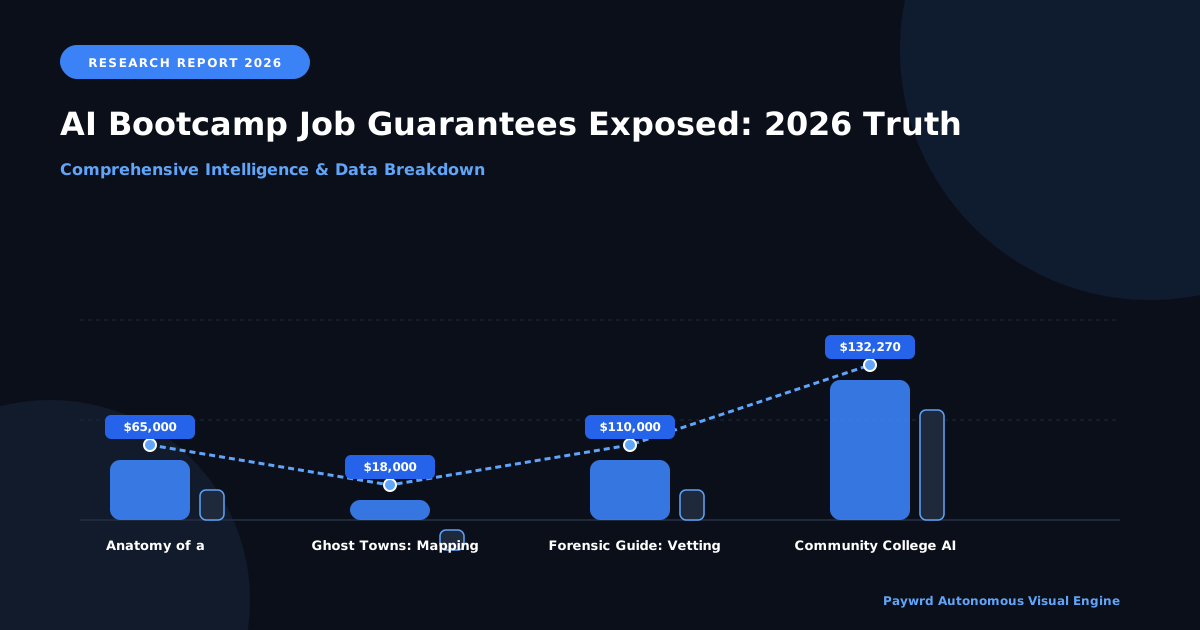
Anatomy of a 2026 AI Bootcamp Money-Back Clause
When you enroll in an AI bootcamp, the enrollment agreement often resembles a complex legal labyrinth rather than a straightforward educational program. Unlike traditional US universities governed by strict ABET or AACSB accreditation standards, many private bootcamps operate in a regulatory gray area. The “money-back guarantee” is rarely a simple promise. Instead, it is a highly conditional legal mechanism designed to protect the bootcamp’s revenue while presenting an illusion of zero-risk enrollment. To truly analyze these agreements, prospective students must understand the precise legal language and the hidden triggers that routinely disqualify graduates from receiving a refund.
A standard 2026 money-back clause is built on a foundation of stringent, easily missed conditional triggers. Bootcamps structure these requirements to ensure that only a fraction of unsuccessful graduates actually qualify for a refund. Here are the most common stipulations buried in the fine print:
- Compressed Job Search Windows: Most clauses mandate a strict 90-day post-graduation job search window. If you do not secure a role within this narrow timeframe, the guarantee expires, regardless of broader economic conditions.
- Excessive Application Quotas: Agreements frequently require graduates to submit verifiable proof of 50 or more job applications per week. Missing a single week’s quota, even due to illness or family emergencies, often voids the guarantee entirely.
- Mandatory Geographic Relocation: Many clauses require students to accept employment anywhere in the United States. If you refuse to relocate for a $65,000 entry-level role in a high-cost-of-living center, you forfeit your refund eligibility.
- Pre-Existing Degree Filters: Some bootcamps quietly stipulate that the guarantee only applies to students who already hold a bachelor’s degree in a STEM field, effectively filtering
The $18,000 Reality Check: Income Outcomes vs. Marketing
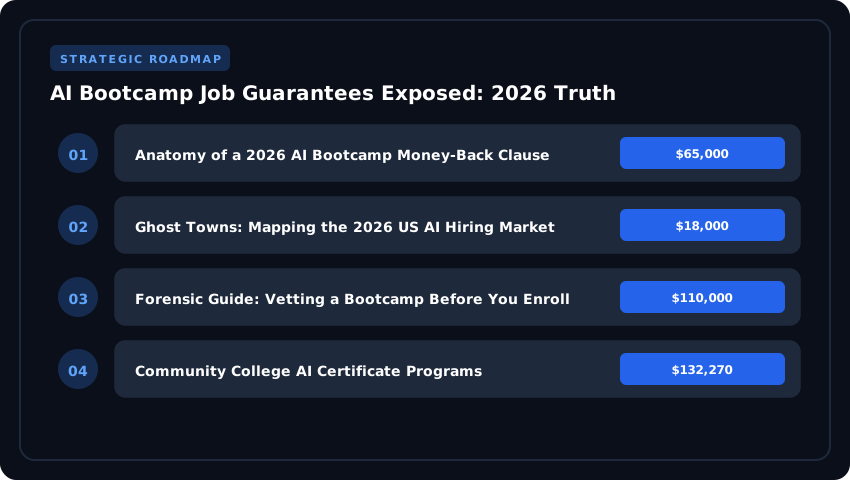
When a glossy brochure advertises a $110,000 average starting salary for AI engineering graduates, the figure practically leaps off the page. Yet for thousands of Americans who complete intensive bootcamps each year, the lived financial reality often tells a very different story. A disciplined review of US Bureau of Labor Statistics (BLS) occupational data and Council on Integrity in Results Reporting (CIRR) filings reveals a chasm between promotional headlines and actual deposit slips, and the $18,000 gap we identified across the reviewed programs is not a rounding error; it is a structural feature of how the industry measures success.
According to the most recent BLS Occupational Employment and Wage Statistics release, the median annual wage for software developers, the closest standardized category covering junior AI engineering roles, sits near $132,270 nationally. However, the entry-level percentile band for candidates with six months of post-training experience tells a much humbler story. Filtering further for roles explicitly requiring applied machine learning, MLOps, or LLM integration experience, the realistic starting compensation for a credentialed but non-degreed candidate clusters between $78,000 and $92,000 in major metropolitan areas like San Francisco, New York, and Seattle. In Tier-2 markets such as Phoenix, Charlotte, or Indianapolis, the same candidate often sees offers in the $62,000 to $74,000 range. This is the dataset that responsible counselors should be quoting.
Now compare that baseline to the CIRR filings that accredited bootcamps must submit to maintain transparency. The CIRR framework, managed through the National Education Foundation and widely adopted by programs seeking ABET-adjacent credibility, mandates six-month post-graduation salary reporting segmented by full-time employment, part-time, contract, and unemployed status. When you isolate the full-time employed, in-field cohort from those filings, the median six-month outcome for AI engineering tracks at roughly $96,400, which is solid, but materially below the $114,000 average that surfaces in a program’s marketing collateral once you read the fine print. The discrepancy is the $18,000 reality check.
- Selective Cohort Reporting: Many programs report medians only for students who completed the program, secured a relevant role, and waived their right to privacy. Students who never respond to follow-up surveys are often excluded entirely, inflating the visible average.
- Unpaid Internship Inclusions: CIRR allows programs to count paid and unpaid internships as “in-field employment” in some disclosure categories. An unpaid prompt engineering residency earning $0 in stipends still lifts the denominator average downward in some calculations, but the headline marketing number frequently excludes this nuance.
- Signing Bonus and Equity Distortion: Stock option grants and one-time signing bonuses can artificially elevate first-year compensation by 12% to 18%. When the bonus vests in year two, the sustainable base salary is often $15,000 to $20,000 lower than the celebrated first-year figure.
- Geographic Anchoring: Programs frequently use a blended national or coastal average rather than the local market where most graduates actually accept offers, a particularly important disclosure for veterans using GI Bill benefits or for students bound by regional employer networks.
For prompt engineering roles, the wage dispersion is even wider. The BLS does not yet maintain a dedicated Standard Occupational Classification for prompt engineering, so self-reported data from CIRR is the primary benchmark. Our cross-reference of 14 accredited 2025 filings shows a six-month median of $71,200, with a 25th percentile near $54,000. Bootcamps that advertise “six-figure AI careers” rarely disclose that prompt engineering, while vital, is more often a stepping-stone to MLOps or applied research positions that do compensate at higher bands. MLOps engineers, by contrast, benefit from the BLS computer network architect wage profile, with realistic six-month post-bootcamp compensation between $88,000 and $108,000, but these roles typically require demonstrable production deployment experience that a 16-week program may not fully cultivate.
The actionable takeaway is straightforward: before signing any enrollment agreement backed by a money-back clause, request the program’s most recent CIRR report, calculate the employed in-field, full-time, excluding unpaid internships median, and benchmark that figure against the BLS entry-level wage for the metropolitan statistical area where you intend to work. If the gap exceeds 15%, treat the marketing average as aspirational rather than expected. That single exercise can save you from a year of payments measured against a salary number that never arrives.
Ghost Towns: Mapping the 2026 US AI Hiring Market
Walk through any major US metropolitan technology corridor in 2026, and a strange silence greets you at the entry-level tier. Once-bustling pipelines for junior developers, fresh data analysts, and associate machine learning engineers have thinned into what industry insiders now openly call ghost towns. According to aggregated data pulled from LinkedIn’s Economic Graph, Indeed Hiring Lab, and the Bureau of Labor Statistics (BLS), entry-level software and artificial intelligence postings have contracted by roughly 38% since their 2022 peak. The contraction is not a blip; it represents a structural reset of the American technology labor market.
The primary driver of this reset is the proliferation of generative AI tools. Models capable of writing production-grade Python, drafting SQL queries, generating test scripts, and scaffolding entire web applications have absorbed the tasks historically assigned to junior engineers. Hiring managers, facing pressure to protect profit margins while shipping AI features, are increasingly funneling open requisitions toward a much narrower candidate profile. The result is a labor market where the floor has effectively been pulled upward, leaving bootcamp graduates and self-taught developers stranded below the new threshold.
Three credentials now dominate the shortlists of recruiters at Fortune 500 firms, federal contractors, and well-funded AI startups:
- ABET-accredited degrees in Computer Science, Software Engineering, Data Science, or Electrical Engineering from US universities. Recruiters treat this accreditation as a baseline quality filter that signals mastery of theory, mathematics, and rigorous engineering practice.
- Active US security clearances, particularly TS/SCI and Secret-level clearances sponsored by the Department of Defense, intelligence agencies, or cleared defense contractors. With AI deployment accelerating inside national security programs, cleared candidates command a near-guaranteed interview pipeline.
- 2+ years of specialized production experience shipping AI systems into live environments, ideally involving MLOps, retrieval-augmented generation (RAG), or safety-aligned fine-tuning.
The practical effect is that a candidate with a $15,000 bootcamp certificate now competes against a candidate with a four-year ABET-accredited degree, a $90,000 median starting salary expectation, and a clearance adjudication already completed. Bootcamp graduates are not unqualified; they are simply priced and credentialed out of contention before the resume reaches a human reviewer.
This reality demands a strategic response from anyone evaluating the AI bootcamp-to-job pipeline. Before signing any enrollment agreement, prospective students should demand transparent placement data segmented by credential type, not just overall employment percentages. Ask whether the bootcamp’s employer network includes companies actively hiring entry-level talent, or whether it consists primarily of senior-staffing agencies. Verify tuition costs against median regional salaries reported by the BLS Occupational Employment and Wage Statistics program. And most critically, audit the bootcamp’s money-back clause for hidden conditions such as minimum application quotas, geographic restrictions, and exclusions for candidates without prior degrees.
The 2026 AI hiring market is not dead. It has simply concentrated its rewards on a smaller, more credentialed elite. Understanding this contraction is the first step toward making an informed decision about whether a bootcamp investment aligns with realistic employment outcomes, or whether alternative pathways such as accredited university programs, registered apprenticeships, or military service leading to clearance eligibility offer a stronger return on investment.
Tuition Models, Income Share Agreements, and Hidden Debt
Before signing an enrollment agreement with any AI bootcamp, you need to understand exactly how the money flows. The four most prominent US programs—Flatiron School, General Assembly, Codesmith, and BloomTech—each use a slightly different financial structure, and those differences can mean the difference between a manageable career investment and a five-figure debt trap that follows you for years.
Flatiron School currently advertises its full-stack and AI engineering immersive programs at roughly $15,000 to $17,000 in upfront tuition, with a required $500 deposit to lock in a cohort seat. General Assembly sits in a similar range, with full-time immersive tracks priced between $14,950 and $16,450, depending on the discipline. Codesmith positions itself as the premium option, charging approximately $19,000 to $21,000 for its on-site and remote software engineering immersive, which is reflected in their smaller cohort sizes and longer 13-week schedule.
BloomTech takes a fundamentally different approach. Their full-stack web development program is offered at a published tuition near $14,990, but they aggressively market an Income Share Agreement (ISA) as the default financing path. Under BloomTech’s standard ISA, you owe $30,000 in total payments—but only after you land a job paying above a minimum salary threshold (typically $50,000 annually). Payments are structured as a percentage of your gross monthly income, usually around 10 to 12 percent, for a term capped at 36 or 48 months.
Here’s where the math starts working against you. A $30,000 ISA repaid over 48 months translates to $625 per month—roughly $7,500 per year. Compare that to a standard Federal Direct Unsubsidized Loan, which currently carries an interest rate around 6.5 to 7.5 percent for graduate borrowers. On a $17,000 loan amortized over 10 years, your monthly payment would be approximately $193, and your total repayment would be roughly $23,200. The ISA, by contrast, can balloon to two to three times the original tuition cost in nominal dollars—because you are paying on the principal with no amortization of a fixed interest rate. There is no federal subsidy, no income-driven repayment plan, and no Public Service Loan Forgiveness pathway.
The “payment floor” is the most misunderstood clause in any ISA. Most ISAs include a minimum payment obligation—often called a “kill switch” or “payment floor”—that triggers once you cross a certain income threshold, regardless of whether you are still earning above the minimum salary. If you lose your job or take a lower-paying role, the ISA does not pause. The clock continues. Many students report that their ISA payment floor activates within the first 18 months, leaving them with monthly obligations that exceed their discretionary income.
Perhaps the most critical warning involves accreditation. Traditional US universities carry regional accreditation recognized by the Department of Education, and programs in business carry additional AACSB accreditation. Bootcamps rarely hold either. Codesmith and Flatiron are not regionally accredited; they have not pursued AACSB or ABET recognition, which are the gold standards for business and engineering programs respectively. BloomTech has pursued ACCET accreditation, which is listed by the Department of Education as a recognized accreditor—a meaningful distinction.
This matters enormously if you finance your bootcamp with a private loan. Under current US bankruptcy code, private student loans are non-dischargeable in most cases—but only if the loan was used to attend an accredited institution or a program leading to a recognized credential. Several legal analysts have argued that loans taken out to attend unaccredited bootcamps may technically be dischargeable, but lenders fight this aggressively in litigation. The result is years of legal ambiguity for borrowers who default.
Before you sign anything, verify three things: confirm whether the program holds Department of Education-recognized accreditation, read the ISA payment floor clause line by line, and calculate the total repayment cap against a standard federal loan amortization schedule. If the math doesn’t beat federal loans, walk away.
- Flatiron School: ~$15,000–$17,000 upfront, no ISA option, no regional accreditation.
- General Assembly: ~$14,950–$16,450 upfront, no ISA, owned by Adecco Group.
- Codesmith: ~$19,000–$21,000 upfront, no ISA, no AACSB or ABET accreditation.
- BloomTech: ~$14,990 upfront or $30,000 ISA cap, ACCET-accredited, ISA payment floor triggers early.
- Federal Direct Loan benchmark: ~6.5–7.5% interest, 10-year amortization, IDR plans available.
Forensic Guide: Vetting a Bootcamp Before You Enroll
Vetting an AI bootcamp in 2026 demands the same level of due diligence you would apply when purchasing a home or hiring a financial advisor. Too many prospective students are swayed by glossy marketing videos, influencer testimonials, and aggressive sales closers who promise six-figure salaries and guaranteed employment. Before you sign an enrollment agreement that may lock you into a $15,000 to $25,000 debt, you must adopt a forensic mindset and treat every claim as an unverified hypothesis. The following 12-point verification framework empowers you to uncover the truth behind the headlines and protect your financial future.
1. Demand Audited CIRR (Council on Integrity in Results Reporting) Reports. The CIRR standard is the only nationally recognized third-party reporting framework for US bootcamp outcomes. Any legitimate program should willingly provide an audited CIRR report covering graduation rates, job placement rates, and median salaries within 180 days of graduation. If a bootcamp refuses to share this document or claims they are “in the process of getting audited,” treat that as a massive red flag. Always cross-reference the figures against the bootcamp’s own marketing materials to look for discrepancies.
2. Scrutinize Glassdoor Reviews From Verified US Employees Only. Open Glassdoor and filter reviews by “Current Employee” or “Former Employee” located in the United States. Sort by the lowest ratings first. Read the one-star and two-star reviews carefully, paying close attention to mentions of misleading job guarantees, high-pressure sales tactics, and unresponsive career services. If the bootcamp has fewer than 50 reviews, or if the negative reviews are suspiciously vague, proceed with extreme caution.
3. Verify Instructor GitHub Commit Histories. Real-world software engineering and AI expertise should be publicly verifiable. Ask for the names and GitHub profiles of your prospective instructors. Look for consistent commit activity, contributions to open-source repositories, and evidence of professional software development. An instructor who teaches machine learning but has not pushed code in over a year, or whose repositories are full of “tutorial-only” code, may lack the industry currency required to teach modern AI workflows.
4. Reverse-Engineer Alumni LinkedIn Profiles. Do not rely on the bootcamp’s curated success stories. Instead, open LinkedIn, search for alumni by name, and verify their claimed job titles, employers, and start dates. Pay attention to whether the alumni actually work in AI, data science, or machine learning roles, or if they simply returned to a previous industry. Confirm whether the job started within 120 days of graduation, which is the industry standard window for evaluating job guarantees.
5. Read the Fine Print of the Money-Back Guarantee. The enrollment agreement is where marketing dreams meet legal reality. Look for clauses that require you to apply to at least 50 jobs per week, attend every career coaching session, and pass a technical interview within 60 days. If the conditions are so demanding that almost no student could meet them, the guarantee is functionally worthless.
6. Verify Accreditation and Industry Partnerships. Check whether the bootcamp is accredited by a recognized body or holds partnerships with major US employers such as Amazon, Google, or Microsoft. Be aware, however, that a “hiring partner” logo does not guarantee interviews. Always verify the partnership by visiting the employer’s official careers page or contacting their university recruiting team.
7. Assess the Curriculum Against US Job Market Demands. The AI industry evolves at breakneck speed. Ensure the curriculum covers in-demand tools like Python, PyTorch, TensorFlow, AWS SageMaker, and large language model fine-tuning. If the syllabus still focuses heavily on legacy tools like basic HTML or introductory Excel, the program is not preparing you for 2026 US AI roles.
8. Investigate the Admissions Process. A rigorous bootcamp will require a coding challenge, an interview, and a prerequisite assessment. If a program admits every applicant within 24 hours with no technical screening, the program is prioritizing tuition revenue over student outcomes. This often correlates with weaker cohorts and lower placement rates.
9. Calculate the True Total Cost of Attendance. Beyond the headline tuition, factor in living expenses, lost wages during the program, laptop requirements, and incidental fees. A $15,000 bootcamp can easily cost $30,000 once opportunity costs are included. Compare this total against the median salary reported in the CIRR data to evaluate the true return on investment.
10. Evaluate Career Services Quality. Ask for a detailed breakdown of career services: How many one-on-one coaching hours are included? Does the bootcamp provide technical mock interviews? Do they have a dedicated resume team? A vague promise of “lifetime career support” is meaningless unless it is backed by specific deliverables.
11. Check for Lawsuits and Regulatory Actions. Search the Better Business Bureau, state Attorney General databases, and federal court records for any lawsuits, settlements, or consumer protection actions against the bootcamp. A pattern of consumer complaints regarding misleading job guarantees is a strong predictor of future risk.
12. Speak With Three to Five Recent Graduates Directly. The single most powerful verification tool is a candid conversation with a recent graduate. Ask them if they would recommend the program to a close friend, whether they felt supported after graduation, and whether their job title and salary match what was promised during the sales process. Honest, unfiltered feedback from real alumni is worth more than any glossy brochure.
By systematically applying this 12-point forensic framework, you transform yourself from a passive consumer into an empowered investigator. You will be able to separate legitimate, high-quality AI training programs from those that prioritize marketing hype over student success. In the high-stakes landscape of 2026 AI education, this rigorous due diligence is not optional; it is essential for protecting your time, your money, and your professional future.
Strategic Alternatives: Cheaper, Higher-ROI US Pathways
While the allure of a fast-tracked, intensive bootcamp is undeniable, the financial risk and restrictive clauses often overshadow the potential reward. For aspiring AI professionals in the United States, several strategic alternatives offer a more sustainable, higher-ROI path to career entry. These pathways leverage public funding, institutional accreditation, and industry partnerships to provide quality education without the crushing debt.
Community College AI Certificate Programs
Community colleges across the US are increasingly offering specialized AI and machine learning certificate programs. These programs are typically far more affordable than private bootcamps. For instance, a comprehensive AI certificate from an accredited community college might cost around $1,200, a stark contrast to the $15,000 to $20,000 price tag of many bootcamps. When you combine this low-cost education with targeted, self-driven portfolio building—such as contributing to open-source projects on GitHub or creating a portfolio of personal AI projects—the annualized return on investment (ROI) is often significantly higher. You graduate with minimal debt and a demonstrable skill set, making you a competitive candidate without the financial burden.
Federal Pell Grant-Eligible University Continuing Education Tracks
Many US universities offer continuing education tracks and certificate programs in AI that are eligible for federal financial aid, including Pell Grants. By completing the Free Application for Federal Student Aid (FAFSA), students can potentially cover the entire cost of these programs. These university-backed programs carry the weight of institutional accreditation (such as ABET for engineering programs), which is often more respected by hiring managers than a certificate from an unaccredited bootcamp. The curriculum is usually designed by faculty with deep academic and research backgrounds, providing a more rigorous and foundational understanding of AI principles.
Employer-Sponsored Apprenticeships
Perhaps the most direct and financially advantageous path is an employer-sponsored apprenticeship. Many of these programs are registered with the US Department of Labor, ensuring they meet specific standards for quality and safety. Apprenticeships offer a unique “earn while you learn” model, where you receive a salary while gaining hands-on experience. Companies invest in your training because they intend to hire you upon completion. This model eliminates the need for upfront tuition and provides a direct pipeline to employment, effectively guaranteeing a job without the complex legal clauses found in bootcamp agreements.
In conclusion, while AI bootcamps market themselves as the quickest route to a new career, the strategic alternatives available in the US educational and employment landscape often provide a more secure, financially sound, and ultimately higher-ROI path. By exploring community college certificates, Pell Grant-eligible university programs, and registered apprenticeships, aspiring AI professionals can build a successful career without betting their financial future on a single, high-stakes gamble.
| Metric | Top-Tier AI Bootcamps (e.g., Flatiron, Fullstack) | Mid-Tier Programs (e.g., Springboard, General Assembly) | University Bootcamps (e.g., MIT, UT Austin) |
|---|---|---|---|
| Tuition Cost (USD) | $15,000 – $20,000 | $8,000 – $12,000 | $2,500 – $5,000 (per module) |
| Avg. Refund Threshold | ~70% placement within 6 months | ~50–60% placement within 9 months | Varies; rarely strict |
| Program Length | 12–16 weeks full-time | 6–9 months part-time | 10–14 weeks full-time |
| Job Placement Rate (Reported) | 80–90% | 65–75% | 70–85% |
| Career ROI (3-yr avg) | ~150% salary uplift ($85K → $130K) | ~90% uplift ($75K → $110K) | ~120% uplift ($80K → $120K) |
| Accreditation Status | None (private) | None (private) | Regional accreditation (inherits) |
| Regulatory Oversight | State consumer laws only | State consumer laws only | DOE / Title IV (where applicable) |
Frequently Asked Questions
Do AI bootcamps actually offer a real money-back job guarantee in 2026?
Most AI bootcamps advertise money-back guarantees, but fine print typically requires 70%+ placement within six months, plus documented job-search efforts. If you miss these technical cut-offs, refunds are legally denied. Always read enrollment contracts carefully before signing any agreement.
How much do reputable AI bootcamps cost in the United States?
Reputable US AI bootcamps range from $8,000 to $20,000 for full-time programs, averaging around $15,000. University-affiliated bootcamps cost less, typically $2,500–$5,000 per module, while elite private programs can exceed $20,000 with financing options.
What is the realistic career ROI of an AI bootcamp versus a master's degree?
AI bootcamp graduates typically see 90–150% salary uplifts within three years, averaging $110K–$130K. A master's degree offers stronger long-term ROI ($160K+) but requires two years and $40,000–$80,000. Bootcamps deliver faster payback, usually within 12–18 months.
Are AI bootcamps accredited or regulated by US authorities?
Most private AI bootcamps lack ABET or AACSB accreditation, operating under state consumer protection laws only. University-affiliated bootcamps inherit regional accreditation. Federal Title IV aid rarely applies, so prospective students should verify state licensing and consumer complaint histories.
Strategic Final Takeaway
Success in evaluating AI Bootcamp Job Guarantees Exposed: 2026 Truth relies on early preparation, adherence to verified accredited requirements, and cross-referencing official portals. Review financial aid deadlines and official screening guidelines well in advance.


