
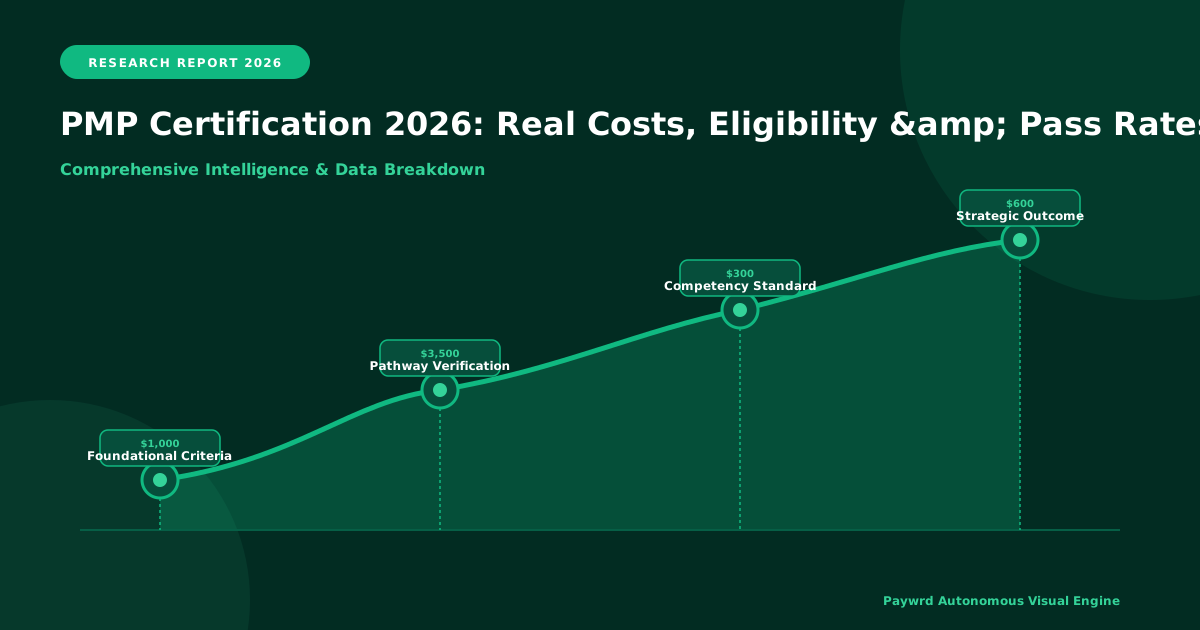
Breaking Down the Real Cost of PMP Certification in 2022
Understanding the true financial commitment required for Project Management Professional (PMP) certification requires looking far beyond the initial exam fee. Aspiring project leaders across the United States should budget between $1,000 and $3,500 for their first attempt, with renewal expenses adding another $300 to $600 every three-year cycle. Let me walk you through every dollar you’ll need, because transparency here is the difference between a smart investment and a budget-breaking surprise.

The first major line item is the exam application fee itself, which is set by the Project Management Institute (PMI). If you are an active PMI member, the computer-based testing fee is $405. Non-members pay $575. The $170 annual difference is significant, which is why most candidates opt for membership, especially since PMI membership ($139 plus a one-time $10 application fee) includes access to free digital copies of the PMBOK Guide, project management journals, and local chapter networking events that can indirectly support your career growth.
However, you cannot simply pay the exam fee and walk into a Pearson VUE testing center. PMI mandates that all candidates complete 35 contact hours of formal project management education before they are even eligible to sit for the exam. This prerequisite course is non-negotiable, and the price varies dramatically based on the provider and delivery format:
- Self-paced online bootcamps: $300 to $600
- Live virtual instructor-led cohorts: $800 to $1,200
- University-affiliated certificate programs (e.g., through accredited US institutions): $1,200 to $1,500
Be cautious of free or ultra-cheap courses that fail to provide a verifiable certificate of completion; if PMI audits your application and the documentation is insufficient, your $405 or $575 exam fee is forfeited entirely.
Beyond the mandatory training, the hidden expenses are where most candidates underestimate their total spend. Comprehensive study materials, such as the PMBOK Guide (7th Edition) and the Agile Practice Guide, typically run between $50 and $80 for printed copies or roughly $45 for PMI member digital access. Practice exams, which are arguably the single most predictive factor for passing on your first attempt, cost anywhere from $30 to $150 depending on whether you choose simulators like Rita Mulcahy, PrepCast, or Simplilearn. Many professionals also purchase secondary reference books or enroll in study groups, easily adding another $100 to $200 to their preparation budget.
Perhaps the most overlooked cost is opportunity cost. The average PMP candidate invests 120 to 200 study hours over a 2 to 4 month period. If you take unpaid time off from your current salaried role to attend a week-long intensive bootcamp or to travel to a testing center, you could be absorbing $1,000 to $2,000 in lost wages. For salaried US professionals averaging between $35 and $55 per hour, this time is the real price of certification.
Finally, certification is not a one-and-done expense. PMI requires you to earn 60 Professional Development Units (PDUs) every three years to maintain the credential. The renewal fee itself is $60 for PMI members and $150 for non-members. However, accumulating those PDUs usually requires purchasing additional courses, webinars, or training packages that range from $300 to $600 per cycle, depending on whether you seek free local chapter events or premium continuing education.
When you tally it all up, here is your realistic three-year budget for PMP certification:
- First-attempt total (Year 1): $1,000 to $3,500
- Renewal cycle (Year 3): $360 to $750
- Six-year cumulative investment: $1,720 to $8,500
The smartest strategy is to pursue PMI membership immediately, bundle your 35-hour prep course with a practice exam package, and document all expenses as professional development, since many US-based employers offer tuition reimbursement or continuing education allowances that can offset 50% to 100% of these costs.
Decoding 2026 PMP Eligibility: The 4-Year Degree vs. High School Pathway
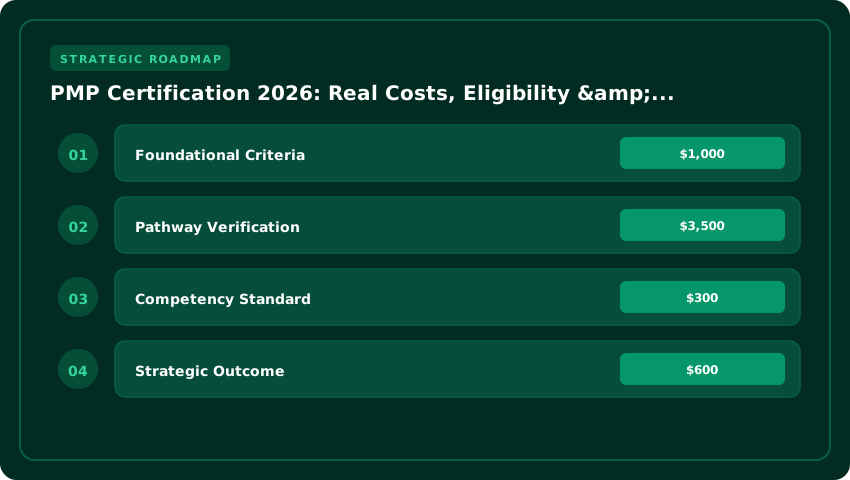
Understanding the two eligibility tracks established by the Project Management Institute (PMI) is the single most important step before you invest a single dollar in exam prep or application fees. PMI does not allow candidates to self-select whichever route feels easier; the track you qualify for depends entirely on your formal education at the time you submit your application. Getting this wrong is one of the leading causes of application rejection, which costs professionals both time and money, so let us walk through each pathway with the precision your career planning deserves.
The Bachelor’s Degree Route (Track One): If you hold a four-year degree from a regionally accredited United States university — whether from an AACSB-accredited business program, an ABET-accredited engineering school, or a liberal arts college recognized by a Council for Higher Education Accreditation (CHEA) body — you qualify for the streamlined experience requirement. Under this track, you must demonstrate a combined 6,000 hours of unique, non-overlapping project leadership experience across 36 months. The keyword here is “unique.” PMI’s audit team cross-references dates carefully, and duplicating hours across two projects that ran simultaneously will trigger an immediate red flag.
- Formal education prerequisite: A bachelor’s degree (or global equivalent) from an accredited institution.
- Experience requirement: 36 months of professional project leadership within the last 8 consecutive years.
- Hour calculation: Approximately 6,000 hours, derived from documented project work.
- Training prerequisite: 35 contact hours of formal project management education.
The High School Diploma / Associate Degree Route (Track Two): Candidates whose highest formal credential is a high school diploma, GED, or an associate degree must satisfy a significantly steeper experience requirement. You must log 60 months — five full years — of project leadership experience, equating to roughly 10,000 hours. The 35 contact hours of training remain identical across both tracks, which PMI considers a non-negotiable baseline for every applicant regardless of academic background. This route is often the path of choice for seasoned professionals who built their careers through military service, trades, or non-traditional education but lack a four-year credential.
- Formal education prerequisite: High school diploma, GED, or associate degree.
- Experience requirement: 60 months of professional project leadership within the last 8 consecutive years.
- Hour calculation: Approximately 10,000 hours, requiring careful date logging.
- Training prerequisite: 35 contact hours of formal project management education.
Documenting and Submitting Project Hours Without Rejection: PMI randomly audits between 10% and 20% of applications, and your documentation strategy must hold up under that scrutiny. For every project you list, you need to capture the project title, a concise description of the business objective, your specific role, the start and end dates (month and year), and the approximate number of hours you personally contributed. Crucially, the hours must reflect direction, coordination, and leadership — not routine administrative tasks. Managing a cross-functional team, owning the budget, mitigating risks, and delivering outcomes are the verbs PMI reviewers look for. Use the PMI application template exactly as provided, and avoid embellishing responsibilities; honest, clearly written entries are far more likely to sail through audit than vague, over-promising claims. Finally, ensure your 35 contact hours come from a PMI Authorized Training Partner or an authorized provider listed on the PMI Registry, and retain your certificate of completion in both PDF and printed formats for at least one year after submission.
PMP Exam Pass Rates: What PMI Actually Reports vs. First-Attempt Success
One of the most frequently quoted statistics in the project management world is that roughly 60% of first-time PMP candidates fail the exam on their initial attempt. This figure, widely circulated by the Project Management Institute (PMI) itself and echoed across training providers, sets realistic expectations for the difficulty ahead. However, the reality of PMP pass rates is far more nuanced than a single percentage suggests, especially when comparing official disclosures with third-party boot camp outcomes that range anywhere from 40% to 85% depending on the cohort, instructor quality, and study methodology.
PMI does not publish a comprehensive, real-time pass-rate dashboard the way the College Board releases annual SAT performance data. Instead, the organization periodically shares aggregate observations through its annual Project Management Job Growth and Talent Gap reports, member webinars, and credentialing whitepapers. The widely cited 40-to-60% first-attempt range reflects the difficulty of an exam that blends three distinct project management frameworks into a single 230-minute testing window. Candidates who treat the PMP as a memorization exercise rather than a scenario-driven assessment often find themselves on the wrong side of that statistic.
- Official PMI position: Approximately 60% of first-time test takers pass, with global pass rates trending slightly higher among candidates who complete 35 contact hours of formal preparation.
- Boot camp high performers: Reputable US-based providers such as Velociteach, PMTraining, and Simplilearn report cohort pass rates between 85% and 98% for students who attend every session, complete all practice questions, and sit the exam within two weeks of course completion.
- Self-study candidates: Independent learners using only Rita Mulcahy’s PMBOK study guide or free online resources tend to cluster closer to the 40% benchmark, often because they underestimate the agile and hybrid methodology weighting introduced in the 2021 exam redesign.
- Retake impact: PMI charges a $275 retake fee for members (or $375 for non-members), and second-attempt pass rates climb dramatically once a candidate has experienced the question style and time pressure firsthand.
The 2021 exam format deserves special attention because it fundamentally changed why candidates fail. Prior versions of the PMP leaned heavily on predictive, waterfall-style process groups and knowledge areas drawn directly from the PMBOK Guide. Today’s exam divides its 180 questions across three domains: People (42%), Process (50%), and Business Environment (8%). Within those domains, roughly half of the scored items now reflect agile, Scrum, Kanban, or hybrid approaches rather than traditional plan-driven execution. Examinees face 230 minutes of testing time, plus two 10-minute breaks for mental resets, meaning they must answer each question in roughly 75 seconds while interpreting situational prompts that rarely offer an obviously correct answer.
Another factor driving variance in reported pass rates is PMI’s score-reporting transparency. Candidates receive a numeric score (typically reported as “Above Target,” “Target,” “Below Target,” or “Needs Improvement” across each domain) but no public leaderboard exists. Boot camps therefore rely on voluntary student surveys, internal registration data, and post-exam feedback emails to calculate their advertised success metrics. A provider claiming “98% pass rate” may actually be measuring only the 60% of enrolled students who completed the course, sat for the exam, and reported back, a classic case of selection bias that candidates should weigh carefully when comparing tuition packages ranging from $1,200 to $3,500 across the United States.
For US-based professionals evaluating whether the PMP credential justifies the investment, the practical takeaway is straightforward: your personal pass probability correlates far more strongly with study hours and question-bank repetition than with the training provider you select. Candidates who invest 200 to 300 hours of preparation, complete at least three full-length模拟 exams under timed conditions, and dedicate focused attention to servant leadership, agile estimation, and benefits realization typically outperform the 60% average. Conversely, professionals who rush through the 35 contact hours requirement and schedule their exam within a week of finishing prep are statistically far more likely to join the 40% who must budget for a $275 retake and another study cycle before crossing the finish line.
Strategic Study Roadmap: Building a 12-Week PMP Prep Schedule
Crafting a disciplined 12-week study plan is the single most reliable way to clear the PMP exam on your first attempt, and the structure you build today will determine whether you walk into the testing center feeling prepared or panicked. Most successful candidates in the United States devote roughly 120 to 150 total hours of combined study over three months, which translates to ten focused hours per week when life gets busy with work, family, and professional obligations. The roadmap below blends three cornerstone resources, namely Rita Mulcahy’s PMP Exam Prep, the PMBOK Guide 7th Edition, and the Agile Practice Guide, into a sequenced schedule that mirrors the 2026 PMI examination blueprint, where the People domain carries 42% of the scored weight, Process commands 50%, and Business Environment accounts for the remaining 8%.
Weeks 1 through 3: Foundation and the 35 Contact Hours. Begin by enrolling in a 35-hour project management education program through a Registered Education Provider (REP) like the University of California, Irvine, or Villanova, or complete a structured online bootcamp through Coursera or LinkedIn Learning. Front-load this requirement so your certificate of completion is locked in before you submit your PMI application, which currently costs $405 for PMI members and $575 for non-members. While progressing through the contact-hour coursework, read the first six chapters of Rita Mulcahy’s manual and skim Part One of the PMBOK Guide 7th Edition to internalize the twelve Principles of Project Management. Reserve Sunday evenings for a 30-question quiz on the Process domain so you start building recall muscle memory early.
Weeks 4 through 6: Deep Dive into the People Domain (42%). Since People represents the largest scored section, dedicate your most cognitively demanding study blocks, traditionally Tuesday and Thursday evenings from 7:00 to 9:30 PM, to conflict resolution, servant leadership, emotional intelligence, and team-building activities. Rita Mulcahy’s chapters on managing teams and stakeholders should be reread twice, and you should map every Agile Practice Guide recommendation onto a real-world scenario from your own professional history, because the exam increasingly presents situational questions drawn from hybrid environments blending predictive and adaptive methodologies.
Weeks 7 through 9: Mastering the Process Domain (50%). This is where most candidates either gain separation or fall behind, so allocate three hours every Saturday morning to work through predictive, agile, and hybrid life-cycle models in detail. Use the PMBOK Guide 7th Edition Performance Domains, which replaced the older 49-process framework, to organize your notes by value delivery, planning, uncertainty, and measurement rather than by knowledge area. Supplement this work with Rita’s process chart flashcards and finish every chapter-end exam until you consistently score above 75%.
Weeks 10 through 12: Business Environment, Practice Simulations, and Recovery. In the final stretch, spend a focused Sunday reviewing the Business Environment domain (8%), which covers benefits realization, compliance, and organizational change. Then schedule two full-length, 230-minute practice simulations, one in Week 10 and another in Week 12, to build the endurance required for 180 scored questions plus two unscored pretest items. Take each simulation under timed Pearson VUE conditions, then conduct a forensic review of every incorrect answer the following evening. Aim to finish Week 12 with at least three consecutive mock scores above 78% before booking your exam date.
- Weekly Time Budget: Target 10 hours of study, broken into four weekday blocks of 90 minutes and one weekend block of three hours.
- Resource Allocation: 40% Rita Mulcahy, 30% PMBOK 7th Edition, 20% Agile Practice Guide, and 10% mock exams and flashcards.
- Milestone Targets: 75% average on topic quizzes by Week 6, 80% on full simulations by Week 11, and a final confidence check by end of Week 12.
- Buffer Rule: Build in one full recovery week to absorb unexpected work travel, family events, or burnout without losing momentum.
Salary Impact and ROI: How PMP Certification Affects US Paychecks
Across the United States, the financial signal sent by earning the Project Management Professional (PMP) credential remains one of the strongest in the professional certification landscape. According to the latest published data from the Project Management Institute (PMI) Salary Survey, PMP-certified practitioners in the United States report a median base salary that consistently lands between $90,000 and $130,000, depending on industry vertical, years of experience, and metropolitan market. When benchmarked against peers who hold equivalent years of project experience but no certification, PMP holders command a salary premium of roughly 20%. In a labor market where wage growth has averaged just 3% to 4% year over year, that differential represents a transformative return on a relatively modest educational investment.
For a mid-career professional earning $75,000 before certification, a 20% uplift translates into an additional $15,000 in annual base compensation, often accompanied by expanded bonus eligibility, expanded access to senior roles, and stronger leverage during performance reviews. This is not a marginal perk; it is a structural wage advantage that compounds across an entire career. Over a ten-year horizon, a PMP-certified professional earning the median premium outpaces uncertified peers by an estimated $150,000 to $200,000 in cumulative base compensation alone, before accounting for bonus structures and equity participation that frequently scale with credentialed leadership status.
Calculating the payback period requires stacking the realistic, all-in cost of PMP preparation against the salary uplift. Most US candidates invest between $2,500 and $7,500 when combining the PMI membership fee, the exam fee for non-members, a 35-hour contact-hour prep course, study guides, and one or two exam attempts. Using a conservative midpoint of $5,000 in total preparation costs, the payback math becomes straightforward in any major US metro market:
- New York, San Francisco, and San Jose: Median PMP salaries exceed $135,000, and the 20% premium over uncertified peers produces an annual lift of roughly $22,000 to $28,000. Payback period on a $5,000 investment is approximately 3 to 4 months.
- Washington DC, Boston, and Seattle: Median PMP compensation sits near $120,000, generating an annual uplift around $20,000. Payback falls within 3 to 5 months.
- Chicago, Los Angeles, and Dallas-Fort Worth: Median earnings cluster near $105,000, yielding an annual premium close to $17,500. Payback typically lands at 4 to 6 months.
- Atlanta, Denver, and Phoenix: Median salaries reach roughly $95,000, with the 20% premium producing an annual lift near $15,000. Payback generally completes within 5 to 7 months.
- Mid-tier markets such as Indianapolis, Cincinnati, and Kansas City: Median PMP compensation hovers around $90,000, generating an annual uplift close to $15,000. Payback remains under 6 to 8 months.
These figures demonstrate that regardless of geographic location, payback periods remain under one year in every major US metro, making PMP one of the highest-return professional certifications available to American project managers. Industry segmentation further sharpens the ROI picture. PMP holders in healthcare, financial services, IT, and federal contracting consistently report salary figures at the upper end of the national range, particularly in regions anchored by Fortune 500 headquarters or major Department of Defense installations. Professionals targeting the federal sector should also note that many GS-grade position descriptions and GSA Schedule contract roles explicitly cite PMP as a preferred or required qualification, which compounds the credential’s value beyond pure base compensation.
It is important for prospective candidates to recognize that the PMP salary premium is not static. PMI longitudinal data indicates that the credential’s earning power grows alongside tenure, peaking for professionals with ten or more years of post-certification experience. This trajectory contrasts sharply with non-certified peers, whose wage curves tend to flatten earlier in their careers. The combination of accelerated early-career earnings and sustained late-career growth produces an unusually steep lifetime earnings trajectory. When you weigh that against the relatively contained upfront cost, time commitment, and the fact that PMI-accredited exam preparation does not require a traditional university degree pathway, the PMP emerges as one of the most financially defensible credentials a US-based professional can pursue heading into 2026 and beyond.
Application Audit Survival: Avoiding the PMI Review Suspension
Submitting your PMP application to the Project Management Institute (PMI) is the moment when months of careful planning, logged hours, and 35 contact hours of project management education are finally placed under a microscope. Most candidates sail through the standard review, but a meaningful percentage receive an email notifying them that their application has been pulled into a PMI audit. Understanding the difference between a routine five-day review and a multi-week audit timeline can save you weeks of stress, hundreds of dollars in potential rework, and the risk of a one-year application suspension.
A standard PMI application review typically takes up to five business days, during which the global credentialing team verifies that your experience descriptions align with PMI’s Talent Triangle and that your educational prerequisites meet current PMI standards. If your application is selected for an audit, however, the clock resets dramatically. Audits routinely stretch beyond four to six weeks, and some candidates have reported timelines approaching twelve weeks during peak submission seasons in March and September. During that period, your application status remains in limbo, and you cannot schedule your PMP examination or access PMI’s online study resources. Worse, submitting incomplete or inconsistent documentation can trigger a PMI review suspension, freezing your account for up to twelve months before you can resubmit.
The most reliable defense is a meticulous, evidence-backed application built before you ever click submit. Below is a field-tested checklist designed for US-based candidates navigating the 2026 certification cycle.
- Phrase every project using the five process groups. PMI examiners are trained to scan for evidence of Initiating, Planning, Executing, Monitoring & Controlling, and Closing. A strong description reads like a narrative paragraph, not a job-duty list. For example, instead of writing “Managed project budget,” write “Initiated the project charter by identifying $250,000 in stakeholder funding, planned the cost baseline using a work-breakdown structure across six deliverables, executed resource allocation across two cross-functional teams, monitored variance through weekly earned-value analysis, and closed the project by documenting final budget reconciliation for executive leadership.” This level of specificity demonstrates competency and dramatically reduces audit triggers.
- Quantify scope, budget, team size, and duration. PMI reviewers look for verifiable, numerical evidence. Each project entry should clearly state the number of team members led, approximate budget in US dollars, project length in months, and the methodology used (predictive, agile, or hybrid). Ambiguous descriptions like “led a large initiative” are a red flag that invites deeper scrutiny.
- Align experience with PMI’s current examination content outline. The 2026 exam continues to emphasize predictive, agile, and hybrid approaches. Candidates whose experience only references traditional waterfall deliverables without mentioning iterative delivery, servant leadership, or product backlogs are statistically more likely to be flagged. Cross-reference your descriptions against the latest PMI Examination Content Outline to confirm balanced representation.
- Document your 35 contact hours correctly. Your education proof must come from an authorized PMI Registered Education Provider (REP) or an accredited university program. Certificates should clearly state the provider name, course title, contact hours completed, and the date of completion. Free or informal training certificates without REP accreditation are one of the most common reasons applications are paused or rejected outright.
- Verify contact information for every project manager reference. PMI requires contact details for each supervisor or PMO lead who can confirm your experience. If a reference email bounces, is out of office for more than ten days, or disputes a single element of your submission, your application can be escalated into a secondary audit that adds several weeks to your timeline.
- Avoid the seven most common red flags. PMI reviewers are trained to watch for overlapping project dates that exceed 100% utilization, descriptions that lack any initiating or closing language, identical phrasing copied across multiple projects, missing dollar figures, unverifiable company names, missing education certificates, and references to non-accredited training providers. Treat each of these as an automatic audit risk.
- Maintain a personal audit folder. Before submission, assemble a digital folder containing your diploma transcripts, REP certificates, supervisor contact sheets, project charters, and a one-page narrative for each project. If PMI requests supporting documentation, candidates who respond within five business days with clean, organized files typically resolve their audits in under three weeks. Those who scramble to reconstruct evidence often push their timelines past eight weeks.
- Submit during low-volume windows when possible. PMI’s review queue is shortest between January and February and again between late April and early June. Submitting during the late-summer or year-end surge can double your standard review time and increase the statistical probability of random audits.
Ultimately, the PMP application is less about listing what you did and more about proving how you led. A clean, audit-ready submission transforms the credentialing process from a stressful waiting game into a predictable five-day confirmation, freeing you to focus your energy on exam preparation rather than document recovery. Treat the application as your first PMP deliverable: scope it carefully, plan the narrative, execute with verifiable detail, monitor it against PMI’s current rubric, and close it with documented evidence. Doing so is the single most effective way to avoid a PMI review suspension and keep your 2026 certification timeline firmly on track.
| Metric | PMI Member | Non-Member | Retake | 3-Year Renewal |
|---|---|---|---|---|
| Exam Fee | $405 | $595 | $275 / $405 | — |
| Membership Fee | $139 + $10 app | $0 | — | $139 |
| 35 Contact Hours (Training) | $300–$1,500 | $300–$1,500 | — | 60 PDUs ($300–$600) |
| Study Materials / Simulator | $100–$400 | $100–$400 | — | — |
| Total First Attempt | $844–$2,454 | $995–$2,495 | + $275–$405 | $300–$600 |
| Eligibility (Experience Cutoff) | 36 months + degree OR 60 months + HS | Same | — | — |
| Application Timeline | 5–7 days audit | 5–7 days audit | — | — |
| Exam Prep Timeline | 8–12 weeks | 8–12 weeks | — | — |
| Pass Rate (Industry Est.) | ~60–70% | ~60–70% | — | — |
| Average Salary ROI | $112,000–$135,000 | $112,000–$135,000 | — | — |
| Salary Premium vs Non-PMP | +16–23% | +16–23% | — | — |
| Payback Period | 3–6 months | 3–6 months | — | — |
Strategic Final Takeaway
Success in evaluating PMP Certification 2026: Real Costs, Eligibility & Pass Rates relies on early preparation, adherence to verified accredited requirements, and cross-referencing official portals. Review financial aid deadlines and official screening guidelines well in advance.

