

Decoding the 2024-2025 NIH & NSF Indirect Cost Rate Crisis
Picture this: your principal investigator just got the official word from the grants office, and the math is ugly. Federal agencies like the National Institutes of Health (NIH) and National Science Foundation (NSF) do not simply write a check to cover your $38,000 stipend. Instead, they award a direct cost grant, which pays your wages, and an indirect cost rate (also called Facilities & Administrative, or F&A), which reimburses the university for the lights, labs, and administrative staff that keep your research running.

When Washington capped these reimbursement rates earlier this year, the ripple effect hit department budgets almost overnight. Universities historically recovered anywhere from 55% to 70% on every direct research dollar. That cushion is what pays for Graduate Research Assistants (GRAs) when a lab runs short. With new caps pushing rates down toward 15% for some institutions, the gap is being passed directly to departmental operating budgets, and consequently, to your paycheck.
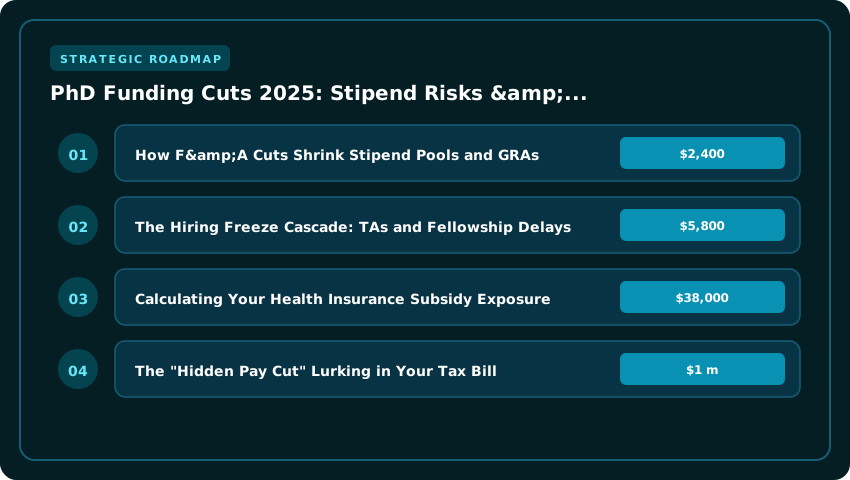
How F&A Cuts Shrink Stipend Pools and GRAs
Think of the indirect cost recovery as the university’s research savings account. At a typical R1 institution, a $1 million NIH grant might generate $600,000 in F&A funds. Departments leverage that overhead to bridge gaps for graduate students whose advisor funding lapses between grants. When that F&A stream dries up, bridge funding disappears, and new offers get quietly rescinded.
Cross-reference this against the Council of Graduate Schools (CGS) 2024 stipend benchmark: the median US PhD stipend now sits around $34,000 to $38,000. If a department absorbs a 10% budget contraction by trimming unfunded lines, incoming cohorts may face smaller cohorts, delayed start dates, or stipends frozen at 2023 levels while inflation continues compounding at roughly 3.4%.
The Hiring Freeze Cascade: TAs and Fellowship Delays
It is not just research grants feeling the pinch. Teaching Assistantships (TAs) rely heavily on tuition revenue and departmental reserves. When universities brace for lower F&A, they often freeze new TA hires, increase class sizes for existing TAs, and push fellowship disbursement timelines by 30 to 90 days.
- Fewer TA lines: Larger sections mean less individualized mentorship and heavier grading workloads.
- Delayed disbursements: Some students report fellowship checks arriving late, forcing credit card float at 20%+ APR.
- Hiring freezes: Postdoc and adjunct pipelines narrow, which signals to current PhDs that the academic safety net is shrinking.
Calculating Your Health Insurance Subsidy Exposure
Here is the line item most students forget to stress-test. Most universities subsidize 80% to 100% of the graduate student health insurance premium, a benefit worth roughly $2,500 to $4,000 per year. As operating budgets tighten, expect universities to cap subsidies at a fixed dollar amount while premium hikes continue. If your plan renews at an 8% premium increase and the university caps its contribution, you could see $400 to $800 in new out-of-pocket exposure annually.
Run the math tonight: take your current monthly take-home, add your estimated stipend cut, subtract your new premium delta, and then factor in delayed fellowship timing. That is the real 2025 PhD funding equation, and it is forcing a growing number of scholars to explore the $150,000+ alt-career pivots we will break down next.
Stipend Benchmarking: Are You Below the 2025 Living Wage Threshold?
If your Fall 2025 offer letter feels suspiciously flat, you are not imagining the squeeze. The Council of Graduate Schools (CGS) and the National Association of Colleges and Employers (NACE) both tracked a modest stipend bump for the 2024-2025 academic year, landing around a 3.2% median increase across research-doctorate programs. Meanwhile, the Bureau of Labor Statistics CPI-U (Consumer Price Index for All Urban Consumers) is still chugging along with a 12-month change hovering in the 2.9% to 3.4% range nationally, which sounds like a wash until you zoom in on the specific metros where R1 universities actually sit. In Boston, the Cambridge zip codes that house Harvard and MIT are running closer to 4.1% effective cost growth, because rent alone has outpaced the headline inflation number. The Bay Area around Stanford, UCSF, and Berkeley is even tighter, with housing-weighted inflation north of 4.8%. New York City and Durham are slightly more forgiving on shelter, but their food, transit, and childcare indices are quietly eating the 3% stipend bump in quarters, not years. Translation: in real purchasing power, most first-year PhD cohorts in 2025 are earning less than they did in 2022.
The “Hidden Pay Cut” Lurking in Your Tax Bill
Here is the part your admissions packet probably did not highlight. Under the Tax Cuts and Jobs Act (TCJA), tuition remission waivers for graduate teaching and research assistants remain tax-free at the federal level through 2025, but several states, including California, Pennsylvania, and Indiana, have aggressively moved to tax the value of that remission as ordinary income. If your university recently shifted a portion of your compensation from a “tuition remission plus small stipend” structure to a “larger taxable fellowship” model, your take-home pay can actually shrink even when the gross number goes up. Run the math on your offer letter using a state-specific tax calculator from the IRS or a credible university financial aid office before you sign.
Emergency Funding Protocols You Should Activate This Week
Do not wait for a crisis to discover the emergency funds already sitting on your campus. The Graduate School at most major US universities administers a Confidential Fund for Graduate Students in Crisis, typically dispensing $500 to $1,500 in 48 hours for housing, medical, or immigration emergencies. If your department drags its feet, escalate to the Graduate Employee Union (GEO), where applicable. In 2024, GEOs at the University of Michigan and Columbia won retroactive arbitration awards averaging $1,200 per affected stipend worker, paid out after documented complaints about delayed emergency disbursements. Document everything in writing, cite the award letters, and you create leverage your department cannot ignore.
Mapping Dissertation Skills to $100K-$200K+ Corporate Role Taxonomies
If the thought of losing roughly $300 per month to indirect cost rate caps has you staring at your dissertation draft with newfound suspicion, you are not alone. The smartest move you can make right now is to stop treating your PhD as an academic-only credential and start treating it as a high-yield corporate commodity. US employers in tech, finance, and policy are aggressively poaching doctorate holders because advanced research training is basically a cheat code for roles that demand rigorous evidence-based judgment. According to the National Association of Colleges and Employers (NACE) salary data, mid-level corporate research roles routinely clear the $110,000 mark, while senior individual contributor positions in machine learning and quantitative trading regularly post base salaries between $150,000 and $220,000. The trick is knowing exactly how to translate your academic muscle memory into corporate ATS-friendly language.
Qualitative Coding & Causal Inference to UX Research and Product Analytics
Stop telling recruiters that you “conducted interviews.” Instead, pitch yourself as someone who has shipped structured thematic analysis and quasi-experimental design at scale. Companies like Google, Meta, and Atlassian hire UX Researchers (UXRs) starting in the $115,000-$145,000 band, and they are looking for candidates who understand counterfactual reasoning, journey mapping, and triangulated data validation. Meanwhile, Product Analytics roles at consumer SaaS firms frequently advertise mid-range salaries from $105,000 up to $160,000 for senior candidates. Your dissertation’s literature review is your discovery research portfolio; your mixed-methods chapter is your A/B testing playbook.
- Methodology: Ethnography, grounded theory, propensity score matching.
- Corporate Translation: Discovery research, behavioral cohort analysis, causal lift modeling.
- Tools to Highlight: NVivo, Atlas.ti, SQL, Python (pandas, statsmodels).
Quantitative Modeling & HPC Experience to Quant Research and ML Engineering
If you have ever submitted a job to a SLURM-managed cluster, optimized CUDA kernels, or wrangled a Bayesian hierarchical model until it finally converged, you are sitting on a goldmine. Quantitative Researcher roles at hedge funds and prop trading shops in New York and Chicago routinely offer total compensation between $175,000 and $400,000+, according to BLS-adjacent industry salary surveys. ML Engineering and Applied Science positions at Amazon, Netflix, and Anthropic post base salaries from $140,000 to $210,000 for mid-level talent. The corporate interview loop for these jobs maps directly onto your dissertation defense: you already know how to defend a methodology under pressure, debug stochastic gradient descent, and communicate uncertainty bounds to non-technical stakeholders.
- Methodology: Time-series forecasting, Monte Carlo simulation, structural equation modeling.
- Corporate Translation: Alpha signal generation, production ML pipelines, backtesting frameworks.
- Tools to Highlight: PyTorch, TensorFlow, C++, kdb+, AWS Batch, Kubernetes.
Grant Writing & Stakeholder Management to Policy Analysis and Program Management
Your NSF GRFP or NIH F31 proposal is essentially a finished product roadmap with a built-in budget justification and risk mitigation plan. Federal contractors, think tanks like the RAND Corporation, and program management offices at USAID, the Department of Education, or large hospital systems routinely hire PhD-level Policy Analysts and Program Managers in the $95,000-$155,000 band. These employers want people who can synthesize dense regulatory text, manage multi-stakeholder timelines, and write persuasive narratives under deadline pressure. You have literally been doing this for three to six years; you just need to repackage the deliverables in corporate-resume format.
- Methodology: Scoping reviews, stakeholder interviews, logic model construction.
- Corporate Translation: RFP response writing, cross-functional program delivery, regulatory compliance auditing.
- Tools to Highlight: Smartsheet, Asana, Tableau, Stata, R Markdown.
The bottom line: your dissertation is not a liability in a tight federal funding market. It is a credential stack worth $100,000 to $200,000+ the moment you rebrand your academic outputs as deployable corporate assets.
The H-1B Cap-Exempt Playbook for F-1 & STEM OPT Holders
If you are an international PhD student staring at a smaller stipend, the worst move is panicking into the wrong job offer. The smartest move is reading the fine print on immigration eligibility before you sign anything. Cap-exempt H-1B sponsorship is essentially a legal loophole that allows certain US employers to petition your work visa outside the annual 85,000-visa lottery. For F-1 students and STEM OPT holders, this pathway can effectively remove the March lottery anxiety that traps most of your classmates into consulting or tech outsourcing roles.
Identifying Cap-Exempt Employers
Under the Immigration and Nationality Act §214.2(h)(8)(ii)(F), cap-exempt status applies to three primary categories. First, institutions of higher education such as state universities, community colleges, and many accredited private colleges. Second, non-profit research organizations or governmental research organizations whose primary purpose is research. Third, non-profit entities related to or affiliated with higher education institutions, including university teaching hospitals and medical centers.
- Universities: All R1 and R2 doctoral universities, plus most liberal arts colleges with accredited graduate programs.
- Non-profit research organizations: Think of entities like the Howard Hughes Medical Institute, the Salk Institute, or policy-focused think tanks registered as 501(c)(3).
- Affiliated hospitals and medical centers: University-owned teaching hospitals where faculty appointments exist.
A common mistake is assuming every “research” job qualifies. A cap-exempt petition must be filed by the qualifying institution directly, and the offered role must logically relate to the organization’s exempt mission. For-profit biotech startups and contract research organizations rarely qualify unless they have a formal affiliation agreement with a university.
Concurrent H-1B Strategy
The “concurrent” or “change of status” strategy lets you maintain your F-1 student status while a cap-exempt employer files an H-1B petition on your behalf. Because cap-exempt petitions are filed and approved year-round rather than during the April lottery window, you can typically start working within three to six months of filing. Many PhD students in their final dissertation year use this path to transition from graduate research assistant roles into postdoctoral or industry research positions without ever leaving the United States.
STEM OPT Extension Compliance
Before your cap-exempt H-1B is approved, you will likely operate under the 24-month STEM OPT extension. The compliance burden here is substantial, especially after the 2023 Final Rule tightened enforcement. Your employer must complete Form I-983 within 30 days of your start date, detailing measurable learning objectives directly tied to your academic field. Site visits by the Student and Exchange Visitor Program (SEVP) can occur at any time, and failure to maintain a bona fide employer-employee relationship is the leading cause of STEM OPT revocations.
- Remote and hybrid work rules: Your employer must use a bona fide payroll system and assign a supervisor who conducts performance reviews. A 1099 contract role will get your SEVIS record terminated.
- Reporting requirements: You must report changes in employer name, address, and job duties through your Designated School Official within 10 days. Material deviations from your I-983 training plan trigger an automatic review.
Long-term Green Card sponsorship is the final filter. Cap-exempt institutions often follow the EB-1B or EB-2 NIW tracks, which can shave two to five years off the typical EB-2/EB-3 backlog depending on your country of chargeability. Choosing an employer with cap-exempt status is not just about skipping the lottery; it is about buying yourself a faster path to permanent residency.
Building the “Alt-Ac” Portfolio: From CV to ATS-Optimized Resume
Facing a potential $5,800 annual stipend cut as NIH and NSF indirect cost rates compress makes the “alt-ac” pivot less of a luxury and more of a financial necessity. For US-based PhDs eyeing six-figure corporate exits, the hardest part is not learning Python or agile frameworks; it is translating a 30-page academic CV into a one-page, ATS-optimized resume that a tired hiring manager can scan in six seconds. Below is a tactical checklist designed specifically for the 2025 corporate and policy landscape.
Step 1: Reframe Your CV’s “Publications” Section
Recruiters at Fortune 500 firms, think tanks, and biotech firms rarely understand the difference between a first-author Nature paper and a book review. Stop leading with citations and impact factors. Instead, rebrand your scholarship as deliverables a corporate buyer recognizes:
- Peer-reviewed papers → “Technical Reports” or “White Papers.” A director at a McKinsey or a policy lead at RAND speaks this language fluently. Lead with the problem solved, not the journal name.
- Conference posters → “Stakeholder Presentations” or “Executive Briefings.” Quantify the audience size if you can.
- Book chapters → “Industry Knowledge Base Contributions.” Drop the academic press; emphasize the expertise you codified.
Step 2: Translate Grant Money into “Budgets Managed”
If you are an alt-ac candidate chasing Project Management roles, your ability to shepherd money is your golden ticket. Hiring managers using PMI-aligned competency models need to see scale, not just responsibility.
- Replace “$45,000 NSF GRFP” with “Managed a $45,000 research budget across 24 months.”
- Swap “Supervised three graduate RAs” with “Led a cross-functional team of 3 researchers and 2 undergraduates to deliver milestones 2 weeks ahead of schedule.”
- Translate “IRB approval” into “Risk assessment and regulatory compliance,” a phrase that lights up ATS parsers for biotech and healthcare pivots.
Step 3: Match Your Portfolio to the Target Industry
A one-size-fits-all portfolio is the fastest way to get ghosted. Hiring managers at a hedge fund want different proof than those at the Brookings Institution. Tailor your digital footprint with surgical precision:
- Data Science pivots: Maintain a clean GitHub repository with Jupyter notebooks, READMEs, and unit tests. Recruiters want to see reproducible code, not just a Kaggle badge.
- Think Tank / Policy pivots: Host your work on a personal site or Substack as downloadable Policy Briefs (PDFs, 4-6 pages). Include executive summaries and clear methodology sections.
- Corporate Strategy pivots: Build case-style write-ups using the “Situation, Task, Action, Result” (STAR) method, mimicking top-tier consulting deliverables.
Step 4: Beat the Bots with ATS Hygiene
Before a human ever reads your resume, an Applicant Tracking System will parse it. Academic formatting is notoriously bot-hostile. Strip out two-column layouts, embedded images of data, and special Unicode characters. Use standard section headings like “Professional Experience” and “Technical Skills,” and mirror the exact keywords found in the job description. If the posting says “stakeholder management,” use that phrase, not “PI liaison.”
The transition from academia is a translation project. Treat your PhD not as a credential but as a five-to-seven-year data set proving you can manage complexity, money, and teams. Package that proof in the language of the industry you want to join, and the six-figure pivot becomes a matter of formatting, not luck.
Strategic Exit Timing: Master’s Pass-Through vs. ABD Leverage vs. Defense Deadline
Deciding when to walk away from a doctoral program is rarely an emotional decision anymore; it is a spreadsheet problem. With 2025 funding cuts eating roughly $2,400 to $5,800 out of your annual stipend, the opportunity cost of staying in a lab for two more years is no longer trivial. According to the US Bureau of Labor Statistics, the median annual wage for a Computer and Information Research Scientist hits $145,080, while a Materials Scientist averages around $104,170. Compare that to a typical university stipend hovering between $35,000 and $40,000, and the math becomes brutally clear. Every year you spend waiting on a committee or chasing a dissertation chapter, you are forfeiting roughly $60,000 to $90,000 in lifetime earnings velocity.
The Three Strategic Exits
Students typically weigh three distinct exit windows. The Master’s Pass-Through is the cleanest financial pivot: you graduate with a funded thesis, pivot immediately to a six-figure industry role, and start compounding raises and 401(k) employer matches in your late twenties. The ABD Leverage window (All But Dissertation) is where many tech and biotech candidates find their sweet spot. You carry the gravitas of a doctoral candidate without the sunk cost of defending. The Defense Deadline is the final flag you plant, locking in the title of “PhD” for the rest of your career, but extending your time-to-income by three to five additional years.
Financial Modeling the Runway
When modeling your personal runway, you have to stress-test your funding letter against the new federal indirect cost rate caps. Universities typically pass 25% to 30% of those cuts directly to graduate students by freezing stipend growth, shrinking summer research support, or quietly trimming health insurance subsidies. If your department signals a $3,000 annual stipend haircut, your break-even point shifts dramatically. Take a hypothetical candidate in a Bay Area PhD program. Walking away at the end of Year 2 with a Master’s to accept a $120,000 base salary at a FAANG firm yields roughly $240,000 in immediate gross earnings before the PhD would have finished. Add equity vesting, and that gap swells past $350,000 by Year 4. Sunk cost fallacy is expensive when tuition inflation runs at 5% annually according to College Board trend data.
Negotiating Leave of Absence Policies
Smart candidates treat the doctoral program like an option contract. Before pulling the trigger, review your graduate school’s leave of absence policy with the same rigor you would apply to an offer letter. Many R1 universities allow a one or two semester leave, and some will even let you maintain library access, health insurance, and dissertation committee standing. If you are a finalist at a National Lab like Sandia or Lawrence Livermore, ask your recruiter to expedite the start date by negotiating a delayed defense schedule rather than a permanent withdrawal. This protects your defense deadline while letting you capture the industry return offer.
Leveraging ABD Status for Research Scientist Titles
ABD candidates have more negotiating power than most applicants realize. Hiring managers at Google, Meta, and Pacific Northwest National Laboratory understand that finishing a doctoral dissertation teaches project triage, grant writing, and statistical modeling. When you list “ABD” on your resume, apply for “Research Scientist” or “Applied Scientist” pipelines rather than entry-level “Analyst” rotations. Sponsorship via an H-1B or an O-1 visa pathway is also easier at the Scientist tier because the US Department of Labor prevailing wage levels are higher, justifying the petition. Aim for Level 4 or 5 job codes where the median total compensation tracks closer to $180,000 than the $90,000 starting analyst track.
- Model your opportunity cost using BLS O*NET wage data for your target occupation.
- Audit your funding letter for any clause allowing stipend reduction or tuition remission changes.
- Request a formal Leave of Absence memo from the graduate dean before accepting an industry offer.
- Apply to Research Scientist II+ requisitions, not generic entry-level analyst postings.
Frequently Asked Questions
How much will NIH and NSF PhD stipends drop in 2025?
Due to recent federal indirect cost rate caps, US PhD students funded by NIH or NSF grants could see their net stipend drop by $2,400 to $5,800 annually. This reduction stems from decreased overhead recovery, forcing universities to cut direct costs like graduate student stipends to balance lab budgets.
What are the best $150,000+ alternative careers for current PhD students?
Current PhD students can pivot to lucrative alternative careers like data science, quantitative finance, and AI product management. These roles typically offer starting salaries ranging from $120,000 to over $150,000 in the US, requiring upskilling in Python, SQL, and machine learning through bootcamps or self-directed study.
How do federal indirect cost rate caps affect graduate student funding?
Federal indirect cost rate caps limit the overhead universities can charge to grants for facilities and administration. When these rates are capped, universities lose millions, prompting departments to reduce direct research expenses, which often translates to frozen wages, reduced stipends, or fewer funded slots for graduate students.
Is a fully funded PhD still financially worth it in 2025?
With 2025 stipend cuts reducing net pay to around $32,000 in high-cost US cities, the opportunity cost of a 5-7 year PhD is steep. Pivoting to a $150,000 tech or quant role offers faster wealth accumulation, making alternative careers increasingly attractive compared to traditional academic paths.
Strategic Final Takeaway
When evaluating Graduate Student Funding Cuts Impact On PhD Stipends And Non-Academic Career Alternatives, base your decisions on accredited institutional standards, measurable return on investment (ROI), and up-to-date official guidelines. Always verify specific dates and requirements through official regulatory portals.


