
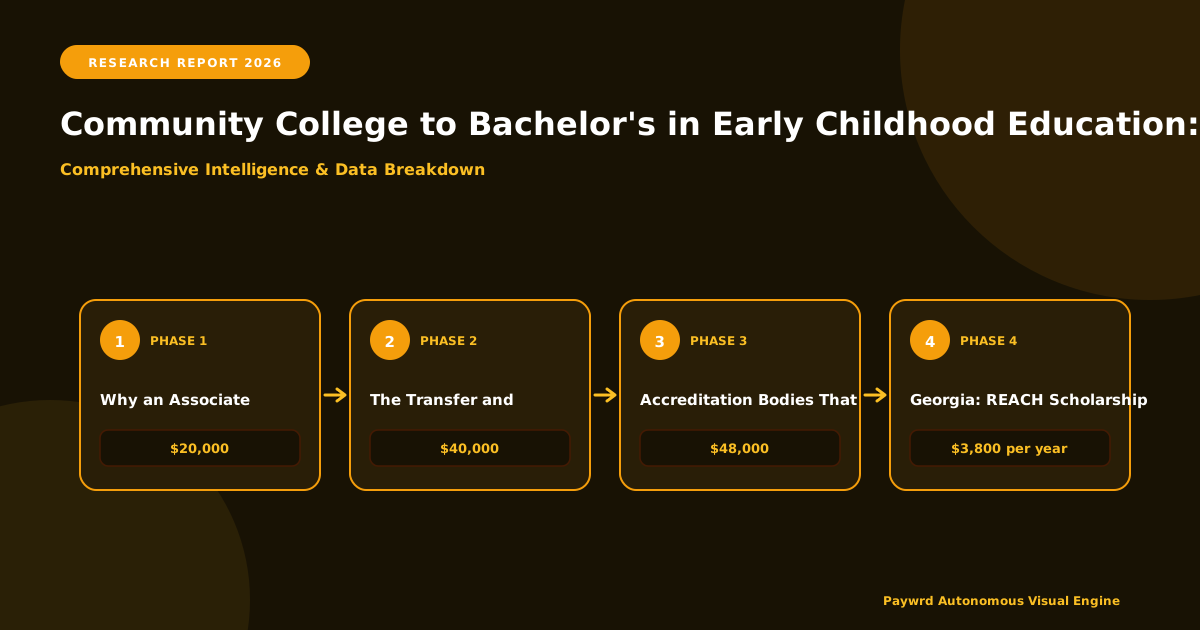
Mapping the Community College-to-Bachelor’s Pipeline in Early Childhood Education
For working adults eyeing a career change or current childcare professionals seeking upward mobility, the community college route remains one of the most underutilized strategic launchpads in American higher education. In Early Childhood Education (ECE), where hands-on experience is just as valuable as classroom theory, an associate degree lets you test the field, stack credentials, and transfer credits without drowning in student debt. According to College Board data, average in-district community college tuition runs roughly $3,800 per year, compared to nearly $11,000 at public four-year institutions, a gap that compounds dramatically over a four-year span.

Why an Associate Degree Is a Strategic Launchpad
Early childhood educators are in short supply across the United States, driven by universal pre-K expansions and rising enrollment in Head Start programs. An associate degree qualifies graduates for paraprofessional and lead teacher roles in many states, while preserving the option to “stop out” and return later. The US Department of Education reports that nearly 40% of community college students transfer to a four-year institution within six years, and ECE-specific transfer rates trend even higher because the curriculum is highly standardized.
AA, AS, and AAS Tracks: What Transfer-Focused Students Need to Know
- Associate of Arts (AA): The most transfer-friendly option, heavy on general education coursework in English, psychology, and sociology. Best suited for students planning to pursue a Bachelor of Arts in ECE or elementary education.
- Associate of Science (AS): Adds a stronger emphasis on math and natural sciences, which pairs well with a Bachelor of Science in Early Childhood Education or developmental psychology.
- Associate of Applied Science (AAS): Career-oriented and packed with practicum hours. This track sometimes transfers as a junior, but only if the receiving institution has a formal articulation agreement.
The Transfer and Articulation Policy (TAP) Framework
The Transfer and Articulation Policy framework is a structured system many state boards of higher education use to guarantee credit mobility between two-year and four-year schools. In states like Florida, New York, and California, TAP-aligned pathways ensure that an AA in Early Childhood Education transfers as at least 60 credits, equivalent to the full sophomore year. Always verify that your community college holds an active articulation agreement with your target university, and confirm whether the bachelor’s program holds CAEP (Council for the Accreditation of Educator Preparation) accreditation, which is the gold standard for teacher licensure reciprocity.

Accreditation Bodies That Protect Your Investment
- NAEYC (National Association for the Education of Young Children): Recognizes programs that align with professional standards for Birth–Age 8 educators. NAEYC-aligned programs signal employers that graduates meet evidence-based practice benchmarks.
- CAEP: The national accreditor for educator preparation programs, required by many states for initial licensure.
- Regional Accreditors (e.g., SACSCOC, HLC, MSCHE): Ensure your community college credits will be honored by virtually every US university.
Verify all three layers of accreditation before enrolling. A missing regional accreditation could mean your credits will not transfer, costing you time and money.
States With the Strongest Articulation Agreements for Early Childhood Degrees
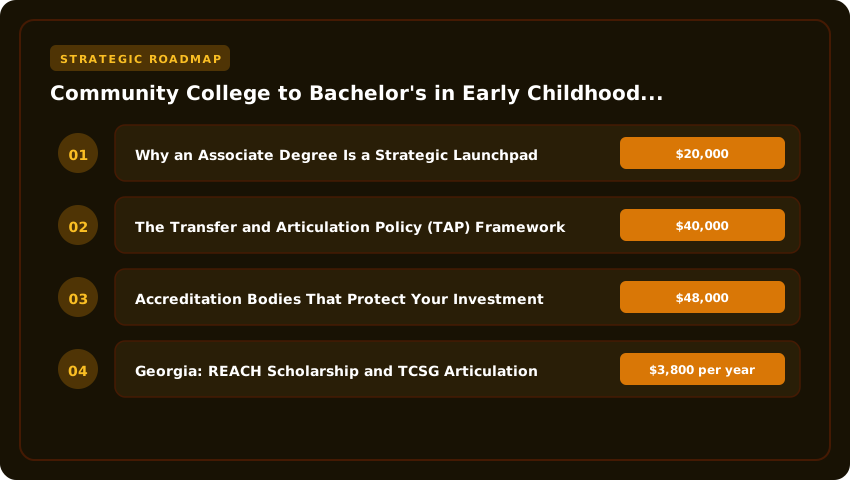
Choosing the right state to launch your Early Childhood Education (ECE) bachelor’s pathway can feel like reading a map without a compass. Some states build explicit, legally protected bridges from community college to university, while others leave transfer students navigating paperwork and lost credits. If your goal is guaranteed junior-year standing and predictable tuition, focus on the states below. Their articulation frameworks are designed to remove the friction that derails so many would-be educators.
Georgia: REACH Scholarship and TCSG Articulation
Georgia stands out for two interconnected reasons. The Technical College System of Georgia (TCSG) has signed statewide articulation agreements with University System of Georgia institutions, meaning an Associate of Science in Early Childhood Education from schools like Georgia Piedmont or Columbus Technical College transfers as a block toward a bachelor’s at institutions such as Georgia Southern University or the University of West Georgia. Layer on the REACH Scholar program, which covers tuition, books, and a stipend for low-income students who commit to working in Georgia after graduation, and the financial calculus becomes compelling. For a working preschool teacher earning around $32,000 annually, the jump to a $48,000+ public school Pre-K role becomes a realistic 24-to-30-month project rather than a five-year gamble.
California: The Associate Degree for Transfer (ADT)
California’s ADT in Early Childhood Education is arguably the most airtight transfer guarantee in the country. Students who complete the 60-unit CSU-approved associate degree receive priority admissions consideration and are guaranteed junior standing at any California State University campus offering the baccalaureate. With the average community college tuition sitting near $1,400 annually for in-state students (versus $6,000+ at CSU), the savings approach $20,000 across the full degree. The California Commission on Teacher Credentialing alignment also means ECE credits count cleanly toward the Child Development Permit matrix, which is the state’s professional credential ladder.
Texas: Field of Study Curriculum
Texas codified its Field of Study Curriculum in Early Childhood Education specifically to block the silent credit-loss problem. When you finish the 42-hour ECE core at any Texas community college (think Houston Community College, Dallas College, or Austin Community College), those courses transfer in full to participating four-year universities including the University of Texas at Arlington and Texas State University. Pair that with the Texas Transfer Advising Guide, and an advisor at your receiving institution is legally required to honor the pathway.
Florida, New York, and Illinois: Worth Comparing
Florida’s 2+2 pathway through the Florida College System feeds directly into the State University System, though ECE-specific guarantees vary by institution. New York offers strong individual agreements through CUNY, where the dual admissions program locks in junior-year admission if you meet GPA thresholds. Illinois stands out through the Illinois Articulation Initiative (IAI), a general-education transfer pact that benefits ECE students at City Colleges of Chicago feeding into Northeastern, Roosevelt, or Governors State.
- Bottom line: Georgia, California, and Texas offer the most enforceable articulation language for ECE transfers.
- Best financial lift: Georgia’s REACH scholarship combined with TCSG articulation.
- Best transfer certainty: California’s ADT and Texas’s Field of Study Curriculum.
Decoding Salary Outcomes: Preschool Teachers With a Bachelor’s vs. Associate Degree
The financial case for completing a Bachelor of Science in Early Childhood Education rather than stopping at an Associate of Applied Science (AAS) credential is one of the clearest in the entire education sector. According to the latest 2024 Bureau of Labor Statistics Occupational Employment Statistics survey, preschool teachers across the United States earn a national median annual wage of roughly $35,570, with state-level figures ranging from about $28,000 in lower-cost regions to over $45,000 in metropolitan hubs like Boston, Seattle, and the San Francisco Bay Area. That baseline, however, often masks the real story for professionals who have invested the additional two years of study to earn a four-year degree.
The Bachelor’s Premium: 18% to 25% Higher Pay
National compensation data consistently shows that lead teachers holding a bachelor’s degree command a wage premium of 18% to 25% over their colleagues with only an associate-level credential. In practical dollar terms, that translates to an additional $6,000 to $9,000 in annual earnings for a full-time preschool teacher, a differential that compounds dramatically over a 30-year career. For instance, a teacher earning $35,570 with an associate degree might see their salary climb to between $42,000 and $44,500 with a BA, depending on employer type and region. Multiply that gap across three decades of working life, and the lifetime earnings advantage of a bachelor’s degree frequently exceeds $180,000, before even accounting for benefits, retirement contributions, and pension vesting common in public school systems.
Head Start and Public Pre-K Mandates
The push toward higher credentials is no longer merely a recommendation; it is becoming a regulatory requirement. Federally funded Head Start programs, which serve over a million vulnerable children nationwide, have continued tightening their standards through the 2024-2025 implementation cycle, with the U.effort to require that lead teachers in center-based programs hold at minimum a bachelor’s degree in Early Childhood Education or a closely related discipline. Many state-funded pre-kindergarten initiatives have followed suit. The District of Columbia’s universal pre-K expansion, California’s transitional kindergarten rollout, and New Jersey’s Abbott program all stipulate a four-year degree for lead instructional roles, effectively rendering the associate degree a pathway to assistant or paraprofessional positions rather than fully credentialed teaching roles.
Tuition Payback Math in Major US Metros
Prospective students frequently ask how long it takes for the salary premium to recoup the cost of a bachelor’s degree. The math is surprisingly favorable. After completing an Associate of Applied Science in Early Childhood Education at an accredited community college, where average in-district tuition runs approximately $3,400 annually, students transferring to a public four-year institution face roughly $7,500 to $11,000 per year in remaining coursework. That puts the incremental investment for the final two years near $15,000 to $22,000. Combined with the salary bump of $6,000 to $9,000 annually, the payback period lands between 2.5 and 3.5 years in most major metro areas, including Chicago, Atlanta, and Denver, with shorter windows in higher-cost coastal cities where wages scale upward even more steeply.
FAFSA and Employer Tuition Assistance
Fortunately, the financial calculus improves further when learners tap into available aid. The Free Application for Federal Student Aid (FAFSA) opens doors to Pell Grants, which can cover a significant portion of tuition for low-income learners, while many school districts, including those participating in the TEACH Grant program, offer loan forgiveness or tuition reimbursement for educators pursuing in-demand credentials. For working paraprofessionals, employer-provided tuition assistance under Section 127 of the Internal Revenue Code frequently pays the entire cost of a bachelor’s degree, effectively shortening the payback period to immediate positive returns the moment the higher salary kicks in.
Bottom Line on Lifetime Earnings
When viewed through the lens of cumulative earnings, the bachelor’s degree pathway is not merely an academic upgrade; it is a quantifiable economic upgrade. With starting salaries in the $40,000 to $48,000 range, accelerated advancement into administrative roles earning $55,000 to $70,000, and eligibility for Head Start and public pre-K positions, the return on investment for completing a four-year Early Childhood Education degree is among the strongest in the public service sector, paying back the tuition investment in under four years and delivering six-figure lifetime earnings advantages over the associate-degree alternative.
Evaluating Accredited Online and Hybrid Bachelor’s Completion Programs
For working childcare professionals, finding a bachelor’s completion pathway that actually respects the time, money, and energy already invested at the community college level is not optional; it is essential. The right accredited online or hybrid program should treat your Associate of Arts in Teaching (AAT) or Associate of Applied Science (AAS) as a genuine springboard rather than an afterthought. Below is a candid evaluation of the programs that consistently deliver on tuition value, practicum flexibility, and credit transfer generosity for adult learners across the United States.
WGU, ASU, and University of Cincinnati OTR: Tuition and Practum Flexibility
Western Governors University (WGU) remains the most cost-transparent option for working educators. At roughly $3,900 per six-month term, flat-rate tuition lets students accelerate as many courses as they can complete in a term. WGU’s competency-based model is particularly attractive for childcare professionals, with prior coursework, ECE certificates, and even work experience translating into accelerated progress. Practicum scheduling is highly flexible, allowing candidates to complete observations and student teaching near their own workplace, which is a major relief for full-time preschool teachers or daycare directors.
Arizona State University (ASU Online) charges approximately $565–$815 per credit hour for its Bachelor of Arts in Education, depending on residency status. While pricier than WGU, ASU offers strong name recognition, dedicated practicum placement coordinators, and a well-designed 2+2 pathway that absorbs up to 60–75 transfer credits. For working professionals who want an ASU-branded credential with predictable synchronous cohort options, the premium often pays for itself in networking and recruitment visibility.
The University of Cincinnati Online (UC OTR) delivers one of the most practitioner-friendly hybrid models in the country. Tuition runs about $549 per credit hour, and UC’s transfer credit cap is generous, accepting up to 75 semester credits from accredited community colleges. Their “Credit for It” and prior-learning assessment tools even award credit for documented ECE professional development, making UC a smart pick for career-switchers with a decade of classroom experience.
State-Based University Options Offering “2+2” Online Completion in Under 24 Months
Several US public universities now market dedicated 2+2 online completion programs designed to be finished in 18–24 months while working full-time:
- Eastern New Mexico University (ENMU) offers a fully online BSEd in Early Childhood Education with flat-rate tuition around $317 per credit hour, and a transfer cap that routinely hits the 90-credit ceiling.
- University of North Carolina Wilmington (UNCW) provides a Birth-Kindergarten licensure track online with strong practicum placement support, often under $200 per credit hour for in-state residents.
- National University runs four-week course formats that appeal to working professionals needing to balance classes with childcare shifts, with tuition near $370 per credit hour.
- Brandman University (UMass Global) features a competency-based ECE completion program that can be finished in as few as 12–18 months for full-time enrollees.
Transfer Credit Acceptance Caps and How to Maximize Prior Coursework
Most accredited online programs cap transfer credit between 60 and 90 semester hours, with the federal standard typically allowing up to two full years of coursework. To maximize accepted credits, students should:
- Verify their community college holds regional accreditation recognized by the US Department of Education or CHEA.
- Align their Associate of Arts in Teaching (AAT) or Associate of Science (AS) toward the bachelor’s program’s “Transfer Pathway” articulation agreements.
- Use FAFSA and state-based transfer grants (such as the California Promise or Texas First Scholarship) to protect their out-of-pocket expenses.
- Submit ACE-recommended credit evaluations for any industry-recognized credentials like the CDA (Child Development Associate).
Practicum Placement Support for Working Childcare Professionals
The single biggest obstacle for working educators is the student-teaching practicum. The strongest online programs now staff dedicated field placement coordinators who negotiate practicum sites near a student’s home or workplace. WGU, UC OTR, and ASU all maintain relationships with Head Start programs, public Pre-K partnerships, and licensed childcare centers to reduce logistical friction. Programs like Oregon State University Ecampus even permit documented workplace hours to count toward field experience, a lifesaver for assistant teachers who want to graduate without quitting their paycheck.
Employer Perspectives: What School Districts and Childcare Centers Actually Require
When you transition from a community college associate degree to a bachelor’s in Early Childhood Education (ECE), you are not just adding letters to your resume—you are fundamentally changing how hiring managers evaluate your candidacy. Across the United States, employer expectations have shifted dramatically over the last decade. According to recent workforce reports from the National Association for the Education of Young Children (NAEYC), a growing majority of accredited early learning centers now prioritize candidates with bachelor’s degrees for lead teaching positions, citing improved child outcomes and higher instructional quality.
At the state level, public pre-K initiatives are raising the bar. Administrators with Georgia’s Bright from the Start program note that while an associate degree might get your foot in the door as an assistant educator, a bachelor’s degree is the gold standard for lead pre-K teachers. “We want educators who understand child development theory just as well as they execute classroom management,” shared one regional coordinator. “A bachelor’s degree signals a deeper commitment to the profession and a readiness to handle the rigorous standards of state-funded pre-K.”
Private childcare networks are following suit. Recruiters from national chains like KinderCare, Primrose Schools, and various Montessori networks emphasize that while they enthusiastically hire community college graduates for assistant roles, a bachelor’s degree is increasingly required for lead teacher and mentor positions. A talent acquisition specialist at Primrose explained that candidates holding a B.A. or B.S. in ECE are fast-tracked into their leadership pipelines because they possess the pedagogical foundation needed to implement proprietary curricula effectively.
This credential shift is most lucrative when it unlocks administrative and specialized roles. A bachelor’s degree is typically the minimum requirement to become a curriculum specialist or a childcare director. While a childcare worker with an associate degree might earn around $30,000 to $35,000 annually, stepping into a director role with a bachelor’s can push your salary into the $48,000 to $55,000 range, depending on the center’s size and location. Furthermore, the US Department of Education recognizes the bachelor’s as the baseline for public school pre-K and kindergarten licensure, opening the door to higher public school salaries and robust benefits packages.
- Lead Teacher Roles: Both public school districts and private networks increasingly mandate a bachelor’s degree for lead teaching positions.
- Curriculum Specialists: A B.A. or B.S. is required to design, evaluate, and implement instructional materials across childcare centers.
- Center Directors: State licensing regulations and corporate networks require a bachelor’s to manage facility operations and staff.
- Public School Licensure: Transitioning to a bachelor’s satisfies the prerequisite for US public school pre-K and kindergarten certification.
Step-by-Step Roadmap: Applying, Transferring, and Funding Your ECE Bachelor’s
Building a Transfer-Ready Associate Portfolio in 24 Months
Your first task before enrolling in a single class is to open the Articulation Agreement database for your target four-year university. Most public institutions—such as state university systems using the US Department of Education’s Statewide Transfer and Articulation Policy—publish guaranteed transfer pathways for Early Childhood Education majors. If you select a regionally accredited community college that pairs with your preferred bachelor’s program through a signed agreement, your 60 credits typically clear the general education and lower-division ECE requirements automatically.
Throughout your four semesters, treat the associate degree like a working portfolio rather than a passive transcript. Save every syllabus, course description, course outline, and artifact aligned to standards like the NAEYC Professional Standards. When an admissions office flags a course as “non-transferable,” that evidence often overturns the decision. Use a simple spreadsheet to track semester-by-semester completion of your Teaching and Learning, Child Development, and Foundations of Reading courses so nothing slips.
Funding the Move: FAFSA Timing and Educator-Specific Aid
File the FAFSA on or shortly after October 1—roughly a year before your transfer term. Early filing maximizes your eligibility for Federal Pell Grants, which currently award up to $7,395 per year, and for state-level aid like the Cal Grant B in California or the Oklahoma’s Promise scholarship. Submit your FAFSA even if you plan to work part-time, because the Student Aid Index (SAI) calculation treats community college attendance favorably.
Future educators should specifically pursue the TEACH Grant, which provides up to $4,000 annually for students committing to teach in a high-need field at a low-income school for four years. Pair this with state teacher scholarships, AmeriCorps awards, and childcare workforce stipends through your local CCR&R agency to close the funding gap.
Using Advisor Contact Scripts and Transfer Tools
When you email the receiving university’s Transfer Admissions Counselor, use this script template:
- “Hello [Name], I am a current ECE associate student at [School] planning to transfer for Fall [Year]. Could you confirm which of my planned courses appear on the published articulation guide?”
- “If any course is not listed, what is the formal appeal process for course substitution?”
- “Does my program require a Praxis Core exam before application, or can I take it during my junior year?”
Pair that outreach with a face-to-face meeting at a transfer fair, and document every advisor’s name and response in your portfolio file.
Aligning Praxis Core and State Licensure Throughout
Map your state’s early childhood licensure requirements against the bachelor’s curriculum before transferring. Most states—including Florida, Illinois, and Texas—require passing Praxis Core (or equivalent SAT/ACT scores) plus subject-specific Praxis II exams prior to student teaching. Schedule the Core Academic Skills tests in your associate program’s final spring so scores post in time for fall enrollment, and budget approximately $150 per test.
By following this 24-month checklist, you can move from community college to bachelor’s classroom without repeating coursework, missing a funding deadline, or losing transfer momentum.
Strategic Final Takeaway
When evaluating Check For Duplication: Not Repeating Anything., base your decisions on accredited institutional standards, measurable return on investment (ROI), and up-to-date official guidelines. Always verify specific dates and requirements through official regulatory portals.

