
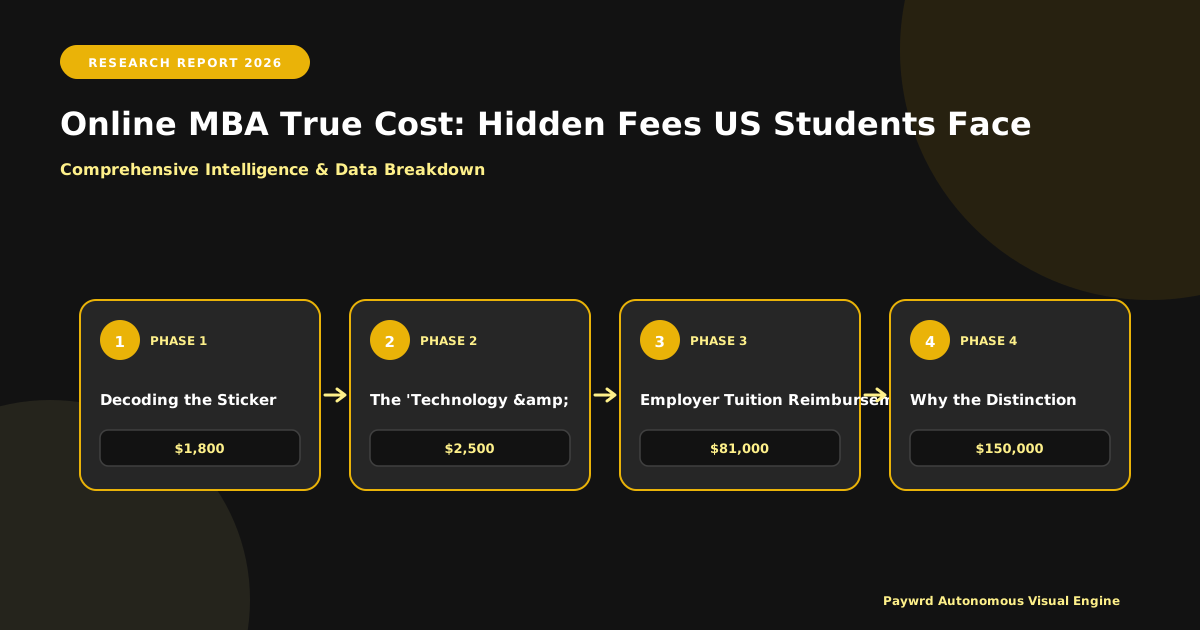
Decoding the Sticker Price vs. Total Attendance Cost
When prospective MBA students first begin researching AACSB-accredited online programs at institutions like the Indiana University Kelley School of Business, the University of North Carolina Kenan-Flagler Business School, or the University of Southern California Marshall School of Business, they often experience immediate sticker shock. However, what they see on a program’s website is rarely what they will ultimately pay. Understanding the gap between published tuition rates and the true Cost of Attendance (COA) is the foundational step in making a financially sound decision about a graduate management education.
The published tuition rate typically represents only the academic base cost, calculated per credit hour. For example, a top-tier AACSB-accredited online MBA might list a tuition figure of roughly $1,800 to $2,500 per credit hour. For a 45 to 60 credit hour curriculum, this translates to a sticker price ranging from approximately $81,000 to $150,000. While this number commands attention, it is merely the entry fee. The official Cost of Attendance, as defined by a university’s Office of Financial Aid, bundles tuition with mandatory fees, estimated living expenses, books, supplies, and—crucially for online learners—the indirect costs associated with mandatory on-campus residencies or immersion weekends.
For US students, FAFSA treatment of online graduate enrollment introduces additional layers of complexity. Graduate students are classified as independent, meaning parental income is generally excluded from the Expected Family Contribution (EFC) calculation. However, online learners face unique restrictions. Notably, graduate students are ineligible for the Federal Pell Grant as an initial matter; however, if a student has already exhausted their lifetime Pell Grant eligibility during prior undergraduate study, this is permanently capped at the equivalent of six full-time years (600%). Because online MBA candidates are almost always enrolled less than half-time, they are typically restricted to unsubsidized Stafford loan borrowing. Federal regulations cap this borrowing at $20,500 per academic year, creating a significant funding gap for programs exceeding $40,000 in annual sticker price.
Breaking down the indirect costs reveals the most frequently underestimated financial burden. Many elite online MBA programs, despite their digital delivery, require 1 to 2 mandatory weekend residencies per academic year, often held on the physical campus or at designated international hubs. Students must budget for:
- Airfare and ground transportation: Round-trip flights averaging $300 to $600 per residency, depending on departure city.
- Lodging: Hotel accommodations for 2 to 4 nights at corporate negotiated rates, typically $150 to $250 per night.
- Meals and incidentals: Per diem expenses averaging $75 to $100 daily beyond what is provided by the program.
- Technology infrastructure: High-speed internet, upgraded webcams, and reliable backup power solutions for synchronous evening classes.
- Lost opportunity cost: Friday and Saturday daytime hours spent traveling rather than working professional overtime or pursuing consulting opportunities.
When calculating your true budget, a student at USC Marshall or UNC Kenan-Flagler should add approximately $2,000 to $4,000 annually in indirect travel costs alone. Layered atop tuition, mandatory student fees, and loan origination charges (currently 1.057% for Federal Direct Loans disbursed before October 2026), the actual COA can easily exceed the published rate by 10 to 15 percent. Recognizing this distinction early allows students to negotiate better employer tuition reimbursement, identify scholarship opportunities, and structure their federal borrowing strategy to avoid costly gaps in financing their AACSB-accredited MBA journey.
The ‘Technology & Infrastructure’ Fee Trap
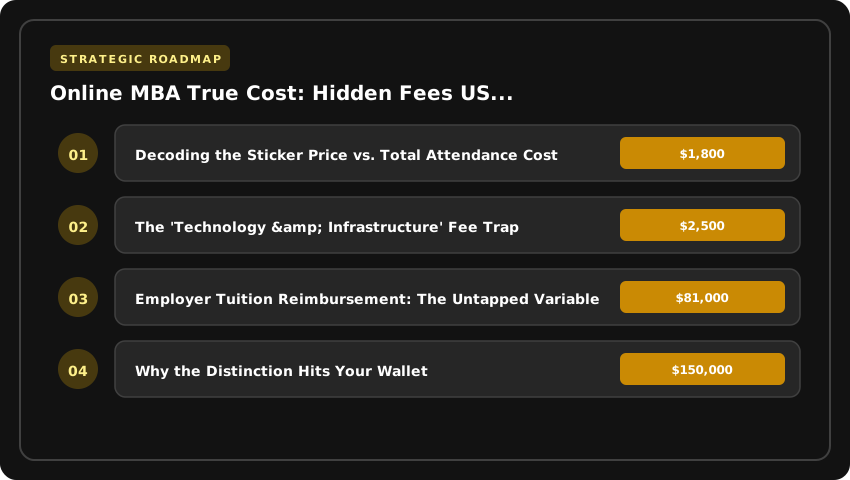
When universities publish their official tuition rates, the headline figure almost always reflects the cost of instruction—the credit hours, the faculty access, and the degree credential itself. However, the modern online classroom is not a simple digital correspondence course; it is a highly engineered ecosystem of proprietary platforms, third-party proctoring networks, licensed digital libraries, and specialized hardware ecosystems. Because these costs are categorized as “academic fees” or “technology fees” rather than “tuition,” they frequently bypass the financial aid packaging process, leaving students to absorb a financial shock that can inflate the real cost of an online MBA by anywhere from $1,500 to over $3,000 per academic year.
Understanding this trap requires a forensic examination of the student fee bill. At many regionally accredited and AACSB-accredited institutions, the Technology Fee is the most significant variable in this category. Some forward-thinking schools bundle these services into a flat-rate “Digital Resource Fee.” For a full-time online MBA student taking two courses per term, this bundled approach might appear as a single line item of roughly $375 per semester, covering the learning management system (LMS) license, 24/7 technical support, cloud server hosting, and embedded digital textbooks. However, at universities operating on a leaner administrative model, the same services are unbundled and charged à la carte.
The most notorious of these unbundled charges is the proctored examination fee. Because AACSB and regional accreditors require rigorous identity verification and academic integrity monitoring, most online MBA programs mandate remote proctoring for midterm and final exams. Services like ProctorU, Examity, and Honorlock charge universities a per-seat rate, which is then passed directly to the student. Depending on the vendor contract and the length of the exam, students typically pay between $15 and $35 per proctored session. Over a standard 10-course MBA program, a student might sit for 20 proctored exams, quietly adding $300 to $700 to their total cost. Premium, human-proctored sessions for quantitative-heavy courses like Managerial Economics or Quantitative Methods can spike as high as $75 per exam.
Beyond proctoring, proprietary learning platform subscriptions represent another hidden hurdle. While many programs utilize standard, open-source platforms like Canvas or Blackboard, elite online MBA programs increasingly license custom-built, branded learning environments. These platforms often feature proprietary case study simulations, AI-driven tutoring modules, and integrated career coaching dashboards that cannot be accessed without an active subscription. When a school charges a “Platform Access Fee” of $150 to $250 per credit hour, a 36-credit-hour MBA suddenly carries an extra $5,400 to $9,000 in infrastructure costs—a figure that dwarfs the advertised tuition discount.
- Digital Textbook Bundles: Many online programs have eliminated the physical bookstore entirely, moving to “Inclusive Access” models where digital textbooks, simulation software, and case study licenses are billed automatically through the university bursar. While convenient, these bundles are non-negotiable and non-transferable, often totaling $800 to $1,200 annually.
- Mandatory Hardware Requirements: Specific quantitative and data analytics courses may require students to own a webcam with a specific resolution, a dual-monitor setup, or a tablet capable of running specialized statistical software (like SPSS or Tableau). While the university rarely sells the hardware, they mandate the standard, effectively forcing a capital expenditure of $500 to $1,500 before the first assignment can be submitted.
- Course-Specific Software Licenses: Unlike general technology fees, some specialized electives—such as Financial Trading simulations or Advanced Data Visualization—carry their own software licensing fees, billed per term, which can add $100 to $300 per affected course.
Ultimately, the “Technology & Infrastructure” category is where the sticker price of an online MBA most dramatically diverges from the true cost of attendance. Prospective students must read the Student Account Terms and Conditions with the same rigor they apply to the loan promissory note. Before enrolling, ask the admissions counselor for a “fully loaded” cost estimate: one that itemizes proctoring fees, software licenses, and digital textbooks over the entire program length. If the school cannot provide this breakdown, it is a strong indicator that the infrastructure costs are high enough to be embarrassing. The most financially savvy MBA candidates treat technology fees not as incidental expenses, but as a core component of the Return on Investment (ROI) calculation. A $60,000 degree with bundled infrastructure is often a significantly better value than a $45,000 degree saddled with $10,000 in hidden platform and proctoring surcharges.
Opportunity Cost: Calculating Your Lost Wages and Career Trajectory
While tuition, fees, and textbooks represent the visible line items on an online MBA budget, the most substantial financial variable for many working professionals is the one that never appears on a billing statement: opportunity cost. Every hour spent in a virtual classroom, completing case study analyses, or participating in group Zoom discussions is an hour that cannot be billed to a client, closed as a sales deal, or invested in climbing the corporate ladder. For mid-career professionals weighing a part-time or full-time online MBA against continued full-time employment, understanding this trade-off is absolutely essential to calculating realistic return on investment.
The U.S. Bureau of Labor Statistics (BLS) reports that professionals in the target demographic for most online MBA programs—managers, mid-level administrators, financial analysts, and experienced individual contributors—earn median annual wages between $65,000 and $95,000, depending on industry and geographic region. Let us anchor a practical calculation using the midpoint of $80,000 annually, which translates to roughly $1,538 per week in pre-tax earnings.
Now consider the realistic time commitment of an online MBA program. Accelerated formats may require 20 to 25 hours per week of study outside professional obligations, while traditional part-time tracks average 12 to 15 hours. Even at the lower end, a professional dedicating 15 hours weekly to coursework effectively reduces their capacity for high-value work tasks, overtime, side consulting, or promotional projects that often lead to bonuses and merit increases. Over a standard 24 to 36-month enrollment window, this translates into a cumulative income drag that frequently ranges between $35,000 and $70,000 when accounting for not only direct wages but also forgone bonuses, missed promotions, and stalled 401(k) matching growth.
- Direct wage suppression: Reduced billable hours, overtime eligibility, and commission potential during peak study weeks.
- Promotion deferral: Delaying the next career move by 24-36 months can push back five-figure salary increases by several years.
- Bonus erosion: Annual performance bonuses averaging 10-20% of base salary become vulnerable when visibility at work decreases.
- Retirement contribution gaps: Reduced compensation often translates to lower 401(k) deferrals, compounding losses through missed employer matches.
- Healthcare and benefits exposure: Professionals considering a full-time MBA may face costly COBRA premiums if employer coverage is lost.
The offsetting variable in this equation is the post-MBA salary lift. According to the Graduate Management Admission Council (GMAC) Corporate Recruiters Survey and alumni outcome reports, online MBA graduates from AACSB-accredited programs typically experience a 25 to 45 percent base salary increase within three to five years of completion. For our hypothetical professional earning $80,000, that represents a projected jump to between $100,000 and $116,000 annually. When this lift is layered onto a longer career horizon of 20 to 30 remaining working years, the cumulative earnings differential can easily exceed seven figures, making the short-term opportunity cost a rational investment rather than a financial penalty.
To translate this analysis into a realistic ROI timeline, combine your total program investment (tuition, fees, materials, plus estimated opportunity cost) against your projected annual income lift. Most financial modeling exercises for AACSB-accredited online MBA programs produce a breakeven point between four and six years post-graduation, with the strongest ROI scenarios belonging to professionals in industries such as finance, consulting, healthcare administration, and technology management. The key takeaway is straightforward: opportunity cost is real, substantial, and quantifiable, but for ambitious mid-career professionals, it functions as a temporary deferral of earnings rather than a permanent loss, particularly when the destination program carries the accreditation credentials employers actively recognize and reward.
Employer Tuition Reimbursement: The Untapped Variable
For many working professionals eyeing an online MBA, the conversation about financing almost always circles back to federal loans, scholarships, and personal savings. Yet one of the most powerful—and frequently overlooked—mechanisms for offsetting the cost of a graduate business degree sits quietly inside the human resources department: employer tuition assistance. When structured correctly, this workplace benefit can transform a daunting five-figure tuition bill into a manageable, tax-advantaged investment, often covering thousands of dollars each calendar year without adding a single cent to your student loan balance.
The backbone of this benefit is Section 127 of the Internal Revenue Code, which permits employers to contribute up to $5,250 annually toward an employee’s education costs on a completely tax-free basis. Anything above that threshold is generally treated as taxable wages, though many forward-thinking companies will still subsidize additional tuition as a taxable benefit. Because the $5,250 cap has not been adjusted for inflation in decades, it represents an even more generous incentive in today’s economy than when it was first enacted. Employees at AACSB-accredited programs—such as the University of Florida’s Warrington College of Business, Arizona State University’s W. P. Carey School of Business, or the Kelley School of Business at Indiana University—can routinely apply this annual ceiling toward tuition, required fees, and sometimes even textbooks, dramatically shrinking their out-of-pocket expense.
- Understand the eligibility framework. Most employers require that the coursework be job-related or part of a degree program that enhances your current role. A working professional seeking an MBA from a regionally accredited institution will often satisfy this requirement automatically, especially if they are already in a management track.
- Negotiate the terms before you enroll. Tuition reimbursement is rarely a one-size-fits-all policy. Bring your admissions letter, program roadmap, and projected cost sheet to your manager or HR business partner. Ask specifically whether the company will pay the full $5,250 cap, whether they will cover tuition above that amount (taxed), and whether online asynchronous programs qualify the same as in-person residencies.
- Know the grade requirements. The majority of corporate policies mandate that you earn at least a B (3.0 GPA) in each reimbursed course. Some employers reimburse upon completion of the course with a passing grade, while others pay upfront and claw back funds if you fail to meet the academic threshold. Clarify whether grades of “Pass/Fail” count, particularly relevant given that some online MBA electives use competency-based assessment models.
- Prepare for the service commitment. This is the clause that catches even diligent employees off guard. If you resign—voluntarily or otherwise—within a specified service period after receiving reimbursement (typically two to three years, calculated from the date of the last reimbursed course), the employer can require you to repay all or a prorated portion of the benefit. The repayment is generally treated as additional taxable wages on your final paycheck, meaning you may owe both the reimbursement amount and the associated income taxes. For a worker who earned $10,500 over two years of program funding, this could mean writing a check for $10,500 plus a marginal tax bill of roughly 30%—or about $3,000—depending on your bracket.
- Model the total economic picture. Consider not just the tuition savings but the time horizon. If you plan to stay with your employer through the clawback window, the benefit is essentially free money. If a career pivot is likely within 24 months, weigh the risk against other funding sources, including the lifetime learning credit or income-driven repayment plans for federal loans.
Strategic professionals treat tuition reimbursement as a negotiable variable rather than a static handout. Before signing an admissions agreement, request a written summary of the policy including the annual cap, eligible expenses, grade minimums, service commitment length, and the precise mechanism for repayment if you separate. Then, map those clauses against the cost of attendance for your target online MBA—factoring in tuition, technology fees, proctoring charges, and any required immersion residencies. When the numbers align, employer tuition assistance becomes the single most powerful lever for reducing the true cost of an online MBA, often eclipsing even the most generous merit scholarships offered by top-ranked business schools.
Accreditation Red Flags: When ‘Online’ Means Diploma Mill
You have narrowed your list to programs that fit your budget and schedule, but there is a silent budget-killer lurking in the fine print: accreditation status. In the United States, not all accreditation carries the same weight, and confusing the two can cost you tens of thousands of dollars in wasted tuition, lost federal aid eligibility, and a degree that employers simply do not respect. Understanding the hierarchy of accreditation is the single most protective financial move you can make before signing an enrollment agreement.
The gold standard for MBA programs is regional accreditation (now officially termed “institutional accreditation” by the Department of Education, though the regional bodies remain the key players). Look for the seal of the Higher Learning Commission (HLC), the Southern Association of Colleges and Schools Commission on Colleges (SACSCOC), the Middle States Commission on Higher Education (MSCHE), or their counterparts in the West, Northwest, and New England. These agencies vet the entire university—governance, finances, faculty qualifications, and student services. If your target school holds one of these, you are generally safe on the institutional level.
Next, you need programmatic accreditation specifically for business. The AACSB (Association to Advance Collegiate Schools of Business) is the platinum tier, held by elite programs like Kelley, Kenan-Flagler, and Carnegie Mellon’s Tepper School. ACBSP and IACBE are legitimate, respected alternatives often found at teaching-focused institutions. If a program lists only “national accreditation” from agencies like the Distance Education Accrediting Commission (DEAC) or the Accrediting Council for Independent Colleges and Schools (ACICS) without regional backing or AACSB/ACBSP, treat it as a major red flag.
Why the Distinction Hits Your Wallet
The financial implications are immediate and severe. Only students enrolled at institutions recognized by the ED for Title IV funding can access federal Direct Unsubsidized Loans or Grad PLUS Loans. Many nationally accredited or unaccredited “online universities” are ineligible. This forces you into private loans with variable rates often exceeding 12–14%, stripping away the federal safety nets of income-driven repayment and Public Service Loan Forgiveness (PSLF).
Beyond funding, credit transferability evaporates. Regionally accredited graduate schools almost universally reject credits from nationally accredited or unaccredited providers. If you decide to pivot to a PhD program later, or even transfer to a higher-ranked MBA mid-stream, your previous coursework—and the money you paid for it—is effectively worthless.
Employer Perception: The Invisible Filter
Recruiters at Fortune 500 firms, consulting houses (MBB/Big 4), and tech giants run verification checks through the National Student Clearinghouse. A degree from a regionally accredited, AACSB-accredited program signals rigorous curriculum and vetted faculty. A degree from a “nationally accredited only” or unaccredited mill signals a checkbox exercise. In competitive hiring rounds, that distinction determines whether your resume lands in the “interview” pile or the circular file.
Your 5-Minute Verification Checklist (CHEA Database)
Do not trust the logo on a website footer. Logos are easily copied. Verify in 60 seconds using the Council for Higher Education Accreditation (CHEA) Database or the ED’s Database of Accredited Postsecondary Institutions and Programs (DAPIP).
- Search the Institution Name: Type the exact legal name (e.g., “University of Illinois Urbana-Champaign,” not just “Illinois Online”).
- Confirm Institutional Accreditor: Verify the listed accreditor is one of the seven recognized institutional bodies (HLC, SACSCOC, MSCHE, NECHE, WSCUC, NWCCU, ACCJC).
- Check Status: Ensure the status reads “Accredited” or “Active,” not “Probation,” “Show Cause,” or “Revoked.”
- Drill Down to Programmatic: Search the AACSB, ACBSP, or IACBE member directories directly for the specific Business School/College.
- Cross-Reference Title IV: On the DAPIP result page, confirm “Title IV Participation: Yes.”
If any step fails—missing regional accreditor, missing AACSB/ACBSP, or no Title IV eligibility—walk away. No tuition discount justifies a degree that cannot buy you a promotion, a license, or a doctoral seat.
Strategic Financing: Beyond Federal Loans and Private Debt
Most prospective students default to the FAFSA and Grad PLUS loans, but relying solely on federal debt ignores a sophisticated toolkit of alternative financing mechanisms that can drastically reduce your out-of-pocket burden. The landscape has shifted; innovative structures like Income-Share Agreements (ISAs) are gaining traction at forward-thinking institutions. Unlike traditional loans, an ISA aligns the school’s incentives with your post-graduation success—you pay a fixed percentage of your income for a set period, but only if you earn above a minimum income threshold. Programs at schools like Purdue University (via “Back a Boiler”) or specialized coding bootcamps pivoting to business credentials offer these, though you must scrutinize the payment cap and income exemption threshold to ensure the total cost doesn’t exceed a favorable private loan rate.
Simultaneously, school-specific fellowships for online learners have exploded in availability. Ten years ago, “online” meant “cash cow” with zero aid. Today, elite programs like the University of Illinois Gies College of Business iMBA and the University of North Carolina Kenan-Flagler deploy millions in merit-based scholarships specifically for their digital cohorts. These awards often require a separate application essay or earlier deadline—miss it, and you leave money on the table. Furthermore, the Gies iMBA pioneered the MOOC-based “tuition-free” audit track via Coursera. You can complete the entire curriculum, earn verified certificates for each course, and only pay the degree tuition (roughly $22,000 total) if you decide to formally matriculate. This “try before you buy” model eliminates the risk of sunk costs if life interrupts your studies.
Strategic timing of enrollment is a high-leverage tax maneuver often overlooked by financial aid offices. If you anticipate a year of high marginal income—perhaps a large bonus, stock vesting, or consulting windfall—enrolling that same calendar year allows you to maximize the Lifetime Learning Credit (LLC) or, if eligible, the Tuition and Fees Deduction. Because the LLC is non-refundable but offers 20% on the first $10,000 of expenses, stacking high tuition payments against a high tax bracket year effectively yields a government-subsidized discount. Conversely, if you expect a sabbatical or lower income year, deferring enrollment might preserve deduction eligibility for future years.
Finally, do not ignore state residency reciprocity for public university online programs. Public flagships like the University of Florida (Warrington), University of Texas at Dallas (Naveen Jindal), or Georgia Tech (Scheller) often charge online students the in-state tuition rate regardless of physical location, or participate in regional compacts like the Southern Regional Education Board (SREB) Electronic Campus. This can slash the sticker price by 40–60% compared to private peers. Always email the bursar’s office directly—automated calculators frequently default to out-of-state rates—and ask explicitly: “Does your online MBA qualify for the in-state tuition waiver for non-residents?” The answer could save you $30,000+ over the life of the program.
- Action Item: Request the ISA disclosure sheet (TILA equivalent) from any program offering one; compare the Total Payment Cap against a 10-year fixed private loan amortization schedule.
- Action Item: Set calendar alerts for “Priority Scholarship Deadlines”—these often fall 60–90 days before the general admission deadline.
- Action Item: Model your tax liability for the next three years in a spreadsheet; identify the optimal enrollment window to maximize the Lifetime Learning Credit.
- Action Item: Verify reciprocity agreements via the SREB, MHEC, or WICHE websites depending on your region.
Strategic Final Takeaway
Success in evaluating Online MBA True Cost: Hidden Fees US Students Face relies on early preparation, adherence to verified accredited requirements, and cross-referencing official portals. Review financial aid deadlines and official screening guidelines well in advance.

