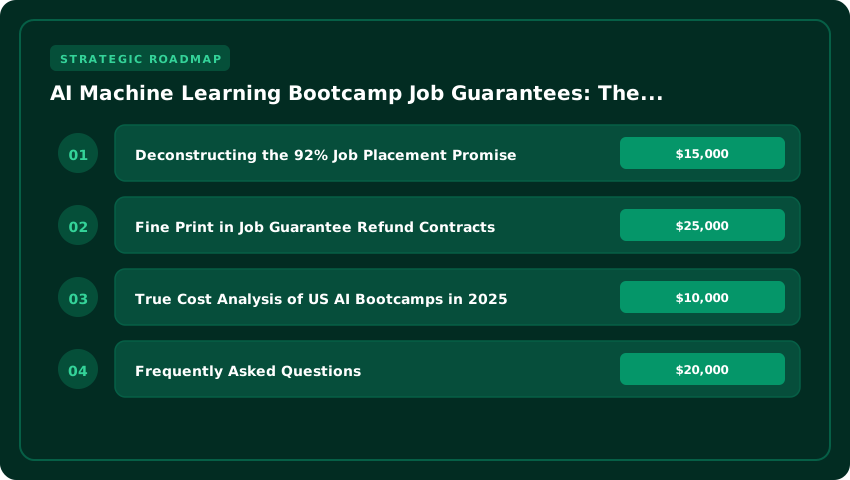
Deconstructing the 92% Job Placement Promise
Walk into the polished sales page of nearly any AI or Machine Learning bootcamp operating in the United States and you will almost certainly encounter a striking statistic: a placement rate that hovers somewhere between 85% and 95%, often anchored around that eye-catching 92% figure. It is presented in bold typography, surrounded by smiling alumni testimonials and logos of recognizable employers. To a prospective student evaluating a $15,000 to $25,000 investment, the number reads like a near-certain outcome. However, when that headline statistic is deconstructed against federal employment data, regulatory disclosures, and the fine print buried within enrollment agreements, the picture grows considerably more nuanced.
The first layer of scrutiny begins with the definition of the word placement itself. Most bootcamps measure this metric across a window of six to twelve months following graduation, which is a far more forgiving timeframe than the immediate post-graduation benchmarks used by traditional universities reporting to the U.S. Department of Education. Within that elongated window, a graduate who accepts a short-term contract in an unrelated field six months after finishing the program may technically be counted as placed. This redefinition of success is rarely communicated transparently on the landing page, yet it sits at the very foundation of how placement percentages are constructed and marketed.
- Timeframe inflation: A 6 to 12 month measurement window is roughly double the standard 90 to 180 day window used by traditional higher-education reporting.
- Self-reported surveys: Many programs rely heavily on voluntary alumni responses, sometimes with response rates below 40%, which introduces significant selection bias into the final headline number.
- Gig and contract work inclusion: Short-term freelance engagements, unpaid internships converted to stipends, and part-time roles may be counted as full placements depending on the program’s internal policy.
The second layer involves the exclusion of non-paying or low-paying gig work from the denominator of the calculation. When a bootcamp reports a 92% placement rate, it is typically calculating that figure against the number of graduates who actively sought employment, not against the total number of students who enrolled. Students who withdrew, returned to a previous employer, started independent businesses, left the country, or transitioned to unpaid volunteer roles are frequently removed from the statistical pool. The result is a denominator that has been carefully curated to maximize the appearance of success, and the marketing team is under very little regulatory pressure to disclose this methodology to the public.

The third layer of distortion lies in cohort cherry-picking. Selective bootcamps that require applicants to pass rigorous technical interviews, complete prerequisite coursework in Python, linear algebra, and statistics, and demonstrate prior professional experience are quietly filtering their incoming classes long before the first day of instruction. These programs then advertise placement statistics as though they apply to any motivated learner, when in reality the underlying cohort already possessed significant advantages. By contrast, the Bureau of Labor Statistics Occupational Outlook Handbook reports that employment of Computer and Information Technology occupations is projected to grow approximately 17% from 2023 to 2033, a rate that is dramatically faster than the average for all occupations. While that projection confirms strong industry demand, it does not validate any single bootcamp’s internal placement claim.
- Admissions filtering: Selective prerequisites artificially inflate outcomes by screening out candidates unlikely to succeed.
- Conditional guarantees: Many offers require graduates to apply to a minimum number of jobs, attend career coaching, and relocate, or the guarantee is voided entirely.
- Refund structures: When guarantees do trigger, reimbursements are often partial, processed slowly, or structured as credits toward future programs rather than direct cash returns.
For decision-makers, the actionable takeaway is straightforward. Before committing tuition dollars, request the full placement audit from any bootcamp under consideration. Ask specifically for the response rate of their alumni survey, the exact job titles counted toward the placement figure, the average salary of those placed, and whether contract and freelance work are included. Cross-reference those figures against the publicly available BLS Occupational Employment and Wage Statistics for SOC code 15-1221 (Computer and Information Research Scientists) and SOC code 15-1252 (Software Developers). A responsible program will answer these questions transparently, while one that deflects is signaling that the headline statistic may be more marketing artifact than measurable outcome.
Fine Print in Job Guarantee Refund Contracts
Beneath the glossy marketing language of “100% money-back guarantee” and “land a job in six months or your tuition is refunded,” bootcamp enrollment agreements contain a dense thicket of contractual conditions that can quietly disqualify even the most diligent graduate from receiving a single dollar back. Understanding these clauses is not optional reading; it is the single most important financial literacy skill a prospective student can develop before signing an enrollment agreement worth $10,000 to $20,000.
The first and most common eligibility cliff is the application quota clause. Most leading AI and Machine Learning bootcamps—including programs aligned with ABET-recognized curriculum standards and those accredited by bodies such as the AACSB for business-analytics tracks—require graduates to submit a minimum number of job applications, often between 100 and 200, within a specified 90-to-180-day window. Submitting 99 instead of 100, or failing to provide verifiable proof through a tracked job board, can void the entire guarantee. These applications are typically verified through platforms like LinkedIn, Handshake, or the bootcamp’s proprietary tracking dashboard.
A second common hurdle is the networking and interview compliance clause. Students frequently agree to attend a minimum of four networking events per week, participate in mock interviews, and engage with a dedicated career coach on a weekly basis. Missing three consecutive coaching sessions or declining a scheduled employer introduction is routinely cited as non-compliance. Many contracts also mandate the use of an approved resume template, a specific cover-letter format, and a portfolio hosted on a designated platform. While these requirements sound reasonable, they collectively create dozens of tripwires where a single missed checkbox can nullify the student’s eligibility.
Bootcamp refund models generally fall into two categories: the traditional refund guarantee and the Income Share Agreement (ISA). Under a traditional refund model, the student pays $10,000 to $20,000 upfront, and the contract promises a full or prorated refund if no qualifying job is secured within a defined period. Under an ISA, the student owes nothing upfront but agrees to pay a fixed percentage of their post-graduation income—typically 10% to 15%—for 24 to 48 months, capped at a maximum payment (commonly 1.5x to 2.0x the original tuition). ISAs do not usually offer a refund; instead, they offer payment forgiveness if the graduate fails to secure a job earning above a stated minimum salary threshold, often $40,000 to $50,000 annually. A critical distinction: an ISA payment pause is not the same as a refund, and accrued interest-style tuition adjustments can still apply in some contracts.
US state consumer protection laws add another important layer. California, through the Bureau for Private Postsecondary Education (BPPE) and the California Consumer Legal Remedies Act, requires licensed institutions to maintain approved refund policies and disclose them in enrollment agreements, with a cooling-off period and pro-rata refund calculations. New York, regulated by the New York State Education Department (NYSED), mandates that non-degree programs disclose job placement statistics using standardized methodologies, and the state’s General Business Law provides additional protections against deceptive refund practices. Texas, governed by the Texas Workforce Commission (TWC) and the Texas Private Postsecondary Education Act, requires career-oriented schools to file surety bonds and adhere to strict refund schedules, especially when Title IV federal financial aid is involved. Students filing a FAFSA-linked complaint can escalate unresolved disputes through the state attorney general’s office or the Federal Student Aid Ombudsman.
Tuition clawback conditions deserve special attention in the fine print. If a graduate secures a job that is later deemed non-qualifying—because the role is part-time, contract-only, below a certain salary floor, or outside the bootcamp’s approved “related field” definition—the bootcamp can, in some contracts, demand partial or full repayment of any refund previously issued. Some ISA agreements even include a “clawback trigger” requiring graduates to repay a portion of the forgiven amount if they fail to report income accurately. Before enrolling, students should request the enrollment agreement in full, highlight every clause referencing “qualifying employment,” “minimum salary,” “documentation requirements,” and “repayment obligations,” and consider having the document reviewed by a consumer protection attorney or a local legal aid clinic.
- Verify the exact number of job applications required and how submissions must be documented.
- Confirm whether the program operates under a refund model, an ISA, or a hybrid structure.
- Check the bootcamp’s accreditation status with the Council on Integrity in Results Reporting (CIRR) or US Department of Education-recognized accreditors.
- Review your state’s specific consumer protection statutes before signing the enrollment agreement.
- Request a sample refund request, and ask how long the review process takes once all documentation is submitted.
True Cost Analysis of US AI Bootcamps in 2025
When evaluating accelerated AI and Machine Learning programs, the advertised tuition represents only a fraction of the real financial commitment. For 2025, the most reputable US-based bootcamps—including Flatiron School, General Assembly, Springboard, and Fullstack Academy—charge between $7,000 and $20,000 depending on format, duration, and specialization track. Flatiron’s Data Science and AI tracks typically fall in the $14,000 to $15,500 range, while General Assembly’s immersive programs often sit between $12,500 and $15,000. Springboard’s part-time, mentor-driven model lowers entry costs to roughly $7,000 to $9,000, and Fullstack Academy’s AI-focused curriculum averages around $12,000 to $16,000 for full-time learners. While these figures appear competitive at first glance, they tell only part of the financial story.
A traditional state university Master’s in Data Science, accredited by regional bodies and often featuring AACSB-aligned analytics concentrations, averages $20,000 to $60,000 in total tuition for in-state students over a two-year period. Out-of-state and private university options frequently exceed $80,000. Although the sticker price is higher, a Master’s degree offers federally backed financial aid, FAFSA eligibility, employer tuition reimbursement, and a credential recognized by HR departments and immigration authorities alike. When factoring in opportunity costs, tax-deductible education expenses, and the ability to work part-time under an F-1 visa, the Master’s pathway can deliver comparable total investment with substantially less personal financial risk.
- Missed Wages: Full-time bootcamps require 40–60 hours weekly for 12 to 24 weeks. For professionals earning $70,000 annually, the income forfeited during enrollment ranges from $16,000 to $32,000—often exceeding the bootcamp tuition itself.
- Hardware and Software Requirements: Most AI curricula demand a machine with a minimum 16GB RAM, dedicated GPU (RTX 3060 or higher), and an SSD. New laptops meeting these specifications cost $1,200 to $2,500, and cloud computing credits for AWS, GCP, or Azure labs add $300 to $800 over the program duration.
- Prep Course Add-Ons: Many bootcamps recommend or require paid preparatory modules. Flatiron’s pre-work and Springboard’s foundational statistics courses add $500 to $1,500. External certifications such as AWS Cloud Practitioner or Google Data Analytics are often encouraged, costing an additional $200 to $500 including exam fees.
- Living Expenses and Relocation: In-person programs in New York City, San Francisco, or Atlanta require housing deposits and rent that can reach $2,000 to $3,500 monthly, adding $10,000 to $25,000 for the full program cycle.
After layering these variables, the realistic all-in cost of a top-tier US AI bootcamp in 2025 typically lands between $25,000 and $55,000—a range that narrows considerably when measured against a state university Master’s degree offering accredited rigor, financial aid access, and long-term credential portability. Prospective students should request a fully itemized cost breakdown from admissions advisors, confirm whether job guarantee refunds include living expenses, and verify whether employer partnerships offer tuition sponsorship that can offset opportunity costs. Understanding the true price of accelerated training is the first disciplined step toward making a financially sound career investment in artificial intelligence.
Accreditation, Curriculum Quality, and Hiring Pipeline Reality
The single biggest misconception prospective students carry into a Machine Learning bootcamp search is the belief that the program holds something equivalent to a university degree. It does not. No top-tier US AI or ML bootcamp — including Fullstack Academy, Flatiron School, General Assembly, Springboard, or the data science tracks at Galvanize — carries regional or programmatic accreditation recognized by the Department of Education. They are not accredited by AACSB, which is the gold-standard business school accreditor (think Wharton, Booth, or Stern). They are not accredited by ABET, which evaluates engineering, computing, and applied science programs (think MIT, Georgia Tech, or Carnegie Mellon’s undergraduate degrees). Those acronyms simply do not apply to a 12-to-36-week private coding academy.
What bootcamps do sometimes hold is third-party review from organizations like the Council on Integrity in Results Reporting (CIRR), which audits bootcamp graduate outcomes against a defined methodology, or curriculum alignment notes from employers like AWS, Microsoft Azure, or Google Cloud. CIRR accreditation is a transparency standard, not an academic one — it forces schools to publish graduate counts, in-field employment rates, and salary bands using a consistent template. That is genuinely valuable and worth weighing, but it is not the same thing as a regional accreditor telling you that a faculty member holds a PhD in the subject being taught. When you read a bootcamp brochure claiming it is “accredited,” drill into exactly what body issued that status and what they actually reviewed.
Curriculum depth is where the marketing-versus-reality gap gets uncomfortable. A serious AI/ML bootcamp will cover Python fluency, statistics and probability, supervised and unsupervised learning, model evaluation, feature engineering, deployment basics, and at least one deep learning framework. The honest question is whether that coverage is genuine working knowledge or surface-level exposure. Programs that lean heavily on scikit-learn for the bulk of their machine learning instruction are usually teaching classical algorithms — linear regression, logistic regression, decision trees, random forests, gradient boosting, k-means, and PCA — through a clean, well-documented API. That is the right starting point and it remains what most applied ML engineers use in production. Programs that emphasize PyTorch or TensorFlow are signaling a deeper commitment to deep learning: custom neural network architectures, backpropagation mechanics, CNNs for computer vision, RNNs or Transformers for sequence data, and GPU-based training workflows. PyTorch is the dominant research and industry framework in the United States as of 2025, especially at FAANG research labs and AI-native startups. If your goal is a machine learning engineer role touching LLM fine-tuning, RAG systems, or computer vision, scikit-learn alone will not get you there. Look for explicit PyTorch modules, capstone projects involving transformer architectures, and exposure to tools like Hugging Face, Weights and Biases, or MLflow.
- Instructor-to-student ratio: Reputable bootcamps publish ratios between 1:15 and 1:25 for live lectures and 1:8 to 1:12 for one-on-one project review. Anything weaker than that, especially in a 100% online cohort, should be a red flag. You are paying $10,000 to $20,000 for access to expert feedback, not pre-recorded videos.
- Project portfolio expectations: Strong programs require 3 to 5 portfolio-grade projects with code review from an instructor. A GitHub profile with clean READMEs, reproducible environments, and deployed demos (Streamlit, Hugging Face Spaces, or a simple AWS endpoint) is what hiring managers actually scroll through.
- Hiring partner reality: “Hiring partner” logos — Deloitte, Amazon, Google, local US startups — usually mean the bootcamp is in a recruiter’s newsletter distribution list or that graduates get access to a job board. They rarely mean a guaranteed interview pipeline. Deloitte’s enterprise analytics team and Amazon’s AWS ML Solutions Architect org hire experienced PhDs and MS graduates far more often than bootcamp alumni. What is realistic is that a bootcamp grad can land interviews at US-based startups, mid-market SaaS companies building ML features, consulting firms hiring junior data engineers, or internal analytics teams at Fortune 1000 companies. Treat the big logos as marketing, and ask the admissions advisor — point blank — how many graduates from the last three cohorts were actually placed at each named employer.
The honest takeaway: accreditation in the bootcamp world means transparency reporting and employer-recognized curriculum alignment, not academic rigor on par with an MS in Computer Science at a regionally accredited university. Curriculum quality ranges from genuinely excellent — with rigorous statistics, deep PyTorch work, and tight instructor ratios — to disappointingly shallow. And hiring partner logos are a signal of relationship, not a pipeline. Ask for the graduate outcomes report by cohort, look at the GitHub profiles of recent alumni, and verify whether the deep learning stack matches the job descriptions you actually want.
Realistic Salary Outcomes vs. Six-Figure Marketing Claims
The gap between what AI and Machine Learning bootcamps advertise on their hero banners and what their graduates actually earn in their first full-time role is, frankly, one of the most consequential disconnects in American post-secondary education marketing today. When you see splashy claims of “$165,000 average starting salaries” or “six-figure guarantees,” it is worth pausing and asking a far more grounded question: what do independent, third-party salary surveys actually report for entry-level Machine Learning Engineers (MLEs) and junior data scientists in the United States?
According to the most recent Stack Overflow Developer Survey and aggregated data published by Level Up through its salary-explorer tooling, entry-level Machine Learning Engineers working in major US tech hubs earn a median base salary in the range of $85,000 to $115,000 annually. The Course Report annual outcomes survey, which specifically tracks bootcamp alumni six months post-graduation, lands in a remarkably similar band, with most programs reporting median starting compensation between $78,000 and $102,000 once cost-of-living adjustments are applied. These figures represent real offer letters, verified W-2 income, and self-reported data from graduates who actually sat through a 14-to-36-week immersive curriculum and then competed in the open market.
Now compare that to a computer science degree holder from a regionally accredited, ABET-accredited US university entering the same role. A bachelor’s degree graduate from a state flagship — whether that is the University of Washington in Seattle, UC Berkeley in the Bay Area, or UT Austin — typically commands a starting salary that is 10% to 18% higher than a bootcamp counterpart with comparable practical skills, according to the US Bureau of Labor Statistics Occupational Employment and Wage Statistics (OEWS) program. In Seattle, where Amazon, Microsoft, and a constellation of AI startups compete for talent, the median entry-level MLE wage hovers near $112,000 for degree holders. In the Bay Area, that number climbs above $125,000, though the cost of housing quickly absorbs the nominal advantage.
The honest comparison by metro looks like this for first-year MLEs, blending bootcamp graduates and CS degree holders into the same candidate pool:
- Austin, TX: Bootcamp grads median ~$88K; CS degree holders median ~$98K. The presence of Tesla, Oracle, and a growing roster of AI-focused startups keeps the floor elevated, but rarely produces the $165K headlines.
- Seattle, WA: Bootcamp grads median ~$105K; CS degree holders median ~$118K. Bonuses and stock grants from Amazon-adjacent employers can push total compensation higher, but base salary stays grounded.
- New York City, NY: Bootcamp grads median ~$102K; CS degree holders median ~$115K. Fintech and quant-heavy employers pay premiums, but the $165K figure almost always includes equity vesting, signing bonuses, or senior-level titles.
- Bay Area (San Francisco/San Jose): Bootcamp grads median ~$115K; CS degree holders median ~$135K. This is the only metro where six-figure base offers for true entry-level roles are routine, yet even here, $165K is the exception, not the norm.
So where do the six-figure marketing claims originate? A careful read of nearly every bootcamp’s methodology disclosure reveals a familiar pattern: reported figures blend total compensation (base plus signing bonus plus first-year RSU vesting), include a self-selected survey population skewed toward graduates who landed at FAANG-tier employers, and frequently exclude graduates who took six months or longer to secure their first technical role. Course Report’s own methodology page acknowledges that its salary medians are calculated only from respondents who reported employment in a related field, which inherently filters out the underemployed.
The actionable takeaway for prospective students evaluating an AI Machine Learning bootcamp is straightforward: budget your tuition against a realistic $85,000 to $115,000 first-year salary expectation, not the $165K headline. If a program promises otherwise, ask for the methodology, the sample size, and whether the figure is base-only or total compensation. If the recruiter hesitates on any of those three questions, you have your answer. A FAFSA-eligible, accredited degree path may carry a higher sticker price upfront, but its verified median outcomes, transferability of credits, and stronger negotiating leverage at the offer table frequently produce a higher lifetime earnings trajectory than the bootcamp alternative, particularly for students who have not yet built a professional network in the US tech ecosystem.
A Decision Framework: Who Should (and Should Not) Enroll
Choosing whether to enroll in an AI or Machine Learning bootcamp with a job guarantee is rarely a simple yes-or-no calculation. For career-changers across the United States, the decision sits at the intersection of existing credentials, financial tolerance, geographic reality, and long-term professional ambition. Before committing $10,000 to $20,000 in tuition (and often another $5,000 to $15,000 in living expenses), prospective students should pressure-test their personal profile against a candid framework that prioritizes return on investment over marketing polish.
The most important first question is whether you already hold a STEM credential or substantial coding exposure. Bootcamps are fundamentally accelerators, not foundation layers. Learners who arrive with a bachelor’s degree in computer science, mathematics, statistics, engineering, or physics typically extract dramatically more value because they can layer machine learning concepts onto a pre-existing mental model of variables, functions, and optimization. Similarly, professionals who have shipped production code in Python, R, or even JavaScript will find the curriculum navigable rather than overwhelming. If neither of these conditions describes you, a 12-to-24-week immersive bootcamp may attempt to compress two years of essential learning into a timeframe that leaves dangerous conceptual gaps, precisely the gaps that technical interviewers at FAANG and Fortune 500 companies are trained to expose.
The second pillar is financial runway. Job guarantees almost universally include fine print about refund eligibility windows (often 6 to 12 months post-graduation), and many require graduates to decline offers below a specific salary threshold (commonly $50,000 to $65,000 annually) before triggering any reimbursement clause. Learners without at least three to six months of living expenses saved should approach these programs with extreme caution. Federal FAFSA-eligible alternatives, employer tuition reimbursement programs through Section 127 of the Internal Revenue Code, and even income-share agreements (ISAs) from accredited providers may present lower-risk pathways. Always verify whether a bootcamp is accredited by the Accrediting Council for Continuing Education and Training (ACCET) or holds regional accreditation, which can affect your ability to transfer credits or qualify for military benefits under the GI Bill.
The third consideration is geographic proximity to technology hubs. Bootcamp placement statistics are heavily influenced by the local labor market. A graduate completing a program in San Francisco, Austin, Boston, Seattle, or the Research Triangle will encounter a fundamentally different hiring environment than one finishing in a region with sparse AI hiring. If you are not within reasonable commuting distance of a major tech corridor, the promised placement rates often erode substantially. In that case, hybrid programs with strong remote placement infrastructure or relocation support become essential evaluation criteria, not optional features.
For learners who determine that a traditional bootcamp is misaligned with their profile, several alternative pathways frequently deliver superior ROI. The Google Career Certificate in Data Analytics or IT Automation costs roughly $39 per month on Coursera, can be completed in three to six months, and is recognized by over 150 US employers including Verizon, Target, and Walmart. The AWS Certified Machine Learning Specialty credential, while demanding, carries significant weight with cloud-forward employers and costs approximately $300 for the exam plus study materials. Community college AI and machine learning programs, particularly those aligned with ABET-accredited engineering transfer pathways or AACSB-accredited business analytics tracks, offer another compelling route, often at $2,500 to $6,000 total with daytime schedules that accommodate working adults.
Finally, before enrolling in any bootcamp, run this strategic checklist:
- Do I have at least 200 hours of prior hands-on coding experience, verifiable through GitHub contributions or professional work?
- Can I document a financial runway covering full tuition plus nine months of living expenses?
- Is the program accredited, and does the job guarantee include a clear refund trigger independent of “best efforts” language?
- Will I be physically or virtually situated within reach of active AI/ML hiring pipelines?
- Have I evaluated lower-cost alternatives such as Google Career Certificates, AWS specialty certifications, or regional community college programs that may yield comparable employment outcomes?
If you answered “no” to two or more of these questions, a bootcamp job guarantee is likely not the optimal next step. Instead, invest six to twelve months building foundational skills through free or low-cost resources, then reassess whether the accelerated, high-cost pathway aligns with your strengthened profile and clearer career targets.
| Metric | AI/ML Bootcamps (Job Guarantee) | Traditional CS Degree | Self-Paced Online Programs | |
|---|---|---|---|---|
| Total Cost (USD) | $11,000 – $17,500 | $40,000 – $120,000 | $500 – $2,500 | |
| Average Sticker Price | ~$14,000 | ~$78,000 (in-state private avg.) | ~$1,200 | |
| Tuition Refund Window | 14–30 days (varies by provider) | Federal 14-day withdrawal rule | 7–14 days standard | |
| Admission Cut-off | Pre-assessment quiz + coding interview | SAT/ACT + GPA + essays | None / open enrollment | |
| Minimum Education | High school diploma + logic test | High school diploma (required) | None | |
| Program Length | 16–28 weeks (full-time) | 4 years (Bachelor’s) | 3–12 months (self-paced) | |
| Placement Rate Claimed | 85%–95% (often 92% cited) | N/A (degree-based outcome) | Not tracked | |
| Income Share Agreement (ISA) Available | Yes (~$30K cap, 12–36 mo.) | No | No | |
| Median Starting Salary (US) | $95,000 – $112,000 | $85,000 – $105,000 | $70,000 – $90,000 | |
| Time-to-ROI | 8–14 months post-graduation | 36–60 months post-graduation | 12–24 months | |
| Accreditation Status | Not regionally accredited (industry certs) | Regionally accredited (DOE) | None / MOOC |
Frequently Asked Questions
What does a 92% job placement rate actually mean for AI bootcamp graduates in the US?
A 92% placement rate typically counts graduates who land any tech-adjacent role, including junior data analyst positions, within 180 days. It does not guarantee AI or Machine Learning engineering roles specifically, and self-reported figures are rarely audited against Bureau of Labor Statistics outcomes.
Are AI machine learning bootcamp job guarantees legally binding in the United States?
Most job guarantees are contractual promises with narrow conditions. Students must typically complete 100% of coursework, maintain a code portfolio, and apply to a minimum number of roles weekly. Failure to meet these obligations voids the refund clause regardless of the graduate's actual employment status.
How much do AI bootcamps with job placement guarantees cost in 2024?
Top-tier US AI and Machine Learning bootcamps with placement guarantees range from $11,000 to $17,500. Income Share Agreements typically cap at $30,000, payable only after securing a position earning above $50,000 annually, making upfront tuition the lower-risk option for most candidates.
Is an AI bootcamp or a computer science degree better for career ROI in 2024?
AI bootcamps achieve ROI in 8–14 months versus 36–60 months for traditional degrees, according to Switchup and BLS data. However, bootcamps lack regional accreditation, limiting eligibility for federal financial aid, military benefits, and future graduate school admissions requiring accredited undergraduate credentials.
Strategic Final Takeaway
Success in evaluating AI Machine Learning Bootcamp Job Guarantees: The Hidden Reality Behind US Placement Stats relies on early preparation, adherence to verified accredited requirements, and cross-referencing official portals. Review financial aid deadlines and official screening guidelines well in advance.