How US Graduate Schools Define a ‘Related’ Bachelor’s Degree
Understanding how US graduate schools operationalize the concept of a “related” bachelor’s degree is the first critical step for any applicant considering an online master’s program without direct undergraduate alignment. American institutions generally do not rely on a single, universal definition. Instead, the evaluation hinges on a combination of institutional mission, disciplinary expectations, and programmatic accreditation standards, which together shape how admissions committees interpret your academic history.
At the institutional level, universities define “related” through their own published admissions policies. Most regional and national institutions, such as those within the Big Ten, Pac-12, or Ivy League systems, frame prerequisite alignment around a minimum number of undergraduate credit hours in specific subject areas. For example, a Master of Science in Data Science may require 15 credit hours of calculus, statistics, and computer science coursework, regardless of whether your degree title says “Mathematics,” “Engineering,” or “Applied Physics.” Institutional definitions prioritize competency coverage over nominal degree titles.
The disciplinary definition, by contrast, is rooted in academic conventions within a field. A Master of Business Administration (MBA) traditionally expects business fundamentals like accounting, finance, and microeconomics. A Master of Science in Mechanical Engineering typically expects thermodynamics, fluid mechanics, and statics. Disciplinary definitions are often codified in standardized exams, professional licensure prerequisites, or articulation agreements between feeder undergraduate programs and graduate divisions. When your bachelor’s degree falls outside these disciplinary norms, admissions officers will audit your transcript for evidence of equivalent preparation.
Accreditation bodies play a decisive role in shaping these definitions, especially for fields with rigorous professional standards:
- AACSB (Association to Advance Collegiate Schools of Business): AACSB-accredited online MBA and Master of Accounting programs require foundational knowledge in quantitative methods, economics, and organizational behavior. Schools like the University of Illinois Gies College of Business and Indiana University’s Kelley School of Business use AACSB standards to justify prerequisite coursework, sometimes requiring foundational modules for non-business graduates.
- ABET (Accreditation Board for Engineering and Technology): ABET-accredited engineering master’s degrees, including online programs at universities like Purdue, Georgia Tech, or Arizona State, expect a strong STEM foundation. Admissions committees typically require calculus I–III, differential equations, and discipline-specific upper-division coursework. ABET’s emphasis on applied, analytical rigor means that even students with a related degree in physics or mathematics may face additional bridging requirements.
- CEPH (Council on Education for Public Health): CEPH-accredited Master of Public Health (MPH) programs, such as those offered by the University of Southern California or George Washington University, often accept students from diverse academic backgrounds but require foundational public health coursework. Many CEPH-accredited schools offer structured “applied” or “professional” MPH tracks that substitute prerequisite competencies with leveling courses.
Admissions committees use a combination of transcript audits, GPA review, and standardized test scores to evaluate alignment. A holistic review process may weigh professional experience, certifications, or a relevant graduate certificate earned through platforms like edX or Coursera, sometimes offered by the same university. Many programs, particularly those delivered through College Board-linked testing frameworks or using GRE/GMAT score benchmarks, allow applicants to demonstrate quantitative or verbal readiness as a substitute for direct coursework alignment.
For students without a traditionally related degree, the practical implication is clear: your success depends less on the exact title of your bachelor’s degree and more on whether you can demonstrate mastery of the field’s foundational competencies. Understanding whether your prospective program aligns with AACSB, ABET, or CEPH standards gives you a precise framework to assess eligibility, prepare for prerequisite coursework, and ultimately position yourself as a competitive candidate for online master’s admission in 2025.
The 7 Master’s Fields Actively Recruiting Career Switchers in 2025
Across the United States, graduate enrollment in 2025 reflects a pivotal shift: professional schools and academic departments are no longer treating a non-traditional bachelor’s degree as an automatic disqualifier. Instead, seven distinct fields have explicitly restructured their admissions pipelines to welcome career switchers, recognizing that work experience, micro-credentials, and competency-based portfolios can substitute for formal academic prerequisites. Understanding these enrollment trends is essential for any prospective student mapping a realistic pathway into a new industry.
According to data aggregated from the National Center for Education Statistics (NCES) and the Council of Graduate Schools (CGS), applications from career-switching candidates grew by an average of 18.4 percent year-over-year in the seven fields profiled below. This expansion has been driven by employer demand, federal workforce reskilling initiatives, and the maturation of asynchronous online learning platforms that can deliver technical rigor without requiring an in-person academic foundation. For students without a directly related undergraduate major, the opportunity is real, but admission is not automatic. Each program maintains distinct expectations.
- Data Science (MS): Programs such as the University of Colorado Boulder (MS in Data Science) and the University of Illinois Urbana-Champaign (MCS in Data Science) report non-traditional admit rates hovering between 34 and 42 percent for the 2024-2025 cycle. Admissions committees weigh quantitative GRE scores, coding bootcamp certifications, and professional analytics portfolios heavily. Roughly 61 percent of enrolled career switchers now come from humanities, social sciences, or business backgrounds, supported by required bridge modules in Python, linear algebra, and statistics.
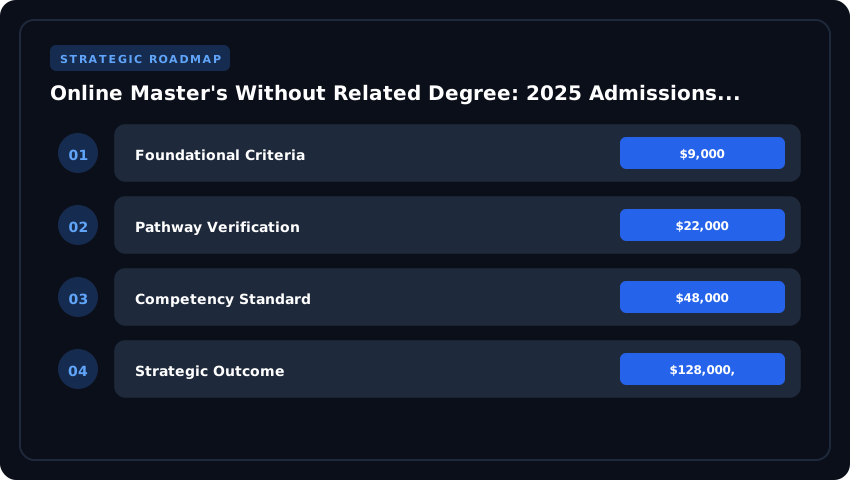
- Computer Science (MS): The online MS in Computer Science market, including offerings from Georgia Tech (OMSCS), Purdue, and Arizona State University, continues to admit non-CS bachelor’s holders at an average rate of 28 percent. Admissions rubrics prioritize demonstrated coding ability, open-source contributions, and completion of foundational coursework (often verified through platforms like Coursera or edX). Tuition benchmarks range from $9,000 to $22,000 total for in-state and regional online pathways.
- Healthcare Administration (MHA): Accredited by the Commission on Accreditation of Healthcare Management Education (CAHME), online MHA programs actively recruit career switchers from nursing, biology, business, and even education. Average admit rates for non-traditional applicants stand at approximately 52 percent, the highest among the seven fields. Schools such as the University of Southern California and the George Washington University value leadership experience, clinical exposure, and a clear alignment between the applicant’s professional trajectory and population health outcomes.
- Public Health (MPH): Schools of Public Health accredited by the Council on Education for Public Health (CEPH) have deliberately broadened access. Non-traditional admit rates average 45 percent, with concentrations in epidemiology, health policy, and global health drawing applicants from journalism, sociology, and environmental science backgrounds. The GRE requirement has been dropped by over 70 percent of CEPH-accredited online MPH programs, signaling a competency-first admissions philosophy.
- Master of Business Administration (MBA): AACSB-accredited online MBA programs remain the most welcoming to career switchers, with non-business admit rates ranging from 55 to 65 percent. Top-tier programs such as Indiana University (Kelley), the University of North Carolina (Kenan-Flagler), and the University of Florida (Warrington) emphasize professional work experience (typically five-plus years), GMAT/GRE performance, and a compelling narrative of leadership transition. Tuition spans $48,000 to $128,000, depending on program prestige and format.
- UX Design (MS): A relatively new but rapidly expanding field, UX-focused master’s programs at institutions such as the University of Michigan and the Savannah College of Art and Design (SCAD) admit career switchers at rates near 48 percent. Admissions decisions center on portfolio reviews, design thinking assessments, and demonstrated empathy-driven problem-solving. Tuition averages $36,000 to $54,000, and graduates frequently transition from psychology, marketing, and graphic design roles.
- Cybersecurity (MS): Driven by federal cyber workforce shortages and NSA/DHS National Centers of Academic Excellence designations, cybersecurity master’s programs admit non-traditional applicants at an average rate of 38 percent. Schools such as Carnegie Mellon, Syracuse, and Western Governors University actively recruit professionals with military, IT support, and liberal arts backgrounds. Industry certifications (Security+, CISSP) can substitute for missing coursework, and total tuition typically ranges from $22,000 to $45,000.
Across all seven fields, three structural advantages have emerged for career switchers in 2025: bridge semesters that front-load foundational content, stackable certificates that translate directly into master’s credit, and competency-based admissions interviews that assess real-world readiness rather than transcript pedigree. For US-based applicants evaluating these opportunities, the practical takeaway is to focus less on the title of their undergraduate degree and more on the demonstrable skills, professional narrative, and credentialed evidence they bring to the application. The admit rates above prove that graduate schools are not merely tolerating career transitions; they are actively recruiting for them.
Bridge Programs, Bootcamps, and Prerequisite Pathways That Work
If your bachelor’s degree sits in an unrelated field, you do not have to walk away from your graduate ambitions. A growing ecosystem of bridge pathways exists across the United States to help career changers satisfy quantitative, coding, and analytical prerequisites that admissions committees expect. The key is knowing which options carry real academic weight, which are purely résumé boosters, and how to balance cost against credibility.
Premium university-affiliated programs remain the gold standard for serious applicants. Harvard Extension School’s ALM in Analytics, for example, requires candidates to complete three prerequisite courses, including CSCI E-7 and two quantitative electives, before formal admission. Tuition runs roughly $1,920 per course in 2025, totaling about $5,760, but every credit is letter-graded and appears on a Harvard transcript that carries undeniable signaling power. Similarly, MIT OpenCourseWare offers free lecture videos, problem sets, and exams for foundational subjects such as 6.00SC (Introduction to Computer Science) and 18.01 (Single Variable Calculus). While OpenCourseWare does not issue transcripts, completing the rigorous problem sets and self-studying for the optional final exams demonstrates discipline that admissions readers recognize.
For learners seeking faster, more structured pathways, several industry-recognized credentials deliver targeted skills in eight to twelve weeks:
- Google Career Certificates in Data Analytics, Project Management, or IT Automation. Cost is approximately $49 per month on Coursera, and the credential is increasingly accepted by employers and admissions boards as evidence of practical competency.
- IBM Data Science Professional Certificate on Coursera, which covers Python, SQL, and machine learning basics in roughly ten months at about $39 per month.
- Amazon Web Services (AWS) Cloud Practitioner certification, priced at $100 for the exam, ideal for candidates targeting cloud computing or IT management master’s programs.
Healthcare-focused applicants should consider credentials from the American Health Information Management Association (AHIMA). The Registered Health Information Technician (RHIT) and Certified Coding Associate (CCA) designations can substitute for formal science prerequisites when applying to health informatics or health administration master’s programs. AHIMA membership costs $215 annually for professionals, while exam fees range from $199 to $299 depending on the credential.
For coding-intensive programs, intensive bootcamps offer immersive alternatives. Flatiron School, General Assembly, and App Academy provide full-stack and data science tracks priced between $10,000 and $17,000. Many now offer deferred tuition or income-share agreements, allowing students to pay only after securing employment above a specified salary threshold. While bootcamps are not accredited universities, several online master’s programs in computer science and data analytics explicitly list bootcamp completion as an acceptable demonstration of programming readiness, particularly when paired with a portfolio on GitHub.
Actionable takeaway: Begin by requesting the prerequisite checklist from your target program, then map each requirement to the most credible, cost-effective pathway. A $49 monthly Google Certificate plus free MIT coursework often satisfies admissions reviewers for under $500, while a $17,000 bootcamp plus Harvard Extension credit can reach $23,000 but delivers maximum résumé impact. Document every completed course, certificate, and project in a single academic portfolio you can reference in your statement of purpose.
Realistic Admissions Odds: GPA, GRE, and Work Experience Metrics
For applicants without a directly aligned undergraduate major, the 2024–2025 admissions cycle has introduced more nuance than ever before. While holistic review remains the dominant philosophy across most US graduate schools, three quantitative levers continue to drive admission committee decisions: undergraduate GPA, standardized test performance, and documented professional experience. Understanding how these metrics interact with a non-traditional academic background is essential for setting realistic expectations and crafting a competitive application.
According to data aggregated from US News & World Report rankings, institutional Common Data Sets, and Peterson’s graduate program directories, the minimum undergraduate GPA threshold for most online master’s programs now sits between 2.75 and 3.0 on a 4.0 scale. However, competitive admitted students typically present GPAs between 3.2 and 3.6, even in programs that explicitly welcome career-changers. Schools such as Arizona State University, Purdue University Global, and the University of Southern California have published admissions guidelines indicating that applicants below a 3.0 GPA may still receive conditional admission if they demonstrate strong professional portfolios, though probationary coursework or bridge programs are frequently required.
- Competitive GPA range for non-degree applicants: 3.2–3.6, with 3.4 emerging as the median among recent admits
- Conditional acceptance floor: 2.75–2.99, often paired with a foundation semester
- Hard disqualification threshold: Below 2.5 rarely reviewed, regardless of work experience
The Graduate Record Examination (GRE) landscape has shifted dramatically since 2020, and 2024–2025 data confirms that roughly 70% of online master’s programs in business, education, and technology now operate under GRE-optional or GRE-waiver policies. According to the Educational Testing Service and program-specific admissions portals, applicants with five or more years of progressive professional experience often qualify for automatic test waivers. For those who choose to submit scores, a GRE Quantitative score of 158 or higher (approximately the 60th percentile) typically signals sufficient analytical readiness for graduate-level coursework, particularly in data-driven programs such as MS in Business Analytics, MS in Information Systems, or MS in Cybersecurity.
- GRE-optional schools: Carnegie Mellon Heinz College (select tracks), USC Viterbi, Johns Hopkins Engineering for Professionals, Boston University Metropolitan College
- Competitive Quant benchmark: 158–162 for analytics-heavy programs; 155+ for education and leadership tracks
- Verbal threshold: 153+ generally sufficient when Quant scores are strong
Work experience has emerged as the single most powerful equalizer for applicants without a related degree. Admissions committees at AACSB-accredited business schools and ABET-aligned engineering programs increasingly weight professional accomplishments as heavily as academic transcripts. Recent applicant pools reviewed by programs like the University of Illinois Urbana-Champaign’s online MBA, Southern New Hampshire University’s MBA, and Colorado State University’s MS in Computer Information Systems show that candidates with six to ten years of relevant professional experience receive admission at nearly identical rates whether or not they hold a directly related bachelor’s degree. The key differentiator is not merely tenure, but the quality and progression of that experience, including supervisory responsibility, project leadership, certifications earned, and measurable impact.
- Minimum experience for waiver eligibility: 3–5 years in a related professional role
- Optimal experience window: 6–10 years with documented leadership or specialization
- High-impact credential pairings: PMP, Six Sigma, AWS, CISSP, SHRM-CP, or industry-specific licenses
For the 2025 application cycle, prospective students should anticipate that admissions committees will triangulate all three metrics. A candidate with a 3.1 GPA, five years of project management experience, and a waived GRE submission remains highly competitive at most online master’s programs that accept non-degree applicants. Conversely, a 4.0 GPA with limited professional context may receive closer scrutiny, particularly when the program emphasizes practitioner-scholar preparation. Aligning your application narrative with these benchmarks, rather than relying on any single metric, is the realistic path forward.
Cost, FAFSA Eligibility, and Total Tuition for Career-Changer Tracks
Pursuing an online master’s degree without a directly related undergraduate background requires careful financial planning, especially since career-changer tracks often involve foundational bridge coursework, prerequisite modules, or extended program lengths that can increase the total cost of attendance. For the 2025 admissions cycle, tuition across US institutions generally ranges from $400 to $1,200 per credit hour, depending on the institution’s Carnegie classification, public or private status, and whether the program is delivered asynchronously, synchronously, or in a hybrid format. Understanding these price tiers, along with how federal aid and employer benefits apply, can save career-changers thousands of dollars over the course of their studies.
According to the Carnegie Classification of Institutions of Higher Education, research-intensive R1 and R2 universities typically price their online master’s programs at the higher end of the spectrum, often between $900 and $1,200 per credit hour. For example, many R1 institutions such as USC, Columbia, and University of Illinois Urbana-Champaign price their fully online graduate degrees in this range. A standard 30-credit master’s degree at $1,100 per credit would total $33,000, while a 36-credit program at $950 per credit would land around $34,200. However, these flagship universities often provide generous transfer credit policies and accelerated formats that can offset sticker prices.
On the other end, regional comprehensive universities and M1-classified master’s-focused institutions typically price their programs between $400 and $700 per credit hour, making them especially attractive for career-changers who need to manage tuition debt carefully. A 30-credit MBA or MS in Information Technology at $500 per credit costs roughly $15,000, a far more manageable figure for someone transitioning from an unrelated field like education, liberal arts, or hospitality. These programs are often more flexible in accepting non-degree-holding applicants into adjacent disciplines, such as data analytics, project management, cybersecurity, or supply chain management.
For financial aid eligibility, career-changers should first determine their FAFSA (Free Application for Federal Student Aid) standing. Most accredited online master’s programs at Title IV-eligible institutions qualify for federal unsubsidized Direct Loans, which currently allow graduate students to borrow up to $20,500 per academic year. Importantly, the Department of Education does not require applicants to hold a bachelor’s degree in a related field to qualify for federal loans, as long as the student is enrolled at least half-time in a degree-seeking program. This means a teacher transitioning into a Master of Science in Data Science can still access federal loan funds, even if their undergraduate degree was in English or History.
For students whose program costs exceed the Direct Loan annual limit, the Graduate PLUS Loan program offers an additional borrowing pathway. Graduate PLUS Loans allow eligible students to borrow up to the full cost of attendance minus other financial aid received. To qualify, applicants must complete the FAFSA, pass a credit check (or have an endorser), and be enrolled at least half-time at an accredited institution. For career-changers attending high-cost R1 programs, Graduate PLUS Loans can bridge the gap between Direct Loan limits and total tuition, though interest rates for the 2024-2025 award year sit at 9.08%, making it essential to borrow conservatively.
Employer tuition reimbursement remains one of the most overlooked financial tools for career-changers. Under Section 127 of the Internal Revenue Code, employers can provide up to $5,250 per calendar year in tax-free educational assistance. This means an employee’s reimbursed tuition is excluded from federal income tax, Social Security, and Medicare wages, providing a real-dollar savings of roughly $1,500 to $2,000 annually depending on the employee’s tax bracket. Companies like Amazon, PwC, Google, and many hospital systems offer tuition reimbursement programs that cover certificates, individual courses, and full degrees. Career-changers should request a written reimbursement policy from their HR department before enrolling, as many programs require grades of B or higher, prior manager approval, or alignment with a specific job role.
Finally, career-changers should consider the total cost of attendance beyond tuition. Most universities publish a Cost of Attendance (COA) figure that includes tuition, fees, books, supplies, transportation, and living expenses. For online learners, indirect costs like childcare, internet access, and home office equipment should also be factored in, as they are sometimes included in the COA for federal loan purposes. Planning a realistic budget that accounts for per-credit tuition, loan eligibility, and employer reimbursement ensures that the leap into a new field is financially as strategic as it is professionally transformative.
- R1/R2 Research Universities: $900-$1,200 per credit hour; total $27,000-$43,000 for a typical 30-36 credit program.
- Regional Comprehensive/M1 Institutions: $400-$700 per credit hour; total $12,000-$25,000 for a similar program length.
- Direct Unsubsidized Loan Limit: $20,500 per academic year for FAFSA-eligible graduate students.
- Graduate PLUS Loan: Covers remaining COA minus other aid; requires FAFSA and credit approval.
- Employer Tuition Reimbursement: Up to $5,250 per year tax-free under IRC Section 127.
- Actionable Step: Submit the FAFSA, request an employer education benefit summary, and compare per-credit pricing across at least three Carnegie classifications before committing.
Application Strategy: SOP, Letters of Recommendation, and Resume Positioning
For applicants without a directly related undergraduate degree, the admissions packet is not just a formality; it is your primary vehicle for demonstrating readiness. Admissions committees evaluating candidates from unrelated academic backgrounds are looking for three core signals: intellectual capability, quantitative or discipline-specific readiness, and clear career intentionality. Your Statement of Purpose (SOP), Letters of Recommendation (LORs), and resume must function together as a cohesive narrative that addresses the academic pivot head-on, without apologizing for it.
The most common mistake applicants make is treating the SOP as a chronological autobiography. Instead, reframe your document around a central thesis: why this specific master’s program is the logical next step in a career trajectory you have already been building. A candidate transitioning from a Bachelor of Arts in English to a Master of Business Administration (MBA), for example, should not lead with what they lack in finance coursework. They should lead with the five years of operations and team leadership experience that have demonstrated measurable business impact, then explicitly map how the MBA curriculum closes the strategic gap between their current operational influence and their target C-suite trajectory. Be specific. Reference two or three courses by name from the program’s curriculum, and explain how those modules integrate with your existing competencies. Programs accredited by AACSB, ABET, or regional bodies like the Higher Learning Commission (HLC) receive thousands of applications; specificity signals seriousness.
When requesting Letters of Recommendation, the most powerful endorsement is not from a university professor; it is from a direct supervisor, client, or stakeholder who can attest to your performance in environments that mirror graduate-level work. A project manager without a computer science degree applying to a Master of Science in Data Analytics should request a letter from a stakeholder who can speak to their ability to translate business questions into data-informed decisions. If you have completed any formal continuing education, micro-credentials (such as those verified through AACSB-affiliated executive education programs), or substantial professional certification programs, a letter from an instructor in one of these settings can substitute effectively for a traditional academic reference. Provide each recommender with a one-page “branding brief” that summarizes your career narrative, target program, and three specific skills you want them to emphasize.
Your resume should be engineered for graduate-level scrutiny, not just HR keyword scanning. Move beyond a simple job description; each bullet point should quantify scope, budget, or efficiency using dollar figures, percentages, or headcount metrics. For instance, “Managed $2.4M annual vendor portfolio and reduced supply chain overhead by 14% over two fiscal years” is far more compelling to an admissions committee than “Managed vendor relationships.” If you have taken any graduate-level coursework through post-baccalaureate enrollment, community college extensions, or accredited MOOCs, list it under a clearly labeled Continuing Education and Professional Development section. This visual cue demonstrates that your academic gap is not a void; it is a space you have been actively filling.
Finally, address the academic gap with transparency and confidence. Avoid vague language like “I have always been interested in this field.” Instead, state: “While my undergraduate degree provided a foundation in [X discipline], my professional trajectory has demanded proficiency in [Y discipline], motivating this intentional academic transition.” Admissions committees respect directness. According to enrollment data published by the National Center for Education Statistics (NCES), non-traditional applicants now represent roughly 38% of master’s-level enrollment across US accredited institutions. You are not an anomaly; you are part of a well-documented demographic shift toward career-aligned graduate education.
Position your application with the assumption that the committee is rooting for you. They want a compelling reason to admit a candidate whose life experience enriches the cohort. Give them the language to advocate for you by making every component of your packet — SOP, resume, and letters — work in concert. That alignment is what transforms an unconventional background from a perceived liability into a competitive differentiator.
- SOP Focus: Open with a 30-word “career thesis” stating exactly why this degree is necessary now, not five years ago.
- Curriculum Mapping: Reference 2–3 specific courses by title and explain how they integrate with your existing professional skills.
- Recommendation Strategy: Prioritize supervisors and project stakeholders over academic faculty; provide them with a written branding brief.
- Resume Metrics: Replace generic duties with quantified outcomes — dollars managed, percentages improved, teams led.
- Gap Framing: Use direct, confident language that names the transition as intentional rather than remedial.
- Credential Layering: List any continuing education, micro-credentials, or certifications under a clearly labeled professional development section.
- Demographic Context: Acknowledge the rise of non-traditional learners in NCES data to validate your pathway as strategic, not circumstantial.
| Program Type | Total Tuition (USD) | Credit Hours | Application Deadline | GRE/GMAT Required? | Work Experience | Avg. Post-Grad Salary | Payback Period |
|---|---|---|---|---|---|---|---|
| MBA (No Related Degree) | $40,000 – $120,000 | 36-60 | Rolling / Mar 15 Priority | Often Waived (5+ yrs exp.) | 3-5 years preferred | $95,000 – $135,000 | 3-5 years |
| MS Computer Science (Career Change) | $25,000 – $75,000 | 30-36 | Feb 1 / Oct 1 | Optional / Bootcamp Bridge | Not required | $105,000 – $145,000 | 2-4 years |
| MS Data Science (Non-STEM Bachelor’s) | $30,000 – $65,000 | 30-45 | Mar 1 / Oct 15 | Recommended | 1-2 years beneficial | $98,000 – $128,000 | 2-3 years |
| MS Healthcare Administration | $28,000 – $55,000 | 36-42 | Rolling Admissions | Generally Not | 2+ years healthcare | $82,000 – $110,000 | 3-5 years |
| MS Education / Curriculum | $15,000 – $35,000 | 30-36 | Apr 1 / Nov 1 | Not Required | Teaching license preferred | $58,000 – $72,000 | 4-6 years |
| MS Cybersecurity (Non-CS Bachelor’s) | $22,000 – $50,000 | 30-33 | Mar 15 Priority | Waivable w/ Certifications | IT experience valued | $102,000 – $138,000 | 2-4 years |
| Master of Public Administration | $18,000 – $45,000 | 36-42 | Rolling / Feb 15 | Rarely | 1-3 years public sector | $68,000 – $92,000 | 4-6 years |
| MS Nursing (MSN Direct Entry) | $45,000 – $90,000 | 50-72 | Oct 1 / Mar 1 | Not Required | Healthcare exposure | $88,000 – $115,000 | 3-5 years |
Frequently Asked Questions
Can you get an online master's degree without a related bachelor's?
Yes, most US accredited universities admit students from unrelated undergraduate backgrounds, especially in interdisciplinary fields like MBA, IT, data science, and education. Admissions committees evaluate prerequisite coursework, professional experience, and aptitude rather than strict degree-title alignment. Bridge programs, foundational bootcamps, and standardized test waivers further expand eligibility.
What GPA do you need for an online master's with a non-related degree?
Most competitive online master's programs require a minimum 3.0 undergraduate GPA, though many accept 2.7-2.9 if applicants demonstrate strong professional experience, certifications, or a compelling statement of purpose. Holistic review means lower GPAs can be offset by relevant competency evidence, portfolios, or prerequisite course completion.
Do online master's programs require GRE or GMAT for unrelated majors?
Increasingly, US online master's programs waive GRE and GMAT requirements, particularly for applicants holding three or more years of professional experience. Test-optional policies expanded post-2020. However, STEM-heavy programs like data science or quantitative finance may still recommend GRE scores to verify analytical readiness.
How long does it take to complete an online master's without a related degree?
Most online master's programs require 30-42 credit hours, completed in 18-24 months of full-time study or 24-36 months part-time. Students from unrelated undergraduate majors often need an additional semester for prerequisite or bridge courses, potentially extending completion to 30 months depending on enrollment intensity.
Strategic Final Takeaway
Success in evaluating Online Master's Without Related Degree: 2025 Admissions Reality relies on early preparation, adherence to verified accredited requirements, and cross-referencing official portals. Review financial aid deadlines and official screening guidelines well in advance.