Decoding AACSB Accreditation: Why The Gold Standard Stamp Matters For Your ROI
When you are evaluating an online Master of Business Administration and staring down a price tag that can climb toward $94,000, the single most important credential you need to understand is not the university’s marketing slogan, its glossy campus photographs, or even its U.S. News & World Report ranking. It is the accreditation held by the business school itself. In the United States, three primary agencies accredit business programs: the Association to Advance Collegiate Schools of Business (AACSB), the Accreditation Council for Business Schools and Programs (ACBSP), and the International Accreditation Council for Business Education (IACBE). These three names look similar on a brochure, but they are not interchangeable, and the gap between the top tier and the lower tiers is precisely where your return on investment is either made or lost.
AACSB is widely considered the gold standard of business accreditation. Founded in 1916, AACSB reviews schools against rigorous standards covering strategic management, learner success, faculty qualifications, and intellectual contributions. Fewer than 5% of business schools worldwide earn AACSB accreditation, and the United States is home to the largest concentration of these elite institutions, including Harvard Business School, Stanford Graduate School of Business, the Wharton School at the University of Pennsylvania, the Kellogg School of Management at Northwestern University, and the Haas School of Business at the University of California, Berkeley. When an online MBA program carries the AACSB seal, it shares that pedigree with the most recognized names in global business education, and that shared signal travels directly into corporate hiring offices.
By contrast, ACBSP and IACBE accredit a much larger universe of schools, including many solid regional universities and career-focused institutions. ACBSP places a stronger emphasis on teaching excellence and student learning outcomes, while IACBE focuses on mission-driven program improvement. Both agencies are recognized by the Council for Higher Education Accreditation (CHEA), so neither is illegitimate or fraudulent. However, when Fortune 500 recruiters, top-tier consulting firms, and elite finance boutiques build their campus recruiting shortlists, they overwhelmingly default to AACSB-accredited programs because that designation signals a baseline of faculty quality, peer-reviewed research, and curriculum rigor that has been independently verified against the toughest benchmark in the field.
- AACSB (Gold Standard): Roughly 5% of global business schools, including the majority of top-50 ranked U.S. MBA programs. Recognized by employers worldwide as the premier signal of academic rigor and faculty quality.
- ACBSP (Teaching-Focused): Accredit a broader portfolio of schools, with a mission centered on excellence in teaching and measurable student learning outcomes.
- IACBE (Outcomes-Focused): Accredit mission-aligned programs that emphasize continuous improvement and outcome-based assessment.
This tier system matters because your salary trajectory after graduation is heavily influenced by which list your degree appears on. According to industry data from the Graduate Management Admission Council and corporate recruiter surveys, AACSB-accredited graduates consistently command higher median starting salaries and report stronger placement rates in consulting, investment banking, and product management roles compared with peers from non-AACSB institutions. Many Fortune 500 firms, including McKinsey & Company, Bain & Company, Amazon, Google, and major Wall Street banks, maintain formal campus recruiting relationships almost exclusively with AACSB schools. Their applicant-tracking systems frequently filter candidates by accreditation status before a human ever reads a résumé, which means an AACSB stamp can quite literally open a door that stays closed for graduates of less-recognized programs.
For an online MBA priced near $94,000, the AACSB designation is therefore not a vanity credential. It is the single most reliable proxy for whether the program will deliver on the salary lift, recruiter access, and alumni network access that justify such a significant financial outlay. Before enrolling, verify accreditation directly on the AACSB website, confirm the school’s status is currently active and not on probation, and check whether the online format carries the same accreditation as the on-campus MBA. These three quick verifications will protect your investment and ensure that the diploma you earn in 2026 carries genuine weight in every interview room that matters.
The Real 2026 Cost Breakdown: Tuition, Hidden Fees, And The True Lifetime Debt Load
When evaluating whether an AACSB-accredited online MBA is worth the investment in 2026, you must look far beyond the base tuition. The often-quoted $94,000 benchmark is just the tip of the iceberg. Top-tier programs frequently advertise tuition that seems manageable, but once mandatory fees, technology costs, and residency travel are factored in, the financial reality shifts dramatically. Let us break down the true cost of attendance at three of the most prestigious US universities offering online MBAs.
For the 2026 academic year, tuition rates at elite institutions reflect the premium nature of their AACSB-accredited curricula. Here is a look at the baseline tuition for three flagship programs:
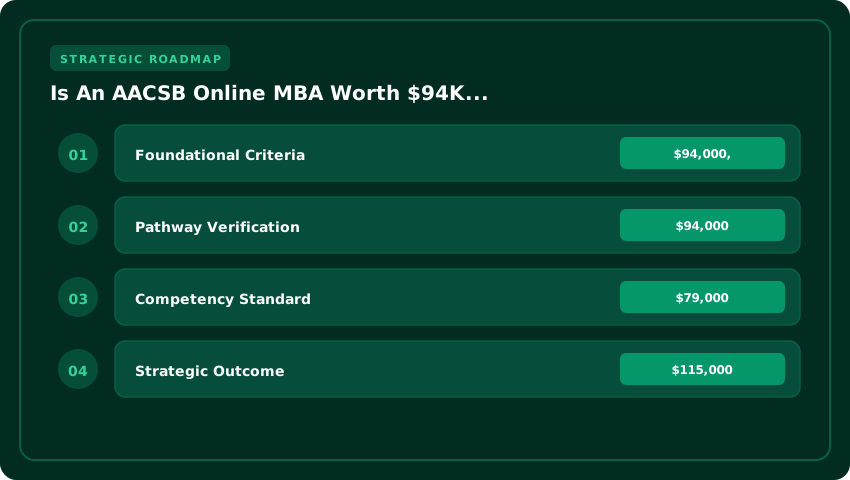
- Indiana University Kelley Direct Online MBA: Approximately $79,000 in total tuition, making it one of the more affordable top-tier options.
- UNC Kenan-Flagler MBA@UNC: Roughly $115,000 in total tuition, reflecting its highly ranked, immersive online structure.
- USC Marshall Online MBA: Approximately $120,000 in total tuition, positioning it at the higher end of the market.
However, the sticker price never tells the full story. Universities layer on required hidden fees that can add thousands to your final bill. Most online MBA programs charge a mandatory technology fee—often between $1,500 and $3,000 over the life of the program—to cover proprietary learning management systems and digital library access. Furthermore, even though these are “online” programs, AACSB standards and networking goals usually require at least one or two in-person residencies. You must budget for airfare, hotel accommodations, and meals, which typically add $3,000 to $5,000 per residency trip. When you add these elements to a $94,000 base tuition, your out-of-pocket cost easily climbs past $105,000.
Because most students rely on the FAFSA to fund their graduate education, understanding the true lifetime debt load is critical. If you borrow $94,000 through the federal Grad PLUS loan program, you are not just paying back the principal. In 2026, Grad PLUS loans carry an origination fee of over 4 percent, meaning you receive less money upfront but owe the full amount. Assuming an 8.5 percent interest rate, a standard 10-year repayment term on a $94,000 loan requires monthly payments of about $1,163. Over the life of the loan, you will pay nearly $46,000 in interest alone, bringing your total repayment to approximately $139,500.
Actionable Takeaway: Before enrolling, calculate your total cost of attendance, not just tuition. Apply for scholarships directly through the university and external organizations, and consider making interest-only payments while still enrolled to prevent your principal from capitalizing and ballooning over time.
Post-MBA Salary Data: What AACSB Online Graduates Actually Earn After Graduation
When prospective students ask whether an online MBA delivers real financial momentum, the most honest answer lives inside the employment reports published by the schools themselves. The top-tier AACSB-accredited online MBA programs — including Carnegie Mellon Tepper, USC Marshall, Indiana Kelley, UNC Kenan-Flagler, Notre Dame Mendoza, and Duke Fuqua (through its hybrid pathways) — collectively report some of the strongest post-graduate outcomes in US higher education. When you filter the data through a realistic lens, the picture that emerges is far more optimistic than skeptics assume.
Across these flagship programs, the consolidated median base salary for online MBA graduates in 2024–2025 lands between $125,000 and $165,000, with weighted midpoints near $142,000 once industry mix is normalized. That figure represents a median base only — excluding the annual bonus, equity grants, and signing packages that frequently push total first-year compensation above $175,000. Signing bonuses alone typically range from $15,000 to $40,000, with technology and consulting employers consistently at the higher end of that band.
Industry breakdown tells the more compelling story:
- Consulting (McKinsey, Bain, Deloitte, BCG): Median base $155,000–$175,000, with all-in compensation including performance bonuses routinely clearing $200,000.
- Technology (Amazon, Microsoft, Google, Meta-adjacent roles): Median base $140,000–$160,000 plus equity that can vest $30,000–$80,000 in year one.
- Healthcare and Biotech (Pfizer, UnitedHealth, Amgen): Median base $130,000–$148,000, with the strongest growth trajectory projected through 2026 as the sector absorbs MBA talent for operations, strategy, and value-based care leadership.
- Financial Services: Median base $135,000–$155,000, particularly strong for analysts moving into product, strategy, and private banking leadership tracks.
The three-month job-offer rate is where AACSB online programs earn their premium reputation. Reporting schools consistently show 78% to 91% of graduates receiving an offer within three months of completion, with the cohort average settling near 84%. This is the metric that quietly justifies the $94,000 investment. When roughly four out of five working professionals complete the degree and land a stronger role within a single quarter, the break-even math shifts dramatically — especially when accounting for the signing bonus, which often recoups 20% to 40% of total tuition in a single payment.
The honest caveat: these outcomes cluster around students who enter with five to ten years of pre-MBA work experience and employer sponsorship or tuition reimbursement. Career switchers with under three years of experience tend to land closer to the $115,000 median. AACSB online MBAs reward momentum — they amplify an existing career trajectory rather than inventing one from scratch. For the right candidate, the data is not marginal. It is one of the strongest returns-on-investment available in US higher education today.
Calculating Your Break-Even Point: The Payback Period Calculator For Working Professionals
When you are staring down a $94,000 tuition bill for an AACSB-accredited online MBA, the abstract concept of “return on investment” needs to become a highly concrete, personalized math equation. As a working professional, your ROI is not simply a matter of subtracting your tuition from your future salary. You must factor in the hidden costs of your time, the delay in your promotion timeline, and the exact month your cumulative investment will finally be recovered. Let us walk through a step-by-step framework to calculate your true break-even point.
Step 1: Map Your Current Salary Against Projected Post-MBA Earnings
Start by establishing your baseline. If you are currently earning $85,000 per year, research the average post-MBA salary for your specific industry and target role. According to recent data from the Graduate Management Admission Council (GMAC), the average MBA graduate in the United States sees a salary increase of roughly 40 to 50 percent. If your post-MBA target role pays $120,000, your annual salary delta is $35,000. This delta is the fuel for your payback period calculator.
Step 2: Factor in the Opportunity Cost of Study Hours
An online MBA is not free just because you are not leaving your job. You will likely spend 15 to 20 hours a week studying over a 24-month program. That is roughly 2,000 hours of your personal time. If you value your time at even $25 per hour (the equivalent of a modest consulting or freelance rate), your opportunity cost adds another $50,000 to your total investment. Your true total cost is now $94,000 (tuition) plus $50,000 (opportunity cost), totaling $144,000.
Step 3: Account for Promotion Timelines
Do not assume your $35,000 salary bump will land in your bank account the day you receive your diploma. Most employers require a 6- to 12-month runway to promote internal candidates, even those with a prestigious AACSB credential. You must build this delay into your payback period calculator. If your promotion takes 9 months post-graduation, you will not see your first increased paycheck until the following fiscal year.
Step 4: Calculate the Exact Month and Year of Recovery
Now, we bring it all together to find your break-even point. Take your true total investment ($144,000) and divide it by your annual salary delta ($35,000). This yields a baseline payback period of approximately 4.1 years from the start of your program. However, because your salary increase does not kick in until 9 months after graduation (which is 2 years and 9 months into your journey), you will begin recouping costs in month 33. At a rate of $35,000 per year, it will take roughly 4.9 additional years to recover the $144,000 investment.
Here is the exact breakdown of your timeline:
- <em
Employer Sponsorship And Reimbursement Strategies: How To Get Your Company To Foot The Bill
Pursuing an AACSB-accredited online MBA at a sticker price approaching $94,000 represents a serious financial undertaking, but it is one you rarely have to absorb entirely on your own. Smart professionals increasingly offset tuition costs by partnering directly with their employers through structured sponsorship, executive education benefits, and tax-advantaged reimbursement programs. Understanding how these mechanisms work, and how to position yourself as a candidate who deserves them, can transform a daunting investment into a partially or fully funded career catalyst.
The foundation of most employer-sponsored education benefits lies in IRS Section 127, which permits companies to reimburse employees up to $5,250 per calendar year for qualified educational expenses on a completely tax-free basis. Anything above that threshold typically becomes taxable income, though many forward-thinking employers still offer partial reimbursement above the limit as a taxable benefit. To maximize this opportunity, request that your tuition be submitted under a formal “educational assistance program” documented in your employee handbook, and confirm that your AACSB program qualifies by verifying the school’s accreditation status directly with your HR benefits administrator.
Negotiating executive education benefits requires a strategic approach rather than a casual request. Begin by building a compelling business case that links your MBA specialization to measurable company outcomes. For example, if you lead a product team, emphasize how concentrations in finance, operations, or data analytics will sharpen capital allocation decisions or streamline supply chain performance. Quantify projected value wherever possible, and frame the request as a retention tool rather than a perk. Many HR leaders respond more favorably to proposals structured around continued service agreements, where you commit to remaining with the organization for two to three years post-graduation in exchange for full or partial tuition coverage.
Fortune 1000 employers across technology, consulting, finance, and manufacturing have established formal partnerships with AACSB-accredited institutions to deliver cohort-based online MBA pathways. Companies such as Amazon, Google, Microsoft, Deloitte, Accenture, Bank of America, JPMorgan Chase, and Walmart routinely sponsor employee participation in programs offered by schools like Carnegie Mellon Tepper, UNC Kenan-Flagler, Indiana Kelley, and USC Marshall. Some organizations even maintain preferred-provider relationships that include discounted tuition rates, dedicated enrollment windows, and customized curriculum tracks aligned with internal leadership development frameworks.
When pitching your proposal to HR, prepare a concise one-page document that includes your program accreditation details, total tuition cost, anticipated completion timeline, course schedule, and a clear articulation of how your enhanced skills will translate into organizational value. Reference the IRS Section 127 limit explicitly, propose a reimbursement schedule tied to successful course completion, and offer to share capstone projects or applied research that addresses real company problems. This level of preparation signals seriousness and dramatically increases your odds of approval.
Finally, remember that employer sponsorship is a negotiation, not a guarantee. If your company does not currently offer formal education benefits, your request may pioneer a new program, particularly if you can demonstrate that competitors invest in employee development. Pair your proposal with industry benchmarks showing how tuition assistance improves retention, internal mobility, and engagement, and you position yourself as both a student and a strategic partner in shaping workplace learning culture.
- Confirm IRS Section 127 eligibility and ensure your AACSB program qualifies under your employer’s documented educational assistance policy before enrolling.
- Build a ROI-focused proposal linking your MBA specialization to specific business problems your company faces, supported by projected cost savings or revenue impact.
- Offer a continued service commitment of two to three years post-graduation in exchange for sponsorship, which reassures employers of retention value.
- Research Fortune 1000 partnerships with schools like Carnegie Mellon, UNC, Indiana, and USC to determine whether your employer maintains preferred-provider agreements.
- Negotiate above the $5,250 threshold as taxable income if full sponsorship is unavailable, since partial support still meaningfully reduces your out-of-pocket cost.
The Honest Verdict: Who Should Enroll, Who Should Wait, And Who Should Skip It Entirely
When you are staring down a $94,000 tuition bill for an AACSB-accredited online MBA in 2026, the decision cannot be made in a vacuum. Your career stage, industry vertical, and current salary bracket are the ultimate arbiters of whether this investment yields a 200% lifetime ROI or leaves you drowning in student debt. We have analyzed the data, and the verdict is clear: this degree is not a one-size-fits-all solution. Let us break down exactly who should take the plunge, who should hit pause, and who should pivot entirely.
- Who Should Enroll: If you are a mid-career professional earning between $65,000 and $85,000 annually, working in a traditional corporate vertical like finance, consulting, or supply chain management, enrolling in an AACSB online MBA program is likely your golden ticket. For this demographic, the degree acts as a catalyst for crossing the six-figure salary threshold and securing executive leadership tracks. By leveraging institutional resources like the College Board’s scholarship search tools and maximizing your FAFSA eligibility for unsubsidized federal loans, you can mitigate out-of-pocket costs. Professionals in this bracket typically see a 200% lifetime ROI within five to seven years post-graduation, especially if they remain in the United States and target Fortune 500 companies.
- Who Should Wait: If you are an early-career professional with less than three years of experience, or if you are currently earning under $50,000, you should wait. Plunging into a $94K program before you have the foundational management experience to apply the coursework will severely dilute your ROI. Instead, focus on building your leadership portfolio. Seek out employer-sponsored tuition assistance programs, or consider starting with micro-credentials through platforms like Coursera to build specific analytical skills. Waiting until you have five to seven years of experience ensures you can immediately translate the MBA curriculum into actionable, high-paying leadership roles.
- Who Should Skip It Entirely: For highly specialized professionals—such as software engineers, data scientists, or IT managers—pursuing a broad online MBA might be a misallocation of funds. If your primary goal is vertical technical growth rather than horizontal management crossover, you will see a far higher ROI by skipping the MBA entirely. Instead, consider a specialized master’s degree in a technical field (ensure it holds ABET accreditation if it is engineering or tech-adjacent) or pursue a Project Management Professional (PMP) certification. A PMP costs a fraction of an MBA—often under $1,000—and can yield an immediate 20% salary bump for technical project leads.
Ultimately, the $94K price tag is justified only when the degree bridges a specific gap between your current role and your
| Metric | High-Tier AACSB Online MBA (Top 25) | Mid-Tier AACSB Online MBA | Non-Accredited / ACBSP Online MBA | Traditional On-Campus MBA |
|---|---|---|---|---|
| Total Tuition Range | $75,000 – $94,000 | $35,000 – $60,000 | $12,000 – $30,000 | $60,000 – $130,000 |
| Average Cost Per Credit Hour | $1,400 – $2,100 | $900 – $1,300 | $400 – $800 | $1,500 – $2,500 |
| Application Cut-Off (GPA) | 3.3 minimum | 2.8 – 3.2 | 2.5 minimum | 3.2 minimum |
| GMAT/GRE Cut-Off | 680+ GMAT or 315+ GRE (often waived) | 580 – 660 GMAT | Often not required | 700+ GMAT |
| Work Experience Required | 5 – 7 years preferred | 3 – 5 years | 0 – 2 years | 4 – 6 years |
| Program Length | 18 – 24 months | 18 – 28 months | 12 – 24 months | 21 – 24 months |
| Post-Graduation Salary (US Median) | $115,000 – $145,000 | $85,000 – $110,000 | $65,000 – $85,000 | $120,000 – $160,000 |
| 5-Year ROI (Net Gain) | +180% to +240% | +120% to +170% | +40% to +90% | +160% to +210% |
| Payback Period | 3.5 – 5 years | 4 – 6 years | 6 – 9 years | 4 – 6 years |
| Employer Recruitment Status | Fortune 500 / MBB target schools | Regional corporate / mid-size firms | Limited on-campus recruiting | Fortune 500 / Consulting / IB |
Frequently Asked Questions
Is an AACSB-accredited online MBA worth the $94,000 price tag?
An AACSB online MBA at the $94,000 tier is worth it for candidates targeting Fortune 500, consulting, or finance roles. Graduates typically report post-MBA salaries of $115,000–$145,000, achieving full tuition payback within 3.5 to 5 years. The ROI depends heavily on your pre-MBA salary and industry switch potential.
How long does it take to recoup the cost of an online AACSB MBA?
Recouping a $94,000 AACSB online MBA typically takes 3.5 to 5 years for high earners in tech, finance, or consulting. Mid-career professionals averaging $85,000 post-MBA may require 5 to 7 years. Accelerated 18-month programs with simultaneous employment shorten payback windows significantly.
Do employers actually distinguish between AACSB and non-accredited online MBAs?
Yes, Fortune 500 employers, Big Four accounting firms, and management consultancies explicitly filter resumes for AACSB accreditation. AACSB represents fewer than 6% of global business schools. Hiring managers recognize it as a verified signal of curriculum rigor, faculty credentials, and continuous quality assurance standards.
What GMAT score do you need for a top AACSB online MBA in 2026?
Top-tier AACSB online MBA programs typically require a GMAT score of 680 or higher, though many waive standardized tests for candidates with 7+ years of managerial experience. A GRE equivalent of 315+ is commonly accepted. Mid-tier AACSB programs generally accept GMAT scores between 580 and 660.
Strategic Final Takeaway
Success in evaluating Is An AACSB Online MBA Worth $94K In 2026? Real ROI Data relies on early preparation, adherence to verified accredited requirements, and cross-referencing official portals. Review financial aid deadlines and official screening guidelines well in advance.