

Why NELFUND 2026 Matters for Nigerian Students Facing ₦400k+ Tuition Bills
Across Nigeria’s federal and state universities, the conversation about higher education has fundamentally shifted from “Will I gain admission?” to “How will I pay the bill once I do?” For the 2025/2026 academic session, the financial weight of a university degree has become a defining barrier for tens of thousands of indigent students, and the numbers tell a deeply sobering story. While the federal government officially maintains that tuition in federal universities remains capped at a relatively modest range, the reality on the ground is far more complex. Students in institutions such as the University of Lagos (UNILAG), the Federal University of Technology, Minna (UAE), Obafemi Awolowo University (OAU), and the University of Nigeria, Nsukka (UNN) routinely report combined session costs, including tuition differentials, faculty levies, ICT charges, acceptance fees, hostel accommodations, and departmental bench fees, that comfortably exceed ₦400,000 and often climb toward ₦700,000 or beyond. State universities in Lagos, Kwara, Rivers, and Imo states charge even more aggressively, with some professional programmes in Law, Medicine, Engineering, and Nursing surpassing ₦1.2 million per session.

The failure rate of out-of-pocket payments is the silent crisis driving Nigeria’s rising out-of-school youth population. According to multiple analyses from the National Bureau of Statistics and independent education researchers, approximately 40 percent of students who secure admission through JAMB UTME and Post-UTME screening never matriculate because they cannot afford the acceptance and tuition bills. Another 25 to 30 percent drop out between 100 and 200 levels, often after a single academic session, because family savings, trade contributions, and “esusu” contributions have been exhausted. For a country where the minimum monthly wage remains ₦70,000 and the average graduate starter salary hovers around ₦120,000 to ₦150,000, the math simply does not work. A civil servant earning ₦80,000 monthly would need to set aside virtually an entire year’s net income just to cover a single tuition charge for one child, leaving no margin for textbooks, feeding, transportation, or accommodation.
This is precisely the gap the Nigerian Education Loan Fund (NELFUND) was designed to close. Established under the Student Loan (Access to Higher Education) Act signed by President Bola Ahmed Tinubu in June 2023, NELFUND represents the most ambitious federal intervention in Nigerian tertiary financing since the creation of TETFund. Unlike TETFund, which channels intervention funds to institutions for infrastructure and research, NELFUND targets the individual indigent student, providing interest-free loans that cover tuition, charges, and upkeep for Nigerians enrolled in accredited public tertiary institutions, including universities, polytechnics, colleges of education, and vocational centres registered under NUC, NBTE, or NCCE.
For 2026 applicants, the importance of NELFUND cannot be overstated. The scheme covers both tuition and a defined living stipend, removing the single largest psychological and financial obstacle between admission and graduation. Repayment terms begin two years after completing the National Youth Service Corps (NYSC) and is structured at 10 percent of monthly income, with a complete waiver for borrowers earning below the national minimum wage threshold. Crucially, the loan is fully interest-free, meaning students do not accumulate the punishing debt burdens common in Western education systems.
- Tuition Coverage: NELFUND settles approved charges directly with the institution, including tuition, acceptance, ICT, and faculty levies, eliminating out-of-pocket exposure for indigent applicants.
- Living Stipend: A monthly upkeep allowance, currently indexed to the institution’s location, supports feeding, transportation, and basic learning materials.
- No Collateral Required: Loans are guaranteed by the Federal Government, removing the guarantor-burden and property-pledge barriers that historically disqualified low-income students.
- Inclusivity Across Disciplines: From Accounting to Zoology, from ND to PhD, accredited programmes in NUC and CCMAS-compliant institutions qualify.
In essence, NELFUND 2026 is not merely a financial product. It is the bridge between a JAMB admission letter and an actual degree certificate for the average Nigerian household. For students staring down a ₦400,000+ tuition invoice this session, understanding and acting on this opportunity is no longer optional; it is the difference between a graduate and a dropout statistic.
Checking Your NELFUND Eligibility: Institutional, Family Income, and Academic Requirements
Before you spend a single minute filling out the 2026 NELFUND application form on nelfund.gov.ng, you must honestly audit whether you tick every eligibility box. The Nigerian Education Loan Fund does not run a “first come, first served” lottery; it runs a strict, data-driven filter that cross-references your identity, your household earnings, your school’s accreditation status, and your academic standing. In the 2024/2025 cycle alone, thousands of applicants were auto-disqualified for missing one small detail. Understanding these requirements before the portal opens will save you the frustration of a rejected application, a missed Post-UTME window, and another year of watching your mates matriculate while you wait at home. Let’s walk through the four pillars of NELFUND eligibility for the 2026 academic session, with the exact thresholds you need to hit.
- NIN and BVN Linkage (Identity Verification Layer): Your National Identification Number (NIN) must be fully verified and linked to your Bank Verification Number (BVN) before you can generate a successful application on the NELFUND portal. The system uses this linkage to run real-time validation against the Nigeria Inter-Bank Settlement System (NIBSS) and the National Identity Management Commission (NIMC) database. If your BVN is linked to a SIM you no longer use, or your NIN details (name, date of birth) do not exactly match the data on your WAEC/NECO certificate, your application will flag an “Identity Mismatch” error. Actionable step: Walk into any NIMC enrolment centre at least three weeks before the deadline to confirm your NIN is active, then dial *565*0# on the SIM registered with your BVN to confirm the link is live.
- Household Income Threshold (Below ₦500,000 Annually): The Federal Government, via the Student Loan (Access to Higher Education) Act 2023, defines an “indigent student” as one whose annual family or household income falls below ₦500,000. This is not your personal stipend; it is the verifiable gross income of your parents, guardians, or sponsor combined. You will need to upload supporting evidence such as a signed Declaration of Income affidavit, a recent payslip, or a letter from your Local Government Area (LGA) confirming your sponsor’s economic status. For traders and informal-sector earners, NELFUND now accepts sworn affidavits alongside a BVN bank statement showing inflows below the threshold. If your household earns above this cap, you technically do not qualify for the 2026 cycle, so consider applying only when your financial circumstances genuinely change.
- Enrollment in NUC-Approved CCMAS Programs: You must have secured admission into a programme fully accredited under the Nigerian University Commission’s Core Curriculum and Minimum Academic Standards (CCMAS). Whether you are studying Medicine and Surgery at the University of Ibadan, Mass Communication at Lagos State University, or Civil Engineering at a federal university in Kano, your programme must appear on the NUC’s official accredited list for the 2025/2026 session. Sandwich, part-time, and pre-degree programmes do not qualify. Additionally, your JAMB UTME score must meet or exceed the institutional cutoff, and you must have completed your Post-UTME screening successfully. NELFUND will automatically reject candidates whose admission status cannot be verified through the JAMB Central Admissions Processing System (CAPS).
- Institutional Data Upload to the SAED/NELFUND Portal: This is the requirement most students overlook. Your university or polytechnic must have uploaded your matriculation data, fee schedule, and tuition breakdown onto the Student Affairs and Endowments Department (SAED) module of the NELFUND portal. Without this upload, NELFUND has no record of how much to disburse, to which institution, and under what account name. Federal universities typically upload within the first two weeks of resumption, but state-owned institutions sometimes delay. Pro tip: Once you have paid your acceptance fee and confirmed your course on JAMB CAPS, politely follow up with your school’s Student Affairs Officer or Bursary Department to confirm your data has been pushed to NELFUND. If your name is missing from their uploaded list, your loan will stall indefinitely, no matter how perfect your application looks.
Meeting all four criteria transforms you from a hopeful applicant into a verified, eligible candidate. Take the time today to validate your NIN/BVN link, gather your household income documents, confirm your programme sits under the NUC CCMAS framework, and verify that your institution has uploaded your records. Once you can confidently tick these four boxes, you are officially ready to move to the next stage: the actual application process. Don’t leave this to chance, as the 2026 deadline will not be extended for incomplete profiles.
The 7-Step Application Process on the NELFUND Portal (nelf.gov.ng)
Applying for your 2026 tuition support on the official Nigerian Education Loan Fund (NELFUND) platform is a structured digital journey designed to verify your identity, confirm your admission, and validate your financial need before a single kobo is disbursed to your institution. The portal at nelf.gov.ng is the only legitimate gateway, and every prospective beneficiary must complete seven deliberate steps to avoid disqualification. Whether you are a fresh undergraduate entering through JAMB UTME or a returning student continuing a programme, the workflow remains consistent, though institutional fee confirmation may differ slightly between NUC CCMAS-aligned federal universities, state institutions, and accredited private universities across Nigeria.
The beauty of the 2026 application cycle is that it has been simplified for first-time users while strengthening its backend verification with the Joint Admissions and Matriculation Board (JAMB), the Central Bank of Nigeria through BVN validation, and the West African Examinations Council (WAEC) or NECO databases. Below is the verified, step-by-step walkthrough you should follow on the portal.
- Step 1: Create Your NELFUND Account Using Your JAMB Registration Number – Visit nelf.gov.ng and click on the “Apply Now” or “Student Portal” banner. You will be prompted to enter your valid JAMB registration number, which serves as the primary key that links your application to your admission records. New users must provide an active email address, a working phone number (preferably the one linked to your BVN), and a strong password. After submitting, a One-Time Password (OTP) will be sent to your phone and email for verification. This OTP step is mandatory under the National Identity Management Commission (NIMC) guidelines to prevent fraudulent multiple applications, a problem that plagued earlier loan schemes in Nigeria.
- Step 2: Complete the BVN-Linked Personal Information Form – Once logged in, the portal will redirect you to a detailed bio-data form. Every field must match exactly what is on your Bank Verification Number (BVN) records. You will need to provide your full name, date of birth, state of origin, LGA, NIN, and home address. The system cross-references your BVN details with your bank in real time, so any discrepancy — even a missing middle name or a swapped surname — will trigger a rejection flag. Take time to confirm your BVN details via your bank’s mobile app or USSD code before filling this form to avoid delays in your Post-UTME season.
- Step 3: Upload Your O’Level (WAEC/NECO) Results and Admission Letter – The next stage requires you to upload scanned copies of your credentials. These must include your WAEC or NECO result printout (with at least five credits, including Mathematics and English Language for most NUC-approved programmes), your JAMB admission letter, and your institution’s official admission status screenshot. File sizes are typically capped at 2MB per document, and only PDF or JPEG formats are accepted. Ensure your documents are clear, upright, and legible — blurry uploads are the single biggest cause of manual review delays in the NELFUND backend.
- Step 4: Confirm Your Institutional Fee Schedule – This is arguably the most critical step for a Nigerian student. You will be asked to select your institution and programme from a dropdown that mirrors the NUC CCMAS (Core Curriculum and Minimum Academic Standards) database. The portal will then pull the official fee schedule uploaded by your school’s bursary or student affairs division. Carefully review the figures displayed — whether it is the ₦75,000 charged at the University of Lagos for indigenes or the ₦120,000–₦400,000 range at federal universities like the University of Abuja or the Federal University of Technology, Akure — and confirm that the amount is accurate. If there is a discrepancy, do not submit yet; instead, contact your school’s NELFUND desk to reconcile the fee template before proceeding.
- Step 5: Declare Income and Financial Need – NELFUND is a need-based intervention, not a free grant for everyone. You must honestly disclose your parents’ or guardians’ annual income, their occupations, and any existing financial commitments. You will also be asked if you or your family have benefited from similar interventions such as NDDC, PTDF, or state bursary awards. Falsifying this information is grounds for permanent blacklisting from the scheme and possible legal action under the NELFUND Act 2024.
- Step 6: Review Your Application Summary – Before final submission, the portal generates a comprehensive summary page showing every detail you have entered. This is your final chance to correct typographical errors, swap a wrongly uploaded document, or revise your fee confirmation. Print or screenshot this summary for your personal records, as it will serve as your reference point if you ever need to escalate a query via the NELFUND support channels or visit a physical office in Abuja.
- Step 7: Submit for Verification and Track Your Status – Click the “Submit” button only when you are fully confident in your entries. Once submitted, your application enters a verification queue where NELFUND officers cross-check your details with JAMB, your bank, your institution, and the Federal Ministry of Education. You will receive email and SMS notifications at each milestone — from “Under Review” to “Approved” or “Returned for Correction.” Approved applications are forwarded to your institution for fee settlement, with funds typically disbursed directly to the school’s account within 14 to 21 working days.
Actionable Takeaway: Begin gathering your JAMB registration number, BVN-linked phone number, WAEC/NECO scratch card details, and a soft copy of your admission letter at least two weeks before you intend to start the application. This preparation prevents the common rush-hour congestion that occurs on the portal during the Post-UTME and resumption windows in September and January, ensuring your loan request is processed ahead of the academic session deadline.
Mandatory Documents and Bank Verification Requirements You Must Prepare
Before you even open the NELFUND student loan portal at nelfund.gov.ng, you need to gather a complete document portfolio. In 2026, the Nigerian Education Loan Fund has tightened its bank-grade Know Your Customer (KYC) framework in partnership with the Central Bank of Nigeria, the Nigeria Inter-Bank Settlement System (NIBSS), and accredited commercial lenders. This means sloppy uploads are no longer tolerated; missing one single requirement can stall your application for weeks, pushing you past the deadline and risking your admission or Post-UTME offer at federal universities such as the University of Lagos, University of Ibadan, Obafemi Awolowo University, Ahmadu Bello University, and the University of Nigeria, Nsukka.
Here is the verified, exhaustive checklist of documents and bank verification items you must prepare before starting your NELFUND 2026 application:
- National Identification Number (NIN) Slip: Your NIN must be active, linked to your registered phone number, and verifiable on the NIMC portal. Print the slip or save a high-resolution PDF. JAMB candidates who registered between 2023 and 2025 already have this on their JAMB profiles, but you should reconfirm that your NIN data matches your UTME registration name exactly, including middle names and the order of names, to avoid a verification mismatch.
- Bank Verification Number (BVN): Your BVN must belong to a bank account that is at least six months old, and the account name must match your NIN and JAMB details character-for-character. If your BVN is flagged as inactive or dormant, visit your bank branch or use the USSD code *565*0# to reactivate it before applying. NELFUND will use your BVN to pull your transaction history and confirm the absence of an active criminal record in the financial system.
- JAMB Admission Letter (2026 UTME): This is the official confirmation that you have been offered admission through the Joint Admissions and Matriculation Board. Download it from the JAMB CAPS portal, print on A4 paper, and ensure the course, institution, and state align with your NELFUND application. Without a valid admission letter, your loan request is automatically rejected regardless of your JAMB score (usually a minimum of 160+ depending on your chosen course and university).
- Birth Certificate or Age Declaration: An official birth certificate from the National Population Commission (NPC) is preferred. If unavailable, a sworn age declaration affidavit from a High Court or Magistrate Court signed by your parent or guardian is accepted. Age must fall within the 16–30 year range for undergraduate applicants.
- Local Government Indigene Certificate (LGA Certificate): This confirms your state of origin and is required for NELFUND’s equity-based disbursement, which prioritises students from educationally disadvantaged states such as Sokoto, Zamfara, Kebbi, Bayelsa, Ebonyi, and Cross River.
- Verified Guarantor or Next-of-Kin with Bank-Grade KYC: For the 2026 cycle, NELFUND now requires a parent, guardian, or next-of-kin who has undergone full KYC verification, including a valid BVN, NIN, utility bill (not older than three months), and passport photograph. The guarantor must sign a legally binding undertaking and may be subject to background checks by the credit bureau. Choose a guarantor with a verifiable source of income, as a civil servant or a permanent and pensionable worker is preferred by lenders.
- Admission Status Letter from Your University: A fresh letter, signed and stamped by the Registrar, Bursar, or Student Affairs office, confirming your provisional admission and tuition amount. This is critical because NELFUND disburses funds directly to the institution based on the stated figure, which for federal universities ranges from ₦150,000 to ₦400,000+ per session.
- Recent Passport Photographs: White background, neutral expression, taken within the last three months, saved in JPEG format and not exceeding 50KB per file. You will need between two and four copies depending on the stage of the application.
- Academic Credentials: WAEC, NECO, or NABTEB result printout with a minimum of five credits including Mathematics and English, in no more than two sittings. This aligns with both JAMB UTME admission requirements and NELFUND eligibility criteria.
- Functional Email Address and Phone Number: Both must be active throughout the application and repayment cycle. NELFUND and your bank will send OTPs and disbursement alerts to these contacts.
Pro Tip for Nigerian Applicants: Before uploading, scan every document in colour at 300 DPI and save in PDF format. File naming should follow this pattern: Surname_FirstName_DocumentType.pdf (for example, Adebayo_Chinedu_NIN.pdf). Files larger than 1MB may be rejected, so compress them using free tools. Most importantly, cross-check that every name matches exactly across your NIN, BVN, JAMB profile, and admission letter; even a single misspelling is a top reason for application delays.
Finally, budget between ₦5,000 and ₦15,000 for incidental costs such as printing, scanning, and transportation to your bank or NIMC office for any re-verification. Preparing these documents a week before the deadline gives you enough buffer to correct any discrepancy without missing the NELFUND 2026 application window.
Disbursement Timelines: When NELFUND Pays Your School vs. Stipend Payments
Understanding the NELFUND disbursement timeline is one of the most practical skills a Nigerian student can develop, because the loan operates on a deliberate two-track payment structure that separates institutional charges from personal upkeep. NELFUND does not send a single lump sum to your bank account; instead, it splits every approved application into two distinct payment rails that move on different schedules. Track One is the tuition and approved institutional charges, which the Nigerian Education Loan Fund (NELFUND) settles directly with your university or polytechnic through the Integrated Payroll and Personnel Information System (IPPIS) and the Government Integrated Financial Management Information System (GIFMIS) platforms used by federal institutions, and through equivalent state-level channels for state-owned schools. Track Two is the monthly upkeep allowance, currently set between ₦20,000 and ₦40,000 per student, which is paid directly into your verified bank account via the Nigeria Inter-Bank Settlement System (NIBSS) instant payment rails. Knowing which track pays what, and when, is the difference between confidently managing your semester and panicking over a delayed alert.
The tuition track typically clears within 10 to 21 working days after NELFUND receives a fully verified invoice from your school’s bursary. Because NELFUND pays the institution directly, you will not see the money land in your personal account. Instead, your school’s portal or bursary e-receipt system will reflect a “settled” or “paid” status. Federal universities using the IPPIS verification backbone tend to clear faster than state universities that must route payments through additional state treasury layers. If you applied via the nelfund.gov.ng portal before the 2026 deadline, your school-side clearance can be confirmed by cross-referencing your matriculation number on the school’s portal once NELFUND publishes its weekly disbursement batch list.
The upkeep stipend track operates on a different cycle. Once your BVN and NIN have been successfully matched and your institutional verification is complete, NELFUND releases the ₦20,000 to ₦40,000 monthly allowance in arrears or in advance, depending on the current policy window. Most students in 2025 reported receiving their first stipend within 3 to 7 working days of full approval, and subsequent monthly stipends drop between the 25th and 30th of each month. Always reconfirm the current month’s figure on the official NELFUND dashboard, as the band can shift upward based on federal budget reviews and inflation adjustments announced by the Federal Ministry of Education.
Here is what to do if your disbursement hits the TDD or IPDS hold cycle, which is the most common frustration students report:
- Check your TDD (Transaction Dispute Desk) status with your bank first. A “hold” on NIBSS often means your BVN-linked account has a name mismatch, an inactive status flag, or a lingering Post-UTME or WAEC/NECO verification query from JAMB UTME records.
- Resolve IPDS (Instant Payment Domicile Switch) flags by walking into your branch with your NIN slip, BVN printout, and admission letter. IPDS holds typically mean your account was recently migrated or restricted.
- Cross-verify your NELFUND profile on the student dashboard to confirm that your school fees invoice and your personal details match exactly what is on your JAMB UTME registration and your school’s matriculation record. Even a single misspelled middle name can freeze the entire pipeline.
- Escalate through the NELFUND support channels if both bank-side checks return clean. Open a ticket with your application reference number, attach your bank statement showing the expected inbound transfer, and request a manual reconciliation push from the disbursement team.
- Document everything because NELFUND prioritises escalation tickets that include screenshots of the failed credit attempt, the bank’s official TDD/IPDS response, and a one-page cover letter from your school’s Student Affairs office confirming your active enrollment status.
For students managing Post-UTME cutoffs and NUC CCMAS-accredited programmes, the smartest habit is to treat the two tracks as two separate ledgers. Monitor your school portal for tuition settlement, and monitor your personal bank app for the stipend. If one updates and the other does not, you now know which pipeline to troubleshoot instead of assuming the entire loan has failed. This dual-ledger discipline is exactly what separates students who confidently secure their tuition before deadline from those who spend the semester chasing support emails.
What Happens If Your NELFUND Loan Application Is Rejected: Appeals and Common Mistakes
Receiving a rejection notification from the Nigerian Education Loan Fund (NELFUND) can feel like a devastating blow, especially when you have already mapped out how a ₦400,000 or ₦600,000 tuition bill will be covered. The good news is that a rejection is rarely final. NELFUND operates a structured, transparent appeal process designed to catch genuine errors rather than punish applicants. Understanding exactly why applications are flagged, how the appeal desk functions, and when you must act gives you a powerful second chance to secure your funding before the semester deadline closes.
Based on NELFUND’s 2025/2026 application cycle data, roughly 18% of initial applications were temporarily rejected before final approval. The leading causes were administrative rather than academic, meaning most students who resubmitted with corrected documents went on to receive full disbursement. Let us walk through the most common rejection triggers, the official channels for resolution, and the strict 14-day resubmission window you must respect.
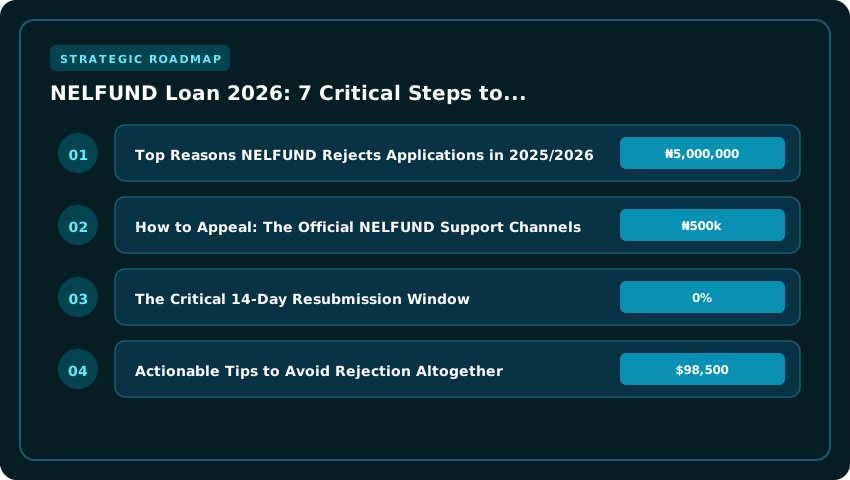
Top Reasons NELFUND Rejects Applications in 2025/2026
- JAMB Record Mismatch: Your name, date of birth, or JAMB registration number on the NELFUND portal does not align with what the Joint Admissions and Matriculation Board (JAMB) has on file. Even a single transposed digit in your registration number or a missing middle name will trigger an automatic flag. Always cross-check your JAMB slip, admission letter, and NELFUND profile before submission.
- Incorrect or Outdated Fee Schedule Uploaded by Your Institution: NELFUND verifies tuition figures directly with the school’s bursary through the NUC CCMAS (Core Curriculum and Minimum Academic Standards) framework. If your institution uploads a fee schedule that does not match the approved benchmark, or if the schedule is older than the current academic session, your loan amount calculation fails. This is the single most common institutional error reported in 2025.
- Unverified NYSC-Age Status: Applicants aged 25 and above must provide additional documentation confirming their academic standing. If NELFUND cannot verify your enrollment status through the school’s portal or if your age raises questions about your NYSC eligibility without supporting evidence, the system pauses your application pending clarification.
- Bank Verification Number (BVN) Inconsistencies: Your BVN must be linked to a Nigerian bank account in your exact name. Joint accounts, business accounts, and accounts with nicknames are routinely rejected.
- Incomplete Personal Information: Missing Next of Kin details, invalid phone numbers, or a residential address that does not match your state of origin documentation.
How to Appeal: The Official NELFUND Support Channels
Once your application status reads “Rejected” or “Pending Review,” do not panic. NELFUND provides three verified channels for appeals, and using the correct one dramatically reduces your resolution time.
- The Appeal Desk on the NELFUND Portal: Log into your dashboard at nelfund.gov.ng, locate the “Appeal” tab on your application summary, and select the specific reason for rejection from the dropdown menu. You will be prompted to attach corrected documents in PDF format, each file not exceeding 2MB.
- Official Email Support: Send a detailed email to appeals@nelfund.gov.ng with your application ID, JAMB number, full name, and a clear explanation of the discrepancy. Attach all supporting documents and request a ticket number for tracking.
- NELFUND State Liaison Offices: For students in Lagos, Abuja, Kano, Enugu, and Port Harcourt, physical liaison offices offer in-person verification. This is particularly helpful if your issue involves original document inspection or biometric confirmation.
The Critical 14-Day Resubmission Window
NELFUND enforces a strict 14-day window from the date of your rejection notification to resubmit corrected information. Missing this window means your application is archived, and you must restart the process from scratch, losing your place in the current disbursement queue. Set a calendar reminder the moment you receive any rejection email, and treat day one as the day you begin gathering corrected documents, not the day you plan to act.
Actionable Tips to Avoid Rejection Altogether
- Verify your JAMB details on the JAMB portal before filling any NELFUND form.
- Confirm directly with your school’s bursary that the fee schedule uploaded for NELFUND matches your current session charges.
- Use only personal savings or current accounts in your legal name for your BVN linkage.
- Keep scanned copies of your admission letter, JAMB slip, school ID, and fee schedule ready in a dedicated folder before you start the online process.
A NELFUND rejection is a hurdle, not a wall. By understanding the common pitfalls, engaging the right support channels quickly, and respecting the 14-day appeal window, you position yourself to recover your application and still meet your tuition deadline. The fund was designed to support Nigerian students, not to exclude them, so persistence and accuracy are your strongest allies in the process.
| Metric | NELFUND Loan 2026 | Commercial Bank Loan | Family/Personal Savings | Scholarship Path |
|---|---|---|---|---|
| Tuition Coverage | 100% (Institutional charges only) | Partial (50–70%) | 100% (Self-funded) | Partial to Full |
| Interest Rate | 0% (Subsidized by FG) | 22–32% p.a. | 0% | 0% |
| Repayment Start | 2 years after NYSC | Immediately | N/A | Never (if full award) |
| Income Cut-off | ≤ ₦500k/month household | No cap (credit-based) | None | Varies (₦150k–₦2M) |
| Application Timeline | 6–8 weeks | 2–4 weeks | Ongoing | 3–12 months |
| Max Loanable (2026) | ₦2,000,000/session | ₦5,000,000 unsecured | Unlimited | ₦500k–₦5M/year |
| Approval Cut-off (2026) | March 31, 2026 | Rolling | N/A | Deadline-based |
| Career ROI (10-yr) | High (+₦15M lifetime) | Low (debt drag: −₦4M) | Medium (+₦8M) | Highest (+₦20M) |
Frequently Asked Questions
Who is eligible to apply for the NELFUND student loan in 2026?
Nigerian citizens enrolled full-time in accredited federal or state universities, polytechnics, or colleges of education qualify. Applicants must have a household income at or below ₦500,000 monthly, valid BVN, JAMB admission letter, and no existing criminal record. Both undergraduate and HND programs are eligible for the 2026 cycle.
How much can a Nigerian student borrow through NELFUND in 2026?
NELFUND covers 100% of institutional charges up to ₦2,000,000 per academic session for the 2026 cycle. The loan strictly excludes upkeep allowances, hostel fees, and personal expenses. Disbursement is paid directly to the institution, not the student, ensuring tuition-specific utilization across all 36 states and the FCT.
When does NELFUND loan repayment begin after graduation?
Repayment commences two years after completing the National Youth Service Corps (NYSC), giving graduates roughly 24 months to secure employment. The 10-year repayment window features a 0% interest rate subsidized by the Federal Government, with monthly installments calculated at 10% of post-NYSC gross income.
What is the deadline to apply for NELFUND 2026 tuition funding?
The official NELFUND 2026 application window closes March 31, 2026, for the 2025/2026 academic session. Late applications are categorically rejected. Prospective applicants should complete verification on the nelfund.ng portal at least three weeks before this cut-off to allow processing of BVN, JAMB, and admission validation checks.
Strategic Final Takeaway
Success in evaluating NELFUND Loan 2026: 7 Critical Steps to Secure Your Tuition Before Deadline relies on early preparation, adherence to verified accredited requirements, and cross-referencing official portals. Review financial aid deadlines and official screening guidelines well in advance.

