The New Credit-for-Skills Economy: How Micro-Credentials Disrupt the Degree Pipeline
Walk into any manufacturing plant in Ohio, a hospital system in Texas, or a data center in Northern Virginia, and you will find hiring managers quietly rewriting their talent strategies. They are no longer asking whether a candidate checked the bachelor’s degree box on an application; they are asking whether the candidate can demonstrate a verifiable, role-ready competency. In 2026, that shift has matured into a full-blown economic realignment, one in which the welding certification earned at a community college, the AWS D1.1 credential, or the OSHA 30-Hour card can be transacted into college credit the same way an AP exam or a CLEP test has been for decades.
This is the era of the credit-for-skills economy, and it is being shaped by three converging forces. First, the American Council on Education (ACE) has dramatically expanded its Credit Recommendations database, formally evaluating more than 1,200 industry certifications and digital badges for college-level equivalency. Second, AACRAO, the association serving US registrars and admissions officers, has published a sweeping 2025 guidance document urging institutions to adopt standard operating procedures for accepting alternative credentials into degree audits. Third, platforms such as Credly, Parchment, and the newer WalletED ecosystem have become the trusted verification rails that allow a welding instructor in Tulsa to issue a badge that a university registrar in Michigan will actually accept.
The scale of the movement is striking. According to the Lumina Foundation’s 2025 State of Higher Education report, 46% of working-age adult learners in the United States now hold at least one non-degree credential, ranging from industry certifications to digital micro-credentials. That is roughly 72 million Americans who have invested time and tuition dollars into skills that historically stopped at the shop floor or the server rack. With the average cost of a community college welding program hovering around $4,800 and a bachelor’s degree still averaging $11,260 per year at public four-year institutions, the financial incentive to convert prior learning into credit has never been stronger.
- ACE Credit Recommendations: ACE now evaluates credentials across 38 competency domains, with welding, industrial maintenance, and additive manufacturing among the fastest-growing categories. A credential holder can download an official transcript through Credly or Parchment, and any ACE-member institution can apply the recommendation toward a degree audit, often satisfying 3 to 12 credit hours per certification.
- AACRAO’s Transfer Credit Framework: The 2025 AACRAO guidance recommends that registrars treat verified digital badges with the same rigor as traditional transcripts, including a review of the issuing body’s accreditation, assessment rigor, and learner outcomes data. This is a quiet but seismic policy shift that removes one of the biggest administrative barriers to credit acceptance.
- Verification Infrastructure: Platforms like Credly issue blockchain-anchored digital badges, while Parchment serves as the secure courier for formal academic records. WalletED, an emerging player backed by several state higher education executive officers, acts as a learner-controlled wallet where individuals can store, share, and revoke access to their verified skills portfolio.
- Employer Demand: A 2025 American Workforce Policy survey found that 81% of US employers now recognize an industry certification as equivalent to a degree for at least one role in their organization, and 34% have explicit corporate policies offering tuition reimbursement when an employee stacks a credential onto a degree.
The financial aid picture is also evolving. The FAFSA Simplification Act, fully implemented for the 2025-2026 award year, removed several barriers that historically punished non-traditional students. Most notably, prior-prior year income data has streamlined the application process, and the new Student Aid Index (SAI) formula no longer penalizes applicants for holding industry certifications. Students pursuing short-term Pell grants, which now cover programs as brief as eight weeks, can apply those funds toward welding or industrial technology credentials at participating institutions, provided the program is part of a Title IV-eligible pathway. When a learner later decides to ladder those credits into a bachelor’s program, their FAFSA renewal reflects their updated enrollment status without the bureaucratic friction that defined the system a decade ago.
What this means practically is that the boundary between a welding helmet and a graduation cap is dissolving. A 28-year-old fabricator in Wisconsin who earns a Certified Welding Inspector credential through the American Welding Society can, in many cases, walk into a regional university with a Credly-anchored badge, an ACE credit recommendation, and a FAFSA on file, and walk out with a degree plan that shaves a full year off a mechanical engineering or operations management bachelor’s. That is not a hypothetical; it is the operating reality of the credit-for-skills economy in 2026, and it is rewriting what counts as a college credential in America.
Mapping AWS and NCCER Certifications to General Education Requirements
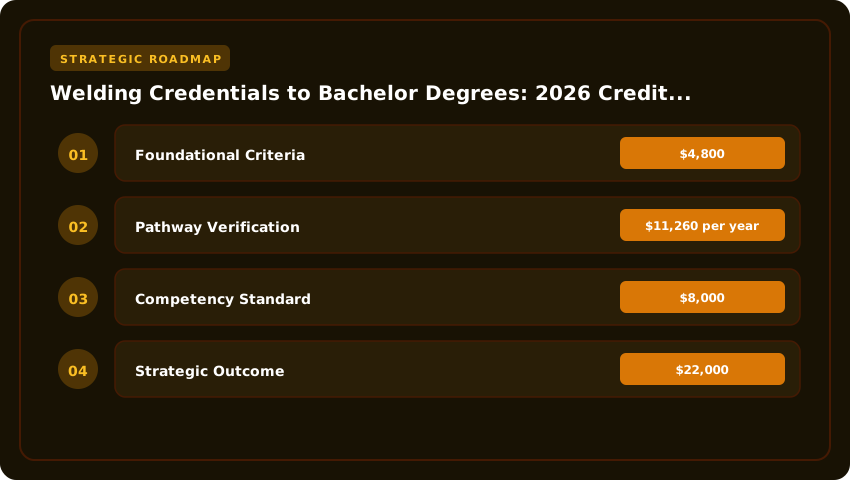
For decades, the journeyman welder who returned to college carried a heavy burden: a thick blue binder of American Welding Society (AWS) certifications and NCCER (National Center for Construction Education and Research) transcripts that often translated to zero college credits. In 2026, that reality has fundamentally shifted. Thanks to standardized crosswalks between the American Council on Education (ACE), the AWS, and individual regional accrediting bodies, technical credentials are now routinely evaluated against the lower-division core curriculum at community colleges and four-year institutions across the United States. Understanding how these evaluations are conducted is the first step toward saving a student between $8,000 and $22,000 in tuition costs.
The credential evaluation process begins with a faculty committee at the receiving institution, typically led by a Dean of Curriculum or a designated Prior Learning Assessment (PLA) Director. At institutions like the University of North Texas (UNT) and the University of Houston, incoming transcripts are routed through the Office of the Registrar and evaluated under specific state-level articulation frameworks. In Texas, the Field of Study curriculum and the Lower-Division Academic Course Guide Manual (ACGM) dictate how welding credentials are mapped. Nationally, the ACE credit recommendations serve as the baseline benchmark, though individual schools may grant evaluated credit (awarded automatically based on the credential) or recommended credit (awarded after a departmental review or competency exam).
The most commonly mapped credentials include:
- AWS D1.1 Structural Welding Code – Typically evaluated for 3 to 4 semester credit hours in introductory materials science or applied physics.
- AWS D1.2 Structural Welding Code (Aluminum) – Frequently transfers as a 3-credit technical elective in manufacturing or aerospace engineering technology programs.
- AWS Certified Welding Inspector (CWI) – A 9-hour, three-part examination that frequently translates to 6 to 9 credits, mapping directly to advanced blueprint reading, quality assurance, and metallurgy coursework.
- NCCER Core + Welding Level 1-3 – Provides a broad foundation, often translating to 12 to 18 lower-division credits in technical mathematics, construction safety, and introductory fabrication.
At Lone Star College in Texas, the evaluation process is particularly transparent. Students holding an active CWI license can petition for credit through the Credit by Examination process, which costs approximately $50 per course challenged. The Lone Star system uses a direct crosswalk where an NCCER Welding Level 2 transcript translates to TECH 1307 (Introduction to Welding), while the CWI 9-year recertification cycle demands a portfolio review that can yield up to 9 credit hours in MCHN courses (Machining and Manufacturing).
The most frequently misunderstood evaluations surround the general education core—the math, English, and humanities classes that all bachelor’s degrees require. Here is where the real value lies for the returning welder:
- Technical Mathematics: AWS and NCCER curricula require mastery of geometry, trigonometry, and algebraic heat calculations (using the Heat Input Formula). ACE typically recommends 3 credits of college-level math (MATH 1314 or equivalent) for verified welders, though the credit is often recommended rather than evaluated, meaning the student may need to pass a departmental math placement test (such as the TSIA in Texas or the Accuplacer nationally) to claim the credit.
- Blueprint Reading (MCHN/DFTG): The AWS D1.1 plate welding endorsement demands rigorous blueprint interpretation, including AWS A2.4 standard symbols. This typically earns 3 credits of evaluated credit in Engineering Graphics (DFTG 1309 or ENGR 1204).
- OSHA 30-Hour Construction: This 30-hour outreach program is widely recognized by ABET-accredited programs and trade-focused bachelor’s degrees. It routinely satisfies a 1-credit safety requirement or, at some schools, counts toward a 3-credit Occupational Health and Safety elective.
- Written Communication: While not a direct match, the technical writing required for weld procedure specifications (WPS) and procedure qualification records (PQR) often satisfies ENGL 1301 (Composition I) at institutions with robust PLA programs.
To maximize this credit transfer, students should request sealed transcripts directly from the AWS Certification Department in Miami, Florida, and the NCCER Registry System (which now offers digital badging through Credly). When requesting an evaluation, insist that the registrar conduct a course-by-course review rather than a block evaluation, as this often unlocks an additional 3 to 6 credits in the humanities and social sciences. Finally, verify that the receiving institution holds regional accreditation—through SACSCOC, HLC, MSCHE, or NWCCU—because employers and graduate programs in the United States rarely recognize credits from non-accredited schools, regardless of how rigorous the welding credential may be. By mapping these certifications strategically, a seasoned welder can shave up to 18 months off a bachelor’s degree timeline, reducing total program costs to the $11,000 to $24,000 range at regional public universities.
Institutional Gatekeepers: Which US Universities Actually Accept Trade Badges?
For the 40 million Americans carrying some college credit but no diploma, the modern university landscape looks fundamentally different than it did a decade ago. A growing cohort of accredited institutions now treats industry certifications, military training, and digital badges not as extracurricular résumé items, but as legitimate academic currency. Understanding which schools function as genuine “institutional gatekeepers” — and which merely pay lip service to prior-learning assessment (PLA) — is the first strategic move for any welder, HVAC technician, or industrial electrician aiming to convert a trade credential into a bachelor’s degree by 2026.
The most PLA-aggressive universities share three defining traits: an outcomes-based tuition model, an academic infrastructure built around competency rather than seat-time, and explicit articulation agreements with certifying bodies like the American Welding Society (AWS), the National Center for Construction Education and Research (NCCER), or CompTIA. Below is a profile of seven accredited, tuition-friendly institutions leading this movement, followed by a critical comparison of how ABET versus AACSB accreditation shapes their transfer policies.
- Western Governors University (WGU) — A nonprofit, regionally accredited institution charging approximately $4,000 per six-month term for the Bachelor of Science in Business Administration or the BS in IT. WGU’s “competency-based” model allows certified welders and technicians to accelerate through general-education modules, often shaving 12 to 18 months off a four-year degree. NCCER and AWS credentials frequently map directly into elective credit buckets.
- Excelsior University — A transfer-friendly veteran-serving institution in New York offering a BS in Technical Management with tuition around $29,500 total. Excelsior’s “Credit for What You Know” PLA program evaluates certifications through portfolio assessment, awarding up to 30 credits for AWS Certified Welding Inspector (CWI) or NCCER journeyman status.
- Eastern New Mexico University (ENMU) — A Hispanic-Serving Institution (HSI) with one of the most generous PLA caps in the Southwest. Annual tuition runs roughly $7,200 for non-resident online students. ENMU’s Bachelor of Applied Arts and Sciences openly welcomes NCCER and American Petroleum Institute (API) credentials, applying them toward technical-elective requirements.
- Thomas Edison State University (TESU) — Located in New Jersey, TESU offers a BS in Technical Studies with tuition near $12,000 total for in-state online learners. Their “Degree Pathways” database explicitly lists AWS, NCCER, and Federal Communications Commission (FCC) licenses as credit-bearing credentials.
- Southern Illinois University (SIU) Carbondale — SIU’s Bachelor of Science in Advanced Technical Studies accepts up to 40 semester hours of PLA credit, including trade-school transcripts, military JST transcripts, and industry certifications at a tuition of approximately $430 per credit hour.
- University of Memphis — Through its Workforce Development initiative, Memphis offers a Bachelor of Professional Studies with articulation agreements covering NCCER and Manufacturing Skill Standards Council (MSSC) credentials. Online tuition runs about $475 per credit hour.
- Fort Hays State University (FHSU) — A Kansas-based leader in virtual PLA with the Bachelor of Science in Technology and Leadership. In-state online tuition is roughly $226 per credit hour, with documented award of up to 30 credits for validated industry certifications.
ABET vs. AACSB: Why the Accreditation Stamp Matters for Your Transfer Policy
Not all accreditations transfer equally. The Accreditation Board for Engineering and Technology (ABET) governs engineering, computing, and applied-science programs, which means ABET-accredited universities — like many engineering pathways at SIU or Excelsior’s tech tracks — tend to scrutinize technical math and science prerequisites strictly. A welder seeking an ABET-aligned mechanical engineering or mechatronics degree will likely find PLA credit applied to general-education or lower-division technical electives, but rarely to upper-division engineering core courses, which are protected by continuous accreditation review.
Conversely, the Association to Advance Collegiate Schools of Business (AACSB) accredits business and management programs. For the AWS-certified inspector aiming for a Bachelor of Science in Business Administration or Technical Management, AACSB-accredited schools like WGU or FHSU are typically more generous: PLA credit can substitute for foundational business electives, and applied leadership modules earned through NCCER supervision training often satisfy upper-division management requirements when accompanied by a documented portfolio.
The SREB and the Electronic Campus: A Regional Lifeline
The Southern Regional Education Board (SREB) deserves particular attention because its 16 member states — stretching from Texas to Florida to Virginia — concentrate a disproportionate share of the 40 million “some college, no degree” Americans. The SREB Electronic Campus functions as a vetted portal where regionally accredited distance programs publish tuition, PLA policies, and accreditation status in a transparent, comparable format. For welding and skilled-trade professionals in the Sun Belt, the Electronic Campus is essentially a centralized map of which universities will honor an NCCER journeyman card, an API 1104 welding endorsement, or a CompTIA A+ certification as transferable credit, dramatically shortening the path from shop floor to registrar’s office.
Actionable Takeaway: Before enrolling, request each university’s official PLA crosswalk document, verify that the accepting institution holds regional accreditation (recognized by the U.S. Department of Education’s CHEA database), and confirm the maximum PLA cap. Choosing one of these seven gatekeepers can compress a four-year degree into 18 to 24 months and save between $15,000 and $40,000 in tuition — a return on investment rarely matched in higher education.
Decoding PLA and the $10,000 Degree Pathway
Prior Learning Assessment, commonly abbreviated as PLA, represents one of the most significant academic disruptions of the past three decades, fundamentally rewriting the traditional relationship between time spent in a classroom and knowledge actually mastered. For working welders, industrial technicians, military veterans, and career-driven adults across Ohio, Texas, and Virginia, PLA offers a proven financial bridge that converts verified industry competencies into formal college credits, effectively compressing a standard 120-credit four-year degree into a focused 12-to-18-month sprint. The economic rationale is straightforward: instead of paying tuition for foundational courses that simply re-teach skills already honed on the shop floor or in a deployed environment, students translate their existing expertise into academic currency. This mechanism is the engine behind the widely cited “$10,000 Degree Pathway,” a benchmark reflecting what a determined learner can actually spend to earn an accredited bachelor’s degree when maximizing every available PLA channel.
The cost-benefit mathematics are compelling when measured against the $11,260 average annual in-state tuition at a public four-year institution, a figure reported by the College Board for the 2024-2025 academic year. A traditional full-time student completing a 120-credit bachelor’s degree over four years typically shoulders roughly $45,000 in tuition alone, before accounting for $1,400 in mandatory fees, roughly $1,200 annually for textbooks and supplies, and the significant opportunity cost of forgone wages. By strategically layering portfolio-based credit evaluation, standardized exams like CLEP and DSST, and credit recommendations issued by the American Council on Education (ACE), a motivated learner can realistically enter a competency-based program with 60 to 90 credits already on their transcript, cutting both the time and the out-of-pocket cost by more than sixty percent.
Portfolio-based assessment functions as the cornerstone of this compression strategy. In this model, a student builds a comprehensive dossier documenting specific learning outcomes, supervisor verifications, project photographs, weld procedure specifications, safety training certifications, and reflective essays demonstrating college-level mastery of a subject. Most public universities charge a flat evaluation fee of $250 to $500 per portfolio, meaning a learner claiming 30 credits through three well-prepared portfolios invests between $750 and $1,500 to capture what would otherwise cost $11,260 in a single academic year. This represents an extraordinary return on investment when portfolio credits are accepted.
Standardized examinations offer the second pillar of the PLA framework. The College-Level Examination Program (CLEP) and DANTES Subject Standardized Tests (DSST) are both endorsed by ACE and accepted at more than 2,900 U.S. colleges and universities. Each exam costs approximately $93, with a $20 proctoring fee, and yields between three and six semester credits. A candidate strategically selecting five exams can accumulate 24 semester credits for under $565, capturing nearly a full year of coursework for less than five percent of traditional tuition. For a welder pursuing a Bachelor of Applied Science in Engineering Technology or a Bachelor of Science in Industrial Management, subjects such as College Mathematics, Natural Sciences, Principles of Management, and Introduction to Business typically align directly with their professional experience.
The third pillar consists of ACE credit recommendations, which evaluate industry-recognized training programs, certifications, and digital badges issued by workforce providers. American Welding Society (AWS) credentials, NCCER certifications, OSHA safety training, and various digital badge programs often carry ACE-reviewed credit values ranging from one to twelve semester hours each. These recommendations are published in the National Guide to College-Based Learning and the ACE Credit Equivalency Guide, both of which are standard reference tools utilized by academic advisors and registrars across ABET and AACSB-accredited institutions.
A realistic financial comparison clarifies the true savings potential. A traditional commuter student at an in-state public university pays roughly $12,660 per year (tuition plus fees and textbooks), faces transportation costs, and sacrifices full-time wages averaging $55,000 annually, resulting in a true four-year cost of nearly $230,000 in lost income and direct expenses. By contrast, a learner enrolled in a competency-based or PLA-optimized program maintains employment while earning credits at an accelerated pace. The remaining coursework, typically delivered online or in hybrid formats through institutions such as Western Governors University, Excelsior University, or Southern New Hampshire University, often carries flat-rate tuition of approximately $3,500 to $4,000 per six-month term, meaning a learner finishing in just two terms spends between $7,000 and $8,000 in tuition, plus roughly $1,500 in PLA assessment fees and exam charges. The complete pathway, including lost wages during minimal study hours, generally falls between $9,000 and $12,000, perfectly aligning with the “$10,000 Degree Pathway” benchmark promoted by workforce advocates and student success organizations.
- Direct Tuition Savings: $45,000 (traditional) versus $8,000 (PLA-optimized) — a 78% reduction.
- Time-to-Degree Compression: 48 months versus 12 to 18 months.
- Opportunity Cost Reduction: $165,000 in forgone wages preserved by maintaining employment.
- Accelerated Earning Trajectory: Bachelor’s completion unlocks promotions averaging 22% higher lifetime earnings per Bureau of Labor Statistics longitudinal data.
Actionable takeaway: Before enrolling in any program, request a free unofficial transcript evaluation from your target institution’s PLA office, submit an ACE transcript through their official portal, and complete at least two CLEP exams during the six months prior to your intended start term. This preparation alone can save a single student between $11,000 and $20,000 while dramatically shortening the journey from the welding booth to the boardroom.
The Employer Partnership Playbook: Tuition Reimbursement and Apprenticeship 2.0
For working welders, machinists, and industrial technicians, the most overlooked scholarship in America sits inside their own human resources department. As the manufacturing sector faces a projected shortage of nearly 3.8 million skilled trade positions by 2033, forward-thinking employers have transformed tuition benefits from a glossy recruiting brochure into a strategic retention engine. Understanding how to navigate these programs can mean the difference between a six-figure debt load and a debt-free bachelor’s degree earned while collecting a paycheck.
The cornerstone of modern workforce development is the Department of Labor (DOL) Registered Apprenticeship Program (RAP). Unlike the unpaid vocational tracks of the past, today’s “Apprenticeship 2.0” model combines 2,000 hours of paid on-the-job training with 144 hours of formal classroom instruction, increasingly delivered through accredited online institutions. When an apprenticeship is registered with the DOL, the apprentice earns a nationally portable credential recognized across all 50 states, and the employer gains access to tax credits and reimbursement pathways that can offset up to $5,000 per apprentice annually.
Industry leaders have built sophisticated ecosystems around this framework. Lincoln Electric, headquartered in Cleveland, Ohio, partners with community colleges and online universities to allow welding apprentices to apply classroom Related Technical Instruction (RTI) hours directly toward associate and bachelor’s degrees in engineering technology or technical management. Caterpillar funds its Earn While You Learn initiative, covering 100% of tuition, books, and fees for employees pursuing degrees in mechatronics, advanced manufacturing, or supply chain management at accredited partner schools. Boeing operates one of the most generous programs in the aerospace sector, offering up to $25,000 per year in tuition assistance for STEM-aligned bachelor’s programs, with no lifetime cap for employees in critical skill roles.
The financial scaffolding beneath these employer programs often involves federal funding streams that students rarely see. The Workforce Innovation and Opportunity Act (WIOA) channels more than $3 billion annually through state workforce development boards, funding Individual Training Accounts (ITAs) that can cover tuition, certification exams, and required tools for eligible job seekers. WIOA Title I funds prioritize veterans, low-income workers, and individuals displaced by automation. For a welder earning an industry-recognized credential, stacking WIOA funding with employer tuition reimbursement can effectively eliminate out-of-pocket costs for a two-year degree, and dramatically reduce the price tag on a four-year program.
Navigating this landscape requires deliberate strategy. Before accepting any position, smart candidates request the specific tuition policy in writing, including the cap per credit hour, the list of approved institutions, grade requirements, and clawback provisions for employees who leave within a specified window, typically 12 to 24 months. Negotiating educational benefits follows a simple hierarchy: secure an accredited online program aligned with your employer’s approved list, confirm the reimbursement schedule (most employers pay after course completion with a grade of C or better), and identify which certifications and prior learning credits can accelerate your timeline.
Actionable steps begin with three concrete moves. First, contact your local American Job Center to confirm WIOA eligibility and request a list of approved training providers in your region. Second, ask prospective employers specific questions about their RAP participation, tuition reimbursement caps, and partnerships with accredited universities. Third, build a degree pathway that converts every credential into stackable credit, ensuring that the welding certificate earned today becomes the first sixty credits of a bachelor’s degree finished tomorrow. In the new economy, the welder who masters the employer partnership playbook does not choose between earning a living and earning a degree; they do both, simultaneously, on someone else’s dime.
Actionable Roadmap: Auditing Your Digital Wallet for College Credit
For the working welder, pipefitter, or industrial technician mapping a transition toward a Bachelor of Science in Engineering Technology or Technical Management, the journey begins not on a college campus, but in the cab of a service truck or at a kitchen table with a laptop open. Building a Prior Learning Assessment (PLA) portfolio is fundamentally an act of professional archaeology. You are excavating years of muscle memory, code compliance, blueprint reading, and safety leadership, and translating that lived experience into the academic currency American universities recognize under ACE (American Council on Education) credit recommendations. Before you ever submit an admissions application to an accredited institution—look for regional accrediting bodies recognized by the Council for Higher Education Accreditation (CHEA)—you must first conduct a rigorous, unflinching audit of your “digital wallet.”
Start by inventorying every verifiable credential you have earned since your high school graduation. This includes American Welding Society (AWS) certifications, NCCER (National Center for Construction Education and Research) modules, OSHA 30-hour cards, NDT (Non-Destructive Testing) qualifications, and any micro-credentials issued through platforms like Credly or Badgr. These digital badges are not merely symbolic; when cross-referenced with the ACE National Guide, they often translate directly into lower-division college credit at hundreds of US universities.
- Step 1: The Credential Inventory: Log into every certification portal you have used. Download official PDFs of every active certificate, including expiration dates and examination scores. Create a single master spreadsheet listing the issuing body, the date awarded, and the corresponding National Guide identifier if one exists.
- Step 2: The Resume Reformatting: Traditional resumes bury your competencies under job titles. For a PLA portfolio, you must write a “competency-based resume” that translates every job duty into measurable learning outcomes. Instead of writing “Welded structural steel,” write “Applied metallurgy principles and AWS D1.1 structural welding code to fabricate load-bearing assemblies in compliance with engineering specifications.”
- Step 3: Supervisor Verification Letters: Universities require third-party validation. Contact former foremen, project managers, or QA/QC inspectors and request a formal letter on company letterhead. The letter must specify the exact skills you performed, the duration of that performance, and the industry standards you adhered to.
- Step 4: Drafting Experiential Essays: Most PLA programs require between two and five narrative essays, typically 800 to 2,000 words each. These are not memoir pieces. They are structured academic arguments linking a specific workplace challenge to a theoretical framework you mastered in practice.
Once your artifacts are gathered, you must align your timeline with the institution’s enrollment calendar. Non-traditional students frequently overlook priority deadlines, especially at community colleges and regional state universities where rolling admissions and modular eight-week formats are common. If you intend to maximize federal financial aid, your enrollment intensity matters intensely. The Free Application for Federal Student Aid (FAFSA) calculates your Pell Grant eligibility primarily on your Expected Family Contribution (EFC)—now renamed the Student Aid Index (SAI)—and your enrollment status. Enrolling at full-time status (typically 12 credit hours per semester) unlocks the maximum Pell award, which for the 2025-2026 award year maxes out at $7,395. However, careful sequencing of PLA credits can allow you to enroll part-time while still satisfying full-time financial aid requirements via a consortium agreement if your prior credits are posted before the census date. Always verify these specific enrollment windows with the university’s financial aid office, as missing a FAFSA submission deadline (often June 30 for the following academic year) could mean surrendering thousands in grant funding.
Ultimately, auditing your digital wallet is about transforming invisible labor into documented learning. It requires meticulous organization, honest self-evaluation, and a willingness to view your career not as a series of jobs, but as a rigorous, self-directed curriculum.
Strategic Final Takeaway
Success in evaluating Welding Credentials to Bachelor Degrees: 2026 Credit Transfer Guide relies on early preparation, adherence to verified accredited requirements, and cross-referencing official portals. Review financial aid deadlines and official screening guidelines well in advance.