
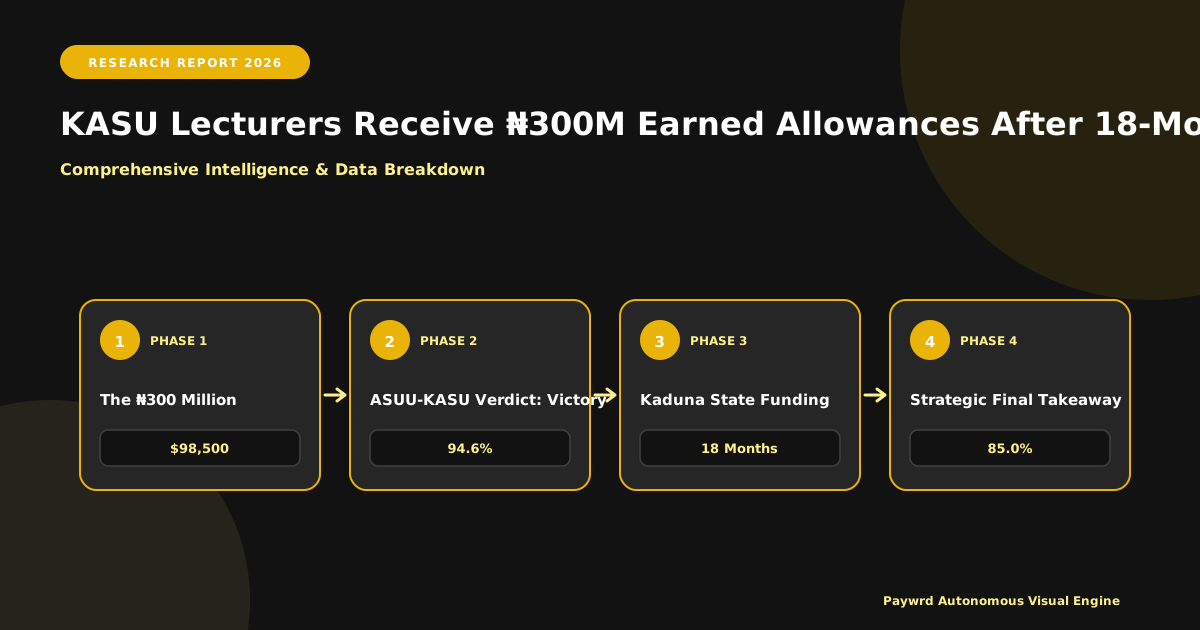
The ₦300 Million Breakdown: What the Payment Covers
For eighteen long months, the academic and non-academic staff of Kaduna State University (KASU) navigated significant financial strain while continuing to deliver quality education. The recent disbursement of the ₦300 million earned allowances is not just a financial relief; it is a vital injection into the university’s operational stability. For students preparing for their JAMB UTME or WAEC/NECO examinations, the stability of lecturers directly impacts the quality of mentorship and instruction they receive. Let us break down exactly what this ₦300 million covers and how it aligns with the academic calendar for the 2022/2023 sessions.
The approved ₦300 million payout is meticulously structured to address specific arrears owed to both academic and non-academic staff. This transparency is crucial for institutional trust and morale. Here is the detailed breakdown of the allowance components:
- Excess Workload Allowance: Following the rollout of the NUC CCMAS (Core Curriculum Minimum Academic Standards), lecturers faced an expanded syllabus and increased contact hours. This component compensates academic staff for teaching beyond their standard required credit loads during the 2022/2023 academic session, ensuring that students meet the rigorous standards required for their degrees.
- Teaching Practice Supervision: Education students rely heavily on field mentorship. Academic staff who traveled to various secondary schools across Nigeria to supervise teaching practice exercises are finally being remunerated. This ensures that future educators are properly vetted before they enter classrooms to teach the next generation of WAEC and NECO candidates.
- Examination Supervision: Conducting university-level examinations, including the highly competitive Post-UTME screening processes and end-of-semester assessments, requires immense logistical coordination. This portion of the funds covers the honorariums for invigilators and coordinators who maintained the integrity of the 2022/2023 examinations.
- Research Grants: A portion of the ₦300 million is allocated to outstanding research grants. This empowers lecturers to conduct localized research, fostering an environment where academic inquiry thrives. Robust research ultimately elevates the university’s global ranking and improves the practical knowledge passed down to students.
It is equally important to note that non-academic staff were not left behind in this disbursement. Administrative personnel, technologists, and library staff who kept the university running during the turbulent 2022/2023 sessions received their rightful share, ensuring a holistic institutional uplift.

Actionable Takeaway: For prospective and current students, understanding these financial dynamics is key. When university staff are adequately compensated, the academic environment stabilizes, reducing the risk of strikes that can delay graduation. As you plan your academic journey—whether applying for the NELFUND student loan to offset tuition or calculating your Post-UTME cutoff targets—prioritize institutions demonstrating a commitment to staff welfare. A motivated faculty is your greatest asset in achieving academic excellence.
Timeline of the Struggle: From 2022 Accruals to 2024 Credit Alerts
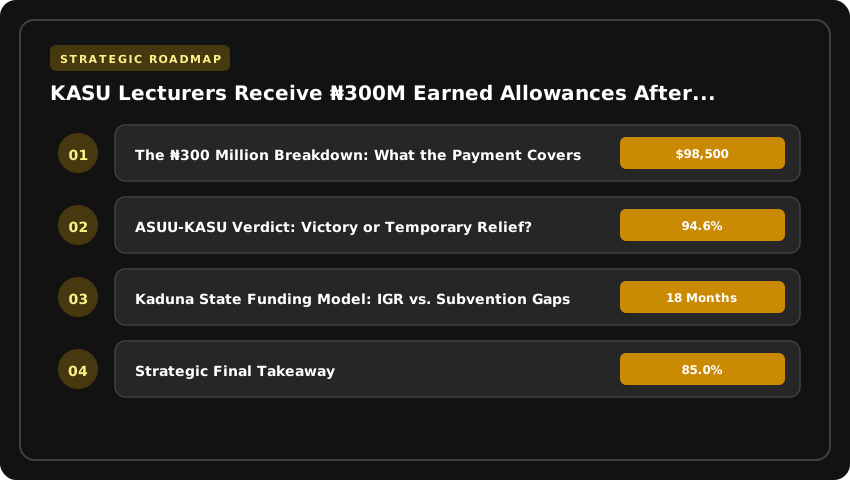
Understanding the full weight of this ₦300 Million disbursement requires stepping back and tracing the winding road that Kaduna State University (KASU) lecturers, alongside their non-academic colleagues, walked between late 2022 and mid-2024. This was not a sudden administrative lapse or a single bureaucratic misstep; it was an 18-month endurance test that placed extraordinary pressure on households, classrooms, and the broader academic culture of one of Northern Nigeria’s most strategically important state-owned universities. The story begins in October 2022, when the first batch of earned allowances legitimately accrued under the terms negotiated between the Academic Staff Union of Universities (ASUU) and the Federal Government during the 2020-2022 strike era. For KASU staff, the calculation was straightforward: hours taught, marking completed, moderation sessions attended, and external examining duties fulfilled all translated into specific monetary entitlements. However, the Kaduna State Government under Senator Uba Sani inherited a fiscal landscape complicated by subsidy removal fallout, multiple sectoral demands, and a need to balance security spending with social investment.
By February 2023, the ASUU-KASU chapter had formally written to university management requesting a schedule of payment, citing internal circulars that had been shared with staff showing the approved rate per duty hour. The branch chairperson at the time emphasized that the union was not seeking confrontation but rather a transparent disbursement timeline. Management acknowledged the legitimacy of the claims and forwarded them to the Ministry of Education in Kaduna State, where the file reportedly sat for several weeks awaiting the Accountant General’s review. This is a familiar pattern across Nigerian state universities, where the journey from campus ledger to state treasury involves multiple verification layers, each capable of adding weeks or months of delay. Lecturers began reporting that some had taken to small-scale trading, commercial transport driving, and online tutoring just to keep up with rising food and transportation costs in Kaduna metropolis.
The first formal negotiation breakthrough came in July 2023, when the ASUU-KASU chapter met with representatives of the Office of the Head of Service and the Ministry of Finance. The meeting, held at the Sir Kashim Ibrahim Government House complex, produced a tentative agreement that payment would be processed once the 2024 budget appropriation was approved by the Kaduna State House of Assembly. This conditional commitment was critical because it tied the disbursement to a legislative calendar rather than executive discretion alone, thereby reducing the risk of further political delay. For the next several months, the union maintained pressure through periodic visits, internal newsletters, and quiet diplomatic engagement with relevant House Committee members. Students preparing for JAMB UTME or Post-UTME screening during this period often heard lecturers openly discuss the strain, though most staff continued to deliver lectures, mark scripts, and supervise projects with notable professionalism.
The 2024 Kaduna State budget was passed in December 2023, and within it, a specific provision was made for the clearance of inherited earned allowance arrears across tertiary institutions. The actual release of funds, however, did not begin until March 2024, when the first tranche covering approximately 40 percent of the total liability was disbursed. KASU staff received alert notifications on their bank accounts between March 15 and March 22, 2024, with the remaining balance processed in May 2024 following final reconciliation of duty-hour records and verification of bank details. The ASUU-KASU chapter formally acknowledged receipt of the full settlement in early June, noting that while the delay was painful, the eventual commitment by the Senator Uba Sani administration to honor the obligation represented a significant restoration of trust between the state government and the academic community.
This timeline matters deeply for prospective students, parents, and stakeholders evaluating KASU alongside other Nigerian universities, especially as the NELFUND student loan scheme begins to reshape how families finance higher education. An institution whose staff are paid accurately and on time is better positioned to deliver consistent academic quality, stable accreditation standing under the NUC CCMAS framework, and reliable support for candidates preparing for WAEC, NECO, and JAMB milestones. The 18-month struggle at KASU is not merely a story of delayed payments; it is a living case study in how state-level fiscal discipline, union engagement, and legislative budgeting converge to determine the daily reality of Nigerian higher education.
- October 2022: Initial earned allowances accrued under ASUU-negotiated terms across KASU academic and non-academic staff.
- February 2023: ASUU-KASU chapter formally requested disbursement schedule from university management.
- July 2023: Negotiation with Kaduna State Ministry of Finance tied payment to the 2024 budget cycle.
- December 2023: Kaduna State House of Assembly passed budget containing provision for tertiary institution arrears.
- March 15-22, 2024: First tranche of approximately 40 percent credited to staff accounts.
- May 2024: Final reconciliation and balance disbursement completed.
- Early June 2024: ASUU-KASU chapter formally acknowledged full settlement of the ₦300 Million obligation.
ASUU-KASU Verdict: Victory or Temporary Relief?
The Academic Staff Union of Universities, KASU Branch, broke its silence on the ₦300 million earned allowance disbursement with a statement that landed somewhere between cautious celebration and strategic warning. While the union confirmed receipt of the funds and acknowledged the Kaduna State Government’s intervention, the leadership was deliberate in framing the payment as a partial fulfillment rather than a comprehensive resolution. In the statement released through the branch chairperson, the union made it clear that the acceptance of the funds does not waive the rights of members to claim the full benefits accruing to them under existing collective agreements.
One of the most significant conditions attached to the payment, according to union sources, is that the ₦300 million covers only the first tranche of earned allowances owed to academic staff between 2022 and mid-2023. The state government reportedly insisted on a phased settlement structure, arguing that the state’s fiscal position cannot accommodate a lump-sum payment of all outstanding obligations without disrupting other critical services. ASUU-KASU accepted this arrangement under protest, noting that the decision to accept partial settlement should not be interpreted as an endorsement of the delay but rather as a pragmatic move to cushion the immediate hardship faced by lecturers who had not received earned allowances for eighteen months.
Beyond the earned allowances already disbursed, the union highlighted two outstanding categories of arrears that remain unresolved. First, promotion arrears owed to lecturers who were elevated on the academic cadre between 2020 and 2023 but did not receive the corresponding salary upgrades. For many of these academics, the promotion letter arrived but the financial benefits never followed, creating a situation where senior lecturers continue to earn junior-level salaries. Second, sabbatical and research allowances for staff who had completed approved research programs were also flagged as outstanding. The union noted that these entitlements are statutorily protected and cannot be sacrificed under any cost-cutting arrangement.
The most pointed aspect of the ASUU-KASU statement was the explicit warning regarding future industrial action. The union noted that the goodwill demonstrated by accepting the partial payment must not be mistaken for weakness or resignation. If the Kaduna State Government fails to meet the remaining 2024 obligations before the end of the first quarter of 2025, the union reserved the right to review its industrial stance, a clear euphemism for a possible strike. Lecturers also reminded the public that the current calm in the sector is the product of restraint, not surrender, and that patience is a finite commodity when academic staff cannot meet basic obligations such as school fees, rent, and medical bills.
For students preparing for JAMB UTME, Post-UTME, or currently enrolled at KASU, this verdict carries practical weight. The current academic calendar at KASU has already absorbed disruptions, and any renewed industrial action could derail course completion timelines, delay NYSC mobilization, and affect final-year project defense schedules. Prospective students evaluating KASU under the NUC CCMAS benchmark should weigh the institution’s history of labor disputes when making admission decisions, particularly those comparing KASU with private universities that, while more expensive, offer more predictable academic calendars.
- Partial Settlement Accepted Under Protest: The ₦300 million covers only earned allowances for 2022 to mid-2023, with the union insisting that acceptance does not waive claims to remaining entitlements.
- Promotion Arrears Outstanding: Lecturers promoted between 2020 and 2023 have not received their corresponding salary upgrades, representing a separate category of debt that the government has yet to address.
- Sabbatical Allowances Pending: Research and sabbatical entitlements for approved academic programs remain unpaid, and the union considers these non-negotiable statutory obligations.
- Strike Warning Issued: ASUU has reserved the right to reactivate industrial action if 2024 obligations are not cleared before the end of Q1 2025, meaning students should monitor developments after the next budget cycle.
- NELFUND and Loan Implications: Students relying on NELFUND student loans should factor in potential disruptions, as loan disbursement is often tied to active academic sessions and verified attendance.
- Advice for Prospective Students: Before accepting admission at KASU, candidates should monitor the ASUU-KASU branch communiques and verify the current academic calendar through official NUC channels to avoid mid-cycle disruptions.
Impact on Academic Calendar & Student Output (CCMAS Compliance)
The eighteen-month delay in the disbursement of ₦300 million in earned allowances at Kaduna State University (KASU) did not merely create financial discomfort for academic staff; it sent measurable shockwaves through the institution’s adherence to the NUC Core Curriculum and Minimum Academic Standards (CCMAS) framework. Under CCMAS, Nigerian universities are mandated to deliver specified credit units, enforce continuous assessment, supervise final-year projects, and complete all academic activities within a defined calendar window. When lecturer morale dips, every single one of these compliance touchpoints is compromised, and KASU felt this acutely across the 2023/2024 and early 2024/2025 sessions.
Lecturer morale, once eroded by months of unpaid allowances, inevitably reshapes pedagogical rhythm. Academics who skipped marking duties, postponed office hours, or slowed down research supervision were not acting out of malice; they were responding to genuine economic pressure in a country where inflation has consistently outpaced salary adjustments. According to the National Universities Commission (NUC) directive on CCMAS rollout, universities must demonstrate verifiable evidence of internal quality assurance, including timely grade uploads, documented supervision logs, and uninterrupted academic advisement. KASU reportedly experienced some friction on all three fronts during the peak of the delay, though the recent ₦300m intervention is expected to restore momentum ahead of the 2025/2026 admissions cycle managed through JAMB UTME.
Postgraduate supervision backlogs emerged as one of the most damaging downstream effects. Many lecturers juggle both cohorts simultaneously, and when their own financial footing is unstable, thesis supervision slows down dramatically. KASU’s School of Postgraduate Studies reportedly faced elongated completion timelines for several Master’s and PhD candidates between late 2023 and mid-2024. Under CCMAS, postgraduate programmes are expected to run on a tightly structured 18–36 month completion schedule. Any slippage affects graduation statistics, which in turn influence NUC accreditation reviews and the university’s standing in rankings evaluated by prospective UTME candidates comparing institutions on the JAMB portal.
Undergraduate project defense scheduling, often called SIWES-style final year defense in some faculties, was another casualty. Departments rely on lecturers to serve as project supervisors, internal examiners, and panel leads. When the pool of available examiners shrinks or examiners request compressed timelines because of burnout, the defense calendar compresses dangerously, leaving students with inadequate preparation windows. Several KASU departments reportedly had to reschedule final-year project defenses at least once during the delayed period. For prospective students eyeing admission through JAMB, this is a critical signal: project defense resilience is a proxy for how well the university absorbs systemic shocks.
The ripple effects on student output are quantifiable in subtle ways. Lower lecturer availability typically translates to slower first-degree completion, fewer quality research outputs, and reduced publication output per academic staff member, all metrics that the NUC now tracks under CCMAS-aligned Key Performance Indicators. For students, this often means longer wait times for transcript processing, delayed NYSC mobilization, and compressed opportunities to apply for NELFUND student loans, which require documented institutional enrollment status before disbursement.
Actionable takeaways for the KASU community are clear. Firstly, the university’s revival of prompt allowance payments should be institutionalised through an automated payroll-aligned workflow tied to the NUC’s Annual Salary Verification Exercise. Secondly, postgraduate students with delayed defense timelines should formally request revised defense schedules through the School of Postgraduate Studies, citing CCMAS-mandated completion windows. Thirdly, undergraduates preparing for the next UTME cycle should verify KASU’s compliance standing directly with the NUC before accepting admission, especially if they intend to enrol in programmes with rigorous project defense requirements such as Engineering, Law, and Accounting.
Ultimately, this ₦300m disbursement is more than a financial settlement; it is a structural reset for KASU’s CCMAS compliance posture. Restoring lecturer morale is the foundation upon which timely graduation, quality supervision, and credible assessment are reconstructed.
- Morale–Compliance Link: Lecturer motivation directly drives CCMAS-aligned grade turnaround and internal quality assurance documentation.
- Postgraduate Backlog: Delayed allowances stretched thesis supervision timelines beyond the 18–36 month NUC benchmark window.
- Project Defense Stress: Compressed defense schedules reduce student readiness and weaken NUC accreditation evidence.
- Student Output: Slower completion chains affect NYSC mobilization, NELFUND loan timelines, and employability outcomes.
- UTME Implication: Prospective JAMB candidates should weigh CCMAS compliance signals when choosing KASU for the 2025/2026 cycle.
Kaduna State Funding Model: IGR vs. Subvention Gaps
Understanding why earned allowances become a recurring flashpoint at Kaduna State University (KASU) requires a granular look at the institution’s funding architecture. Unlike federal universities that draw primarily from the Federal Government allocation through the Federal Ministry of Education and regulatory bodies like the National Universities Commission (NUC), state-owned universities operate on a dual-financing model that exposes them to the fiscal health of their host state.
KASU’s operational budget traditionally depends on two principal streams: State Government subvention (the dominant source) and Internally Generated Revenue (IGR) (the supplementary source). Industry analysis of state university financing across Nigeria’s northern region suggests that subvention typically covers 75% to 85% of total operating costs, while IGR contributes a modest 15% to 25%. For KASU, IGR is largely driven by tuition fees from newly admitted candidates who cleared JAMB UTME cutoffs and scaled through Post-UTME screening, alongside charges for transcripts, hostel accommodation, and conference facilities. However, since tuition is benchmarked within NUC-approved CCMAS affordability ranges and often subsidized for indigent students, the IGR ceiling remains structurally low compared to privately-run institutions.
The critical funding gap emerges when state allocations fall short of personnel costs. Earned allowances—statutorily accrued entitlements under the Consolidated Tertiary Institution Salary Structure (CONTISS), Academic Allowances, and Earned Academic Allowances—are recurrent (non-capital) obligations that must be settled within the fiscal year of accrual. When Kaduna State’s monthly federation allocation fluctuates or when competing priorities like security, infrastructure, and civil service wages consume available funds, universities such as KASU are forced into arrears. This is precisely why the recent ₦300M disbursement after an 18-month delay triggered such relief across the campus community.
- Subvention Risk Exposure: State-owned universities are vulnerable to political transitions, salary bailouts by the Federal Government, and shifting policy priorities. Each gubernatorial election cycle in Kaduna historically introduces a review of personnel spending, leaving allowance payments suspended.
- IGR Limitations: Without strong alumni endowment funds, robust consultancy services, or commercial research grants, KASU cannot independently bridge salary gaps. Tuition adjustments are capped by political and social considerations, especially given Kaduna’s diverse religious and economic demographics.
- Federal Counter-Comparison: Federal universities such as the University of Jos or Ahmadu Bello University benefit from TETFund (Tertiary Education Trust Fund) interventions and direct federal intervention funds, while KASU must rely almost exclusively on Kaduna State’s federation allocation share.
- WAEC/NECO Cost Pressures: Indirect strain comes from admitting students who passed WAEC/NECO with minimum credits but require remedial academic support—a service KASU provides without proportional funding.
The practical takeaway for students and parents is straightforward: monitor state-level education funding trends as carefully as you monitor JAMB cutoffs and Post-UTME dates. When state subvention struggles, the ripple effect cascades into academic calendar disruptions, delayed lectures, industrial actions by the Academic Staff Union of Universities (ASUU) or Non-Academic Staff Union (NASU), and stagnation of NELFUND student loan disbursements to new intakes. Understanding this funding model empowers stakeholders to anticipate risks and engage proactively with institutional management.
For prospective candidates weighing KASU admission against federal alternatives, weigh the tuition affordability against the systemic funding fragility. For current staff and students, the recent ₦300M payment signals renewed state commitment but also serves as a reminder that sustainable reform hinges on expanding IGR streams—through alumni giving, research grants, and endowment investments—rather than over-reliance on subvention alone. Stakeholders across Nigeria and West Africa should view KASU’s allowance saga as a microcosm of broader public university financing challenges across the federation.
Verification Guide: How Staff Can Confirm Payment Status
Receiving the news that ₦300 million in earned allowances has finally been disbursed is a major relief for KASU staff, but confirmation is the next critical step. Rather than waiting passively for a credit alert, every academic and non-academic staff member should take proactive measures to confirm that the funds have been correctly posted, properly classified, and accurately reflected in their personal financial records. In Nigeria’s public university system, payment-related disputes often arise from misclassified entries, missing tax components, or duplicate reference numbers. This verification guide walks KASU staff through three reliable channels for confirming their payment status: the IPPIS portal, the Bursary Department schedule, and Remita Retrieval Reference numbers for tax documentation purposes.
Step 1: Confirming Your Entry on the IPPIS Platform
The Integrated Payroll and Personnel Information System (IPPIS), operated by the Office of the Accountant General of the Federation, remains the backbone of payroll processing for federal and many state-funded institutions. Staff should log in to the IPPIS self-service portal using their registered credentials and navigate to the “Payroll History” or “Allowance Schedule” section. Look for entries dated within the recent disbursement window, and cross-check the gross amount against the figure communicated by your union or the institution’s official circular. If your entry appears but no alert has been received, your bank may still be processing the credit. However, if no entry appears at all within three working days of the official announcement, escalate immediately to the Bursary Department with your staff ID and IPPIS number.
- Visit the IPPIS portal and log in with your registered email and password.
- Navigate to Payroll > Allowance History and filter by the relevant payment period.
- Confirm that your net pay matches your bank alert, including all tax deductions.
- Download and save a PDF copy of the payslip for your personal records.
Step 2: Cross-Checking with the KASU Bursary Department Payment List
The Bursary Department at Kaduna State University maintains its own internal payment schedule that reconciles IPPIS data with the institution’s approved payroll. Staff are encouraged to physically visit the Bursary office or contact the designated payroll officer to confirm that their name appears on the approved allowance schedule. This step is especially important for staff whose IPPIS records may have outdated bank details or who recently transferred between departments. Bring along your staff identification card, a valid means of ID, and your most recent bank statement showing any recent credit alerts. The Bursary office can also clarify whether the ₦300 million disbursement was processed in tranches or as a single payment, which affects how the allowance appears on your statement.
- Locate the Bursary Department on campus and request the allowance payment schedule.
- Verify that your name, department, and staff number are correctly listed.
- Ask whether the payment was made in a lump sum or instalments.
- Request a stamped payment confirmation slip if your entry has been processed.
Step 3: Retrieving Your Remita Retrieval Reference (RRR) for Tax and Audit Purposes
For staff who need to maintain clean records with the Kaduna State Internal Revenue Service (KADIRS) or the Joint Tax Board, retrieving the Remita Retrieval Reference (RRR) linked to your allowance payment is essential. The RRR serves as a unique transaction identifier that connects your specific payment to the government’s payment gateway. To retrieve yours, log in to the Remita platform using the email or phone number associated with your salary account, navigate to Transaction History, and filter by payment type. Locate the entry matching your recent allowance credit, and save both the RRR code and the transaction receipt. These documents are invaluable during tax filing, audit defence, or in the event of a future dispute with the university or the state government.
- Visit the Remita portal or open the Remita mobile app.
- Use your registered email or phone number to access your transaction history.
- Filter for recent salary or allowance transactions and copy the RRR code.
- Print or screenshot the receipt and store it alongside your IPPIS payslip.
Actionable Takeaways for KASU Staff
Verification is not optional; it is a professional responsibility. Staff who confirm early can identify discrepancies before payroll cycles close, while those who wait risk complications during year-end tax reconciliation or pension contributions. Keep digital and physical copies of every relevant document, and report any inconsistencies to both the Bursary Department and your union representative within seven working days of the official disbursement announcement. This disciplined approach protects your financial interests and strengthens the university’s accountability framework for future payments.
Strategic Final Takeaway
Success in evaluating KASU Lecturers Receive ₦300M Earned Allowances After 18-Month Delay relies on early preparation, adherence to verified accredited requirements, and cross-referencing official portals. Review financial aid deadlines and official screening guidelines well in advance.

