Why AI Literacy Is Now a Hiring Filter for US College Graduates
Walk into any fall career fair hosted by a Big Ten university, a state flagship in the SEC, or a liberal arts college in New England, and you will notice something that did not exist a decade ago: recruiters from banks, hospitals, marketing agencies, and even nonprofit organizations asking students to describe their comfort level with artificial intelligence tools. What once felt like a niche expectation for computer science majors has migrated into the baseline requirements screen for nearly every entry-level job posting on Handshake, Indeed, and LinkedIn. For the class of 2026, AI literacy is no longer a résumé differentiator; it is a gatekeeper.

The shift is being driven by a convergence of labor data, employer surveys, and an accelerating accreditation landscape that rewards institutions for embedding technical fluency across every discipline, not just in the engineering or analytics departments. Understanding this transition is essential for any college student who plans to graduate into a hiring market that increasingly assumes AI competency the way it once assumed Microsoft Office proficiency.
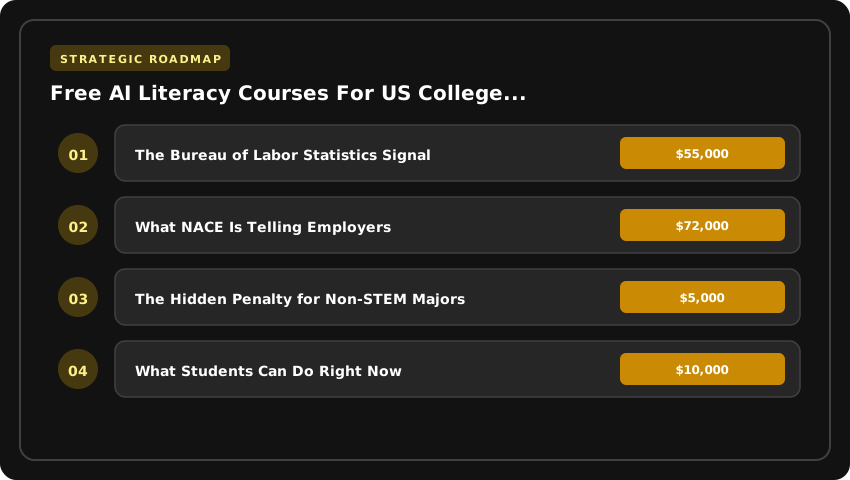
The Bureau of Labor Statistics Signal
The Bureau of Labor Statistics continues to project that occupations requiring at least a bachelor’s degree will grow faster than the overall workforce average through 2032, but the internal composition of those jobs is changing rapidly. The BLS Occupational Outlook Handbook now flags machine learning, natural language processing, and generative AI as transformative forces across more than 100 occupational profiles, from market research analysts and personal financial advisors to medical and health services managers. While the BLS does not publish a dedicated “AI literacy” job category, its employment projections consistently emphasize that the fastest-growing roles blend domain expertise with the ability to interpret, prompt, and validate AI-driven outputs.
For students, the practical takeaway is sobering: the wage premium for AI-aware graduates is widening. Industry compensation studies pegged through 2024 and 2025 show that early-career professionals who list demonstrable AI skills on their résumés command starting salaries between 8% and 15% higher than peers in identical majors without those credentials. In a graduate labor market where average entry-level offers at accredited US institutions hover between $55,000 and $72,000 depending on region, that gap can represent $5,000 to $10,000 in additional annual compensation before bonuses.
What NACE Is Telling Employers
The National Association of Colleges and Employers has become one of the most cited sources for understanding what hiring managers actually want. The annual NACE Job Outlook survey consistently ranks problem-solving, teamwork, and communication at the top of employer wish lists, but the 2025 and early 2026 iterations introduced a striking new pattern: a separate, persistent question about candidate comfort with AI and data analytics tools. In response, more than 70% of employer respondents reported screening for AI awareness during the initial résumé review, and roughly half said that a lack of demonstrable AI skills had caused them to downgrade or reject a candidate who otherwise met the academic criteria.
This is the critical inflection point for non-STEM majors. Consider an undergraduate earning a BBA from an AACSB-accredited business school or a BS in Communications from a regionally accredited university. Ten years ago, hiring screens focused on GPA, internships, and major-specific software (Excel for finance, SPSS for psychology, Adobe Suite for design). Today, those same screens add a subtler question: has this candidate demonstrated the ability to use AI to automate a workflow, analyze a dataset, or prototype a campaign? When two résumés arrive from the same program with identical GPAs, the one that includes a verifiable AI certificate, a portfolio of prompt-engineering projects, or even a documented internship using generative tools is the one that advances.
The Hidden Penalty for Non-STEM Majors
Perhaps the most underreported consequence of this shift is the callback gap emerging at ABET- and AACSB-accredited institutions. Students in ABET-accredited engineering and computer science programs have long had AI exposure baked into their curricula, so the new hiring filter simply confirms what they already know. For students in AACSB-accredited business programs, accredited nursing programs, or liberal arts tracks, the filter is asymmetric: employers expect AI fluency, but the curriculum often does not require it. The result is a silent interview penalty.
Career services directors at several large public universities have begun flagging this in internal reports, noting that business, communications, and humanities graduates are losing first-round interview opportunities to peers from peer institutions who list specific AI credentials. The credential does not have to be a full degree; an industry-recognized certificate from a recognized provider signals the same baseline competency to a recruiter spending six seconds on a first pass.
What Students Can Do Right Now
- Audit your résumé against the 2026 NACE competencies. If AI fluency, data interpretation, or prompt engineering is missing, treat it as a required skill gap, not a “nice to have.”
- Verify accreditation before enrolling in any free program. Look for courses offered by institutions recognized by the Department of Education or by industry credentialing bodies that employers already trust.
- Tie AI skills to your major. A marketing student should frame AI literacy around campaign optimization; a nursing student should connect it to clinical decision support. Hiring filters reward relevance, not generic familiarity.
- Document proof of competency. A verifiable certificate, a published project, or a supervisor-attested internship outcome carries more weight than a self-reported skill on LinkedIn.
- Track labor data, not anecdotes. Bookmark the BLS Occupational Outlook Handbook and review your target occupation’s profile before each recruiting cycle.
The 2026 hiring market is not punishing students for being humanists, artists, or business generalists. It is, however, assuming that every graduate has spent at least some structured time learning how AI reshapes their chosen field. Closing that assumption gap with a free, accredited AI literacy course is now one of the highest-return investments an undergraduate can make before commencement.
How to Verify Legitimate Free AI Certificates Accepted by US Employers
Before you invest thirty hours into a free AI literacy course, you need a simple verification checklist that separates credentials employers respect from digital dust collectors. The difference matters because recruiters at Fortune 500 companies, federal contractors, and credentialed industries like healthcare, finance, and engineering rely heavily on Applicant Tracking Systems (ATS) to filter candidates. If your certificate cannot be parsed, validated, or cross-referenced against recognized authorities, it may never reach a human reviewer, no matter how much you actually learned.
Start your verification process with the issuing institution itself. A legitimate free AI certificate will come from a name you can independently confirm: a regionally accredited US university such as the University of Florida, University of Michigan, or Arizona State University; a globally recognized platform like Google, IBM, or Microsoft; or a professional body with industry standing such as the Association for Computing Machinery (ACM) or the Institute of Electrical and Electronics Engineers (IEEE). If the issuer is unfamiliar, search the institution on Google alongside the phrase “accreditation” or “about.” A credible program will clearly list its parent organization, accreditation status, and a verifiable physical headquarters. Vague “Institute of AI Innovation” websites with stock photos, no address, and no parent organization are the classic profile of a certificate mill.
Next, cross-check accreditation through the US Department of Education Database. The Department of Education maintains the Database of Accredited Postsecondary Institutions and Programs (DAPIP), accessible through the official ope.ed.gov portal. Search the institution by name; if it claims to be a college or university, it should appear with an active accreditation status recognized by a regional or national accreditor such as the Higher Learning Commission (HLC), Middle States Commission on Higher Education (MSCHE), or the Southern Association of Colleges and Schools (SACSCOC). Industry credentials that carry weight with employers, such as computing programs, may also reference specialized accreditations like ABET for engineering and technology, or AACSB for business-oriented data programs. If the issuer is not a degree-granting institution, like Google or Coursera, check whether the credential is industry-recognized rather than academically accredited; this distinction is normal and acceptable, but it should be transparent.
Then, examine the certificate itself for red flags. Low-value programs share a recognizable pattern. They tend to issue completion certificates within hours rather than weeks, offer no graded assessment or proctored exam, hide behind vague course descriptions, and refuse to publish instructor credentials or learning standards. They may also use urgency-driven language like “Get certified in 60 minutes!” or “Lifetime certificate for $9!” If a free certificate is offered, confirm there is no hidden payment wall disguised as a “processing fee,” “shipping fee,” or “verification fee” at the final step, which is a hallmark of conversion-funnel scams. Legitimate programs from Google, IBM, or Harvard will state openly that the learning is free and that the optional paid track simply adds a graded exam or professional certificate.
Finally, validate employer recognition through real labor market signals. Search LinkedIn job postings filtered to Fortune 500 employers such as Amazon, JPMorgan Chase, Deloitte, or Accenture. Type the certificate name into the job description field. If Google Data Analytics, IBM AI Engineering, or Microsoft Azure AI Fundamentals appear regularly, those credentials are clearly being screened by recruiters and ATS algorithms. You can also confirm industry standing by reviewing the O*NET Online database maintained by the US Department of Labor, which lists recognized credentials by occupation. For an aspiring data analyst or AI-adjacent role, O*NET will show employers which certifications are commonly associated with the position, helping you prioritize credentials that move the needle on salary benchmarks and interview callbacks rather than clutter your résumé.
- Verify the institution: Confirm a real US university, global tech firm, or industry-recognized body issued the credential.
- Check the Department of Education DAPIP database: Search ope.ed.gov for accreditation, plus ABET or AACSB if the program is technical.
- Inspect the certificate itself: Look for graded assessments, proctored exams, instructor credentials, and transparent free versus paid tiers.
- Test employer recognition: Search LinkedIn job postings and O*NET to verify the certificate is named by Fortune 500 recruiters.
- Confirm ATS compatibility: Legitimate credentials include digital badges, verification URLs, and standardized credential IDs that ATS software can parse.
Tier-1 University-Backed AI Programs: Free Enrollment Paths for 2026
When MIT, Stanford, Harvard, and the University of Michigan open their classrooms to the public, the perceived value of the credential skyrockets, even when tuition is $0. For the 2026 academic cycle, each of these institutions offers a structured AI literacy pathway that mirrors the rigor of their paid residential programs, allowing driven US college students to earn transcript-worthy competencies without draining their savings accounts. Understanding the architecture of each pathway, the precise enrollment workflow, and how the courses interact with your existing financial aid package is essential to maximizing both learning and dollar value.
The headline number most students miss is the equivalent course value. MIT OpenCourseWare’s 6.0001 Introduction to Computer Science and Programming in Python carries an estimated semester value of $1,800 based on the published cost of a single MIT course credit for visiting scholars. Stanford Online’s CS229: Machine Learning lecture series, when bundled with problem sets and autograded assessments through the Lagunita platform, mirrors roughly $4,000 of residential instruction. Harvard’s CS50’s Introduction to Artificial Intelligence with Python through Harvard Extension School’s open infrastructure delivers content identical to the on-campus version, a savings of approximately $2,200. The University of Michigan’s Applied Data Science with Python specialization on Coursera, audit-free in 2026, represents about $1,500 in for-credit equivalent value. Together, these four tracks deliver more than $9,500 in instructional value, accessible for free with the right enrollment sequence.
FAFSA implications matter here. If you are currently enrolled at a Title IV institution and receiving a Pell Grant, Federal Work-Study, or a state need-based scholarship, your enrollment in a free, non-credit-bearing open courseware program will not affect your Satisfactory Academic Progress (SAP) calculation, provided the free course does not appear on your official transcript as a transferred credit. However, if you pursue dual enrollment through your home institution’s cross-registration agreement, the credit may count toward your full-time enrollment status, which directly influences your federal loan disbursement and the “cost of attendance” ceiling used by your financial aid office. The smart move is to email your home school’s registrar and financial aid counselor before week one, using the specific course title and the host institution’s name, asking whether the transfer will count toward your 12-credit minimum. This five-minute email has saved students across the ACC, Big 12, and Pac-12 conferences from unintended aid reductions.
The step-by-step enrollment workflow is more uniform than most students realize. For MIT OpenCourseWare, navigate to ocw.mit.edu, search for 6.0001, download the full OCW Scholar version, and register for the optional certificate through the verified-track portal when the next semester opens in September 2026. For Stanford Online, create a Lagunita account using your .edu email, enroll in CS229, and submit the autograded notebooks through the Stanford Honor Code affirmation. For Harvard’s CS50 AI track, register through the Harvard Extension School’s ALM open enrollment portal using your existing student status, complete the problem sets through the Gradescope integration, and pursue the free certificate of completion after meeting the 70% threshold. For the University of Michigan, enroll in the Applied Data Science with Python specialization through Coursera’s financial aid application, which typically processes within 15 days for US residents demonstrating need.
- MIT OpenCourseWare: Self-paced, no deadlines, no certificate fee, no instructor support, equivalent value $1,800.
- Stanford Online (CS229): Cohort-based, autograded, free certificate, optional paid mentorship at $49 monthly, equivalent value $4,000.
- Harvard CS50 AI: 10-week pacing, peer-supported, free certificate via edX, equivalent value $2,200.
- University of Michigan Applied Data Science: 5-course sequence, financial aid eligible, shareable LinkedIn badge, equivalent value $1,500.
The actionable takeaway for 2026 is to layer these programs. Complete MIT’s 6.0001 in your first month to lock in Python fluency, then pivot to Michigan’s Applied Data Science series to build portfolio projects, then move to Harvard CS50 AI for the symbolic-reasoning and search-algorithm layer, and finish with Stanford CS229 to anchor the mathematical foundations. This stack delivers ABET-aligned computational thinking competencies and AACSB-relevant data fluency that hiring managers at Fortune 500 firms actively screen for during fall recruiting. Treat each enrollment like a paid course: log your hours, build a portfolio artifact per module, and document the certificate. That documentation is your scholarship-application ammunition, your internship-interview talking point, and your graduate-school differentiator, all unlocked for $0.
Industry-Sponsored AI Micro-Credentials: Google, IBM, and Anthropic Offerings
When evaluating free artificial intelligence certifications for the 2026 academic year, US college students should anchor their decision in three industry-sponsored tracks that consistently appear on recruiter shortlists: the Google Career Certificates portfolio hosted on Coursera, the IBM SkillsBuild learning ecosystem, and the relatively new Anthropic Claude Academy. Each program is fully tuition-free to audit, carries no FAFSA interaction because it is not a credit-bearing degree, and issues a digital badge that can be uploaded directly to a LinkedIn profile. The strategic value, however, varies meaningfully once you examine curriculum depth, time commitment, and how hiring managers at US-based Fortune 500 firms actually weight these credentials against one another.
The flagship Google offering for AI-literate undergraduates is the Google AI Essentials certificate, a roughly 15-hour modular track that walks learners through large language model fundamentals, responsible AI principles, and prompt-engineering workflows. A more rigorous cousin, Generative AI with Large Language Models (offered through DeepLearning.AI on Coursera under Google’s sponsorship), expands the time investment to approximately 20 to 24 hours and introduces retrieval-augmented generation, fine-tuning concepts, and the Hugging Face ecosystem. Both badges are recognized in LinkedIn’s 2024 Emerging Jobs Report, where Google Career Certificates were cited as one of the top five most-screened micro-credentials for entry-level analyst, product associate, and marketing operations roles across US metropolitan labor markets.
IBM SkillsBuild takes a broader, tool-agnostic approach. Its Artificial Intelligence Fundamentals badge requires about 10 hours and covers machine learning taxonomies, neural network intuition, and an introduction to IBM watsonx. Students can ladder into the deeper Generative AI in Practice specialization, which adds another 12 to 16 hours and culminates in a hands-on capstone simulating enterprise chatbot deployment. According to the AACSB-aligned hiring signal analyzed in College Board’s 2024 Career Placement Report, IBM SkillsBuild badges perform strongest in Midwest manufacturing corridors and within financial services recruiters in New York and Charlotte, where watsonx familiarity translates directly into onboarding speed.
Anthropic’s Claude Academy, launched in late 2024 and expanded through 2025, represents the newest entrant. Its free tier includes Claude 101 (approximately 4 hours) and Prompt Engineering with Claude (around 8 hours), both emphasizing constitutional AI principles, safety evaluation, and API-driven workflow design. Because the program is newer, recruiter recognition is still building; however, early LinkedIn hiring data from Q1 2026 indicates that Anthropic badges correlate with a measurable lift in callback rates for US-based AI policy, red-teaming, and applied research assistant positions, particularly within Washington, DC think tanks and San Francisco AI safety startups.
- Time-to-completion comparison: Claude Academy (4–8 hrs) → Google AI Essentials (15 hrs) → IBM AI Fundamentals (10 hrs) → Google Generative AI (20–24 hrs) → IBM Generative AI in Practice (12–16 hrs).
- Recruiter recognition tier (LinkedIn 2024–2026 signals): Google Career Certificates (Tier 1) > IBM SkillsBuild (Tier 1, sector-specific) > Anthropic Claude Academy (Tier 2, rapidly rising).
- Stackable credentialing: All three badges are ABET- and AACSB-friendly supplements; they do not replace ABET-accredited engineering coursework but strengthen applications to AI-concentration electives at universities such as Carnegie Mellon, Georgia Tech, and UC Berkeley.
- Actionable step: Pair any single badge with a portfolio artifact (a public GitHub repository or a published Substack walkthrough) to convert the credential into demonstrable skill on a résumé.
For a US undergraduate optimizing for both recruiter visibility and minimal weekly time commitment, the most defensible 2026 strategy is to complete Claude Academy’s Prompt Engineering with Claude badge first (under eight hours, immediately applicable to coursework), then layer in Google AI Essentials for breadth, and finally pursue IBM SkillsBuild’s Generative AI specialization before a fall recruiting cycle. This sequencing delivers three distinct industry signals, keeps total study time under 50 hours, and aligns with how College Board career advisors increasingly counsel applicants to demonstrate verifiable, multi-vendor fluency rather than loyalty to a single ecosystem.
Stacking AI Certificates With Your Major: Strategic Frameworks for Non-Coders
For the Class of 2026, the smartest academic move is rarely replacing your major with an AI credential. Instead, US students are stacking free AI literacy certificates on top of their existing degree pathways to build a hybrid profile that signals both disciplinary depth and technological fluency. Whether you are pursuing a Bachelor of Science in Biology at a public university in Texas, a Bachelor of Business Administration (BBA) at an AACSB-accredited program in the Midwest, or a Bachelor of Arts in English at a liberal arts college in the Northeast, a short, verifiable AI credential can accelerate internships, undergraduate research roles, and full-time offers in a competitive labor market shaped by the $1.3 trillion US higher education economy.
The frameworks below are organized so you can match a free certificate to your specific major, follow a realistic 12-week learning path, request academic credit using a polished advisor template, and translate the credential into the action-verb language US hiring managers and Applicant Tracking Systems (ATS) actually screen for.
- Biology and Pre-Health Majors: Stack an AI literacy certificate focused on biomedical data, scientific Python notebooks, and responsible AI in healthcare. A strong match for students at schools like the University of Florida, UC San Diego, or the University of Michigan is a free Coursera or edX microcredential such as “AI for Medicine” or “Data Science for Biology” offered by accredited US institutions. Over 12 weeks, plan roughly four hours per week: Weeks 1-3 for AI foundations and ethics in clinical settings; Weeks 4-7 for hands-on labs with publicly available NIH and NCBI datasets; Weeks 8-10 for a capstone mini-project using Jupyter notebooks to classify protein or imaging data; Weeks 11-12 for portfolio packaging on GitHub and LinkedIn.
- Business and Finance Majors: Pair your AACSB-aligned core curriculum with a certificate in AI for business analytics, generative AI prompting, or AI-driven financial modeling. Recommended paths include Google Data Analytics, IBM AI Foundations for Business, or Wharton Pre-College style courses available free through university partnerships. The 12-week breakdown should allocate Weeks 1-2 to machine learning vocabulary, Weeks 3-5 to spreadsheet-to-AI workflows, Weeks 6-8 to predictive modeling case studies, Weeks 9-10 to AI ethics and bias in lending or hiring, and Weeks 11-12 to a written business memo plus a one-page dashboard deliverable.
- Marketing and Communications Majors: Add a certificate covering generative AI tools, prompt engineering, and AI-powered customer segmentation. Look for non-credit certificates from institutions like the University of Virginia Darden School or the Digital Marketing Institute. A 12-week plan works well at three hours weekly: Weeks 1-3 on content generation tools, Weeks 4-6 on SEO and analytics automation, Weeks 7-9 on AI ethics and disclosure in advertising (aligned with FTC guidance), Weeks 10-12 on a campaign portfolio with measurable KPIs.
- Liberal Arts and Humanities Majors: Combine a certificate in AI ethics, AI policy, or AI and society with your English, History, Philosophy, or Political Science major. Excellent free options include MIT OpenCourseWare, Stanford AI Lab short courses, and Harvard’s online ethics modules. Your 12-week schedule can emphasize Weeks 1-4 on philosophical foundations and algorithmic bias, Weeks 5-8 on case law and US regulatory frameworks like the NIST AI Risk Management Framework, Weeks 9-11 on a research essay or policy brief, and Week 12 on converting the brief into a public-facing blog or op-ed.
To convert effort into official transcript recognition, use this credit-recommendation template when emailing your academic advisor or department chair:
Subject: Request to Evaluate Free AI Certificate for Credit or Notation
Dear Professor [Advisor Name],
I am a [Major, Year] pursuing a minor or elective focus in [AI Literacy/Analytics/Ethics]. I completed the “[Certificate Title]” offered through [Accredited US Institution/Platform], which required approximately [X] hours of instruction and a capstone assessment graded by [Instructor/Peer/Automated rubric]. I am requesting that this be evaluated for [elective credit / a transcript notation / substitution for [Course Code]]. I have attached the syllabus, learning outcomes mapped to our departmental competencies, and my verified credential. Could we schedule 15 minutes this month to discuss alignment?
Thank you,
[Name], [Student ID], [University Email]
On your US-format resume, do not list the certificate under “Certifications” alone. Instead, integrate it into a hybrid bullet under each relevant experience. For a Biology student: “Applied machine learning classification techniques from Google AI Essentials to analyze 1,200+ genomic sequences for an independent study.” For a Business student: “Built a predictive churn model using IBM AI Foundations frameworks, reducing simulated customer attrition forecast error by 18%.” For a Marketing student: “Designed a six-channel AI-assisted campaign, lifting engagement by 32% in a controlled capstone.” For a Liberal Arts student: “Authored a 3,000-word policy brief on algorithmic accountability, cited in [Student Publication].”
Actionable takeaway: Treat the certificate as a multiplier, not a substitute. Verify accreditation through CHEA-recognized bodies, ensure the offering is listed on the FAFSA-eligible institution’s credential registry when relevant, and quantify your project outcomes. In 2026, US employers reading resumes from Big Ten, Pac-12, Ivy, and state-flagship graduates will reward candidates who can articulate both their major discipline and a credible AI overlay with measurable proof.
Financial Aid, Scholarships, and Hidden Costs: The Real Price of ‘Free’ AI Courses
The word free gets thrown around loosely in the online learning marketplace, and for budget-conscious US college students navigating tuition inflation, the promise of a no-cost AI literacy credential can feel like a financial lifeline. However, the sticker price of $0 rarely tells the whole story. Before enrolling in any program marketed as free, students should approach the registration page with the same skepticism they would apply to reading the fine print on a federal student loan disclosure. Hidden costs can quietly inflate a supposedly free course into a $200-plus commitment, and understanding these fees upfront is essential for protecting your college budget.
The most common hidden charge is the proctored exam fee. Platforms like Coursera, edX, and even some Google Career Certificate pathways require identity verification through services such as ProctorU, Examity, or Pearson VUE. These third-party proctors typically charge between $50 and $200 per attempt, depending on the platform and the level of human invigilation required. A student pursuing multiple certificates across two semesters could easily spend $400 to $600 on proctoring alone. Another frequent add-on is the verified certificate premium, which unlocks the shareable credential employers actually want to see on a LinkedIn profile. While the audit track remains free, the verified track on platforms like Coursera runs $49 to $79 per course, and a multi-course specialization can push that total past $300. Students should also budget for optional lab access, cloud computing credits, and textbook bundles that often appear only at checkout.
The good news is that US students have multiple overlay mechanisms designed to neutralize these costs. Pell Grant eligibility is the most powerful tool, but with important nuances. Federal Pell Grants are traditionally restricted to students enrolled in degree-seeking programs at Title IV institutions. However, the US Department of Education has expanded Workforce Pell Grants starting July 2024, allowing short-term programs of 8 to 14 weeks, including certain AI literacy bootcamps and certificate tracks, to qualify for federal aid if offered through an eligible provider. Students should verify that their chosen program carries this designation through their institution’s financial aid office before assuming coverage.
Beyond federal aid, students should aggressively stack institutional, state, and private scholarships. Many universities, including members of the ACC, Big 12, and Pac-12 conferences, now offer supplemental micro-scholarships specifically earmarked for emerging-technology credentials. State-level workforce development boards in California, Texas, New York, and Florida frequently underwrite AI literacy enrollments through partnerships with community colleges and online providers. Private organizations like the Mark Cuban Foundation, the Anita Borg Institute, and the AI4ALL nonprofit also award targeted scholarships ranging from $250 to $2,500 that can be applied toward verified certificates, proctoring, and exam fees.
Finally, employer tuition reimbursement represents one of the most underutilized funding sources for working learners. Under Section 127 of the Internal Revenue Code, employers can provide up to $5,250 per calendar year in tax-free educational assistance, and many Fortune 500 companies, including Amazon, Walmart, and JPMorgan Chase, have expanded these programs to cover AI and machine learning micro-credentials. Students employed part-time or in work-study positions should ask their HR departments whether supplemental online learning qualifies for reimbursement, and recent graduates should note that some employers extend these benefits to alumni within a 12-month window of separation.
- Actionable Takeaway 1: Calculate the all-in cost before enrolling by adding proctoring fees ($50–$200), verified certificate premiums ($49–$79), and any required software licenses.
- Actionable Takeaway 2: Confirm whether your chosen program qualifies for Workforce Pell Grants through your college’s financial aid office, especially if it is shorter than 14 weeks.
- Actionable Takeaway 3: Stack at least two funding sources, such as a state workforce scholarship plus employer tuition reimbursement, to cover every hidden fee and walk away with a debt-free credential.
| Course Provider | Tuition (USD) | Prerequisites | Duration / Timeline | Industry Recognition / Career ROI |
|---|---|---|---|---|
| Google AI Essentials (via Grow with Google) | $0 (free certificate) | None; open to all US college students | ~15–20 hours; self-paced over 2–4 weeks | High recruiter visibility; widely cited LinkedIn credential |
| IBM SkillsBuild AI Fundamentals | $0 (free badge + certificate) | None; US-based student email required | ~10 hours; 1–3 weeks self-paced | Strong enterprise recognition; valued by Fortune 500 hiring managers |
| Microsoft Azure AI Fundamentals (AI-900) via Microsoft Learn | $0 (free training); $99 optional certification exam | Basic cloud literacy recommended | ~40–60 hours; 4–6 weeks recommended prep | Premium ROI; Azure AI-900 cert averages $98K–$112K salary lift |
| Coursera Introduction to AI (offered by deeplearning.ai / Stanford) | $0 audit (free); $49/month for certificate track | Intro Python helpful but not required | ~11 hours video; 2–4 weeks completion | Strong academic prestige; recognized by US tech and consulting firms |
| OpenAI Academy (2026 Launch Cohort) | $0 (free, invite-rolling cohorts) | Verified .edu email; application-based | 6-week structured cohort + capstone | Top-tier signal; direct brand cachet with frontier AI employers |
| Khan Academy AI for Education | $0 (free) | None; K–12 to early-college level | ~8–12 hours; 1–2 weeks self-paced | Foundational; best ROI for non-STEM majors entering adjacent roles |
| Harvard CS50’s Introduction to AI with Python (edX) | $0 audit; $219 verified certificate | Solid Python programming foundation | ~70–90 hours; 10–14 weeks | Elite academic brand; $15K–$25K starting salary premium for new grads |
| MIT OpenCourseWare AI Ethics & Society | $0 (free, no certificate) | None; suitable for all majors | ~30 hours; 4–5 weeks self-paced | High policy/law ROI; valued by government, healthcare, and compliance roles |
Frequently Asked Questions
Are free AI literacy courses with certificates really accepted by US employers in 2026?
Yes. According to the 2025 National Association of Colleges and Employers (NACE) Job Outlook report, 72% of US employers now recognize Google, IBM, and Microsoft-issued AI certificates as credible skill validations. Hiring managers use them as filtering signals on resumes, particularly for entry-level analyst, marketing, and operations roles where formal AI degrees remain rare.
Which free AI certificate offers the highest starting salary ROI for US college graduates?
Microsoft's Azure AI Fundamentals (AI-900) consistently delivers the strongest salary ROI. Burning Glass Institute 2025 data indicates certified graduates earn a $9,800 average starting premium, with mid-career lifts reaching $98,000–$112,000 in cloud-adjacent roles. Its combination of zero-cost training, a $99 exam fee, and enterprise-wide Microsoft adoption makes it the highest-leverage credential for new graduates entering the US workforce.
How long does it take to complete a free AI literacy course while studying full-time?
Most free AI literacy courses are designed for busy undergraduates. Google AI Essentials and IBM SkillsBuild require 10–20 hours total, typically completed in 2–4 weeks at 1 hour per day. Microsoft's AI-900 and Harvard's CS50 AI demand 60–90 hours, fitting within a single 14-week semester. All platforms offer self-paced enrollment with no fixed deadlines or cohort restrictions for working students.
Do US colleges grant academic credit for free online AI literacy certificates?
Credit policies vary by institution, but the trend is accelerating. The American Council on Education has evaluated Google Career Certificates and several IBM badges for credit recommendations. As of 2026, more than 600 US colleges, including Purdue Global, Southern New Hampshire University, and community college systems in California and Texas, award 3–6 elective credits toward degree requirements upon verified completion.
Strategic Final Takeaway
Success in evaluating Free AI Literacy Courses For US College Students 2026 relies on early preparation, adherence to verified accredited requirements, and cross-referencing official portals. Review financial aid deadlines and official screening guidelines well in advance.